Sample Category Title
GBP/JPY Mid-Day Outlook
Daily Pivots: (S1) 144.48; (P) 145.49; (R1) 147.26; More...
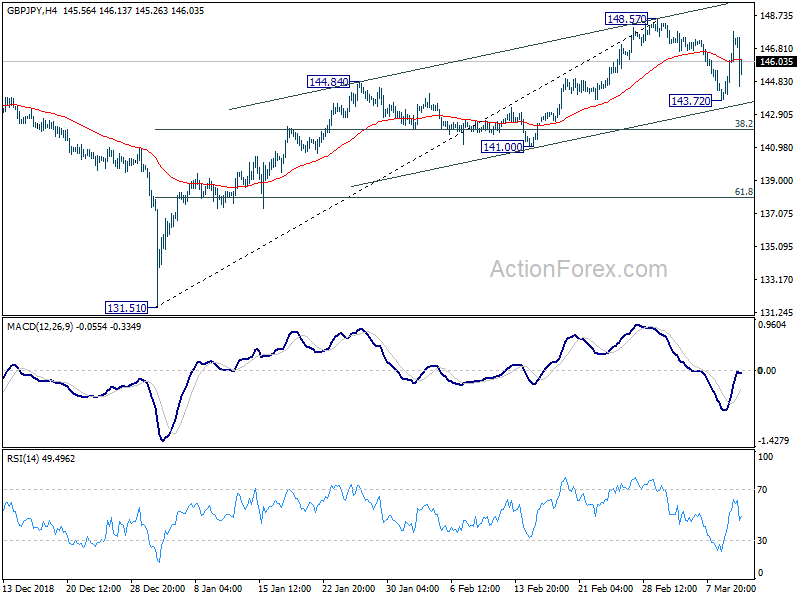
GBP/JPY failed to break through 148.57 resistance and dropped sharply since then. Intraday bias is turned neutral first. On the upside, break of 148.75 will resume rebound from 131.51 and target 149.48 key resistance next. On the downside, break of 143.72 will resume the pull back from 148.57 to 141.00 support.
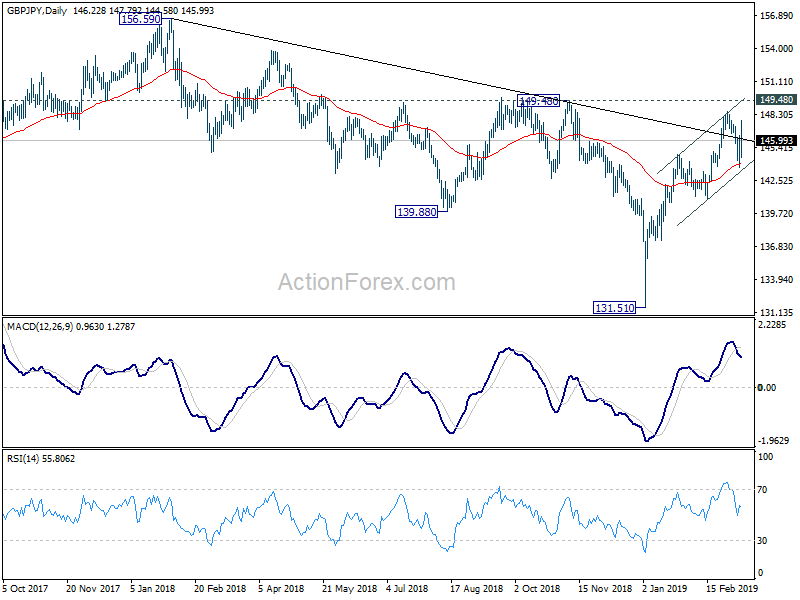
In the bigger picture, the strong rebound from 131.51 suggests that medium term fall from 156.59 (2018 high) has completed already. The corrective structure of such decline in turn argues that it's the second leg of the corrective pattern from 122.36 (2016 low). And this pattern is starting the third leg. On the upside, decisive break of 149.48 will pave the way to 156.59 resistance and above. However, firm break of 141.00 support will dampen this view and turn focus back to 131.51 low instead.
EUR/GBP Mid-Day Outlook
Daily Pivots: (S1) 0.8497; (P) 0.8587; (R1) 0.8640; More...
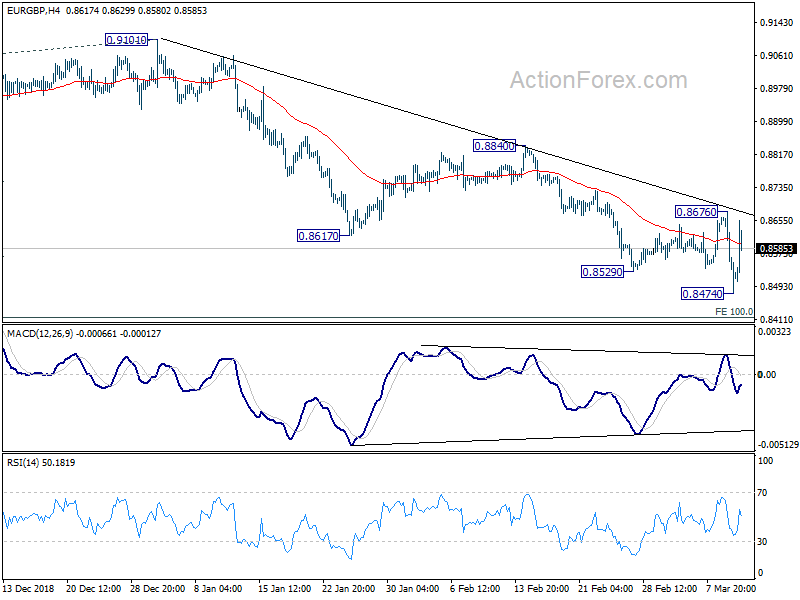
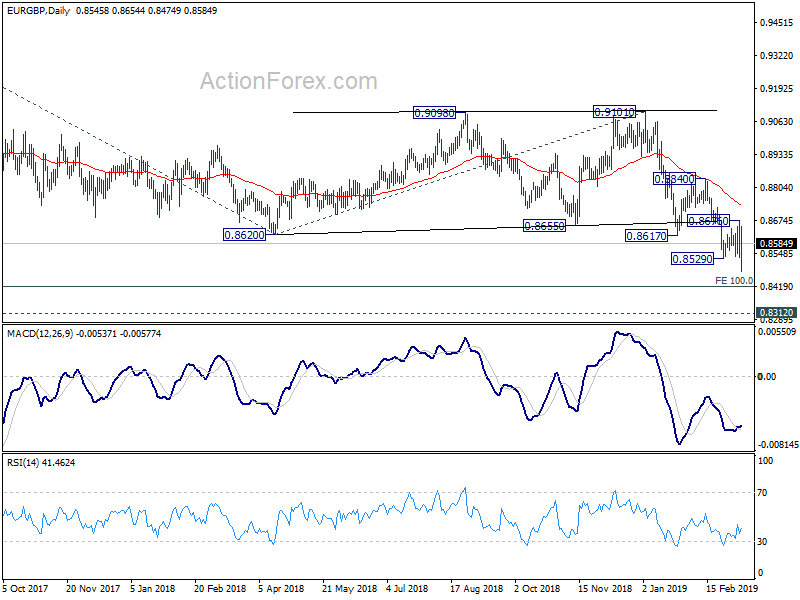
EUR/GBP recovers strongly after hitting 0.8474 and intraday bias is turned neutral again. On the downside, break of 0.8474 will resume larger down trend to 0.8416 long term projection next. On the upside, break of 0.8676 resistance is needed to indicate short term bottoming. Otherwise, outlook will remain bearish in case of recovery.
In the bigger picture, EUR/GBP is seen as staying in long term range pattern started at 0.9304 (2016 high). Current fall from 0.9305 (2017 high), is a falling leg inside the pattern. Such decline is now targeting 100% projection of 0.9305 to 0.8620 from 0.9101 at 0.8416 and possibly below. But for now, we'd expect strong support around 0.8312 support to contain downside and bring rebound.
USD/JPY Mid-Day Outlook
Daily Pivots: (S1) 110.95; (P) 111.13; (R1) 111.39; More...
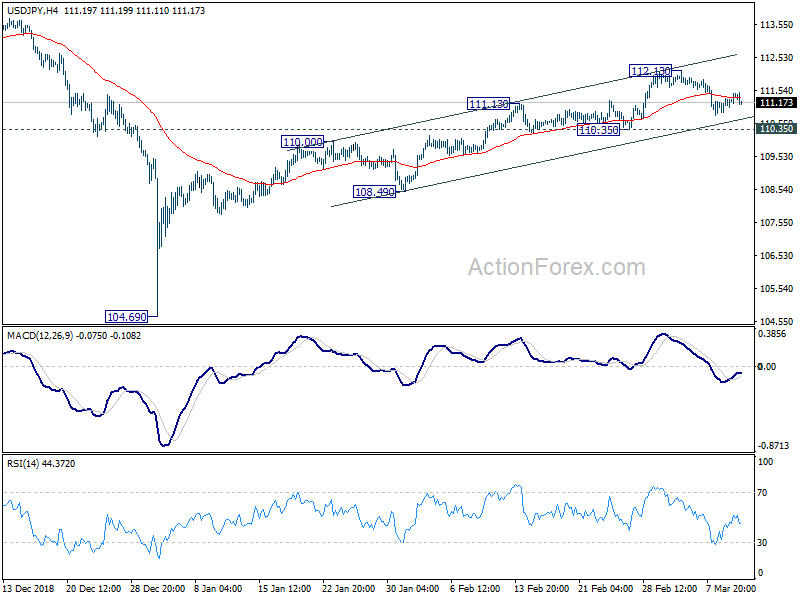
USD/JPY is staying in range below 112.13 as consolidation continues. Intraday bias remains neutral first. As long as 110.35 support holds, near term outlook remains bullish and rise from 104.69 is still in favor to resume. On the upside, break of 112.13 will target 114.54 resistance next. However, firm break of 110.35 should confirm near term reversal and turn outlook bearish for 108.49 support and below.
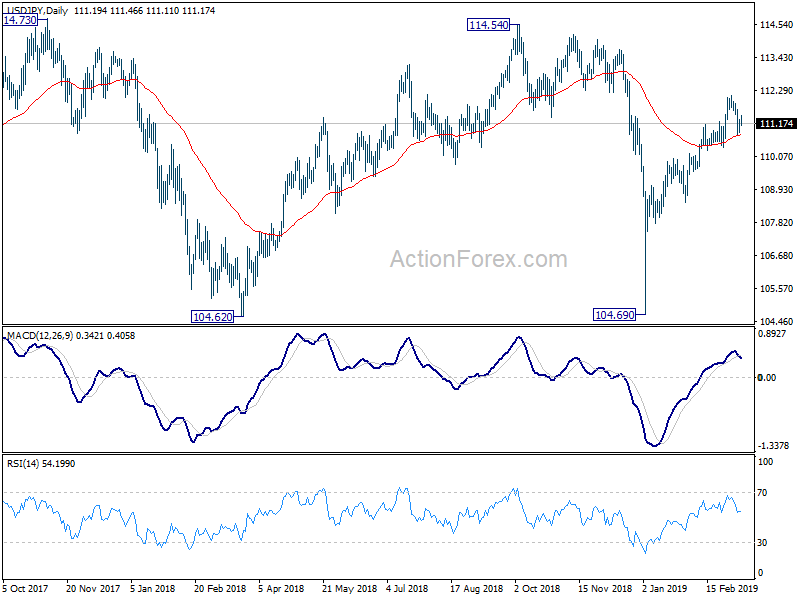
In the bigger picture, strong rebound from 104.69 argues that decline from 118.65 (2016 high) has completed with three waves down to 104.69, after failing 104.62. More importantly, the rise from 98.97 (2016 low) could be resuming. Decisive break of 114.54 resistance will add more credence to this bullish case and target 118.65. This will now be the favored case as long as 110.35 support holds. However, firm break of 110.35 will mix up the medium term outlook again and turn focus back to 104.69 low.
USD/CHF Mid-Day Outlook
Daily Pivots: (S1) 1.0078; (P) 1.0099; (R1) 1.0128; More....
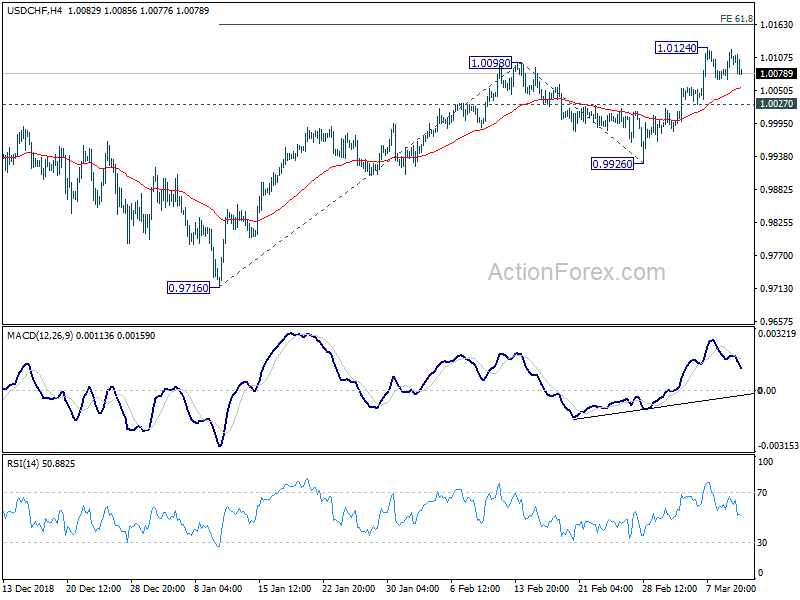
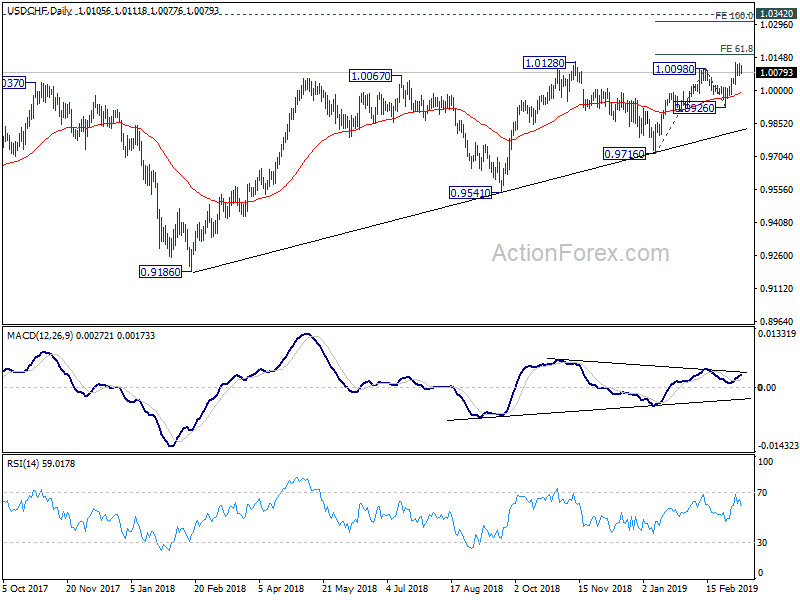
USD/CHF is staying in consolidation below 1.0124 temporary top and intraday bias remains neutral. In case of another retreat, downside should be contained by 1.0027 minor support to bring another rally. On the upside, break of 1.0124 will target 61.8% projection of 0.9716 to 1.0098 from 0.9926 at 1.0162 and then 100% projection at 1.0308.
In the bigger picture, USD/CHF drew strong support from medium term trend line and rebounded. That suggests rise from 0.9186 is still in progress. Further break of 1.0128 will confirm up trend resumption and target 1.0342 key resistance. Nevertheless, break of 0.9926 support will be the first signal of medium term reversal and bring another test on the trend line.
EUR/USD Mid-Day Outlook
Daily Pivots: (S1) 1.1225; (P) 1.1241; (R1) 1.1262; More.....
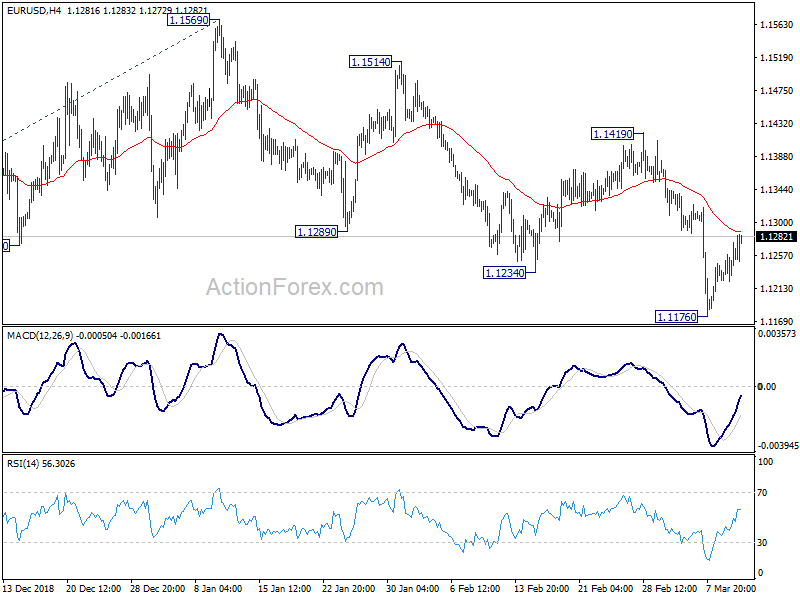
EUR/USD's recovery from 1.1176 is still in progress and further rise might be seen. But upside should be limited well below 1.1419 resistance to bring fall resumption. On the downside, break of 1.1176 will extend the down trend from 1.2555 and target 100% projection of 1.1814 to 1.1215 from 1.1569 at 1.0970 next.
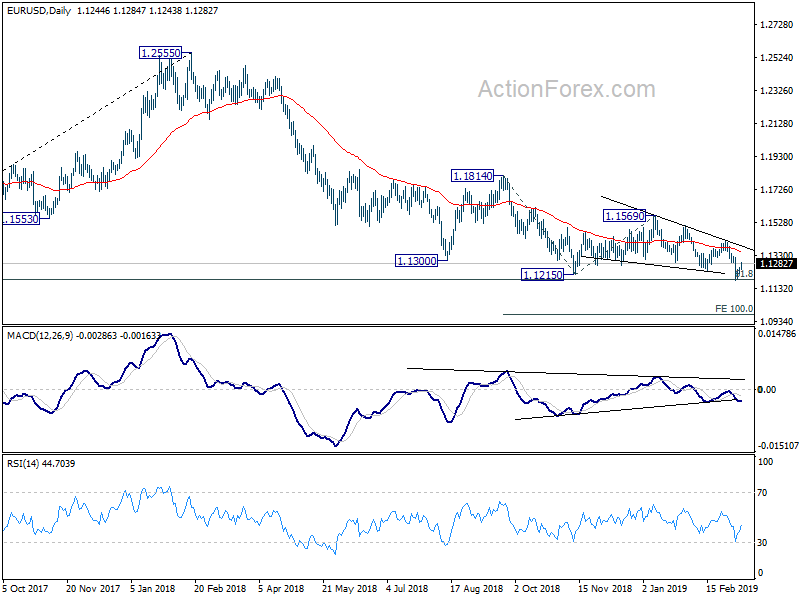
In the bigger picture, down trend from 1.2555 medium term top is still in progress. Bearishness is affirmed by sustained trading below falling 55 week EMA. 61.8% retracement of 1.0339 (2017 low) to 1.2555 at 1.1186 is met. Sustained break there will pave the way to retest 1.0339. On the upside, break of 1.1569 resistance will now indicate completion of such down trend and turn medium term outlook bullish.
US: Inflation Pressures Steady as She Goes in February
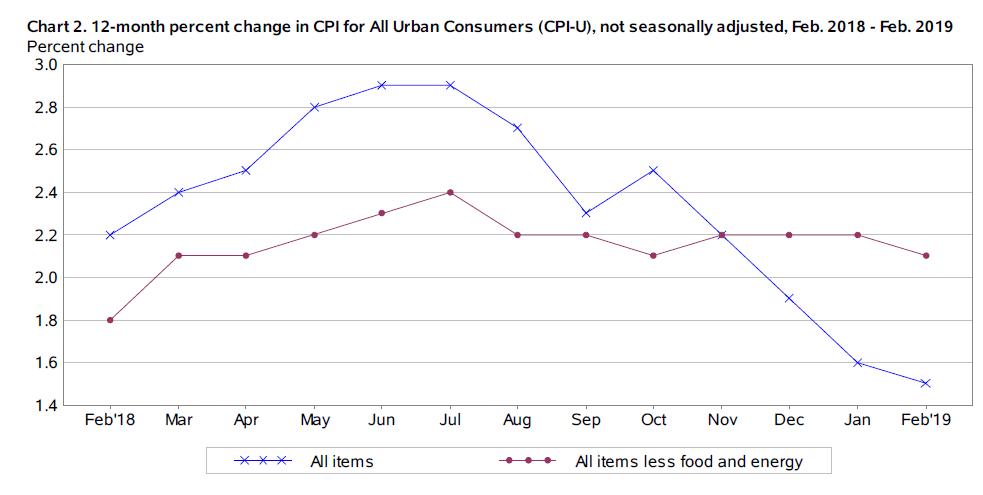
Consumer prices rose 0.2% on a month-on-month basis in February, in line with market expectations. Headline inflation was up a modest 1.5% on a year-on-year basis, the weakest pace since September 2016.
Price pressures in the core (excluding food and energy) were a little softer than expected, up only 0.1% in February. A decline in core goods prices (-0.2% m/m) was the culprit behind the softness in core inflation. Prices fell for new (-0.2 m/m%) and used (-0.7% m/m) vehicles, prescription drugs (-1.0% m/m), and recreation (-0.4% m/m). Inflation for core goods remained in positive territory on a year-on-year basis (+0.1%).
Inflation pressures for core services remained steady, up 0.2% in February. The key shelter category rose 0.3% in February, and is up 3.4% on a year-on year basis. Core services are now up 2.7% y/y, and have been cooling from a high of 3.1% last summer. Overall core inflation also decelerated to 2.1% y/y. Core inflation, has been at or above 2% for a year now. .
One area where inflation did pick up was food prices, which rose 0.4% on the month. Food prices are up 2% versus a year ago, the fastest pace in four years.
Key Implications
Inflation pressures remained remarkably well behaved in February. Some might point to a softer core reading as a sign that pressures are ebbing, but a couple of the price declines look temporary, and we are not going to read too much into one-month's reading. At the same time, there are few signs that inflation presents a threat to the Fed's current wait and see monetary policy stance.
Inflation's goldilocks moment continues. Inflation as measured by the CPI (not the Fed's preferred metric) is essentially right at 2%, with little indication it will shift in either direction soon. This should make the FOMC comfortable with its recent decision to be patient on monetary policy, and await clearer signs on how slower global growth and weaker confidence shows up in domestic data in the months ahead. We expect the U.S. economy to remain resilient, and that the next Fed hike is likely to come in the latter half of this year.
GBP/USD Mid-Day Outlook
Daily Pivots: (S1) 1.3016; (P) 1.3094; (R1) 1.3227; More....
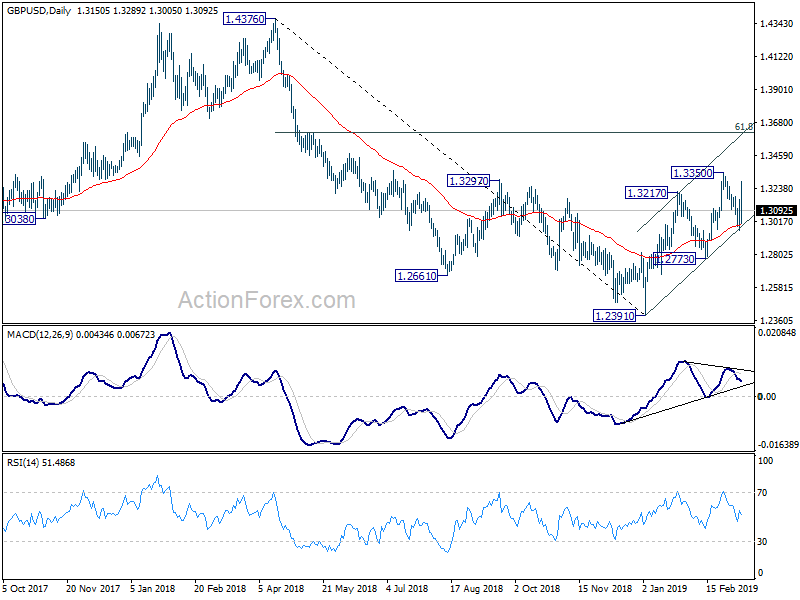
GBP/USD failed to break through 1.3350 resistance despite today's strong rebound. Intraday bias is turned neutral with subsequent steep retreat. On the upside, Break of 1.3350 will resume the rebound from 1.2391 low to 61.8% retracement of 1.4376 to 1.2391 at 1.3618 next. On the downside, again, sustained break of trend line support will argue that rebound from 1.2391 has completed earlier than expected at 1.3350. Deeper fall would then be seen to 1.2773 support for confirmation.
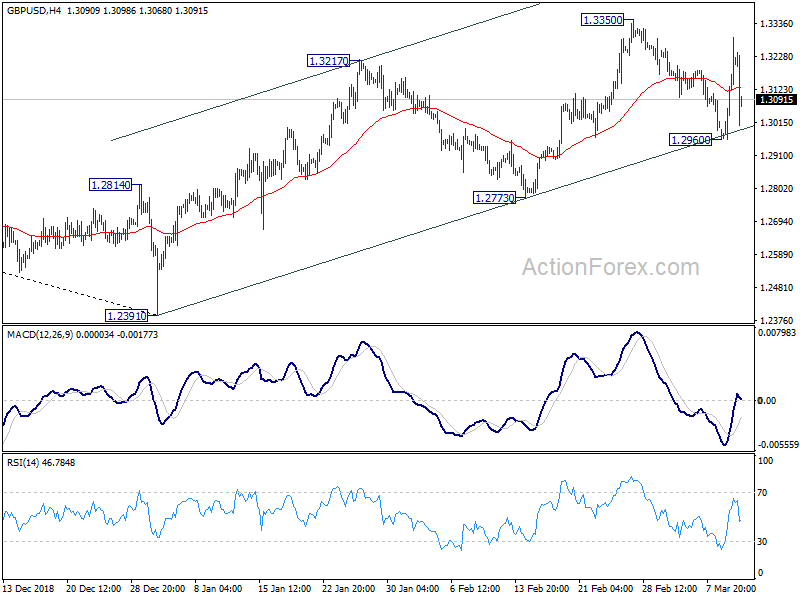
In the bigger picture, medium term decline from 1.4376 (2018 high) should have completed at 1.2391. Rise from 1.2391 is now seen as the third leg of the corrective pattern from 1.1946 (2016 low). Further rise could be seen through 1.4376 in medium term. On the downside, though, break of 1.2773 support will dampen this view. Focus will be turned back to 1.2391 low and break will resume the fall from 1.4376 to 1.1946.
Sterling Reverses as Brexit Turns Back into a Mess after Legal Setback
Sterling reverses and dives sharply as Brexit turns into a mess again. The new assurances UK Prime Minister Theresa May got from EU provided some nervous hope earlier today. But legal advice from Attorney General Geoffrey Cox killed the chance of getting the Brexit deal through the meaningful vote today. Basically, the updated deal just reduces risks of being tied in the Irish backstop forever. But such risk is not eliminated.
Pound is now trading as the weakest one for today, despite strong January GDP data. Canadian Dollar follows as the second weakest. Dollar got not support from CPI inflation data, which slowed in February. The greenback is the third weakest. On the other hand, New Zealand Dollar is the weakest one, followed by Euro, and then Swiss Franc.
In other markets, FTSE is currently up 0.19%. CAC is down -0.14%. DAX is down -0.19%. German 10-year bund yield is up 0.002 at 0.063. Earlier in Asia, Nikkei rose 1.79%. China Shanghai SSE rose 1.10%. Hong Kong HSI rose 1.46%. Singapore Strait Times rose 0.65%. Japan 10-year JGB yield rose 0.003 to -0.032.
Just released, US headline CPI slowed to 1.5% yoy in February, down from 1.6% yoy and missed expectation of 1.6% yoy. Core CPI also slowed to 2.1% yoy, down from 2.2% yoy and missed expectation of 2.2%. yoy.
Attorney General Cox said risk of indefinite Irish backstop reduced, not eliminated
Sterling is knocked down sharply after UK Attorney General Geoffrey Cox published his updated legal advice up the new Brexit deal agreed by UK Prime Minister Theresa May and European Commission President Jean-Claude Juncker late Monday. In short, Cox said that he new documents "reduce the risk" the UK is trapped indefinitely in the Northern Ireland backstop. But such risk is not eliminated.
And most importantly, as Cox's letter concluded: "the legal risk remains unchanged that if through no such demonstrable failure to either party, but simply because of intractable differences, that situation does arise, the United Kingdom would have, at least while the fundamental circumstances remained the same, no internationally lawful means of exiting the Protocol's arrangements, save by agreement".
In the Parliament, Cox said "the question for the house is whether, in the light of these improvements, as a political judgment, the house should now enter in to those arrangements" He added that his legal advice could only inform "what is essentially a political decision that each of us must make."
May got new joint legally binding instrument and joint statement from EU Juncker
May got "legally binding" changes to the Brexit deal after meeting with Juncker in the European Parliament in Strasbourg, France late Monday. Two important agreements were agreed that could "strengthen and improve" both the withdrawal agrement. The most important one is a "joint legally binding instrument." May believed it could be used to start a "formal dispute" against EU if it tried to keep UK into the backstop indefinitely. And under ruling of an arbitration panel, UK would have "the right to enact a unilateral, proportionate suspension of its obligations under the Withdrawal Agreement"
Secondly, there is another "joint statement" adding to the political declaration. A specific negotiating track would be established given both sides' to work "at speed" on an agreement by end of 2020 to avoid triggering the Irish backstop. Thirdly, May will put forward a "unilateral declaration" to outline the UK's position that there was nothing to prevent it from leaving the backstop arrangement if discussions on a future relationship with the EU break down and there is no prospect on an agreement.
UK GDP grew 0.5% mom in Jan, productions beat expectations
UK GDP grew strongly by 0.5% in January, well above expectation of 0.2% mom. Services rose 0.3%, production rose 0.6%, manufacturing rose 0.8% and construction jumped 2.8%. Though, agriculture dropped -1.3%. Rolling three-month growth was unchanged at 0.2% qoq.
ONS Head of GDP Rob Kent-Smith said: "Across the latest three months, growth remained weak with falls in manufacture of metal products, cars and construction repair work all dampening economic growth. These were offset by strong performances in wholesale, IT and health services. This sluggish growth came despite the economy bouncing back from a weak December."
Also from UK, visible trade deficit widened to GBP -13.1B in January. Industrial production rose 0.6% mom, -0.9% yoy versus expectation of 0.2% mom, -1.3% yoy. Manufacturing production rose 0.8% mom, -1.1% yoy versus expectation o f0.2% mom, -1.9% yoy.
BoJ Amamiya: No debate on exit until price target in sight
BoJ Deputy Governor Masayoshi Amamiya reiterated to the parliament that the priority for the central bank is to achieve the 2% inflation target. He noted that it's also "important and necessary for the BOJ to communicate to markets its strategy for exiting ultra-loose monetary policy". However, "debate on an exit must begin only when achievement of our price target comes into sight."
On the other hand, Finance Minister Taro Aso told the parliament that "I don't think anyone in the general public is angry about the fact that inflation hasn't reached 2 percent. And, BoJ "could be a bit more flexible: on the inflation target too.
Release from Japan, BSI large manufacturing index dropped to -7.3 in Q1.
Australia business conditions and confidence dropped, home loans contracted further
Australia NAB Business Conditions dropped to 4 in February, down from 7 and missed expectation of 5. Business Confidence dropped to 2, down from 4 and missed expectation of 3. Alan Oster, NAB Group Chief Economist said "conditions declined in February to below average levels – with profitability and trading now below average." Employment index "remained resilient" but that is "likely reflecting that labour demand decisions typically lag economic activity."
Forward looking indicates point to an "ongoing weakness in business conditions" And, "this may have important implications for both future investment and employment decisions of business." The survey suggests "little improvement" in Q1 and "some further growing risks to our outlook for business investment in 2019".
GBP/USD Mid-Day Outlook
Daily Pivots: (S1) 1.3016; (P) 1.3094; (R1) 1.3227; More....
GBP/USD failed to break through 1.3350 resistance despite today's strong rebound. Intraday bias is turned neutral with subsequent steep retreat. On the upside, Break of 1.3350 will resume the rebound from 1.2391 low to 61.8% retracement of 1.4376 to 1.2391 at 1.3618 next. On the downside, again, sustained break of trend line support will argue that rebound from 1.2391 has completed earlier than expected at 1.3350. Deeper fall would then be seen to 1.2773 support for confirmation.
In the bigger picture, medium term decline from 1.4376 (2018 high) should have completed at 1.2391. Rise from 1.2391 is now seen as the third leg of the corrective pattern from 1.1946 (2016 low). Further rise could be seen through 1.4376 in medium term. On the downside, though, break of 1.2773 support will dampen this view. Focus will be turned back to 1.2391 low and break will resume the fall from 1.4376 to 1.1946.
Economic Indicators Update
| GMT | Ccy | Events | Actual | Forecast | Previous | Revised |
|---|---|---|---|---|---|---|
| 23:50 | JPY | BSI Large Manufacturing Q/Q Q1 | -7.3 | 4.8 | 5.5 | |
| 00:30 | AUD | NAB Business Conditions Feb | 4 | 5 | 7 | |
| 00:30 | AUD | NAB Business Confidence Feb | 2 | 3 | 4 | |
| 00:30 | AUD | Home Loans M/M Jan | -2.60% | -2.00% | -8.20% | |
| 09:30 | GBP | GDP M/M Jan | 0.50% | 0.20% | -0.40% | |
| 09:30 | GBP | Index of Services 3M/3M Jan | 0.50% | 0.50% | 0.40% | |
| 09:30 | GBP | Visible Trade Balance (GBP) Jan | -13.1B | -12.11B | -12.10B | |
| 09:30 | GBP | Industrial Production M/M Jan | 0.60% | 0.20% | -0.50% | |
| 09:30 | GBP | Industrial Production Y/Y Jan | -0.90% | -1.30% | -0.90% | |
| 09:30 | GBP | Manufacturing Production M/M Jan | 0.80% | 0.20% | -0.70% | |
| 09:30 | GBP | Manufacturing Production Y/Y Jan | -1.10% | -1.90% | -2.10% | |
| 09:30 | GBP | Construction Output M/M Jan | 2.80% | 0.80% | -2.80% | |
| 12:30 | USD | CPI M/M Feb | 0.20% | 0.20% | 0.00% | |
| 12:30 | USD | CPI Y/Y Feb | 1.50% | 1.60% | 1.60% | |
| 12:30 | USD | CPI Core M/M Feb | 0.10% | 0.20% | 0.20% | |
| 12:30 | USD | CPI Core Y/Y Feb | 2.10% | 2.20% | 2.20% |
Canadian Dollar Listless as U.S. Consumer Inflation Within Expectations
The Canadian dollar is almost unchanged in the Tuesday session. Currently, the pair is trading at 1.3390, down 0.02% on the day. In economic news, U.S. there were no surprises from consumer inflation numbers. Core CPI edged down to 0.1%, shy of the estimate of 0.2%. CPI remained steady at 0.2%. On Wednesday, the U.S. publishes PPI and durable goods orders data. There are no Canadian events until Thursday.
The Canadian dollar lost close to 1.0% last week, but ended the week with gains and has continued the upward trend this week. On Friday, the U.S. economy posted a shocking nonfarm payroll report, with a gain of only 20 thousand jobs. The Canadian economy did much better, creating 55.9 thousand jobs, its second sharp gain in as many months. However, other key numbers have been soft, such as two successive GDP readings of -0.1%. The Bank of Canada has said that it expects the economy to improve, but the dovish rate statement from the BoC is a sign that policymakers are unlikely to raise rates before the second half of 2019. With no interest rate hikes on horizon, investor appetite for Canadian dollars could soften.
U.S. inflation numbers remain well below the Federal Reserve’s inflation target of 2.0 percent. This has given the Fed plenty of breathing room regarding rate hikes, as policymakers continue to signal that the Fed could hold off until the second half of the year. The dovish stance of the Fed could weigh on the dollar, as a lack of rate hikes makes the greenback less attractive to investors.
US CPI slowed to 1.5% in Feb, core CPI dropped to 2.1%
US headline CPI slowed to 1.5% yoy in February, down from 1.6% yoy and missed expectation of 1.6% yoy. Core CPI also slowed to 2.1% yoy, down from 2.2% yoy and missed expectation of 2.2%. yoy.