

Sample Category Title
Brexit Update – Deal Rejected for Second Time
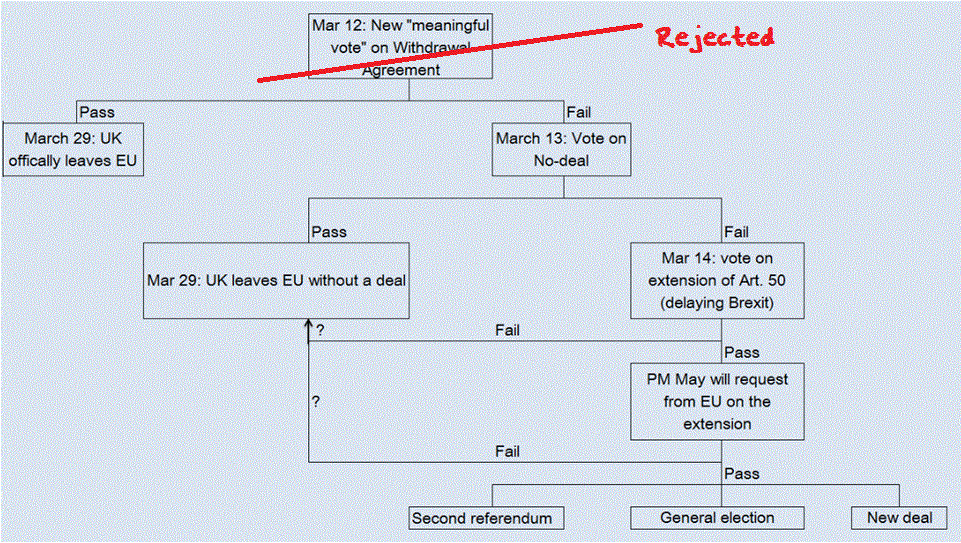
The UK parliament again defeated, by 149 votes, the Withdrawal Agreement that PM Theresa May secured from the EU parliament. Despite the changes, attorney general Geoffrey Cox suggested the UK still would risk struck in the Irish backstop indefinitely. His opinion has raised concerns of both Brexit hardliners and some in the Bremain camp, leaving to the second defeat. There will be two more votes on Wednesday and Thursday. After all, the chances of extension of Article 50 and a second referendum have greatly increased.
What’s the difference between the revised deal and the first one?
On Monday, May announced that she secured “legally binding” changes in the deal regarding Irish border issues. First, a "joint legally binding instrument" was included, allowing the UK to start a "formal dispute" against the EU if it tried to keep the UK tied into the backstop indefinitely. Second, there was a UK-EU "joint statement" added to the political declaration, pledging to replace the backstop with alternative arrangements by December 2020. Third, the UK released a "unilateral declaration", outlining the UK's position that it would choose to leave the backstop arrangement if negotiations with the EU on future relationships break down. Yet, Cox suggested that these changes still carried a "legal risk" that the UK would not be able to leave the backstop arrangement if the EU does not agree.
What Next?
PM May would table a motion, asking if the MPs support to leave the EU without a deal on March 29. This is to get explicit consensus from the parliament as PM May affirmed that the UK “will only leave without a deal … if there is explicit consent in the House for that outcome”. It is almost certain that the motion would be defeated. This would be followed by Thursday's vote on Extension of Art. 50 (delaying the time to officially leave the EU from Mar 29, 2019). It appears that the majority of MPs would prefer the extension. The key here is “for how long?”. It is believed that PM May favored a short extension. Meanwhile, Labors also revealed their preference for a short delay of about 3 months. This seems to be in contradiction with the party’s stance of supporting a second referendum, which probably needs at least a year of extension. Another critical factor is the European parliament election schedule in May. A short extension suggests that the UK would not participate in the elections. This would prevent the UK from legally extending its EU membership beyond June.
Market Morning Briefing: Aussie Has Fallen Sharply
STOCKS
Asians are trading in the red. Nikkei and Shanghai looks vulnerable for further fall from current levels. Dow and DAX looks mixed and could consolidate in the near term. The Indian equities are standing out by shrugging-off the weakness in the global indices. Sensex and Nifty seems to have begun its pre-election rally and looks strong to revisit their previous highs.
Dow Jones (25,554.66, -96.22, -0.38%) seems to be pausing below the key 21-day moving average resistance level of 25,741. Inability to break this resistance can pull the index lower to 25,100 levels again.
DAX (11,524.17, -19.31, -0.17%) has come-off from the day's high yesterday. It can oscillate between its support at 11,430 (21-day moving average) and resistance at 11,670 for some time.
Nikkei (21,199.78, -303.91, -1.41%) given back all the gains made yesterday and is likely to retest the psychological 21,000 level.
Shanghai (3,045.29, -15.02, -0.49%) has come-off from near 3,100. It looks vulnerable to break below 3,000 and fall to 2,970-2,950 in the coming sessions.
Sensex (37,535.66, +481.56, +1.30%) and Nifty 50 (11,301.20, 133.15, +1.19%) are retaining their momentum. Both the indices looks strong enough to revisit their previous highs of 11,760 (Nifty) and 38,989 (Sensex) as the markets move closer to the general elections next month. Support for Sensex is around 37,000 and for the Nifty at 11,200. A dip to test these supports cannot be ruled out in the near term though.
COMMODITIES
Gold and Silver have gained strength on the back of a weak dollar. They can inch further higher in the coming days. Copper may remain range bound with a bullish bias. Oil continues to trade mixed within its broad sideways range.
The support at 1290 has held very well as expected and Gold (1304) has risen above 1300. As long as it sustains above 1300, a rise to 1310 and 1315 can be seen in the near term.
Silver (15.44) has also risen and is heading to test 15.50-15.60 as expected.
Copper (2.92) rose to test 2.95 yesterday as expected and has come-off slightly from there. While below 2.95, a dip to 2.89 cannot be ruled out in the coming sessions and a range bound move between 2.89 and 2.95 is possible for some time. A decisive close above 2.95 will bring back the bullish sentiment and will open doors for a test of 3.0 and even higher levels.
Brent (66.75) seems to be not getting strong follow through buyers above 67. The broader 64-68 sideways range remains intact. Within this range, a dip to 66 and 65.7 looks possible in the coming sessions while it remains below 67.
WTI (57) is oscillating around 57. The chart looks mixed leaving equal chances for a rise to 57.80 or a fall to 56 from current levels.
FOREX
Theresa May's EU withdrawal deal has been rejected by MPs by an overwhelming majority for a second time, with just 17 days to go to Brexit. MPs voted down the prime minister's deal by 149 - a smaller margin than when they rejected it in January. The weakness in pound is keeping the Dollar Index low, favoring a short period of strength in other currencies.
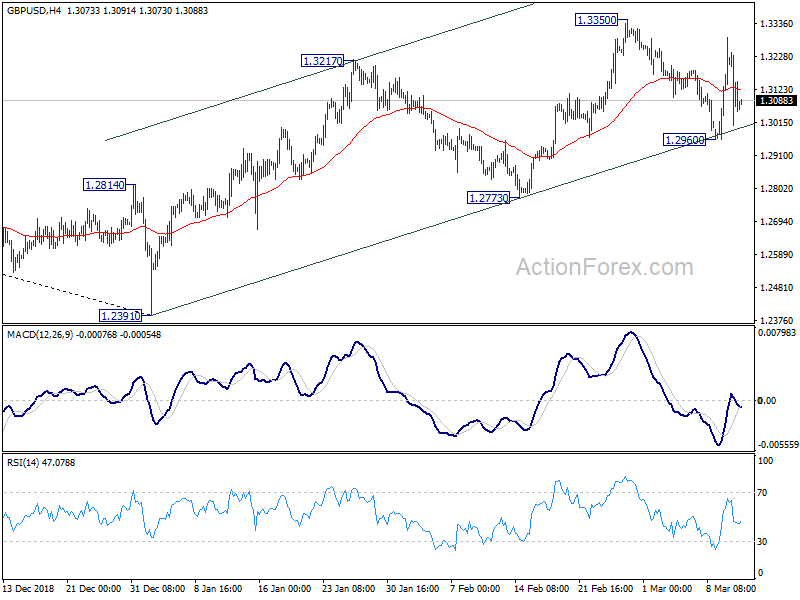
Pound (1.3088) has bounced to trade near current levels after seeing a volatile trade between 1.300-1.3288 yesterday. While Pound trades above support at 1.30, it may continue to rise towards 1.32-1.33 again in the near term. Immediate view is bullish.
Dollar-Index (96.97) is trading in the red below 97. Unless a bounce back above 97 is seen, Dollar Index could be bearish for the near term targeting 96.50 or lower.
Euro (1.1288) has moved up on Dollar weakness and while the upside momentum remains intact, we could see a rise towards 1.1340 in the near term before a corrective dip is seen.
Euro-Yen (125.49) is almost stable. We stick to our view of a rise to 126.00/80 in the near term. View is bullish for the coming sessions.
Dollar Yen (111.19) is also almost stable, trying to move up a bit. While above 111, the pair has scope to rise towards 112.0-112.5 levels in the near to medium term.
Aussie (0.7055) has fallen sharply. But note support at 0.70 which is likely to hold and gradually push Aussie back to higher levels near 0.7150.
USDCNY (6.7073) has fallen from resistance near 6.72/73 levels and while that holds, Yuan could strengthen towards 6.68. At the same time watch interim support at 6.70.
Dollar Rupee (69.7125) managed to bounce back from 69.50 yesterday but while the Dollar trades weak; Rupee could possibly attempt another fall towards 69.50 today. Upside is likely to be limited to 69.80/90. A break below 69.50 would open up chances of testing 69.25/00. We would watch if Dollar-Rupee re-tests 69.50 today.
INTEREST RATES
The UK yields are trading low. The 5YR (0.837%), 10YR (1.1650%) and the 20YR (1.62%) are trading lower than yesterday’s levels of 0.90%, 1.2270% and 1.6610% respectively. The yields look bearish for the near term and could take a few sessions to test support levels from where a bounce could be expected. The 20YR could test 1.60/59% while the 10Yr may target 1.10%.
The US yields have fallen as well. The 2Yr (2.46%), 5Yr (2.42%), 10Yr (2.61%) and 30Yr (3.00%) have fallen back from levels near 2.50%, 2.46%, 2.66% and 3.05% respectively. 30YR could test 2.95%, while the 10Yr and 5YR could test 2.6% and 2.4% respectively before rising from there. While the overall long term trend is down for the US yields, we could see the current fall to continue for a few more sessions followed by a short corrective upmove.
Australia consumer sentiment dropped to 98.8, pessimists outnumbered again
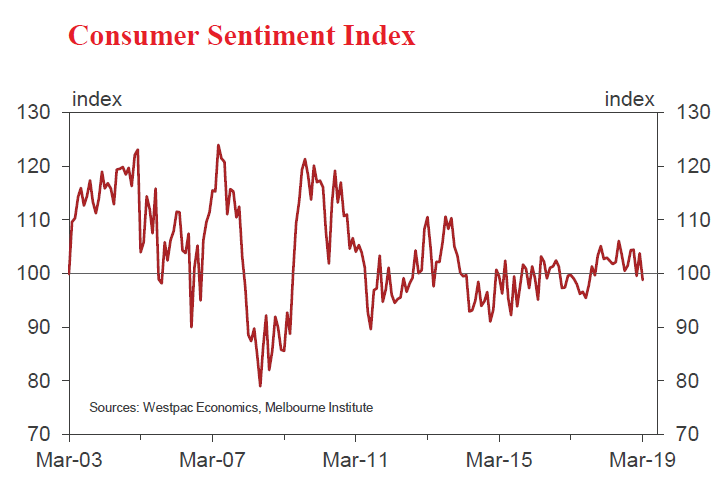
Australia Westpac Consumer Sentiment dropped sharply by -4.9 to 98.8 in March, down from 103.8. That's the lowest level since September 2017. Also, with sub-100 reading, pessimists outnumbered optimists again. The release of the national accounts update is seen as a piece of news that triggered the deterioration. Data collected before the March 6 release showed reading of 100.7. Those collected after showed combined reading of 92.7, down -8.
Westpac continues to expect a total of -50bps rate cut by RBA by the end of 2019. And they expect the hikes to happen in August and then November.
AUD/USD Rebound Reaching Crucial Juncture
Key Highlights
The Aussie Dollar tested the 0.7000 support and rebounded nicely against the US Dollar.
AUD/USD traded above a major bearish trend line at 0.7046 on the 4-hour chart.
The US CPI in Feb 2019 increased 1.5% (YoY), less than the 1.6% forecast.
The US Durable Goods Orders for Jan 2019 will be released today, which could decline 0.5% (MoM).
AUDUSD Technical Analysis
The Aussie Dollar found a strong buying interest near the 0.7000 level against the US Dollar. The AUD/USD pair started a solid upward move and broke the 0.7020 and 0.7050 resistance levels.
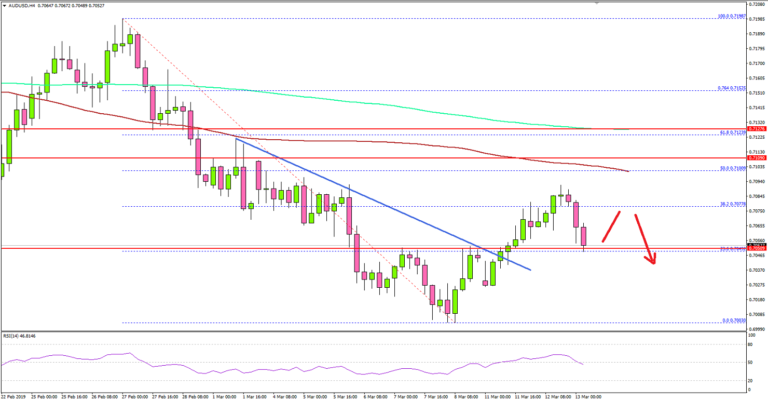
Looking at the 4-hours chart, the pair gained traction from the 0.7000 support and climbed above the 23.6% Fib retracement level of the last decline from the 0.7198 high to 0.7000 swing low.
During the upside, the pair cleared the 0.7060 resistance and a major bearish trend line at 0.7046 on the same chart. It opened the doors for more gains above the 0.7070 resistance. However, there are many hurdles on the upside near the 0.7100-0.7125 zone.
The 50% Fib retracement level of the last decline from the 0.7198 high to 0.7000 swing low is positioned along with the 100 simple moving average (red, 4-hours) near the 0.7100-0.7125 resistance.
Therefore, the pair could struggle to clear the 0.7100-0.7125 resistance zone. If buyers succeed, the pair could trade towards the 0.7150 or 0.7175 levels. On the downside, an initial support is at 0.7050, followed by the key 0.7020 support.
Fundamentally, the US CPI figure for Feb 2019 was released by the US Bureau of Labor Statistics. The market was looking for a 0.2% rise in the CPI in Feb 2019, compared with the previous month.
The result was in line with the forecast as the CPI increased 0.2%. Looking at the yearly change, there was a rise of 1.5% in the CPI, less than the 1.6% forecast. The US CPI Ex Food & Energy increased 0.1% (MoM), less than the 0.2% forecast.
The report added that:
The food index rose 2.0 percent over the past year, its largest 12-month increase since the period ending April 2015. In contrast, the energy index declined 5.0 percent over the last 12 months.
Overall, AUD/USD recovered nicely and it seems like it could make an attempt to climb above the 0.7125 resistance area in the near term.
Economic Releases to Watch Today
- US Producer Price Index Feb 2019 (MoM) – Forecast +0.2%, versus -0.1% previous.
- US Durable Goods Orders Jan 2019 – Forecast -0.5% versus +1.2% previous.
- US Durable Goods Orders Ex Transportation Jan 2019 – Forecast +0.1% versus +0.1% previous.
Australia Consumer Sentiment Falls on Weak Growth Figures
The Westpac-Melbourne Institute Index of Consumer Sentiment fell 4.8% to 98.8 in March from 103.8 in February.
The consumer mood deteriorated in March, sentiment falling to its lowest level since September 2017. With the index moving back below 100, pessimists again outnumber optimists. That contrasts with the ‘cautiously optimistic’ reads that prevailed throughout 2018 although at 98.8 the index is only ‘cautiously pessimistic’ and still above the average level recorded in 2017.
The main development over the last month was the December quarter national accounts update that showed Australia’s economic growth slowing to a 1% annual pace over the second half of 2018, widely described as a ‘per capita recession’ in media coverage.
The survey detail indicates that this had a significant negative impact on confidence.
Responses over the survey week show a marked drop-off after the national accounts update. Those collected before the March 6 release had a combined index read of 100.7. Those collected after the release had a combined read of 92.7, an 8% fall.
Responses to additional questions on news recall also suggest the economic news had a major bearing on consumers. Over a third of respondents recalled news on ‘economic conditions’, the highest recall rate since March 2016, with the news assessed as very unfavourable. The next highest recall was for news around ‘interest rates’ (22%); ‘Budget and tax’ (22%); and ‘international conditions’ (14%), all of which was viewed as more unfavourable than in December. The less favourable assessment of interest rate news is despite a clear shift from the RBA, from a position that the next move on rates was more likely to be up than down to an ‘evenly balanced’ view.
Australia’s housing market downturn – a key factor in the disappointing December quarter growth figures – also looks to have had a more direct impact on sentiment. Consumers in Sydney, which has seen the largest house price declines over the last 18 months, recorded a sharp 10% fall in sentiment. Those working as labourers or operators also recorded a particularly sharp 14% decline, likely reflecting the significant weakening in dwelling construction.
All index components recorded falls in March but the biggest shift was in consumers’ near term expectations for the economy. The ‘economic outlook, next 12 months’ sub-index fell 6.9%, following a 7% gain in February and a 7.8% drop in January. The ‘economic outlook, next 5 years’ sub-index also fell 5.5%, with a similar choppy profile over the previous two months. With the December quarter national accounts likely clarifying what were previously somewhat mixed signals about the extent of Australia’s growth slowdown, the March weakening in consumer expectations for the economy looks likely to be sustained.
Consumer views on family finances also weakened, the ‘finances next 12 months’ sub-index down 5.9% and the ‘finances vs a year ago’ sub-index down 5.6% in March. Both sub-indexes are well below their long run averages. We continue to monitor this sub-index closely for signs of ‘wealth effect’ drags weighing on readings in NSW and Victoria. So far the evidence is still not clear cut although the March month did show bigger declines in expectations for ‘finances, next 12 months’ across these states (NSW –11%; Victoria –9%) consistent with more pessimistic expectations for house prices.
Consumer attitudes towards major purchases have been steadier in recent months, the ‘time to buy a major household item’ sub-index down just 0.6% in March following small moves in January and February. That said, the sub-index remains well below average, consistent with a continuation of the weak consumer spending growth seen through the second half of 2018.
Job loss concerns rose sharply in March. The Westpac- Melbourne Institute Unemployment Expectations Index recorded an 8.9% jump, indicating more consumers expect unemployment to rise in the year ahead. At 130.6 the index is at an 18 month high after touching a seven year low in February. While the move takes the index back near its long run average of 130 rather than to outright weak levels, the jump points to a material deterioration from the strong labour market conditions that prevailed throughout 2018." On housing, sentiment towards house purchase decisions continues to improve but price expectations were again marked down.
The 'time to buy a dwelling' index rose a further 3.5% to 116.6 in March, a four year high. The index has now risen 30% from its mid 2017 low remains below its long run average of 120. Improving affordability continues to see a lift in buyer sentiment in NSW and Victoria although there still looks to be some way to go on affordability before buyer sentiment returns to 'normal' levels.
The Westpac-Melbourne Institute Index of House Price Expectations declined a further 2.7% to 85.4 in March, marking a new record low since we began compiling this index in 2009 and a 44% cumulative decline from the peak in early 2017. Weakness remains more pronounced in NSW and Vic, with around half of consumers in these states expecting prices to be lower in a year's time.
Responses to additional questions on the 'wisest place for savings' suggest risk aversion has risen further. Over two thirds of consumers now favour safe options – bank deposits, superannuation or paying down debt. Only 9% favour real estate, a new record low going back to 1974, while only 8% nominate shares. The mix is more risk averse than at the height of the global financial crisis in 2008 and highlights the risk that a move by households to increase savings rates could further undermine consumer demand.
The Reserve Bank Board next meets on April 2. While Westpac expects the RBA to cut the cash rate by 50bps by the end of 2019 we do not expect the Bank to move rates at its April meeting. The weak December quarter national accounts will prompt a further downward revision to the RBA's growth forecasts. However, this is unlikely to shift its views on the labour market – an area of strength that the Bank has highlighted as key to its policy considerations – by enough to warrant a policy easing. As such, we expect the first 25bp rate cut from the RBA to come in August once the extent of spillovers from the housing downturn, on the labour market in particular, become more apparent, with a follow-up 25bp cut in November
UK CBI: Extending Article 50 to close the door on no-deal is now urgent
In a rather short statement, UK CBI Direct-General Carolyn Fairbairn expressed the frustration on the parliament's Brexit circus. She said:
"Enough is enough. This must be the last day of failed politics. A new approach is needed by all parties. Jobs and livelihoods depend on it. Extending Article 50 to close the door on a March no-deal is now urgent. It should be as short as realistically possible and backed by a clear plan. Conservatives must consign their red lines to history, while Labour must come to the table with a genuine commitment to solutions. It's time for Parliament to stop this circus."
Sterling staying in range after May’s Brexit defeat, no-deal vote next
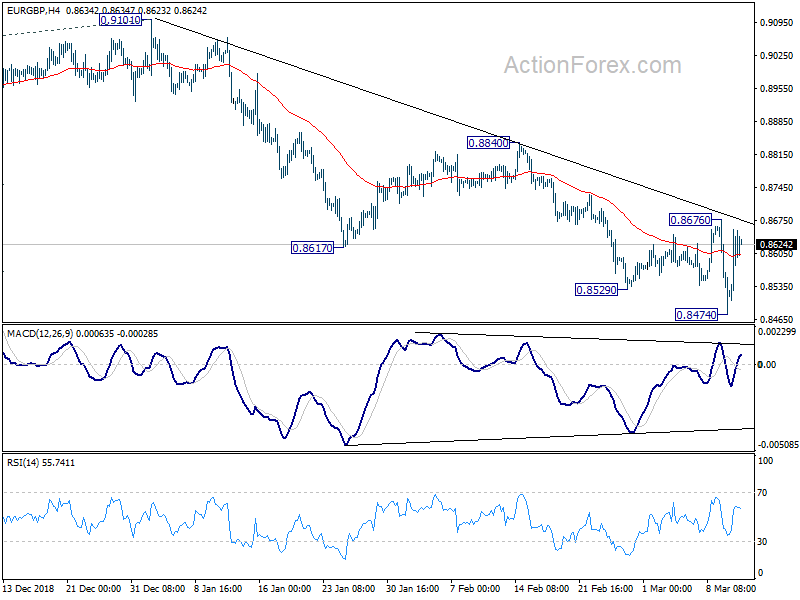
Sterling is steadily in range for now awaiting more clarify regarding the path forward for Brexit. UK Prime Minister Theresa May's Brexit deal was voted down again in the Commons overnight, despite the last minute concessions from EU. MPs voted 391-242 to reject the deal, an insufficient improvement from January's 432-202 votes. Now, a vote on no-deal Brexit will be carried out at 1900GMT on Wednesday. If no-deal is voted down, there will be another vote on Thursday for seeking Article 50 extension.
May warned after the defeat. "Let me be clear. Voting against leaving without a deal and for an extension does not solve the problems we face." And, with the government at impasse, she asked "Does it wish to revoke Article 50 (announcing intention to leave the EU)? Does it want to hold a second referendum? Or does it want to leave with a deal, but not this deal?"
EU President Donald Tusk's spokesman said the EU has done "all that is possible to reach an agreement" and the solution "can only be found in London." The results now increases the risk for UK to crash out the EU without a deal. And he emphasized that there needs to be a "credible justification for a possible extension and its duration."
Reactions in Sterling is rather mild. The development was not unexpected except that May and Juncker provided some false hope that lifted the Pound briefly.
Daily Markets Broadcast
Wall Street mixed as Boeing weighs
It was mixed session on Wall Street overnight as the SPX500 and Nas100 indices gained but the US30 index fell, pressured by Boeing amid an escalating crisis surrounding the 737-Max jet. PM May's latest Brexit deal was rejected by the UK Parliament.
US30USD Daily Chart
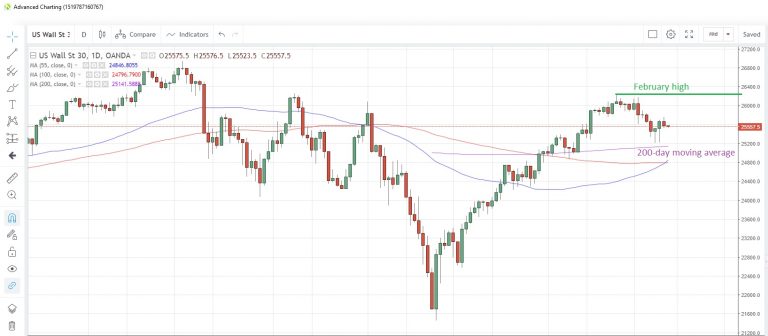
The US30 index snapped a two-day advance yesterday as Boeing shares weakened further. US CPI data remained benign suggesting the Fed can remain comfortably on hold, which prevented a deeper rout
The 200-day moving average at 25,141 remains untouched, supporting prices since February 12. The February high of 26,238 will likely act as the next resistance point
US durable goods orders are seen falling 0.5% in January, the first decline in three months, according to the latest survey. After yesterday's benign CPI print, February's producer prices could also head the same way.
DE30EUR Daily Chart
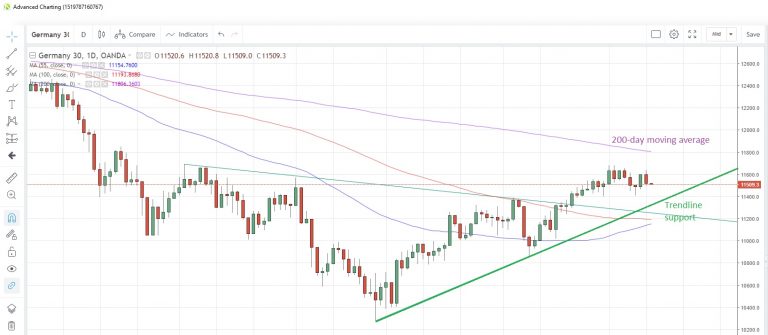
The Germany30 index fell yesterday amid expectations that the “improved” Brexit deal would be rejected by UK politicians
The index remains sandwiched between resistance at the 200-day moving average at 11,806 and rising trendline support near 11,340
The weaker data for Germany's industrial production data for January will likely be repeated again today when the Euro-zone releases its own numbers. Forecasts suggest a 2.1% y/y decline.
JP225USD Daily Chart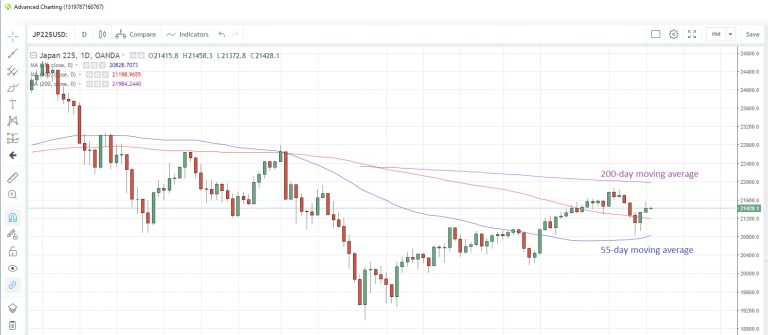
The Japan 225 index has opened flat this morning amid conflicting signals from Wall Street and weak economic data
The index has been confined between the 55- and 200-day moving averages at 20,828 and 21,984 respectively since February 12
Japan's machinery orders fell 5.4% m/m in January, the weakest print in three months, amid signs that contagion from the global economic slowdown may be spreading to Japan. The tertiary industry index, which measures the domestic service sector, is expected to rise 0.5% in February, latest surveys show.
Global Markets Gently Simmer
Global markets gently simmer
Right now, the only game in town is from a macroeconomic perspective – the outcome of the US-China trade talks. Until the world’s two largest economies conclude an agreement (or not), it will be difficult to gauge a clearer picture of the global economy in 2019. Data suggests the world’s industrialised economies (including China) are slowing, which shouldn’t surprise anyone after a ten-year QE-induced bull run. The outcome of the trade talks, (and perhaps the US/Eurozone will likely follow) will dictate whether we will gently roll down the slope or off the edge of the cliff.
Markets have a short attention span, and as bureaucrats on both sides quietly go about their business, they tend to lose patience and focus. It’s a bit like giving a hyperactive child a triple espresso. The result tends to be lots of noise and short-term volatility but as the day ends not much has changed. Short-term money chases headlines and data but moves to the sidelines as the session ends.
This has been the story in recent times and yesterday was no exception. Brexit-induced volatility yesterday saw the pound (GBP) gyrate in a near-3% intra-day range, but as the dust settled, GBP closed only 0.6% lower with the FTSE 100 rising a benign 0.3%.
Similarly, US core CPI came in ever so slightly lower at 2.1% (expected 2.2%) which saw Wall Street rise and US-10-year bonds dip below 2.60% and the greenback give back some of its gains.
Asia’s focus will turn to Japan machine orders data this morning before US durable goods this evening.
We can expect much hand-wringing analysis on Brexit today following the rejection of UK Prime Minister May’s latest deal by the House of Commons. My tuppence is that Parliament has, in their own mind, seized control of the Brexit process and will duly ask and likely get an extension to the 29 March exit date. The breathing space granted will be used by whomever to renegotiate a more palatable Brexit deal for the UK. Except nobody has asked the Europeans yet. A short-term gain may yet belie long-term pain.
FX
The dollar fell overnight, tracking lower US treasury yields following a softish US CPI print. The dollar index fell 0.3% with the Euro (EUR) a notable gainer, rising 50 points to 1.1290. The single currency was also buoyed by the UK Brexit vote, which decreased the likelihood of a hard exit substantially.
GBP gyrated wildly in a 2.3% range between 1.3000 and 1.3300 on Brexit headlines and hot money flows, closing in New York at 1.3080. The street is assuming that a no-deal Brexit in any form is off the table now and the price action yesterday suggests they are looking for excuses to buy and not sell. This could make the upside more vulnerable to sudden spikes. As I have repeated ad nauseam, this could be a dangerous game, so traders would do well to stay light and nimble.
Elsewhere, Asian currencies could carve out small gains as lower US bond yields and the dollar support emerging markets.
Equities
Wall Street closed mostly higher with the S&P rising 0.3 % and the Nasdaq 0.45%. The Dow Jones fell 0.4 % weighed down by another significant fall in Boeing’s stock, as an ever-increasing group of countries (including China and the Eurozone) ground the 737-Max aircraft.
Asian equities will probably follow Wall Street’s lead higher initially, with Japan data closely watched on a slow news day for the region.
Oil
Both Brent crude and WTI had sideways trading days as the attention of traders was focused elsewhere. Brent rose only 0.1%, implying Asian energy markets are in for a quiet start.
Gold
Gold recaptured the 1,300 handle overnight. A weaker dollar and falling bond yields mixed in with some Brexit volatility saw the yellow metal rise USD8 to 1,301.50 dollars an ounce. The technical charts show strong support is in place at the 1280 area. Ongoing UK volatility and lower yields could see gold continue to benefit.
Eco Data 3/13/19
[php_everywhere instance="1"]