

Sample Category Title
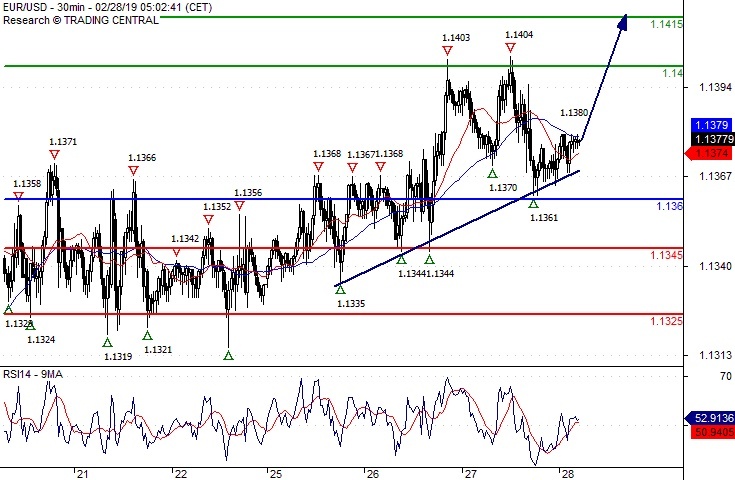
EUR/USD Supported By A Rising Trend Line
Pivot (invalidation): 1.1360
Our preference Long positions above 1.1360 with targets at 1.1400 & 1.1415 in extension.
Alternative scenario Below 1.1360 look for further downside with 1.1345 & 1.1325 as targets.
Comment The RSI is above its neutrality area at 50%.
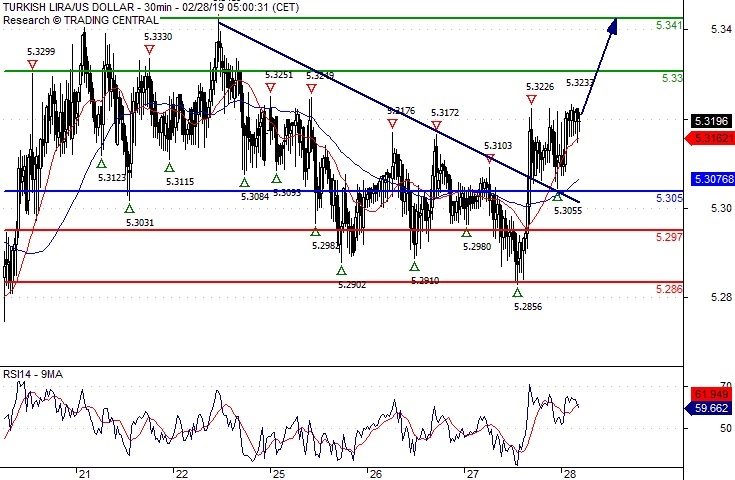
USD/TRY Further Advance
Pivot (invalidation): 5.3050
Our preference Long positions above 5.3050 with targets at 5.3300 & 5.3410 in extension.
Alternative scenario Below 5.3050 look for further downside with 5.2970 & 5.2860 as targets.
Comment The RSI is bullish and calls for further advance.
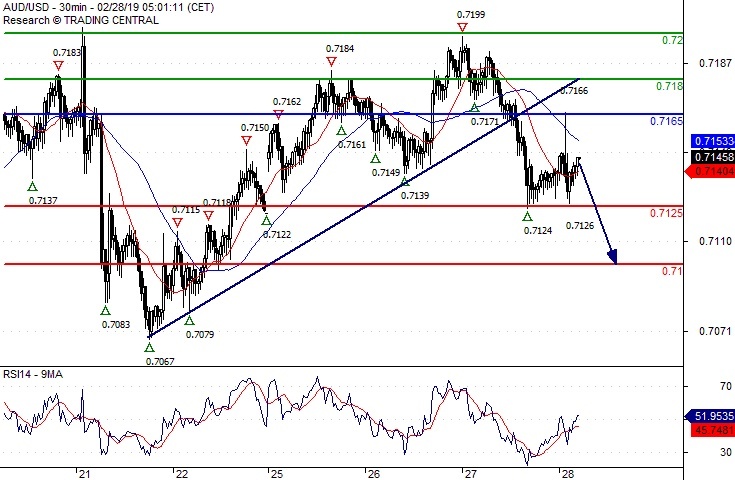
AUD/USD Key Resistance At 0.7165
Pivot (invalidation): 0.7165
Our preference Short positions below 0.7165 with targets at 0.7125 & 0.7100 in extension.
Alternative scenario Above 0.7165 look for further upside with 0.7180 & 0.7200 as targets.
Comment The RSI is below its neutrality area at 50%
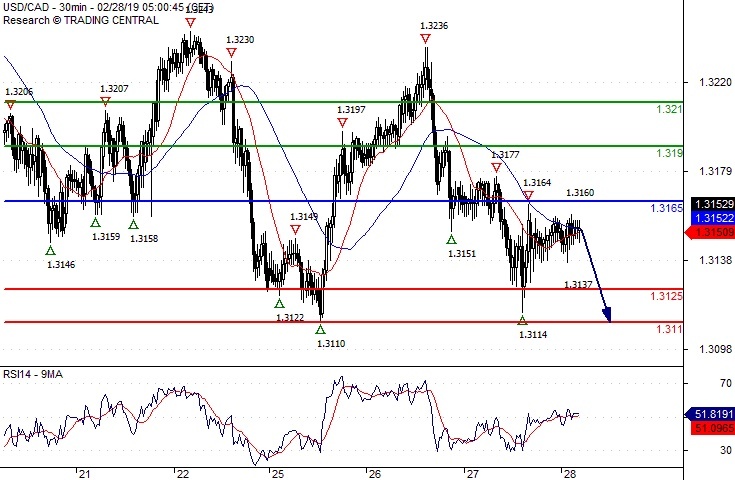
USD/CAD Key Resistance At 1.3165
Pivot (invalidation): 1.3165
Our preference Short positions below 1.3165 with targets at 1.3125 & 1.3110 in extension.
Alternative scenario Above 1.3165 look for further upside with 1.3190 & 1.3210 as targets.
Comment As Long as 1.3165 is resistance, look for choppy price action with a bearish bias.
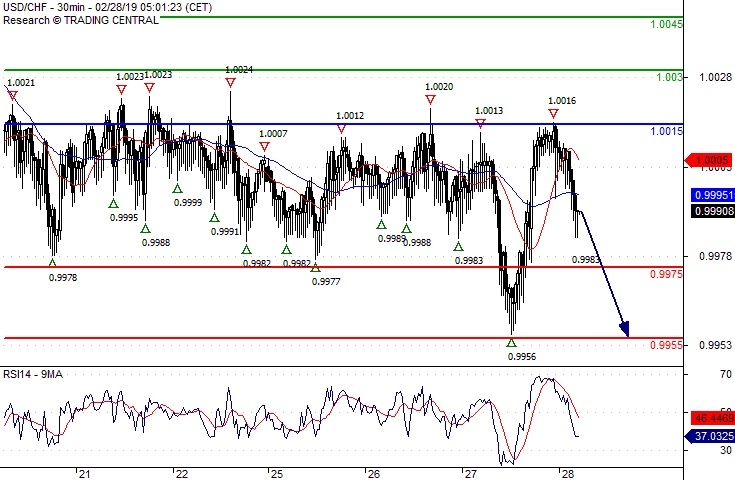
USD/CHF Watch 0.9955
Pivot (invalidation): 1.0015
Our preference Short positions below 1.0015 with targets at 0.9975 & 0.9955 in extension.
Alternative scenario Above 1.0015 look for further upside with 1.0030 & 1.0045 as targets.
Comment The RSI calls for a drop.
XAUUSD Intraday Analysis
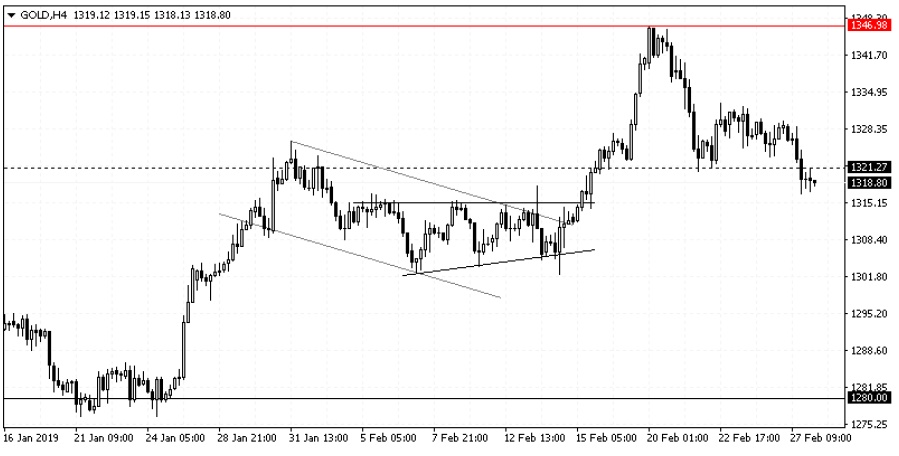
XAUUSD (1318.80): Gold prices declined after prices stayed muted in the previous three sessions. Price action barely closed below the main support level of 1321.58. This could signal a possible move back above this level in which case the bias would remain to the upside. If gold prices extend lower declines, a modest rebound could lead to a lower high in place. A significant lower high could with no doubt signal that the bullish momentum is off the charts. Watch the 1321.58 level where resistance could be next in the near term. This would indicate a move to the 1300 level initially where support could hold.
USDJPY Intraday Analysis
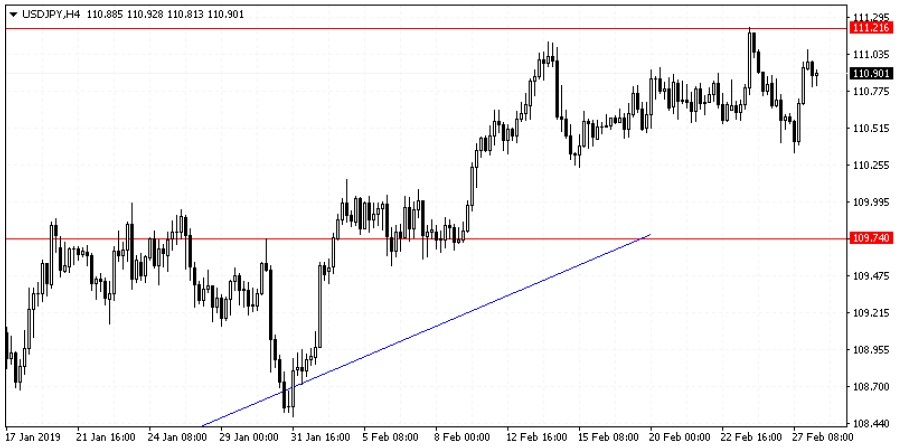
USDJPY (110.90): The USDJPY currency pair managed to rebound with price action pushing to the upside over the past few sessions. The resistance level at 111.21 remains in sight for another firm retest. This could confirm the upside bias for the bullish ascending triangle pattern on the daily time frame. A breakout above this level might see USDJPY posting further gains. The next primary target should be at 112.54.
EURUSD Intraday Analysis
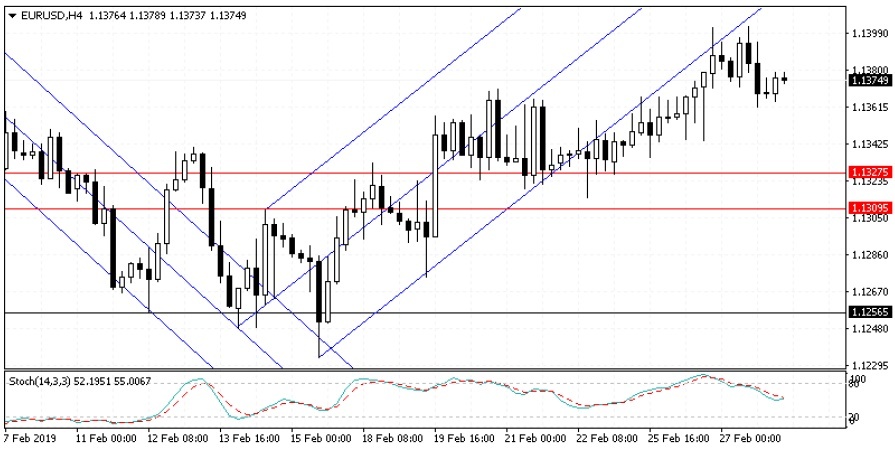
EURUSD (1.1374): The EURUSD currency pair maintains the gradual gains. Price action rallied to a 3-week high briefly before easing back. With the support level near 1.1327 - 1.309 holding out in the near term, price action is biased to the upside. The modest gains keep the EURUSD on track for prices to test the resistance level at 1.1435 level. The Stochastics on the 4-hour chart time frame could post a bullish signal confirming the upside.
U.S. Q4 GDP Report On Tap
The U.S. dollar attempted to pare losses from Wednesday. Economic data on the day was relatively quiet from the Eurozone. Germany's Bundesbank President Jens Weidmann gave a speech where he said that he would like to lead the central bank. Weidmann has been a harsh critique of Mario Draghi and the ECB's ultra-loose monetary policy. The euro did not react much to the comments.
Canada's headline inflation rose by 0.1% on the month, which was below estimates of a 0.2% increase. On a year over year basis, headline inflation increased by 1.9% matching estimates. However, the BoC's core inflation rate remained well above 2.0% which is the inflation target rate.
Final US wholesale inventories report showed a 1.1% increase on the month in January. Factory orders, however, rose just 0.1% in December, missing estimates of a 1.5% increase. Pending home sales were stronger than expected, rising 4.6% against estimates of a 0.7% increase.
More data from around the world
The economic calendar today gets off to a busy start. Earlier, in the Asian trading session, Australia's private Capex released figures forQ4 and a 2.0% increase. Economists forecast that Capex would rise 1.1% during the fourth quarter. This follows a 0.5% decline from the third quarter.
China's manufacturing PMI report released earlier today showed a decline to 49.2 for February. This was lower than the forecasts of a drop to 49.5.
The European trading session kicks off with the quarterly GDP report from Switzerland. Data should show a 0.4% increase in the quarter during the three months ending December. This follows a 0.2% decline in the third quarter.
Germany's preliminary inflation report is due later today including France. Inflation should rise by 0.5% on the month in Germany. French inflation should increase by 0.4% which would reverse the 0.4% decline from the month before.
The NY trading session today will see the release of the advance GDP report. Forecasts point to a 2.6% increase in GDP during the quarter ending December 2018. This would mark a slower pace of growth during the period.
Currencies: Will Balance Between US And EMU Data Support Further EUR/USD Gain?
- Rates: First resistance in German 10-yr yield at risk of break
Core bonds sold off yesterday with UK Gilts leading the way lower as the prospect of a no deal brexit fades. The German 10-yr yield tested first resistance at 0.15%. Today’s national inflation readings could cause a break with Bund underperforming US Treasuries in a daily perspective. Recent ECB comments show no desire to change policy (guidance) next week. - Currencies: Will balance between US and EMU data support further EUR/USD gain?
The tentative USD decline/rise of the euro slowed yesterday as there was no important news to force a EUR/USD break beyond 1.14. Today, EMU CPI’s and US Q4 GDP will be published. A bottoming in EMU CPI’s and a soft US GDP might support the gradual EUR/USD uptrend. Sterling stays well bid. How much good news on Brexit is currently discounted?
The Sunrise Headlines
- US equity markets were mixed to negative with Nasdaq outperforming (+0.07%). Asian equities were broadly mixed overnight until US/North Korean nuclear talks wrapped up sooner than expected, sending bourses south.
- The US Trade Rep. Lighthizer said that the US and China settled on a process for enforcing a (possible) trade agreement between the countries. He added that it is still too early to tell if China will concede to US demands.
- US President Trump and North Korean leader Kim Jong Un abruptly wrapped up negotiations in Vietnam, without a public joint statement. The US said no agreement was reached but talks had been “good and constructive”.
- Federal Reserve chairman Jerome Powell confirmed that the balance sheet normalization could be ended by the end of this year. In that case, the balance sheet would be 16-17% of GDP, up from about 6% before the financial crisis.
- ECB governor François Villeroy warned for keeping interest rates below zero for too long as it may hinder the ECB’s policy from dripping to the economy. He therefore thinks a normalization of monetary policy is still “desirable”.
- China’s manufacturing sector contracted further in February, with the PMI down to 49.2 from 49.5 a month before and below 50 for a third straight month. The non-manufacturing component decreased to 54.3, down from 54.7.
- Today’s US eco calendar contains US Q4 GDP results, weekly jobless claims and the Chicago PMI for February. Germany, France, Spain and Italy print February inflation numbers. Fed’s Clarida, Bostic, Kaplan and Harker speak
Currencies: Will Balance Between US And EMU Data Support Further EUR/USD Gain?
Will data support further EUR/USD gains?
There was tentative USD softness on FX markets earlier this week while the euro enjoyed a cautious bid. Both ‘trends’ halted yesterday, but there was no big countermove. EC confidence suggested that the downturn in the region might be slowing. ECB speakers kept the line that the recent, supposed temporarily economic slowdown still allows the ECB to consider first cautious steps to policy normalization in a not-that-distance future. EUR/USD retested the 1.14 area, but the test was rejecte (close at 1.1370). USD/JPY reversed earlier losses as US yields rose and as sentiment on risk improved gradually. USD/JPY finished at 111.00. Overnight, Chinese PMI’s printed again soft, with the manufacturing measure holding below the 50 level. However, the number was not that far from consensus. Asian equities initially showed a mixed picture, but sentiment deteriorated as president Trump and Kim Jong Un abruptly ended their meeting in Hanoi without a joined statement, raising geopolitical uncertainty in the region. The yen rose slightly with USD/JPY trading in the 110.75 area. EUR/USD is trading little changed in the 1.1370/75 area. The yuan is trading in the 6.6850 area. Today, several EMU countries including Germany and France will release February CPI data. Signs of a bottoming out process might support the idea that a start of ECB policy normalisation might still be on the table at the end of 2019 or early 2020 and might be a tentative euro supportive. In the US, the Q4 GDP release will be published. A modest rise (2.2%) is expected. As soft figure (e.g. <2.0%) would confirm that the Fed has the time to consider further policy steps and could be a tentative negative for the dollar. Geopoltical tensions (US-North Korea) area a wildcard, but we don’t expect it to be a big topic for EUR/USD. We started this week with a cautious bias on the US dollar as the US currency mighty become (slightly) more sensitive to soft US data. Last week, EUR/USD rebounded but unconvincingly. Any EUR/USD rebound will develop slowly as long as EMU data stay unconvincing. Still, we see room for EUR/USD to extend gains in the 1.12/1.15 trading range.
Yesterday, the sterling rebound/short squeeze simply continued. EUR/GBP dropped below the 0.8550 handle. At the Brexit debate in the UK Parliament yesterday, May’s Brexit timetable was not really challenged. Today, Brexit headlines might move a bit to the background and eco data probably won’t change the global picture for sterling trading. Sterling had a good run of late and quite some ‘good news’ on Brexit is discounted. Some consolidation might be on the cards.
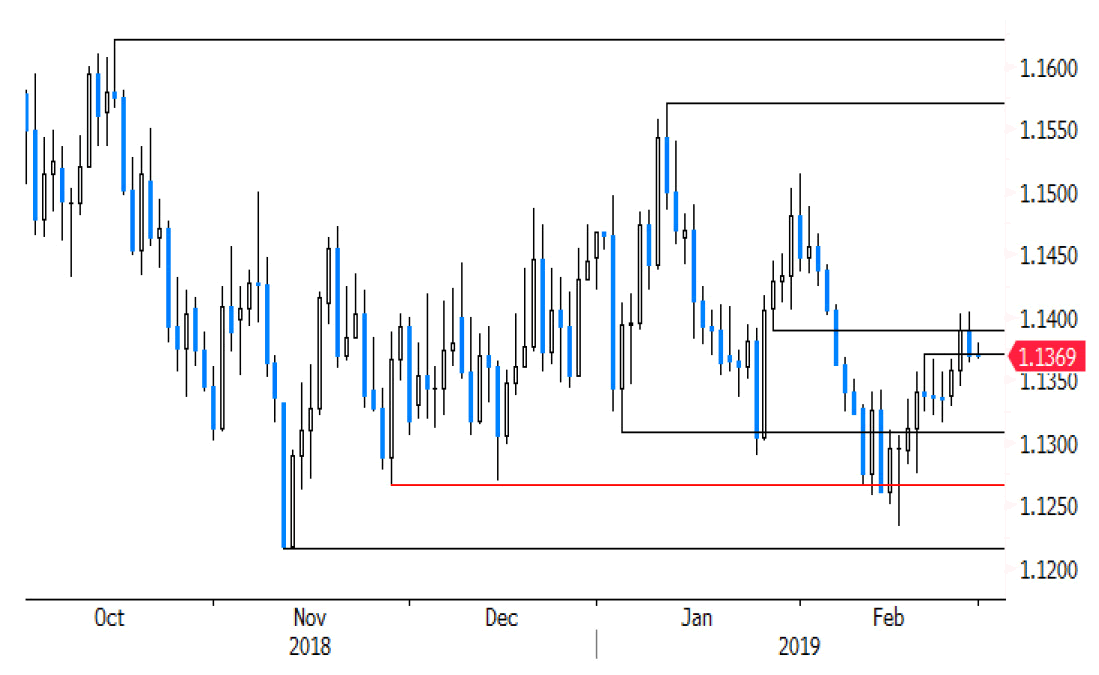
EUR/USD testing the 1.14 big figure, but no sustained break (yet?)