Sample Category Title
EUR/USD Turning Down
Pivot (invalidation): 1.1315
Our preference Short positions below 1.1315 with targets at 1.1285 & 1.1260 in extension.
Alternative scenario Above 1.1315 look for further upside with 1.1335 & 1.1350 as targets.
Comment The RSI is bearish and calls for further downside.

Currencies: Sentiment Data (ZEW) To Ease Euro Downside Pressure?
- Rates: Looking for clues from the ECB
US investors return after the long weekend, but the US eco calendar is razor-thin. EMU investors look for signs of improvement in the forward-looking German ZEW expectations index and for hints on possible future policy changes in speeches by ECB de Guindos and Praet. Current very dovish market positioning probably limits market moving potential. - Currencies: Sentiment data (ZEW) to ease euro downside pressure?
EUR/USD tried to extend gains beyond 1.13, but the move had no strong momentum yesterday. Today and in the coming days, EMU sentiment indicators will give a new update on the health of the EMU economy. The jury is still out, but better data might give EUR/USD some downside protection. BoJ’s Kuroda signals the banks stays alert on yen strength
The Sunrise Headlines
- US equity markets were closed yesterday for US Presidents’ Day, but reopen today. Asian equity markets are trading mixed this morning with Chinese indices underperforming.
- EU Commission president Juncker is confident US president Trump will keep his promise of not imposing car tariffs for the time being. Otherwise, he threatened to retaliate immediately with less purchases of soy and liquid gas.
- Sixteen US states, led by California, have filed a federal lawsuit challenging President Trump’s national-emergency declaration to finance the wall on the Mexican border, setting the stage for more bickering in US Congress.
- UK Attorney General Cox proposed amendments to the delicate Irish border backstop. Brexit Secretary Barclay will hold more talks with EU chief negotiator Barnier this week, while UK manufacturers warn of ‘catastrophic’ no-deal Brexit.
- Bank of Japan governor Haruhiko Kuroda, speaking to parliament, said the bank would have to consider additional monetary stimulus if a stronger Japanese yen affects Japan’s inflation and economy too much.
- ECB chief economist Peter Praet showed concern over the economic slowdown, adding to the dovish shift of the ECB lately. He said the bank could delay to raise interest rates as a first response against a deeper downturn.
- Today’s eco calendar contains the NAHB Housing Market Index in the US and labour data for the UK. Germany prints the ZEW investor confidence gauge, while Sweden releases inflation data. ECB de Guindos and Praet speak
Currencies: Sentiment Data (ZEW) To Ease Euro Downside Pressure?
Better sentiment data to support EUR/USD?
EUR/USD rebounded further off Friday’s correction low yesterday as mixed US data last week tempered the USD positive bias. There were no important data and US markets were closed (Presidents’ Day). Later in the session, soft ECB comments also capped the upside of the euro. EUR/USD settled in the lower part of the 1.13 big figure for most of the day to close at 1.1311. USD/JPY gained a few ticks as risk sentiment remained constructive and finished the day at 110.62.
Asian equities are trading mixed. Markets are looking for concrete results from the China-US trade talks. At the same time, investors are keen to know the content of the US security report on auto tariffs and what conclusion president Trump will draw. EUR/USD is losing a few ticks, returning to the 1.13 area. BOJ’s Kuroda indicated that the BOJ could ease policy further if needed. It can also be used if yen strength would affect Japan’s inflation or the economy. USD/JPY reversed an earlier decline and trades again in the 110.65 area. The Aussie dollar (AUD/USD 0.7115 area) eased as the RBA Minutes showed the bank is closely watching the impact of declining house prices on the economy. US markets reopen today, but the US eco calendar is thin. In Europe, ZEW investor sentiment is expected to ease from 27.6 to 21.0. Other EMU sentiment indicators including the PMI’s on Thursday and the IFO on Friday are more important to assess the health of the economy. Still, markets are keen to see whether recent EMU downturn slows or accelerates. Signs of improvement might be modestly euro supportive.
At the end of last week, poor US retail sales and production data capped the USD rebound. We started the week with a cautious/rather balanced EUR/USD bias. An improvement in the global trade picture and better EMU data are needed to improve sentiment on EUR/USD. There are hopeful signs on trade, but the jury is still out. EUR/USD 1.1216 marks the Nov low. EUR/USD 1.1287 is 61% retracement (2016 low/2018 top). The EUR/USD downside looks a bit more solid versus last week.
EUR/GBP hovered in a tight range in the mid 0.87 area yesterday. There was plenty of analysis on 7 Labour MP’s leaving the party, but the direct consequences for Brexit were unclear. Today, UK labour market data are expected solid. Additional wage rises and solid employment growth would reinforce the BOE’s case to raise the policy rate in case a disorderly Brexit is avoided. However, any positive reaction of sterling will be guarded as Brexit uncertainty still reigns.
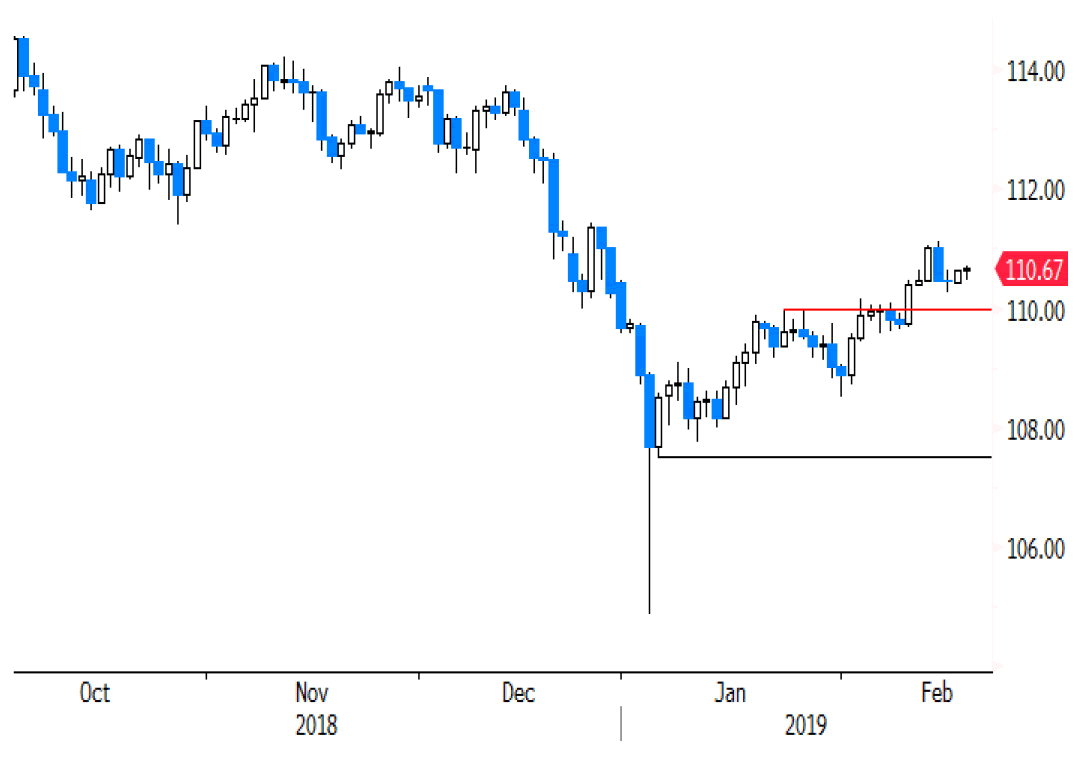
USD/JPY: BoJ’s Kuroda signals the BOJ stays alert on potential excessive
USD/JPY Prepares For Strong Uptrend Continuation
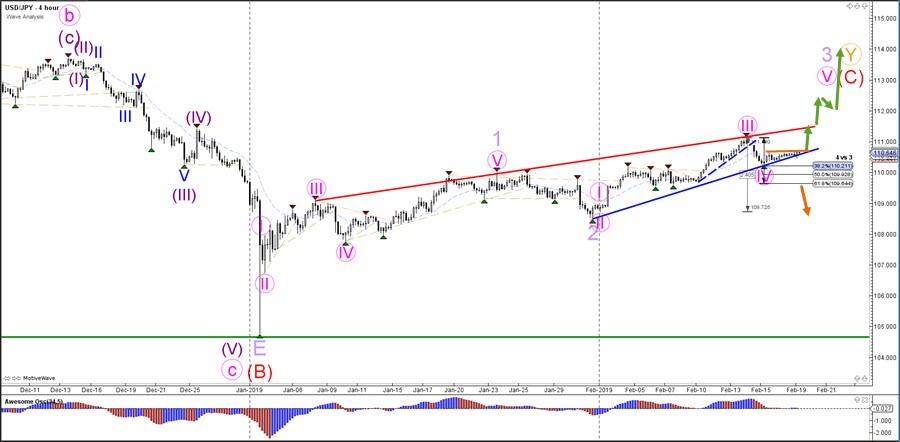
The USD/JPY could be building a larger uptrend within wave 3 (light purple) but the main confirmation occurs if price is able to break above the channel resistance (red line). A break below the support trend line (blue) and 61.8% Fibonacci level of wave 4 vs 3 invalidates the current wave outlook and makes a deeper bearish retracement more likely.
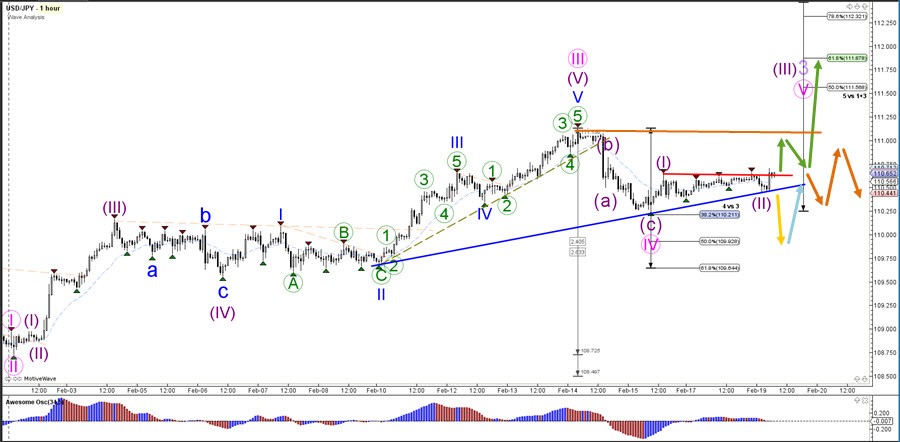
The USD/JPY seems to have completed an ABC correction (purple), which could complete the wave 4 (pink). Waves 4 however tend to be lengthy and price could build a larger triangle chart pattern if the previous top (orange line) is not broken. The potential break above the resistance trend line (red) is either an immediate trend continuation (green arrows) or could start a larger triangle correction (orange arrows). The Fibonacci levels of wave 4 vs 3 remain potential support levels too.
Asian Equities Give Up Gains After Reaching A Four-Month High
After a muted session in Europe, and the U.S. markets closed for Presidents’ Day, investors seem to be moved by news flows coming from U.S.- China trade negotiations. Asian stocks were near a four-month high today driven by Chinese and Australian markets, but gains were later surrendered after China accused the U.S. of fueling cybersecurity fears.
On the trade negotiations front, we have so far learned that China is willing to decrease its trade surplus with the U.S. by substantially increasing the amount of goods and services it purchases. This sounds like good progress, but it may not be enough to end the trade dispute. The crucial points remain on matters related to intellectual property, forced technology transfers and subsidies that China provides to its domestic firms. These issues are likely to be more complicated than just reducing the trade deficit and without a meaningful agreement, markets will not respond positively.
We still think there is a long way to go to end the current dispute. The most important component needed for any deal to be reached is trust. A memorandum of understanding without an enforcement mechanism may suggest that an achieved deal is weak and may break anytime. The base case scenario is likely to be the extension of the 1 March deadline,to allow for more time to negotiate a meaningful deal.
While trade optimism encouraged risk-taking for several weeks, signals from central banks across the globe have played a more important factor in lifting risky assets, particularly from the Federal Reserve. On Wednesday, the FOMC Minutes will provide insight into whether the tightening cycle has come close to an end or we still need to expect further rate increases in 2019. More importantly, markets need to know whether the Fed is prepared to slow down or is likely to end the unwinding of its balance sheet.
Gold hasrallied significantly since the beginning of the year rising 3.4%, a gain of more than 14% from August 2018 lows. The recent rally in Gold came despite a strong dollar, weak inflation expectations and a strong recovery in equities. This hasn’t been the case in the past. Gold used to have a negative correlation with the U.S. dollar and equity prices. The difference this time is that markets are beginning to anticipate a new round of quantitative easing, making the yellow metal the major beneficiary of central banks policies. The FOMC Minutes tomorrow will further highlight whether we’re getting closer to a shift in policy.
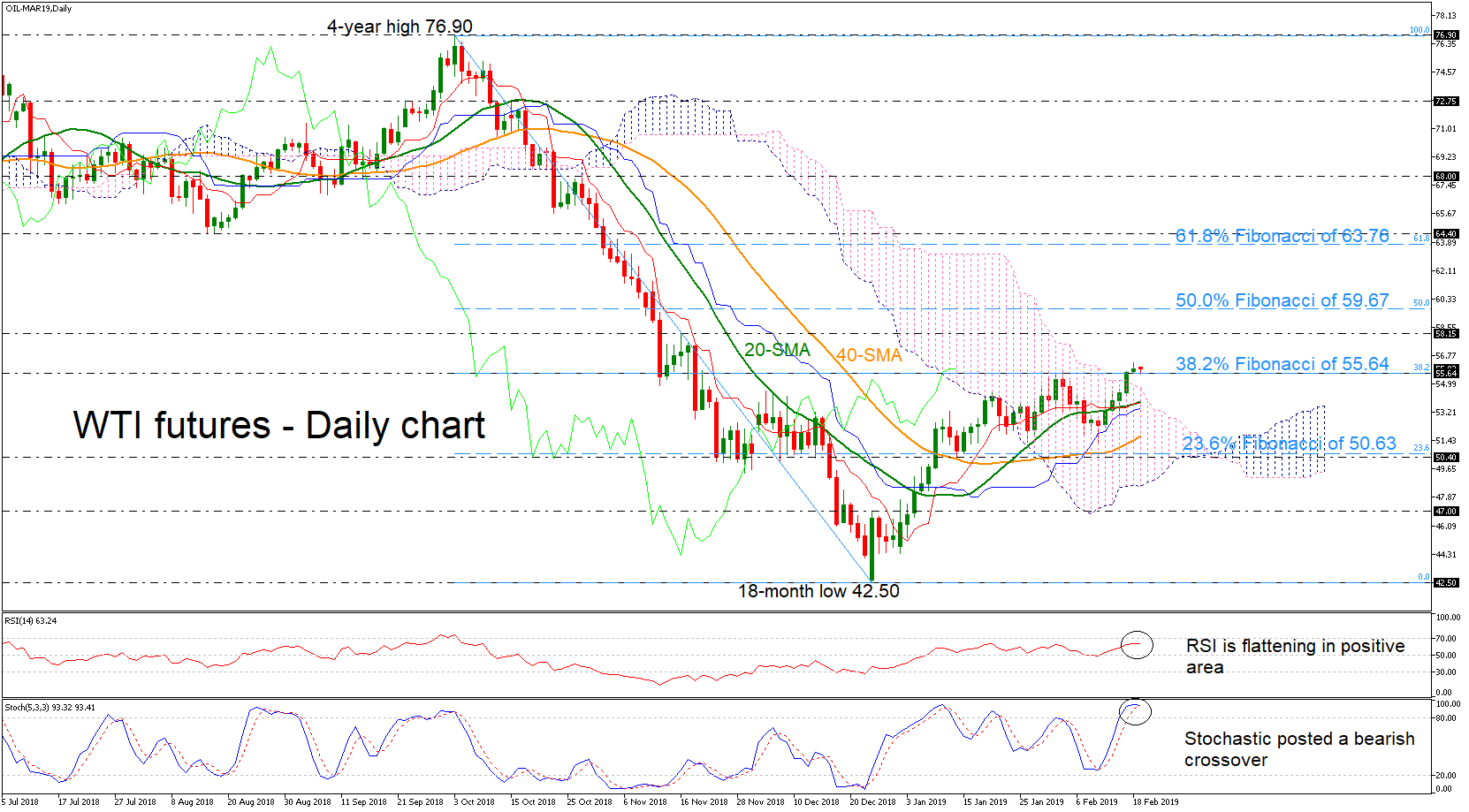
WTI Crude Oil Futures Hits 3-Month High, Bullish Correction Mode In Near Term
West Texas Intermediate crude oil futures topped at a new three-month high of 56.31 during yesterday’s trading session, advancing above the 38.2% Fibonacci retracement level of the downleg from the four-year high of 76.90 to the 18-month low of 42.50.
The technical indicators seem to be overbought, as the RSI is flattening in the positive zone, while the %K line of the stochastic oscillator posted a bearish cross with the %D line in the strong bullish area, signaling possible downside pressures to come in the near term. However, the price successfully surpassed above the Ichimoku cloud and the red Tenkan-sen line is sloping up, endorsing the upside correction.
On the upside, the price could retest the 58.15 resistance level, which if broken, the door could open for the 50.0% Fibonacci mark of 59.67. Should traders continue to buy oil above that region, strengthening the short-term positive bias, resistance could then run towards the 61.8% Fibonacci of 63.76.
A reversal to the downside, could find immediate support at the 20-day simple moving average (SMA) currently at 53.94, while slightly lower the 40-day SMA near 57.72 and the 23.6% Fibonacci of 50.63 could be a critical zone for the bears. If the latter fails to halt bearish movements, the next target could be at the 47.00 round number, taken from the inside swing top on December 26.
Overall, the short-term bias is in bullish correction mode after the rebound on the 18-month low. Further gains above the 61.8% Fibonacci would switch the medium-term neutral outlook to a more positive one.
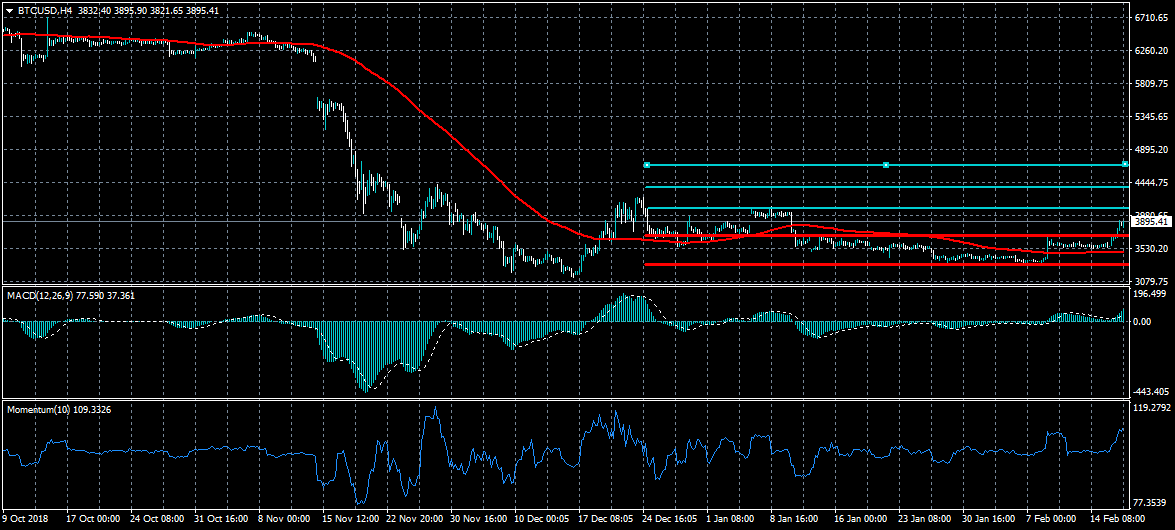
BTCUSD Further Bullish Above $3,960
Bitcoin has finally turned bullish in the short-term after the number one cryptocurrency performed a technical breakout above the $3,700 level on Monday. If BTCUSD buyers can break the upcoming $3,960 resistance level, a strong rally towards the $4,600 level may occur. Technical indicators on the four-hour time frame continue to rise, with the BTCUSD pair also supported by bullish trading momentum.
The BTCUSD pair is strongly bullish while trading above the $3,700 level, key technical resistance is found at the $3,960 and $4,600 levels.
If the BTCUSD pair trades below the $3,700 level, key support is found at the $3,450 and $3,330 levels.
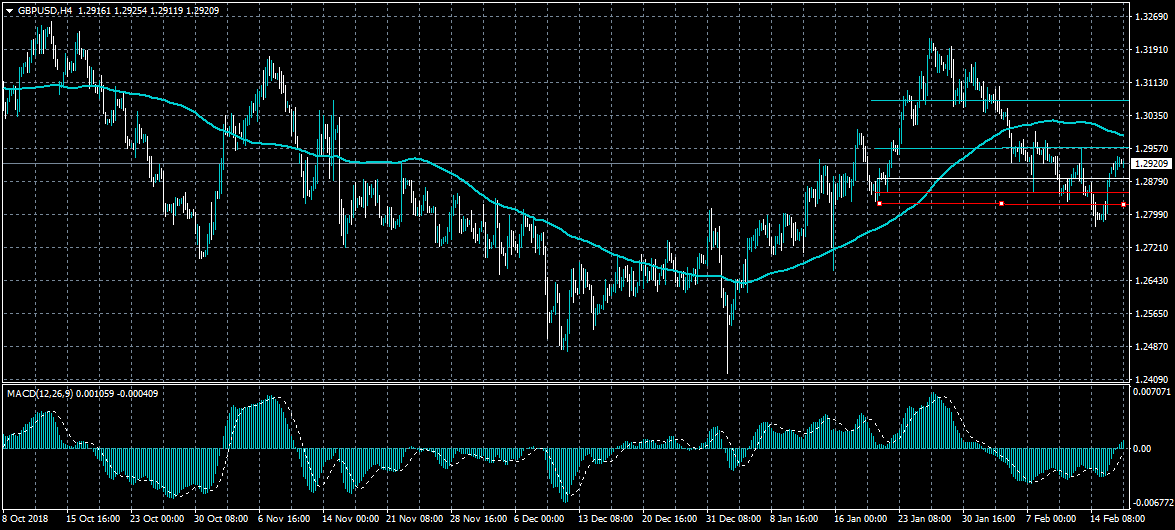
GBPUSD Awaiting Wage And Jobs Data
The British pound is holding above the 1.2900 level against the US dollar on Tuesday, as traders await the release of key wage and jobs data from the United Kingdom economy this morning. The GBPUSD pair may test towards the key 1.3000 level if the data is better than expected, while worse than expected data may see the pair failing back towards the 1.2830 level. Overall, traders should expected further upside while the GBPUSD pair trades comfortably above the 1.2900 level.
The GBPUSD pair is bullish while trading above the 1.2900 level, key technical resistance is found at the 1.2960 and 1.3000 levels
If the GBPUSD pair falls below the 1.2900 level, sellers may test towards the 1.2850 and 1.2830 levels.
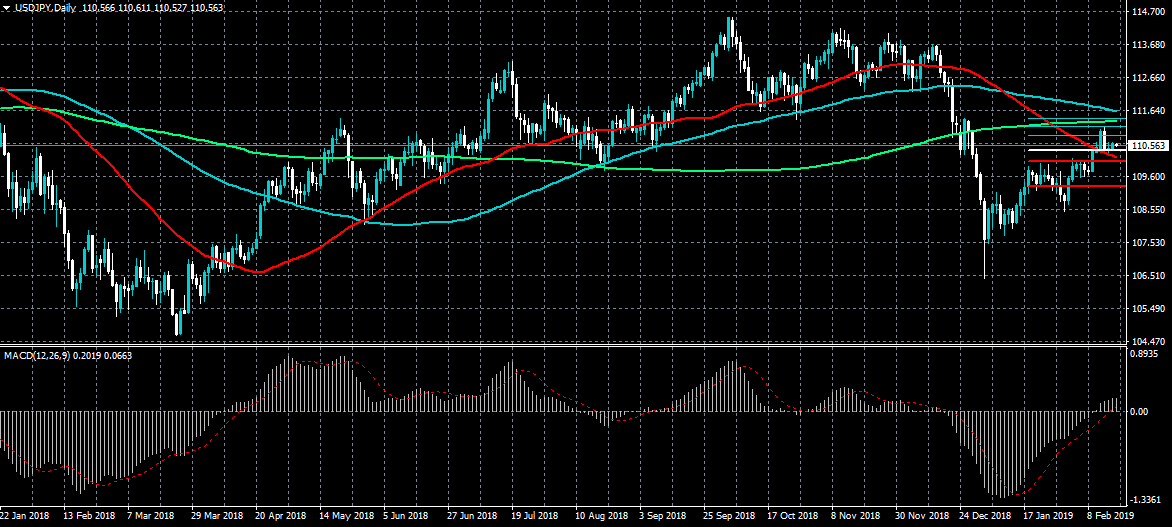
USDJPY Remains Range Bound
The US dollar continues to trade in a narrow range against the Japanese yen currency and is retaining a slight intraday bullish bias while trading above the 110.40 level. A break above the 110.80 level may trigger technical buying in the USDJPY pair towards the 111.40 level. A sustained move below the 110.24 support level should provoke technical selling towards key the 109.80 level.
The USDJPY pair is only bullish while trading above the 110.80 level, key technical resistance is found at the 111.10 and 111.40 levels.
If the USDJPY pair trades below the 110.24 level, sellers may test towards the 110.00 and 109.80 support levels.
Crypto Rally Continues After JP Morgan Move
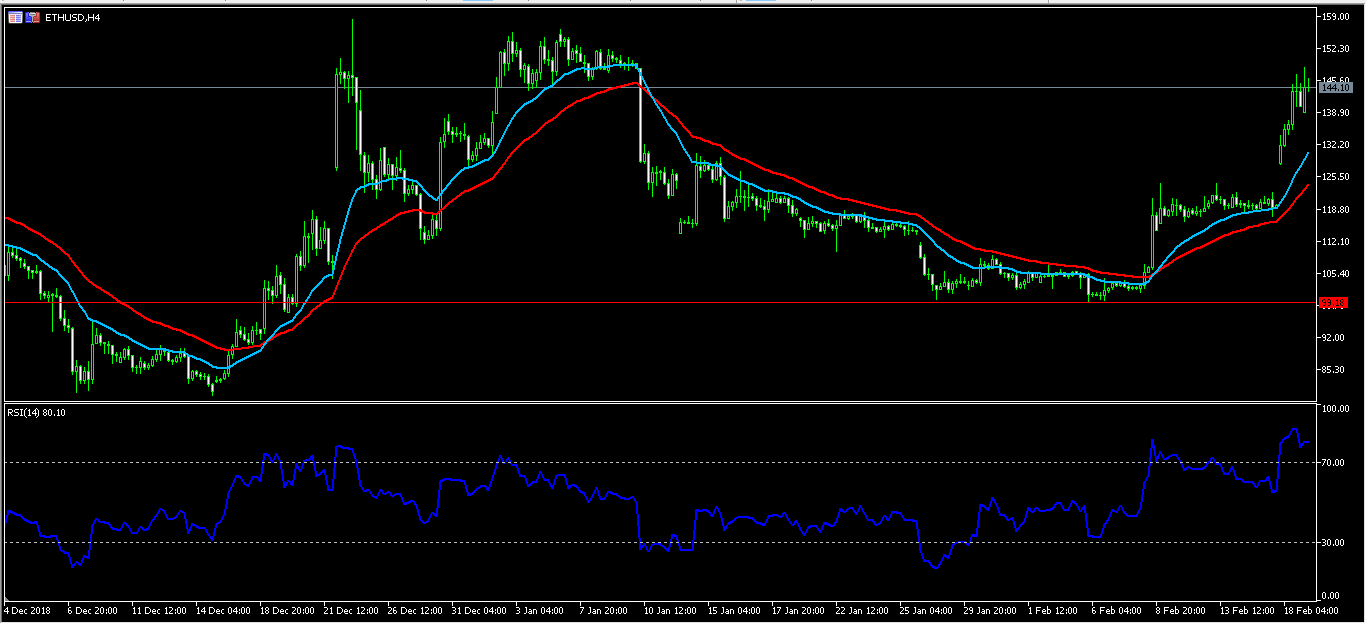
The price of cryptocurrencies continued to rise following JP Morgan’s announcement that it would launch its own cryptocurrency. Over the past few days, the market value of all cryptocurrencies has risen by more than $10 billion. As of this writing, the price of Bitcoin and Ethereum are at $3860 and $145. These levels are close to the YTD highs.
JP Morgan’s currency will not be like Bitcoin or the currencies in existence today. Instead, it will be a stablecoin, that will be backed by the US dollar. It will be used mostly by large corporations, who transfer significant sums of money internationally. It is not clear how the currency will be mined.
In all this, the optimism is that stablecoins are now becoming mainstream. In December, it was announced that Facebook was considering launching a stablecoin that will be mostly used for money transfers. Facebook’s entry would be a major event for the blockchain world because of its size as the world’s biggest social media company.
What’s more, there is also a likelihood that other large companies will enter the industry. Last year, high-profile asset manager, BlackRock, announced that it was exploring the crypto sector. BlackRock has assets worth more than $6 trillion. Additionally, Fidelity, one of the biggest brokers in the US has announced plans to launch custodial services for the cryptocurrencies industry.
The ETH/USD pair is trading at 144.33. This is slightly lower than the previous high of 148.28. The price is higher than the 21-day and 42-day moving averages. The RSI has moved deeply into the overbought level of 80. In the short term, the price could continue moving up. However, it could also decline as investors realize that the new stablecoins have nothing much to do with ETH.
EURO Falls As Investors Focus On US-EU Trade Relations
The euro declined slightly against the USD as investors waited for Donald Trump’s reaction to a report submitted by the Commerce Department. The report was commissioned to evaluate whether European autos pose a national security threat to the United States. For years, Trump has cautioned against the Europeans, saying that they take advantage of the US. Imposing tariffs on European cars would lead to swift retaliation, which would have major implications in trans-Atlantic relations and trade.
These tariffs would reduce total German car exports by 7.7 per cent, or by €18.4bn,” said Gabriel Felbermayr, head of ifo’s Centre for Foreign Trade, adding that value creation in the German car industry would fall by €7bn, or about 5 per cent. About 60 per cent of the total damage inflicted on the European car industry by such tariffs would be felt by Germany.
Trade negotiations between the United States and China will continue this week in Washington. China’s vice premier will travel to the country again to meet with Steve Mnuchin and Robert Lighthizer. This comes a week after the US team travelled to Beijing where they continued with the negotiations. While the finer details of the meetings are not yet known, investors are optimistic that they will lead to a deal before the March 1 deadline.
The Australian dollar declined today after the RBA released minutes from a past meeting during which officials sounded caution on the slowing Australian economy. They also discussed the slowing rate of inflation, which has been caused by increasing competition in the retail sector. Concern was also expressed about the real estate sector, which has seen the value of houses drop sharply. A statement said:
Given that further progress in reducing unemployment and lifting inflation was a reasonable expectation, members agreed that there was not a strong case for a near-term adjustment in monetary policy. Rather, they assessed that it would be appropriate to hold the cash rate steady and for the Bank to be a source of stability and confidence while further progress unfolds. Members judged that holding the stance of monetary policy unchanged at this meeting would be consistent with sustainable growth in the economy and achieving the inflation target over time.
EUR/USD
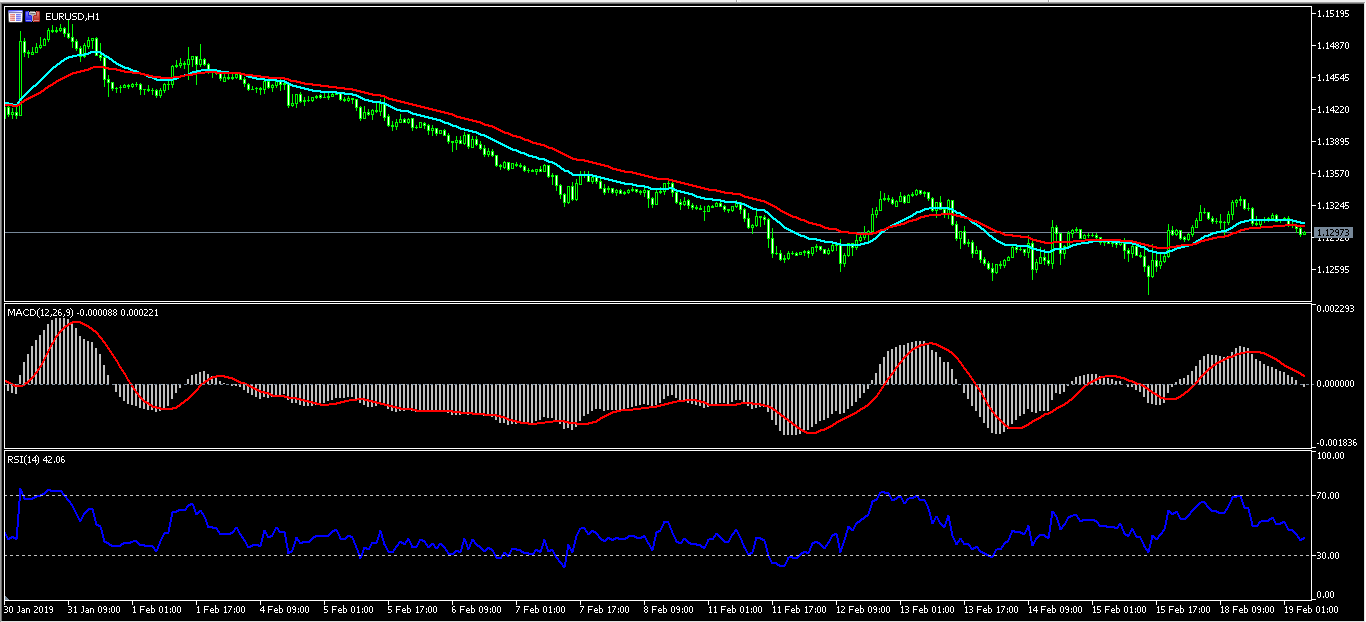
The EUR/USD pair declined to an intraday low of 1.1295 as traders started to worry about trans-Atlantic trade. This price is below the 21-day and 42-day EMAs. The signal line of the MACD has turned lower while the RSI has declined to the current level of 40. The pair will likely continue to decline today and test the important support of 1.1233.
AUD/USD
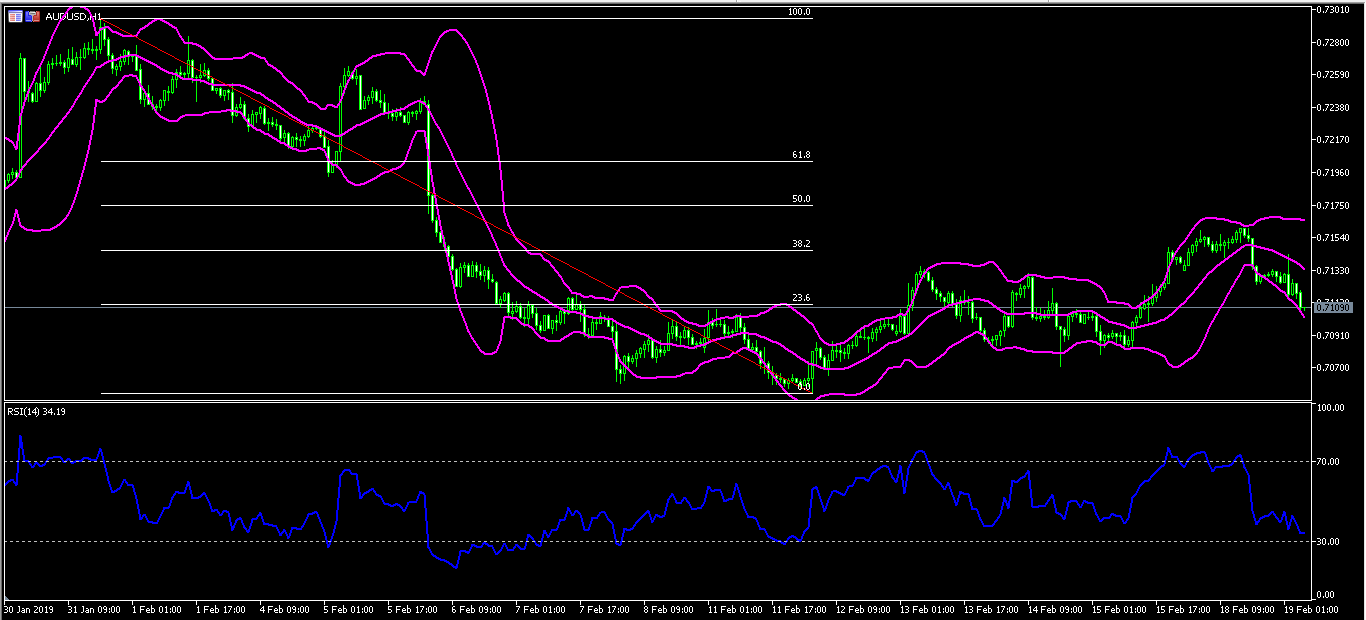
The AUD/USD pair declined sharply to an intraday low of 0.7100. This was the lowest level since Friday and is along the 21.6% Fibonacci Retracement level. It is also along the lower band of the Bollinger Bands while the RSI has dropped to 33. With the RBA minutes a bit dovish, there is a likelihood that the pair will continue moving downwards today.
XAU/USD
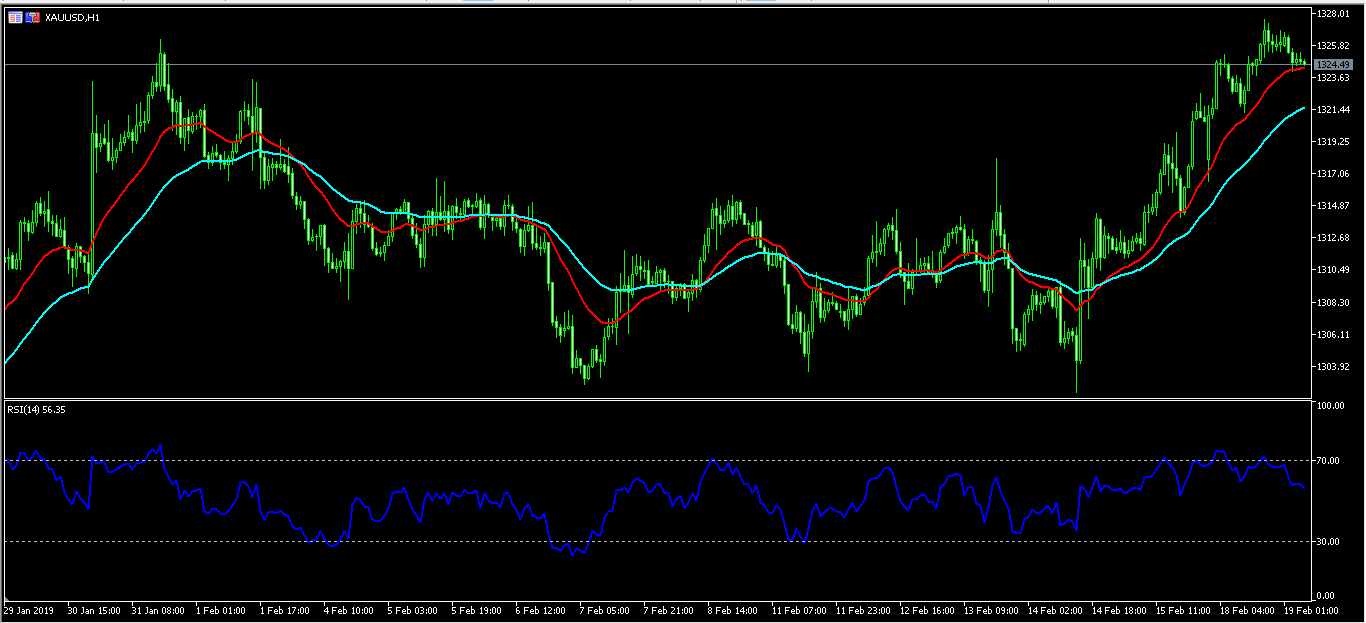
The XAU/USD pair declined to a low of 1325. This price was along the 20-day EMA and higher than the 42-day EMA. The spread between the two moving averages has continued to get wide. The RSI has moved lower from 70 to below 55. The pair could resume the upward trend and test the previous high of 1325.