

Sample Category Title
Aussie Drops As Investors Wait For Government Report On Banks
The USD was little moved in the Asian session. This comes after the Labor department released jobs numbers that were better than expected. In January, the economy created more jobs than had earlier been expected. For a second month in a row, the numbers came above the 300K mark. The unemployment rate climbed a little to 4.0% while the average hourly earnings and the average number of weekly hours remained unchanged.
The Australian dollar moved down against the USD as investors wait for a major government report on banks. The report was recommended by the government and headed by a former senior judge to examine the ills of the financial sector. This report will focus on the big banks, large pension funds, insurers, and regulators in the sector. The recommendations could lead to shocks in the financial sector, which is dominated by a few powerful companies. Over the past 11 months of the inquiry, these companies have shed more than $43 billion in market value.
The price of crude oil remained at Friday's highs. The jump on Friday came as the United States toughened the sanctions already in place on Venezuela. In recent weeks, the country has been in turmoil after the head of parliament declared himself President and got the support of the international community. The small Latin country matters because it has the biggest oil reserves in the world. Just last week, the country's leaders tried to sell more than 20 tons of gold, a move that was rejected by the United States.
EUR/USD
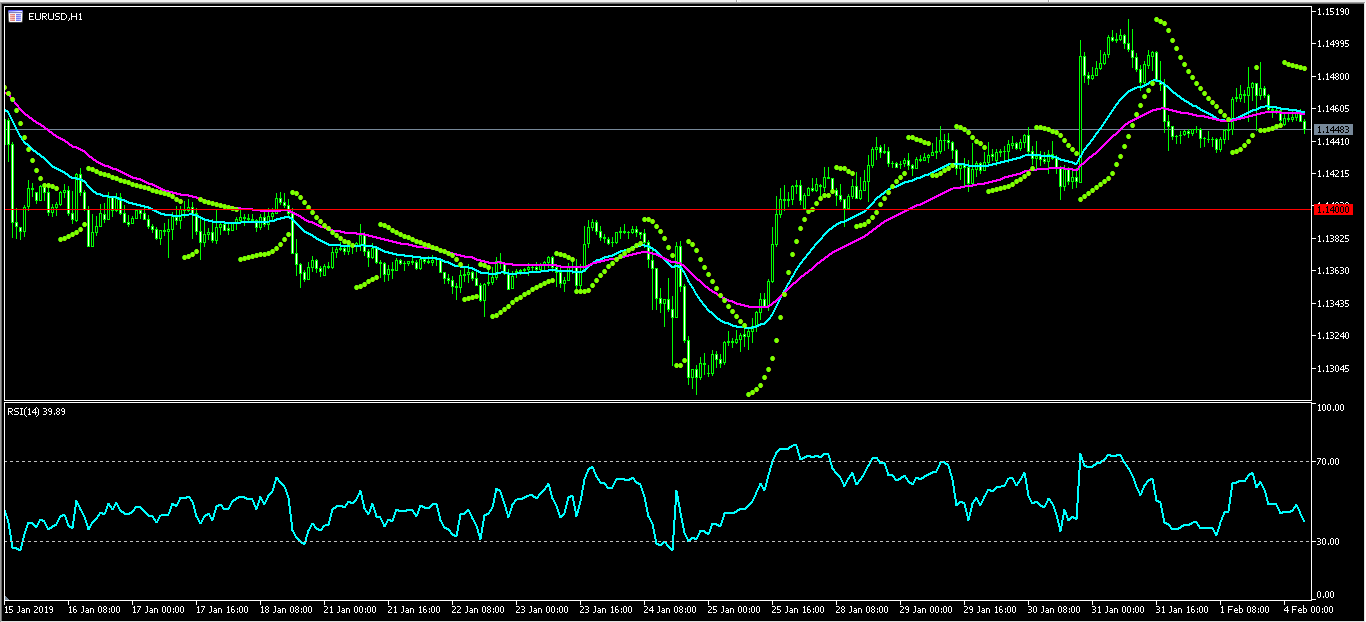
The EUR/USD pair was little unchanged in the Asian session. The pair is trading at 1.1448, which is still lower than last week's high of 1.1515. This price is along the short and medium-term EMAs while the RSI is headed lower. The Parabolic SAR shows that the pair could continue the downward momentum. There is a likelihood that the pair will move lower, potentially to the 1.1400 level as traders focus on the EU weakness.
AUD/CAD
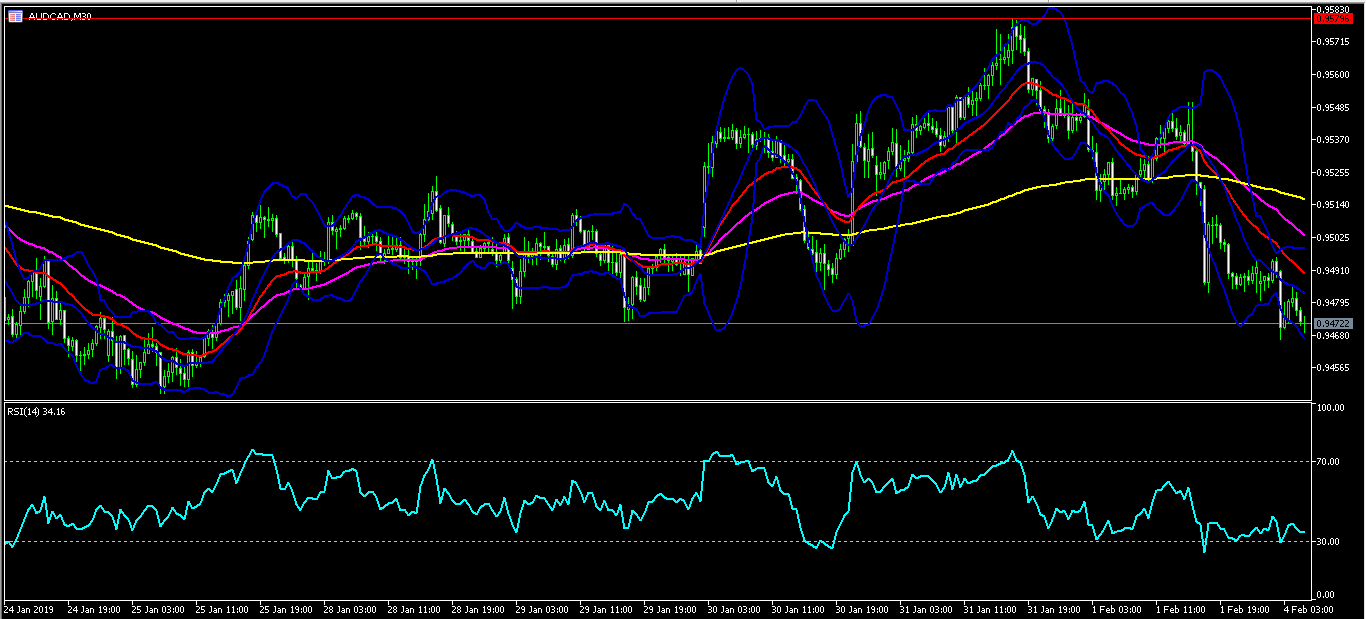
The AUD/CAD continued the downward trend started on Thursday when the pair reached a high of 0.9580. Today, it reached a low of 0.9468, which is a bit higher from Friday's low of 0.9467. The pair's price is below all the major moving averages as shown below. The RSI too has continued to remain close to the overbought level of 30. The pair is along the lower line of the Bollinger Band. There is a likelihood that the pair will continue the downward trend.
GBP/USD
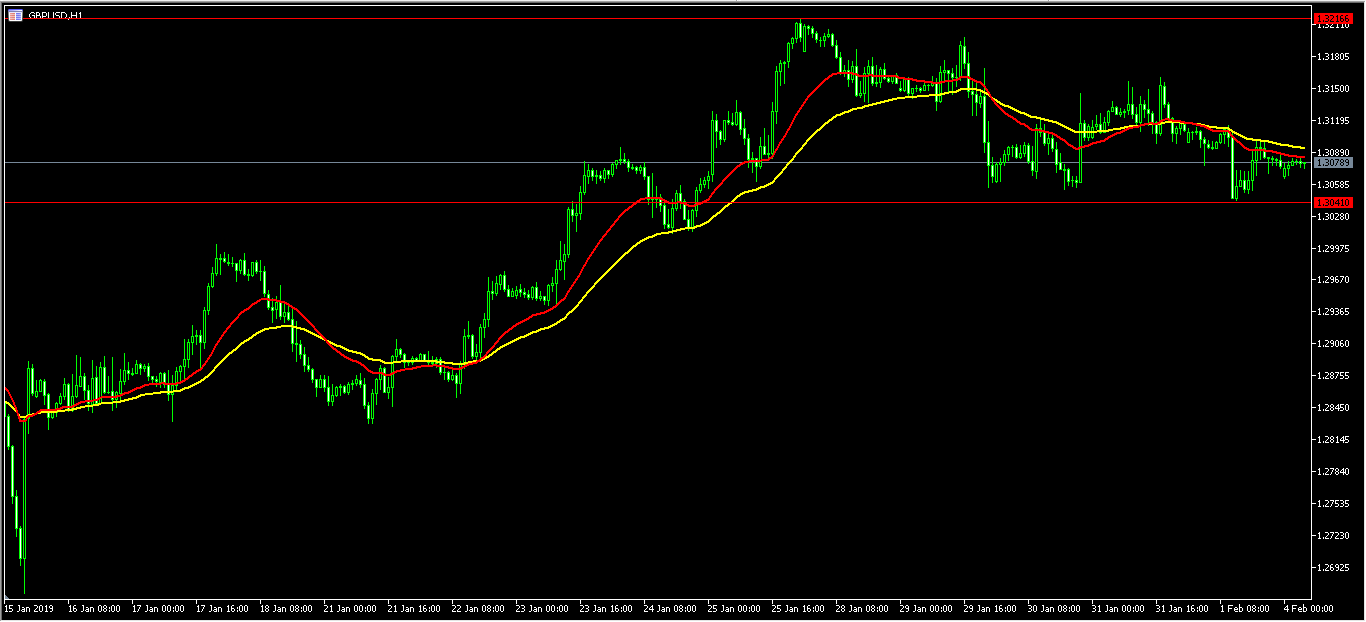
The GBP/USD pair was relatively unmoved today as investors wait for a number of key meetings between Theresa May and the European Union leaders. The pair remained along the 1.3080 level, which is also where the short and long-term moving averages are. The main technical indicators show that the pair could move in either direction today.
GBP/USD And USD/CAD: Risk Of More Losses
GBP/USD struggled to stay above 1.3150 and declined recently. USD/CAD is under a lot of pressure below the 1.3120 and 1.3150 resistance levels.
Important Takeaways for GBP/USD and USD/CAD
- The British Pound declined recently and tested the 1.3040-1.3050 support area.
- There are two bearish trend lines formed with resistance at 1.3115 and 1.3155 on the hourly chart of GBP/USD.
- USD/CAD declined heavily after it broke the 1.3200 support area.
- There is a key bearish trend line in place with resistance at 1.3185 on the hourly chart.
GBP/USD Technical Analysis
The British Pound struggled a lot to stay above the 1.3180 and 1.3200 resistance levels against the US Dollar. The GBP/USD pair declined recently and broke the 1.3150 and 1.3120 support levels.
The decline was strong as there was a break below the 1.3100 support and the 50 hourly simple moving average. A low was formed at 1.3043 on FXOpen and later the pair started an upside correction.
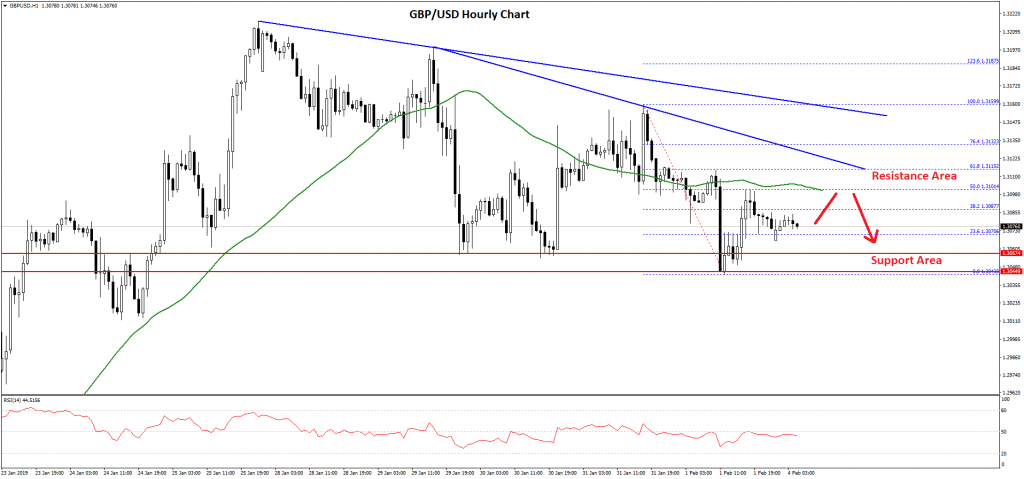
It moved above the 1.3060 level and the 23.6% Fib retracement level of the last decline from the 1.3159 high to 1.3043 low. However, there are many hurdles formed on the upside near the 1.3100 and 1.3120 levels.
The pair recently failed to clear the 50% Fib retracement level of the last decline from the 1.3159 high to 1.3043 low. Moreover, there are two bearish trend lines formed with resistance at 1.3115 and 1.3155 on the hourly chart of GBP/USD.
Finally, the 50 hourly simple moving average is placed near the 1.3100 resistance level. Therefore, as long as the pair is below the 1.3100 and 1.3155 resistance levels, there is a risk of more losses in the near term.
On the downside, an initial support is near the 1.3050 level, below which there is a risk of a fresh drop below the 1.3040 and 1.3020 support levels.
USD/CAD Technical Analysis
The US Dollar remained in a strong downtrend from well above the 1.3350 resistance level against the Canadian Dollar. The USD/CAD pair broke the 1.3250 and 1.3180 support levels to enter a bearish zone.
Sellers remained in action and pushed the pair below the 1.3100 level and the 50 hourly simple moving average. The pair traded towards the 1.3050 support level and a low was formed at 1.3068 before an upside correction.
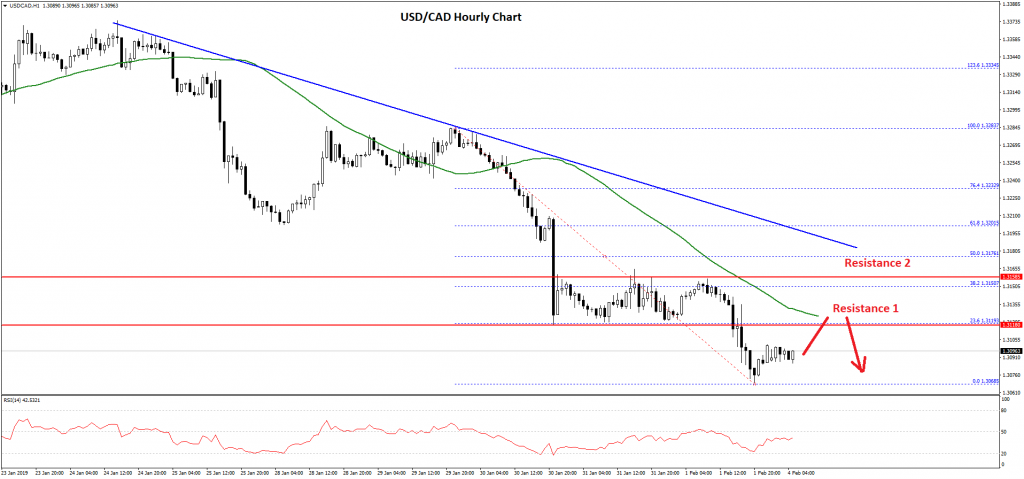
An initial resistance is at 1.3100, followed by the 23.6% Fib retracement level of the recent decline from the 1.3293 high to 1.3068 low. The 50 hourly simple moving average is also positioned near the 1.3120 to act as a solid hurdle.
The next resistance is the 50% Fib retracement level of the recent decline from the 1.3293 high to 1.3068 low at 1.3176. There is also a key bearish trend line in place with resistance at 1.3185 on the hourly chart of USD/CAD.
Therefore, there are many resistances on the upside, but the main resistance is near 1.3185-1.3200, above which the pair is likely to start a solid upward move.
On the other hand, once the current correction is complete, the USD/CAD pair is likely to resume its decline below 1.3080. A break below the 1.3050 support may clear the path for a test of 1.3000.
Forex Forecast And Cryptocurrencies Forecast
First, a review of last week's events:
EUR/USD. In general, the week has not brought any surprises. No one had expected a rate increase at this FOMC meeting, but investors had been worried about the comments of the Fed management on plans for 2019. And here their forebodings about the “pigeon” comments were fully justified. Instead of specific promises, the regulator spoke about the fact that the decision to further rate increase should take into account global economic factors and be extremely balanced. Thus, the uncertainty caused a sharp sell-off of the dollar, as a result of which the pair soared to the upper border of the medium-term lateral channel 1.1300-1.1500. However, then the situation calmed down, and the pair turned to the south.
Another expected event was the publication of the US labor market data on Friday, February 01. The statistics really turned out to be extremely positive. Thus, NFP grew by 37% compared with the previous month (from 222K to 304K), and the ISM business activity index rose from 54.3 to 56.6. But this did not come as a surprise either thanks to Trump's economic adviser Larry Kudlow, who, as we wrote in the previous review, “leaked” this information long before the official publication. As a result, the market reaction was limited to insignificant fluctuations within 40 points, after which the pair completed the week at the level of 1.1455;
GBP/USD. The next meeting of the UK Parliament on Brexit has not added any clarity to the process of divorce from the European Union. As a result, the pound lost about 160 points in the first half of the week, and then moved into a sideways trend, making fluctuations in the range of 1.3050-1.3150, and finished the week at the level of 1.3075;
USD/JPY. Like the rest of the dollar pairs, the USD/JPY responded to the Fed's comment with the US currency dropping to 108.50. However, then, taking advantage of the positive dynamics in the US labor market, the dollar won back the losses, and the pair returned by the end of the week to where it had begun, to 109.50;
Cryptocurrencies. It was noted In the previous forecast that the major coins are in a side trend, constantly experiencing pressure from bears. 70% of experts had supported the scenario according to which Bitcoin was supposed to yield to such pressure and gradually decrease to 2018 lows. The past week confirmed the validity of such expectations. On Tuesday, February 29, the benchmark cryptocurrency fixed a local minimum at $3,425, after which the rebound followed, and the pair saw February in the $3,500 zone. As for the capitalization of the crypto market as a whole, it “dried out” by 5.5% over the week, dropping to $113.6 billion.
As for the forecast for the coming week, summarizing the opinions of a number of analysts, as well as forecasts made on the basis of a variety of methods of technical and graphical analysis, we can say the following:
EUR/USD. There appears a hope for a trade deal with China, siding with the dollar. On January 31, another round of negotiations on this topic ended in Washington. And as analysts say, progress in the negotiation process cost both sides a lot of effort. The American negotiators showed an obvious desire to succeed, because President Trump is now in dire need of something positive. However, the industrial espionage accusations made by the Americans against Huawei Technologies Co. somewhat overshadowed the optimistic picture drawn by the parties. The next round of talks is to be held in Beijing in mid-February.
The counterbalance to the successful negotiations, as already mentioned above, was made by the US Federal Reserve, who doubted the need for another increase in the interest rate. And if in the medium term, 60% of analysts are still waiting for the dollar to strengthen, this week the majority (70%) sided with the euro. In their opinion, which is supported by approximately 80% of the oscillators and trend indicators on D1, the EUR/USD will once again try to break through the upper limit of the medium-term side channel 1.1300-1.1500 and gain a foothold in the area of 1.1500-1.1570. The next target is the height of 1.1625.
The alternative scenario has been supported by 30% of experts, graphical analysis on H4 and about 20% of oscillators, giving signals that the pair is overbought. In this case, the pair, having failed to break through the key level of 1.1500, will be located in the side corridor 1.1400-1.1500 for some time. And if there is positive news for the dollar, it will make an attempt to reach support on the horizon of 1.1300;
GBP/USD. Thursday, February 7 will see a decision of the Bank of England on the interest rate, which is likely to remain unchanged, at the level of 0.75%. Investors are Much more concerned about the situation with Brexit, but there is no clarity here. Moreover, the likelihood of a British exit from the EU without a deal has begun to grow again. That is why 65% of analysts predict a decline of the pair first to the level of 1.2930, and then another 100 points lower.
As for the indicators, about 40% of them are colored red on H4, 40% are green and 20% are neutral gray. Although, on D1 the green color dominates: 60% versus 30% red and 10% gray. The nearest resistance is 1.3215, then 1.3250 and 1.3300;
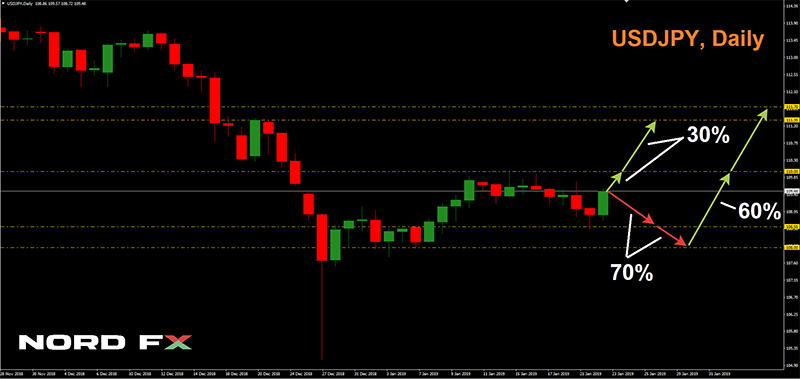
USD/JPY. Certain surprises can be expected from this pair in the near future, and the reason is oriental New Year. Traditionally this time is not only for summarizing financial results, but also for active actions by the Bank of Japan, which for several years in a row begins to buy and sell large amounts of currency at this moment. Such interventions can cause a jump of several hundred points, and at the moment most analysts (70%), supported by graphical analysis on D1, expect the pair to first fall to 108.00-108.55, and then return to the horizon 110.00. At the same time, about 60% of experts believe that the pair will not stop at what has been achieved and can reach resistance at the level of 111.70 within a month;
Cryptocurrencies. Experts and investors can now be divided into two groups. The first group believes that the current lull is the lull before the storm. The second one thinks is that it is a lull before ... even more calm. Andy Bromberg, the head of CoinList crypto exchange, has sided with the latter. , having said in his interview to Yahoo Finance that the situation in the market will be calm as all the necessary instruments have been created already and the companies will focus not on speculations but on innovations and product development.
This scenario is also supported by the report of Circle Research, according to which, despite the fact that direct investment in digital currencies decreased 8.5 times over the year, investments in blockchain companies, on the contrary, increased 3 times and exceeded $5 billion.
As for the forecast for the next few weeks, 70% of experts still believe that Bitcoin should decline to the 2018 lows in the zone of $3,200-3,250, and then rush to support at $ 2,400. The remaining 30% of analysts do not exclude a short-term growth of the BTC/USD pair to $3,700-3,850, and possibly even higher, to the height of 4.215.
Into European session: Dollar paring recent losses, Aussie tumbles on housing data
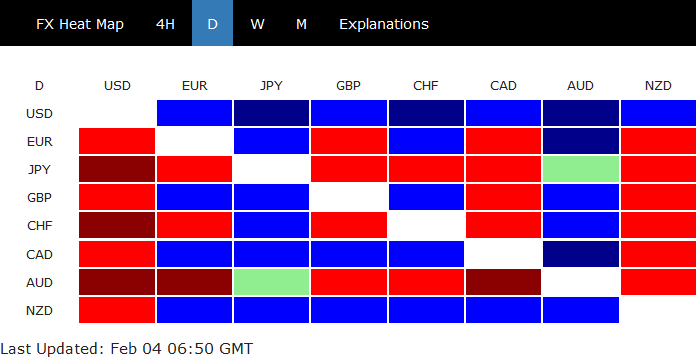
Entering into European session, Dollar is trading broadly higher, recovery some of last week's losses. Minneapolis Fed President Neel Kashkari urged not to tap the break prematurely with more rate hikes. But that prompted little reactions as Fed's "patient" stance is now commonly known. New Zealand Dollar is the second strongest, followed by Canadian.
On the other hand, Yen and Australian Dollar are the weakest, followed by Swiss Franc. The stock markets are rather quite today as lunar new year is approaching. Indeed, China is already on holiday. Slight rally in stocks is pressing Yen and Swiss Franc. Aussie, on the other hand, is weighed down by poor housing data, which daw dwelling approvals contracted sharply in December.
In other markets:
- Nikkei closed up 0.46%.
- Hong Kong HSI is up 0.21%.
- Singapore Strait Times is down -0.13%.
- Japan 10-year JGB yield is up 0.0096 at -0.0011, staying negative.
Australian Dwelling Approvals Down Sharply
Dec –8.4%mth, –22.5%yr (vs mkt +2.0%). Residential investment set to be a clear drag on growth in 2019
Housing weakness in late 2019 was clearly not confined to just turnover and prices with new dwelling approvals sliding sharply into year end – down 26% between Sep and Dec, the last month marking the lowest level for monthly approvals since June 2013. For Q4 as a whole, approvals were down 10.9%qtr and 23.7%yr.
Approvals are now signalling an unambiguous further weakening that will clearly see declining new dwelling investment detract from Australia’s growth in 2019. Westpac expects new dwelling investment to decline 8% in the year with a further 5% contraction in 2020.
The composition of the approvals decline points to downside risks to this outlook. Units continue to drive the cycle with a further 18.8% drop in Dec to be down 38%yr. Within this segment, ‘high rise’ approvals look to be down a further 16% in the month and by over a third in Q4 as a whole. That is outpacing our assumed path of a cumulative 40% decline by the end of 2019, suggesting weakness may be more pronounced and/or 'front loaded'.
More importantly, there continues to be significant weakness in other segments as well – medium density approvals down over 10% in the month and private detached house approvals down –2.2%mth, –11.3%yr. The shorter ‘lags’ on non high rise work means these declines will likely impact activity through the first three quarters of 2019.
The state breakdown shows weakness spread across the major eastern states: NSW –8.1%mth, –21%yr; and Vic –8.1%mth, –23%yr; and Qld –5.8%mth, –29.7%yr. WA posted a slight gain but is also down 30%yr.
The total value of renovation approvals rose 3.1% to be about flat on a year ago but with a modest uptrend in place. While the rise is mild, it is coming across all the major states.
The total value of non res building approvals fell 9.8% to be down about 15%yr. Latest monthly reads have been choppy around a flat trend, albeit with better gains for NSW and Vic and, by sector, for education-related building in the public sector.
Overall the December approvals update clearly challenges the RBA's view from the November Statement on Monetary Policy that "... dwelling investment is expected to decline gradually" and suggests that, as well as incorporating the weaker starting point from the Q3 national accounts, its revised forecasts to be released in Friday's February Statement on Monetary Policy will also need to materially lower the near term outlook for dwelling investment. Even if the Reserve Bank maintains its view that the negative 'wealth effect' spillovers from falling house prices will be limited, there is a clear ‘real economy’ negative coming through via new dwelling investment.
BOE Preview – Downgrade on Economic Outlook as Brexit Remains Uncertain
Again, we expect BOE to vote unanimously to keep the Bank rate unchanged at 0.75%, as well as to leave the asset purchase program at 435B pound, at the February meeting. While the focus of the meeting remains on Brexit uncertainty, economic assessment and forward guidance, the dynamics of the political and economic situation signals that the members would turn more dovish. We do not expect a more cautious BOE to send GBP much lower, as the market has already moved backward the expectations on the next rate hike. Viewing the MPC as torn between Brexit uncertainty and resilient labor market, the market has priced in only 50% chance for a rate hike by end -2019 and not fully priced in a rate hike until end 2020.
Brexit Uncertainty
After rejecting PM Theresa May’s original proposal on the Withdrawal Agreement on January 15, the parliament voted on several amendments of the deal last week. The Brady amendment, calling for replacing the Irish backstop solution by “alternative arrangement”, was passed by a vote of 317 to 301. Meanwhile, Spelman’s non-binding amendment to reject the UK leaving the EU without a deal was also passed. On the other hand, the Cooper amendment, proposing to extend the official Brexit deadline to December 31, in order to rule out a no-deal Brexit, was defeated. As May heads to Brussels to negotiate changes with the EU, the latter has indicated that no further change would be granted.
The uncertainty of the Brexit outlook remains and the possibility of a no-deal Brexit is not eliminated. In our previous report, we have lain down a number of possible outcomes, including extension of Article 50, second referendum, early election and no- deal Brexit. It remains uncertain to the BOE, as well as the parliament, which scenario stands out. At the February meeting, the BOE should warn of the uncertainty and the possibility of an extension of Article 50. If the official Brexit date is postponed, the BOE should delay its rate hike accordingly, given all it assumptions on the economic outlook and monetary policy are based on smooth Brexit.
Economic Developments
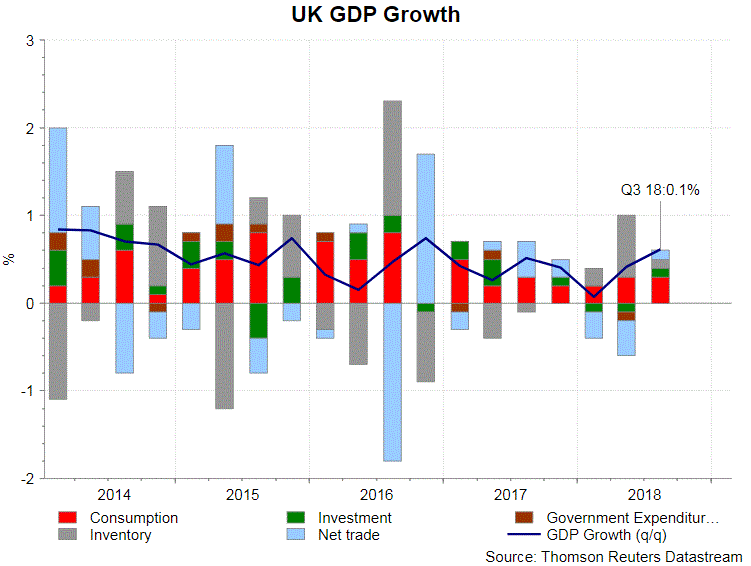
We expect the members to revise lower the GDP growth and inflation forecasts. The job market has been robust, with the unemployment rate falling to a 40- year low of 4% in the three months to November. Meanwhile, the employment rate, which is the ratio of working age population with a job, climbed to 75.8%, from 75.3% the same period last year. Average weekly earnings jumped +3.4% y/y in November, the biggest rise since July 2008, has surpassed inflation. However, the sentiment indicators have been bleak of late. Manufacturing PMI fell to a 3-month low of 52.8 in January. This also marks the second weakest reading since July 2016. Gfk’s consumer confidence index stayed in the negative territory, at -14, in January. As noted in the accompanying statement, “consumers, companies and corporations thrive on certainty, which is in short supply just two months before the planned date for the UK's EU exit”. Whether the higher wage growth would be converted to bigger household spending or saving is critical to the economic growth outlook.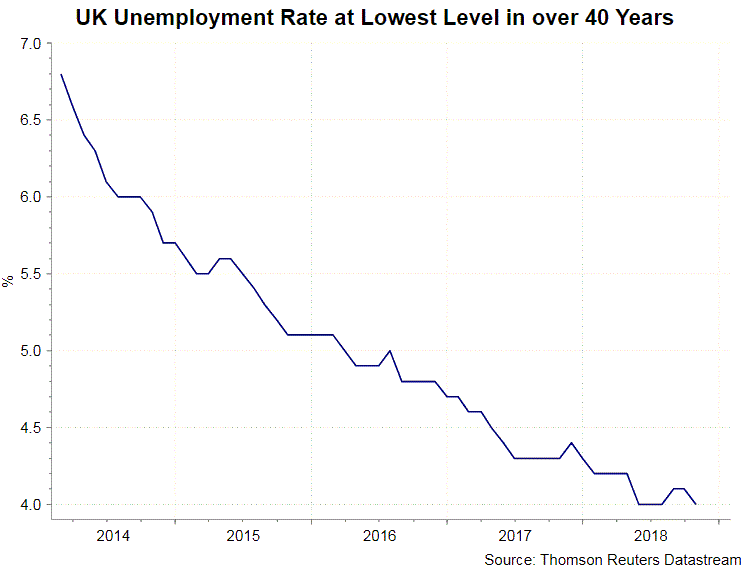
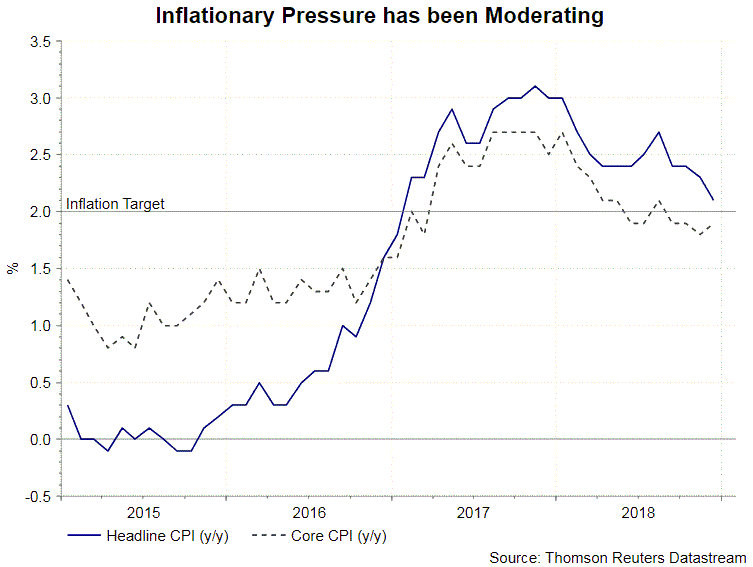
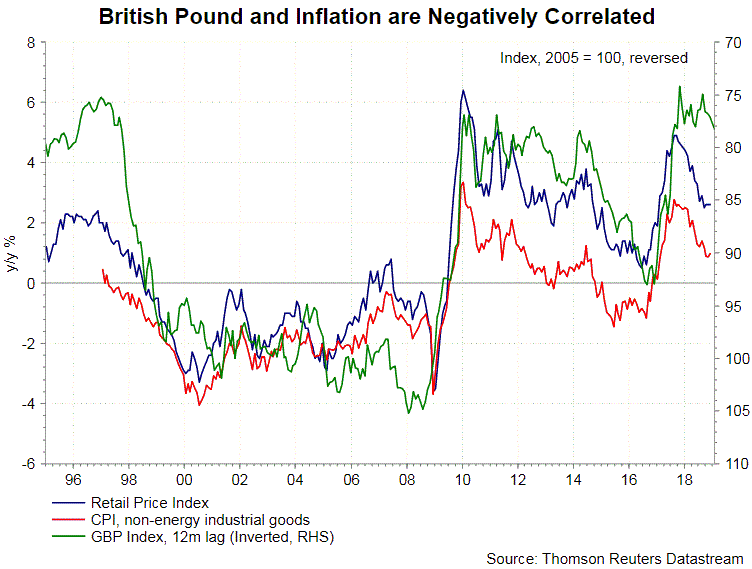
UK’s inflation has moderated significantly after peaking at +3.1% in November 2017. With inflation at 2-year low of +2.1% y/y in December, the price pressure should not be a concern for the central bank. Indeed, given the decline in oil prices, we expect the members to revise lower their inflation forecasts. The rebound in GBP should also have relieved inflationary pressure in the UK, a country highly dependent on imports.
 Forward Guidance
BOE can still retain its forward guidance, suggesting that, under the scenario of a smooth Brexit, an “ongoing tightening of monetary policy over the forecast period, at a gradual pace and to a limited extent, would be appropriate”. It should also reaffirm that “the monetary policy response to Brexit, whatever form it takes, will not be automatic and could be in either direction”.
China Caixin PMI dropped to 50.9, hard to turn around without strong stimulus
China Caixin PMI services dropped to 53.6 in January, down from 53.9 but beat expectation of 53.3. PMI composite dropped to 50.9, down from 52.2. Caixin noted that "services activity continues to rise solidly, but manufacturing sector remains subdued", "new orders rise only slightly, despite rebound in export sales", "overall employment stabilises".
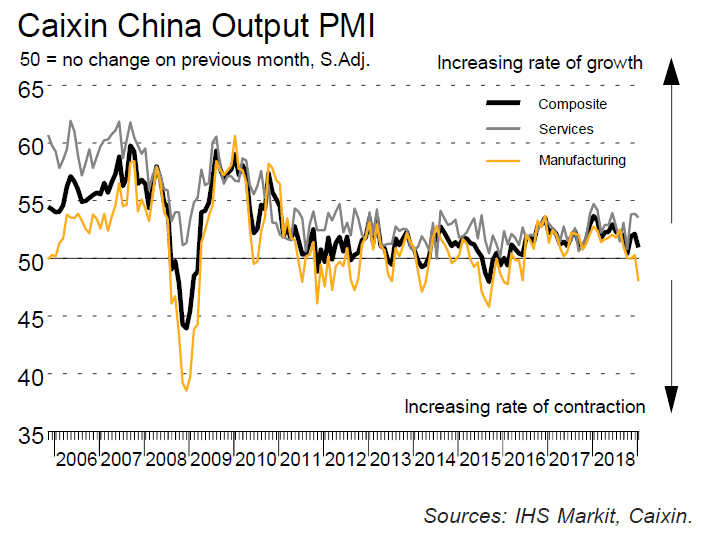
Commenting on the China General Services PMI™ data, Dr. Zhengsheng Zhong, Director of Macroeconomic Analysis at CEBM Group said:
"The Caixin China General Services Business Activity Index came in at 53.6 in January, down slightly from the previous month. Demand for services remained solid as the increase in new business accelerated marginally. The sub-index of employment rose, pointing to a faster expansion of payroll number at service providers. The fall in the input prices sub-index was quicker than the decline seen for the prices charged sub-index, which helped ease the pressure on companies' profit margins. However, the sub-index of business expectations declined from the previous month, indicating services providers' weakening confidence in the outlook of their operation for the coming 12 months.
"The Caixin China Composite Output Index fell from the previous month to 50.9 in January. The increase in new orders softened while new export business rose for the first time after dropping for nine consecutive months. That suggested the downward pressure on domestic demand was growing while external demand was holding up. The sub-index of employment rebounded to the break-even point of 50 after staying in contraction territory for seven straight months, underlining that government efforts to stabilize employment have taken effect. The sub-indices of input prices and output prices both went down, while the sub-index of future output, which reflects business confidence, edged up for the second month in a row.
"Overall, China's economic growth was weighed on by weakening domestic demand in January, although exports improved marginally as the Sino-U.S. trade negotiations flagged signs of progress. The effects of China's policies to support domestic demand and the development of the trade war between the country and the U.S. will remain key to the prospects of the Chinese economy. Given that the government has refrained from taking policies of strong stimulus, the downward trend of the economy may be hard to turn around for the time being."
UK PM May, armed with fresh mandate, to go back to EU with pragmatic Brexit solution
UK Prime Minister Theresa May said she is seeking a "pragmatic solution" for the Brexit withdrawal agreement. She wrote in The Sunday Telegraph that " with changes to the Northern Ireland backstop, they would support the deal that I agreed with Brussels to take us out of the EU". And, "when I return to Brussels I will be battling for Britain and Northern Ireland, I will be armed with a fresh mandate, new ideas and a renewed determination to agree a pragmatic solution that delivers the Brexit the British people voted for."
May's office also said that the government is establishing an "Alternative Arrangements Working Group" to work on alternative arrangement to the Irish border backstop arrangement. Brexit Minister Stephen Barclay will lead the group involving pro-Brexit lawmakers Steve Baker, Marcus Fysh and Owen Paterson, as well as pro-EU Conservatives Damian Green and Nicky Morgan. The first meeting will start today.
Trade Minister Liam Fox said EU would be irresponsible if they insist on refusing to reopen negotiation. He told Sky News that "are they really saying that they would rather not negotiate and end up in a 'no-deal' position?" And, "it is in all our interests to get to that agreement and for the EU to say we are not going to even discuss it seems to me to be quite irresponsible."
Fed Kashkari: Let’s not tap the brakes prematurely
Minneapolis Fed President Neel Kashkari said the US economy is "fundamentally healthy". While "we at the Fed cannot control if Europe has a crisis, or if China has a hard landing", "we can control our own mistakes". He added that " if we can avoid tapping the brakes prematurely, I think the expansion can continue."
Kashkari also noted that"let's let the economy continue to strengthen and if we see signs then, wages pick up, inflation picks up, we can always tap the brakes then; let's just not tap the brakes prematurely."
Market Morning Briefing: Pound Has Immediate Support At 1.3050
STOCKS
Global indices extended their upmove on Friday. However, most of the indices are hovering near their key resistances. This week is going to be crucial to see whether they manage to breach those hurdles or not.
Dow Jones (25,063.89, +64.22, 0.26%) has come-off after making a high of 25,193 on Friday. The daily candle on Friday indicates that the Dow seems to be lack strong follow through buying at higher levels. Inability to sustain above 25,000 in the coming sessions can drag the index lower to 24,300 in the coming days.
DAX (11,180.66, +7.56, 0.07%) looks mixed in the near term with an equal chances for a dip to 11,000 or a rally to 11,400.
Nikkei (20,897.85, +109.46, +0.53%) has come close to its crucial resistance level of 21,000, which if holds can pull the index lower to 20,500 and 20,450. But a strong break above 21,000 could increase the bullish momentum going forward. We will have to wait and see.
Shanghai (2,618.23, +33.66, +1.30%) extended its rally on Friday and is heading towards the next resistance level of 2,650 as expected. The Chinese markets are closed for this whole week on account of the New Year holidays.
The Indian benchmark indices has come-off after cheering the Interim Budget. The resistances at 36,860 on the Sensex (36,469.43 +212.74 +0.59%) and 10,985 on the Nifty 50 (10,893.65, 62.70, 0.58%) were tested on Friday and are holding well as of now. While these resistances hold Sensex can fall to 35,500 and the Nifty 50 can test 10,700-10,600 in the coming days.
COMMODITIES
While gold, silver and copper are likely to see a near-term dip before resuming the overall uptrend, oil is likely to test a key resistance and can remain sideways while this resistance holds.
Gold (1315) has come-off after failing to breach 1320 over the last couple of trading days. While the broader view remains bullish, an interim dip to 1308-1305 is possible before gold heads towards 1350-1360. Similarly, Silver (15.85) can dip to 15.70-15.60 before resuming its uptrend to test its resistance at $16.50-$16.55.
Copper (2.77) can dip to 2.75 and 2.73 before reversing higher towards 2.82-2.83.
WTI (55.37) and Brent (62.90) have surged again breaking above $54 and $62. A test of $56 on WTI and $64 on the Brent is likely in the near term. As mentioned of Friday a sideways movement is possible while Brent remains below $64 and WTI below $56. Brent can trade in the $59-$64 range and WTI in between $50-$54.
FOREX
Major commodities are stable. Some strength in the US Dollar is possible over the next couple of sessions that could keep the other currencies a bit weaker today.
Dollar Index (95.62) and Euro (1.1453) are almost stable. Dollar Index could rise towards 96.10 while Euro could trade within 1.1360-1.1500 region.
Euro-Yen (125.47) has risen and has room on the upside towards 126.00-126.60 from where a dip back towards 124 is possible.
Dollar Yen (109.57) could rise to test immediate resistance near 110.20-110.50. A rejection from there would push back the prices back towards 108.0-107.5 levels.
Pound (1.3077) has immediate support at 1.3050 and while that holds, a rise back to 1.32 could be possible. Failure to sustain above 1.3050 could turn bearish for the medium term towards 1.29 again.
Aussie (0.7241) also has immediate resistance at 0.73 which if holds could push the price to lower levels of 0.72-0.715 in the near term. Watch price action near 0.73 for near term direction.
USD-CNY (6.7425) has risen from 6.6917 and while that holds, the Yuan could weaken towards 6.80 again in the coming sessions.
Dollar Rupee (71.25) could possibly attempt a test of 71.40-60. Note that this is an immediate resistance zone and while that holds, Dollar-Rupee may gradually come off towards 71 again.
INTEREST RATES
The US yields have risen slightly. The 2Yr is up from 2.47% to 2.51%, 5Yr has also risen from 2.48% to 2.51% while the 10yr and the 30Yr are stable at 2.69% and 3.03% respectively. The 5Yr is testing immediate support at current levels while the 10Yr and 30Yr look bearish for the coming sessions.
The Japan yields are trading low and look bearish for the very near term. The 5YR (-0.17%), 10YR (-0.02%) and the 30Yr (0.61%) could fall by 1-2bps over the next couple of session.
The Indian 10YR GOI (7.61%) could rise towards targeting 7.70% on the upside in the next 2-3 sessions. The rise in the yield could bring in some weakness in the Rupee.