

Sample Category Title
Daily Markets Broadcast
US indices snap winning streak
US equity markets were closed yesterday, but index futures retreated following the release of China’s Q4 GDP data. PM May’s Plan B appears to focus on delaying Brexit to get better concessions from the EU.
US30USD Daily Chart
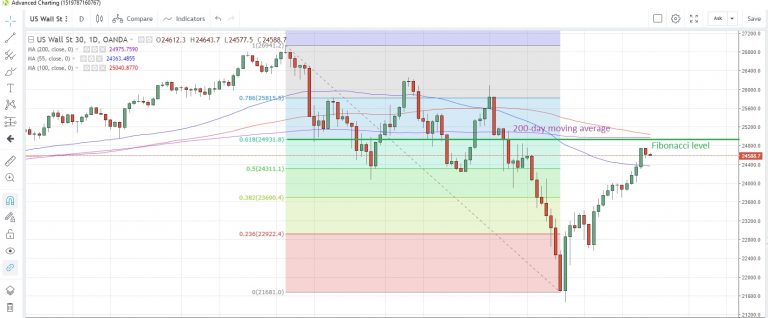
The US30 index declined for the first time in five days yesterday as markets digested the slower China growth and less-positive headlines on trade negotiations
The index is facing a lot of convergent resistance points: 24,932 is the 61.8% Fibonacci retracement of the October-December drop; 24,961 is the 55-week moving average while 24,975 is the 200-day moving average
Wall Street reopens after yesterday’s bank holiday, with December existing home sales on the data slate. They are expected to fall 1.2% m/m, according to the latest survey of economists.
DE30EUR Daily Chart
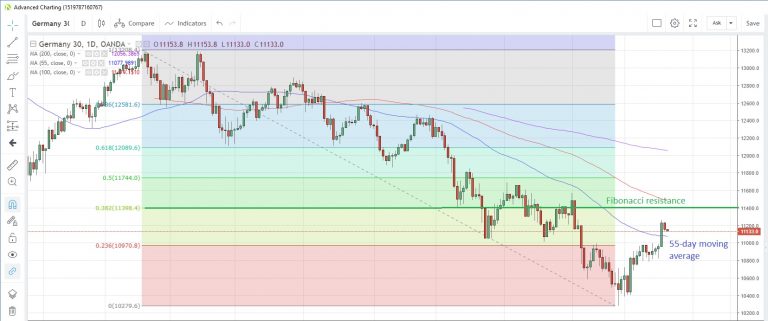
The Germany30 index snapped a four-day winning streak yesterday amid continued uncertainty surrounding the way forward on Brexit
The 55-day moving average at 11,078 could lend some technical support after it was breached on Friday
German ZEW economic sentiment is expected to show further deterioration in January, sliding to -18.4 from -17.5.
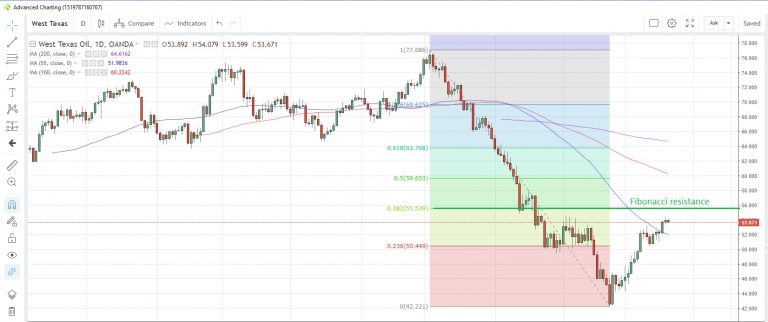
West Texas Intermediate edged higher in thin trading yesterday, touching the highest level in almost seven weeks as investors focused on future supply cuts
Prices are approaching the 38.2% Fibonacci retracement of the October to December drop at $55.539
The API weekly crude oil stocks data as at January 18 are due tomorrow. Lat week saw a drawdown of 560,000 barrels, the third consecutive weekly reduction.
Markets Rebound From China Slowdown On Trade Hopes
FX – Dollar not slowing down despite holiday and ongoing partial shutdown
The US dollar is mixed against major pairs on Monday. The Martin Luther King holiday in the States did not slow down the dollar at the beginning of the week. Chinese data showed the second largest economy is losing momentum with only a 6.4 percent growth in the fourth quarter.
The Chinese indicators were partly offset by a growing optimism that a resolution to the US-China trade war is in the works along with an upcoming stimulus package in China to boost growth.
The negative effect of the ongoing trade dispute was once again evident as the International Monetary Fund (IMF) cut its growth forecast to 3.5 percent in 2019, down from 3.7 percent. The World Economic Forum in Davos will continue to deliver pro-trade headlines as leaders meet in Switzerland.
The British pound rose 0.14 percent to start the week as the reality of a dreaded no-deal exit seems further away. The GBP is not out of the woods yet as Prime Minister May’s best strategy is to seek more concessions from the EU, specially in such a divisive subject as the backstop.
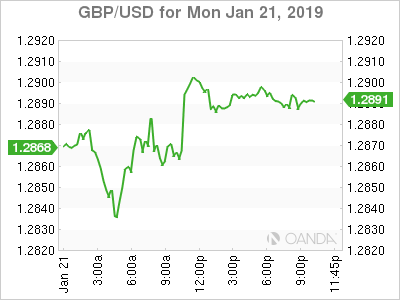
A possibility presented itself as the Polish Foreign Minister was in favour of a 5 year backstop which while not ideal, would allow negotiations to move forward ahead of the impending March 29 deadline.
OIL – Energy Hit by China Slowdown But Trade Optimism Boosts Prices
Energy prices rose on Monday with WTI gaining 0.33 percent and Brent 0.19 percent. Oil prices were hit after China released its GDP data showing a clear slowdown. The Chinese economy is growing at a 6.4 percent pace, the lowest since the financial crisis.
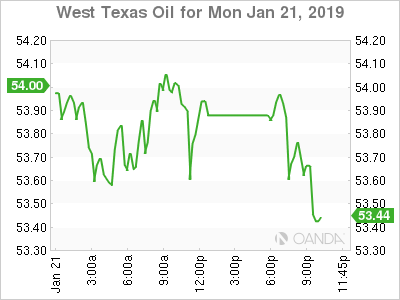
Trade war concerns have reduced global growth expectations and with it comes a lower demand of energy. Crude reversed the losses in the aftermath of the announcement as there is growing optimism that China and the United States will scale back their trade dispute.
Chinese stimulus news also brought a positive to energy prices. The OPEC production limit agreement and lower rig counts in North America are keeping prices stable awaiting signs of progress in US-China negotiations.
GOLD – Yellow metal falls on thin North American volumes
Gold lost 0.23 percent on Monday. The yellow metal is on the back foot as slow growth in China could be the catalyst for the end of the trade war between China and the United States. Investors lost their appetite for the precious metal as a refuge during the Martin Luther King holiday.
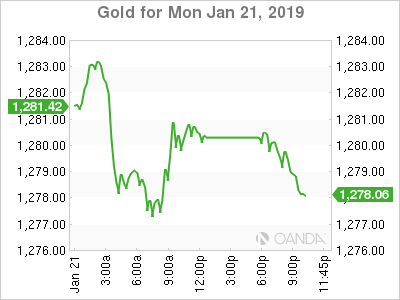
Brexit headlines could spark demand for a safe haven as a there is no clear plan B in the divorce proceedings between the UK and the EU.
The Bank of Japan (BOJ) and the European Central Bank (ECB) are not expected to surprise markets as their respective economies are still struggling to gather momentum.
Eco Data 1/22/19
[php_everywhere instance="1"]
No NY’s Resolutions from ECB
- Reinvestment policy and forward guidance interest rates to remain unaltered
- No downgrade of risks to eco outlook (yet)
- Muted market reaction expected, but sensitivity to comments on TLTRO's?
This week, the ECB holds its first policy meeting after ending net monthly purchases under its Asset Purchase Programme (APP). The two remaining pillars, its interest rate policy and its APP reinvestment strategy, are expected to stay firmly in place. Guidance on interest rates given consistently since last June suggests no action at least through the Summer with markets increasingly emphasizing the 'at least' element of this phrase and pushing expectations of the timing of the ECB's initial rate increase into 2020.
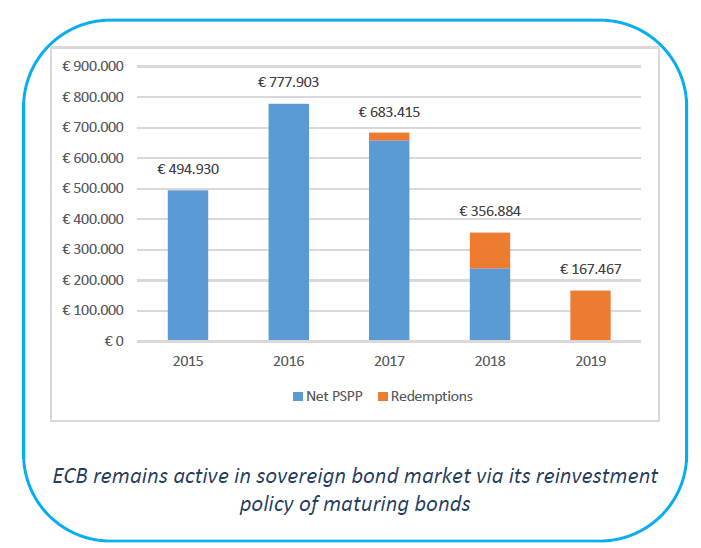
The ECB remains active on bond markets (and consequently exerts a dampening effect on yields) by reinvesting the proceeds of this year's €214bn redemptions from its APPportfolio. The lion share (€168bn) will flow to the government bond market. These amounts are expected to grow next year given the magnitude of the central bank's total portfolio (€2570 bn of which €2102bn government bonds) which leaks duration.
Recent EMU economic activity data extended their soft trend. To an extent this is consistent with the ECB's slight downgrade to its growth forecasts at the December meeting and the accompanying guidance that the balance of risks was moving to the downside. In the interim, the EMU composite PMI in December recorded its fourth consecutive decline, from 52.7 to 51.1, equaling (Nov 2014) the lowest reading since the aftermath of the EMU sovereign debt crisis. Industrial production readings also suggest that the EMU economy didn't recover from the Q3 (0.2% Q/Q) slowdown. The German economy barely grew in Q4 according to national data, while French growth forecasts were significantly lowered because of the yellowvests protests. ECB President Draghi acknowledged that recent economic developments have been weaker than expected in December and that uncertainties, notably related to global factors, remain prominent. However, some more hawkish members of the governing council have downplayed the extent of this devaiation from the ECB's previous baseline scenario.
We don't expect the ECB to alter risks to the economic which it labels "broadly balanced, but moving to the downside" yet. Given volatility in monthly data and the range of uncertainties in the current environment, the central bank will probably take a wait‐and‐see approach until the March 7 policy meeting when new growth and inflation forecasts are available.
The softening trend in activity indicators of late was accompanied by data showing the persistence of subdued price pressures. EMU core inflation remains stubbornly low at 1% Y/Y, while the headline reading suffered an energy price‐related setback to 1.6% Y/Y in December. ECB president Draghi for now holds the narrative that upward wage pressure, the ECB's stimulative policy and a narrowing output gap will eventually deliver higher core EMU inflation, warranting the start of an interest rate hike cycle. Significantly, the ECB continues to distinguish between largely external downside risks and the persistence of a strong domestic economy and improving labour markets which should help overcome the current economic dip. They will be comforted in this regard by the drop in the EMU unemployment rate to 7.9% in November, the lowest level in slightly over a decade.
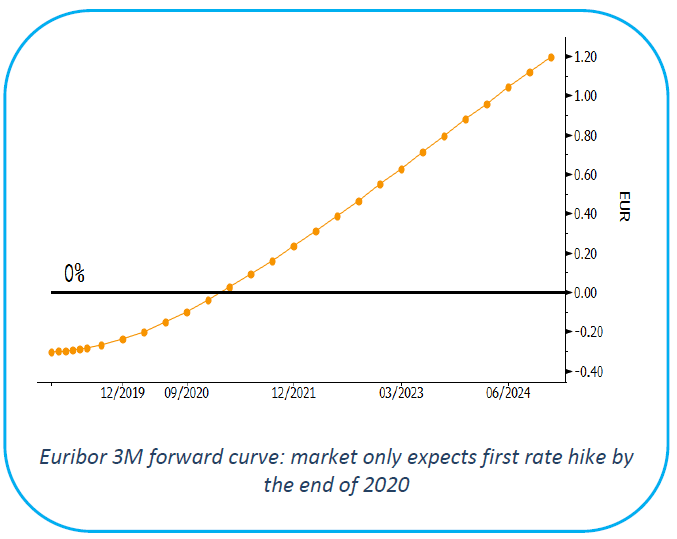
It is important to emphasise that (Rate) markets currently don't buy the ECB's forward guidance. The market implied probability of a first rate hike at this year's December meeting amounts only 25%. The 3M forward Euribor strip curve only crosses the 0% mark for the March 2021 contract! We think that this positioning is too soft and do believe that Draghi's successor could pull the trigger for a tightening cycle at the final meeting of 2019. We think the ECB could follow the playbook adopted by the Federal reserve when it began the US tightening cycle at the end of 2015 and implement a non‐aggressive increase in policy rates that doesn't sharply tighten financial conditions. However, markets aren't considering such a possibility at present.
Another consideration is that by the end of the year, we'll be dealing with a completely different governing council. Chief economist Praet leaves the board at the end of May. His successor is expected to be known by February 11, with Irish central bank governor Lane the clear frontrunner. ECB President Draghi's term ends at the end of October and French governing councel member Coeuré's tenure spans until the end of the year. On balance, the changed composition of the ECB is likely to make it slightly less dovish.
One special topic likely to command increasing market attention in coming months will be the prospect of developments in regard to the ECB's liquidity providing policy. The ECB's 4 remaining outstanding Targeted longerterm refinancing operations mature between June 2020 (€379.85bn) and March 2021 (€233.2bn). The September 2020 (€44.31bn) and December 2020 (€61.48bn) maturities are smaller. Over the past months, rumours repeatedly suggested the ECB might announce an extension of these TLTRO loans by mid‐2019. The TLTRO‐loans are included in commercial banks' long‐term liquidity ratio's (NSFR). These will face a negative impact when the residual maturity drops below 12 months (50% haircut) and below 6 months (100% haircut). Cash‐strapped banks will have to rely on market funding to replace these TLTRO's which might come at a heavy cost and effectively amount to a monetary policy tightening. We don't think that the ECB wants to send such signal. Indeed, the account of the December policy meeting suggest the matter had been raised by some governors.Therefore, ECB President Draghi might this week or in March ask an ECB task force to exploit the options to replace TLTRO's.
Markets will be sensitive to hints about new longer term liquidity operations. They could pull yields and the single currency lower, though we don't expect any lasting impact. As we approach the June deadline, markets will probably start behaving asymmetric. With the "adverse" impact being larger in absence of communication compared to the constructive reaction in case of an extension. Soft warnings on the economy are given current market positioning probably by and large discounted. So all in all, we expect a muted market reaction to the ECB and, in the near term, it may be the equity markets fluctuating attitude to risk that possibly determines the faith of other markets.
Bank of Japan Meets amid Growing Downside Risks and Stronger Yen
The Bank of Japan will hold its first monetary policy meeting of 2019 on January 22-23, and unlike this time last year when there was a real prospect of a QE exit, policymakers will probably be discussing if or how to respond to the weakening outlook. There is no set time for the BoJ’s announcement on Wednesday, but the yen could come under some downside pressure if the Bank lowers its economic forecasts in its latest quarterly outlook report, due to be published on the same day.
As dark clouds start to gather over the world economy, the start of 2019 is not proving a very cheery one for central banks. The BoJ, along with the European Central Bank, is still stuck with negative interest rates and even the Federal Reserve is mulling whether to pause its rate hike cycle. Although Governor Haruhiko Kuroda has been reiterating that the Bank has more tools at its disposal if additional stimulus is needed, investors doubt whether policymakers have any firepower left to respond to any fresh downturn.
Markets’ attention on Wednesday will therefore be on how worried the BoJ is about the growing dangers of a recession and a further southward deviation of inflation from its 2% target. At the last meeting in December, board members had voiced concern that “downside risks to the outlook have been heightening”. And while there’s been relief that the Fed has since signalled “patience”, China has pledged more stimulus measures and there’s been some progress in US-China trade talks, the risks to growth and inflation are still clearly to the downside.
Reports suggest the BoJ will cut its projections for inflation in its outlook report as weaker growth both in Japan and abroad, and lower oil prices are likely to drag on prices. However, the Bank is not expected to make or signal any changes to its policy at this point, as, despite all the gloom, there are a few positives in the Japanese economy.
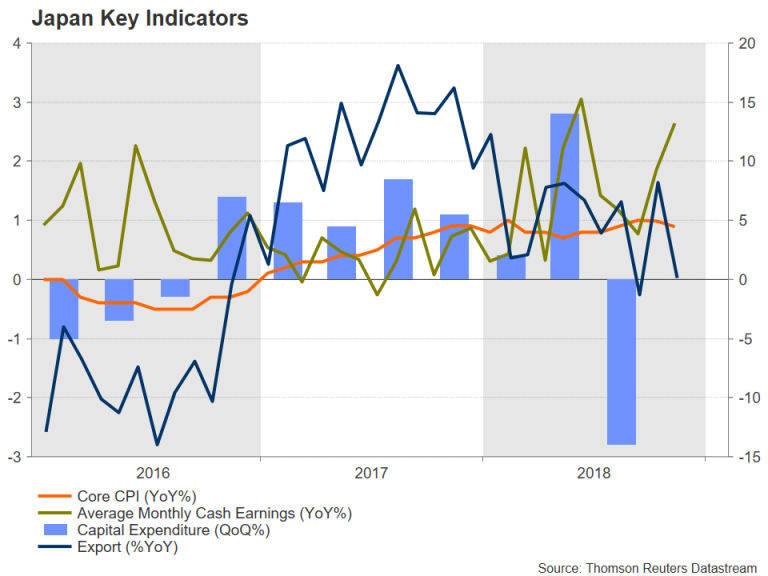
Business confidence remains at healthy levels and, apart from a tumble in the third quarter, capital expenditure has been growing solidly since the end of 2016. More significantly though, wage growth appears to be picking up again, reaching 2% year-on-year in November, and this could support domestic consumption should external demand soften further.
In the currency markets, the yen could further retrace some of its impressive gains versus the US dollar since mid-December if the BoJ strikes a more pessimistic tone than what analysts are anticipating. Having last week broken above the upper level of its recent 107.75-109.20 trading range, dollar/yen could next target the 61.8% Fibonacci retracement of the downleg from 113.70 to 104.96 at 110.36. Clearing this hurdle could see the pair head for the 78.6% Fibonacci at 111.83.
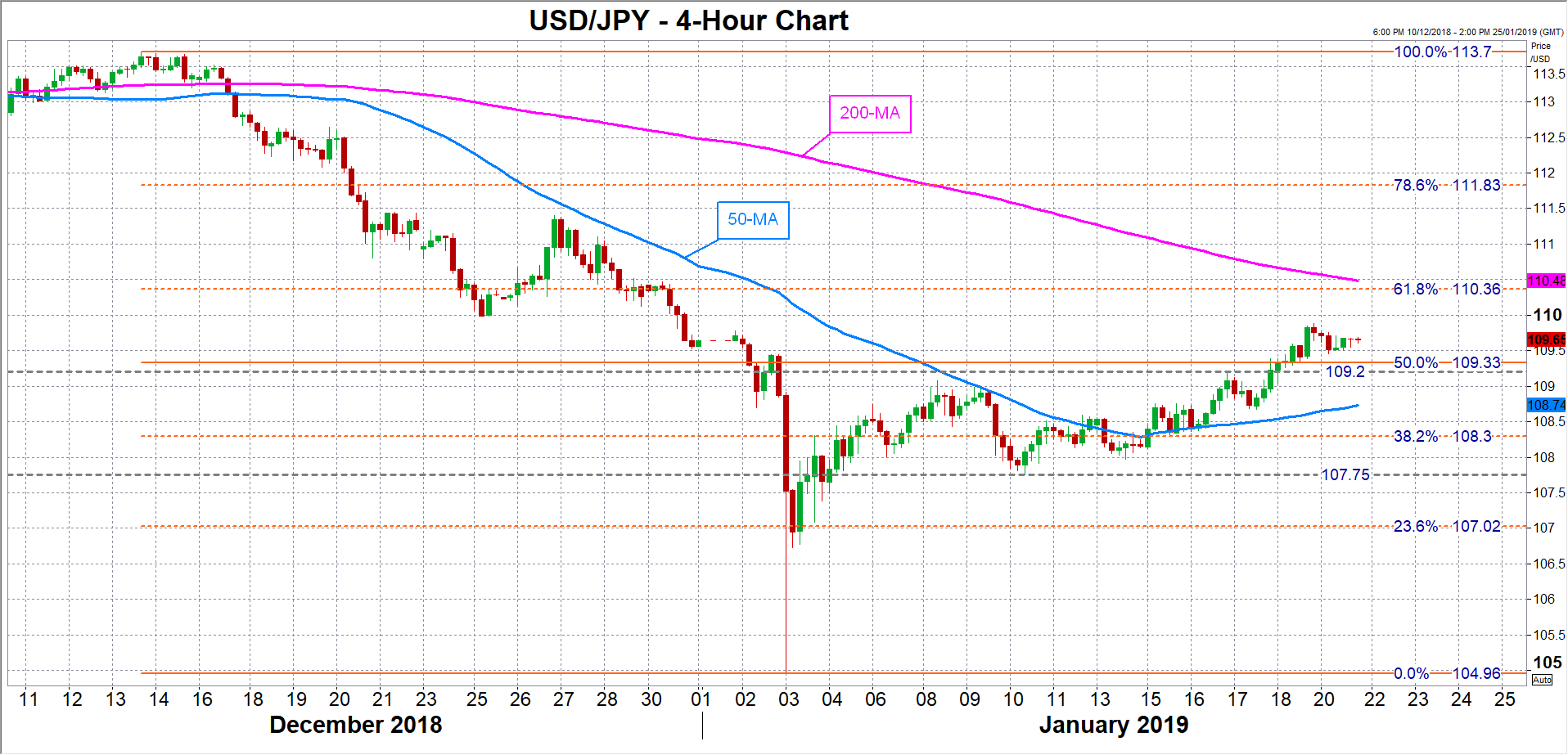
However, if the Bank of Japan maintains cautious optimism about the outlook, dollar/yen could slip below immediate support at the 50% Fibonacci around 109.33, which lies slightly above the top of the recent sideways range. Breaching this zone would bring the 38.2% Fibonacci into focus at 108.30, while failure to hold above this mark could pull the pair towards the 23.6% Fibonacci at just above the 107 handle.
UK Pay Growth to Briefly Steal Limelight from Brexit Developments
The UK labour market report for November will be watched on Tuesday at 09:30 GMT for the latest view on unemployment and wage growth in the Brexit-hit economy. While happenings in Westminster will be the main focus for investors, another solid set of jobs data could provide some support for sterling amid the deepening Brexit uncertainty.
Britain’s unemployment rate was unchanged at near 4-decade lows in the three months to October at 4.1% and is expected to stay at that level in November. Despite businesses holding back on investment decisions due to Brexit clouding the outlook, the impact hasn’t been so evident in the jobs market and firms have continued to hire, albeit at a slower pace. Employment growth picked up speed in September and October after stalling in the summer months. Total employment is forecast to rise by 85k in the three months to November, slightly above the prior 79k.
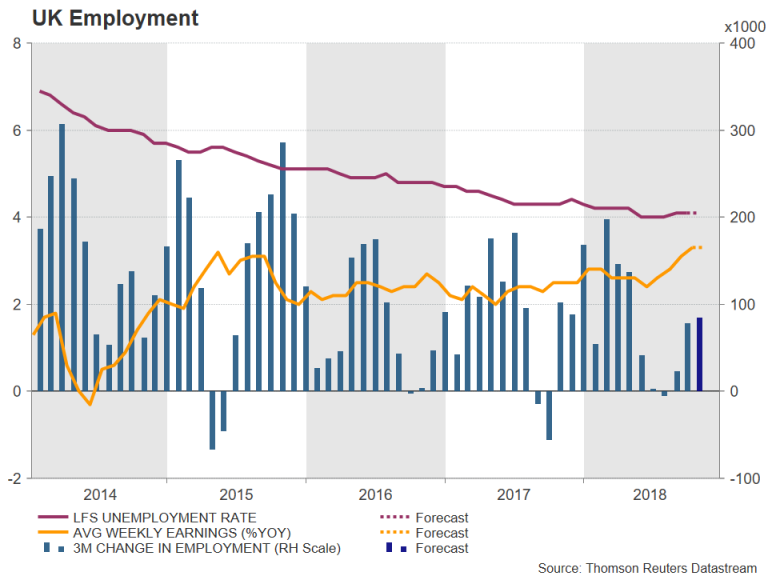
Attracting the biggest attention though on Tuesday, will be the latest estimates of wage growth. The annual rate of change in average weekly earnings accelerated to a 10-year high of 3.3% in the three months to October. It’s expected to hold at 3.3% in November, while the rate that excludes bonuses is also forecast to remain unchanged at 3.3%.
An unexpected slowdown in earnings growth would fuel concerns that the UK economy is stagnating as Parliament’s deadlock on the Brexit Withdrawal Agreement rumbles on, taking a toll on both consumer and business spending. However, if pay increases maintain momentum, it would reassure worried traders that rising household incomes could offset at least some of the negative hit from the Brexit uncertainty and the weakening global economic backdrop.
In forex markets, the pound could resume its recent upswing against the US dollar should the employment data point to further tightening in the labour market. The British currency could re-challenge last week’s 2-month high of $1.30, though it would first have to overcome nearby resistance at the $1.29 handle, which is the 123.6% Fibonacci extension of the downleg from $1.2814 to $1.2436. A successful break above these levels could see traders eyeing the 161.8% and 200% Fibonacci extensions, at $1.3048 and $1.3192, respectively, especially if the positive numbers are accompanied by signs of progress by Theresa May in securing concessions from the EU to help her sell a revised Brexit deal to UK lawmakers.
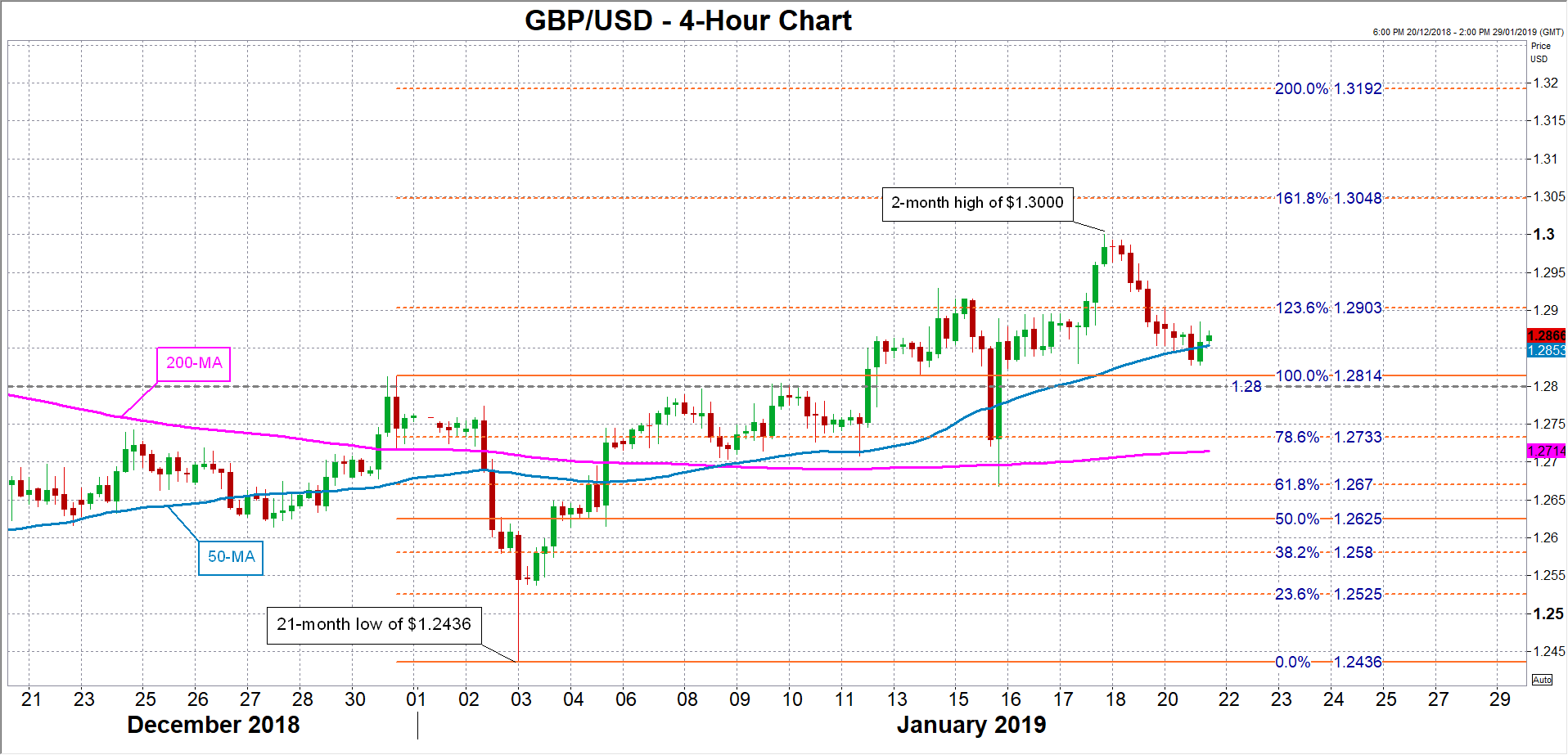
However, if the job figures disappoint or underwhelm and all the indications are that Parliament remains split on how to proceed with Brexit, sterling could slip below immediate support in the $1.28 region. A breach of this support would bring the 78.6% Fibonacci into view at $1.2733, while lower down, the 61.8% Fibonacci at $1.2670 would be the next focus. Even sharper losses could see the pound testing the 50% Fibonacci at $1.2625.
New Zealand Q4 CPI to Keep Rate Cut Odds Alive
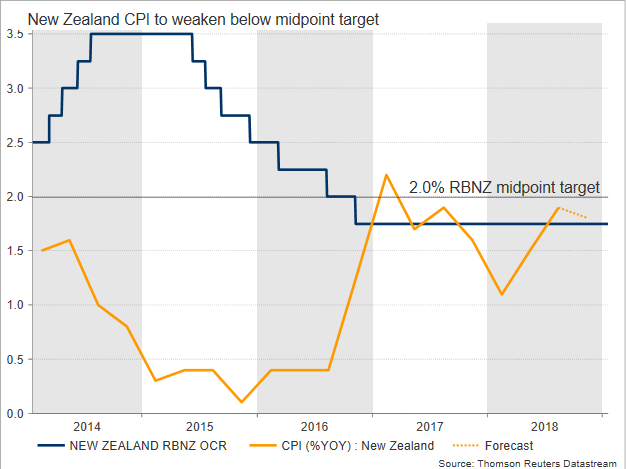
New Zealand CPI figures will steal the spotlight on Tuesday at 2145 GMT to show that the headline inflation rate stretched lower in the fourth quarter, missing the central bank’s midpoint price target of 2.0% for 2018. That being so, and in consideration of the rising global risks, the Reserve Bank of New Zealand (RBNZ) will not rush to raise interest rates.
According to analysts, in the three months to December, the headline Consumer Price Index (CPI) dropped by 0.9 percentage points relative to the previous quarter to reach bottom at 0.0%, most likely in the face of sliding oil prices. The annual measure, which the RBNZ uses to set monetary policy, is also expected to ease, from 1.9% to 1.8%, giving less incentive to policymakers to hike rates, as anything above 2.0% would be more acceptable within the 1-3.0% range the Bank aims to stabilize price growth.
Besides, with core measures staying muted, speculation is rising that wages are not increasing enough to boost consumption and hence inflation. The unemployment rate fell to decade lows in the third quarter, but wages are said to have grown modestly during 2018, making the elevated property and rental costs still not so affordable. Last week’s December electronic card retail sales also highlighted the pressure on consumers, arriving surprisingly at the lowest in ten years despite the festive Christmas season. While someone would expect the saving from lower oil prices spreading to other industries, this did not appear in the numbers, with business confidence also stuck in negative territory in the same month. Yet, should the labor market tighten further making the skill hunting more difficult, employers could soon be forced to start raising pay soon.
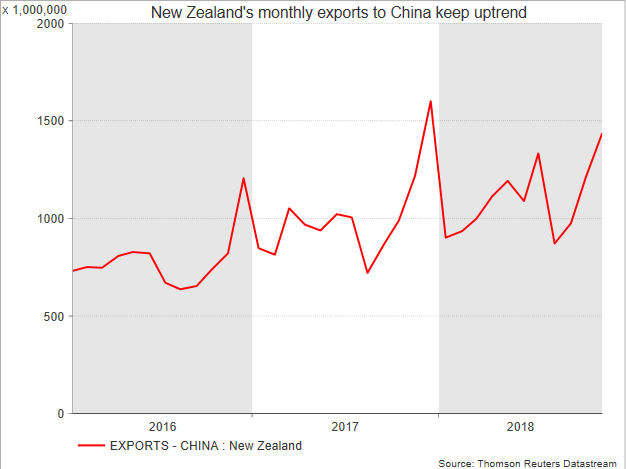
External risks are also heating in the horizon, clouding the outlook of the trade-heavy economy. Specifically, the US-Sino trade war is the number one concern at the moment given that China is the top destination for New Zealand exports and hence a big GDP influencer. Even if New Zealand’s overseas sales look unaffected from the already one-year old tariff game, slowing economic activity in China suggests that Beijing may provide less support to its kiwi partner in the near future if it fails to reach a compromise with Washington.
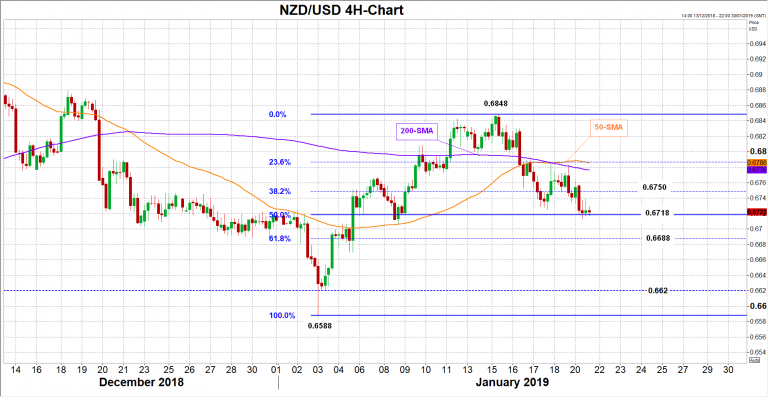
Taking all the above uncertainties into account, the odds are increasingly turning in favour of a rate cut and a surprisingly lower-than-expected CPI reading on Tuesday would give another reason for policymakers to think more seriously about a 25bps rate reduction later this year. In this case kiwi/dollar could break a key barrier around 0.6718 which is the 50% Fibonacci of the upleg from 0.6588 to 0.6848 and potentially head down to meet support at the 61.8% Fibonacci of 0.6688. Beneath this level, the 0.6620 mark could halt downside movements ahead of the 0.6588 bottom.
Should inflation beat forecasts, with the core measures showing improvement as well, the pair could strengthen until the 38.2% Fibonacci of 0.6749 in hopes that monetary support through lower interest rates may not be as necessary as analysts think. Steeper increases may also challenge the 50-period moving average currently at 0.6786 where any successful violation could bring more buying interest into the market, shifting the focus above the 0.6800 round level.
British Pound ahead of Next Brexit Round
GBP/USD has ticked lower in the Monday session. In North American trade, the pair is trading at 1.2869, down 0.03% on the day. On the release front, U.S. banks are closed for a holiday, and there are no U.S. or British indicators. British Prime Minister May is expected to speak as she tables a new Brexit proposal. On Tuesday, the U.K. releases wage growth and the budget deficit.
Last week’s political drama surrounding Brexit triggered sharp swings in the British pound, but GBP/USD ended the week with minor gains. Will the volatility continue this week? It was a rough week for Prime Minister May, as her Brexit withdrawal deal was dead on arrival in parliament. This was followed by a no-confidence vote which May narrowly survived. May must now table a new Brexit proposal and submit it to parliament on Monday. The new proposal is sure to be opposed by many lawmakers, and it’s unclear what happens if parliament rejects the revised agreement. Surprisingly, despite the political turmoil, the pound has posted five successive winning weeks. Will the upward trend continue?
Investors were greeted with weak data on Monday, as China released GDP numbers. The world’s second largest economy continues to expand, but GDP has been softening, pointing to an economic slowdown. China reported that GDP had slowed to 6.6% in 2018, marking its lowest level since 1990. GDP for the fourth quarter dipped to 6.4%, compared to 6.5% in the previous quarter. The soft GDP release comes on the heels of soft trade and manufacturing data. A decline in China could send the Japanese economy into recession, as the export and manufacturing sectors are heavily dependent on Chinese demand.
The Trump administration has threatened further tariffs if a deal is not reached by March 1, but a second round of negotiations between the sides is scheduled for the end of the month in Washington. Chinese officials will be under pressure to show more flexibility in the talks, in order to stem the economic bleeding.
Elliott Wave Analysis: USD/CAD Intra-day Rally
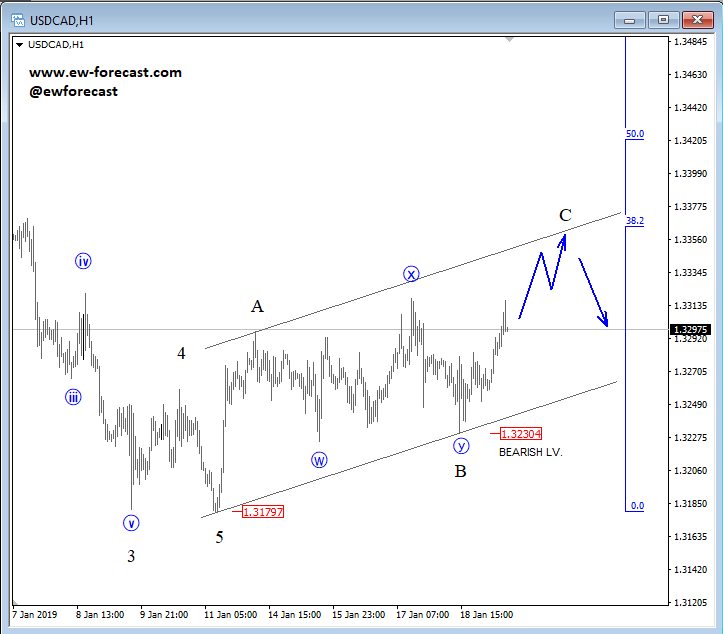
USDCAD is recovering in a wave C as part of a bigger, bullish recovery. We know that wave C is a motive waves, so five legs are expected, before a top can be seen and a reversal may follow. Ideally some resistance and a reversal will follow from around the upper corrective channel line and near the Fibonacci ratio of 38.2. Also a drop in five waves, and below the 1.323 level would confirm a bearish continuation.
USDCAD, 1h
Sunset Market Commentary
Markets
Global core bonds edged cautiously higher in a day characterized by thin volumes and a fading risk-sentiment. US markets were closed in remembrance of Martin Luther King. So the focus was on Europe. With an empty economic calendar, investors stayed on the sidelines. Only the IMF World Economic Outlook was scheduled to be released today. The IMF cut its forecast for the world economy to 3.5% for this year, the weakest pace in three years. Next to that, investors await the Eurozone PMI’s and central bank meetings (ECB, BOJ, Norges Bank) later this week. The ECB’s reinvestment policy and forward guidance on interest rates will remain unaltered. We only expect a muted market reaction as the bank is expected to refrain from downgrading its economic risks outlook. Any hints on new TLTRO’s is not expected but could be a wildcard and support market sentiment. The German Bund edged little higher today, but is currently (partly) pairing its intraday gains. The German yield curve is marginally edging lower with changes varying between -0.2 bps (2-yr) to -0.7 bps (5-yr). Spain has mandated the syndication of a new 10-yr Euro benchmark bond as investors showed strong appetite for peripheral euro-area debt last week at the Italian 15-yr bond syndication. The transaction will most likely be launched tomorrow.
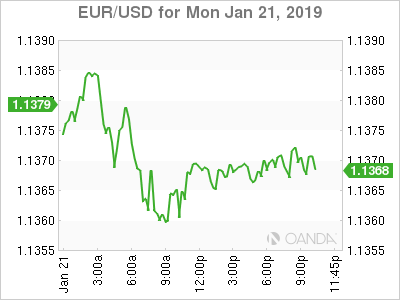
USD trading developed in thin market conditions today as US markets were closed. A constructive risk sentiment overnight in Asia initially suggested a cautious bid for EUR/USD. However, a return toward 1.14 proved impossible. European equities failed to continue last week’s rebound. EUR/USD gradually developed an intraday sell-on upticks pattern. The IMF in particular reducing the EMU/German 2019 growth forecasts didn’t help the single currency. Investors are also keen to see the ECB’s assessment at Thursday’s policy meeting. EUR/USD is trading in the 1.1365 area. Last Friday’s low is within reach. A break would bring the 1.1309 support again on the radar. Recent rise in US interest rates also gives the dollar again better downside protection. USD/JPY drifted sideways, currently trading in the 109.65 area.
There was plenty of activity to make progress on Brexit today, both in London and in Brussels. However, on both sides of the British Channel there were few signs that a consensus was in the making. UK PM May is said to try to get better conditions on the Irish backstop from Brussels, but the EU 27 are highly divided on the conditions the justify a delay and on how long such a delay should last. This afternoon’s meeting in the UK Parliament on PM May’s next steps on Brexit probably won’t bring much clarity. Sterling fell prey to profit taking on Friday and stabilized today. EUR/GBP hovers in the low-to-mid 0.88 area. Cable (1.287 area) is also trading well below last week’s peak at 1.30.
News Headlines
The IMF cut forecasts for global growth in 2019 to the weakest pace in three years. It now predicts growth of 3.5%, down from 3.7% in October last year. With growth forecasts unchanged for the US (2.5%) and China (6.2%), the downgrade is to a large extent the result of weaker than initially thought EMU growth. The bloc saw growth forecasts cut from 1.9% to 1.6% as projections for Germany (1.3% vs. 1.9% previous), Italy and France were trimmed.
Kamala Harris, senator of California, announced she’s running for the Democratic presidential nomination 2020. Harris is California’s former attorney general, has Jamaican-Indian roots and would be the first black woman in the Oval Office.
A meeting of euro-area finance ministers today opens the call for candidates to succeed current ECB chief economist Peter Praet, who’s 8-year term ends in May. Ireland has already put forward its central bank governor Philip Lane as a candidate. Lane was nominated last year for the ECB vice presidency but withdrew from the race in support of de Guindos. The application round runs until the end of this month.