Sample Category Title
USD/JPY Mid-Day Outlook
Daily Pivots: (S1) 109.25; (P) 109.57; (R1) 110.09; More...
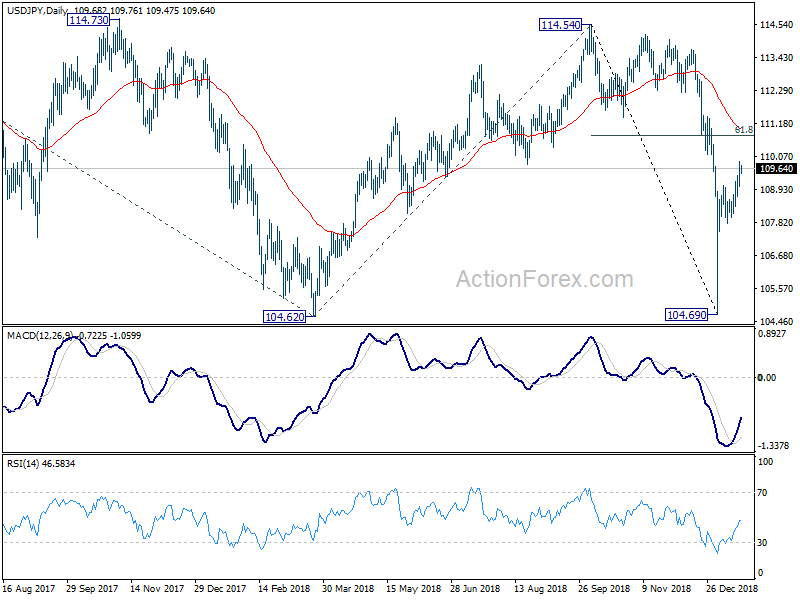
Further rise is still expected in USD/JPY as rebound from 104.69 is in progress. Next target is 61.8% retracement of 114.54 to 104.69 at 110.77. We'd look for topping signal above there. On the downside, break of 107.77 minor support is needed to confirm completion of the rebound. Otherwise, further rise remains in favor even in case of retreat.
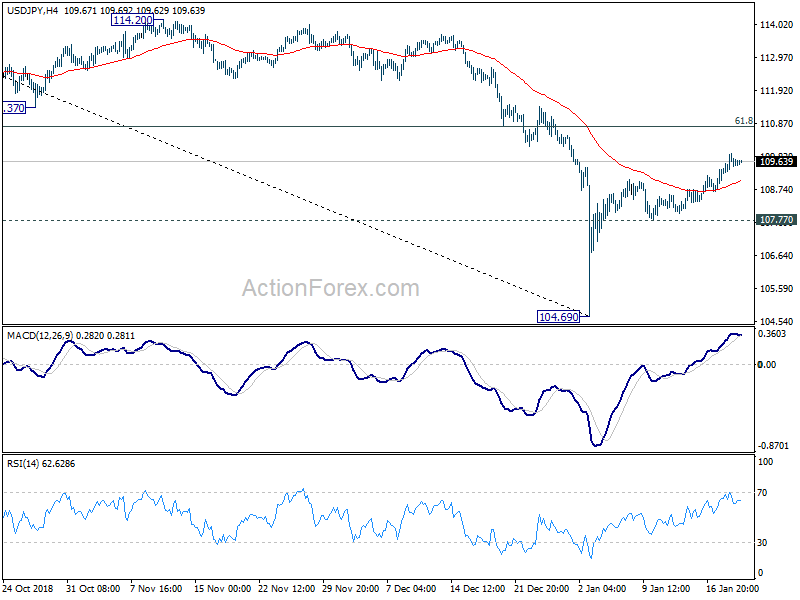
In the bigger picture, price actions from 125.85 (2015 high) are seen as a long term corrective pattern, no change in this view. Apparently, such corrective pattern is not completed yet. Fall from 114.54 is seen as part of the falling leg from 118.65 (2016 high). Break of 104.62 will target 100% projection of 118.65 to 104.62 from 114.54 at 100.51, which is close to 100 psychological level. But in that case, we'd expect strong support from 98.97 to contain downside to bring reversal. Also, this bearish case will remain the preferred one as long as 114.54 resistance holds.
USD/CHF Mid-Day Outlook
Daily Pivots: (S1) 0.9938; (P) 0.9949; (R1) 0.9967; More....
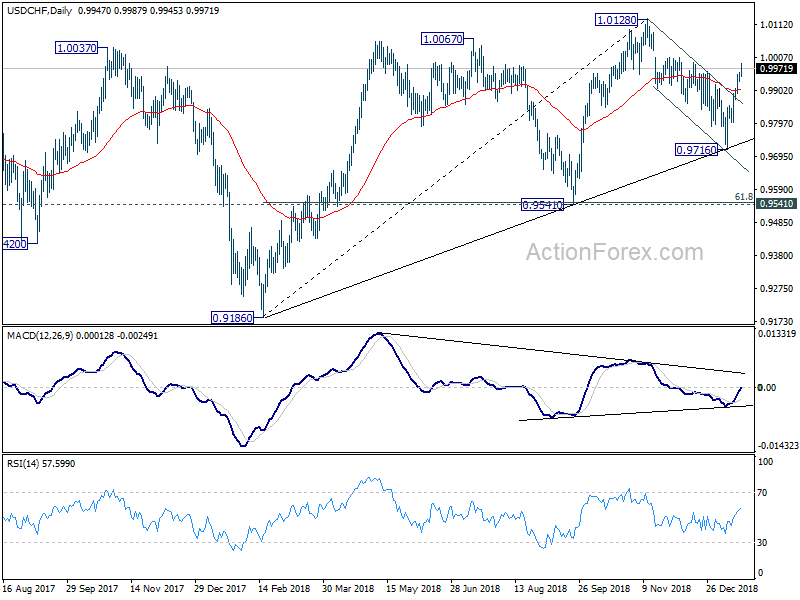
USD/CHF's rally continues today and break of 0.9963 resistance should confirm the bullish case. That is, corrective fall from 1.0128 has completed at 0.9716 already. Intraday bias is back on the upside for retesting 1.0128 next. On the downside, below 0.9932 minor support will turn intraday bias neutral again. But near term outlook will remain cautiously bullish as long as 0.9856 minor support holds.
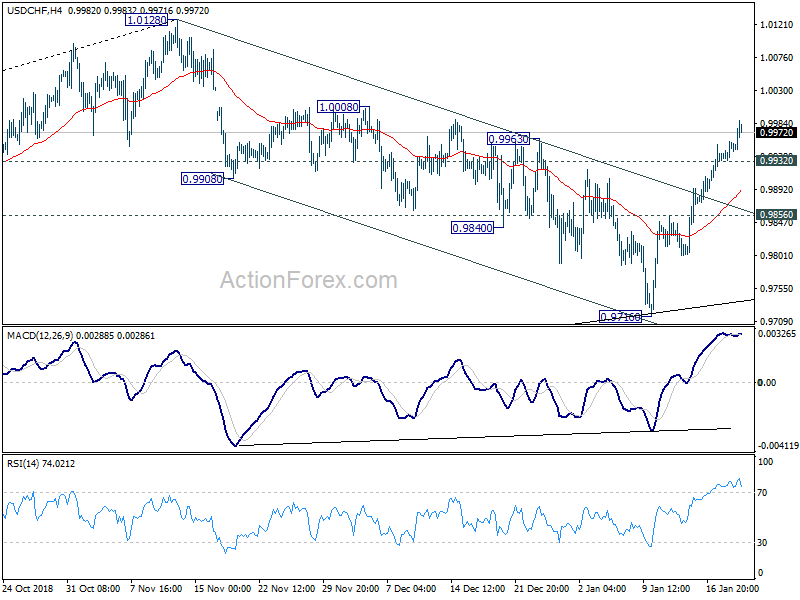
In the bigger picture, current development suggests that rise from 0.9186 has possibly completed with three waves up to 1.0128 already. Decline from 1.0128 could either be correcting this move, or reversing the trend. As long as 0.9541 support holds, we'd slightly favor the former scenario, and expect another rise through 1.0128 at a later stage. However, sustained break of 0.9541 will confirm trend reversal and bring deeper fall back to 0.9186 low.
Dollar Attempting to Rise in Mixed Holiday Markets, Near Term Resistance Still Holds
The forex markets are rather mixed and quiet today. Trading has also become a bit subdued as US is on Martin Luther King day holiday. But UK Prime Minister Theresa May's Brexit plan B might still trigger some volatility. For now, New Zealand Dollar remains the weakest one for the day. It's followed by Canadian Dollar and Australian Dollar. Yen is the strongest one, followed by Euro and then Dollar. But there is actually no apparent sign of risk aversion. The markets are just mixed.
Technically, USD/CHF finally broke 0.9963 resistance, which should indicate completion of correction from 1.0128 at 0.9716, further rise is in favor to retest 1.0128. EUR/CHF is pressing 1.1340/8 resistance zone too. Break will bring further rally. Dollar is apparently trying to strength elsewhere too. But EUR/USD has to break 1.1353 minor support first. Also, AUD/USD needs to break 0.7116 minor support and USD/CAD needs to break 1.3323 minor resistance to proved underlying Dollar strength.
In other markets, FTSE is currently down -0.07%, DAX is down -0.60%, CAC is down -0.29%. German 10 year yield is down -0.0012 at 0.262. Earlier in Asia, Nikkei rose 0.26%, Hong Kong HSI rose 0.39%, China Shanghai SSE rose 0.56%, Singapore Strait Times dropped -0.12%. Japan 10-year JGB yield dropped -0.0099 to 0.004, staying positive.
UK PM May to table her Brexit plan B
Today's focus is on UK Prime Minister Theresa May's Brexit plan B. She's due to make a statement in the parliament at 1530 GMT. Her spokesman said the Brexit will have to be changed if it's to be approved by lawmakers. And there were talks going on to understand what exact changes are needed.
German Foreign Minister Heiko Maas has urged the UK to come back with concrete proposal on solving the Brexit deadlock in its parliament. He tweeted that "So far, unfortunately, the British Parliament has only said what it does not want. What we need now are concrete proposals from the British. The ball is in London, there is not a lot of time left. We #Brexit will also be talking about this in Brussels today. "
Separately, German Economy Minister Peter Altmaier said "Personally I'm optimistic that we can avoid a hard Brexit but the German government is of course prepared for all possible scenarios."
Ireland's European Affairs Minister Helen McEntee said today Ireland wont' engage in bilateral negotiation with the UK on the Irish border backstop issue. She said, "What we can't do and what we won't do, because we have not throughout this entire process, is engage in any kind of bilateral negotiations with the DUP or any other political party in Northern Ireland or the UK. This is a negotiation between the EU and the UK."
China GDP growth slowed to lowest in 28 years, but stabilization seen in December
China GDP growth slowed to 6.4% yoy in Q4, down from 6.5% yoy and matched expectation. For the whole year of 2018, growth slowed to 6.6%, lowest in 28 years since 1990. National Bureau of Statistics head Ning Jizhe said the impacts from trade war with the US are manageable. There were signs of stabilization in the economy over the past twos months. And he added the country has confidence and the capacity to achieve reasonable growth in 2019.
Other December data released today are positive though. Retail sales grew 8.2% yoy, up from 8.1% yoy and beat expectation of 8.1% yoy. Industrial production rose 5.7% yoy, up fro 5.4% and beat expectation of 5.3% yoy. Fixed assets investment grew 5.9% yoy, unchanged from November, but missed expectation of 6.0%.
More in Chinese Economy Shows Signs of Stabilization in Late 2018. More Challenge Ahead
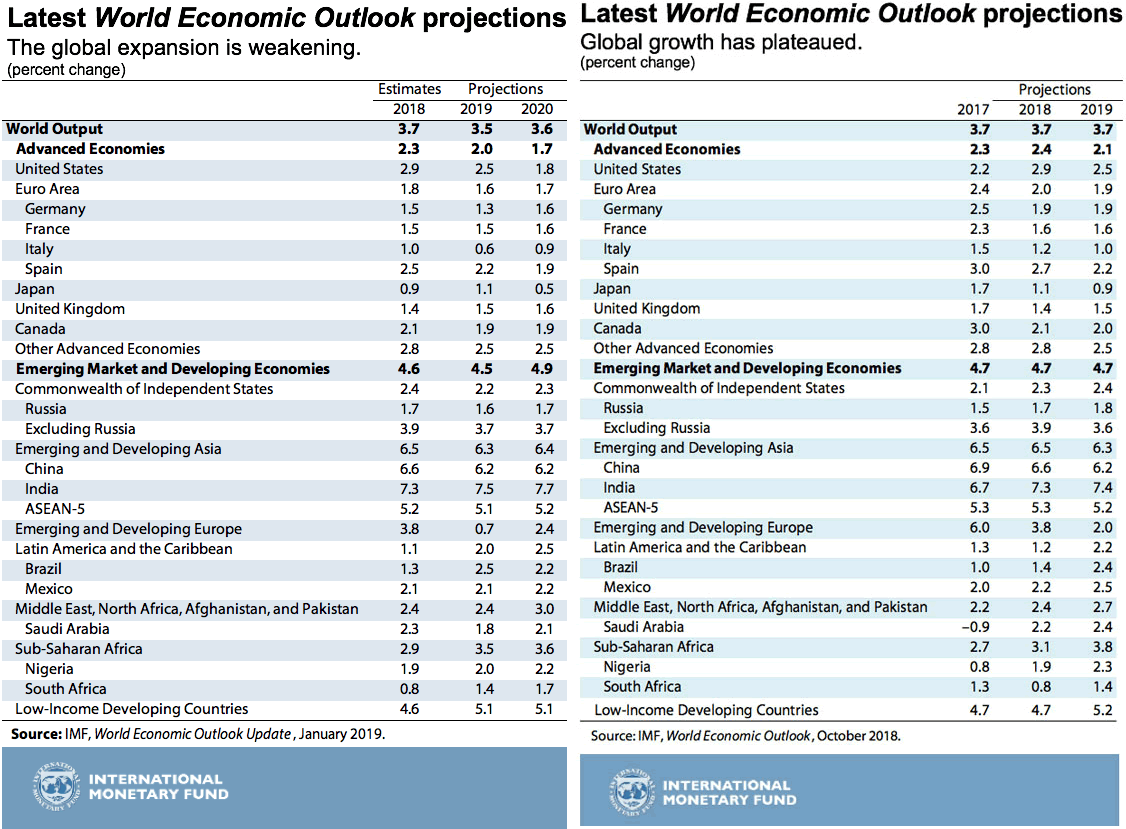
IMF lowers 2019 global growth forecast to 3.5%, risks rising
IMF revised down global growth forecasts and warned that "the global expansion is weakening and at a rate that is somewhat faster than expected." Also, " risks to more significant downward corrections are rising." And, "while financial markets in advanced economies appeared to be decoupled from trade tensions for much of 2018, the two have become intertwined more recently, tightening financial conditions and escalating the risks to global growth."
In particular, IMF warned that "an escalation of trade tensions and a worsening of financial conditions are key sources of risk to the outlook." Meanwhile, China's slowdown could be worsened by trade tensions and trigger "abrupt sell-offs in financial and commodity markets". "Brexit cliffhanger", "financial risk in Italy " and "protracted US federal government shutdown" are other risks.
To summarize, for 2019:
- Global growth is projected at 3.5%, down from prior 3.7% (October forecast).
- US growth is projected at 2.5%, unrevised.
- Eurozone growth is projected at 1.6%, down from prior 1.9%.
- Japan growth is projected at 1.1%, up from prior 0.9%
- China growth is projected at 6.2%, unrevised.
USD/CHF Mid-Day Outlook
Daily Pivots: (S1) 0.9938; (P) 0.9949; (R1) 0.9967; More....
USD/CHF's rally continues today and break of 0.9963 resistance should confirm the bullish case. That is, corrective fall from 1.0128 has completed at 0.9716 already. Intraday bias is back on the upside for retesting 1.0128 next. On the downside, below 0.9932 minor support will turn intraday bias neutral again. But near term outlook will remain cautiously bullish as long as 0.9856 minor support holds.
In the bigger picture, current development suggests that rise from 0.9186 has possibly completed with three waves up to 1.0128 already. Decline from 1.0128 could either be correcting this move, or reversing the trend. As long as 0.9541 support holds, we'd slightly favor the former scenario, and expect another rise through 1.0128 at a later stage. However, sustained break of 0.9541 will confirm trend reversal and bring deeper fall back to 0.9186 low.
Economic Indicators Update
| GMT | Ccy | Events | Actual | Forecast | Previous | Revised |
|---|---|---|---|---|---|---|
| 0:01 | GBP | Rightmove House Prices M/M Jan | 0.40% | -1.50% | ||
| 2:00 | CNY | Retail Sales Y/Y Dec | 8.20% | 8.10% | 8.10% | |
| 2:00 | CNY | Industrial Production Y/Y Dec | 5.70% | 5.30% | 5.40% | |
| 2:00 | CNY | Fixed Assets Ex Rural YTD Y/Y Dec | 5.90% | 6.00% | 5.90% | |
| 2:00 | CNY | GDP Y/Y Q4 | 6.40% | 6.40% | 6.50% | |
| 7:00 | EUR | German PPI M/M Dec | -0.40% | -0.10% | 0.10% | |
| 7:00 | EUR | German PPI Y/Y Dec | 2.70% | 2.90% | 3.30% |
Japanese Yen Steady, Investors Eye BoJ Statement
USD/JPY is quiet at the start of the week. In Monday’s North American session, the pair is trading at 109.67, down 0.09% on the day. In economic news, U.S banks are closed for a holiday. With no U.S or Japanese events on the schedule, traders can expect limited movement from the pair on Monday. On Tuesday, the Bank of Japan releases its rate statement.
Investors were greeted with weak data on Monday, as China released GDP numbers. The world’s second largest economy continues to expand, but GDP has been softening, pointing to an economic slowdown. China reported that GDP had slowed to 6.6% in 2018, marking its lowest level since 1990. GDP for the fourth quarter dipped to 6.4%, compared to 6.5% in the previous quarter. The soft GDP release comes on the heels of soft trade and manufacturing data. A decline in China could send the Japanese economy into recession, as the export and manufacturing sectors are heavily dependent on Chinese demand.
The Trump administration has threatened further tariffs if a deal is not reached by March 1, but a second round of negotiations between the sides is scheduled for the end of the month in Washington. Chinese officials will be under pressure to show more flexibility in the talks, in order to stem the economic bleeding.
The Bank of Japan is expected to keep its monetary policy unchanged on Tuesday. The economy has been showing modest growth, and weak inflation means there is little pressure to raise interest rates. Still, policymakers have major headaches, including the global trade war and further signs that the Chinese economy is slowing down. Japan’s export and manufacturing sectors have weakened, and if the global economy takes a downturn, Japan could be hit with a recession. A negative side effect to prolonged low interest rates is that financial institutions have seen their profits fall, forcing some of them to make questionable loans in order to recoup lost profits. The BoJ has acknowledged the problem, but is unlikely to change course anytime soon.
IMF lowers 2019 global growth forecast to 3.5%, risks rising
IMF revised down global growth forecasts and warned that "the global expansion is weakening and at a rate that is somewhat faster than expected." Also, " risks to more significant downward corrections are rising."
And, "while financial markets in advanced economies appeared to be decoupled from trade tensions for much of 2018, the two have become intertwined more recently, tightening financial conditions and escalating the risks to global growth."
In particular, IMF warned that "an escalation of trade tensions and a worsening of financial conditions are key sources of risk to the outlook." Meanwhile, China's slowdown could be worsened by trade tensions and trigger "abrupt sell-offs in financial and commodity markets". "Brexit cliffhanger", "financial risk in Italy " and "protracted US federal government shutdown" are other risks.
To summarize, for 2019:
- Global growth is projected at 3.5%, down from prior 3.7% (October forecast).
- US growth is projected at 2.5%, unrevised.
- Eurozone growth is projected at 1.6%, down from prior 1.9%.
- Japan growth is projected at 1.1%, up from prior 0.9%
- China growth is projected at 6.2%, unrevised.
https://www.youtube.com/watch?v=i2yOAXp-Trg
Into US session: CHF weakest in quiet markets, Brexit plan B awaited
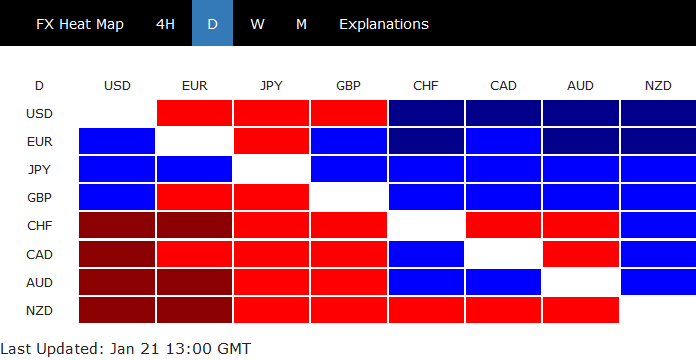
Swiss Franc's selloff pick up momentum in a rather quiet day today. USD/CHF has broken 0.9963 resistance while EUR/CHF is pressing 1.1348. More downside is in favor in the Franc. But it's just the second weakest one, next to New Zealand Dollar. Australia Dollar and Canadian Dollar follow even though there is no clear sign of risk aversion. WTI crude oil is also staying firm at around 54. Meanwhile, Yen is the strongest one in very tight range, followed by Euro and Sterling. Overall, the forex markets are mixed except for that weakness in Franc.
The US markets are on Martin Luther King Day holiday today. Main focus is across the Atlantic on UK Prime Minister Theresa May's Brexit plan B. She's due to make a statement in the parliament at 1530 GMT. Her spokesman said the Brexit will have to be changed if it's to be approved by lawmakers. And there were talks going on to understand what exact changes are needed.
Currently in European markets:
- FTSE is up 0.13%.
- DAX is down -0.45%.
- CAC is down -0.16%.
- German 10 year yield is down -0.013 at 0.251.
Earlier in Asia:
- Nikkei rose 0.26%.
- Hong Kong HSI rose 0.39%.
- China Shanghai SSE rose 0.56%.
- Singapore Strait Times dropped -0.12%.
- Japan 10-year JGB yield dropped -0.0099 to 0.004, stayed positive.
Canadian Dollar Steady, U.S. Markets Off for MLK Day
USD/CAD has posted small gains in the Monday session. Currently, the pair is trading at 1.3298, up 0.23% on the day. There are no U.S. or Canadian events on the schedule, so traders can expect limited movement from the pair during the day. On Tuesday, Canada releases Manufacturing Sales for November, which has posted two declines in the past three months.
The Chinese economy continues to show signs of an economic slowdown. The world’s second largest economy continues to expand, but a downward trend has made investors nervous. On Monday, China reported that GDP had slowed to 6.6% in 2018, marking its lowest level since 1990. GDP for the fourth quarter dipped to 6.4%, compared to 6.5% in the previous quarter. The soft GDP release comes on the heels of soft trade and manufacturing data, pointing to a slowdown due to the ongoing U.S-China trade war. The Trump administration has threatened further tariffs if a deal is not reached by March 1, but a second round of negotiations between the sides is scheduled for the end of the month in Washington. Chinese officials will be under pressure to show more flexibility in the talks, in order to stem the economic bleeding. Investor risk appetite has been strong in January, and that has been a major boost for the Canadian dollar, which has improved 2.5% this month and erased the December losses. However, if China continues to post soft data, investor confidence could nosedive and push the Canadian dollar lower.
The week ended on a positive note, as Canada’s headline inflation improved to 2.0% in December, on an annualized basis. This matches the BoC inflation target. Core inflation is at 1.9%, but weak wage growth continues to be a downside risk on inflation. After an aggressive 2018, the BoC is expected to remain on the sidelines and maintain interest rates in the first half of 2019, which could dampen enthusiasm towards the Canadian dollar.
USD/TRY Outlook: Turkish Lira Maintains Positive Tone Despite Bad News; 200SMA Marks Key Support
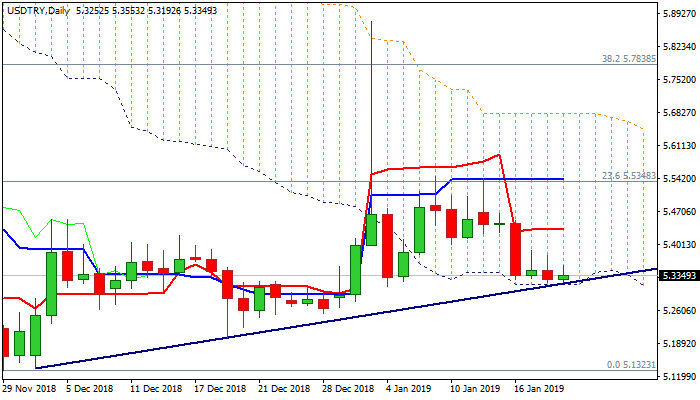
The pair remains at the back foot, following recent double-rejection at 5.5450 zone that left a double-top ahead of subsequent acceleration lower.
Fresh weakness pressures key support at 5.3160 (daily cloud base / bull-trendline off 5.1323 low) break of which would generate strong bearish signal for further retracement of 5.1323/5.5450 recovery leg.
Daily MA's turned to negative setup and along with south-heading momentum and MACD, maintain bearish pressure, which could be partially offset by deeply oversold slow stochastic.
Lira maintains positive tone despite a number of bad news, which include higher oil prices and China's slowdown.
In addition, recent data showed Turkish economy is struggling as trade gap widened to 2.6 bln in Dec vs 0.6 bln in Nov, while imports plunged.
CBRT's 24% interest rate keep lira in good shape, however, overall fragile picture warns that recent bulls could run out of steam and spark fresh weakness of Turkish currency. Rising 200SMA (5.2427) marks pivotal support which should ideally contain and keep recent USDTRY's bears under control.
Bearish signal could be expected on break below 200SMA which would expose key supports at 5.1323 (25 Nov low of pullback from new record high) and psychological 5.50 support.
Res: 5.3669; 5.4051; 5.4512; 5.5413
Sup: 5.3160; 5.2779; 5.2539; 5.2427
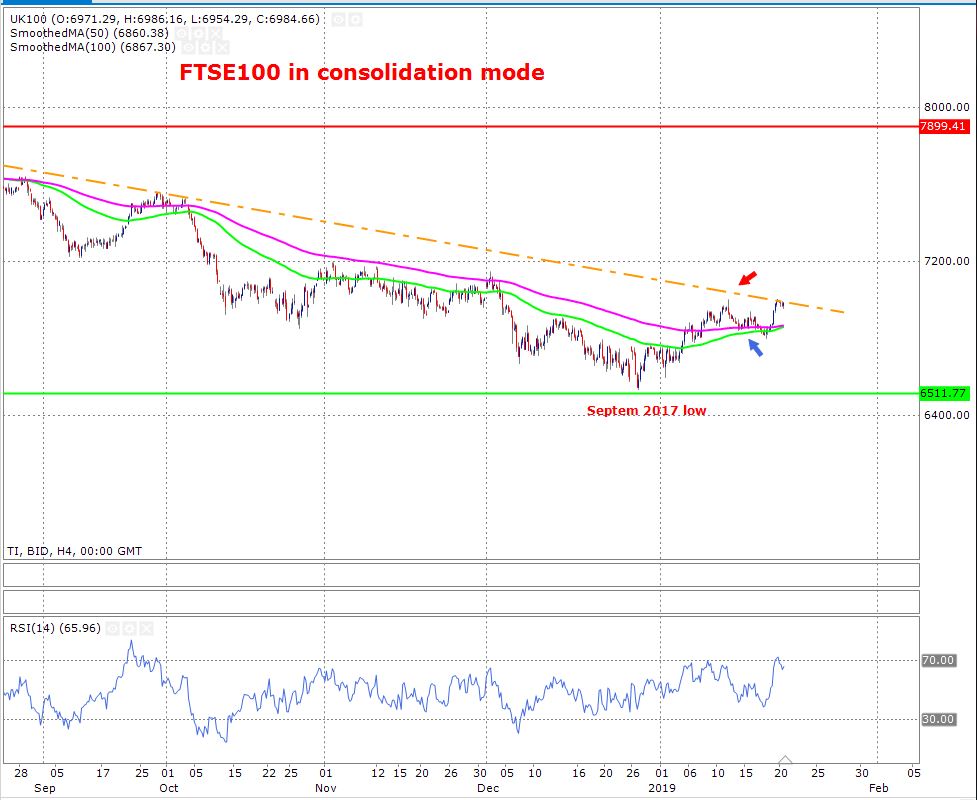
FTSE Could Break Its Downward Trend
The upward momentum is picking up and the chances are that the FTSE price may move higher
The FTSE 100 index is testing the downward trend line on a 4-hour time frame. Given that the price is trading below the downward trend line, it confirms that the current trend is to the downside. Having said this, the upward momentum is strong because the price is trading above the 50 and 100-day moving averages shown in pink and green respectively.
Looking at the candle price action, it appears that the price is likely to break above the downward trend line because we have a bullish harami candle pattern.
The RSI shows that investors should take caution because the price is trading in the oversold region, however, the most recent trend shows a retracement is taking place which is in line with the price.
Risk Appetite To Be Tested On Geopolitical Concerns
Monday January 21: Five things the markets are talking about
It’s expected to be an interesting holiday-shortened week for capital markets. Last night we had Chinese Q4 GDP data, where the world’s second-largest economy grew +6.6% in 2018, the slowest annual pace in nearly 30-years.
Today it’s Martin Luther King Day stateside, tomorrow it’s the Bank of Japan (BoJ) monetary policy meeting, while on Thursday it’s the ECB meeting, where a more “dovish” stance risks being delivered by the Governing Council.
There is also potential for more Sino-U.S trade developments, and perhaps new further twists on Brexit. U.K PM Theresa May’s is due to present to parliament today Plan B, however, many believe it’s likely to look very much like the first Brexit deal which was heavily rejected in parliament last week. Are Brexit negotiators are edging closer to a second referendum?
Euro equities and U.S stocks futures start their sessions on the back foot, while Asian markets posted modest gains as the market digested a mixed bag of Chinese headlines on the economy and trade. Last week, improved investor optimism for Sino-U.S trade talks saw global equities and U.S stock futures climb, however, reports that the two sides are making little progress on the key issue of intellectual property protection has some investors questioning their risk appetite.
Elsewhere, the ‘big’ dollar trades steady in a holiday induced N. American trading session, while sovereign bonds are mostly drifting in a tight range.
On tap: PM Theresa May will explain her next steps on Brexit later today, while U.S earnings season remains in full swing.
1. Stocks mixed results on MLK Day
In Japan, the Nikkei advanced to a one-month high overnight, tracking U.S futures gains that helped support cyclical stocks such as shippers, while a weaker yen supported exporters.
The Nikkei share average rose +0.3%, its highest close since Dec. 19, while the broader Topix rose +0.6%, with the lowest level of shares since last September.
Down-under, Aussie shares rallied for a fifth consecutive session overnight, led by banks and energy firms, despite concerns of a China economy slowdown. The S&P/ASX 200 index rose +0.2%, its best close since Nov. 12. The benchmark rallied +0.5% on Friday. In S. Korea, the Kospi ended flat as China’s strong industrial output (+5.7% vs. +5.3%) limited losses from China posting its weakest economic growth in nearly 30-years.
In China, stocks ended higher overnight as investors shrugged off the country’s slowest rate of annual economic growth in 30-years amid expectations that the People’s Bank of China (PBoC) would pursue more stimulus to support growth. At the close, the Shanghai Composite index was up +0.56%, while the blue-chip CSI300 index was up +0.55%. In Hong Kong, it was a similar story, at the close of trade, the Hang Seng index was up +0.39%, while the Hang Seng China Enterprises index rose +0.72%.
In Europe, regional bourses are trading mostly lower with the FTSE outperforming on PM Maya trying to break Brexit deadlock by more E.U concessions.
U.S stocks are set to open in the ‘red’ (-0.5%).
Indices: Stoxx600 -0.35% at 355.80, FTSE +0.23% at 6,984.75, DAX -0.54% at 11,144.99, CAC-40 -0.25% at 4,863.24, IBEX-35 -0.12% at 9,058.35, FTSE MIB -0.64% at 9,062.35, SMI -0.15% at 9,003.50, S&P 500 Futures -0.50%
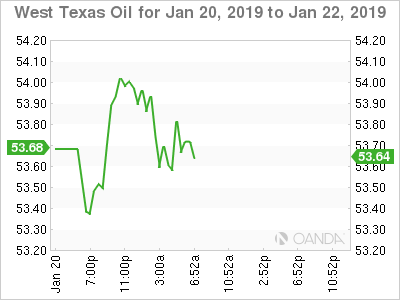
2. Oil reaches 2019-high on strong China crude use, gold steady
Crude prices rallied to an intraday day high overnight after data showed refinery processing in China, the world’s second-largest oil consumer, climbed to a record last year despite a slowing economy.
Brent crude oil futures are at +$62.75 per barrel, up +5c, or +0.1%, from Friday’s close. U.S West Texas Intermediate (WTI) crude futures are at +$53.87 a barrel, up +7c, or +0.1%.
New high intraday prints came after data released by China’s National Bureau of Statistics, earlier this morning, showed crude oil refinery climbed to a record +603.57M tonnes in 2018, or +12.1M bpd, up +6.8% y/y. This morning numbers came despite China’s 2018 economic growth slowing to the weakest in nearly 30years, at +6.6% vs. +6.8% in 2017.
The combination of production cuts by OPEC+, especially the Saudis, and tightening sanctions on Iranian oil exports is bringing the market close to equilibrium.
OPEC+ indicated last week that they had cut oil output sharply in December 2018 before a new accord to limit supply took effect on Jan. 1. This would suggest that the main producers have made a strong start to avoid creating a supply glut in 2019. In its monthly report, OPEC’s oil output fell by -751K bpd in December to +31.58M bpd, the biggest month-on-month drop in 24-months.
Also, a surge in U.S crude output is undermining most of OPEC’s efforts – U.S output has increased by more than +2M bpd in the last 12-months to +11.9M bpd.
Note: OPEC has cut its forecast for daily demand this year to +30.83M bpd, down -910K bpd from last year’s average.
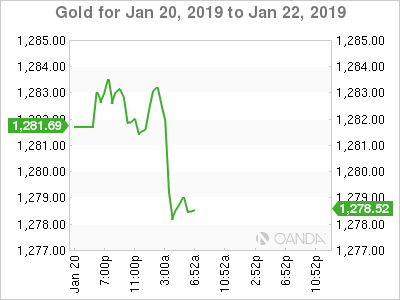
Ahead of the U.S open, gold prices are holding steady as expectations that the U.S Fed would pause its multi-year interest rate hike cycle were offset by improving risk appetite. Spot gold is up +0.1% at +$1,282.80 per ounce, while U.S gold futures were steady at +$1,282.10 an ounce.
3. German Bunds selloff pauses as Chinese growth hits new low
German Bund yields have edged lower in the Euro-session as signs of an economic slowdown in China, Washington’s partial Government shutdown and Brexit worries kept investors wary and strengthened the bid for safe assets such as Bunds.
Note: Signs of further cooling in China are fuelling market worries about risks to the world economy and are weighing on corporate profits.
German 10-year government Bund yields, dipped to +0.256%, coming off a one-month high of +0.276%t hit on Friday.
Other euro zone yields are a tad flatter or a touch lower. Last week, that 10-year Bund yield recorded its biggest weekly rise since early November on growing hopes that Britain was heading towards a “soft Brexit.”
Elsewhere, U.S 10-years are trading atop of +2.76%, while the U.K’s 10-year Gilt yield has declined -2 bps to +1.328%, while Italy’s 10-year BTP yield has climbed less than -1 bps +2.731.
4. U.S dollar confined to tight ranges
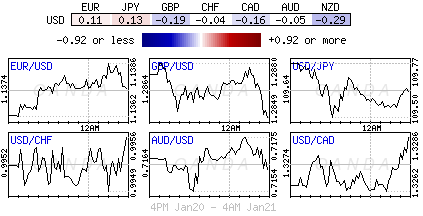
The USD is little changed in a quiet session with U.S markets closed for MLK Day. Expect market participants to be focusing on today’s Brexit outcomes as well as Sino-U.S trade talks.
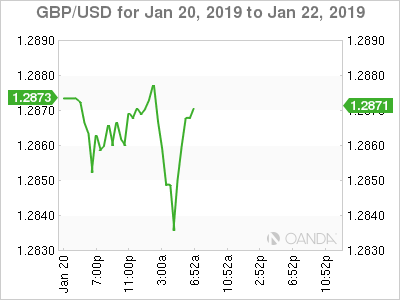
GBP/USD (£1.2849) continues to move off its recent test of the psychological £1.30 handle as high uncertainty was likely to prevail in markets because the current situation regarding the UK’s plan to leave the EU did not appear to be any closer to a solution.
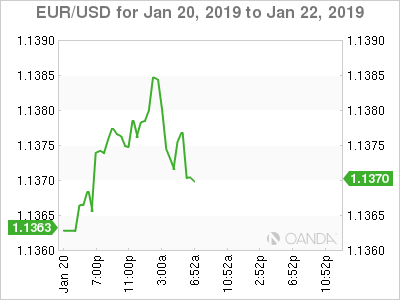
EUR/USD (€1.1378) remains very quiet, with many preferring to look ahead to Thursday’s ECB meeting for direction. The Draghi press conference will again be the markets primary focus, especially given the recent worries of continued weak economic data for the region.
USD/JPY (¥109.63) is holding just below the psychological ¥110 level with recent JPY currency weakness attributed to optimism on the US-China trade front.
5. China data disappoints
China data overnight announced that its official economic growth came in at +6.6% in 2018 – nearly the slowest pace in three-decades.
The disappointing headline print was not a surprise to many considering the ongoing trade dispute with the U.S, its largest trading partner.
Market expectations were looking for a lower headline print to 2017’s +6.8% pace and +6.6% topped many expectations.
Digging deeper, Q4 GDP growth was +6.4%, matching expectations and was a decline from the +6.5% year-over-year growth in Q3, 2018.
There were a number of good areas – Industrial output (IP) grew +5.7% in December from a year earlier, beating expectations of +5.3% growth and outpacing November’s +5.4% growth.
Retail sales data rallied +8.2% in December on-year, in line with a forecast and up from November’s +8.1% gain.