Sample Category Title
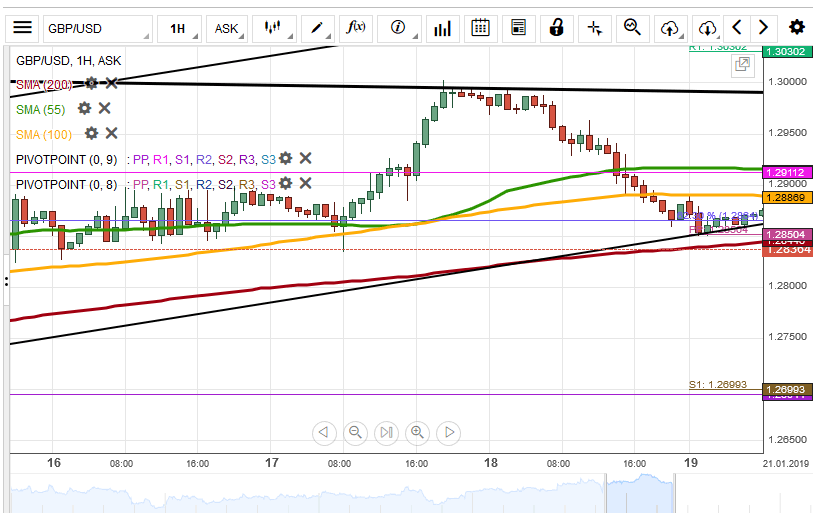
GBP/USD Depreciates To 1.2850
During the previous trading session, the British Pound depreciated against the US Dollar, breaking most of the technical indicators. On Monday morning, the currency exchange rate was trading above the 62.30% Fibo at the 1.2867 mark.
In regards to the near-term future, the rate will be retraced by the 55-hour simple moving average and the monthly R1 at 1.2911 to push the rate to the 1.2800 level.
On the other side, the rate could be supported by the 200-hour simple moving average and the weekly pivot point at 1.2850 to push the rate to break the monthly R1 to trade at the 1.2900 level.
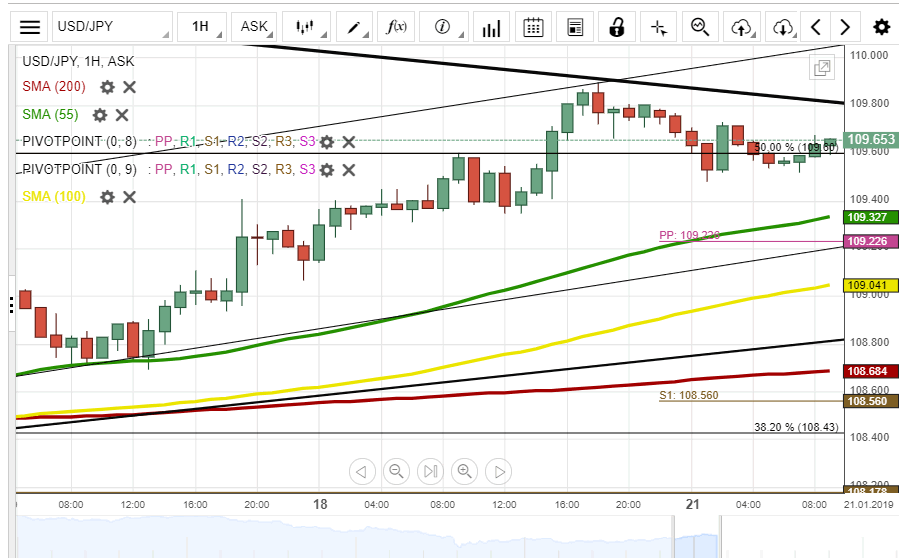
USD/JPY Is At 50.00% Fibo
During the previous trading session, the rate was retraced by the upper boundary of the descending dominant pattern line at 109.90. On Monday morning, the US Dollar was trading at the 50.00% Fibo at the109.58 mark.
In regards to the near-term future, most likely, the rate will be trading at the 109.40 level during the day. In addition, It is expected that the currency exchange rate will reach the dominant pattern line at 109.80.
Besides, the 55-hour simple moving average will try to catch the rate to give additional support for the rest of the trading session.
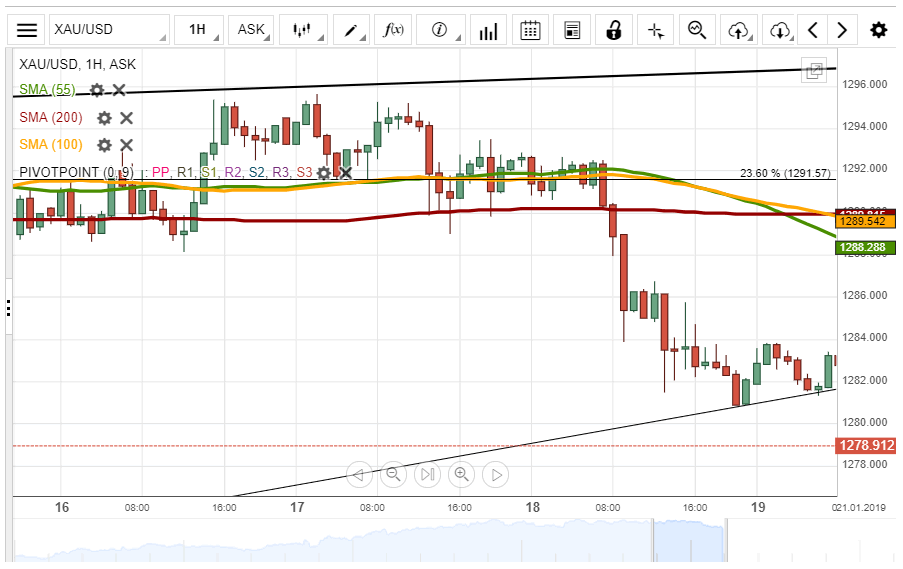
XAU/USD Drops To 1,282.00
Since Friday's trading session, the yellow metal depreciated against the US Dollar by 831 pips or 0.64% to place the rate at the 1,282.50 mark.
In regards to the near-term future, the gold will trade towards the 1,286.00 level, where it could be retraced by the simple moving averages to stay at the 1,284.00 level.
On the other hand, during the trading session, the yellow metal could depreciate towards the 1,275.00 level.
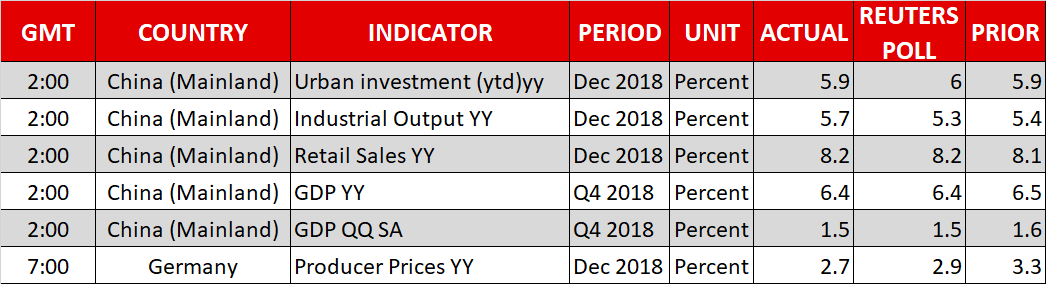
Chinese Economy Shows Signs of Stabilization in Late 2018. More Challenge Ahead
The latest set of macroeconomic data for China shows signs of stabilization. This could be attributed to the government's expansionary policies both monetarily and fiscally. While the government is expected to add more stimuli this year, the challenge remains tough.
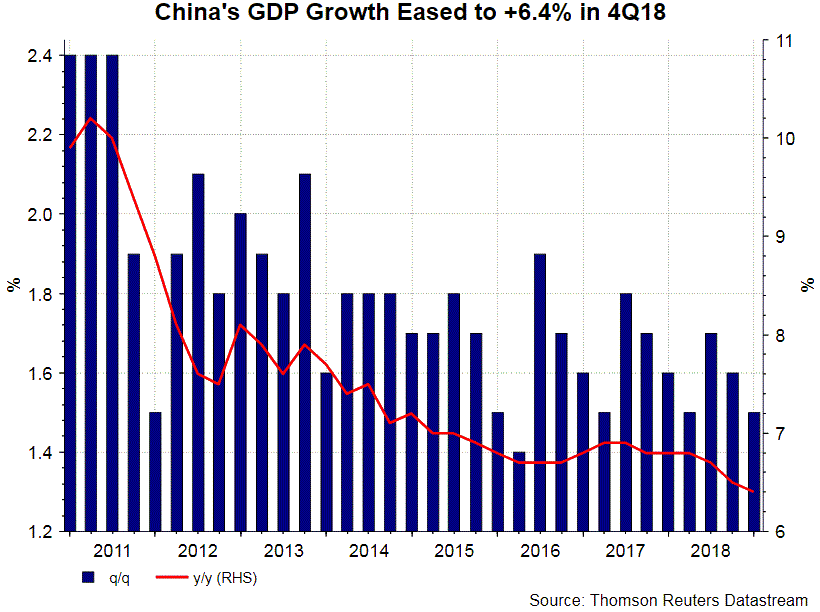
GDP growth eased to +6.4% y/y in 4Q18, from +6.5% a quarter ago. Year-over-year growth has been decelerating every consecutive quarter since 1Q18. For 2018 as a whole, economic growth eased to +6.6%, from +6.7% in the prior year. Struggling with softening domestic demand and ongoing trade war with the US, growth would continue to slow down this year. The IMF expects growth to weaken further to +6.2%, while the World Bank forecasts it to ease to +6.5%. Meanwhile, the government is expected to turn more cautious when it announces the annual growth target. It likely lowers its growth target to 6-6.5%, from “around 6.5%” in 2018.
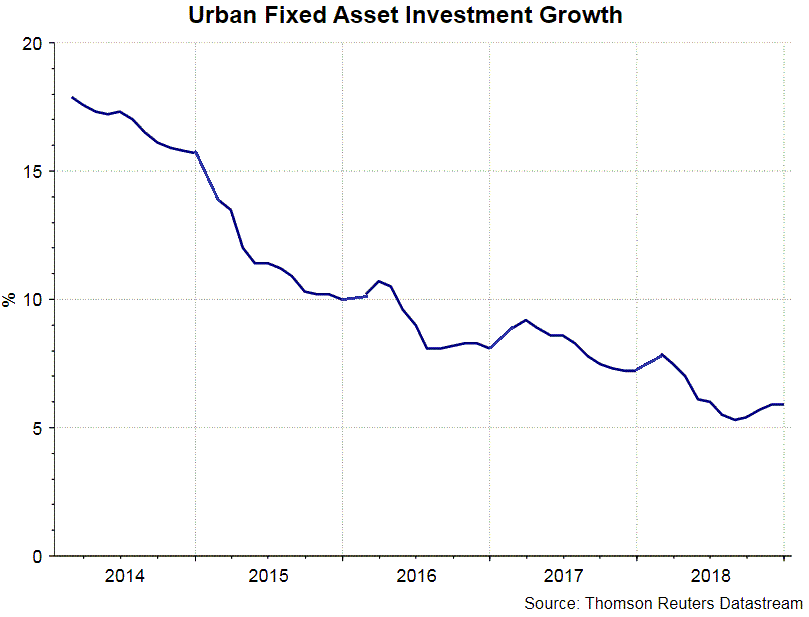
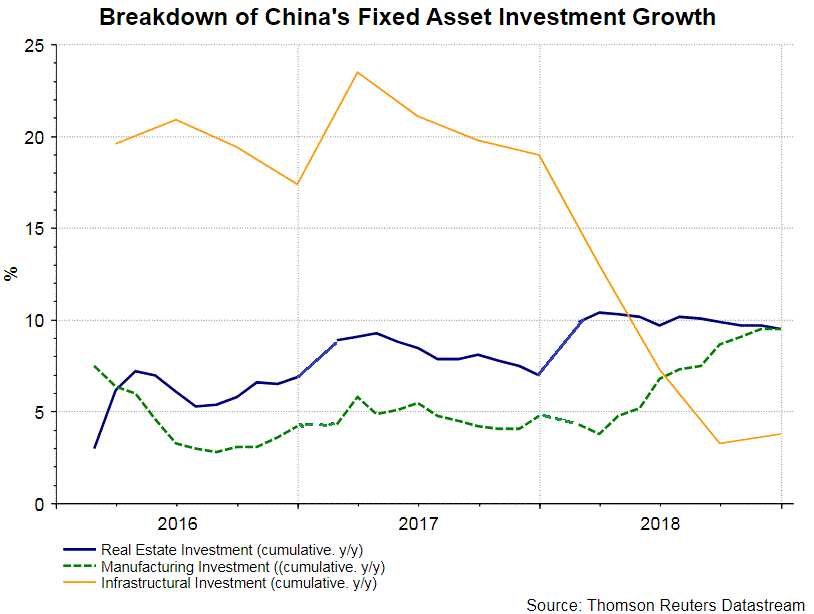
Urban fixed asset investment expanded +5.9% y/y in December, missing consensus of +6% but better than +5.9% in the first 11 months of the year. In short, the rebound in infrastructure investment was offset by a moderation in real estate. Looking into details, real estate investment remained the biggest growth driver but the pace has been stagnant since early 2018. In 2018, real estate investment in China expanded +9.5% y/y, down from +9.7% in the first 11 months of the year. Investment in manufacturing activities continued to improved, with growth rate also at +9.5% last year. Growth in infrastructural investment recovered to +3.8%. This marks the first recovery since 2017. The National Development and Reform Commission (NDRC) has been accelerating approval of infrastructural project. We expect the trend would continue this year, as the government seeks to stabilize the economy.
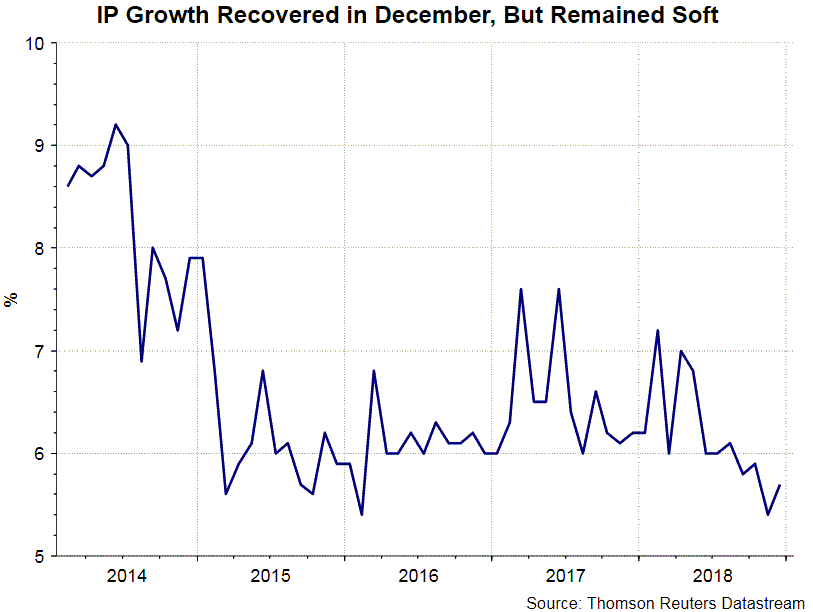
Industrial production recovered to +5.7% y/y in December, from +5.4% a month ago. This also beat consensus of +5.4%. Recall, however, that the pace is the second lowest since November 2015. The strength in December was mainly driven by the mining sector, cement and power generation. Retail sales growth climbed slightly higher to +8.2% y/y, from +8.1% in the prior month. The detailed report suggests that consumers have turned more cautious in their spending behavior. The decline in auto sales (-8.5% y/y) probably reveals hesitation in making consumption in luxurious items.
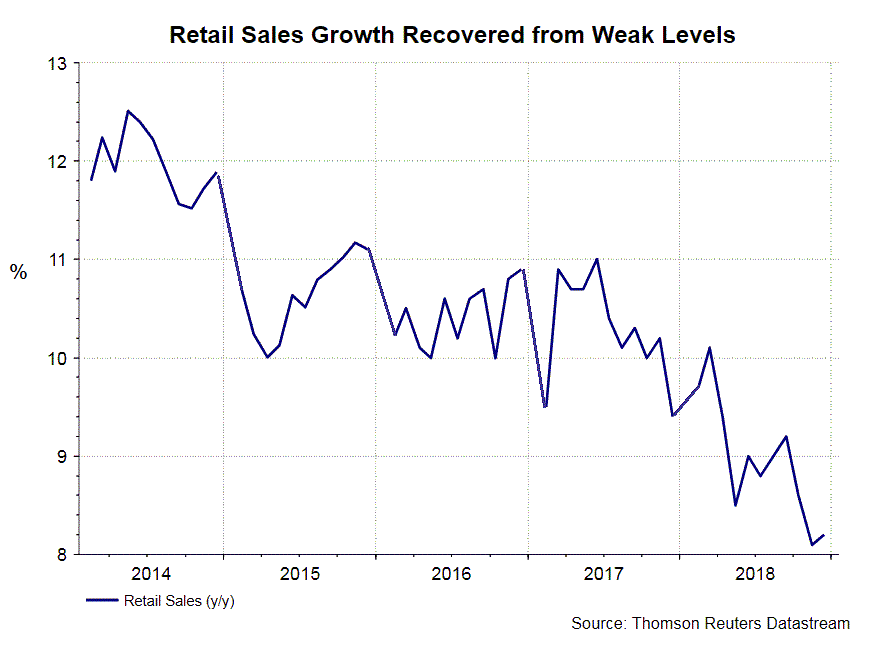
China’s growth slowdown appears to have stabilized, as shown in the latest set of macroeconomic data. However, the challenge is here to stay. Although it is widely believed some sorts of trade deal could be reached between the US and China, other crucial issue concerning intellectual property and transfer of technology requires lengthy negotiations. We do not expect a deal on these aspects to materialize soon. It is likely that more and more countries would announce to ban the use of “made in China” electronic products. Chinese companies engaged in elated business would be facing a difficult time. we would not be surprised to hear more closure or loan defaults from these companies.
GBP/USD Outlook: Bearish Outside Day Adds To Negative Outlook Ahead Of PM May’s Reveal Of Brexit’s Plan B For
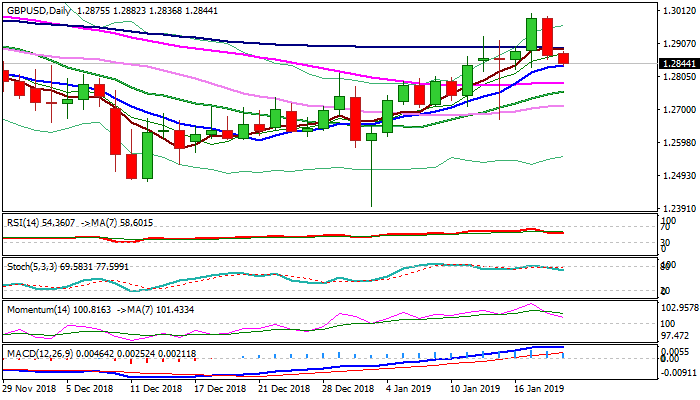
Cable ticked lower in early European trading, after narrow-range trading in Asia on Monday, but remains at the back foot following Friday's 0.9% fall after repeated rejection at psychological 1.30 barrier.
Sterling was hit by weak UK retail sales data on Friday which added to Brexit uncertainty, ending day firmly in red and generating negative signals on formation of bearish outside day pattern and daily close below 100SMA (1.2892).
Fresh extension lower penetrated daily cloud (cloud top lays at 1.2866) and cracked 10SMA (1.2840), also top of rising 4-hr cloud, which is narrowing and could attract bears, showing scope for test of next pivotal support at 1.2800 (Fibo 38.2% of 1.2476/1.3000).
Momentum and slow stochastic on daily chart created bear-crosses and head south, supporting negative scenario.
Also, last week's close in long-legged Doji signals strong indecision and suggests that recovery off 1.2476 low might be running out of steam.
Negative near-term sentiment is maintained by Brexit concerns as PM May is due to reveal the ‘plan B'to the UK parliament later today, after her proposal for Brexit was heavily defeated last week.
Several scenarios over Brexit are on the table, but rising uncertainty is expected to keep sterling under pressure.
Sustained break below 1.2800 Fibo support would signal deeper pullback and expose 1.2735 (daily cloud base / 50% retracement of 1.2476/1.3000).
Only return and close above daily cloud top would ease bearish pressure, but lift above 100SMA is needed to neutralize.
Res: 1.2866, 1.2892, 1.2953, 1.3000
Sup: 1.2800, 1.2781, 1.2758, 1.2735
Forex Technical Analysis: EUR/USD, USD/JPY, GBP/USD
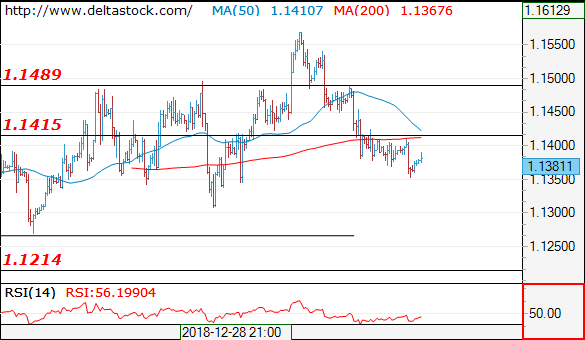
EUR/USD
Current level - 1.1381
The downtrend is intact, heading towards 1.1310 and a violation pf the latter is expected to challenge 1.1214 low. Crucial on the upside is 1.1415 high.
| Resistance | Support | ||
| intraday | intraweek | intraday | intraweek |
| 1.1415 | 1.1630 | 1.1310 | 1.1214 |
| 1.1540 | 1.1820 | 1.1260 | 1.1100 |
USD/JPY
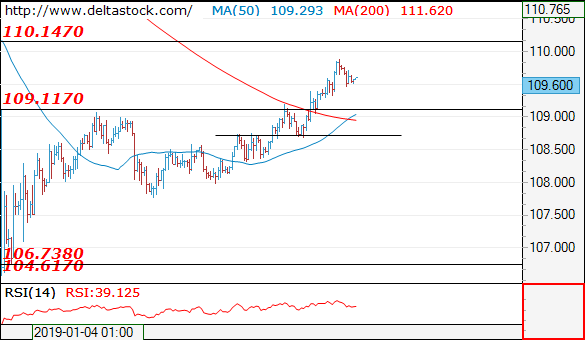
Current level - 109.60
The bias remains positive, for a tight test of 110.20 resistance area. Crucial static support lies at 109.10.
| Resistance | Support | ||
| intraday | intraweek | intraday | intraweek |
| 110.20 | 111.45 | 109.10 | 106.70 |
| 110.20 | 112.20 | 108.65 | 104.60 |
GBP/USD
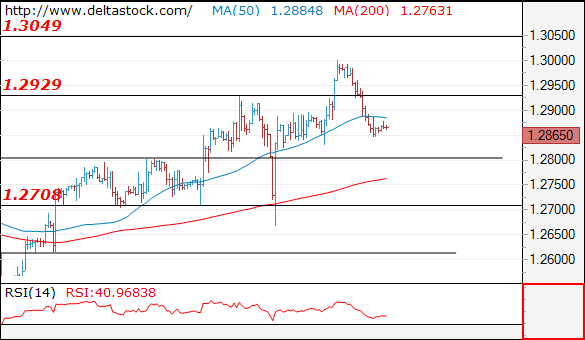
Current level - 1.2865
The return below 1.2930 signals a reversal at 1.3000 and the bias is bearish, for a slide towards 1.2800, en route to 1.2710. Key intraday resistance lies at 1.2930.
| Resistance | Support | ||
| intraday | intraweek | intraday | intraweek |
| 1.2930 | 1.3050 | 1.2800 | 1.2420 |
| 1.3050 | 1.3250 | 1.2710 | 1.2340 |
Elliott Wave Analysis: EUR/USD Update
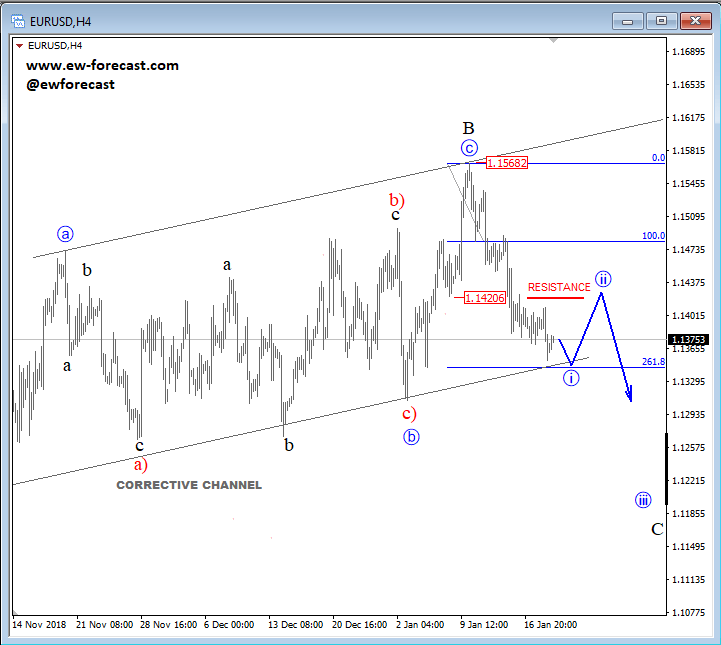
EURUSD is nicely trading lower, now breaking below the 1.142 bearish level which indicates a completed correction and a minimum three-wave drop in play. At the moment we see price unfolding wave i of C, which can look for support and a temporary corrective recovery near the Fibonacci projection zone of 261.8 and at the lower channel line.
EURUSD, 4h
German Maas: Ball is in London and there is not a lot of time left
German Foreign Minister Heiko Maas has urged the UK to come back with concrete proposal on solving the Brexit deadlock in its parliament. He tweeted that "So far, unfortunately, the British Parliament has only said what it does not want. What we need now are concrete proposals from the British. The ball is in London, there is not a lot of time left. We #Brexit will also be talking about this in Brussels today. "
https://twitter.com/HeikoMaas/status/1087268323635707904
Separately, German Economy Minister Peter Altmaier said "Personally I'm optimistic that we can avoid a hard Brexit but the German government is of course prepared for all possible scenarios."
Ireland's European Affairs Minister Helen McEntee said today Ireland wont' engage in bilateral negotiation with the UK on the Irish border backstop issue. She said, "What we can't do and what we won't do, because we have not throughout this entire process, is engage in any kind of bilateral negotiations with the DUP or any other political party in Northern Ireland or the UK. This is a negotiation between the EU and the UK."
USD Holds Steady Despite China’s Slowdown
The USD remained steady against a number of currencies, despite the Chinese economy slowing down as expected. Hopes for an improvement in the US-Sino trading relationships seem to rise as the slowing Chinese GDP growth rate could add further pressure for an agreement. Focus is being turned towards the visit of the Chinese Vice Premier Liu He to the US, near the end of the month. Also it should be noted that some early signs about a possible ending of the US government shutdown are visible, however remain to be proven. Analysts point out that the USD may be in a recovery mode, after the bad start it had early this month. We could see the USD experiencing lower volatility today as the US markets are closed for Martin Luther King Jr. day. EUR/USD dropped on Friday breaking the 1.1387 (R1) support line now turned to resistance and bounced on the 1.1350 (S1) support line. We maintain a bearish outlook for the pair and for our opinion to change we would require the pair’s price action to break the downward trendline incepted since the 10th of January. Should the bulls take over we could see the pair breaking the prementioned downward trendline and the 1.1387 (R1) resistance line, aiming for the 1.1425 (R2) resistance hurdle. Should the bears remain in charge, we could see the pair breaking the 1.1350 (S1) support line and aim for the 1.1305 (S2) support barrier.
UK: Cross party negotiations do not seem to bring results
The pound braces for Theresa May laying out her alternative plan regarding Brexit, today in the UK Parliament, however little change is expected. Over the following week, the UK parliament will be able to propose alternatives and the Parliament is expected to vote on them on the 29th of January. Cross party negotiations seem to have produced little results according to media, hence we see the case for the UK government to concentrate its efforts in altering the Irish backstop clause of the agreement. According to media, the EU seems to be split on whether to delay Brexit and Germany’s Merkel warned the EU that a compromise may be needed. We expect the pound to maintain a bearish sentiment as uncertainty continues. Cable dropped on Friday, breaking the 1.2960 (R2) support line (now turned to resistance), the upward trendline incepted since the 3rd of January and the 1.2880 (R1) support line (now turned to resistance), hovering below it during today’s Asian session. We could see the pair maintaining a sideways motion for today, however some bearish tendencies could occur as negative headlines for Brexit may emerge. Should the market favour the pair’s long positions, we could see it breaking the 1.2880 (R1) resistance line and aim for the 1.2960 (R2) resistance level. Should the pair come under the selling interest of the market, we could see it breaking the 1.2795 (S1) support line.
Today’s other economic highlights
In a quiet Monday in the European session we are getting the Germany’s Producer Prices growth rate for December.
As for the rest of the week:
On Tuesday, we get UK’s employment data for November, Germany’s ZEW economic sentiment for January and New Zealand’s CPI rates for Q4. On Wednesday, Japan’s trade data for December ,BoJ’s interest rate decision, Canada’s retail sales growth rate for November and Eurozone’s preliminary consumer confidence for January, are due out. On a busy Thursday, we get Australia’s employment data for December, a number of preliminary PMI’s for the Eurozone, from Norway Norgesbank’s interest rate decision, ECB’s interest rate decision and from the US the preliminary Markit Mfg PMI for January. On Friday, from Germany we get the Ifo business climate for January, and from the US the durable goods orders growth rates for December.
GBP/USD H4
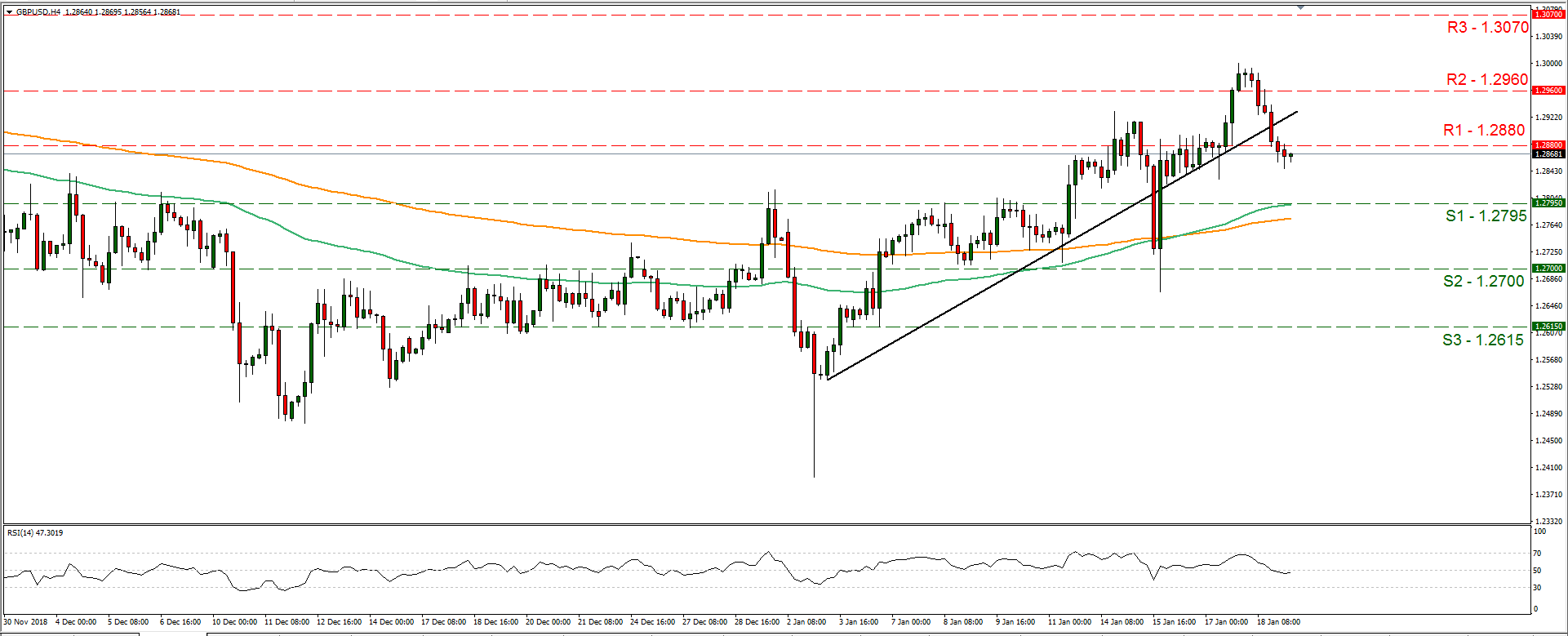
Support: 1.2795 (S1), 1.2700 (S2), 1.2615 (S3)
Resistance: 1.2880 (R1), 1.2960 (R2), 1.3070 (R3)
EURUSD H4
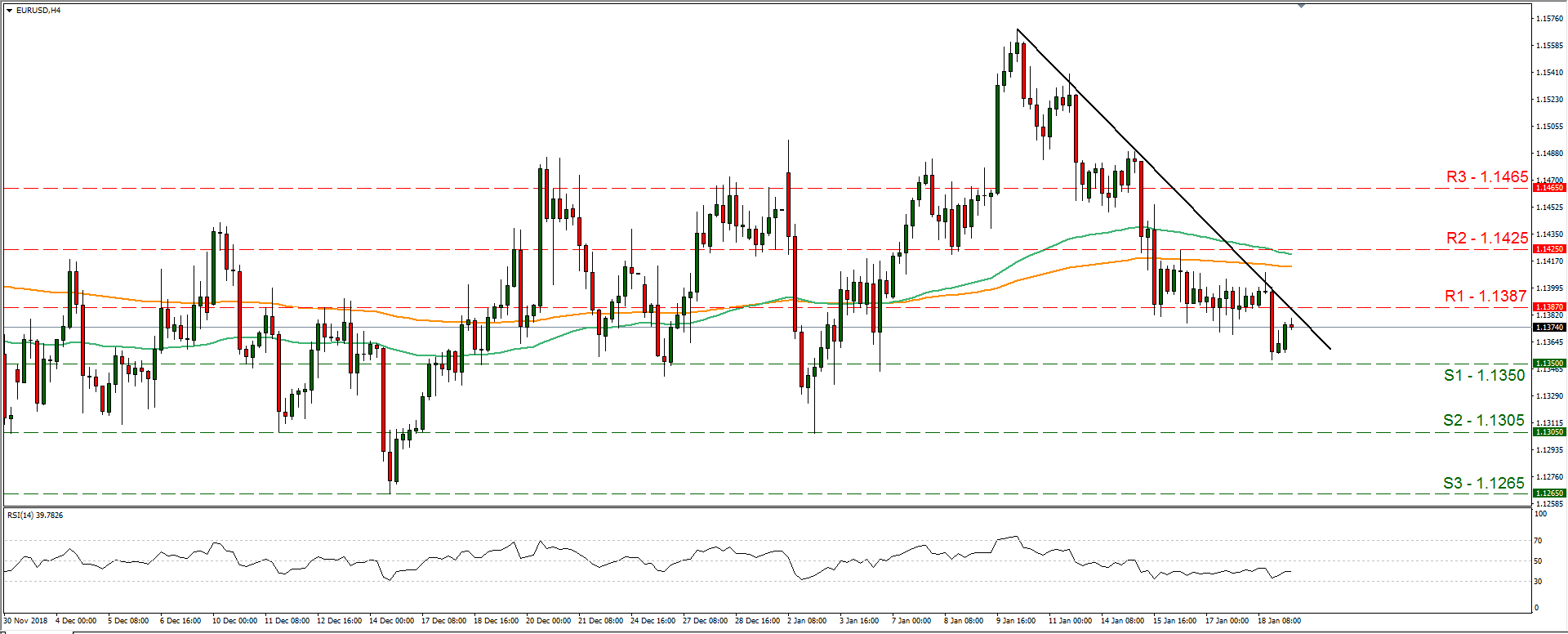
Support: 1.1350 (S1), 1.1305 (S2), 1.1265 (S3)
Resistance: 1.1387 (R1), 1.1425 (R2), 1.1465 (R3)
Stocks Extend Trade Gains, Brexit Saga Continues
- Reports China is willing to buy more US goods keep risk appetite buoyed
- Euro/dollar eyes keep support area, looks to Thursday’s ECB meeting
- Today, focus turns back to the UK; PM May presents her alternative Brexit plan
Fresh trade headlines propel stocks even higher, yen retreats
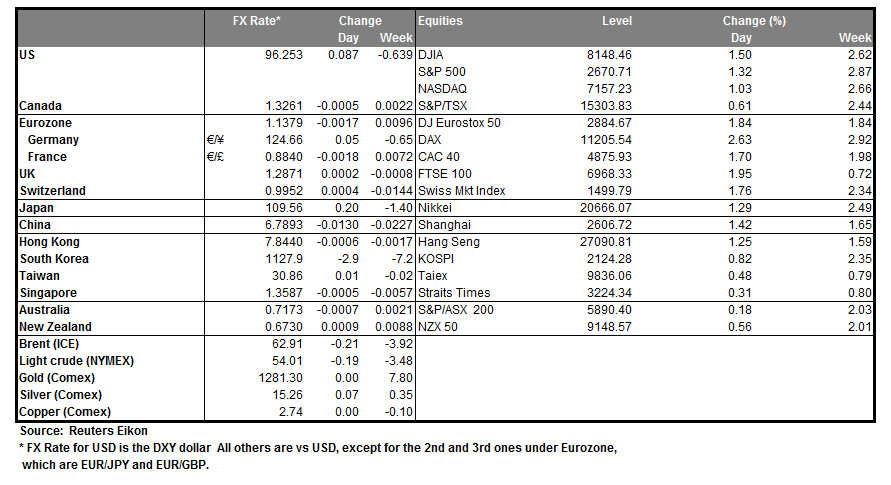
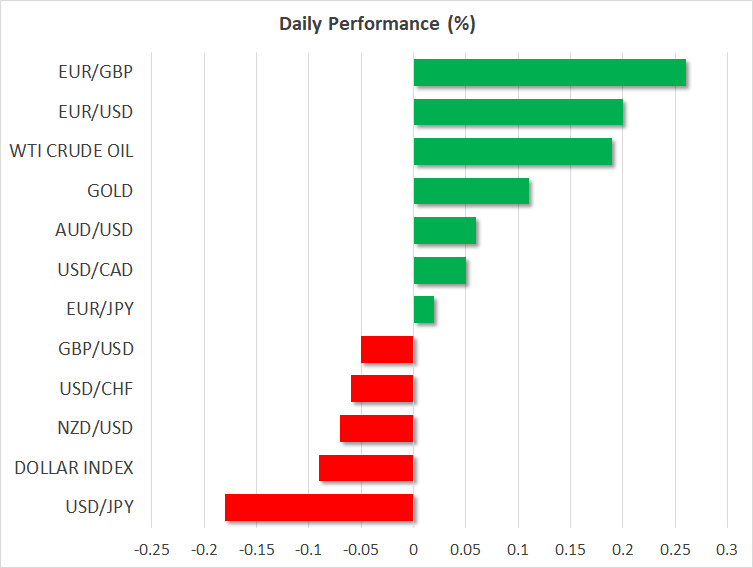
US equity markets recorded another round of sizeable gains on Friday, with the likes of the S&P 500 (+1.32%) and the Dow Jones (+1.38%) establishing further distance above their respective 50-day moving averages. Meanwhile, safe-haven assets such as the Japanese yen and gold surrendered ground. The moves were fueled by fresh reports that China offered to boost its imports of US goods by a combined $1 trillion over the next six years, to eliminate the bilateral trade deficit between the two economies by 2024.
Markets interpreted this as yet another sign that a trade deal is inching closer, particularly since such a move would simultaneously appease President Trump’s deficit concerns and allow him to present his voting base with a “victory” ahead of the 2020 elections. Yet, sentiment has turned around a little on Monday, with futures tracking the major US stock indices pointing to a negative open, following overnight news that the US Treasury saw little progress on intellectual property issues during these talks. GDP data out of China earlier showing the weakest growth in a decade may have contributed too.
Euro/dollar hovers above key support area, looks to ECB meeting
The world’s most trade currency pair drifted lower on Friday as the US dollar received support from an uptick in US bond yields, though the pair is recovering those losses today. The technical picture of euro/dollar is particularly interesting, as the next few sessions will determine whether the bias is to the upside, or neutral. Specifically, the pair seems ready to test an uptrend line drawn from the lows of November. A decisive break below it would mark a lower low on the daily chart, signifying that the trend is sideways, whereas a rebound would keep the structure of higher lows intact, painting a positive picture.
In terms of fundamental catalysts that could cause such a break, or rebound, the most important one will probably be the ECB meeting on Thursday. The latest comments by ECB officials suggest a clear shift in tone towards a more cautious direction, so it will be interesting to see to what extent this is reflected at the actual meeting. Eurozone’s preliminary PMIs due on Thursday or a potential solution to the US government shutdown could also prove crucial for euro/dollar’s forthcoming direction.
Brexit saga continues, PM May to present “plan B” to Parliament
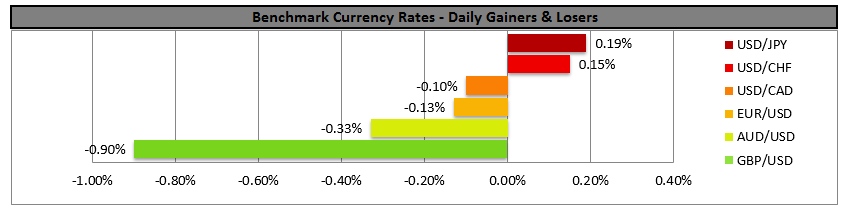
The British pound was the worst performer among its G10 peers on Friday and is also on the back foot today, as speculators likely cut some of their exposure to the British currency ahead of a key Brexit risk event today. Following the overwhelming rejection of the government’s Brexit deal last week, the Prime Minister is expected to present an alternative plan to UK lawmakers later today on how she intends to proceed with the exit process.
Admittedly though, it’s difficult to envision a scenario under which she manages to find a majority in the Commons for any plan she proposes, so political uncertainty – and hence volatility in the pound – are set to remain elevated. Overall, while recent moves by Parliament to ensure a no-deal outcome is avoided are keeping a floor under sterling, for the next leg higher to materialize, it may require a major positive development, such as Article 50 being extended.