Sample Category Title
EURUSD Intraday Analysis
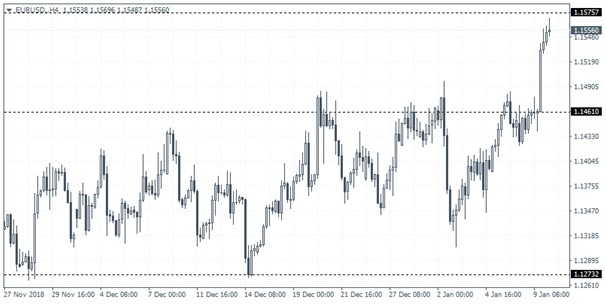
EURUSD (1.1556): The EURUSD currency pair finally broke out to the upside from the resistance level of 1.1461. Price action is seen attempting to test the next upper level at 1.1575 where resistance is likely to be established. In the near term, there is scope for the euro to erase the gains and retest the breakout level at 1.1461 to establish support. This could potentially pave the way for further gains to the upside. Alternately, a breakout above 1.1575 could keep the bullish momentum going in the euro currency.
China’s Data Release Shows Further Easing Of Headline Inflation
The U.S. dollar eased as some Fed members commented that the central bank should be patient in hiking interest rates. Similar views were echoed from the release of the FOMC meeting minutes on Wednesday. A weaker USD currency sent most of its peers to rally on the day.
Germany's trade deficit was seen widening in November due to a fall in imports and exports as well. Non-adjusted trade surplus rose 20.5 billion in November as data from the Federal Statistical Office showed on Wednesday.
Inflation data from Switzerland indicated that consumer prices slowed to the lowest level in 10-months. Consumer price index increased 0.7% on the year, slowing from 0.9% in November and missed forecasts of a 0.8% increase.
From Canada, the housing starts report showed a slowdown in December but was able to beat the market expectations. Housing starts for December were seen at a seasonally adjusted annualized rate of 312,419 units, or down 4.8% from November.
The Bank of Canada held its monetary policy meeting and kept interest rates unchanged at 1.75%. The central bank reiterated that monetary policy path was dependent on incoming data and cited the weak oil prices. Growth forecasts for 2019 were lowered.
China's inflation data released earlier today showed that headline inflation eased further, rising just 1.9% on an annualized basis in December. This was below estimates and data showed that consumer price index slowed from 2.2% in November. Producer price index data was also weaker, rising just 0.9% on the year compared to 2.7% in November.
The European trading session is relatively quiet for the most part today, save for the ECB's monetary policy meeting minutes. The ECB minutes come from the December meeting where the ECB announced an end to its QE program.
The NY trading session will see the Fed Chair, Jerome Powell speaking alongside other Fed members including James Bullard and Evans.
USDJPY Erases Gains After Hitting A Wall At 109
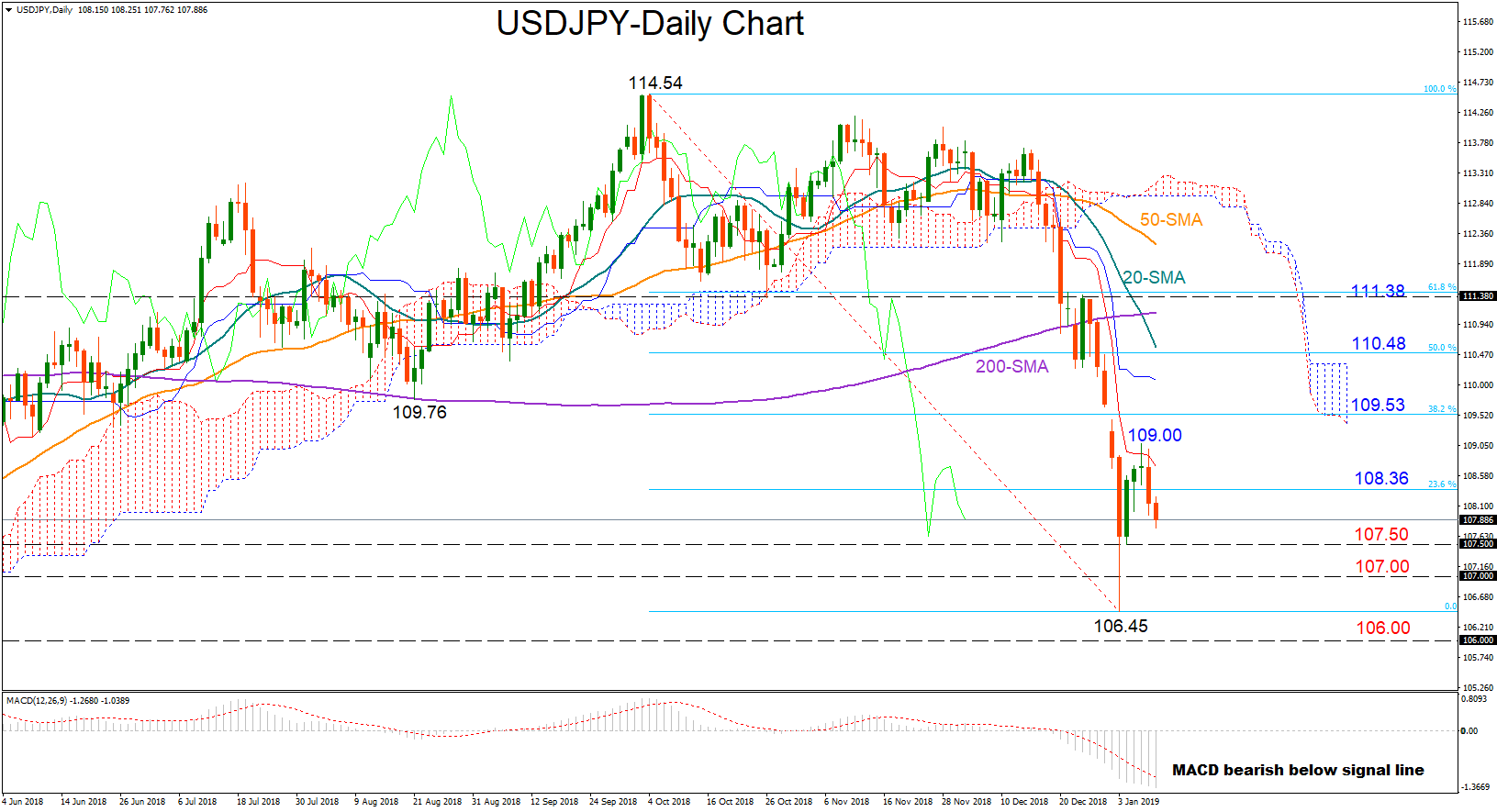
USDJPY is recording its second day of losses after a failed attempt to break significantly above the 109 round level on Tuesday. Chances for a reversal, however, are decreasing as the 20-day simple moving average dropped below the longer-term 200-day MA after six months, while the red Tenkan-sen line has a steeper negative slope now, suggesting that the next move in the price is more likely to be down. The MACD continues to strengthen to the downside and below its red signal line, supporting this view as well.
Another step lower may reach a key support at 107.50, where the price stopped last Friday. Should this prove a weak obstacle, the selling could pick up speed until the 106.45 bottom, where any violation would bring more pressure to the market with the price probably stretching further down to test the 106 and 105 marks.
Alternatively, in case of a rebound, immediate resistance could come from 108.36, the 23.6% Fibonacci of the downleg from 114.54 to 106.45 before the focus shifts to the 109 barrier again. Higher, the 38.2% Fibonacci of 109.53 could also restrict upside movements, though only a close above the 50% Fibonacci of 110.48 would confirm the start of an uptrend.
In the medium-term picture the pair is still increasingly bearish as long as it holds well below 111.38, the October 26 low, and more importantly under the 200-day MA, which is still rising.
Rally Losing Momentum Despite Trade Hopes & Dovish Fed
Investors have kicked off 2019 in a positive mindset. The S&P 500 rallied duringfive out of the past six trading days booking 3.1% gains so far, and the index is up more than 10% from its December lows. The MSCI World Index saw a similar performance rallying 3.6%, and credit spreads have narrowed significantly especially on high-yield bonds supporting the risk-on environment. Oil prices entered a bull market yesterday after gaining around 5% on hopes that Beijing and Washington are moving in the right direction to end their trade dispute. Meanwhile, the Chinese Yuan leapt to a 5-month high.
The impressive comeback in risk appetite indicates that investors were a little too pessimistic in December and that growth outlook isn’t as gloomy as some might think. However, it’s still early to judge.
The three-day talks between U.S. and Chinese officials played a significant role in calming the markets. There were clear signs of progress in terms of moving towards higher levelsof negotiations that could lead to some sort of agreement before March 2,ahead of the90-day truce window. Despite this positive environment, nothing should be taken for granted. Trump’s demands are difficult to meet and talks may break down at any moment.
Probably, that’s why the rally in equity markets seems to have taken a pause on Thursday with Asian markets struggling to find direction and U.S. equity futures pointing towards a lower open.
The FOMC minutes released on Wednesday showed that some policymakers were reluctant to hike rates in December, given the volatility in financial markets and week inflationary pressures. The minutes revealed that the consensus wasmore dovish than Fed Chair Powell’s assessment during the press conference. Fed members saw the risks ofthe outlook to be “roughly balanced”, but some noted that “downside risks may have increased of late”.
The Dollar fell further after the minutes werereleased on expectations that interest rates may be raised only once or not at all in 2019. This should continue to add pressure on the Greenback, unless economic data begins to surprise to the upside.
Currencies: Dollar Decline Accelerates. EUR/USD Clears 1.15 Resistance.
- Rates: Easy part of risk rebound over?
FOMC Minutes and speeches by more Fed governors cement the US central bank’s new narrative of “patience” in the tightening cycle. This message should be by and large discounted. The easy part of the risk rebound seems to be over. Core bonds might stabilize or even gain some ground. The US’s 30-yr bond auction is a wildcard. - Currencies: Dollar decline accelerates. EUR/USD clears 1.15 resistance.
The USD lost further ground as Fed governors and the Minutes of the December Fed meeting indicated that the US currency won’t get additional interest rate support anytime soon. EUR/USD cleared a first technical barrier illustrating a change in investors’ assessment on the dollar. Sterling also ceded ground as the government is losing grip on the Brexit process
The Sunrise Headlines
- US equity markets gained ground yesterday for a fourth consecutive day as risk sentiment remained positive. Technology shares outperformed. Asian equities are trading mixed with Japanese indices underperforming.
- The Bank of Canada kept its policy rate unchanged at 1.75%. They added “over time” in their forward guidance that policy rates will need to rise to neutral, but overall didn’t really sound too worried about the outlook
- US President Trump walked out of a meeting with Democrats, calling it “a total waste of time”, as Democrats still won’t agree to include wall funding in the budget. The US government remains (partially) shut, already lasting 19 days.
- The minutes of the Fed December meeting showed that more and more governors think that the bank can afford to be patient about further policy tightening, a message confirmed yesterday by different governors.
- Saudi Arabia’s energy minister Khalid al Falih vowed to further stabilize the oil market as oil prices are cautiously rebounding after dropping by more than 40% in the fourth quarter last year. Brent crude oil rose back above $60/barrel.
- Chinese inflation dipped more than expected in December. CPI rose by 1.9% Y/Y down from 2.2% and PPI by 0.9% Y/Y, down from 2.7%. Softening demand and lower commodity prices are to blame.
- Today’s economic calendar contains weekly jobless claims, ECB Minutes and speeches by several Fed governors including chair Powell. France and the US tap the bond market
Currencies: Dollar Decline Accelerates. EUR/USD Clears 1.15 Resistance.
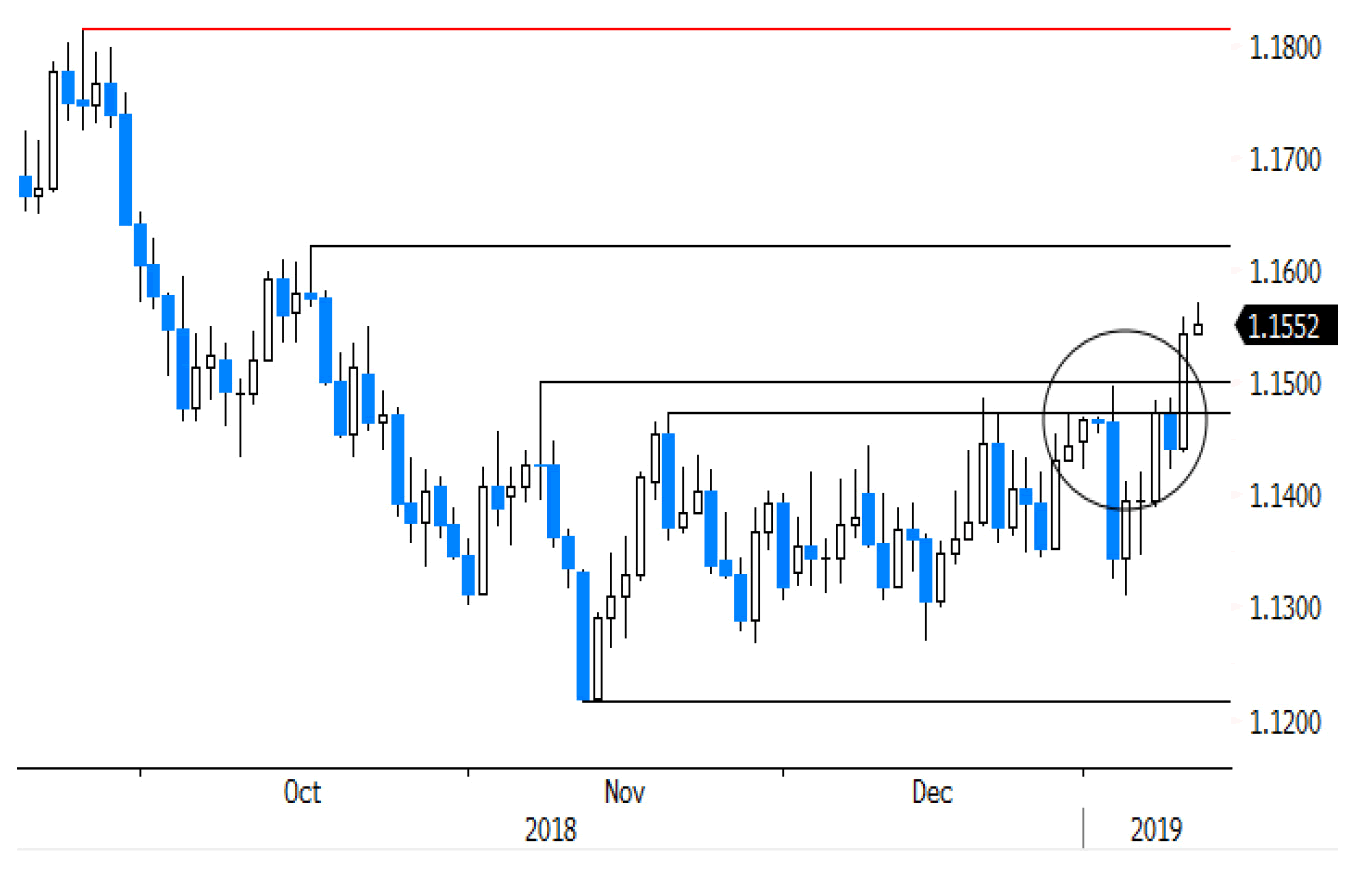
EUR/USD finally clears the 1.15 resistance
The dollar initially drifted sideways on Wednesday as there were few data in EMU and the US. Later in US dealings, the dollar started a new down-leg. Several Fed governors and the Minutes of the Fed December meeting indicated the Fed was likely to pause/slow normalization as it tries to assess the consequences of recent market volatility. Ongoing soft inflation gives the Fed additional room to manoeuvre. EUR/USD jumped above the 1.15 resistance that capped EUR/USD since early November. The pair closed at 1.1543 (from 1.1441) USD/JPY also drifted south even as risk sentiment remained fairly constructive. The pair finished the day at 108.17 (from 108.75). This morning, the risk rally is taking a breather as markets look for more details/results from the US-China trade talks. The impasse of the US government shutdown and an ever more chaotic Brexit process might be (minor) sources of investor caution. Asian equities show a mixed picture. Japan underperforms on a strong yen. USD/JPY dropped below 108. The yuan also accelerates (USD/CNY 6.79 area). EUR/USD (1.1555 area) continues trading with an upward bias. Later today, the eco calendar is again thin. Several Fed governors, including voters Clarida, Evans, Bullard and Fed Chairman Powell are scheduled to speak. They are expected to confirm that the Fed is shifting to a more cautious approach. The impact on markets/the dollar might become less as most of them already gave their view of late. Since end last week, the dollar already lost momentum and the decline accelerated yesterday, with EUR/USD clearing a first technical barrier. We had a cautious bias on the US dollar as it became clear that the US currency will get little interest rate support in the foreseeable future. The USD decline might slow if the risk rally were to lose momentum. Even so, we see no reason to row against the USD negative momentum. EUR/USD 1.1621 (mid-Oct top) is next reference.
Yesterday, UK PM May suffered another defeat in Parliament as the lower House is taking up an ever more important role in the Brexit process. The government losing its grip is an additional factor of uncertainty weighing on sterling. EUR/GBP rebounded north of 0.90. At some point, this process might lead to a Brexit delay or another scenario that might be considered more favourable for sterling. However, short term, visibility on the next Brexit steps is becoming even mistier. This might continue to weigh on sterling. EUR/GBP 0.91 is the next technical reference.
EUR/USD clears 1.15 resistance as Fed signals a slowdown in policy normalisation.
What’s Next For Cryptocurrencies?
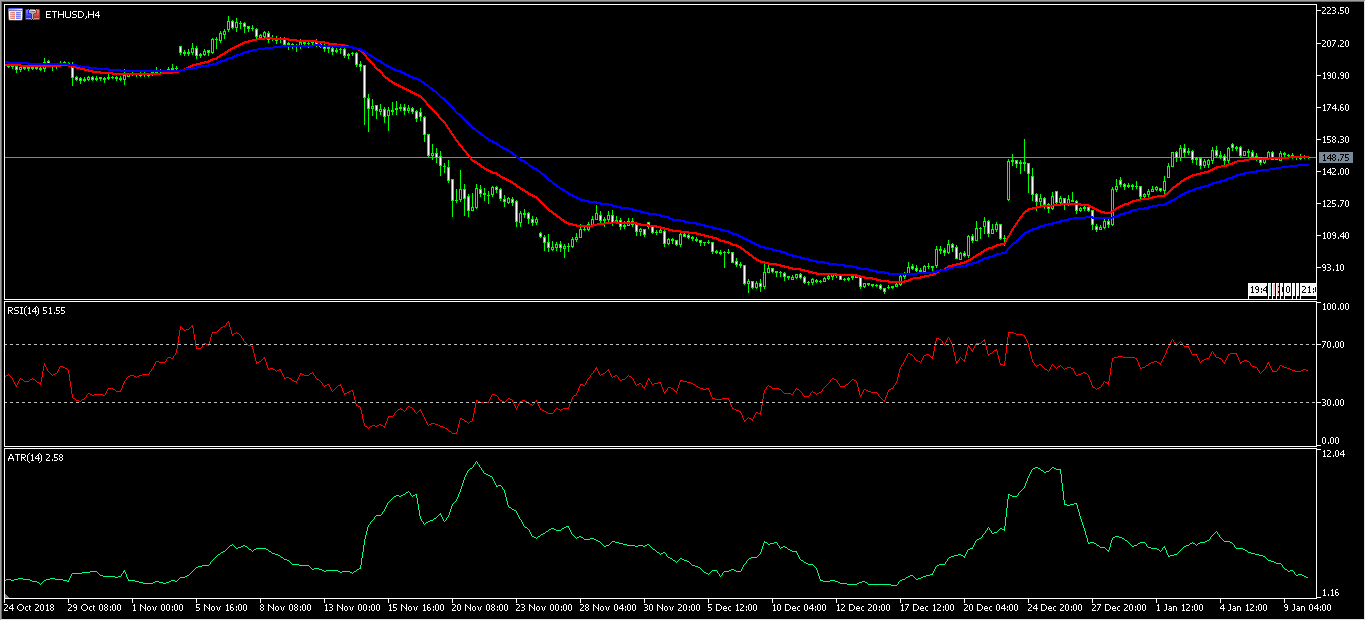
After gaining in the first week of the year, the price of cryptocurrencies has started to cool. Bitcoin remains slightly above the $4000 mark while that of Ethereum remains near the $150 level. This comes as investors consider the next stage for digital currencies.
Recently, major developments have happened in the industry. In December, it was reported that Facebook was developing a stablecoin that will help it monetize WhatsApp. The coins, which will be backed by the USD, will be integral in Facebook’s future because it will lead to revenue from WhatsApp, which it acquired for more than $20 billion. To date, the company has not been able to monetize the platform.
Tokenization will also play a more prominent role in trading. For instance, investors will be able to trade assets over the weekend when the markets are closed helping to remove limitations. Another advantage of this technology is that it will help investors to trade illiquid assets like real estate.
The current cooling of crypto prices could be the calm before another storm. In the past, such prolonged periods of little or no movements have led to major movements. For example, in October last year, the price of cryptos was not volatile. A month later, the prices crashed by double digits. Therefore, with the ETH/USD pair trading at the 148 level and with no volatility, the price could see some major movements. As shown, the Average True Range remains at significant lows while the RSI is unchanged.
USD Tanks After Dovish Minutes And Statements From Fed
US stocks had another day of gains as investors continued to wait on details of the ongoing China-US negotiations. The first round of the talks ended yesterday but no major details were shared. The Dow and the S&P gained by 90 and 50 points respectively. These gains spread to Asia where the Shanghai Composite Index and Hang Seng increased by 5 and 100 points respectively. The rally also extended to the crude oil market, which continued the rally started early this year.
The US dollar fell against major peers after dovish Fed statements. Officials said that they could now afford to be patient with the market before making any interest rate decisions. The statement said:
Many participants expressed the view that, especially in the environment of muted inflation pressures, the FOMC could afford to be patient about further policy firming.
The minutes also said that the Fed would change its policies swiftly if conditions warranted. In December, officials rose interest rates by 25 basis points and guided for two more rate hikes this year.
The Canadian dollar was little moved against the USD after the Bank of Canada made the first interest rates decision this year. The bank left interest rates unchanged and lowered expectations for a rate hike this year. The decision will likely bring some relief to Canadians who have been worried about higher interest rates. This was the second month in a row that the bank has not made a rate hike.
EUR/USD
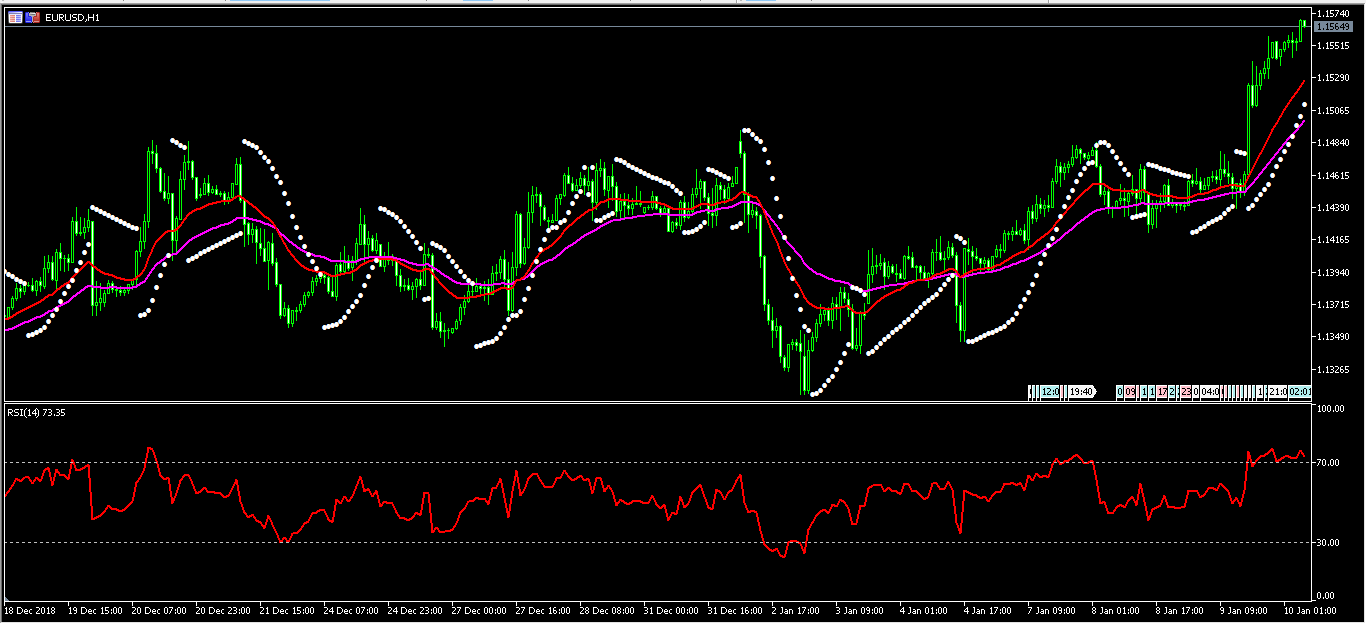
The EUR/USD pair jumped sharply in overnight trading, reaching a high of 1.1570. This is a major milestone for a pair that started the year at the 1.1300 level. On the hourly chart, the pair’s price is above the 42-day and 21-day EMA while the RSI has remained in the overbought level of 70. The Parabolic SAR shows that the pair could continue moving up. If it does, the next important level to watch will be 1.1600.
USD/CAD
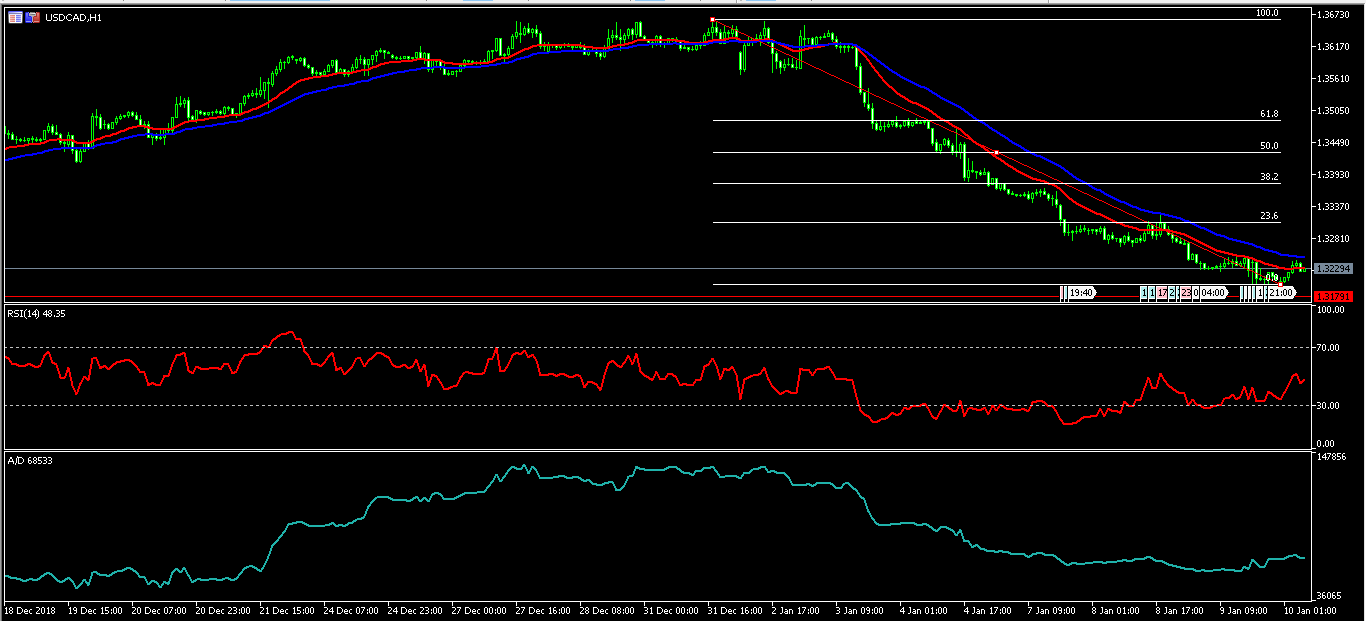
The USD/CAD pair was little moved after two dovish statements by the Fed and the BOC. The pair remains near the multi-month low of 1.3180. On the hourly chart, the pair’s current price is along the shorter-term 21-day EMA and lower than the longer-term EMA of 42. The RSI has moved from the oversold level to the current 48 while the Accumulation/Distribution indicator remains at significant lows. There is a likelihood that the pair will continue moving up. If it does, the important level to is the 23.6% Fibonacci Retracement level of 1.3310.
USD/CHF
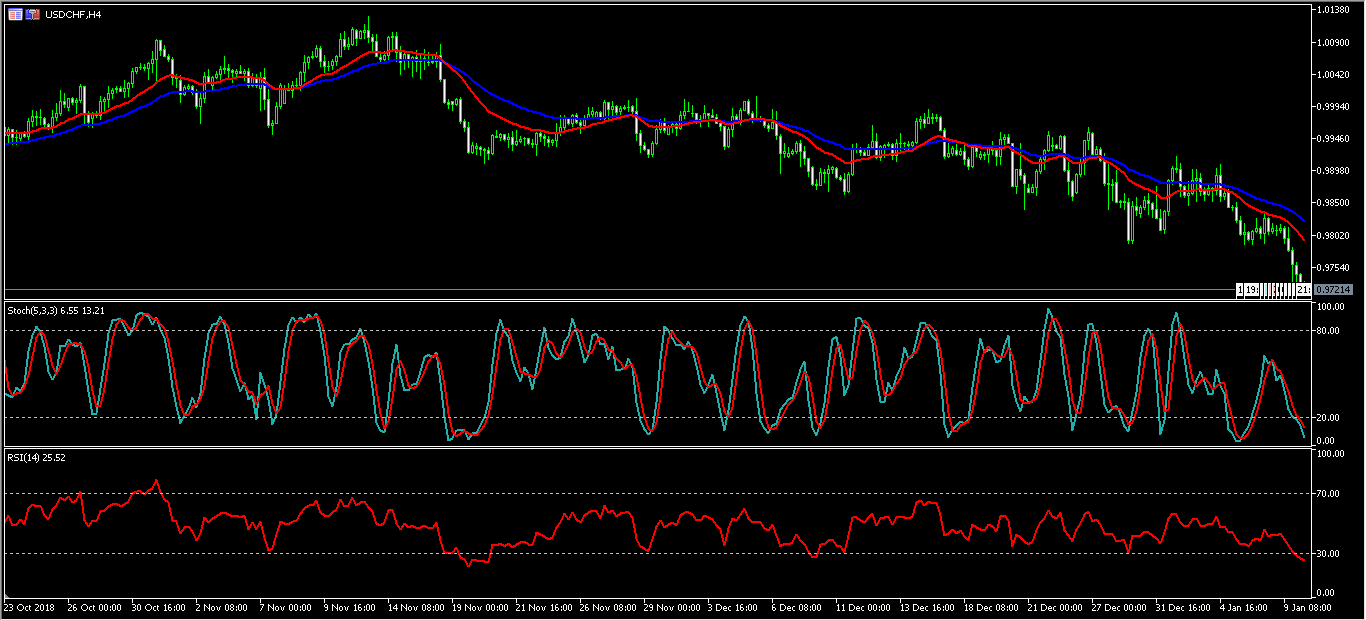
The USD/CHF pair continued the downward momentum after the dovish statement by the Fed. The pair also reacted to the sharp loss announced by the Swiss National Bank. On the four-hour chart, the pair’s current price of 0.9720 is lower than the short and longer-term moving averages. The RSI and the stochastics indicators are in the oversold category. The pair could continue to decline and if it does, it will test the 0.9600 support level.
More Minutes (ECB) And Scandi CPI
Market movers today
In the euro area, the ECB minutes from the December meeting are due out. See page 2.
In the US, several speeches by FOMC members are expected, including Fed Chair Jerome Powell and Vice Chair Richard Clarida, which might be of interest given the current market repricing of the Fed hiking cycle.
In the UK, the Brexit debate has begun ahead of the vote next week, which Theresa May is expected to lose.
In Denmark and Norway, CPI numbers for December are due out and in Sweden, November production data is being released.
Selected market news
Recent FOMC communication, including yesterday's release of FOMC minutes, continues to highlight the Fed's flexibility on further rate hikes, as the FOMC members think they can afford to be patient hiking further as long as inflation remains under control. As the Fed would probably like to see a rebound in market risk sentiment and an improvement in the global business cycle (and a continuation of solid economic data releases in the US), it supports our view that it will skip a hike in Q1 and wait until Q2 (either in May or June, the timing is more difficult this year now that all meetings may be 'live', as Powell now holds a press conference after every meeting). One important dovish twist in the FOMC minutes is that 'several participants' noted the recent drop in market-based inflation expectation gauges, suggesting it may be an important variable to follow again.
Another new thing is that the Fed now also signals some flexibility on the reduction of the balance sheet ('QT'), which may stop earlier than the Fed has aimed for previously (although it has never explicitly set a target for the level of the balance sheet), something we have highlighted many times that it might be forced to do. A more flexible Fed should be positive for risk sentiment. US equities and Treasuries rallied initially after the release only to fall back a bit later in the evening as news broke that Trump might be cancelling a trip to Davos, where he is supposed to meet with the Chinese Vice President.
PM Theresa May suffered another heavy defeat on Brexit yesterday, as the House of Commons passed an amendment forcing her to present a Brexit 'plan B' for Parliament within three days if she loses the vote on her deal next week, which seems very likely. Note that a previous amendment passed last year means that the members of the House of Commons can debate and amendment her statement (i.e. they can try to tie May's hands by telling her what she should seek to get in the negotiations). With less than three months to Brexit day we are in uncharted territory, and it is difficult to predict where Brexit will end. In our view, May's deal (or something very similar) being passed at a later stage or a second EU referendum are the two most likely outcomes right now, but something needs to give before either happens.
GBP/JPY Daily Outlook
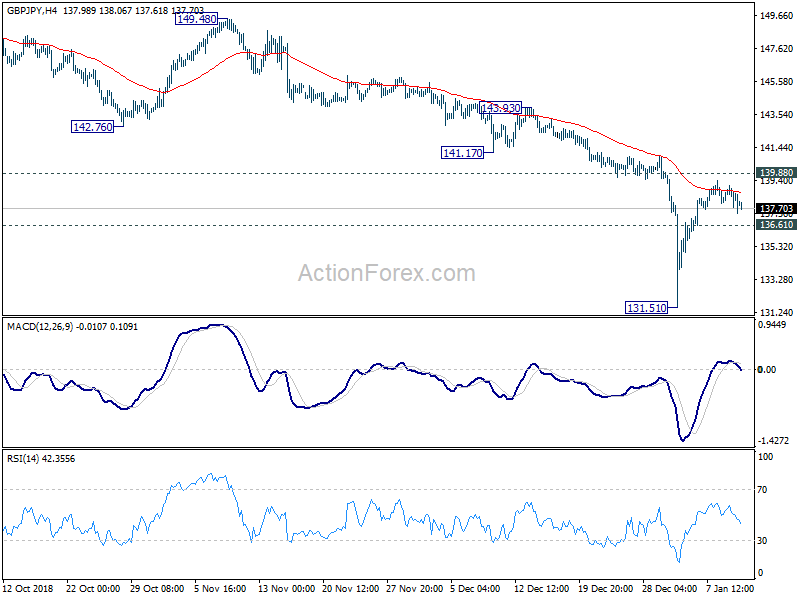
Daily Pivots: (S1) 137.66; (P) 138.39; (R1) 139.01; More...
Intraday bias in GBP/JPY turned neutral with current retreat. In case of another rise, we'd expect strong resistance from 139.88 key resistance to limit upside. On the downside, break of 136.61 minor support will turn bias to the downside for retesting 131.51 low. Overall, larger down trend from 155.59 is expected to resume later after the consolidation completes.
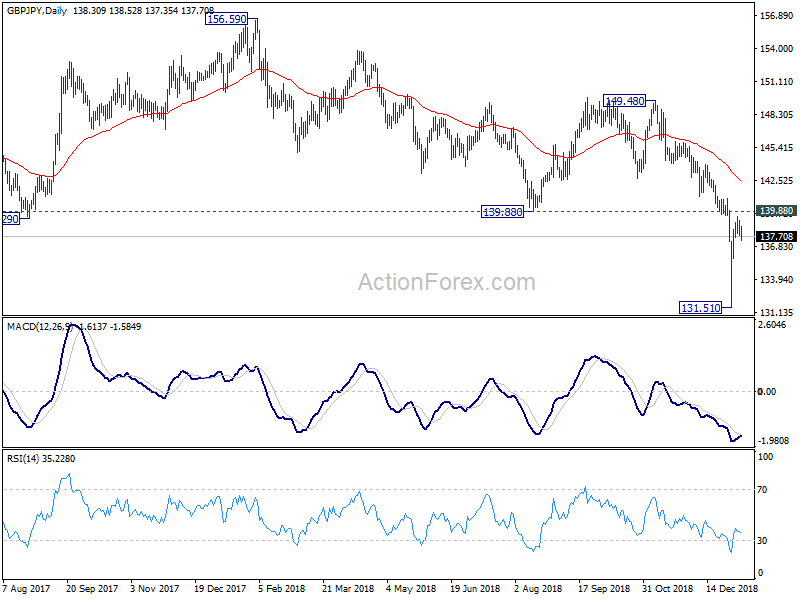
In the bigger picture, corrective medium term rise from 122.36 (2016 low) has completed at 156.69 already. That came after failing to break through 55 month EMA. Fall from 156.59 (2018 high) is seen as resuming the long term down trend from 195.86 (2015 high). Below 131.51 will target 122.36 low first. Break of 122.36 will target 116.83 low first (2011 low). And this will now remain the preferred case as long as 139.88 support turned resistance holds. Sustained break of 139.88 will mix up the outlook and we'll reassess on the final structure of the rebound from 131.51.
EUR/JPY Daily Outlook
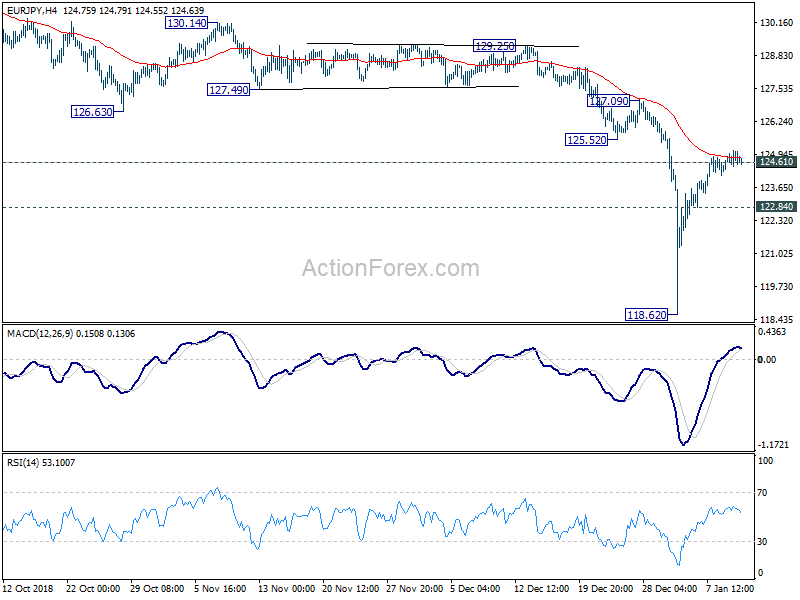
Daily Pivots: (S1) 124.36; (P) 124.72; (R1) 125.19; More....
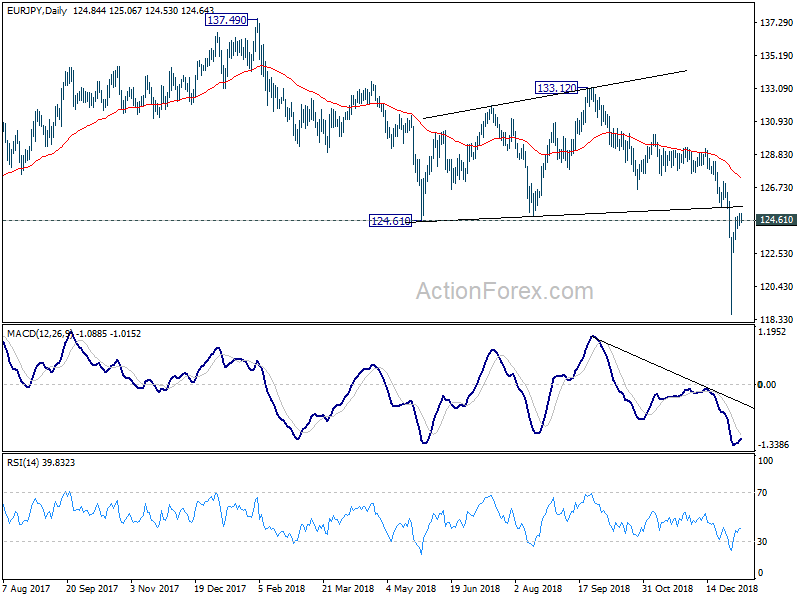
No change in EUR/JPY's outlook. At this point, we're still looking for strong resistance around 124.61 to limit the rebound from 118.62. And, on the downside, break of 122.84 minor support will turn bias back to the downside for retesting 118.62 low first. However, sustained break of 124.61 will extend the rebound to 127.09 resistance next.
In the bigger picture, medium term rebound from 109.03 (2016 low) has completed at 137.49 already, with corrective structure. Fall from 137.39 is seen as a medium term fall, resuming the decline from 149.76 (2014 high). Such decline should break through 109.03 low next. This will remain the preferred case as long as 124.61 support turned resistance holds. Sustained break of 124.61 will mix up the outlook and we'll reassess on the final structure of the rebound from 118.62.