

Sample Category Title
BOC Pushed Back Timing for Next Rate Hike, Trimmed GDP Growth and Inflation Forecasts for 2019
As we expected, BOC left the policy rate unchanged at 1.75% in yesterday. Policymakers admitted that the decline in oil price has “material” impact on the economy. Yet, they viewed the impact as transitory. Reflecting the view on economy projections, the central bank downgraded the GDP growth forecast for this year, but upgraded it for the next year. Similarly, inflation is trimmed for this year due to weakness in oil prices. On the monetary policy stance, BOC retained the view that interest rates would “need to rise” and the decision would be data-dependent. Yet, this time the central bank added that a rate hike would come “over time” and the pace would highly depend on “developments in oil markets, the Canadian housing market, and global trade policy”.
Much of the discussion was confined to the oil sector. While noting that the domestic economy has been “performing well overall”, the members admitted that the selloff in global oil prices has a “material impact on the Canadian outlook, resulting in lower terms of trade and national income”. They cautioned that “investment in Canada’s oil sector is projected to weaken further”, although the spread between WCS oil price and world benchmark has narrowed recently.
Just like other major central banks, BOC’s core mandate is to achieve its inflation target, which has been set at 2%. Benign inflation has removed urgency to increase interest rates in coming months. BOC forecast inflation to “edge further down and be below 2% through much of 2019, owing mainly to lower gasoline prices”. Meanwhile, household consumption, which has been dampened by the decline in housing prices and softer growth in oil –producing provinces, would remain under pressure as the abovementioned factors remain in play. Yet, policymakers judged that depreciation in Canadian dollar will “exert some upward pressure on inflation”. They expected that inflation would return to around the 2% “by late 2019” as the “transitory effects unwind and excess capacity is absorbed”.
On the updated economic projections, the central bank revised lower GDP growth estimate to +1.7% for 2109, compared with +2.1% projected in October. Growth is expected to pick up to an above-trend rate of +2.1% in 2020, compared with +1.9% projected previously. BOC also revised lower this year’s inflation forecast to +1.7% from +2% previously. The major change in the macroeconomic environment since October is the energy sector. The slump of WCS oil price led the province of Alberta to announce a compulsory production cut. While the cut has triggered price recovery, it has also trimmed GDP growth for the near-term.
The January BOC meeting affirmed our view that the market is too optimistic over the growth outlook in Canada. As such, risk to the consensus rate hike forecasts is to the downside. We expect more upside to USDCAD in the near-term. Strong US economic data should support further rate hike in 1H19, while BOC might continue to stand on the sideline during the period.
MOFCOM: China-US trade talks enhanced mutual understanding and laid foundation for resolving mutual concerns
In a relatively brief statement, the Chinese Ministry of Commerce said the trade talks with the US this week were extensive and laid down the foundation for resolving trade friction between the countries.
The MOFCOM statement said "The two sides actively implemented the important consensus of the two heads of state and conducted extensive, in-depth and meticulous exchanges on trade issues and structural issues of common concern, which enhanced mutual understanding and laid the foundation for resolving mutual concerns. Both parties agreed to continue to maintain close contact."
UK Hammond: No specific benefits in the current Brexit deal, just much worse with no-deal
Chancellor of the Exchequer Philip Hammond said yesterday "I firmly believe that my job is to look after the welfare and interests of the British people and I conclude that it would not be in their interests to leave without a deal". "We are very determined that we need a deal. We need a deal that allows us to continue to cooperate and to have a smooth and orderly exit and we'll make sure that we do."
He urged that "What we and many other British businesses need most urgently, is for politicians from all sides to come together and pass a pragmatic agreement that allows an orderly Brexit". Though, he added that "We don't see any specific benefits in the current deal. It's just a lot less bad than a 'no deal'".
But as five-day debate over UK Prime Minister Theresa May's Brexit deal began in the parliament yesterday, there is apparently no breakthrough. Hammond said there is currently no "plan B" to break the deadlock.
EU Trade Commissioner Malmström insists on excluding agriculture in trade negotiation with US
EU Trade Commissioner Cecilia Malmström told reporters yesterday that the scope of trade negotiation with the US was not agreed upon yet. But she emphasized that "we have made very clear agriculture will not be included." In the mean time, EU also haven't got assurance from the US on holding off auto tariffs during the trade negotiation. But Malmström believed EU won't be affected while talks were ongoing.
Malmström made the comments after meeting Japanese Minister of the Economy Hiroshige Seko and U.S. Trade Representative Robert Lighthizer in Washington yesterday, in preparation for another meeting later this week regarding WTO reforms.
European Commission is currently preparing two mandates for trade negotiations with the US. One is for removal of tariffs of industrial goods. Another one is on areas of possible regulatory cooperation in areas such as pharmaceuticals, medical devices and cyber security. The mandates will first have to go through European Commission approval, and then the 28 members of EU states. There is no set time line for the preparation yet.
Separately, Republican Senator Chuck Grassley warned that "I don't know how anybody in Europe that wants a free trade agreement with us can expect it to get through the US Senate if you don't want to negotiate agriculture."
Asian update: Sentiments turned mixed, Dollar weaker after FOMC minutes
Asian markets turned mixed as the rebound in US stocks somewhat lost steam. At the time of writing, Nikkei is trading down -1.14%. Hong Kong HSI is up 0.37%, China Shanghai SSE is up 0.23%. Singapore Strait Times is up 0.64%. Japan 10-year JGB yield is down -0.0026 but stays positive at 0.028.
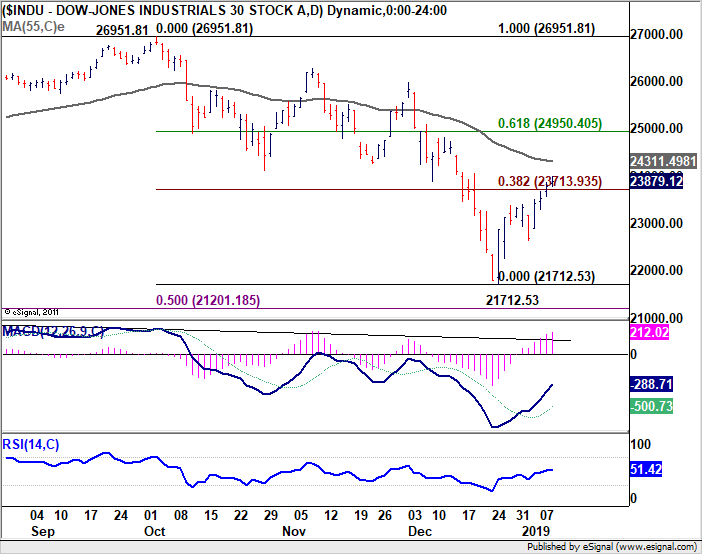
Overnight, DOW ended up just 0.39%, S&P 500 rose 0.41% and NASDAQ gained 0.87%. DOW closed above 38.2% retracement of 26951.81 to 21712.53 at 23713.93 for the second day. Rebound from 21712.53, while slightly stronger than expected, could still be a corrective move. But for now, it will likely have a go at 55 day EMA (24311.49) at least.
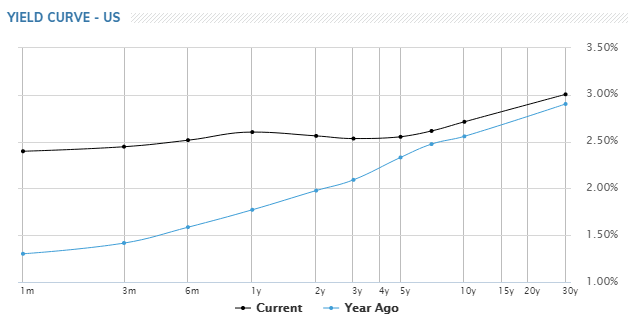
Developments in US treasury yields were also positive. 30-year yield rose 0.031 to 3.024, above 3% handle. 10-year yield rose 0.012 to 2.728. But 5-year yield dropped -0.012 to 2.599. Strength at the long end will be welcomed by Fed policy makers. But yield curve remains inverted from 1-year (2.602) to 2-year (2.561) to 3-year(2.533).
In the currency markets, Dollar was sold off overnight after a chorus of Fed officials who want "patience" before another rate hike, including Boston Fed Eric Rosengren, Chicago Fed Charles Evans, Atlanta Fed Raphael Bostic. FOMC minutes of the December meeting also reflected the cautious tone. They noted that "many participants expressed the view that, especially in an environment of muted inflation pressures, the committee could afford to be patient about further policy firming."Also "a number of participants noted that, before making further changes to the stance of policy, it was important for the committee to assess factors," including risks on growth and the impact of past rate hikes on the economy.
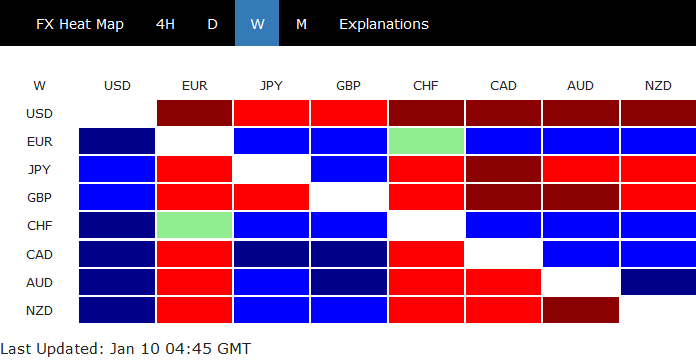
Dollar is the weakest one for the week for now, followed by Sterling and then Yen. Euro and Swiss Franc are the strongest ones.
FOMC Members Weigh Strong Economic Growth Against Tightening Financial Conditions
Minutes from the FOMC's December meeting, in which the federal funds rate was raised 25 basis points to a range of 2.25% to 2.50%, noted participants contrasting still-strong economic data with increased worries in financial markets (and among business contacts) about downside risks to the outlook.
The tightening in financial conditions was enough to cause FOMC participants to migrate down their expectations for future policy rate increases as well as edge down their forecasts for future economic growth. However, most members saw growth as continuing broadly in line with their expectations.
A few participants honed in on the recent weakness in inflation as reason enough to hold off raising rates, even at the December meeting. Still, most participants saw risks to the inflation outlook as relatively balanced.
The minutes note the impact of global developments and concerns in several occasions. Global growth concerns are contributing to the tightening in financial conditions and uncertainty about the future course of fed policy.
Key Implications
U.S. economic growth has long been expected to slow as the sugar high from fiscal stimulus fades. The question for FOMC members and ourselves is whether the economy can transition to a slower, but still healthy, pace of growth, or whether the simple act of slowing is enough to throw confidence into a tailspin and catalyze an outright downturn.
The FOMC continues to emphasize data dependence over forward guidance. This is prudent. As long as economic conditions remain resilient, financial conditions are likely to ease and downside risks to the outlook will diminish. If, on the other hand, data begin to deteriorate (perhaps reflecting the impact of tighter financial conditions), concerns will be exacerbated and the cycle could turn from virtuous to vicious. In this environment, the Fed is likely to sit on its hands until the signal in the data is more clear.
Concerns about global growth appear to be weighing more on the decisions of FOMC members as a source of downside risk to the outlook, while also adding uncertainty as to the impact of fed policy. Expect this to continue as it generally reflects China's growing importance in the global economy. As long as worries about a hard landing in China are a theme in financial markets, the transmission of global outcomes to the U.S. will remain important.
(FED) Minutes of the Federal Open Market Committee December 18-19, 2018
A joint meeting of the Federal Open Market Committee and the Board of Governors was held in the offices of the Board of Governors of the Federal Reserve System in Washington, D.C., on Tuesday, December 18, 2018, at 1:00 p.m. and continued on Wednesday, December 19, 2018, at 9:00 a.m.1
PRESENT:
Jerome H. Powell, Chairman
John C. Williams, Vice Chairman
Thomas I. Barkin
Raphael W. Bostic
Michelle W. Bowman
Lael Brainard
Richard H. Clarida
Mary C. Daly
Loretta J. Mester
Randal K. Quarles
James Bullard, Charles L. Evans, Esther L. George, Eric Rosengren, and Michael Strine, Alternate Members of the Federal Open Market Committee
Patrick Harker, Robert S. Kaplan, and Neel Kashkari, Presidents of the Federal Reserve Banks of Philadelphia, Dallas, and Minneapolis, respectively
James A. Clouse, Secretary
Matthew M. Luecke, Deputy Secretary
David W. Skidmore, Assistant Secretary
Michelle A. Smith, Assistant Secretary
Mark E. Van Der Weide, General Counsel
Michael Held, Deputy General Counsel
Steven B. Kamin, Economist
Thomas Laubach, Economist
David W. Wilcox, Economist
David Altig, Kartik B. Athreya, Thomas A. Connors, David E. Lebow, Trevor A. Reeve, William Wascher, and Beth Anne Wilson, Associate Economists
Simon Potter, Manager, System Open Market Account
Lorie K. Logan, Deputy Manager, System Open Market Account
Ann E. Misback, Secretary, Office of the Secretary, Board of Governors
Matthew J. Eichner,2 Director, Division of Reserve Bank Operations and Payment Systems, Board of Governors; Michael S. Gibson, Director, Division of Supervision and Regulation, Board of Governors; Andreas Lehnert, Director, Division of Financial Stability, Board of Governors
Daniel M. Covitz, Deputy Director, Division of Research and Statistics, Board of Governors; Rochelle M. Edge, Deputy Director, Division of Monetary Affairs, Board of Governors; Michael T. Kiley, Deputy Director, Division of Financial Stability, Board of Governors
Jon Faust, Senior Special Adviser to the Chairman, Office of Board Members, Board of Governors
Antulio N. Bomfim, Special Adviser to the Chairman, Office of Board Members, Board of Governors
Brian M. Doyle, Joseph W. Gruber, Ellen E. Meade, and John M. Roberts, Special Advisers to the Board, Office of Board Members, Board of Governors
Linda Robertson, Assistant to the Board, Office of Board Members, Board of Governors
Shaghil Ahmed and Christopher J. Erceg, Senior Associate Directors, Division of International Finance, Board of Governors; Eric M. Engen, Senior Associate Director, Division of Research and Statistics, Board of Governors; Gretchen C. Weinbach,3 Senior Associate Director, Division of Monetary Affairs, Board of Governors
Edward Nelson, Senior Adviser, Division of Monetary Affairs, Board of Governors
Marnie Gillis DeBoer,3 David López-Salido, and Min Wei, Associate Directors, Division of Monetary Affairs, Board of Governors; John J. Stevens, Associate Director, Division of Research and Statistics, Board of Governors
Steven A. Sharpe, Deputy Associate Director, Division of Research and Statistics, Board of Governors; Jeffrey D. Walker,2 Deputy Associate Director, Division of Reserve Bank Operations and Payment Systems, Board of Governors
Andrew Figura and John Sabelhaus, Assistant Directors, Division of Research and Statistics, Board of Governors; Christopher J. Gust,4 Laura Lipscomb,3 and Zeynep Senyuz,3 Assistant Directors, Division of Monetary Affairs, Board of Governors
Don Kim, Adviser, Division of Monetary Affairs, Board of Governors
Penelope A. Beattie,5 Assistant to the Secretary, Office of the Secretary, Board of Governors
Michele Cavallo,5 Section Chief, Division of Monetary Affairs, Board of Governors
Mark A. Carlson,2 Senior Economic Project Manager, Division of Monetary Affairs, Board of Governors
David H. Small, Project Manager, Division of Monetary Affairs, Board of Governors
Andrea Ajello and Alyssa G. Anderson,3 Principal Economists, Division of Monetary Affairs, Board of Governors
Arsenios Skaperdas,3 Economist, Division of Monetary Affairs, Board of Governors
Donielle A. Winford, Information Management Analyst, Division of Monetary Affairs, Board of Governors
Michael Dotsey, Sylvain Leduc, Daniel G. Sullivan, Geoffrey Tootell, and Christopher J. Waller, Executive Vice Presidents, Federal Reserve Banks of Philadelphia, San Francisco, Chicago, Boston, and St. Louis, respectively
Todd E. Clark, Evan F. Koenig, Antoine Martin, and Julie Ann Remache,3 Senior Vice Presidents, Federal Reserve Banks of Cleveland, Dallas, New York, and New York, respectively
Roc Armenter,3 Kathryn B. Chen,3 Jonathan L. Willis, and Patricia Zobel,3 Vice Presidents, Federal Reserve Banks of Philadelphia, New York, Kansas City, and New York, respectively
Gara Afonso3 and William E. Riordan,3 Assistant Vice Presidents, Federal Reserve Bank of New York.
Suraj Prasanna3 and Lisa Stowe,3 Markets Officers, Federal Reserve Bank of New York.
Samuel Schulhofer-Wohl,2 Senior Economist and Research Advisor, Federal Reserve Bank of Chicago
Fabrizio Perri, Monetary Advisor, Federal Reserve Bank of Minneapolis
Long-Run Monetary Policy Implementation Frameworks
Committee participants resumed their discussion from the November 2018 FOMC meeting of potential long-run frameworks for monetary policy implementation. At the December meeting, the staff provided a set of briefings that considered various issues related to the transition to a long-run operating regime with lower levels of excess reserves than at present and to a long-run composition of the balance sheet.
The staff noted that during the transition to a long-run operating regime with excess reserves below current levels, the effective federal funds rate (EFFR) could begin to rise a little above the interest on excess reserves (IOER) rate as reserves in the banking system declined gradually to a level that the Committee judges to be most appropriate for efficient and effective implementation of policy. This upward movement in the federal funds rate could be gradual. However, the staff noted that the federal funds rate and other money market rates could possibly become somewhat volatile at times as banks and financial markets adjusted to lower levels of reserve balances. Were upward pressures on the federal funds rate to emerge, it could be challenging to distinguish between pressures that were transitory and likely to abate as financial institutions adjust and those that were more persistent and associated with aggregate reserve scarcity. The staff reported on the monitoring of conditions in money markets as well as various survey and market outreach activities that could assist in detecting reserve scarcity. The staff reviewed a number of steps that the Federal Reserve could take to ensure effective monetary policy implementation were upward pressures on the federal funds rate and other money market rates to emerge. These steps included lowering the IOER rate further within the target range, using the discount window to support the efficient distribution of reserves, and slowing or smoothing the pace of reserve decline through open market operations or through slowing portfolio redemptions. The staff also discussed new ceiling tools that could help keep the EFFR within the Committee's target range, including options that would add new counterparties for the Open Market Desk's operations. The staff also provided a review of the liabilities on the Federal Reserve's balance sheet; the review described the factors that influence the size of reserve and nonreserve liabilities and discussed the increase in the size of these liabilities since the financial crisis. Additionally, the staff outlined various issues related to the long-run composition of the System Open Market Account (SOMA) portfolio, including the maturity composition of the portfolio's Treasury securities and the management of residual holdings of agency mortgage-backed securities (MBS) after the Committee has normalized the size of the balance sheet.
In discussing the transition to a long-run operating regime, participants commented on the advantages and disadvantages of allowing reserves to decline to a level that could put noticeable upward pressure on the federal funds rate, at least for a time. Reducing reserves close to the lowest level that still corresponded to the flat portion of the reserve demand curve would be one approach consistent with the Committee's previously stated intention, in the Policy Normalization Principles and Plans that it issued in 2014, to "hold no more securities than necessary to implement monetary policy efficiently and effectively." However, reducing reserves to a point very close to the level at which the reserve demand curve begins to slope upward could lead to a significant increase in the volatility in short-term interest rates and require frequent sizable open market operations or new ceiling facilities to maintain effective interest rate control. These considerations suggested that it might be appropriate to instead provide a buffer of reserves sufficient to ensure that the Federal Reserve operates consistently on the flat portion of the reserve demand curve so as to promote the efficient and effective implementation of monetary policy.
Participants discussed options for maintaining control of interest rates should upward pressures on money market rates emerge during the transition to a regime with lower excess reserves. Several participants commented on options that rely on existing or currently used tools, such as further technical adjustments to the IOER rate to keep the federal funds rate within the target range or using the discount window, although such options were recognized to have limitations in some situations. Some participants commented on the possibility of slowing the pace of the decline in reserves in approaching the longer-run level of reserves. Standard temporary open market operations could be used for this purpose. In addition, participants discussed options such as ending portfolio redemptions with a relatively high level of reserves still in the system and then either maintaining that level of reserves or allowing growth in nonreserve liabilities to very gradually reduce reserves further. These approaches could allow markets and banks more time to adjust to lower reserve levels while maintaining effective control of interest rates. Several participants, however, expressed concern that a slowing of redemptions could be misinterpreted as a signal about the stance of monetary policy. Some participants expressed an interest in learning more about possible options for new ceiling tools to provide firmer control of the policy rate.
Participants commented on the role that the Federal Reserve's nonreserve liabilities have played in the expansion of the Federal Reserve's balance sheet since the financial crisis. Many participants noted that the magnitudes of these nonreserve liabilities--most significantly currency but also liabilities to the Treasury through the Treasury General Account and liabilities to foreign official institutions through their accounts at the Federal Reserve--are not closely related to Federal Reserve monetary policy decisions. They also remarked that the size of the Federal Reserve's balance sheet was expected to increase over time as the growth of these liabilities roughly tracks the growth of nominal gross domestic product (GDP). Additionally, participants cited the social benefits provided by these liabilities to the economy. Participants considered it important to present information on the Federal Reserve's balance sheet to the public in ways that communicated these facts. In discussing the long-run level of reserve liabilities, participants noted that it might be useful to explore ways to encourage banks to reduce their demand for reserves and to provide information to banks and the public about the likely long-run level of reserves.
Participants commented on a number of issues related to the long-run composition of the SOMA portfolio. With regard to the portfolio of Treasury securities, participants discussed the advantages of different portfolio maturity compositions. Several participants noted that a portfolio of holdings weighted toward shorter maturities would provide greater flexibility to lengthen maturity if warranted by an economic downturn, while a couple of others noted that a portfolio with maturities that matched the outstanding Treasury market would have a more neutral effect on the market. With regard to the MBS portfolio, participants noted that the passive runoff of MBS holdings through principal paydowns would continue for many years after the size of the balance sheet had been normalized. Several participants commented on the possibility of reducing agency MBS holdings somewhat more quickly than the passive approach by implementing a program of very gradual MBS sales sometime after the size of the balance sheet had been normalized.
Participants expected to continue their discussion of long-run implementation frameworks and related issues at upcoming meetings. They reiterated the importance of communicating clearly on the rationale for any decision made on the implementation framework.
Developments in Financial Markets and Open Market Operations
The SOMA manager reviewed developments in financial markets over the intermeeting period. Asset prices were volatile in recent weeks, reportedly reflecting a pullback from risk-taking by investors. In part, the deterioration in risk sentiment appeared to stem importantly from uncertainty about the state of trade negotiations between China and the United States. In addition, investors pointed to concerns about the global growth outlook, the unsettled state of Brexit negotiations, and uncertainties about the political situation in Europe.
Against this backdrop, U.S. stock prices were down nearly 8 percent on the period. Risk spreads on corporate bonds widened appreciably, with market participants reportedly focusing on the potential implications of downside risks to the U.S. economic outlook for the financial condition of companies, particularly for companies at the lower end of the investment-grade spectrum. Treasury yields declined significantly, especially at longer maturities, contributing to some flattening of the Treasury yield curve. Based on readings from Treasury Inflation-Protected Securities (TIPS), the decline in nominal Treasury yields was associated with a notable drop in inflation compensation. A sizable decline in oil prices was cited as an important factor contributing to the drop in measures of inflation compensation.
The deterioration in market sentiment was accompanied by a significant downward revision in the expected path of the federal funds rate based on federal funds futures quotes. In addition, futures-based measures of policy expectations moved lower in response to speeches by Federal Reserve officials. The revision in the expected policy path was less noticeable in the Desk's survey-based measures of the expected path of the federal funds rate. Desk surveys indicated that respondents placed high odds on a further quarter-point firming in the stance of monetary policy at the December meeting, but lower than the near certainty of a rate increase reported just before previous policy firmings in 2018; survey responses anticipated that the median projected path of the federal funds rate in the Summary of Economic Projections (SEP) would show only two additional quarter-point policy firmings next year--down from the three policy firmings in the median path in the September SEP results.
The deputy manager followed with a discussion of money market developments and open market operations. After a fast narrowing of the spread between the IOER rate and the EFFR before the November meeting, the EFFR had remained stable at, or just 1 basis point below the level of the IOER rate since then. Some upward pressures on overnight rates were evident in the repurchase agreement (repo) market, apparently from higher issuance of Treasury bills and an associated expansion of primary dealer inventories over the intermeeting period. Banks expanded their lending in repo markets in light of higher repo rates relative to the IOER rate; the willingness of banks to lend in repo markets suggested that the reserve supply was still ample. The deputy manager noted the results of the recent Desk surveys of primary dealers and market participants indicating an increase in the median respondent's estimate of the long-run level of reserve balances to a level closer to that implied by banks' responses in the Senior Financial Officer Survey conducted in advance of the November FOMC meeting. The deputy manager also reported on paydowns on the SOMA securities holdings. Under the baseline outlook, prepayments of principal on agency MBS would remain below the $20 billion redemption cap for the foreseeable future. However, if longer-term interest rates moved substantively lower than assumed in the baseline, some modest reinvestments in MBS could occur for a few months next year concurrent with the pickup in seasonal turnover.
By unanimous vote, the Committee ratified the Desk's domestic transactions over the intermeeting period. There were no intervention operations in foreign currencies for the System's account during the intermeeting period.
Staff Review of the Economic Situation
The information reviewed for the December 18-19 meeting indicated that labor market conditions continued to strengthen in recent months and that real GDP growth was strong. Consumer price inflation, as measured by the 12-month percentage change in the price index for personal consumption expenditures (PCE), was 2 percent in October. Survey-based measures of longer-run inflation expectations were little changed on balance.
Total nonfarm payroll employment expanded further in November, and job gains were strong, on average, over recent months. The national unemployment rate remained at a very low level of 3.7 percent, and both the labor force participation rate and the employment-to-population ratio also stayed flat in November. The unemployment rates for African Americans, Asians, and Hispanics in November were below their levels at the end of the previous economic expansion. The share of workers employed part time for economic reasons was still close to the lows reached in late 2007. The rates of private-sector job openings and quits were both still at high levels in October; initial claims for unemployment insurance benefits in early December were still close to historically low levels. Total labor compensation per hour in the nonfarm business sector--a volatile measure even on a four-quarter change basis--increased 2.2 percent over the four quarters ending in the third quarter. Average hourly earnings for all employees rose 3.1 percent over the 12 months ending in November.
Industrial production expanded, on net, over October and November. Output increased in the mining and utilities sectors, while manufacturing production edged down on balance. Automakers' assembly schedules suggested that production of light motor vehicles would rise in December, and new orders indexes from national and regional manufacturing surveys pointed to moderate gains in total factory output in the coming months.
Household spending continued to increase at a strong pace in recent months. Real PCE growth was brisk in October, and the components of the nominal retail sales used by the Bureau of Economic Analysis to construct its estimate of PCE rose considerably in November. The pace of light motor vehicle sales edged down in November but stayed near its recent elevated level. Key factors that influence consumer spending--including ongoing gains in real disposable personal income and the effects of earlier increases in equity prices and home values on households' net worth--continued to be supportive of solid real PCE growth in the near term. Consumer sentiment, as measured by the University of Michigan Surveys of Consumers, remained relatively upbeat through early December.
Real residential investment appeared to be declining further in the fourth quarter, likely reflecting in part the effects of the rise in mortgage interest rates over the past year on the affordability of housing. Starts of new single-family homes decreased in October and November, although starts of multifamily units rose sharply in November. Building permit issuance for new single-family homes, which tends to be a good indicator of the underlying trend in construction of such homes, moved down modestly over recent months. Sales of new homes declined markedly in October, although existing home sales increased modestly.
Growth in real private expenditures for business equipment and intellectual property looked to be picking up solidly in the fourth quarter after moderating in the previous quarter. Nominal shipments of nondefense capital goods excluding aircraft moved up in October. Forward-looking indicators of business equipment spending--such as a rising backlog of unfilled orders for nondefense capital goods excluding aircraft and upbeat readings on business sentiment--pointed to further spending gains in the near term. Nominal business expenditures for nonresidential structures outside of the drilling and mining sector declined modestly in October, while the number of crude oil and natural gas rigs in operation--an indicator of business spending for structures in the drilling and mining sector--held about steady in November through early December.
Total real government purchases appeared to be rising moderately in the fourth quarter. Nominal defense spending in October and November pointed to solid growth in real federal purchases. Real purchases by state and local governments looked to be only edging up, as nominal construction spending by these governments rose solidly in October but their payrolls declined a little in October and November.
The nominal U.S. international trade deficit widened slightly in October. Exports declined a little, with decreases in exports of agricultural products and capital goods, although exports of industrial supplies increased. Imports rose a bit, with increases in imports of consumer goods and automotive products, but imports of capital goods declined sharply from September's elevated level. Available trade data suggested that the contribution of the change in net exports to the rate of real GDP growth in the fourth quarter would be much less negative than the drag of nearly 2 percentage points in the third quarter.
Total U.S. consumer prices, as measured by the PCE price index, increased 2 percent over the 12 months ending in October. Core PCE price inflation, which excludes changes in consumer food and energy prices, was 1.8 percent over that same period. The consumer price index (CPI) rose 2.2 percent over the 12 months ending in November, and core CPI inflation was also 2.2 percent. Recent readings on survey-based measures of longer-run inflation expectations--including those from the Michigan survey, the Survey of Professional Forecasters, and the Desk's Survey of Primary Dealers and Survey of Market Participants--were little changed on balance.
Foreign economic growth continued at a moderate pace in the third quarter, as a pickup in emerging market economies (EMEs) roughly offset slowing growth in advanced foreign economies (AFEs). Among EMEs, growth in Mexico and Brazil bounced back from transitory second-quarter weakness, more than offsetting a slowdown in China and India. The softness in AFE growth partly reflected temporary factors, including disruptions from natural disasters in Japan and the adoption of new car emissions testing in Germany. Indicators for economic activity in the fourth quarter were consistent with continued moderate foreign economic growth. Foreign inflation fell in recent months, largely reflecting a significant drag from lower oil prices. Underlying inflation pressures, especially in some AFEs, remained muted.
Staff Review of the Financial Situation
Investors' perceptions of downside risks to the domestic and global outlook appeared to increase over the intermeeting period, reportedly driven in part by signs of slowing in foreign economies and growing concerns over escalating trade frictions. Both nominal U.S. Treasury yields and U.S. equity prices declined notably over the period. Financing conditions for businesses and households tightened a bit but generally remained supportive of economic growth.
Remarks by Federal Reserve officials over the intermeeting period were interpreted by market participants as signaling a shift in the stance of policy toward a more gradual path of federal funds rate increases. The market-
implied path for the federal funds rate for 2019 and 2020 shifted down markedly, while the market-implied probability for a rate hike at the December FOMC meeting declined slightly though remained high.
Nominal Treasury yields fell considerably over the period, with the declines most pronounced in longer-dated maturities and contributing to a flattening of the yield curve. The spread between 10- and 2-year nominal Treasury yields narrowed to near the 20th percentile of its distribution since 1971. Investor perceptions of increased downside risks to the outlooks for domestic and foreign economic growth, including growing concerns over trade frictions between the United States and China, reportedly weighed on yields. Measures of inflation compensation derived from TIPS also decreased notably over the period along with the declines in oil prices.
Concerns over escalating trade tensions, global growth prospects, and the sustainability of corporate earnings growth were among the factors that appeared to contribute to a significant drop in U.S. equity prices. The declines were largest in the technology and retail sectors. One-month option-implied volatility on the S&P 500 index--the VIX--increased over the period and corporate credit spreads widened, consistent with the selloff in equities.
Over the intermeeting period, foreign financial markets were affected by perceived increases in downside risks to the global growth outlook and ongoing uncertainty about trade relations between the United States and China. Investors also focused on the state of negotiations over Brexit and the Italian government budget deficit. Equity markets in AFEs posted notable declines, and Europe-dedicated bond and equity funds reported strong outflows. Equity declines in EMEs were more modest, and emerging market funds received modest inflows on net.
AFE sovereign yields declined significantly, reflecting decreases in U.S. bond yields and weaker-than-expected euro-area and U.K. economic data. Measures of inflation compensation generally fell, partly reflecting sharp decreases in oil prices. Spreads of Italian sovereign yields over German counterparts narrowed amid progress on budget negotiations between the Italian government and the European Commission. The U.S. dollar appreciated modestly; although declines in U.S. yields weighed on the dollar, deteriorating global risk sentiment provided support. Ongoing uncertainty about the passage of a Brexit withdrawal agreement put downward pressure on the exchange value of the British pound.
Short-term funding markets functioned smoothly over the intermeeting period. Elevated levels of Treasury bills outstanding have continued to put upward pressure on money market rates. The EFFR held steady at or very close to the level of the IOER rate, while take-up in the overnight reverse repo facility remained near historically low levels. In offshore funding markets, the one-month foreign exchange swap basis for most major currencies increased, consistent with typical year-end pressures.
Financing conditions for nonfinancial firms remained accommodative, on net, though funding conditions for capital markets tightened somewhat as spreads on nonfinancial corporate bonds widened to near the middle of their historical distribution. Gross issuance of corporate bonds also moderated in November, driven by a significant step-down in speculative-grade bond issuance, while institutional leveraged loan issuance also slowed in November. Small business credit market conditions were little changed, and credit conditions in municipal bond markets stayed accommodative on net.
Private-sector analysts revised down their projections for year-ahead corporate earnings a bit. In many cases, nonfinancial firms' earnings reports suggested that tariffs were a salient concern in the changed outlook for corporate earnings. The pace of gross equity issuance through both seasoned and initial offerings moderated, consistent with the weakness and volatility in the stock market.
In the commercial real estate (CRE) sector, financing conditions remained accommodative. Commercial mortgage-backed securities (CMBS) spreads widened slightly over the intermeeting period but remained near post-crisis lows. Issuance of non-agency CMBS was stable while CRE loan growth remained strong at banks. Financing conditions in the residential mortgage market also remained accommodative for most borrowers, but the demand for mortgage credit softened. Purchase mortgage origination activity declined modestly, while refinance activity remained muted.
Financing conditions in consumer credit markets also remained accommodative. Broad consumer credit grew at a solid pace through September, though October and November saw credit card growth at banks edge a bit lower on average. Conditions in the consumer asset-backed securities market remained stable over the intermeeting period with slightly higher spreads and robust issuance.
Staff Economic Outlook
With some stronger-than-expected incoming data on economic activity and the recent tightening in financial conditions, particularly the decline in equity prices, the U.S. economic forecast prepared by the staff for the December FOMC meeting was little revised on balance. The staff continued to expect that real GDP growth would be strong in the fourth quarter of 2018, although somewhat slower than the rapid pace of growth in the previous two quarters. Over the 2018-20 period, real GDP was forecast to rise at a rate above the staff's estimate of potential output growth and then slow to a pace below it in 2021. The unemployment rate was projected to decline further below the staff's estimate of its longer-run natural rate but to bottom out by 2020 and begin to edge up in 2021. With labor market conditions already tight, the staff continued to assume that projected employment gains would manifest in smaller-than-usual downward pressure on the unemployment rate and in larger-than-usual upward pressure on the labor force participation rate.
The staff expected both total and core PCE price inflation to be just a touch below 2 percent in 2018, with total inflation revised down a bit because of recent declines in consumer energy prices. Core PCE price inflation was forecast to move up to 2 percent in 2019 and remain at that level through the medium term; total inflation was forecast to be a little below core inflation in 2019, reflecting projected declines in energy prices, and then to run at the same level as core inflation over the following two years. The staff's medium-term projections for both total and core PCE price inflation were little revised on net.
The staff viewed the uncertainty around its projections for real GDP growth, the unemployment rate, and inflation as similar to the average of the past 20 years. The staff also saw the risks to the forecasts for real GDP growth and the unemployment rate as balanced. On the upside, household spending and business investment could expand faster than the staff projected, supported in part by the tax cuts enacted last year. On the downside, trade policies and foreign economic developments could move in directions that have significant negative effects on U.S. economic growth. Risks to the inflation projection also were seen as balanced. The upside risk that inflation could increase more than expected in an economy that was projected to move further above its potential was counterbalanced by the downside risk that longer-term inflation expectations may be lower than was assumed in the staff forecast.
Participants' Views on Current Conditions and the Economic Outlook
In conjunction with this FOMC meeting, members of the Board of Governors and Federal Reserve Bank presidents submitted their projections of the most likely outcomes for real GDP growth, the unemployment rate, and inflation for each year from 2018 through 2021 and over the longer run, based on their individual assessments of the appropriate path for the federal funds rate. The longer-run projections represented each participant's assessment of the rate to which each variable would be expected to converge, over time, under appropriate monetary policy and in the absence of further shocks to the economy. These projections and policy assessments are described in the SEP, which is an addendum to these minutes.
In their discussion of the economic situation and the outlook, meeting participants agreed that information received since the FOMC met in November indicated that the labor market had continued to strengthen and that economic activity had been rising at a strong rate. Job gains had been strong, on average, in recent months, and the unemployment rate had remained low. Household spending had continued to grow strongly, while growth of business fixed investment had moderated from its rapid pace earlier in the year. On a 12-month basis, both overall inflation and inflation for items other than food and energy remained near 2 percent. Indicators of longer-term inflation expectations were little changed on balance.
In assessing the economic outlook, participants noted the contrast between the strength of incoming data on economic activity and the concerns about downside risks evident in financial markets and in reports from business contacts. Recent readings on household and business spending, inflation, and labor market conditions were largely in line with participants' expectations and indicated continued strength of the economy. By contrast, financial markets were volatile and conditions had tightened over the intermeeting period, with sizable declines in equity prices and notably wider corporate credit spreads coinciding with a continued flattening of the Treasury yield curve; in part, these changes in financial conditions appeared to reflect greater concerns about the global economic outlook. Participants also reported hearing more frequent concerns about the global economic outlook from business contacts.
After taking into account incoming economic data, information from business contacts, and the tightening of financial conditions, participants generally revised down their individual assessments of the appropriate path for monetary policy and indicated either no material change or only a modest downward revision in their assessment of the economic outlook. Economic growth was expected to remain above trend in 2019 and then slow to a pace closer to trend over the medium term. Participants who downgraded their assessment of the economic outlook pointed to a variety of factors underlying their assessment, including recent financial market developments, some softening in the foreign economic growth outlook, or a more pessimistic outlook for housing-sector activity.
In their discussion of the household sector, participants generally characterized real PCE growth as remaining strong. Participants pointed to a number of factors that were supporting consumer spending, including further gains in wages and household income reflecting a strong labor market, expansionary federal tax policies, still-upbeat readings on consumer sentiment, recent declines in oil prices, and household balance sheets that generally remained healthy despite tighter financial conditions. Although household spending overall was seen as strong, several participants noted continued weakness in residential investment. This weakness was attributed to a variety of factors, including increased mortgage rates and rising home prices. Reports from District contacts in the auto sector were mixed.
Several participants noted that business fixed investment remained solid despite a slowdown in the third quarter, as more recent data pointed to a rebound in investment spending. Business contacts in several Districts reported robust activity through the end of 2018 and planned to follow through or expand on their current capital expenditure projects. However, contacts in a number of Districts appeared less upbeat than at the time of the November meeting, as concerns about a variety of factors--including trade policy, waning fiscal stimulus, slowing global economic growth, or financial market volatility--were reportedly beginning to weigh on business sentiment. A couple of participants commented that the recent decline in oil prices could be a sign of a weakening in global demand that could weigh on capital spending by oil production companies and affect companies providing services to the oil industry. However, a couple of participants noted that the recent oil price decline could also be associated with increasing oil supply rather than softening global demand.
Contacts in the agricultural sector reported that conditions remained depressed, in part because of the effects of trade policy actions on exports and farm incomes, uncertainty about future trade agreements, and continued low commodity prices. Banks continued to report a gradual increase in agricultural loan delinquencies in recent months. Nonetheless, participants cited a few recent favorable developments, including new trade mitigation payments as well as legislative action to maintain crop insurance that was seen as reducing uncertainty.
Participants agreed that labor market conditions had remained strong. Payrolls continued to grow at an above-trend rate in November, and measures of labor market tightness such as rates of job openings and quits continued to be elevated. The unemployment rate remained at a historically low level in November, and the labor force participation rate stayed steady, which represented an improvement relative to its gradual downward-sloping underlying trend. Several participants observed that labor force participation had been improving for low-skilled workers and for prime-age workers. A couple of participants saw scope for further improvements in the labor force participation rate relative to its historical downward trend, while a couple of others judged that there was little scope for significant further improvements.
Contacts in many Districts continued to report tight labor markets with difficulties finding qualified workers. In some cases, firms were responding to these difficulties by using various types of nonwage incentives to attract and retain workers, while in other cases, firms were responding by raising wages. Many participants observed that, at the national level, most measures of nominal wage growth had risen and were currently at levels that were broadly in line with trends in productivity growth and inflation.
Participants observed that both overall and core PCE price inflation remained near 2 percent on a 12-month basis, but that core inflation had edged lower in recent months. A few participants noted that the recent declines in energy prices would likely only temporarily weigh on headline inflation. Several participants remarked that longer-term TIPS-based inflation compensation had declined notably since November, concurrent with both falling oil prices and a deterioration in investor risk sentiment. A few participants pointed to the decline in longer-term inflation compensation as an indication that longer-run inflation expectations may have edged lower, while several others cited survey-based measures as suggesting that longer-run expectations likely remained anchored. Participants generally continued to view recent price developments as consistent with their expectation that inflation would remain near the Committee's symmetric 2 percent objective on a sustained basis. Although a few participants pointed to anecdotal and survey evidence indicating rising input costs and pass-through of these higher costs to consumer prices, reports from business contacts and surveys in some other Districts suggested some moderation in inflationary pressure.
In their discussion of financial developments, participants agreed that financial markets had been volatile and financial conditions had tightened over the intermeeting period, as equity prices declined, corporate credit spreads widened, and the Treasury yield curve continued to flatten. Some participants commented that these developments may reflect an increased focus among market participants on tail risks such as a sharp escalation of trade tensions or could be a signal of a significant slowdown in the pace of economic growth in the future. A couple of participants noted that the tightening in financial conditions so far did not appear to be restraining real activity, although a more persistent tightening would undoubtedly weigh on business and household spending. Participants agreed to continue to monitor financial market developments and assess the implications of these developments for the economic outlook.
Participants commented on a number of risks associated with their outlook for economic activity, the labor market, and inflation over the medium term. Various factors that could pose downside risks for domestic economic growth and inflation were mentioned, including the possibilities of a sharper-than-expected slowdown in global economic growth, a more rapid waning of fiscal stimulus, an escalation in trade tensions, a further tightening of financial conditions, or greater-than-anticipated negative effects from the monetary policy tightening to date. A few participants expressed concern that longer-run inflation expectations would remain low, particularly if economic growth slowed more than expected. With regard to upside risks, participants noted that the effects of fiscal stimulus could turn out to be greater than expected and the uncertainties surrounding trade tensions or the global growth outlook could be resolved favorably, leading to stronger-than-expected economic outcomes, while a couple of participants suggested that tightening resource utilization in conjunction with an increase in the ability of firms to pass through increases in input costs to consumer prices could generate undesirable upward pressure on inflation. A couple of participants pointed to risks to financial stability stemming from high levels of corporate borrowing, especially by riskier firms, and elevated CRE prices. In general, participants agreed that risks to the outlook appeared roughly balanced, although some noted that downside risks may have increased of late.
In their consideration of monetary policy at this meeting, participants generally judged that the economy was evolving about as anticipated, with real economic activity rising at a strong rate, labor market conditions continuing to strengthen, and inflation near the Committee's objective. Based on their current assessments, most participants expressed the view that it would be appropriate for the Committee to raise the target range for the federal funds rate 25 basis points at this meeting. A few participants, however, favored no change in the target range at this meeting, judging that the absence of signs of upward inflation pressure afforded the Committee some latitude to wait and see how the data would develop amid the recent rise in financial market volatility and increased uncertainty about the global economic growth outlook.
With regard to the outlook for monetary policy beyond this meeting, participants generally judged that some further gradual increases in the target range for the federal funds rate would most likely be consistent with a sustained economic expansion, strong labor market conditions, and inflation near 2 percent over the medium term. With an increase in the target range at this meeting, the federal funds rate would be at or close to the lower end of the range of estimates of the longer-run neutral interest rate, and participants expressed that recent developments, including the volatility in financial markets and the increased concerns about global growth, made the appropriate extent and timing of future policy firming less clear than earlier. Against this backdrop, many participants expressed the view that, especially in an environment of muted inflation pressures, the Committee could afford to be patient about further policy firming. A number of participants noted that, before making further changes to the stance of policy, it was important for the Committee to assess factors such as how the risks that had become more pronounced in recent months might unfold and to what extent they would affect economic activity, and the effects of past actions to remove policy accommodation, which were likely still working their way through the economy.
Participants emphasized that the Committee's approach to setting the stance of policy should be importantly guided by the implications of incoming data for the economic outlook. They noted that their expectations for the path of the federal funds rate were based on their current assessment of the economic outlook. Monetary policy was not on a preset course; neither the pace nor the ultimate endpoint of future rate increases was known. If incoming information prompted meaningful reassessments of the economic outlook and attendant risks, either to the upside or the downside, their policy outlook would change. Various factors, such as the recent tightening in financial conditions and risks to the global outlook, on the one hand, and further indicators of tightness in labor markets and possible risks to financial stability from a prolonged period of tight resource utilization, on the other hand, were noted in this context.
Participants discussed ideas for effectively communicating to the public the Committee's data-dependent approach, including options for transitioning away from forward guidance language in future postmeeting statements. Several participants expressed the view that it might be appropriate over upcoming meetings to remove forward guidance entirely and replace it with language emphasizing the data-dependent nature of policy decisions.
Participants supported a plan to implement another technical adjustment to the IOER rate that would place it 10 basis points below the top of the target range for the federal funds rate. This adjustment would foster trading in the federal funds market at rates well within the FOMC's target range.
Committee Policy Action
In their discussion of monetary policy for the period ahead, members judged that information received since the Committee met in November indicated that the labor market had continued to strengthen and that economic activity had been rising at a strong rate. Job gains had been strong, on average, in recent months, and the unemployment rate had remained low. Household spending had continued to grow strongly, while growth of business fixed investment had moderated from its rapid pace earlier in the year. On a 12-month basis, both overall inflation and inflation for items other than food and energy remained near 2 percent. Indicators of longer-term inflation expectations were little changed, on balance.
Members generally judged that the economy had been evolving about as they had anticipated at the previous meeting. Though financial conditions had tightened and global growth had moderated, members generally anticipated that growth would remain above trend and the labor market would remain strong. Members judged that some further gradual increases in the target range for the federal funds rate would be consistent with sustained expansion of economic activity, strong labor market conditions, and inflation near the Committee's symmetric 2 percent objective over the medium term.
After assessing current conditions and the outlook for economic activity, the labor market, and inflation, members decided to raise the target range for the federal funds rate to 2-1/4 to 2-1/2 percent. Members agreed that the timing and size of future adjustments to the target range for the federal funds rate would depend on their assessment of realized and expected economic conditions relative to the Committee's maximum employment and symmetric 2 percent inflation objectives. They reiterated that this assessment would take into account a wide range of information, including measures of labor market conditions, indicators of inflation pressures and inflation expectations, and readings on financial and international developments. More generally, members noted that decisions regarding near-term adjustments of the stance of monetary policy would appropriately remain dependent on the evolution of the outlook as informed by incoming data.
With regard to the postmeeting statement, members agreed to modify the phrase "the Committee expects that further gradual increases" to read "the Committee judges that some further gradual increases." The use of the word "judges" in the revised phrase was intended to better convey the data-dependency of the Committee's decisions regarding the future stance of policy; the reference to "some" further gradual increases was viewed as helping indicate that, based on current information, the Committee judged that a relatively limited amount of additional tightening likely would be appropriate. While members judged that the risks to the economic outlook were roughly balanced, they decided that recent developments warranted emphasizing that the Committee would "continue to monitor global economic and financial developments and assess their implications for the economic outlook."
At the conclusion of the discussion, the Committee voted to authorize and direct the Federal Reserve Bank of New York, until instructed otherwise, to execute transactions in the SOMA in accordance with the following domestic policy directive, to be released at 2:00 p.m.:
"Effective December 20, 2018, the Federal Open Market Committee directs the Desk to undertake open market operations as necessary to maintain the federal funds rate in a target range of 2-1/4 to 2-1/2 percent, including overnight reverse repurchase operations (and reverse repurchase operations with maturities of more than one day when necessary to accommodate weekend, holiday, or similar trading conventions) at an offering rate of 2.25 percent, in amounts limited only by the value of Treasury securities held outright in the System Open Market Account that are available for such operations and by a per-counterparty limit of $30 billion per day.
The Committee directs the Desk to continue rolling over at auction the amount of principal payments from the Federal Reserve's holdings of Treasury securities maturing during each calendar month that exceeds $30 billion, and to continue reinvesting in agency mortgage-backed securities the amount of principal payments from the Federal Reserve's holdings of agency debt and agency mortgage-backed securities received during each calendar month that exceeds $20 billion. Small deviations from these amounts for operational reasons are acceptable.
The Committee also directs the Desk to engage in dollar roll and coupon swap transactions as necessary to facilitate settlement of the Federal Reserve's agency mortgage-backed securities transactions."
The vote also encompassed approval of the statement below to be released at 2:00 p.m.:
"Information received since the Federal Open Market Committee met in November indicates that the labor market has continued to strengthen and that economic activity has been rising at a strong rate. Job gains have been strong, on average, in recent months, and the unemployment rate has remained low. Household spending has continued to grow strongly, while growth of business fixed investment has moderated from its rapid pace earlier in the year. On a 12-month basis, both overall inflation and inflation for items other than food and energy remain near 2 percent. Indicators of longer-term inflation expectations are little changed, on balance.
Consistent with its statutory mandate, the Committee seeks to foster maximum employment and price stability. The Committee judges that some further gradual increases in the target range for the federal funds rate will be consistent with sustained expansion of economic activity, strong labor market conditions, and inflation near the Committee's symmetric 2 percent objective over the medium term. The Committee judges that risks to the economic outlook are roughly balanced, but will continue to monitor global economic and financial developments and assess their implications for the economic outlook.
In view of realized and expected labor market conditions and inflation, the Committee decided to raise the target range for the federal funds rate to 2-1/4 to 2-1/2 percent.
In determining the timing and size of future adjustments to the target range for the federal funds rate, the Committee will assess realized and expected economic conditions relative to its maximum employment objective and its symmetric 2 percent inflation objective. This assessment will take into account a wide range of information, including measures of labor market conditions, indicators of inflation pressures and inflation expectations, and readings on financial and international developments."
Voting for this action: Jerome H. Powell, John C. Williams, Thomas I. Barkin, Raphael W. Bostic, Michelle W. Bowman, Lael Brainard, Richard H. Clarida, Mary C. Daly, Loretta J. Mester, and Randal K. Quarles.
Voting against this action: None.
To support the Committee's decision to raise the target range for the federal funds rate, the Board of Governors voted unanimously to raise the interest rates on required and excess reserve balances to 2.40 percent, effective December 20, 2018. The Board of Governors also voted unanimously to approve a 1/4 percentage point increase in the primary credit rate (discount rate) to 3.00 percent, effective December 20, 2018.6
It was agreed that the next meeting of the Committee would be held on Tuesday-Wednesday, January 29-30, 2019. The meeting adjourned at 10:50 a.m. on December 19, 2018.
Notation Vote
By notation vote completed on November 28, 2018, the Committee unanimously approved the minutes of the Committee meeting held on November 7-8, 2018.
James A. Clouse
Secretary
1. The Federal Open Market Committee is referenced as the "FOMC" and the "Committee" in these minutes. Return to text
2. Attended through the discussion of developments in financial markets and open market operations. Return to text
3. Attended through the discussion of the long-run monetary policy implementation frameworks. Return to text
4. Attended the discussion of financial developments and open market operations through the close of the meeting. Return to text
5. Attended Tuesday session only. Return to text
6. In taking this action, the Board approved requests to establish that rate submitted by the boards of directors of the Federal Reserve Banks of Boston, Cleveland, Richmond, Atlanta, Chicago, and San Francisco. This vote also encompassed approval by the Board of Governors of the establishment of a 3.00 percent primary credit rate by the remaining Federal Reserve Banks, effective on the later of December 20, 2018, and the date such Reserve Banks informed the Secretary of the Board of such a request. (Secretary's note: Subsequently, the Federal Reserve Banks of New York, Philadelphia, St. Louis, Minneapolis, Kansas City, and Dallas were informed by the Secretary of the Board's approval of their establishment of a primary credit rate of 3.00 percent, effective December 20, 2018.) The second vote of the Board also encompassed approval of the establishment of the interest rates for secondary and seasonal credit under the existing formulas for computing such rates. Return to text
US Crude Oil Inventory Fell Less Than Expected, While Fuel Stocks Increased Markedly
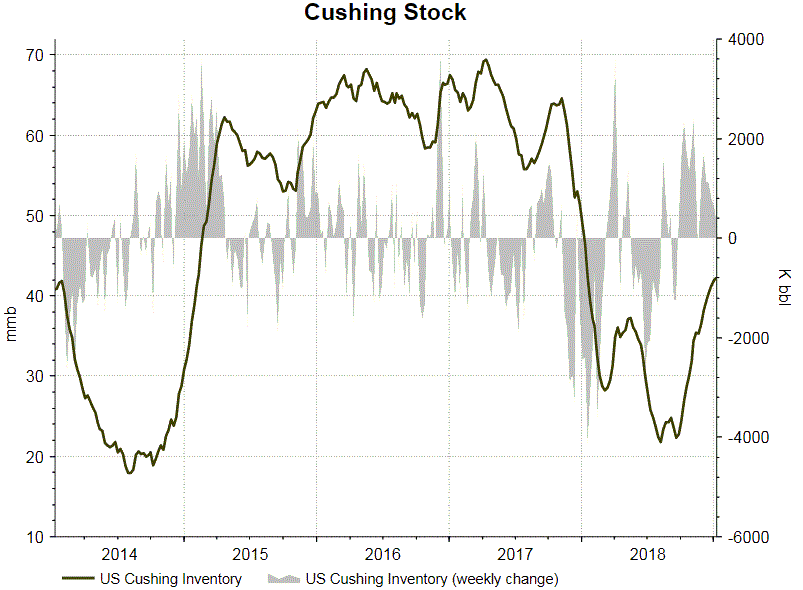
The report from the US Energy Information Administration (EIA) shows that total crude oil and petroleum products (ex. SPR) stocks gained +13.28 mmb to 1255.44 mmb in the week ended January 4. Crude oil inventory fell -1.68 mmb to 439.74 mmb (consensus: -2.8 mmb). Inventories decreased in 3 out of 5 PADDs. Meanwhile, Cushing stock added +0.33 mmb to 42.26 mmb. Utilization rate slipped soared -1.1% to 96.1% and crude production steadied at 11.7M bpd for the week.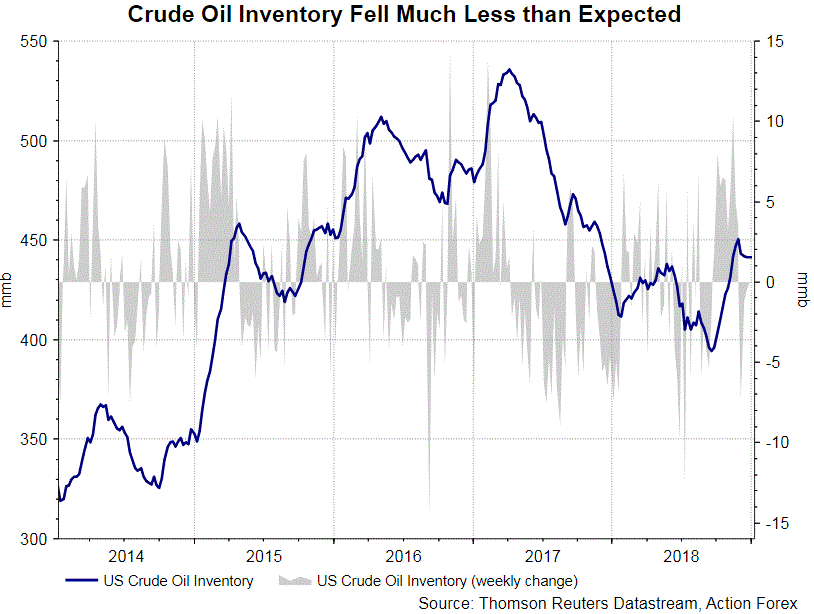
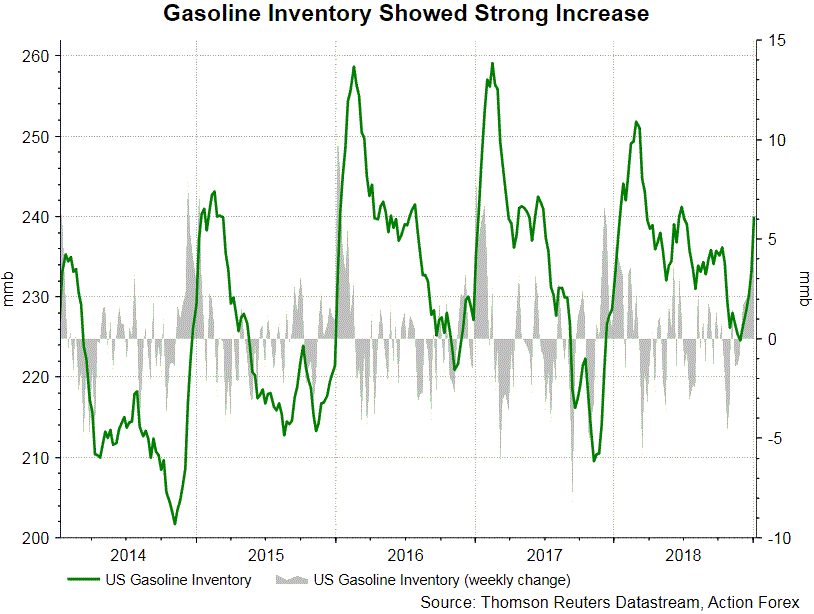
Concerning refined oil product inventories, gasoline inventory jumped +8.07 mmb to 248.06 mmb as demand dropped -1.3% to 8.74M bpd. The market had anticipated a +3.39 mmb increase in stockpile. Production added +1.49% to 9.39 bpd while imports jumped +75.16% to 0.55M bpd during the week. Distillate inventory soared +10.61 mmb to 140.04 mmb. Demand declined -7.74% to 2.96M bpd. The market had anticipated a +1.89 mmb gain in inventory. Production slipped -0.5% to 5.56M bpd while imports rose +33.85% to 0.26M bpd during the week.
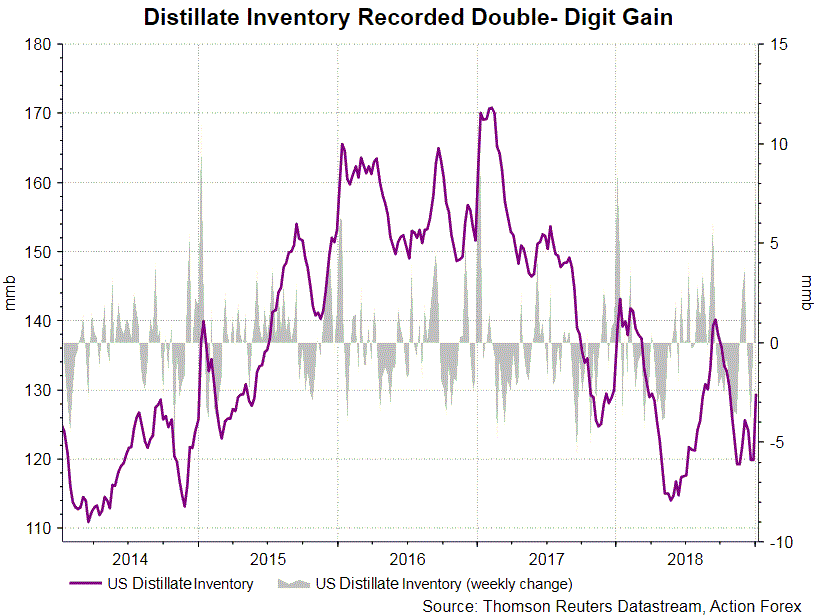
Released after market close on Wednesday, the industry- sponsored API estimated that crude oil inventory slumped -6.1 mmb during the week. For refined oil products, gasoline stockpile soared +5.5 mmb while distillate jumped +10.2 mmb.
Market Morning Briefing: Pound Is Trading Just Below 1.28
STOCKS
Most Equity indices have rallied well over this week and are testing near term Resistances. We could see a near term dip because of that, but the longer term could be bullish.
The Dow (23879, +91.67, +0.39%) saw a high of 23985.45, a hair's breadth away from the 24000 Resistance, the 21-MA on the 3-day chart. Gains beyond 24000 are a 50-50 probability. A break above 24000 takes the Dow up towards 24500. Failure brings it down towards 23500-250, before it picks up steam again.
Dax (10893.32, +89.34, +0.83%) rose to 10962, just below outer Resistance at 11000, which has held for now. Need to see if it now triggers profit-taking in line with what we said yesterday.
As it turns out, the Nikkei (20142, -285, -1.40%) rose momentarily past 20400 yesterday to a high of 20494.35, but was unable to rise past 20500 and has run into profit-taking today. We remain bullish in the longer term, given long-term Support near 19500 on the Weekly Line chart.
Shanghai (2539, -0.20%) has found Resistance at 2575 yesterday. Possibly a dip towards 2500 is needed to bring in fresh buying that can propel it past 2575 later.
Sensex (36212.91, +231.96, +0.64%) has risen past immediate resistance at 36100 while the Nifty (10855.15, +53, +0.49%) has closed just below 10900. With the Sensex breaking above 36100 and Nifty close to 10900, both could be showing strength for further bullishness 37000 and 11000 in medium-term.
COMMODITIES
Commodities are trading higher today.
Crude prices picked up momentum after the Saudi Energy minister said they would meet their goal of reducing output to 10.2 mln bpd this month which is about a reduction of 900,000bpd from the November output. According to him, Saudi Arabia would export around 7.2mln bpd in January and 7.1 mln bpd in Feb’19. Crude prices also got a boost from the Weekly US stockpiles that fell by 1.7 mln barrels according to the data by EIA yesterday.
Brent (60.82) and Nymex WTI (51.73) are trading higher just now. Brent has resistance on the weekly candles near 64 which could be tested in the near term before a dip is seen from there. WTI, on the other hand could test 54-56 levels on the upside. View is bullish for the near term for Brent and WTI towards 64 and 54/56 levels respectively.
Gold (1294.80) and Silver (15.76) have moved up. Gold could test 1300-1320 levels on the upside while above immediate support at 1280. Silver could trade below 16 for now. Weekly candles show 2 important resistances at 16.0 and 16.50 respectively which would be difficult to breach in the medium term. The current rise is likely to be short lived unless a sharp break above the respective resistances is seen.
Copper (2.6550) tested 2.6805 on the upside yesterday before dipping back towards 2.65 again. Currently trading below 2.66, there could be some sideways consolidation above 2.60.
FOREX
Strong rise in Euro (1.1557) above 1.15 contrary to our expectation of a fall from 1.15 towards 1.13. It would be crucial to see if the rise above 1.15 sustains in the medium term, as this could indicate initiation of a fresh rise. However, we would wait for confirmation on a break above weekly resistance at 1.16 also coming from long term moving averages. Failure to come off from 1.16 would be bullish for Euro indicating upside levels of 1.17-1.18 in the medium term.
Dollar Index (95.12) seems to be holding well below the crucial resistance at 98. While below 95.50, the index is likely to remain bearish towards 94.50 on the downside. A bounce back to 95.50+ from current levels would be needed to turn the sentiment otherwise.
The Euro-Yen (124.82) has potential to rise towards 128 in the medium term while we also keep an eye on the immediate resistance at 125.20. In case a break above 125.20 is seen, we would target 128 on the upside indicating a possibility of rising past 1.16 on the Euro, unless the rise is triggered by a rally in Dollar-Yen (107.91) towards 110-112.50 levels. A close watch on the movement in Dollar Yen would be crucial.
Dollar Yen (107.91) is trading below 108 just now. While there is support near 107, we do not expect much of a fall in the medium term. A bounce from 107 looks likely while the long term support on the weekly line charts hold. Failure to bounce from 107 would open up chances of a fall towards 105.
Pound (1.2791) is trading just below 1.28. A dip from here could be expected in the near term; else a rise towards 1.31 could come into the picture.
Aussie (0.7174) is trading slightly lower just now but has scope of testing upside resistance near 0.73 in the coming 1-2 weeks.
USD-CNY (6.7935) is trading below support at 6.80. Failure to bounce back from current levels could make the pair vulnerable to fall towards 6.73. Watch price action near current levels.
Dollar Rupee (70.47) could trade within 70.80-70.00 today. Direction is unclear just now as rising Crude and Indian equities and weakness in the US Dollar and other EM currencies indicate mixed views.
INTEREST RATES
As expected, both the US 5Yr (2.52%, down from 2.57%) and 10Yr (2.69%, down from 2.72%) have dipped from near-term Resistances, as mentioned yesterday. Some more dip towards 2.48% and 2.65% might be expected in the near term. In the longer term, we have to see whether the US 5Yr will break below long-term Support at 2.45% or not.
The drop in US Yields has pulled up the German-US 2Yr Spread (-3.10%, up from -3.17%) and German-US 10-yr (-2.47% up from -2.5%) again yesterday, after they fell the day before. We need to see whether these will rise further towards -3.0% and -2.2% or not. While the German 2Yr (-0.584%) could creep modestly higher, the German 10Yr (0.222%) could move lower. So, a further rise in the German-US Spreads might have to come from a further decline in US yields.
While that is our preferred long-term scenario, we have to see whether the Support at 2.45% on the US 5Yr breaks or not.
The Indian 10Yr GOI (7.47%) was largely stable yesterday. There is some chance of a further rise towards 7.59%.
AUD/USD Recovery Reaching Crucial Juncture
Key Highlights
- The Australian Dollar recovered nicely and moved above 0.7080 against the US Dollar.
- There was a break above a major bearish trend line at 0.7010 on the 4-hours chart of AUD/USD.
- Australia's Building Permits in Nov 2018 declined 9.1% (MoM).
- The US Initial Jobless Claims for the week ending Jan 05, 2019 will be released today, which is forecasted to decline from 231K to 225K.
AUDUSD Technical Analysis
After a significant decline, the Australian Dollar found support at 0.6740 against the US Dollar. The AUD/USD pair bounced back and broke the 0.6900 and 0.7000 resistance levels.
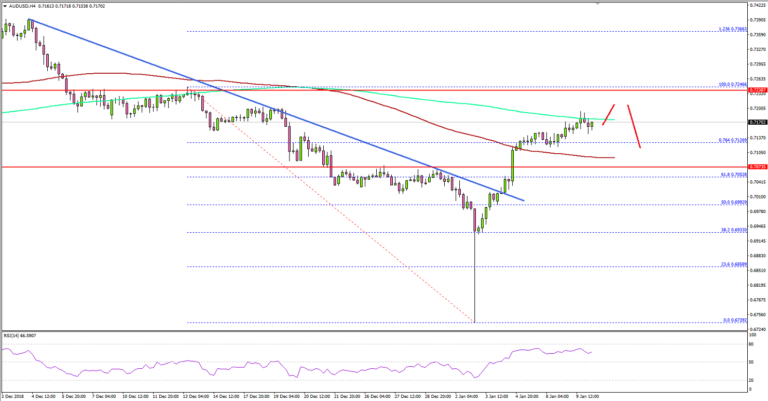
Looking at the 4-hours chart, the pair gained momentum after it broke the 0.7000 resistance. Buyers were successful in pushing the pair above the 61.8% Fib retracement level of the last drop from the 0.7246 high to 0.6739 low.
Moreover, there was a break above a major bearish trend line at 0.7010 on the same chart. The pair even settled above the 0.7080 resistance and the 100 simple moving average (red, 4-hours).
The pair is now placed above the 76.4% Fib retracement level of the last drop from the 0.7246 high to 0.6739 low. However, it approaching a significant resistance near the 0.7220-0.7240 zone.
If the pair struggles to surpass the 0.7220-0.7240 resistance zone, it could start a downside correction. An initial support is at 0.7100, followed by the 0.7080 level and the 100 simple moving average (red, 4-hours).
Recently in Australia, the Building Permits report for Nov 2018 was released by the Australian Bureau of Statistics. The market was looking for a decline of around 0.5% in Nov 2018, compared with the previous month.
However, the result was even disappointing as there was a sharp 9.1% drop in the Building Permits. The yearly change was also disappointing, as there was a 32.8% decline, more than the last -13.4%.
However, the AUD/USD pair did not react much to the news, but it seems like it may struggle near the 0.7220-0.7240 resistance area in the coming sessions.
Economic Releases to Watch Today
- US Initial Jobless Claims – Forecast 225K, versus 231K previous.
- Canada's New Housing Price Index for Nov 2018 (MoM) – Forecast 0%, versus 0% previous.