

Sample Category Title
Fed Evans: Good capacity to wait and look at incoming data and upcoming developments
Chicago Fed President Charles Evans said in a speech that "because inflation is not showing any meaningful sign of heading above 2 percent...I feel we have good capacity to wait and carefully take stock of the incoming data and other developments". He added that "developments in the first half of 2019 will be very important for making this assessment of our future monetary policy actions,"
Though, he also reiterated that "if the downside risks dissipate and the fundamentals continue to be strong, I expect that eventually the fed funds rate will rise a touch above its neutral level." And responding to the question of how many hikes, Evans said "three rate increases would be the short answer to your question". But he also noted "timing is not at all important...whether we get there by the end of 2019 or the end of 2020".
BoC governor Poloz press conference live stream and opening statement
https://www.youtube.com/watch?v=pwfuScsfTdM
Monetary Policy Report Press Conference Opening Statement
USD/CHF Mid-Day Outlook (Update)
Daily Pivots: (S1) 0.9790; (P) 0.9812; (R1) 0.9837; More....
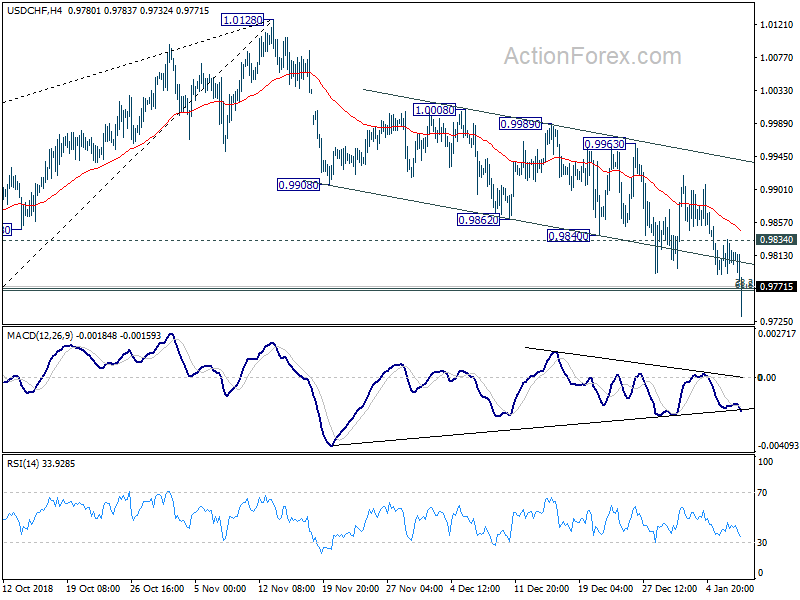
USD/CHF's decline accelerates to as low as 0.9732 so far. The break of 0.9765/8 cluster support and downside acceleration argues that fall from 1.0128 is not correcting the rise from 0.9541, but that from 0.9186. Intraday bias stays on the downside for next key level at 0.9541 (61.8% retracement of 0.9186 to 1.0128 at 0.9546. On the upside, break of 0.9834 minor resistance is now needed to be the first sign of near term bottoming. Otherwise, further decline will remain in favor even in case of recovery.
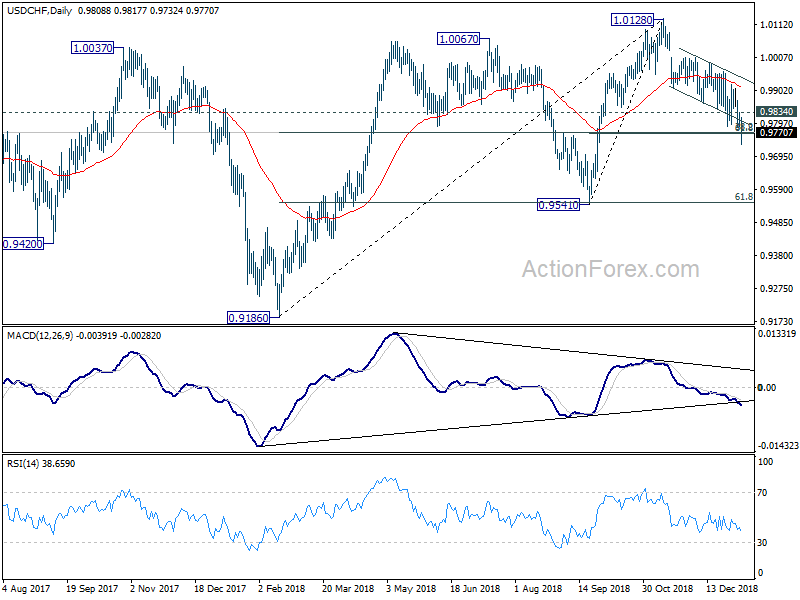
In the bigger picture, current development suggests that rise from 0.9186 has possibly completed with three waves up to 1.0128 already. Decline from 1.0128 could either be correcting this move, or reversing the trend. As long as 0.9541 support holds, we'd slightly favor the former scenario, and expect another rise through 1.0128 at a later stage. However, sustained break of 0.9541 will confirm trend reversal and bring deeper fall back to 0.9186 low.
EUR/USD Mid-Day Outlook (Update)
Daily Pivots: (S1) 1.1414; (P) 1.1450; (R1) 1.1476; More.....
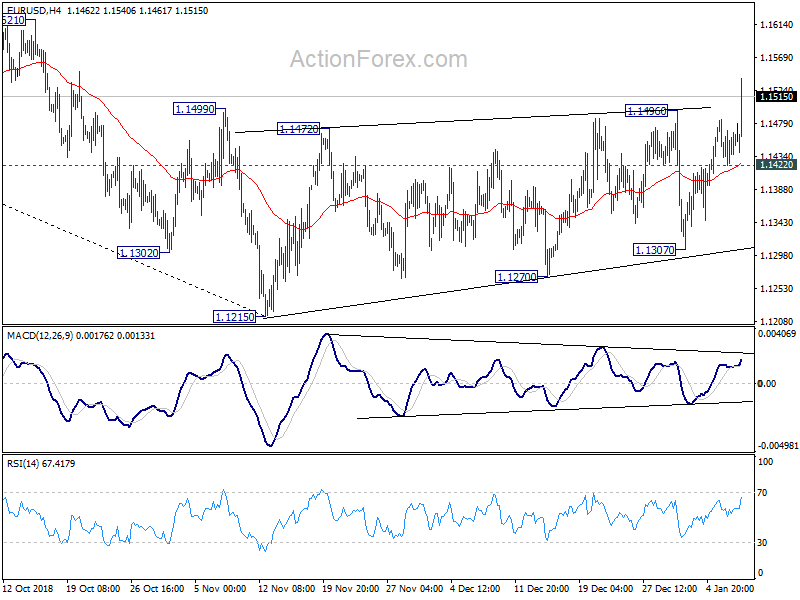
EUR/USD surges to as high as 1.1540 so far in early US session. The strong break of 1.1499 resistance should confirm completion of fall from 1.1814 at 1.1215. Current rebound might indeed be correcting whole decline from 1.2555, if not reversing the down trend. Intraday bias is back on the upside for 1.1621 resistance first. Break will target 38.2% retracement of 1.2555 to 1.1215 at 1.1727 next. On the downside, break of 1.1422 support is needed to indicate completion of the rebound. Otherwise, further rise will now remain in favor in case of retreat.
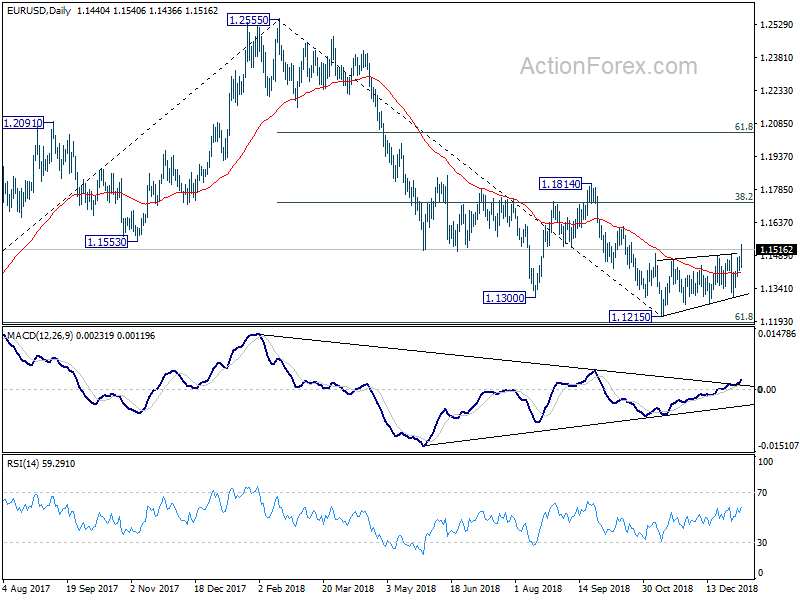
In the bigger picture, as long as 1.1814 resistance holds, down trend down trend from 1.2555 medium term top is still in progress and should target 61.8% retracement of 1.0339 (2017 low) to 1.2555 at 1.1186 next. Sustained break there will pave the way to retest 1.0339. However, break of 1.1814 will confirm completion of such down trend and turn medium term outlook bullish.
ECB Minutes Next in Line as Rate Differentials Keep Euro Resilient
The minutes of the latest ECB meeting, where policymakers officially decided to end QE, are due out on Thursday at 1230 GMT. Investors will look at how officials see the Eurozone’s growth prospects, and whether they are even more worried than President Draghi has let on. Any signs the Bank is growing more cautious may weigh on the euro, though note that the currency has remained resilient in the face of bad news recently, so any downside may be fairly limited.
The Eurozone has lost significant growth momentum in recent quarters, with most of the weakness seen in Italy, and surprisingly Germany as well. While such a slowdown could have been a “red flag” for a central bank trying to terminate its crisis-era Quantitative Easing (QE) program, the ECB remained adamant about ending QE, repeatedly noting that growth was merely reverting to more normal levels after a surprisingly strong 2017. Instead, the Bank has chosen to focus more on wages, which are now growing at the fastest pace in a decade, hoping that the extra disposable income will ultimately lift inflation as consumers start spending more.
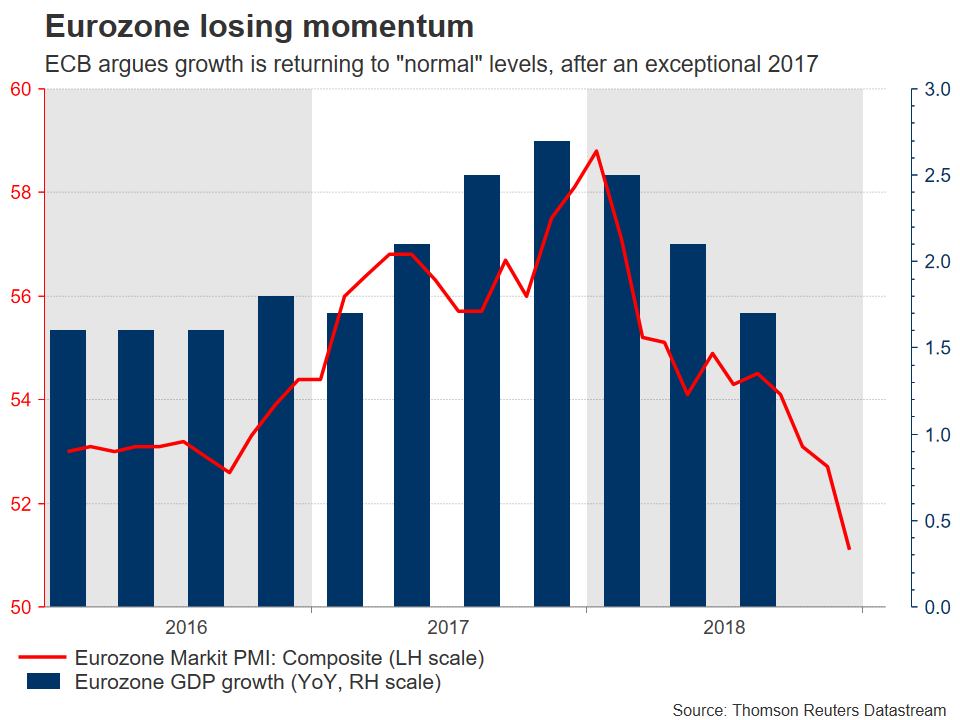
Yet, even the ECB is starting to admit this weakness may persist. At the latest press conference, President Draghi noted that although risks to growth can still be assessed as “broadly balanced”, they are increasingly “moving to the downside” due to geopolitical factors, trade protectionism, emerging market vulnerabilities, and financial market volatility. In other words, although not saying it explicitly, Draghi effectively signaled the Governing Council is growing uneasy.
This is precisely the topic markets are likely to focus on in the minutes; the conversation around the growth outlook. Specifically, the question is: did any official argue in favor of formally changing the balance of risks to “tilted to the downside”? Even if not, any concerned comments hinting that this dovish language shift may occur at the upcoming January 24 meeting could still work against the euro, especially considering that the bloc’s economic data pulse has weakened even further since then.
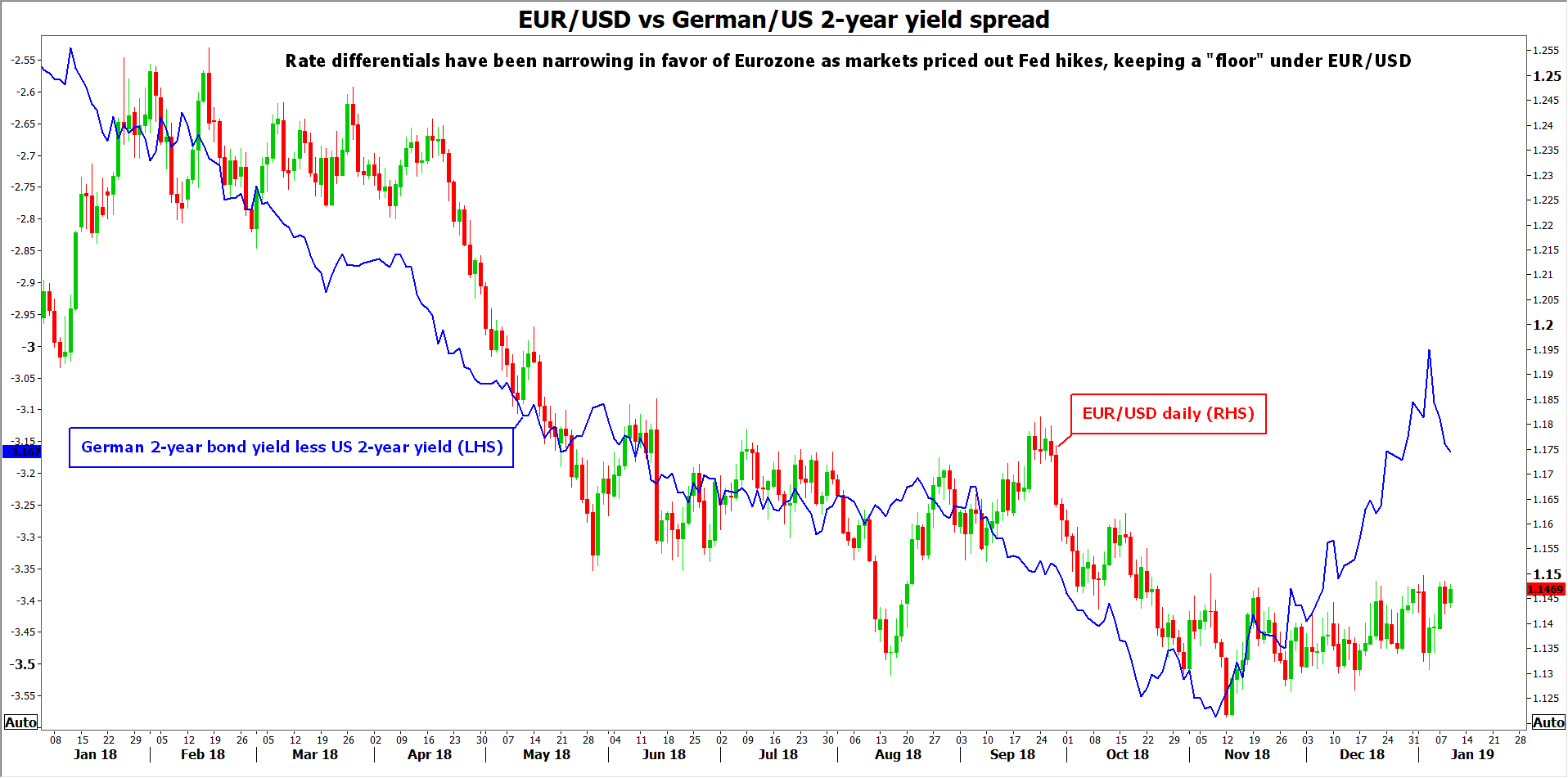
That said, the euro has taken bad news in its stride in recent weeks, with significant disappointments in key economic data often being met with limited downside. This resilience is probably owed to changes in relative interest rates. Namely, with markets having priced out nearly all future Fed tightening lately, but ECB rate pricing remaining quite stable, bond yields between the US and Eurozone have started to narrow in Europe’s favor.
This renders the euro more attractive relative to the dollar, by extent keeping an implicit “floor” under euro/dollar, something also evident by the fact that the pair has been printing higher lows on the daily chart, and highs at around the same levels. To sum up, narrowing Eurozone/US rate differentials may keep any setbacks in euro/dollar relatively short-lived.
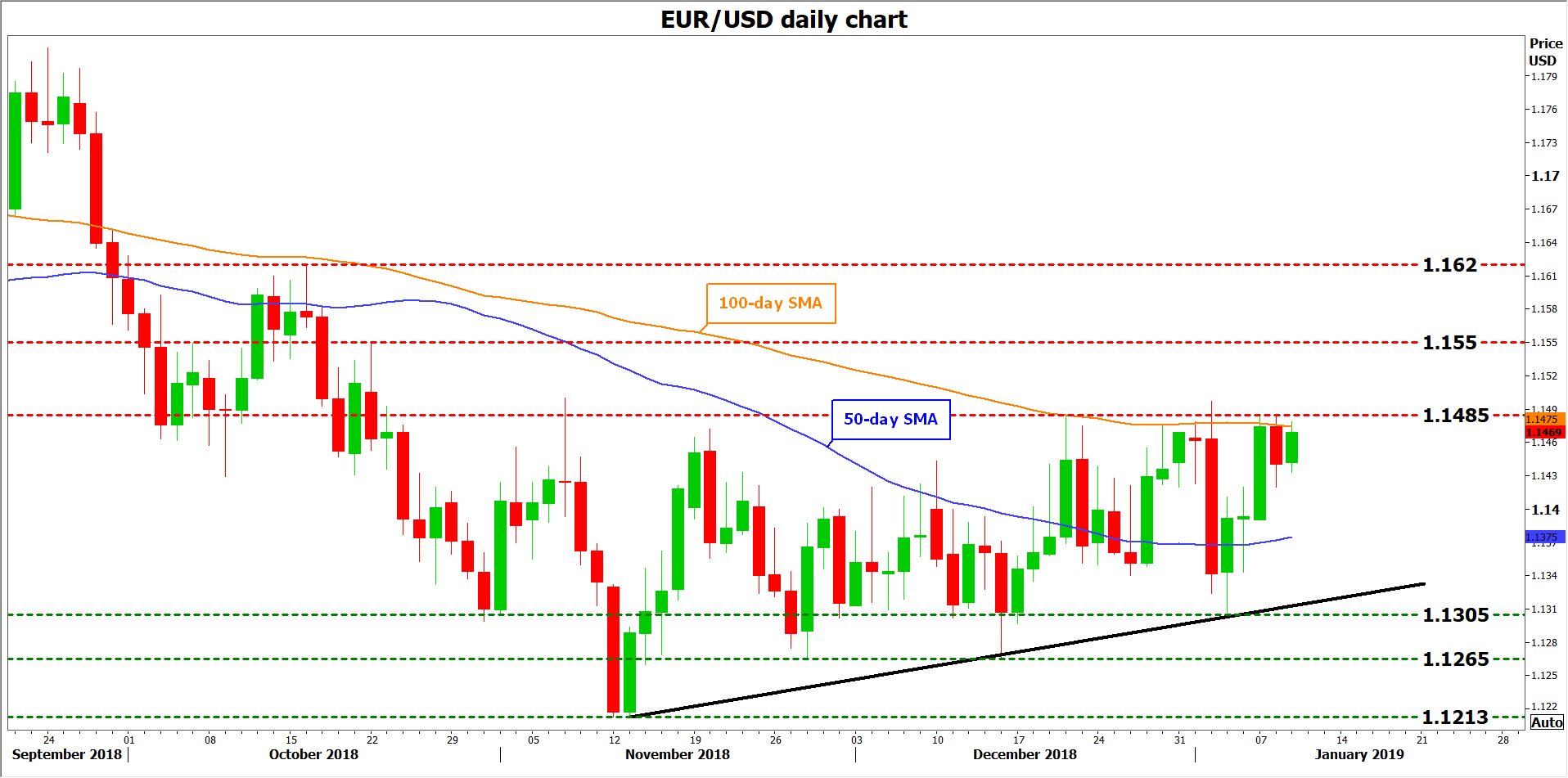
Technically, support to declines in euro/dollar may be found near the 50-day simple moving average (SMA), currently at 1.1375. A downside break could open the way for the crossroads of the uptrend line drawn from the lows of November 12 and the 1.1305 level.
On the flipside, immediate resistance to advances may be found around the latest peaks at 1.1485, with a bullish break likely seeing scope for a test of 1.1550, the October 22 top.
Japanese Yen Edges Higher as Consumer Income Climbs
USD/JPY has posted considerable losses on Wednesday. In the North American session, USD/JPY is trading at 108.22, down 0.48% on the day. In economic news, Japanese Average Cash Earnings jumped to 2.0% in November, up from 1.5% a month earlier. This easily beat the estimate of 1.3%. In the U.S, the key event is the minutes from the Fed policy meeting in December. On Thursday, the U.S. releases unemployment claims and Fed Chair Powell will speak at an event in Washington. Japan will publish household spending.
The Federal Reserve will be in the spotlight, with the release of the FOMC minutes later on Monday. At the December policy meeting, the Fed raised rates by a quarter point, to a range between 2.25% and 2.50%. This ended a very aggressive 2018 for the Fed, which hiked rates four times. The December rate statement hinted that further rates were in the works for 2019, but a sharp drop in the stock markets has forced the Fed to adjust, and Fed Chair Powell was quite dovish in remarks last week, which were well received by investors. The Fed forecast is calling for two more hikes this year, but the markets are doubtful, with some analysts predicting a rate cut late in the year. It will be interesting to see the views of policymakers in the minutes and the reaction of the markets.
Investor optimism is higher this week, as hopes are high that trade tensions between the U.S. and China could ease. The world’s two largest economies have been engaged in a nasty tariff spat, which has rocked the markets in recent weeks and threatens to put a chill on global growth. Chinese and U.S. officials were scheduled to hold a two day meeting at the start of the week, but the talks were extended for a third day on Wednesday. This has raised hopes that the sides are making progress. The stakes are high, as President Trump has threatened to impose higher tariffs on $250 billion worth of Chinese products if there is no deal by March 1. If the nasty trade war shows signs of easing, risk appetite could grow and make the safe-haven yen less attractive.
Sunset Market Commentary
Markets
Global core bonds were mixed and little changed today even as risk sentiment stayed positive. China and the US wrapped up three days of trade negotiations with both sides expressing that progress had been made. An official statement will follow tonight, but Chinese VP Liu He is expected to visit Washington later this month to continue more high-level trade talks. Atlanta Fed’s Bostic was his dovish self and estimates current rate levels close to neutral. He added that the government shutdown may hurt the growth projection of the Fed. Fed’s Evans also gave some balanced comments on the Fed’s normalization process. The release of FOMC meeting minutes of the December meeting are a wild card later today. The US yield curve is currently mixed with changes varying between -0.2 bps (5-yr) to +0.7 bps (30-yr). In the eurozone, the unemployment rate fell to 7.9%, the lowest level in over a decade. European equities continued the rally of late, while German Bunds prove to be resilient. The German yield curve edged cautiously lower with changes in the range of -0.2 bps (2-yr) to -0.1 bp (30-yr).
There was initially no compelling story to guide USD trading today with only second-tier data. Global risk sentiment stays positive as the US and China signaled a constructive tone at the trade negotiations in Beijing. The positive sentiment supported further gains of European equities, but didn’t really help EUR/USD. Yesterday, the pair came within reach of the 1.15 mark and this morning it looked that a retest was possible, but the move had no strong legs. Investors didn’t seen enough reason to attack the 1.15 barrier that proved quite solid of late. Early in US dealings, comments from Fed governors including Fed’s Evans (a voter this year) suggested that low inflation gives the Fed room to take a cautious approach on further tightening. The dollar came again under pressure and EUR/USD is again testing the 1.15 resistance at the moment of writing. In this respect, markets will also keep a close eye on the minutes of the December Fed meeting to be published later today. USD/JPY (108.55/60 area) is also drifting off the intraday ‘top’.
Sterling temporary gained a few ticks this morning. The ‘rebound’ occurred after a vote in Parliament yesterday made it more difficult for the UK government to implement a no-deal Brexit in case PM May’s agreement with the EU is rejected next week. There were also rumours that UK PM May tried to convince the DUP party to approve her deal by providing Northern Ireland ‘guarantees’ in case the backstop procedure on the Irish boarder would be activated. EUR/GBP dropped temporary to the 0.8975 are, but optimism faded soon as the DUP rejected the proposals. This afternoon, PM May faced another defeat on a Brexit-amendment in Parliament that will tie the government’s hands further in case the current deal gets rejected next week. EUR/GBP is regaining the 0.90 barrier as Brexit tensions return back into the spotlights.
News Headlines
Rating agency Fitch issued a warning of a possible cut of the US’s triple-A sovereign credit rating later this year should the government shutdown continue to March 1. This might force the agency to start “thinking about the policy framework, the inability to pass a budget … and whether all of this is consistent with triple-AAA”, in particular when the debt ceiling requires another lift.
Euro zone November unemployment unexpectedly fell to 7.9%, the lowest in a decade, while having the October number revised downwardly to 8%. The figure conceals a wide intra-EMU divergence however, with the Czech Republic (1.9%) and Germany (3.3%) on one side of the spectrum and Italy (10.5%) and Spain (14.7%) on the other. The report didn’t contain the Greek data yet.
NZD/USD: Resumes Recovery Strength, Bullish
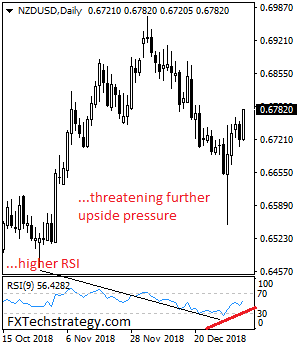
NZDUSD resumes recovery strength as it eyes a move further higher towards the 0.6800 resistance zone. Above here will target the 0.6850 level where a break will turn attention to the 0.6900 level. A break of here will have to occur to create scope for a move towards the 0.6950 level. Further out, resistance resides at the 0.7000 level. Its daily RSI is bullish and pointing higher suggesting further upside. Support stands at the 0.6750 level. Further down, the 0.6700 level comes in as the next downside target and then the 0.6650 level. All in all, NZDUSD faces further upside pressure on recovery.
USD/CAD Mid-Day Outlook
Daily Pivots: (S1) 1.3254; (P) 1.3288; (R1) 1.3309; More...
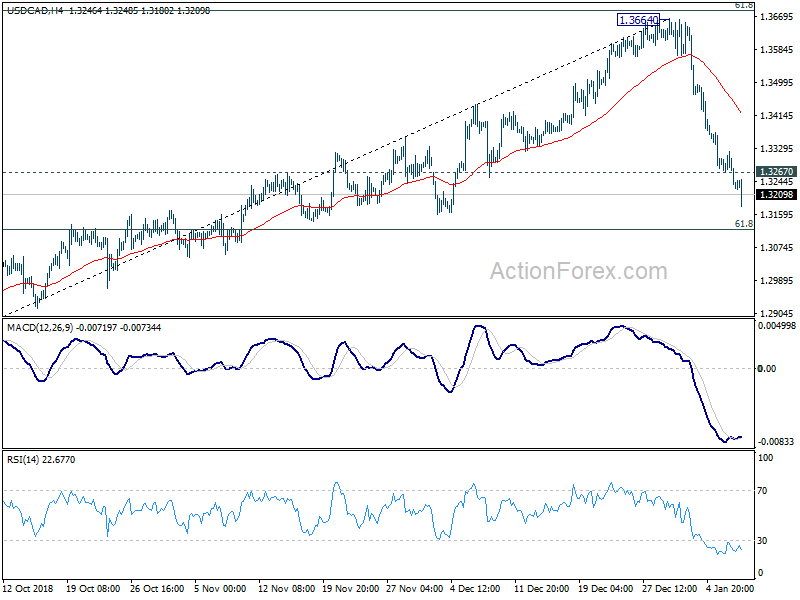
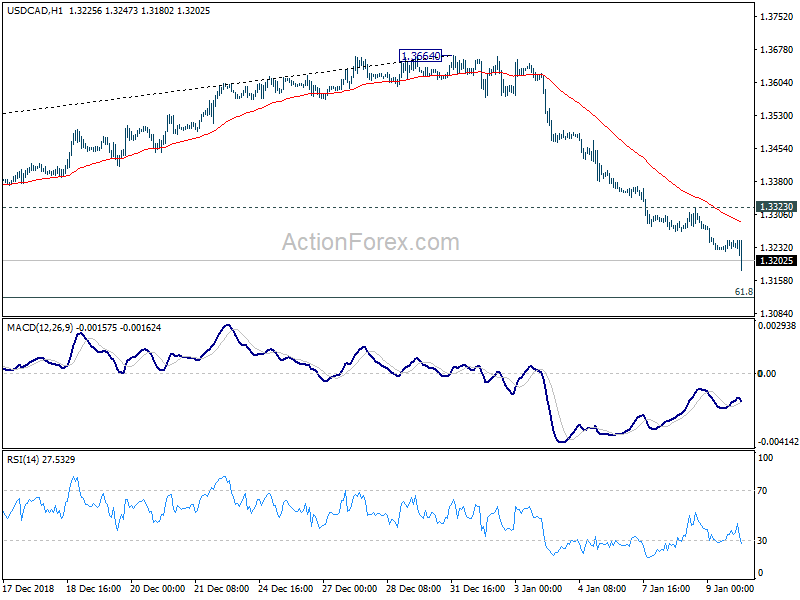
USD/CAD dives further to as low as 1.3180 so far. Intraday bias remains on the downside and fall from 1.3664 should target 61.8% retracement of 1.2781 to 1.3664 at 1.3118. We'll start look for bottoming sign below there. On the upside, above 1.3267 minor resistance will turn bias neutral first. But risk will stay on the downside as long as 4 hour 55 EMA (now at 1.3420) remains intact.
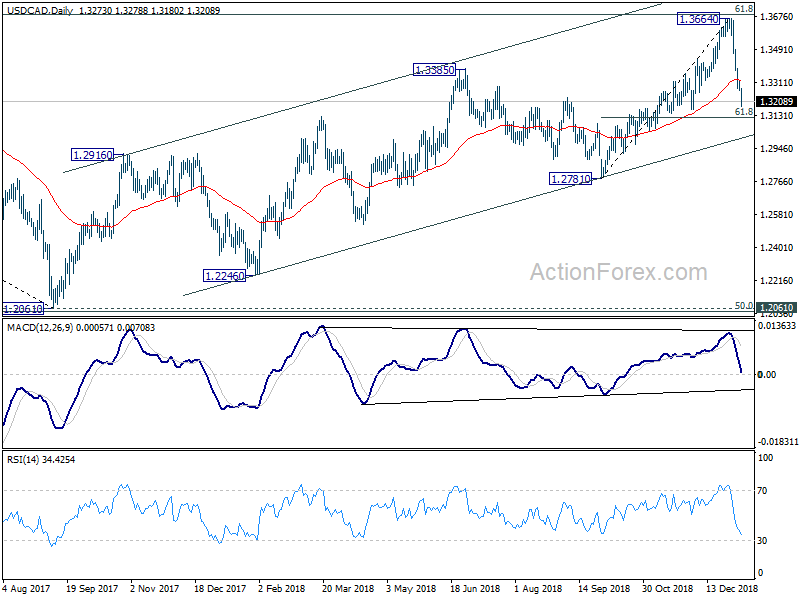
In the bigger picture, the medium term rise from 1.2061 (2017 low) might continue further. But the structure of such rise is not clearly impulsive so far. Hence, we'd stay cautious on strong resistance from 61.8% retracement of 1.4689 (2016 high) to 1.2061 at 1.3685 and 1.3793 resistance to limit upside, and bring medium term topping. But in any case, medium term outlook will stay bullish as long as channel support (now at 1.2993) holds. Sustained break of 1.3793 will pave the way to retest 1.4689 (2015 high).
USD/CAD dives as BoC sounds upbeat despite growth downgrade, full statement
BoC left overnight rate unchanged at 1.75%. While there was downgrade in 2019 growth projection, the overall tone of the statement remains rather upbeat. And most importantly, BoC maintained tightening bias and said "policy interest rate will need to rise over time into a neutral range to achieve the inflation target." Nevertheless, "the appropriate pace of rate increases will depend on how the outlook evolves, with a particular focus on developments in oil markets, the Canadian housing market, and global trade policy."
For 2019, GDP is projected to grow 1.7%, 0.4% slower than October forecast. BoC said it reflects ""temporary" slowing in Q4 2018 and Q1 2019. But is expect indications of demand to show renewed momentum in early 2019. Thus, it will lead to "above-potential growth of 2.1% in 2020."
CPI inflation ins projected to "edge further down" from 1.7% and stay below 2% "through much of 2019". But lower level of Canadian Dollar will "exert some upward pressure on inflation". CPI is projected to return to 2% by late 2019.
BoC also reiterated the concern over fall in global oil prices. However, it also noted that the developments are "occurring in the context of a Canadian economy that has been performing well overall." And, "looking ahead, exports and non-energy investment are projected to grow solidly, supported by foreign demand, the CUSMA, the lower Canadian dollar, and federal tax measures targeted at investment."
USD/CAD dives further after the release.
Full release below:
Bank of Canada maintains overnight rate target at 1 ¾ per cent
The Bank of Canada today maintained its target for the overnight rate at 1 ¾ per cent. The Bank Rate is correspondingly 2 per cent and the deposit rate is 1 ½ per cent.
The global economic expansion continues to moderate, with growth forecast to slow to 3.4 per cent in 2019 from 3.7 per cent in 2018. In particular, growth in the United States remains solid but is expected to slow to a more sustainable pace through 2019. However, there are increasing signs that the US-China trade conflict is weighing on global demand and commodity prices.
Global benchmark prices for oil have been about 25 per cent lower than assumed in the October Monetary Policy Report (MPR). The lower prices primarily reflect sustained increases in US oil supply and, more recently, increased worries about global demand. These worries among market participants have also been reflected in bond and equity markets.
The drop in global oil prices has a material impact on the Canadian outlook, resulting in lower terms of trade and national income. As well, transportation constraints and rising production have combined to push up oil inventories in the west and exert even more downward pressure on Canadian benchmark prices. While price differentials have narrowed in recent weeks following announced mandatory production cuts in Alberta, investment in Canada's oil sector is projected to weaken further.
These developments are occurring in the context of a Canadian economy that has been performing well overall. Growth has been running close to potential, employment growth has been strong and unemployment is at a 40-year low. Looking ahead, exports and non-energy investment are projected to grow solidly, supported by foreign demand, the CUSMA, the lower Canadian dollar, and federal tax measures targeted at investment.
Meanwhile, consumption spending and housing investment have been weaker than expected as housing markets adjust to municipal and provincial measures, changes to mortgage guidelines, and higher interest rates. Household spending will be dampened further by slow growth in oil-producing provinces. The Bank will continue to monitor these adjustments.
The Bank projects real GDP will grow by 1.7 per cent in 2019, 0.4 percentage points slower than the October outlook. This revised forecast reflects a temporary slowing in the fourth quarter of 2018 and the first quarter of 2019. This will open up a modest amount of excess capacity, primarily in oil-producing regions. Nevertheless, indicators of demand should start to show renewed momentum in early 2019, leading to above-potential growth of 2.1 per cent in 2020.
Core inflation measures remain clustered close to 2 per cent. As expected, CPI inflation eased to 1.7% in November, due to lower gasoline prices. CPI inflation is projected to edge further down and be below 2 per cent through much of 2019, owing mainly to lower gasoline prices. On the other hand, the lower level of the Canadian dollar will exert some upward pressure on inflation. As these transitory effects unwind and excess capacity is absorbed, inflation will return to around the 2 per cent target by late 2019.
Weighing all of these factors, Governing Council continues to judge that the policy interest rate will need to rise over time into a neutral range to achieve the inflation target. The appropriate pace of rate increases will depend on how the outlook evolves, with a particular focus on developments in oil markets, the Canadian housing market, and global trade policy.
Information note
The next scheduled date for announcing the overnight rate target is March 6, 2019. The next full update of the Bank's outlook for the economy and inflation, including risks to the projection, will be published in the MPR on April 24, 2019.