

Sample Category Title
(BOC) Bank of Canada maintains overnight rate target at 1 ¾ per cent
The Bank of Canada today maintained its target for the overnight rate at 1 ¾ per cent. The Bank Rate is correspondingly 2 per cent and the deposit rate is 1 ½ per cent.
The global economic expansion continues to moderate, with growth forecast to slow to 3.4 per cent in 2019 from 3.7 per cent in 2018. In particular, growth in the United States remains solid but is expected to slow to a more sustainable pace through 2019. However, there are increasing signs that the US-China trade conflict is weighing on global demand and commodity prices.
Global benchmark prices for oil have been about 25 per cent lower than assumed in the October Monetary Policy Report (MPR). The lower prices primarily reflect sustained increases in US oil supply and, more recently, increased worries about global demand. These worries among market participants have also been reflected in bond and equity markets.
The drop in global oil prices has a material impact on the Canadian outlook, resulting in lower terms of trade and national income. As well, transportation constraints and rising production have combined to push up oil inventories in the west and exert even more downward pressure on Canadian benchmark prices. While price differentials have narrowed in recent weeks following announced mandatory production cuts in Alberta, investment in Canada's oil sector is projected to weaken further.
These developments are occurring in the context of a Canadian economy that has been performing well overall. Growth has been running close to potential, employment growth has been strong and unemployment is at a 40-year low. Looking ahead, exports and non-energy investment are projected to grow solidly, supported by foreign demand, the CUSMA, the lower Canadian dollar, and federal tax measures targeted at investment.
Meanwhile, consumption spending and housing investment have been weaker than expected as housing markets adjust to municipal and provincial measures, changes to mortgage guidelines, and higher interest rates. Household spending will be dampened further by slow growth in oil-producing provinces. The Bank will continue to monitor these adjustments.
The Bank projects real GDP will grow by 1.7 per cent in 2019, 0.4 percentage points slower than the October outlook. This revised forecast reflects a temporary slowing in the fourth quarter of 2018 and the first quarter of 2019. This will open up a modest amount of excess capacity, primarily in oil-producing regions. Nevertheless, indicators of demand should start to show renewed momentum in early 2019, leading to above-potential growth of 2.1 per cent in 2020.
Core inflation measures remain clustered close to 2 per cent. As expected, CPI inflation eased to 1.7% in November, due to lower gasoline prices. CPI inflation is projected to edge further down and be below 2 per cent through much of 2019, owing mainly to lower gasoline prices. On the other hand, the lower level of the Canadian dollar will exert some upward pressure on inflation. As these transitory effects unwind and excess capacity is absorbed, inflation will return to around the 2 per cent target by late 2019.
Weighing all of these factors, Governing Council continues to judge that the policy interest rate will need to rise over time into a neutral range to achieve the inflation target. The appropriate pace of rate increases will depend on how the outlook evolves, with a particular focus on developments in oil markets, the Canadian housing market, and global trade policy.
Information note
The next scheduled date for announcing the overnight rate target is March 6, 2019. The next full update of the Bank's outlook for the economy and inflation, including risks to the projection, will be published in the MPR on April 24, 2019.
EURGBP Remains Neutral in Short and Long Terms
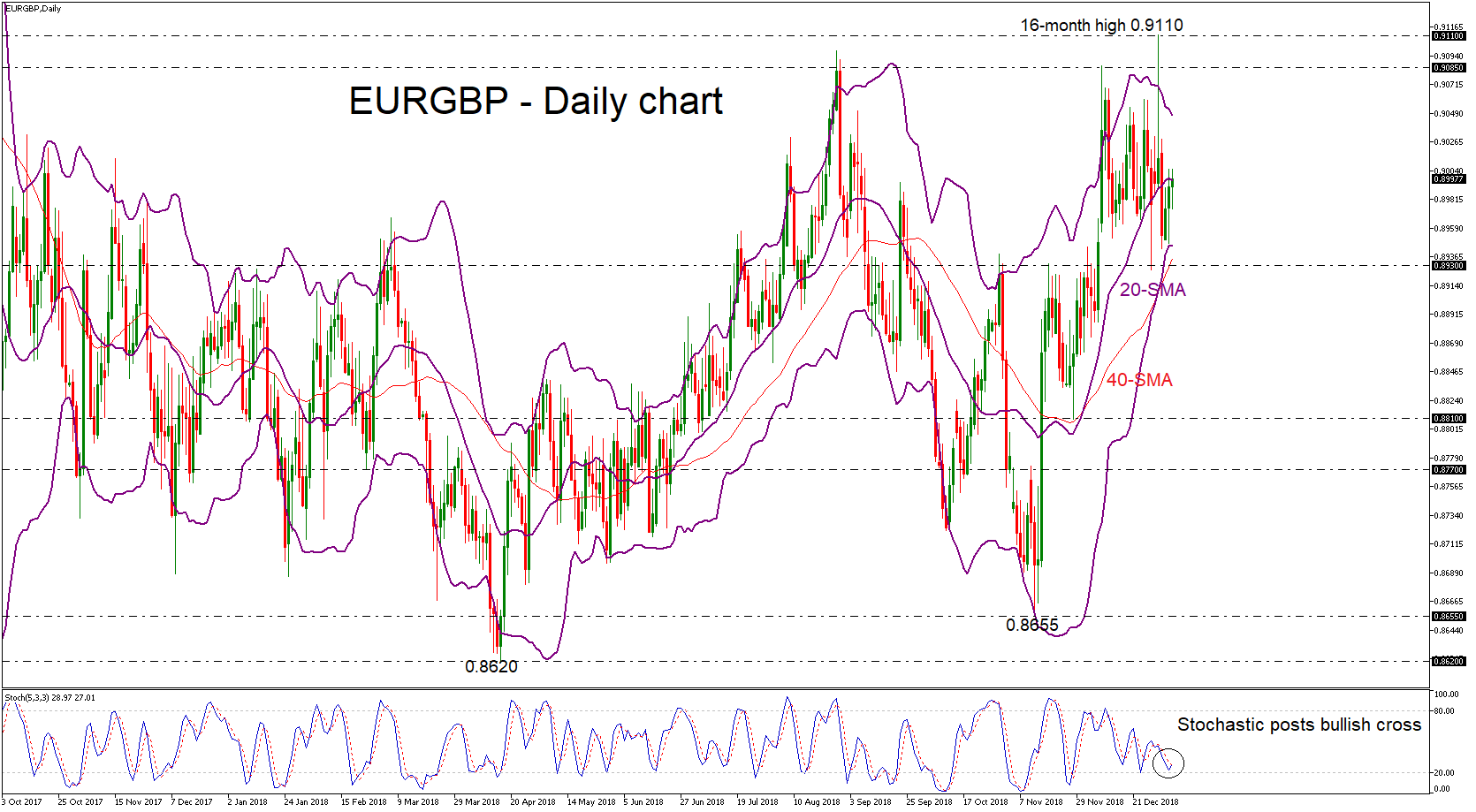
EURGBP has been lacking direction over the last month as it hovers within a narrow range with upper boundary the 0.9085 resistance and lower boundary the 0.8930 support. It is noteworthy that the price created a strong spike to the upside during the previous week, recording a fresh 16-month high of 0.9110. Technically, the %K line of the stochastic oscillator is ready to turn to the upside creating a bullish cross with the %D line.
An upside run in the price and a successful leg above the 20-day simple moving average may retest the upper Bollinger Band of 0.9050. Above this level the pair could challenge the previous peak of the 0.9085 resistance. Also, investors would be interested to see whether bullish dynamics can overcome the previous peak and meet the 0.9110 strong obstacle.
Alternatively, a decline in the price may retest the 0.8930 support barrier, which stands near the 40-day SMA. More downside pressure could send the market until the 0.8810 key level.
Concluding, in the bigger view, EURGBP has been trading in a consolidation area over the last 16 months.
Canadian Housing Starts Dipped to 213k in December
Highlights:
- Housing starts eased to 213k in December. The 6-month trend rate edged down to 207k from 212k in November.
Our Take:
Canadian housing starts remained at solid levels in December at an annualized 213k, although down from a stronger 224k in November. That starts were still strong in December is not so surprising given recent building permit issuance — which averaged 228k per month over the three months ending in October (the latest month available.) Starts fell sharply in Ontario and the Prairies in December, but were up in British Columbia. Most of the changes in the month were in the often-volatile multiple-unit component. Starts for 2018 as a whole came in at 213k. That is down from 220k in 2017 but was still just the third 200k+ annual rate over the last decade.
The new building data remains at odds with a larger pullback in home resales in 2018. We expect housing starts will ultimately follow suit and continue to look for an easing in activity to around 194k this year. That would still be a relatively strong pace of building activity historically and labour markets in Canada still look quite solid. Lower oil prices, though, are having an impact on growth in oil-producing regions and questions have emerged about the durability of the global economic expansion. At the same time, slower housing markets and slower growth in household debt has arguably removed some of the urgency for the Bank of Canada to hike interest rates in the very near-term. We continue to expect that further interest rate hikes from the central bank will ultimately be warranted, but very likely not as early as the policy rate decision later this morning.
Canada: Housing Starts Remain Healthy in December
Canadian housing starts fell 4.9% m/m to 213.4k (annualized) units in December. Still, the level remained healthy and follows an upwardly revised November print of 224.3k (previous: 215.9k). On a six month moving average basis, starts fell to 207.0k from 212.3k.
The dip in December starts was concentrated in multi-family units, which fell 6.5% to 149.8k units. Single-detached starts were flat, coming in at around 63.7k units.
Homebuilding was lower in seven of ten provinces. Starts increased in Nova Scotia (+1.6k to 5.5k units) and Quebec (+2.7k to 52.7k units – the strongest pace since June). Starts also jumped to their highest level since late 2017 in B.C. (+10.6k to 50.9k units). On the other hand, starts experienced notable declines in Ontario (-15.1k to 70.5k units), Alberta (-6.8k to 19.0k units) and Manitoba (-3.2k to 6.7k units). Starts remained low in Saskatchewan (2.5k units) while dropping in every other Atlantic province, with the sharpest percentage decline (-24%) occurring in PEI.
Key Implications
This was a strong report, with a healthy pace of starts in December combined with an upward revision to November's already-healthy print. Homebuilding is being buoyed by strong population growth, on-going job gains, and past growth in pre-construction sales.
With the solid December level, starts are up 10% in the fourth quarter compared to Q3, helping offset the impact of weak sales activity on residential investment and providing a welcome dose of good news for the economy overall. Still economic growth looks likely to slow to a sub 2% (annualized) pace in Q4, weighed down by production cuts in the oil sector.
We expect homebuilding to glide below the 200k mark in 2019 as higher mortgage rates, tighter lending conditions and strained affordability in key markets weighs on demand. Overbuilt markets in the Prairies and moderating pre-construction sales activity are also factors which should cool the pace of new housing construction moving forward. On the supportive side, a rising population coupled with continued – albeit slower – economic growth should ensure that the moderation remains orderly.
USD/CHF Mid-Day Outlook
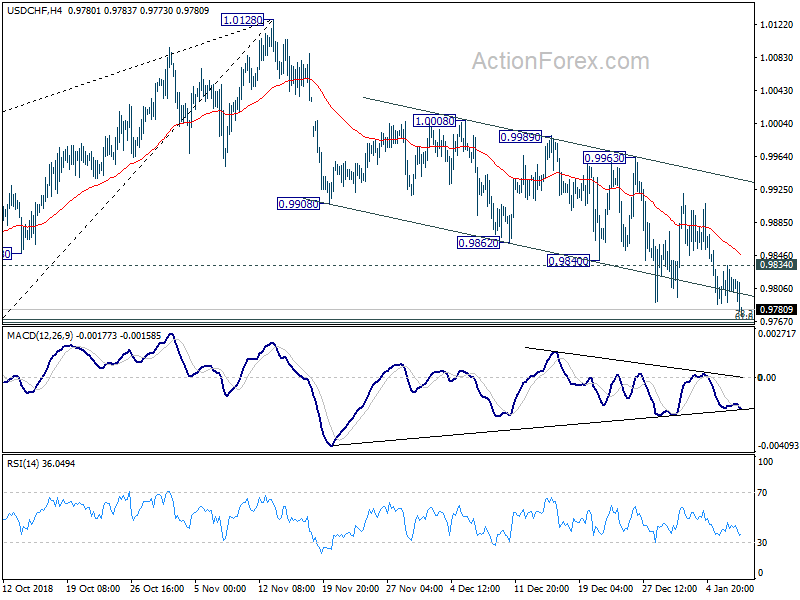
Daily Pivots: (S1) 0.9790; (P) 0.9812; (R1) 0.9837; More...
USD/CHF's correction from 1.0128 extends to as low as 0.9778 so far today. At this point, we'd expect downside to be contained by 0.9765/8 cluster support (61.8% retracement of 0.9541 to 1.0128 at 0.9765, 38.2% retracement of 0.9186 to 1.0128 at 0.9768) to bring rebound. On the upside, break of 0.9834 minor resistance will turn bias back to the upside for 0.9963 resistance. Break will indicate completion of the correction and target 1.0128 high. However, sustained break of 0.9765/8 will bring deeper fall back to 0.9541 support next.
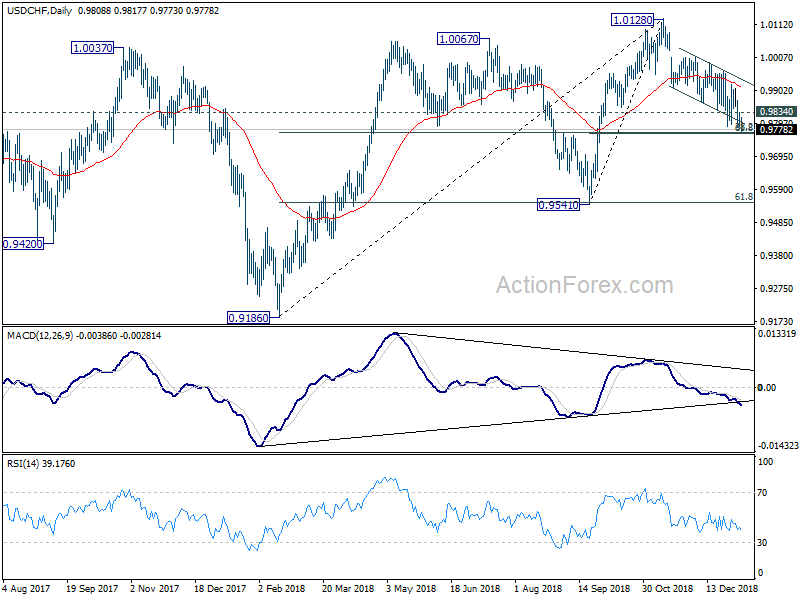
In the bigger picture, while the fall from 1.0128 was slightly deeper than expected, the structure suggests it's a corrective move. As long as 0.9765/8 cluster support (61.8% retracement of 0.9541 to 1.0128 at 0.9765, 38.2% retracement of 0.9186 to 1.0128 at 0.9768) holds, we'd expect up trend from 0.9541 and 0.9186 to resume later through 1.0128. However firm break of 0.9765/8 will argue that the trend has reversed. Further break of 0.9541 support will confirm this bearish scenario and bring deeper fall back to 0.9186 low.
USD/JPY Mid-Day Outlook
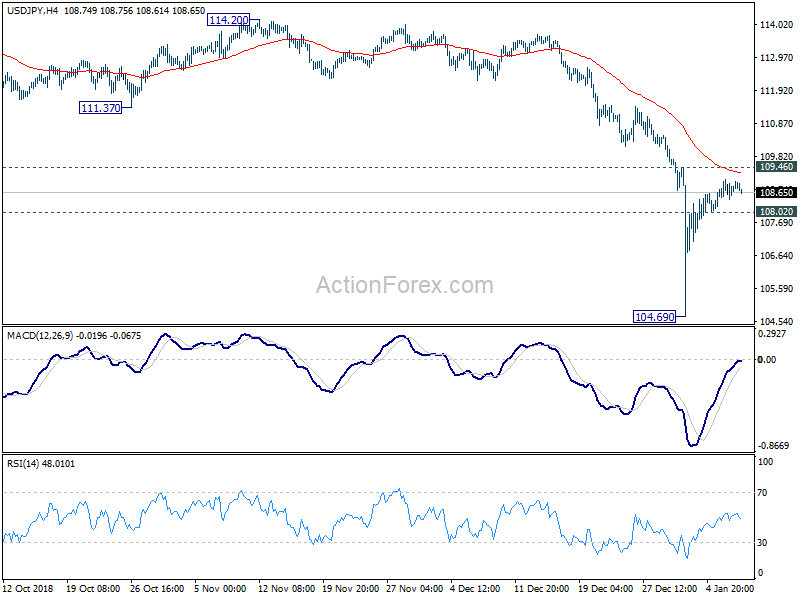
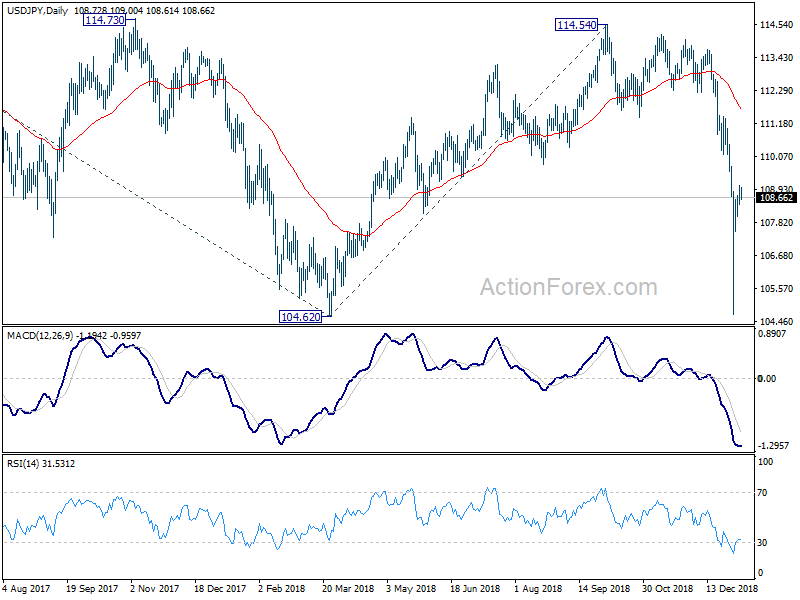
Daily Pivots: (S1) 108.42; (P) 108.76; (R1) 109.07; More..
With 108.02 minor support intact, USD/JPY's rebound from 104.69 short term bottom might extend. But upside will likely be limited by 109.46 minor resistance. On the downside, below 108.02 minor support will turn bias to the downside for 104.62 low. Overall, larger downtrend from 118.65 (2016 high) is expected to resume finally through 104.62 after current consolidation from 104.69 completes.
In the bigger picture, price actions from 125.85 (2015 high) are seen as a long term corrective pattern, no change in this view. Apparently, such corrective pattern is not completed yet. Fall from 114.54 is seen as part of the falling leg from 118.65 (2016 high). Break of 104.62 will target 100% projection of 118.65 to 104.62 from 114.54 at 100.51, which is close to 100 psychological level. But in that case, we'd expect strong support from 98.97 to contain downside to bring reversal. Also, this bearish case will remain the preferred one as long as 114.54 resistance holds.
EUR/USD Mid-Day Outlook
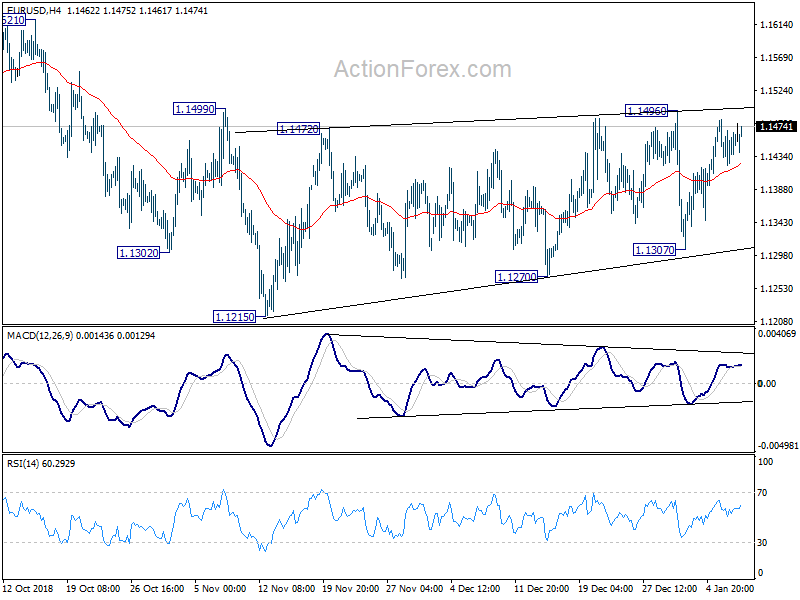
Daily Pivots: (S1) 1.1414; (P) 1.1450; (R1) 1.1476; More.....
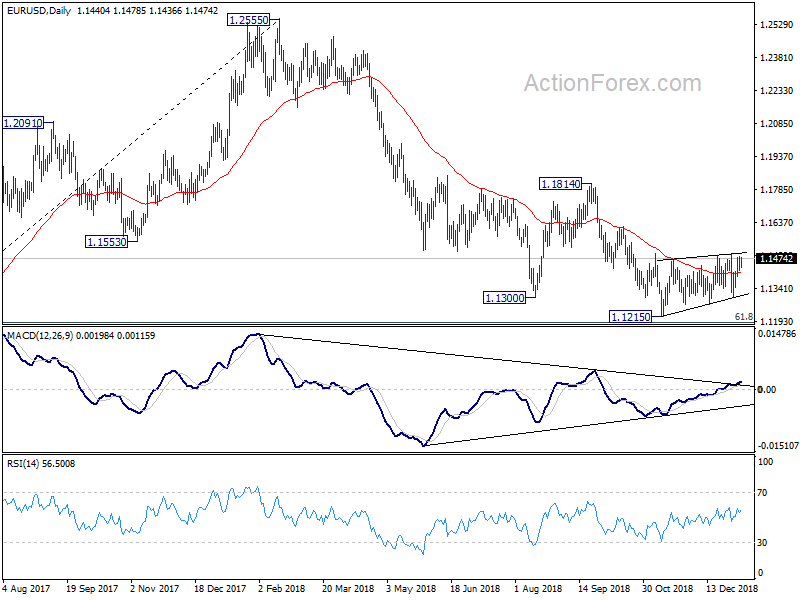
EUR/USD is still staying below 1.1499 resistance and intraday bias remains neutral for now. No change in the view that price actions from 1.1215 are still viewed as a corrective pattern. Hence, downside breakout is favored. On the downside, break of 1.1307 minor support will turn bias back to the downside for 1.1215 low. Break will resume down trend from 1.2555 to 1.1186 key fibonacci level. Nevertheless, sustained break of 1.1499 resistance will suggest near term reversal and bring stronger rebound back to 1.1621 resistance first.
In the bigger picture, as long as 1.1814 resistance holds, down trend down trend from 1.2555 medium term top is still in progress and should target 61.8% retracement of 1.0339 (2017 low) to 1.2555 at 1.1186 next. Sustained break there will pave the way to retest 1.0339. However, break of 1.1814 will confirm completion of such down trend and turn medium term outlook bullish.
GBP/USD Mid-Day Outlook
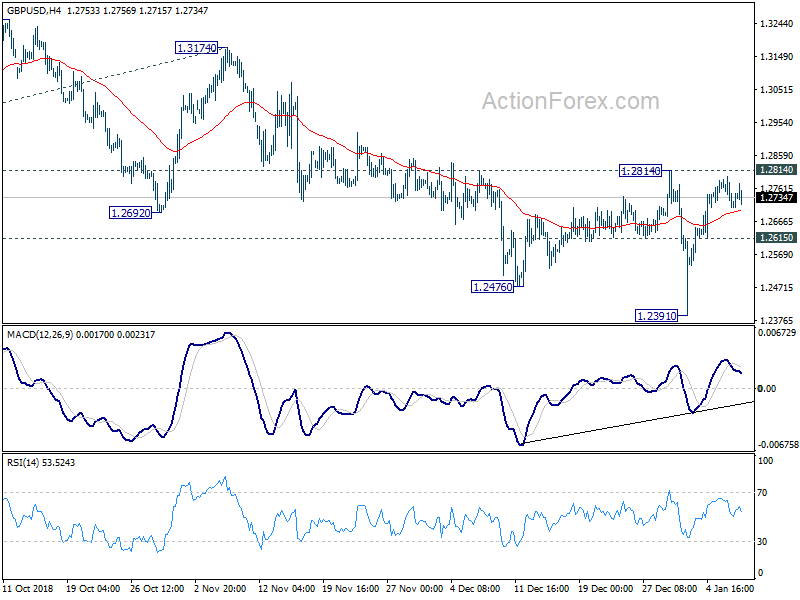
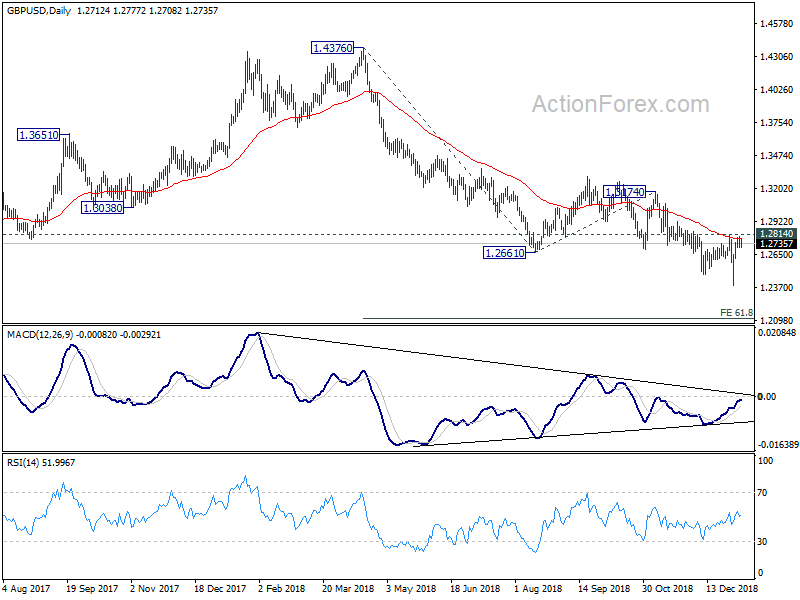
Daily Pivots: (S1) 1.2682; (P) 1.2740; (R1) 1.2773; More....
Intraday bias in GBP/USD stays neutral at this point. Also, near term outlook remains bearish with 1.2814 resistance intact. On the downside, below 1.2615 minor support will turn bias to the downside for retesting 1.2391 first. Break will extend the down trend from 1.4376 and target 61.8% projection of 1.4376 to 1.2661 from 1.3174 at 1.2114 next. However, firm break of 1.2814 resistance will be an early sign of trend reversal and bring stronger rebound back to 1.3174 resistance next.
In the bigger picture, whole medium term rebound from 1.1946 (2016 low) should have completed at 1.4376 already, after rejection from 55 month EMA. The structure and momentum of the fall from 1.4376 argues that it's resuming long term down trend from 2.1161 (2007 high). And this will now remain the preferred case as long as 1.3174 structural resistance holds. GBP/USD should target a test on 1.1946 first. Decisive break there will confirm our bearish view.
Global Markets Surge as US-China Trade Talks Ended Positively
Global stock markets are boosted by optimism over US-China trade negotiation. And commodity currencies ride on positive sentiment to strengthen broadly today. On the other hand, Yen is clearly under broad based pressure as risk aversion receded. It's followed by Dollar and then Swiss Franc. Euro shows little reaction to unexpected fall in unemployment rate. Meanwhile, Sterling is mixed as the Brexit debate resumes in Parliament.
BoC rate decision will be a major focus in US session. The central bank will very likely keep policy rate unchanged at 1.75%. But this is far from being certain after recent rebound in oil prices. Still, the current rebound is seen as mainly driven by the Saudi-led production cut and US-China trade talk. And the boosts to oil prices should be short-lived. BoC might also downgrade its GDP growth forecast modestly in today's new projections.
FOMC December meeting minutes will be another focus. But detail were already provided during the post meeting press conference, as well as the projections. We'd not expecting anything substantial from the minutes.
In other markets, DOW futures point to another day of triple digit gain at open. At the time of writing, FTSE is up 1.06%, DAX Is up 1.35% and CAC is up 1.39%. German 10-year yield is down -0.0021 at 0.228. Earlier in Asia, Nikkei rose 1.10%. Hong Kong HSI rose 2.27%. China Shanghai SSE added 0.71% and Singapore Strati Times rose 1.12%. Japan 10-year JGB yield rose 0.0339 to 0.032.
US-China trade talks concluded after a "good few days"
US and China delegations ended the prolonged three-day trade negotiation meeting in Beijing with some positive signs. Ted McKinney, U.S. Under Secretary of Agriculture for Trade and Foreign Agricultural Affairs, said there were a "good few days" in China, and the meeting "went just fine". He added that "It's been a good one for us."
Chinese Foreign Ministry spokesman Lu Kang said "extending the consultations shows that the two sides were indeed very serious in conducting the consultations."
Bostic: Fed should be patient and wait for greater clarity on economic outlook
Atlanta Fed President Raphael Bostic said Fed should be patient on the next interest rate move until there is greater clarity on the economic outlook. He noted that business executives are "starting to examine their own business strategies and initiatives in anticipation of slowing economic conditions either through deleveraging or holding off on expansionary plans". And, the financial markets showed that there was "heightened uncertainty and concern" among investors.
Bostic said "The appropriate response is to be patient in adjusting the stance of policy and to wait for greater clarity about the direction of the economy and the risks to the outlook". And, "All the available evidence at the moment points to caution regarding firms' approach to expansion. As long as that caution exists I suspect it will act as a natural governor" on growth.
Pro-EU group pushing for binary Brexit referendum
Pro-EU campaigners updated so called "Roadmap to a People's Vote" to push for a referendum on Brexit if, and likely so, Prime Minister Theresa May's deal is voted down in the Commons next week. The report note that "Nobody has come forward with a proposal that could secure a majority in the present circumstances. The blunt reality is that such a proposal does not exist". And, "the only credible way forwards for (lawmakers) will be to hand the decision back to the people." While a referendum would inevitably require extending Article 50 and delaying the March 29 Brexit date, the group said 27 other EU member states are unlikely to stand in its way.
The group preferred a "binary choice": for the referendum": either the Government's deal vs staying in the EU; or an alternative, deliverable form of Brexit vs staying in. But they do not entirely rule out a referendum with three options.
Separately, Prime Minister Theresa May told the parliament that "I've been in contact with European leaders ... about MPs' concerns. These discussions have shown that further clarification over the backstop is possible and those talks will continue over the next few days,"
Eurozone unemployment rate dropped to 7.9%, lowest since Oct 2008
Eurozone unemployment rate dropped to 7.9% in November, lower than expectation of 8.1%. That's notable improvement from 8.7% back in November 2017. It's also the lowest figure since October 2008.
Among the Member States, the lowest unemployment rates in November 2018 were recorded in Czechia (1.9%), Germany (3.3%) and the Netherlands (3.5%). The highest unemployment rates were observed in Greece (18.6% in September 2018) and Spain (14.7%).
Also released in European session, German trade surplus widened to EUR 19.0B in November. Swiss CPI slowed to 0.7% yoy in December versus expectation of 1.0% yoy.
GBP/USD Mid-Day Outlook
Daily Pivots: (S1) 1.2682; (P) 1.2740; (R1) 1.2773; More....
Intraday bias in GBP/USD stays neutral at this point. Also, near term outlook remains bearish with 1.2814 resistance intact. On the downside, below 1.2615 minor support will turn bias to the downside for retesting 1.2391 first. Break will extend the down trend from 1.4376 and target 61.8% projection of 1.4376 to 1.2661 from 1.3174 at 1.2114 next. However, firm break of 1.2814 resistance will be an early sign of trend reversal and bring stronger rebound back to 1.3174 resistance next.
In the bigger picture, whole medium term rebound from 1.1946 (2016 low) should have completed at 1.4376 already, after rejection from 55 month EMA. The structure and momentum of the fall from 1.4376 argues that it's resuming long term down trend from 2.1161 (2007 high). And this will now remain the preferred case as long as 1.3174 structural resistance holds. GBP/USD should target a test on 1.1946 first. Decisive break there will confirm our bearish view.
Economic Indicators Update
| GMT | Ccy | Events | Actual | Forecast | Previous | Revised |
|---|---|---|---|---|---|---|
| 21:30 | AUD | AiG Performance of Service Index Dec | 52.1 | 55.1 | ||
| 00:00 | JPY | Labor Cash Earnings Y/Y Nov | 2.00% | 1.30% | 1.50% | |
| 00:30 | AUD | Building Approvals M/M Nov | -9.10% | -0.30% | -1.50% | |
| 07:00 | EUR | German Trade Balance (EUR) Nov | 19.0B | 17.6B | 17.3B | |
| 07:30 | CHF | CPI M/M Dec | -0.30% | -0.10% | -0.30% | |
| 07:30 | CHF | CPI Y/Y Dec | 0.70% | 1.00% | 0.90% | |
| 10:00 | EUR | Eurozone Unemployment Rate Nov | 7.90% | 8.10% | 8.10% | 8.00% |
| 13:15 | CAD | Housing Starts Dec | 213K | 210K | 216K | |
| 15:00 | CAD | BoC Rate Decision | 1.75% | 1.75% | ||
| 15:30 | USD | Crude Oil Inventories | 0.0M | |||
| 19:00 | USD | FOMC Meeting Minutes |
Bostic: Fed should be patient and wait for greater clarity on economic outlook
Atlanta Fed President Raphael Bostic said Fed should be patient on the next interest rate move until there is greater clarity on the economic outlook. He noted that business executives are "starting to examine their own business strategies and initiatives in anticipation of slowing economic conditions either through deleveraging or holding off on expansionary plans". And, the financial markets showed that there was "heightened uncertainty and concern" among investors.
Bostic said "The appropriate response is to be patient in adjusting the stance of policy and to wait for greater clarity about the direction of the economy and the risks to the outlook". And, "All the available evidence at the moment points to caution regarding firms' approach to expansion. As long as that caution exists I suspect it will act as a natural governor" on growth.