Sample Category Title
Into US session: Commodity currencies surge on US-China trade optimism
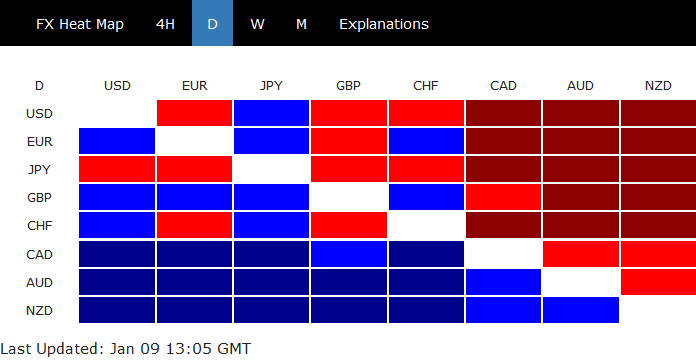
Entering into US session, commodity currencies are generally higher today. Global risk appetite is boosted by optimism regarding US-China trade negotiation. In short, the prolonged three-day meeting in Beijing ended with positive comments from both sides. New Zealand Dollar leads the way, followed by Australian and then Canadian Dollar. On the other hand, Yen is the weakest one followed by Euro and then Swiss Franc.
BoC rate decision will be a major market moving in US session. It's expected to hold policy rate unchanged at 1.75%. But it's far from being certain, considering recent rebound in oil prices. Also, the new economic projections might not be more dovish than markets have expected.
In European markets, at the time of writing:
- FTSE is up 0.94%
- DAX is up 1.16%
- CAC is up 1.27%
- German 10 year yield is down slightly by -0.0001 at 0.23
Earlier in Asia:
- Nikkei rose 1.1%
- Hong Kong HSI rose 2.27%
- China Shanghai SSE rose 0.71%
- Singapore Strait Times rose 1.12%
- Japan 10 year JGB yield rose 0.0339 to 0.032
BTCUSD Hovers above 23.6% Fibonacci with Weak Momentum
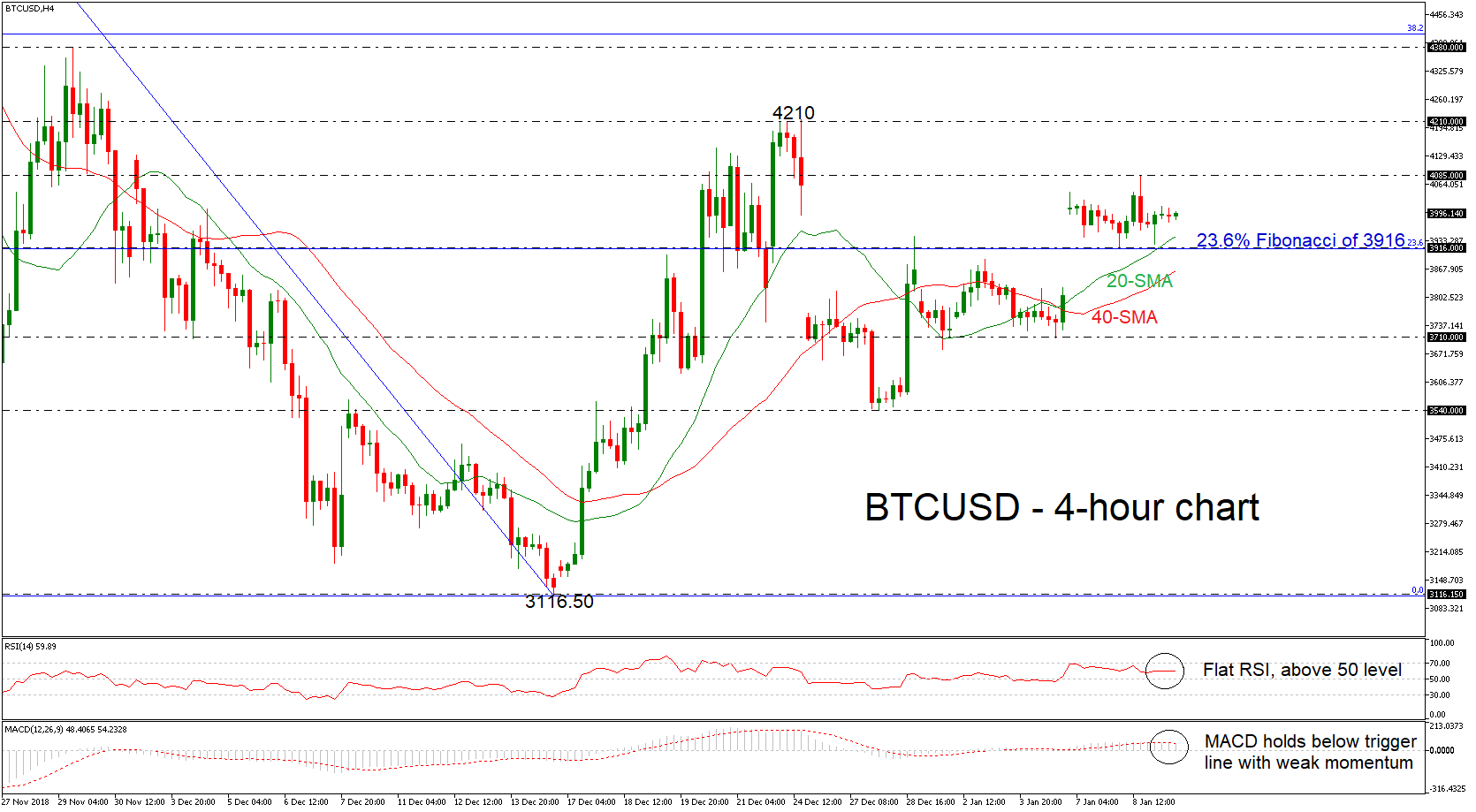
BTCUSD has been recording marginally flat candles over the last sessions in the 4-hour chart, after the advance above the 23.6% Fibonacci retracement level of the downleg from 6508 to 3116.50, around the 3916 support. The price holds above the 20- and 40-simple moving averages (SMAs), while the RSI indicator is flattening above the neutral level. Moreover, the MACD oscillator is losing momentum near the zero line.
If the price strengthens momentum to the upside, the next immediate resistance to have in mind is the 4085 barrier, taken from the latest high on Tuesday. Slightly above this area, the 4210 resistance could come in focus as well.
On the downside, the bitcoin may meet support at the 20-SMA slightly above the 3916support before heading lower to the 40-SMA near 3864. If the market manages to drop below this level and bearish actions take over again, traders could look for the next support at the 3710 hurdle.
To sum up, the very short-term bias remains neutral especially after BTCUSD jumps above the 23.6% Fibonacci.
Optimism Over U.S-China Talks Propels DAX Close to 11,000 Level
The DAX index continues to move higher this week. On Wednesday, the DAX is at 10,905, up 1.13%. German automakers have led the charge – BMW is up 2.0%, Daimler has climbed 4.7% and Volkswagen has gained 3.0%.
In economic news, German and eurozone numbers were stronger than expected. German’s trade surplus jumped to EUR 19.0 billion, above the estimate of EUR 17.9 billion and hitting a 5-month high. As well, the yield on German 10-year bonds continues to fall, with a reading of just 0.29%, its lowest yield since June 2017. The eurozone unemployment rate unexpectedly fell to 7.9%, its lowest level since October 2008.
It’s been a wild ride for the markets in recent weeks. Markets plunged in December, with the DAX falling a staggering 8.4%. The year 2018 was the worst since 2008, but 2019 has started on a bright note. The DAX has climbed 4.24% in just one week, as risk appetite has returned.
There are two main reasons for renewed market optimism. First, Fed Chair Jerome Powell sent a dovish message to the markets, in sharp contrast to the Fed rate statement in December, which was more hawkish than expected and was poorly received by the markets. Powell said that the policymakers would be cautious before making any rate decisions, a strong hint that the Fed will not continue its aggressive rate policy, with four rate hikes in 2018. Policymakers have been talking about one or two hikes in 2019, and some analysts are predicting a rate cut late in the year.
A second catalyst for stronger investor confidence is renewed hope that the U.S. and China could reach a deal and end their nasty trade war, which has rocked global equity markets for months. This week’s meeting between the parties wrapped on Wednesday, after the trade talks, which were slated for two days, were extended by a day. The stakes are high, as President Trump has threatened to impose higher tariffs on $250 billion worth of Chinese products if there is no deal by March 1.
Euro Steady, Investors Eye Fed Minutes
EUR/USD has posted slight gains in the Wednesday session. Currently, the pair is trading at 1.1453, up 0.11% on the day. On the release front, German and eurozone numbers were stronger than expected. German’s trade surplus jumped to EUR 19.0 billion, above the estimate of EUR 17.9 billion and hitting a 5-month high. As well, the yield on German 10-year bonds continues to fall, with a reading of just 0.29%, its lowest yield since June 2017. The eurozone unemployment rate unexpectedly fell to 7.9%, its lowest level since October 2008. In the U.S., today’s highlight is the FOMC minutes from the December meeting. On Thursday, the ECB releases the accounts of its December meeting. The U.S. will post unemployment claims and Federal Reserve Chair Powell speaks at an event in Washington.
The Federal Reserve will be in the spotlight, with the release of the FOMC minutes later on Monday. At the December policy meeting, the Fed raised rates by a quarter point, to a range between 2.25% and 2.50%. This ended a very aggressive 2018 for the Fed, which hiked rates four times. The December rate statement hinted that further rates were in the works for 2019, but a sharp drop in the stock markets has forced the Fed to adjust, and Fed Chair Powell was quite dovish in remarks last week, which were well received by investors. The Fed forecast is calling for two more hikes this year, but the markets are doubtful, with some analysts predicting a rate cut late in the year. It will be interesting to see the views of policymakers in the minutes and the reaction of the markets.
The German manufacturing sector has taken a hit due to ongoing global trade war, and this week’s manufacturing numbers are pointing to a slowdown. Factory orders fell 1.0%, well of the estimate of -0.2%. This was followed by a decline of 1.9% in industrial production, much weaker than the forecast of 0.3%. This marked the fifth decline in the past six months. Unless the ongoing trade war eases soon, we can expect German manufacturing data to struggle.
USD/CAD – Bank Of Canada Rate Decision In Focus
Wednesday January 9: Five things the markets are talking about
Global equities are well supported for a third consecutive session as the U.S and China have found some common ground on trade.
Note: Both countries agreed to extend trade talks in Beijing for an unscheduled third-day.
Despite both negotiating teams being unable to reach an all-encompassing trade deal over the past 48-hours, the world’s two largest economies appear to have progressed towards bridging the hostile divide that has been able to unsettle capital markets over the past 12-months.
These positive signs have given investors the confidence to own risk once again, and has led the U.S dollar to dip against G10 currency pairs and Treasury yields to back up a tad before this afternoons release of the Fed’s December minutes (02:00 pm EDT).
The minutes are unlikely to have much impact on the ‘big’ dollar, given Fed chair Powell’s comments last week, where he indicated that U.S policy makers are prepared to shift the stance of its policy “significantly” if necessary.
On tap: Bank of Canada (BoC) monetary policy meeting (10:00 am EDT) – Governor Poloz is expected to hold rates steady (+1.75%), though pricing in the Overnight Index Swaps (OIS) market suggests there is a +17% possibility that the bank could reverse its most recent hike.
1. Stocks are a delight
With the U.S and China finding some common ground in their trade talks has made owning stocks more appealing.
In Japan, equities rallied for a third-day as signs of progress in Sino-U.S trade talks improved confidence, offsetting weakness in chip-related stocks. Both the Nikkei and the broader Topix advanced +1.1%.
Down-under, Aussie stocks rallied to a two-month high on trade optimism. The S&P/ASX 200 index closed up +1%, building on Tuesday’s gain of +0.7%. In S. Korea, the Kospi index posted its biggest daily percentage gain in two-months, closing +1.95% higher.
In China, these positive trade talks helped push the blue-chip CSI300 index up +1.0% and the Shanghai Composite Index up +0.7%. In Hong Kong, at the close of trade, the Hang Seng index was up +2.3%, while the Hang Seng China Enterprises index jumped +2.2%.
In Europe, with risk being well supported, regional bourses are trading higher – the DAX and the French CAC are the most notable.
U.S stocks are set to open in the ‘black’ (+0.35%).
Indices: Stoxx600 +0.76% at 348.50, FTSE +0.77% at 6,914.25, DAX +0.91% at 10,901.79, CAC-40 +1.09% at 4,825.08, IBEX-35 +0.15% at 8,861.15, FTSE MIB +1.14% at 19,220.50, SMI +0.36% 8,652.50, S&P 500 Futures +0.35%
2. Oil rises over +1% on Sino-U.S trade talks, gold lower
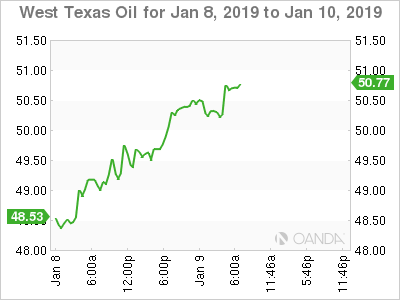
Oil prices have extended their gains from Tuesday’s session on hopes that Washington and Beijing may soon resolve their trade disputes.
Brent crude futures are up +69c, or +1.2%, while U.S West Texas Intermediate (WTI) oil futures are at +$50.42 per barrel, up +64c, or +1.3% from yesterday’s close.
Note: Both benchmarks gained +2% in yesterday’s session.
Aside from global trade optimism, crude oil prices have been receiving support from supply cuts that started at the end of last year by OPEC+.
Theses cuts are intended to rein in a supply overhang, caused mostly by U.S crude oil output – EIA data shows U.S output surged by around +2M bpd in 2018, to a record +11.7M bpd.
Dealers are expected to take their cue from today’s official U.S fuel storage data from the EIA (10:30 am EDT).
Ahead of the U.S open, gold prices have edged lower on stronger risk sentiment. Spot gold is down -0.3% at +$1,282.75 per ounce, while U.S gold futures are -0.2% lower at +$1,283.8 per ounce.
3. Bank of Canada (BoC) rate decision in focus
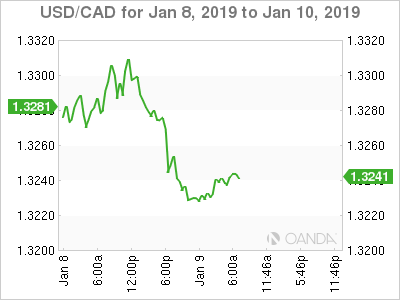
CAD’s OIS curve (overnight index swap) currently paints a ‘dovish’ view of Canadian interest rates (+1.75%). Nevertheless, there are a few dealers who do not prescribe to a ‘no-rate’ change decision by the BoC later this morning; in fact, they are looking for +25 bps hike.
Even without pricing in a hike today, the CAD (C$1.3240) remains the best-performing G10 currency over the past week – the loonie has found support from higher oil prices and a positive surprise from Canadian PMI data. If Governor Poloz gets the urge to tighten matters, USD/CAD could see itself take on C$1.3080 rather quickly.
Elsewhere, the Fed releases the minutes of its Dec. 18-19 meeting this afternoon (2 pm EST). It should provide more details about how policy makers viewed the risks to economic growth when they raised interest rates during a period of heightened market volatility.
They voted unanimously to hike fed-funds to a range between +2.25% and +2.5% at the meeting, their fourth increase of the year. They also made a significant change to their policy forecast by projecting two rate increases in 2019, down from the three they anticipated in September, despite modest changes to their growth expectations.
4. EUR trapped in a range
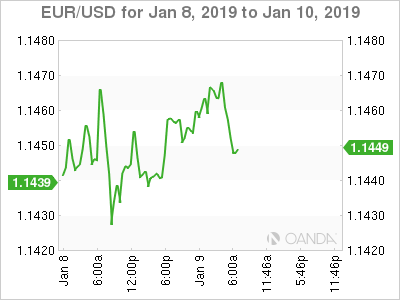
For now, EUR/USD (€1.1450) is trapped within a range as weak German and eurozone economic data will not allow the ‘single’ currency to rally and close above €1.15 despite the ‘big’ dollar weakness. However, if the Sino-US trade talks do happen to show some concrete progress, then the EUR bulls should expect that key resistance of €1.15 to give way rather quickly.
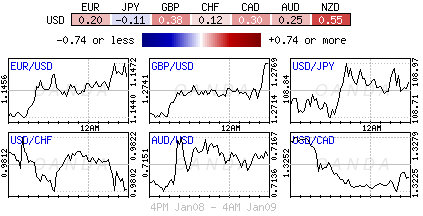
GBP/USD is higher by +0.2% at £1.2735 area as PM May seeks EU assurances on the backstop provision. Last night, the UK government lost a vote on funding a “no-deal” Brexit – this certainly complicates matters for PM May as Parliament tries to stop a “no-deal” Brexit.
Note: The U.K parliament is due to vote on the Brexit withdrawal bill on Jan 15, until then, the pound remains driven by any Brexit developments.
USD/JPY (¥108.90) is higher for a fourth consecutive session as investor risk appetite improves on speculation that U.S-China is making progress in their trade talks.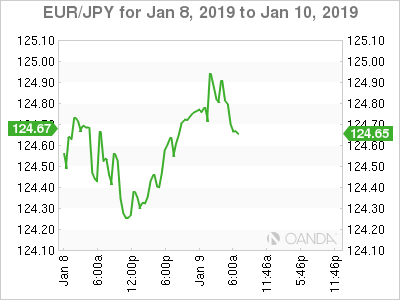
5. German trade balance
Data this morning showed that German exports declined in November, supporting market fears that trade tensions are impeding Germany’s economic upswing.
Exports from the eurozone’s largest economy fell -0.4% on the month to +€110.6B in November, while imports dropped -1.6% to +€91.6B from October. The adjusted trade surplus amounted to +€19.0B in November, surpassing a market forecast of +€18.0B.
Note: The German economy contracted in Q3 2018, for the first-time in three-years, knocked mostly by weaker exports.
The drop in exports coincides with other downbeat data released this week – German new manufacturing orders fell -1% on the month in November, more than the -0.4% decline that the street was expecting.
Awaiting Official Word On Alleged Progress In US-China Trade Talks
Notes/Observations
- Speculation that US-China are making progress in trade talks; current mid-level of talks extended an additional day as President Trump hails progress
- Focus on upcoming FOMC minutes; Fed at odds with the market is still very possible
Asia:
- China may set higher budget deficit to GDP target for 2019, speculated at 2.8% (vs 2.6% expected for 2018)
- Japan Nov wage data better than expected and seen as a positive sign for consumption (Labor Cash Earnings 2.0% v 1.2% prior; Real Cash earnings YoY: 1.1% v 0.4%e)
Europe:
- UK Parliament voted 303-296 for amendment that will restrict tax powers in a 'no deal' Brexit
- UK govt spokesperson: the defeat on the 'no-deal' Brexit amendment vote today does not change the fact that the UK will leave the EU on March 29th
Americas:
- President Trump: There is a growing security crisis at the US southern border, all Americans are hurt by uncontrolled illegal immigration, strains resources, impacts African Americans and Hispanics the most; border wall will very quickly pay for itself. Govt remains shut down only because Democrats will not fund border security. situation could be solved in 45 minute meeting, have invited parties to White House on Wednesday
- World Bank cuts 2019 global growth forecast from 3.0% to 2.9%
Macro
- (AU) Australia: Building approvals saw a sharp drop in November collapsing -32.8% y/y. The weakness was reported to be linked to softer demand, additional supply and tighter lending standards. The ongoing fall in trend terms was also seen weighing on residential construction activity - and by extension GDP growth - in 2019.
- (DE) Germany: Despite a drop in exports Germany's November trade surplus widened. Exports fell -0.4% m/m, while contracted -1.6% m/m, likely driven by lower oil prices, which cut the nominal import bill. The total trade surplus for the first 11 months of 2018 at EUR 214.2B, -6.7% y/y.
- (DE) Germany: VDMA machinery orders saw a 2% y/y rise in export orders in November counterbalancing a -3% y/y correction in import orders. The three month trend rate fell back to 4% from 6%, confirming the weak trend in the official manufacturing orders.
SPEAKERS/FIXED INCOME/FX/COMMODITIES/ERRATUM
Equities
- Indices [Stoxx600 +0.76% at 348.50, FTSE +0.77% at 6,914.25, DAX +0.91% at 10,901.79, CAC-40 +1.09% at 4,825.08, IBEX-35 +0.15% at 8,861.15, FTSE MIB +1.14% at 19,220.50, SMI +0.36% 8,652.50, S&P 500 Futures +0.35%]
- Market Focal Points/Key Themes: European Indices trade higher once again as Indices rally from Decmber lows on continued trade optimism. The Dax and French CAC outperform as Asian Indices also posted gains across the board led by the Kospi and Hang Seng, while US futures point to another higher open after gains yesterday.. On the corporate front Export names continue to rise with the like of Daimler up over 3% on strong December car sales. Ted Baker, Majestic Wines, Shoe Zone, Softcat, Greegs, CGG and Taylor Wimpey are among the names trading higher after positive Earnings and Trading updates. In other news Fincantieri trades lower as the EU is to looking into proposed acquisition of Chantiers de L'Atlantique; Safilo rises on a licensing agreement with Levi Strauss, while Fiat Chryler rises on talk of a settlement with the US on diesel emission this week. Looking ahead notable earners include Greenbrier, Lennar, Actuity Brandsm Constellation Brands and Plug Power.
- Consumer discretionary: Ted Baker [TED.UK] +11.5% (trading update), Majestic Wine [WINE.UK] +1.5% (trading update), Air France-KLM [AF.FR] -1.5% (load factor)
- Consumer staples: Sainsbury [SBRY.UK] +0.5% (sales), Shoe Zone [SHOE.UK] +12% (earnings), Safilo Group [SFL.IT] +5% (collaboration)
- Energy: Faroe Petroleum [FPM.UK] +2% (DNO increases offer and stake)
- Healthcare: Medigene [MDG.DE] +3.5% (awarded patent), Fresenius [FRE.DE] +3% (analyst action)
- Industrials: Daimler [DAI.DE] +3.5% (sales), Taylor Wimpey [TW.UK] +6% (reports stats), Softcat [SCT.UK] +19.5% (trading update), Tecnicas Reunidas [TRE.ES] +4.5% (awarded contract)
Speakers
- UK Govt official Lidington (de facto Dep PM): Idea of alternative Brexit deal is fantasy. Govt to publish specific proposals around the Irish backstop
- Northern Ireland DUP Brexit Spokesman Wilson: No EU assurances to the British govt can change the legalities of the Brexit deal. Views the current deal as ruinous
- UK Junior Brexit Min Heaton-Harris: Do not believe there is a Parliamentary route in which the Brexit could be stopped
- Sweden Central Bank (Riksbank) Dec Minutes noted that conditions were still good for CPIF to be close to target
- Sweden Central Bank (Riksbank) Gov Ingves noted within the Dec minutes that saw cautious and slow rate increases with inflation being stable and close to target
- Sweden Central Bank (Riksbank) member Skingsley noted that If outlook for inflation were to change significantly, he would support adjusting the timing and scope of the forecasted increases
- Sweden Central Bank (Riksbank) Member Jansson (dissenter) reiterated his opposition to rate hike in Dec as inflation risks seemed to be on the downside
- Turkey Fin Min Albayrak reiterated stance that have made headway in rebalancing the domestic economy
- China Foreign Ministry Spokesman Lu confirmed recent trade talks with the US have concluded, statement was due 'soon'
- China PBoC Gov Yi Gang reiterated stance to implement prudent monetary policy
- Fitch: Debt ceiling is more important than govt shutdown for US sovereign rating
Currencies/Fixed Income
- Focus turns to the upcoming release of FOMC Dec Minutes. Analysts note that Fed being at odds with the market remained a possibility especially after last Friday's strong payroll and earnings data. Markets did like Powell's speech last week which indicated a more dovish approach
- GBP/USD higher by 0.2% at 1.2735 area as PM May sought EU assurances on the backstop provision. Markets noting that UK Govt not appear to make any meaningful progress. UK government lost a vote on funding a no-deal Brexit last night which complicates things a little for them as Parliament tries to stop a no-deal Brexit.
- USD/JPY higher for a 4th straight session as risk appetite picks up as speculation that US-China are making progress in trade talks
Economic Data
- (NL) Netherlands Nov Manufacturing Production M/M: 0.5 v 0.4% prior; Y/Y: 2.1% v 3.5% prior; Industrial Sales Y/Y: 3.9% v 10.6% prior
- (DE) Germany Nov Current Account Balance: €21.4B v €24.8Be; Trade Balance: €20.5B v €18.6Be; Exports M/M: -0.4% v -0.5%e; Imports M/M:-1.6 % v 0.0%e
- (DK) Denmark Nov Current Account (DKK): 13.7B v 11.9B prior; Trade Balance: 7.0B v 5.7B prior
- (NO) Norway Nov GDP M/M: -0.3% v +0.8% prior; GDP Mainland M/M: 0.0% v 0.2%e
- (CH) Swiss Dec CPI M/M: -0.3% v -0.2%e; Y/Y: 0.7% v 0.8%e; CPI Core Y/Y: 0.3% v 0.2%e
- (CH) Swiss Dec CPI EU Harmonized M/M:0.0 % v -0.2%e; Y/Y: 0.8% v 0.7%e
- (FR) France Dec Consumer Confidence: 87 v 90e
- (CH) Swiss Dec Foreign Currency Reserves (CHF): 729.0B v 750.0Be
- (CZ) Czech Nov National Trade Balance (CZK):20.2B v 4.9Be
- (CZ) Czech Dec Unemployment Rate: 3.1% v 3.1%e
- (HU) Hungary Nov Preliminary Trade Balance: €0.5B v €0.3B prior
- (SE) Sweden Dec Budget Balance (SEK): -78.3B v +15.6B prior
- (IT) Italy Nov Preliminary Unemployment Rate: 10.5% v 10.5%e
- (IS) Iceland Dec Preliminary Trade Balance (ISK): -10.7B v -18.8B prior
- (ZA) South Africa Dec Manufacturing PMI: 50.7 v 49.0e (1st expansion in 6 months)
- (CN) China Dec retail passenger vehicle sales at 2.26M units, -19% y/y; Overall 2018 retail passenger vehicle sales at 22.7M units; -6.0% y/y (1st annual decline since
- (UK) Q3 Unit Labour Costs Y/Y: 2.8% v 2.0% prior
- (EU) Euro Zone Nov Unemployment Rate: 7.9% v 8.1%e (lowest level since Dec 2008)
- (GR) Greece Nov Industrial Production Y/Y+3.1: % v -1.1% prior
- (BE) Belgium Nov Unemployment Rate: 5.5% v 5.5% prior
Fixed Income Issuance
- (IE) Ireland Debt Agency (NTMA) opened its book to sell EUR-denominated May 2029 bond via syndicate; guidance seen +29bps to mid-swaps
- (PT) Portugal Debt Agency (IGCP) opens book to sell EUR-denominated Jun 2029 bond via syndicate; guidance seen +116bps to mid-swaps
- (SA) Saudi Arabia opened its book to sell USD-denominated 2029 and 2050 bonds via syndicate
- (IL) Israel opened its book to sell EUR-denominated 10-year and 30-year bonds via syndicate
- (IN) India sold total INR90B vs. INR90B indicated in 3-month, 6-month and 12-month bills
- (DK) Denmark sold total DKK2.48B in 2020 and 2027 DGB bonds
- (SE) Sweden sold SEK5.0B vs. SEK5.0B indicated in 3-month bills; Avg Yield: -0.4652% v -0.7757% prior; Bid-to-cover: 2.08x v 2.09x prior
Looking Ahead
- (UR Ukraine Dec CPI M/M: 1.2%e v 1.4% prior; Y/Y: 10.2%e v 10.0% prior
- 05:30 (DE) Germany to sell €4.0B in new 0.25% Feb 2029 Bunds
- 05:30 (GR) Greece Debt Agency (PDMA) to sell €625M in 13-week bills
- 06:00 (IE) Ireland Nov Industrial Production M/M: No est v 0.0% prior; Y/Y: No est v 5.5% prior
- 06:00 (PT) Portugal Nov Trade Balance: No est v -€1.6B prior
- 06:00 (PL) Poland Central Bank (NBP) Interest Rate Decision: Expected to leave Base Rate unchanged at 1.50%
- 06:45 (US) Daily Libor Fixing
- 07:00 (US) MBA Mortgage Applications w/e Jan 4th: No est v -8.5% prior
- 08:00 (HU) Hungary Central Bank (NMB) Dec Minutes
- 08:00 (UK) Baltic Dry Bulk Index
- 08:15 (CA) Canada Dec Annualized Housing Starts: 205.5Ke v 216.0K prior (revised from 215.9K)
- 08:20 (US) Fed's Bostic (dove, voter) on economic outlook
- 09:00 (MX) Mexico Dec CPI M/M: 0.7%e v 0.9% prior; Y/Y: 4.9%e v 4.7% prior; CPI Core M/M: 0.5%e v 0.3% prior
- 09:00 (EU) Weekly ECB Forex Reserves
- 09:00 (US) Fed's Evans (non-voter)
- 10:00 (CA) Bank of Canada (BOC) Interest Rate Decision: Expected to leave Interest Rates unchanged at 1.75%
- 10:00 (PL) Poland Central Bank Gov Glapinski holds post Rate Decision press conference
- 10:30 (US) Weekly DOE Crude Oil Inventories
- 10:30 (UK) BOE Gov Carney participates in an online discussion
- 12:00 (US) Trump at Senate policy lunch
- 13:00 (US) Treasury to sell 10-Year Notes Reopening
- 14:00 (US) FOMC Dec Minutes
- 15:00 (US) President Trump meeting with Congressional Leaders
BREXIT: Sterling Could Jump Above 1.35 Against The Dollar
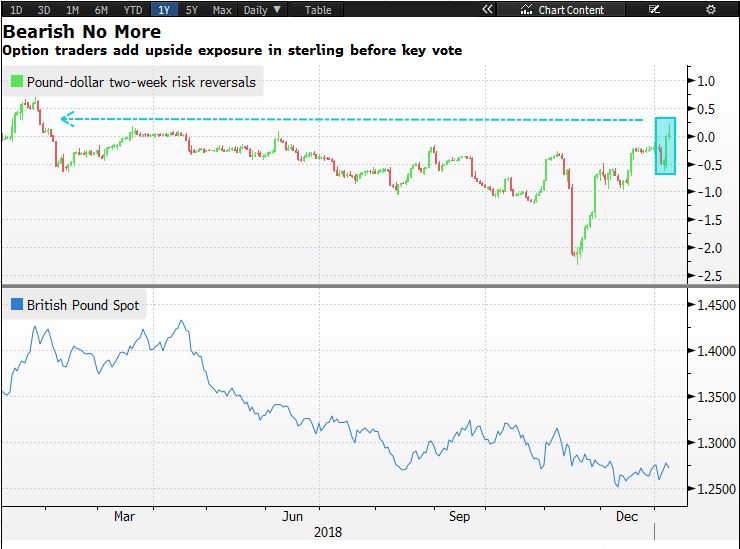
Theresa May is expected to lose the vote in the Parliament on Britain's divorce deal. Traders have already priced this to a large extent and the evidence of this can be seen in the option’s market. A large number of speculators are expecting an upward move for sterling in the coming days. The pound-dollar two-week risk reversal, a gauge of market positioning, has changed substantially from its previous reading of -2.5% to above 0. This is the highest level since late January 2018 and at that time Sterling-dollar pair was trading above the 1.40 mark.
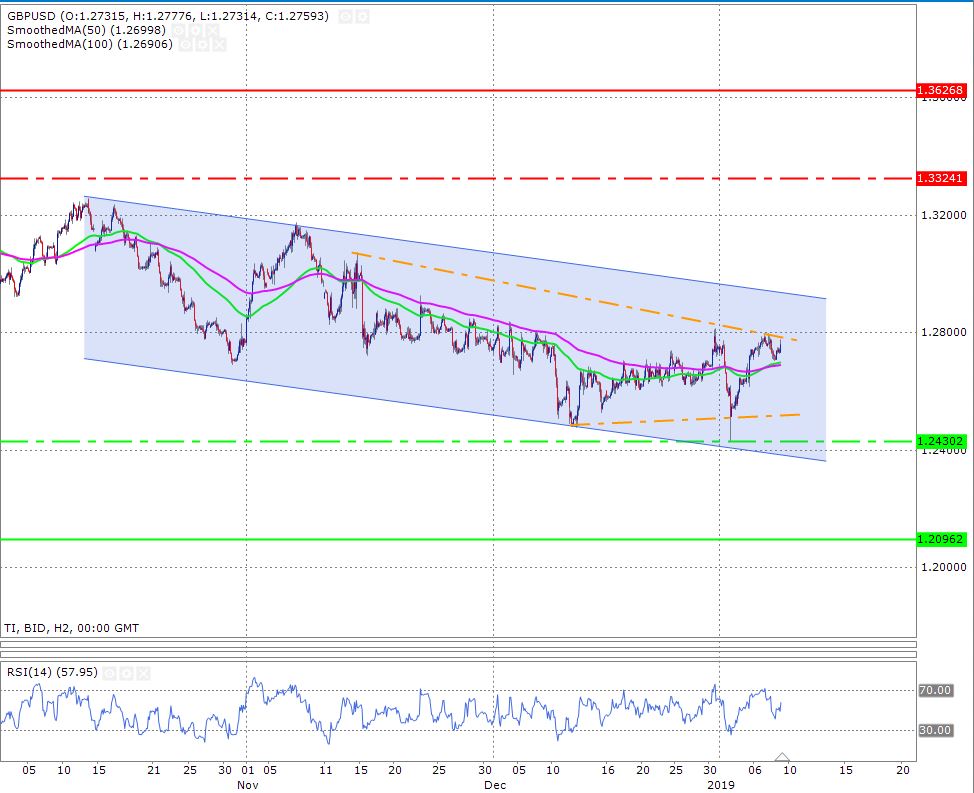
The intra-day 2-hour chart shows that the price is trading within the downward channel, however, the technical study shows the price is about to explode. The first confirmation of this will come if the price breaks the downward trend line (orange colour) and the second confirmation of this will be when the price moves above the 1.32 mark. We have not seen this level since November 2018.
The RSI is showing that the momentum is building up.
The minor support zone is shown by the dotted horizontal green line and the major support by the solid horizontal green line.
The minor resistance zone is shown by the dotted horizontal red line and the major resistance by the solid horizontal red line.
Can The Rally Last? Banking Sector Holds The Key
The basic concept for finding the strength or weakness in any particular trend is to find the sectors which usually have a high correlation with the index. This really gives you a good starting point to assess if the current trend is going to last or what factors are behind it. In other words, one needs to keep an eye on these important variables in order to have strong confidence behind their thesis.
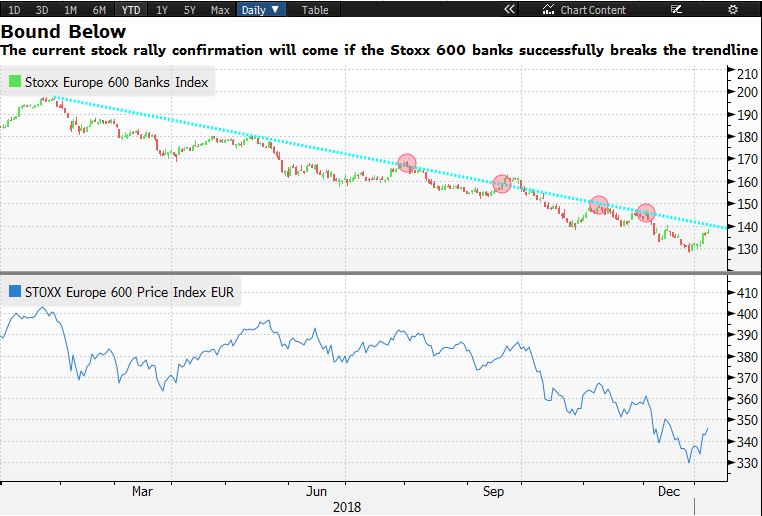
The Stoxx 600 index is up 2.43% year to date. Looking at the current stock rally across the European banking sector, one thing becomes clear, investors have decided to jump back in the riskier assets and the banking sector is one of their favourite one. There is no doubt that this was beaten down badly when the sell-off was intense (during the month of December) and the Italian debt situation only added more pessimism for this sector.
However, things have changed and the Stoxx 600 banks index is about to challenge its downward trend line once again. There have been multiple occasions that the index has challenged the downward trend line, but at each occasion (as shown in the chart below), the index has clearly failed to break above this trend line. So, if the current trend is going to continue for the Stoxx 600 index, a confirmation of this needs to come from here. A break of the downward trend line will confirm that the bottom is strongly in place. Otherwise, all bets are off.
Similarly, the current momentum in the Stoxx 600 index is also coming from another specific sector which has a strong correlation with the index. It is the energy sector. There is no secret that oil prices have seen a huge bounce from its recent lows of $42.36. I am speaking of WTI crude, it touched this level back in December 24th, 2018. Ever since, we have seen the WTI crude hasn’t looked back. By default, higher oil prices stimulate the energy stocks. This fact also has an impact on the index. Hence, the Stoxx 600 chart below shows strong bounce from its recent low. The Stoxx 600 oil and gas index bottomed pretty much at the same time when the WTI price hit the bottom. 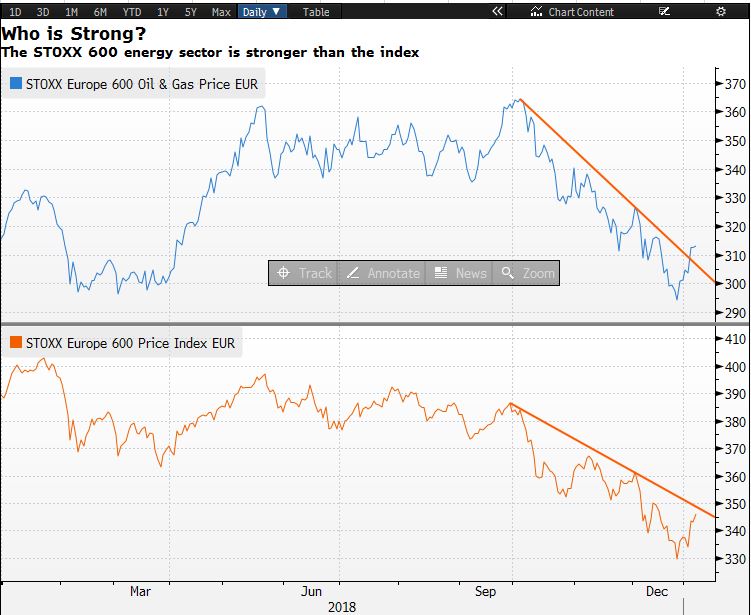
The Stoxx 600 index echo the same concept as well. One important key take away from the below chart is that the energy sector has clearly broken its downward trend and this shows that the bulls are fully in control. However, there is some lack of momentum for the Stoxx 600 index. Having saif this, the bullish momentum is still strong and as long as the energy sector continues to to move higher, the Stoxx 600 is likely to gather more momentum.
Markets Higher Ahead Of Fed Minutes
It looks as though we're heading for a fourth day in the green on Wednesday, as US stocks look to extend their winning streak on the back of strong data and a more dovish Fed.
Fed minutes eyed after Powell dovish shift
The FOMC minutes this evening will be an interesting read, given the clear reluctance within the committee to dramatically alter the course for interest rates at the meeting, followed a couple of weeks later by its Chair delivering a much more flexible and, one could argue, dovish message. At the December meeting, the committee reduced its forecasts for rate hikes this year from three to two but some were expecting it to go further. Powell's recent comments would suggest it won't take much.
Markets have gone one step further and priced in no more hikes this year, with the odds of one at times being as low as 0%. These expectations have pared slightly but even now, a hike is only slightly priced in, with the rebound in markets taking the edge off the growing pessimism. This has naturally been helped by some good economic data on Friday and efforts to resolve the trade war.
Gold continues to pare gains
The apparent improvement in trade relations between the US and China is not only boosting equity markets, it's taking some of the shine off gold as its safe haven appeal wanes. The dollar is also coming under pressure – which has typically been bullish for gold – as bullish positions that were built up during the escalation are slightly reversed. This hasn't been enough to stop gold slipping though although it may limit any decline.
Gold is finding some support around $1,280 at the moment but may slip a little further in the near-term as risk appetite continues to improve. That said, I expect a weakening dollar to continue to support the yellow metal and any hint that policy makers are open to further downward revisions in rate hikes may give it a little push. If gold pushes below $1,280 then $1,260 will be an interesting level. That said, I still remain bullish and expect $1,300 to come under pressure again before too long.
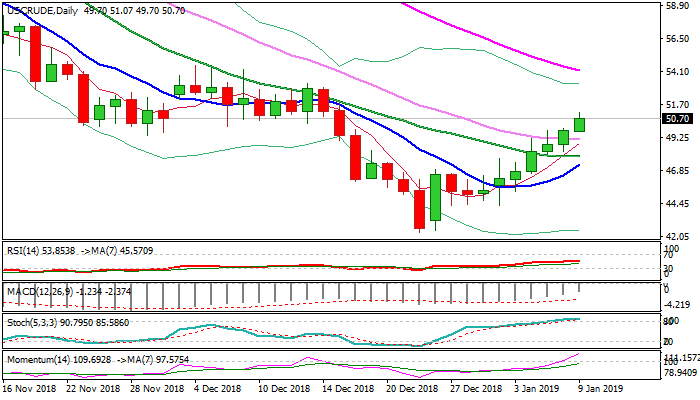
WTI Outlook: Contract Advances Above Key $50 Resistance Zone On Optimism Over US/China Trade Dispute
WTI oil rose nearly 2.5% on Wednesday, in reaction to rising optimism in the market that US/China trade dispute may be resolved.
Fresh bullish acceleration eventually broke above pivotal barriers at $49.89 (Fibo 61.8% of $54.54/$42.36) and psychological $50 barrier and cracked $51.00 level in extension.
Relief on hopes of solution for trade problem sidelines fears of reduced global demand, with sustained break above $50 zone, expected to generate bullish signal for stronger recovery of Oct/Dec 44% fall.
Bulls hit falling 10WMA ($51.07) and could extend towards 200WMA ($52.25).
Fresh bullish sentiment is also supported by stronger than expected draw in US crude stocks (API report showed 6.2 mln bls draw vs 4.5 mln bls draw last week) with focus on EIA report, due later today and forecasted for 2.8 mln bls draw.
Res: 51.07, 51.67, 52.25, 53.24
Sup: 50.51, 50.00, 49.89, 49.17