Sample Category Title
Japanese Yen Steady ahead of Consumer Income Report
The Japanese yen continues to have a quiet week. In Tuesday’s North American session, USD/JPY is trading at 108.48, down 0.23% on the day. In Japan, consumer confidence dipped to 42.7, shy of the estimate of 42.8 points. Later in the day, Average Cash Earnings, a key gauge of consumer spending, is expected to drop to 1.3%. In the U.S., JOLTS Job Openings was unexpectedly soft, dropping to 6.83 million. This marked a four-month low. On Wednesday, the Federal Reserve releases the minutes of its December meeting, when it raised rates.
After strong gains last week, the yen has taken a pause. Risk appetite took a hit after Apple stunned the markets with a revenue warning, and panicky investors responded by snapping up the safe-haven yen. However, investor optimism returned after dovish comments from Fed Chair Jerome Powell on Friday, who made a concentrated effort to ease the volatility which has rocked the markets in recent weeks. The markets had dropped sharply after the Fed’s December rate statement, which was less dovish than expected, as the Fed said it would continue raising interest rates in 2019. Powell tempered this stance with a more cautious outlook over rate policy, saying any rate decisions would be done prudently and with patience.
The Fed seems to be lowering expectations for additional rate hikes. Recent Fed forecasts have indicated two rate increases next year, but on Monday, Atlanta Fed President Raphael Bostic said that the economy would need only one rate hike. Some analysts have gone further, projecting a rate cut in 2019, which has put a chill on sentiment towards the U.S. dollar.
Will we see an easing of tensions in the U.S-China trade spat? Investors are pinning hopes on the outcome of this week’s meeting between U.S and Chinese officials. The teams are holding two days of talks in China, in an effort to reduce global trade tensions. The ongoing trade war has rocked equity markets, which had their worst year in 2018 since the 2008 financial crisis. The world’s two largest economies have engaged in tit-for-tat tariffs, and President Trump has threatened to impose additional tariffs on March 1 if the sides don’t reach a deal. If this set of talks points to progress, traders can expect risk appetite to improve, which could put a cap on the yen’s impressive rally.
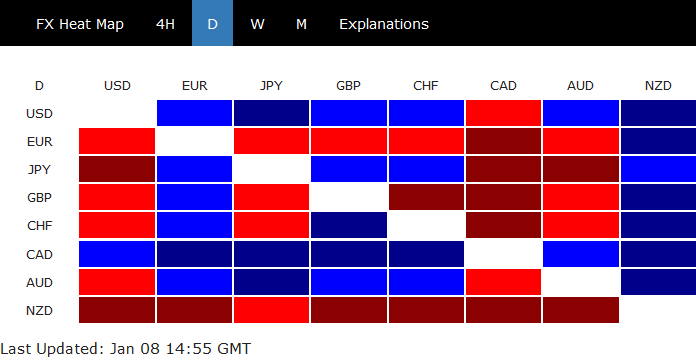
Today’s top mover: NZD/JPY losing momentum ahead of 4H 55 EMA
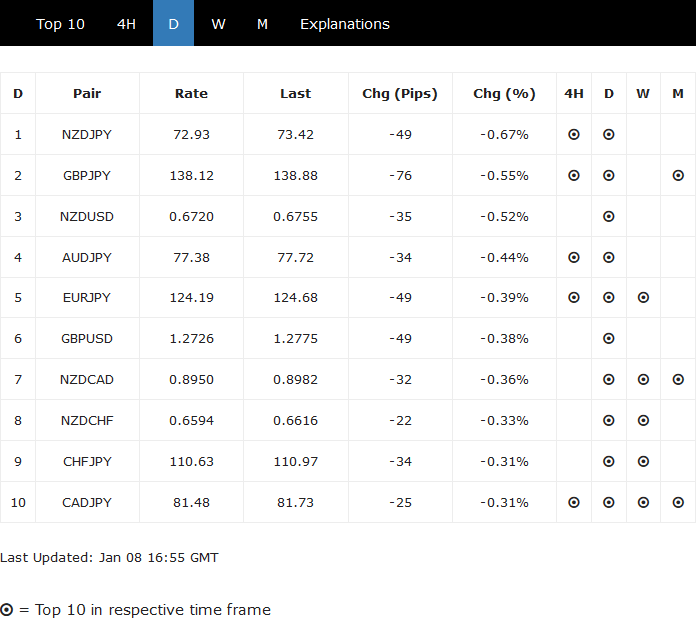
At the time of writing, NZD/JPY is the biggest mover today. But considering that it's just down -49 pips or -0.67%, it's place could easily been taken out by others at close. Also, it's showing that today's trading is rather dull.
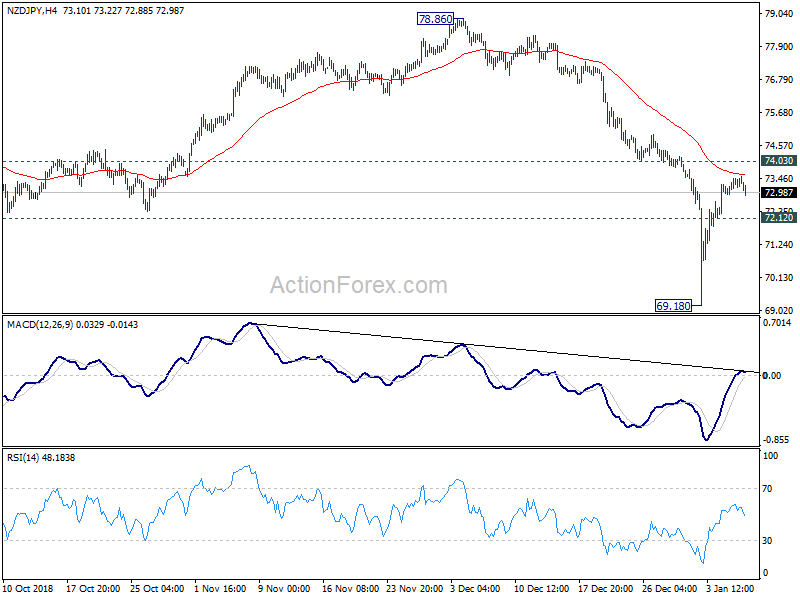
Similar to other Yen crosses, NZD/JPY spiked lower to 69.18 last week on the currency flash crash. It was held slightly above 68.88 key support and rebounded. Rise from 69.18 is seen as a corrective move only and it's already losing some momentum ahead of 4 hour 55 EMA.
While another rise cannot be ruled out yet, upside should be limited by 74.03 minor resistance. On the downside, below 72.12 minor support will turn bias back to the downside for retest 69.18 low.
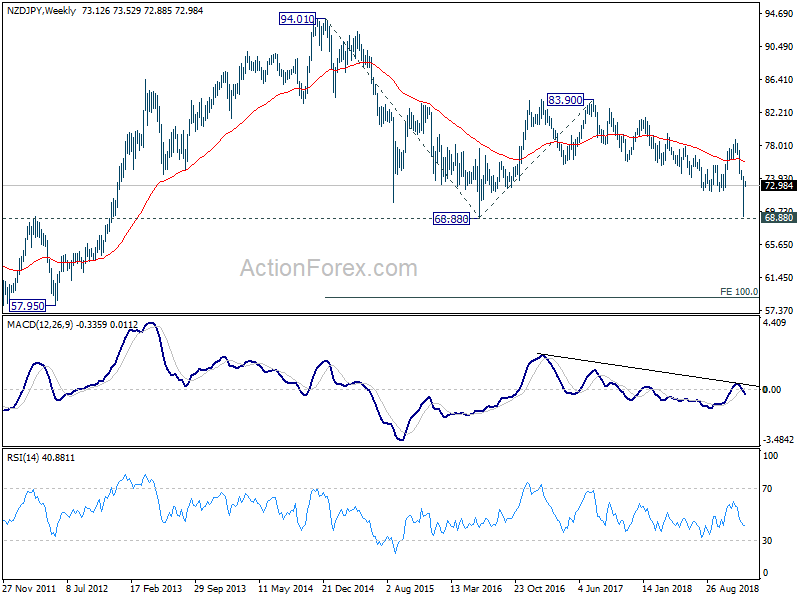
From a medium term point of view, weekly MACD turned negative and crossed below signal line. NZD/JPY is held well below falling 55 week EMA. Both carry mildly bearish implications. For now, we'd favor an eventual break of 68.88 (2016 low) to resume the down trend from 94.01 (2015 high). In that case, next medium-to-long-term target will be 100% projection of 94.01 to 68.88 from 83.90 at 58.77. This will now remain the preferred case as long as 74.03 minor resistance holds.
FOMC Minutes to Highlight a Busy Week for the Dollar
The US economic calendar is packed with significant events this week, with the latest FOMC minutes hitting the markets on Wednesday, at 1900 GMT. Then on Thursday, a slew of Fed speakers including Chair Powell and Vice Chair Clarida will deliver remarks. Investors will look for clues as to whether a pause in rate hikes is indeed in order, amid growing fears a recession may be in sight.
Fed Chairman Powell softened his tone on future rate hikes last week, indicating his central bank will be “flexible” in setting policy and is “listening closely” to market concerns. The key message was that if investors are right, and the US economy does slow severely in 2019, then policymakers won’t hesitate to pause their rate hikes, or even reverse them by cutting rates. His remarks were met with relief, helping stocks to recover while causing the dollar to fall, as investors factored in the prospect of Fed rate cuts by this time next year. Market pricing derived from the Fed funds futures currently implies the Fed will stay on hold throughout 2019, but looking further out, it assigns a 35% chance for a 25bps rate cut by January 2020.
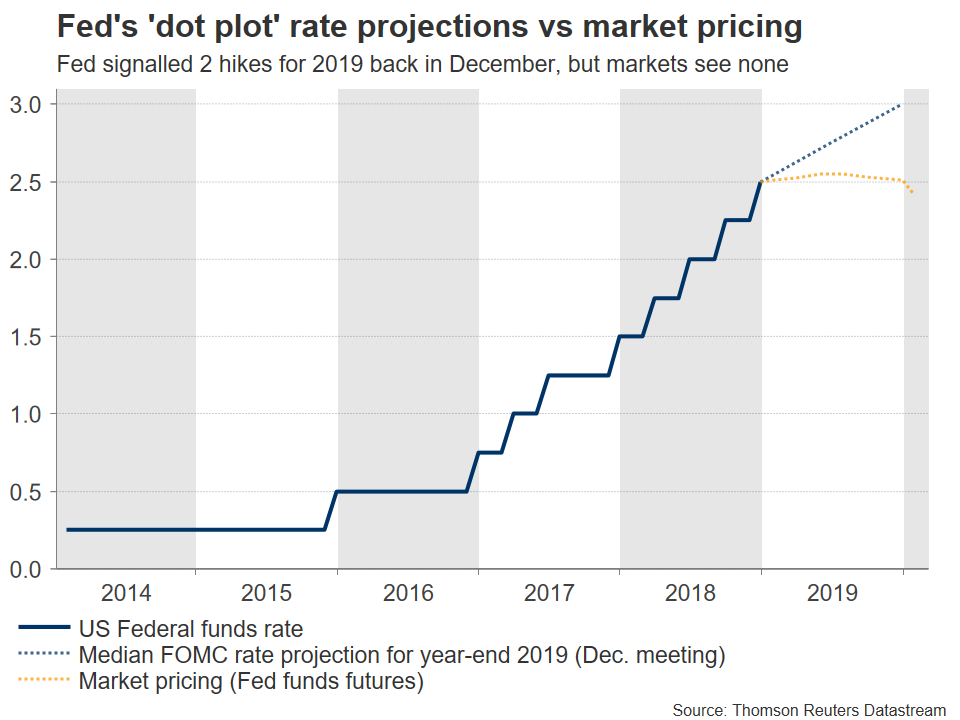
In short, market participants seem to be pricing in a severe slowdown or even outright recession by 2020, under the rationale that the recent weakness in the US housing market and other major foreign economies will soon spill over into the broader US economy as well. And although the Fed until last week appeared adamant about continuing to hike rates, it now seems to be shifting to a more reactionary “on hold for now” approach, with future moves to be guided by incoming data.
Against this backdrop, markets will await eagerly for the FOMC minutes from the December meeting on Wednesday, and will also listen carefully to speeches by several key Fed officials. Chair Powell and Vice Chair Clarida will speak on Thursday, alongside regional Fed Presidents Barkin, Bullard, Evans, and Kashkari. The burning questions on everyone’s minds are: how worried is the Fed about a looming slowdown? Are such worries shared by all officials, or are some still determined to normalize further in light of a robust labor market and strong consumer spending? Is the recent financial market volatility worrisome in itself? What would be the Fed’s first response if the data do deteriorate – pausing hikes or stopping the balance sheet unwinding?
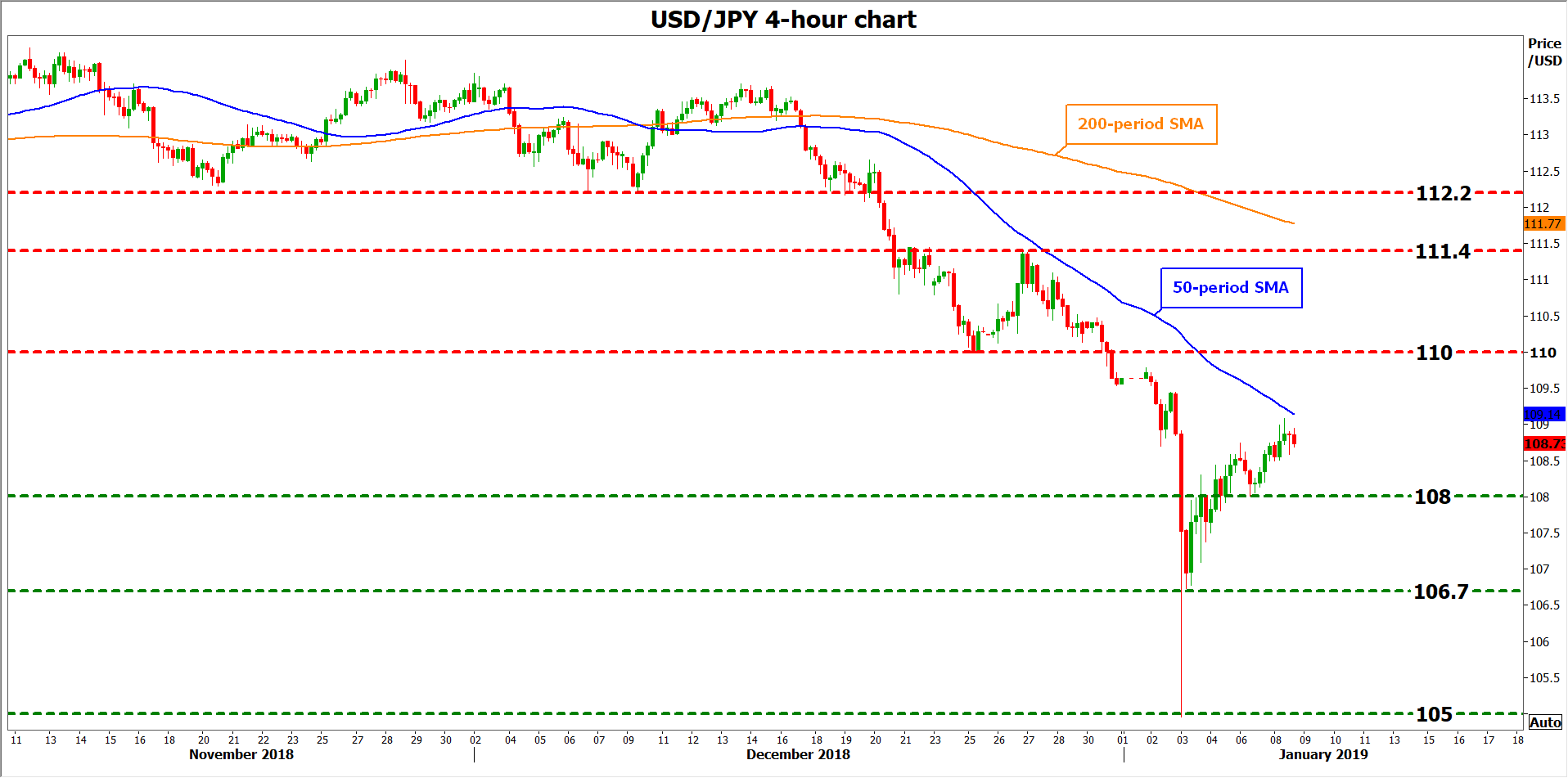
Turning to the market reaction, anything that suggests policymakers are still keen to raise rates even once more will likely be met with a spike higher in the dollar and a tumble in stocks, given that market pricing currently implies no further hikes. In such a case, initial resistance to advances in dollar/yen may be found near the 110.00 handle, with even steeper bullish moves potentially stalling near 111.40, the high of December 26.
On the contrary, if officials make it clear – especially in the minutes – that Powell’s “flexible” approach reflects the entire Committee’s thinking and that the Fed will be especially cautious going forward, market pricing for future rate cuts may grow further, weighing on the greenback and boosting equities. Support to declines in dollar/yen could come around 108.00, with a downside break potentially opening the door for a test of 106.70.
Finally, note that US CPI data for December will be released on Friday. While the Fed prefers the core PCE as its main inflation gauge, the agency that releases the PCE – the Bureau of Economic Analysis – is closed under the US government shutdown. Hence, until this shutdown ends, CPI are the only inflation data “in town”, rendering them all the more important.
Bank of Canada to Put Rate Hikes Aside for Now
The loonie recovered almost 2.0% of its lost value last week, registering its largest gain against the dollar in four months but the currency is waiting another test this week as the Bank of Canada is scheduled to set monetary policy on Wednesday at 1500 GMT. While interest rates are not expected to change, policymakers may use a more dovish tone amid heightened fears of a slowing global economy.
The economic strength stemming from a tightening job market and higher inflationary pressures let the Bank of Canada to raise interest rates five times since July 2017. Projections for 2019 were also positive, with markets pricing in three rate hikes until recently. Hopes for further hikes though soon receded as the trade war between the US and China, unlike the NAFTA drama which came to an end, intensified, bringing some evident headwinds to the global economy and more specifically, to oil prices, which Canadian exports depend the most on.
Besides a riskier trade environment, wage growth appeared to be heading in the wrong direction in the second half of 2018 at a time when consumers should be stepping up efforts to reduce high debt levels. Average hourly earnings moved down from May’s peak of 3.5% y/y to a more-than-a-year low of 1.5% in December, even as the unemployment rate slipped to 40-year lows, providing some explanation as to why the core inflation measures that BoC policymakers monitor to adjust monetary policy remained below the 2.0% price target in November.
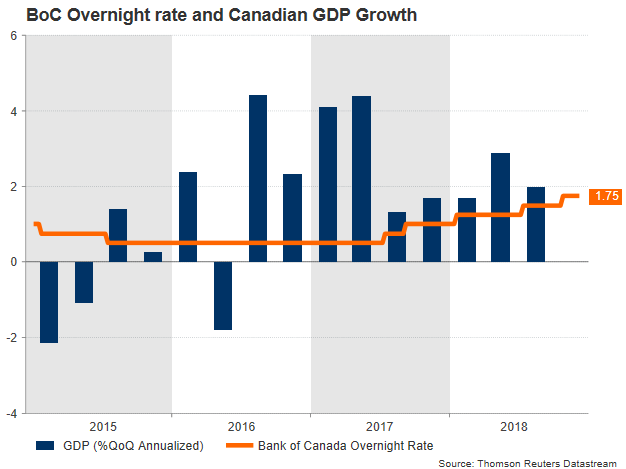
Hence, with weakening Canadian wages threatening household spending and investors being afraid that the US-Sino trade war could cause a bigger economic damage worldwide in 2019, the BoC has no incentive to raise rates on Wednesday. Instead, the Bank may appear more stressed about the exposure of Canada to potential global economic downturns, consequently judging it wiser to adopt a wait-and-see approach until the trade storm passes and data warrant that higher borrowing costs are manageable. Specifically, the Bank is anticipated to keep an extra close eye on oil volatility and wage growth movements in subsequent months as well as on financial conditions in partner countries such as the US, Europe and China. If more clouds surround the Canadian economy, pressuring GDP expansion, the Bank won’t hesitate to lower interest rates. At this point, its worth noting that overnight indexed swaps are currently suggesting a 13.8% chance of a 25-bps rate cut at the January meeting.
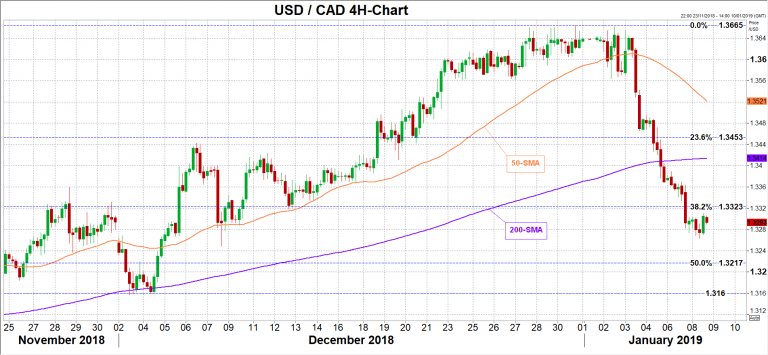
Should policymakers use a more dovish tone, signalling a potential delay in lifting rates or making a rate cut a real possibility in 2019, USDCAD may pause the sell-off and head up towards 1.3323, the 38.2% Fibonacci of the upleg from 1.2775 to 1.3660. Above that key resistance the focus will shift to the 200-period moving average (1.3414), which if broken, additional gains could follow with the next target coming somewhere near the 23.6% Fibonacci of 1.3453.
Alternatively, if the BoC reiterates that it will need to push up interest rates into the 2.5-3.5% neutral range to be consistent with its inflation goals, appearing less concerned about future economic developments, USDCAD may post another red candle near the 50% Fibonacci of 1.3217. If that fails to hold, support could run towards 1.3160, where bears rested in early December, while below that attention would turn to 1.3050, a frequently tested mark in previous months.
Also of great interest on Wednesday, the BoC will update its inflation and growth projections and issue a statement to explain the factors influencing its rate decision, while a press conference is expected to start later at 1600 GMT.Note that the FOMC meeting minutes will be also released in the same day.
Sunset Market Commentary
Markets
Global core bonds were mixed to little changed today as the continued uptick in risk sentiment weighed on core bonds. German industrial production fell in November for the third time in a row and suggests the economic slowdown observed in Q3 will not be temporarily. Next, confidence indicators in the Eurozone disappointed as it declined more than expected in December. However, weaker than expected economic data couldn’t bring down investor sentiment. The German yield curve edged marginally higher with changes in the range of 0.7 bps (2-yr) to 1.0 bp (10-yr). President Trump will speech tonight “on the humanitarian and national security issue” as he still seeks financing for his wall on the US-Mexican border, which still keeps the US government (partially) shut. In the meantime, he again expressed his discontent with the Federal Reserve as it raised interest rates too fast. Business optimism among small US companies decreased slightly in December to 104.4 (down from 104.8), but beat market expectations. The US yield curve is bear flattening with changes in the range of +0.3 bps (30-yr) to + 2.8 bps (2-yr). Peripheral bond yields hardly move on today’s supply glut (issuances in Germany, Netherlands, Austria and Belgium) with only the Italian spread over the German 10-yr yield dilating again (+ 4bps).
Trading in EUR/USD and other major USD cross rates was mainly technical in nature. The (trade-weighted) dollar bottomed after the decline in the wake of Fed’s Powell’s comments on policy flexibility last week. This morning, it looked like a further USD rebound/euro losses were possible. EMU eco data (German production and EC confidence indicators) disappointed and suggested a further erosion in the Q4 economic momentum. However, EUR/USD stabilized in the mid 1.14 area. A test of the USD/JPY 109 area was also rejected. The US NFIB small business confidence declined less than expected. It wasn’t a decisive factor for USD trading, but maybe it helped to ease investor worries on a US slowdown. The dollar tried another upside test. EUR/USD is trading in the 1.1430/35 area. USD/JPY is changing hands in the 108.80 area. Even so, the USD gains remain modest. FX markets are now looking forward to the (positive) outcome from the US-China trade talks and to US president Trump’s address on the financing of a the wall between the US and Mexico.
Sterling showed no clear trend today. Recent (technical) rebound petered out as the political debate on Brexit returned the forefront. The Parliamentary vote on the UK government’s Brexit deal is scheduled for January 15. There were rumours that the UK is still trying to get a better deal for the EU, but for now there is little evidence that the deal will get a majority in Parliament. Political visibility on the Brexit process remains as low as it was and this continues to prevent outright directional position taking in the major sterling cross rates. EUR/GPP regained a few ticks and is trading in the 0.8980 area. Cable (1.2730 area) ceded slightly ground, mostly due to today’s USD rebound.
News Headlines
European data printed weak. German industrial production declined for a third straight month in Nov. (-1.9% MoM, -4.7% YoY) with a downwardly revision of last month’s data. The EC confidence indicator stranded at 107.3 (vs. 108.2 expected) in Dec., down from 109.5. Forward looking components show little reason for economic optimism.
Brazil’s freshly sworn in right wing administration lead by Jair Bolsonaro plans to privatize or liquidate about 100 state-run companies. The decision would fit the government’s aim to reduce the size of the state in order to close fiscal deficits, while attracting private investment into the country.
Italy’s government stepped in to support Banka Carige, which recently fell under ECB administration after it failed to raise capital. The country’s Treasury will guarantee bonds issues and any funds it might borrow from the Bank of Italy. The government’s decision is remarkable given 5SM’s fierce criticism towards past state interventions.
USDTRY – Fragile Geopolitical Situation and Weakening Techs Could Spark Further Fall of Turkish Lira
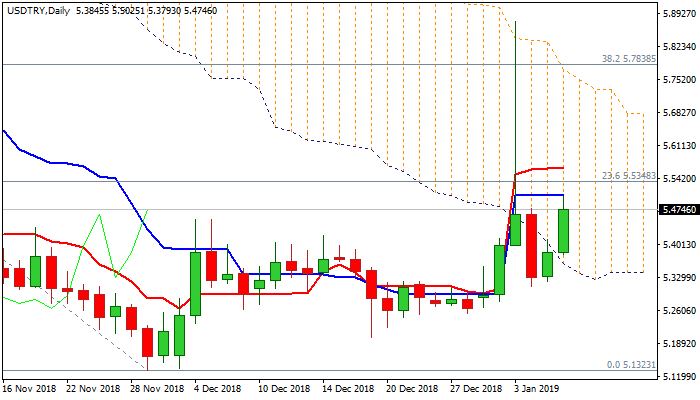
The USDTRY has stabilized and moves higher after last week’s strong rally to 5.8767 and subsequent quick pullback last week.
Fresh upside attempts extend into second day and penetrate daily cloud, on track for close within the cloud after the action in past three days repeatedly closed below the base of thick daily cloud.
Fresh advance is supported by strengthening momentum and daily 10/20/30 SMA turning north and being in bullish setup.
News that Turkey prepares for military action in Syria could have negative impact on lira if the situation deteriorates.
Larger picture shows that pullback from new all-time high was contained by rising 200SMA just above psychological 5.00 zone and attempts to form a base, which keeps the downside protected for now and shows scope for further recovery.
Close within daily close would offer initial bullish signal and expose key barriers at 5.7327 (100SMA); 5.7530 (daily cloud top) and 5.7838 (Fibo 38.2% of 6.8379/5.1323 descend).
Positive outlook could be expected while the price action remains above 200SMA (5.1677), with release of data from Turkey next week (labor; IP; current account) expected to provide more hints about the health of lira.
Res: 5.5025; 5.5348; 5.5653; 5.6484
Sup: 5.3806; 5.3453; 5.3151; 5.2539
WTI Oil Stands at Front Foot But Key Barriers at $50 Zone Still Intact
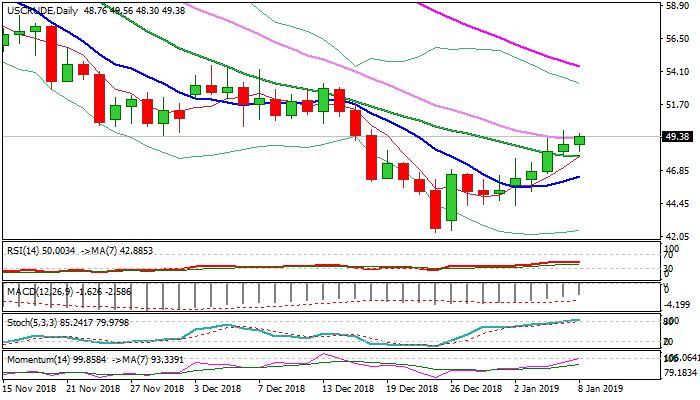
WTI oil maintains positive tone on Tuesday and probes again through falling 30SMA (currently at $49.19) which limited Monday's action.
Oil price remains in green for the sixth straight day and eyes pivotal barriers at $49.89 (Fibo 61.8% of $54.54/$42.36) and psychological $50 barrier, supported by hopes for successful end US/China trade talks, news that Turkey resumed imports from Iran and optimism that production cut by major oil exporters would result in stabilizing oil market.
Improving daily techs (momentum is attempting into positive territory and 10/20/30SMA's turning to bullish setup) support advance, which looks for bullish signal on sustained break above $50 zone.
On the other side, headwinds from fears of global slowdown which would reduce demand, could be limiting factor.
Broken 20SMA offers initial support at $47.90), followed by north-turning 10SMA ($46.47), loss of which would weaken near-term structure.
Release of US crude stocks reports (API today and EIA on Wednesday) would provide fresh signals.
Res: 49.89; 50.00; 50.90; 51.67
Sup: 48.45; 47.90; 46.47; 46.14
GBPUSD – Repeated Rejection at 55SMA Signals Bulls Running Out of Steam
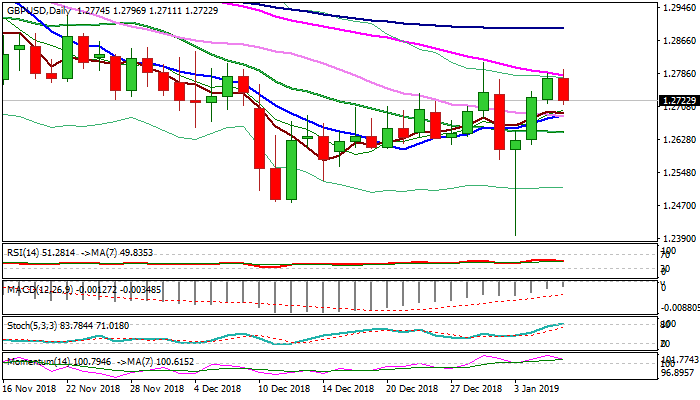
Cable dipped to daily low at 1.2711 in US trading on Tuesday after attempts through 55SMA (1.2782) in early European session resulted in posting new 2019 high 1.2796, but gains were short-lived.
Three-day recovery rally faced strong headwinds at 1.2780 zone (50% retracement of 1.3174/1.2397 / 55SMA) which resisted attacks on 31 Dec and 7/8 Jan.
Subsequent easing approaches converged 10/30 SMA’s (1.2686) and threatens of further weakening if support gives way and pullback extends below pivotal support at 1.2645 (20SMA / Fibo 38.2% of 1.2397/1.2796 recovery leg).
Res: 1.2782; 1.2796; 1.2814; 1.2850
Sup: 1.2686; 1.2645; 1.2597; 1.2550
Elliott Wave Analysis: S&P500 Intra-day Rally!
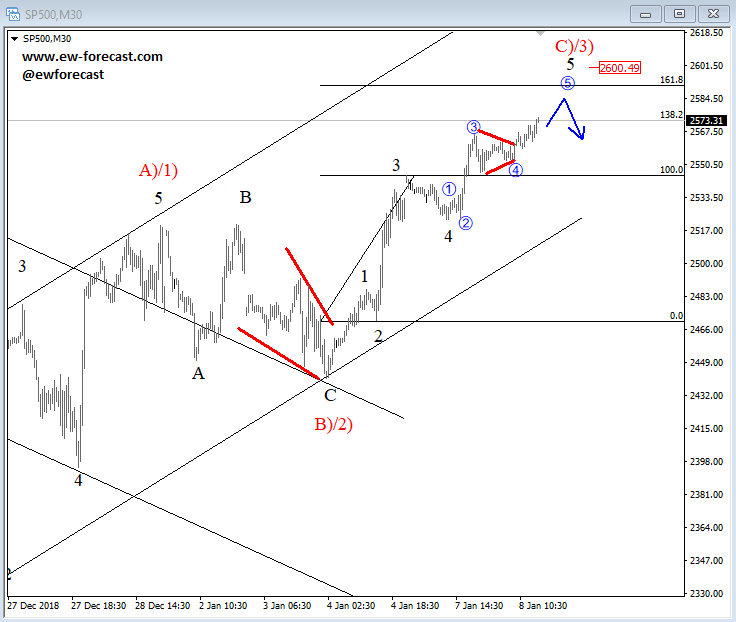
S&P500 is recovering with five waves into black wave 5 of a higher degree wave C) or 3). Resistance for wave C) or 3) can be near the 2600 area, from where a minimum three-wave drop can follow. A decisive breach below the lower channel line, connected from 4th of January would confirm a completed higher degree A)-B)-C) and a bearish continuation.
S&P500, 30Min
DOW surges as Trump said talks with China going very well
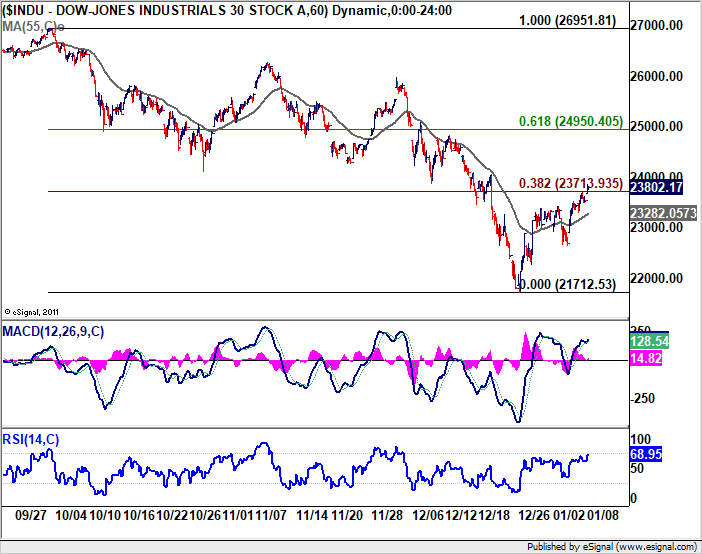
DOW surges to as high as 23864.76 in initial trading and is currently up more than 1.1%. Sentiments are apparently lifted by Trump's tweet that "Talks with China are going very well!" US 10-year yield also extends recent rebound and is back at 2.71.
https://twitter.com/realDonaldTrump/status/1082627015235256321
Technically, DOW's break of 23713.93 Fibonacci level is a positive development for stocks. Focus will be on whether it could sustain above this level at close.
Dollar's reaction is rather muted though. It's the second strongest for today but there is no upside acceleration yet.