

Sample Category Title
US: Small Businesses Confidence Moderates at the End of the Year, but Remains Upbeat Relative to History
The NFIB's small business optimism index fell 0.4 points to 104.4 in December. The headline print came in a touch above market expectations for a 103-point showing. The index has drifted lower over the last four months, but remains elevated relative to history. What's more, with the confidence measure hovering around 107 throughout the year, 2018 marked the most optimistic year in the survey's history.
The performance among the survey's subcomponents was mixed, with six deteriorating and four improving on the month. The share of firms expecting the economy to improve recorded the biggest decline, dropping 6 points to 16% – much lower than the 37% recorded in December of the year prior. The share of firms reporting higher earnings this quarter over last (-3 points to a negative 7%) and those that believe that now is a good time to expand (-5 points to 24%), marked other notable pullbacks.
On the other hand, the employment subcomponents came in strong. Employment picked up steam in December (up 0.25 m/m – the fastest pace since July), while plans to increase employment also improved (up 1 point to 23%). Concerns regarding the quality of labor remained the most pressing issue for business owners despite easing off slightly (-2 points to 23%), whereas unfilled job openings rose to an all-time high of 39% (up 5 points m/m).
Businesses continued to boost compensation to attract workers – 35% of firms raised compensation, up 1 point m/m, while the share of those planning to do so in the months ahead remained elevated (-1 point to 24%).
The share of firms making capital expenditures over the last 6 months held steady at a decent 61%, but capital outlay plans continued to drift lower and are down 8 points from the August cyclical peak.
Key Implications
Given concerns regarding monetary policy, trade uncertainty and the pronounced late-year selloff in equity markets, the slight decline in small business confidence in December may not be entirely unwarranted. Yet, despite the recent losses, the headline confidence measure remains elevated relative to history, suggesting that morale among American small businesses is still quite upbeat. What's more, the December report also carried a few positive nuggets, the most noteworthy being the labor market indicators which wholeheartedly echoed the strength of the December jobs report.
2018 as a whole marked the best yearly showing since the survey's inception as far as confidence goes, with fiscal stimulus and regulatory changes the main supports behind this performance. Going forward, while we still expect both small business confidence and overall economic growth to remain at healthy levels, a confluence of factors suggests that 2018 may stand as a high watermark.
Among the factors pointing to a moderation are the fading boost of fiscal stimulus, higher interest rates and capacity constraints (already on display among the labor market metrics) that will continue to bind. For their part, America's small firms seem to be in tune with the slower-growth narrative, as the share of firms expecting the economy to improve shrunk by more than half compared to this time last year. The current government shutdown, despite it being expected to be short-lived, will add to near-term pressures.
EURUSD Remains in No Man’s Land
EUR/USD remains trapped between 1.12 and 1.15 and as much as the ECB has tried to confirm they are looking to raise rates this year, the market is not agreeing. ECB’s Hansson noted that the ECB still will keep rates at present levels through the summer, implying we could see a hike as early as September is still possible. Money markets are still pricing the first ECB hike closer to the middle of 2020.
Hansson’s overall comments regarding the economy suggests they will remain data dependent and that can’t bold well for rate hike expectations in September.
Overnight, Industrial production disappointed for Germany in the month of November, pointing to a potentially lower GDP reading for the fourth quarter. The broad-based slowdown was led by consumer goods and energy. Both the monthly and annual readings came in worse than expected and the prior months were revised lower. The German economy remains vulnerable to both the ongoing trade talks with the US, which have been going on since the end of summer and the uncertainty of Brexit. If Germany gets their second negative GDP reading, they will fall into a technical recession, which means it will be nearly impossible for the ECB to raise rates in 2019.
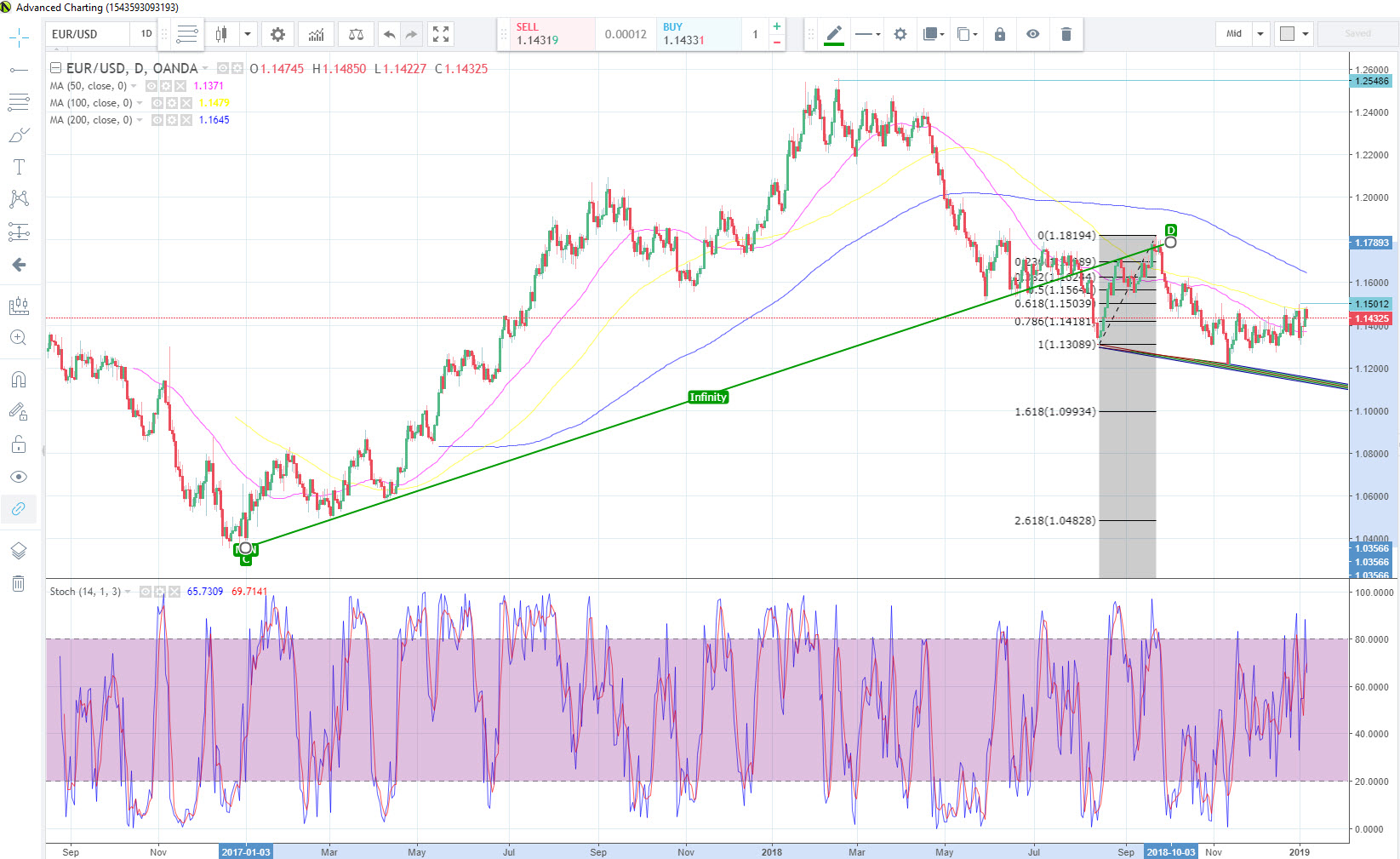
Price action on the EURUSD daily chart highlights that tight range that has been in place since mid-October is attempting to breakout higher. If we see price close above both the 100-day SMA and the 1.15 level, we could see bullish momentum target the 1.1635 level. If the recent holds, price could consolidate back towards the 1.1350.
USD/JPY Mid-Day Outlook
Daily Pivots: (S1) 107.82; (P) 108.21; (R1) 108.90; More..
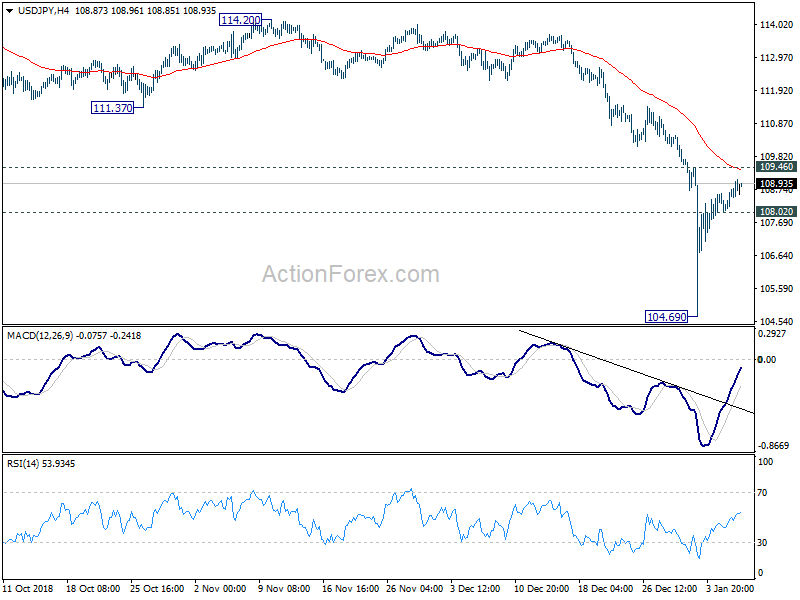
USD/JPY's rebound from 104.69 is still in progress and could extend higher. But upside will likely be limited by 109.46 minor resistance. On the downside, below 106.74 minor support will turn bias to the downside for 104.62 low. Overall, larger downtrend from 118.65 (2016 high) is expected to resume finally through 104.62 after current consolidation from 104.69 completes.
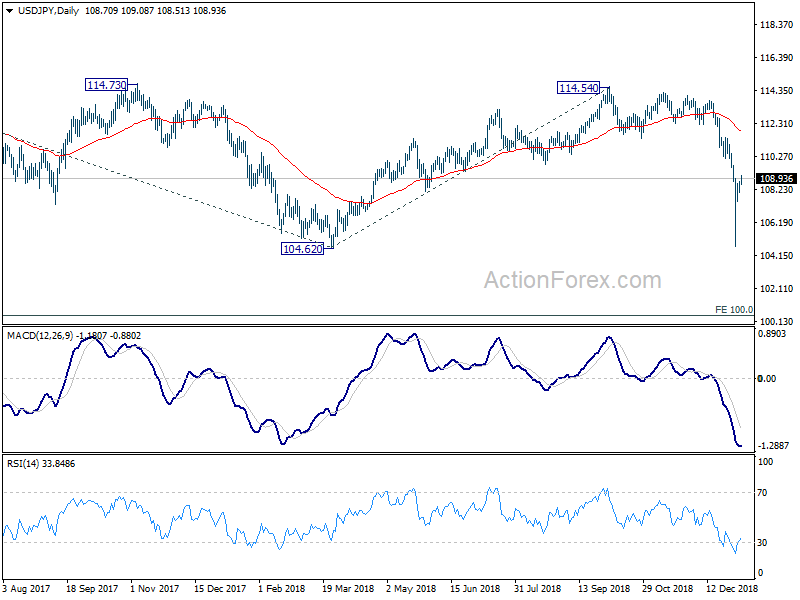
In the bigger picture, price actions from 125.85 (2015 high) are seen as a long term corrective pattern, no change in this view. Apparently, such corrective pattern is not completed yet. Fall from 114.54 is seen as part of the falling leg from 118.65 (2016 high). Break of 104.62 will target 100% projection of 118.65 to 104.62 from 114.54 at 100.51, which is close to 100 psychological level. But in that case, we'd expect strong support from 98.97 to contain downside to bring reversal. Also, this bearish case will remain the preferred one as long as 114.54 resistance holds.
USD/CHF Mid-Day Outlook
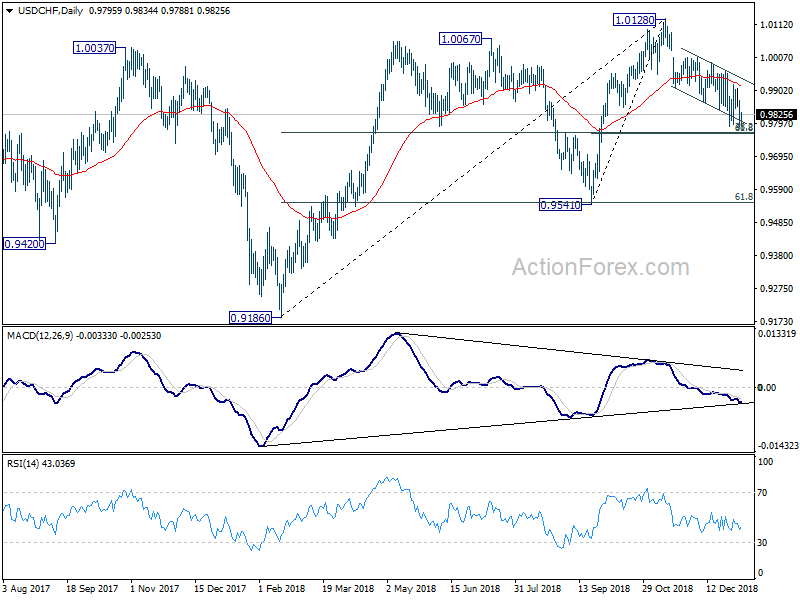
Daily Pivots: (S1) 0.9763; (P) 0.9822; (R1) 0.9856; More...
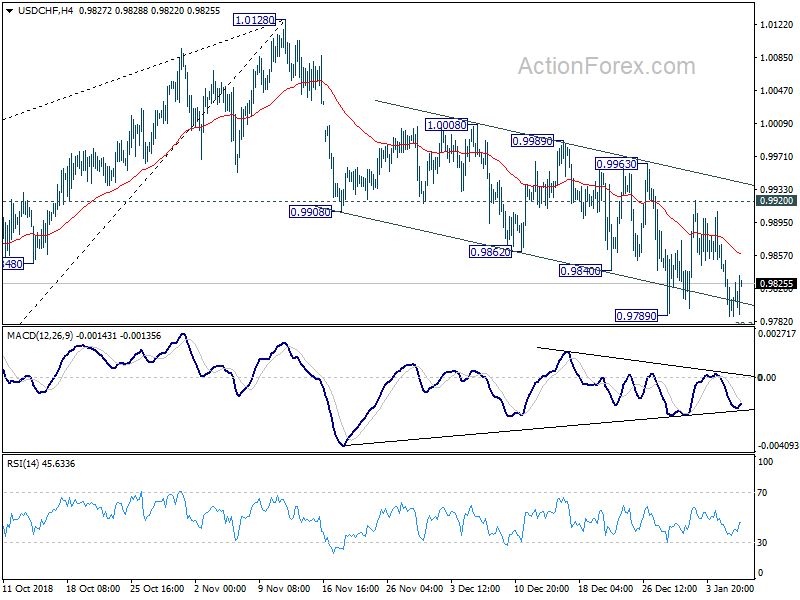
Intraday bias in USD/CHF remains neutral and outlook is unchanged. The corrective fall from 1.0128 is still progress and might extend lower. But downside should be contained by 0.9765/8 cluster support (61.8% retracement of 0.9541 to 1.0128 at 0.9765, 38.2% retracement of 0.9186 to 1.0128 at 0.9768) to bring rebound. On the upside, break of 0.9920 minor resistance will suggest that such correction has completed and turn bias to the upside for retesting 1.0128 resistance. However, sustained break of 0.9765/8 will bring deeper fall back to 0.9541 support next.
In the bigger picture, while the fall from 1.0128 was slightly deeper than expected, the structure suggests it's a corrective move. As long as 0.9765/8 cluster support (61.8% retracement of 0.9541 to 1.0128 at 0.9765, 38.2% retracement of 0.9186 to 1.0128 at 0.9768) holds, we'd expect up trend from 0.9541 and 0.9186 to resume later through 1.0128. However firm break of 0.9765/8 will argue that the trend has reversed. Further break of 0.9541 support will confirm this bearish scenario and bring deeper fall back to 0.9186 low.
EUR/USD Mid-Day Outlook
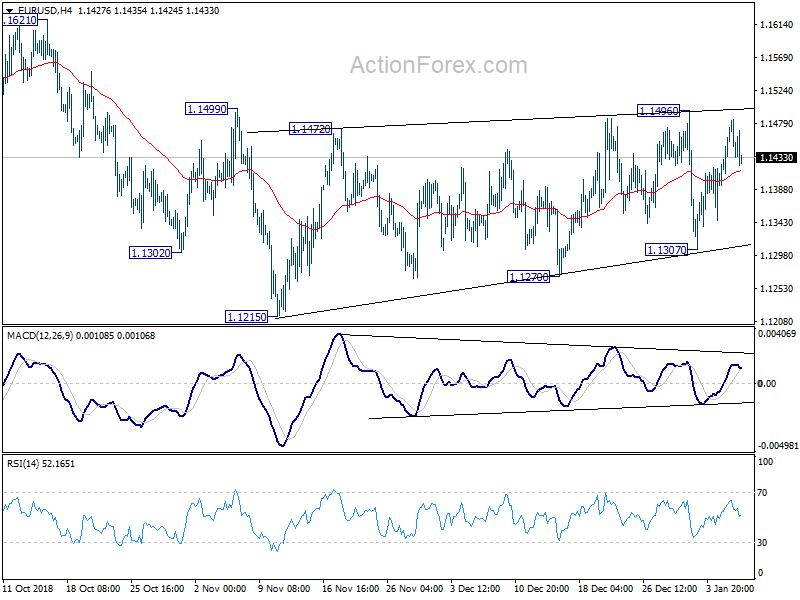
Daily Pivots: (S1) 1.1356; (P) 1.1387; (R1) 1.1430; More.....
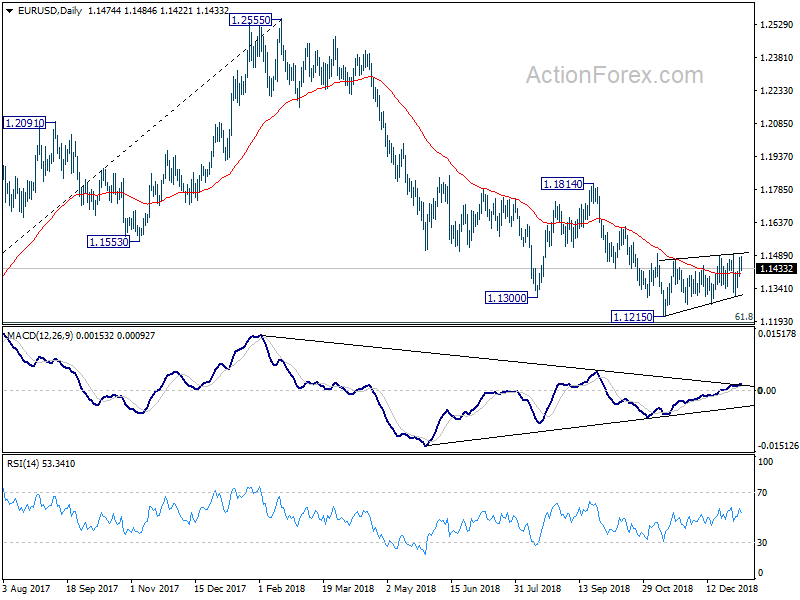
Intraday bias in EUR/USD remains neutral for the moment. Also, price actions from 1.1215 are still viewed as a corrective pattern. Thus, downside breakout is favored. On the downside, break of 1.1307 minor support will turn bias back to the downside for 1.1215 low. Break will resume down trend from 1.2555 to 1.1186 key fibonacci level. Nevertheless, sustained break of 1.1499 resistance will suggest near term reversal and bring stronger rebound back to 1.1621 resistance first.
In the bigger picture, as long as 1.1814 resistance holds, down trend down trend from 1.2555 medium term top is still in progress and should target 61.8% retracement of 1.0339 (2017 low) to 1.2555 at 1.1186 next. Sustained break there will pave the way to retest 1.0339. However, break of 1.1814 will confirm completion of such down trend and turn medium term outlook bullish.
AUD/USD: Retains Corrective Recovery Bias
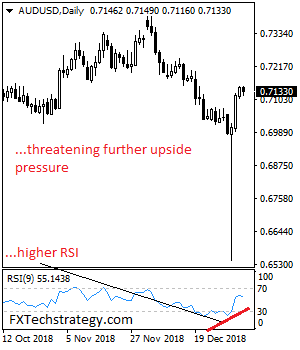
AUDUSD retains corrective recovery bias with eyes on more strength in the days ahead. On the upside, resistance lies at the 1.7150 level. A cut through here will turn attention to the 0.7200 level and then the 0.7250 level where a violation will set the stage for a retarget of the 0.7300 level. Its daily RSI is bullish and pointing higher suggesting further strength. Support resides at the 0.7100 level where a breach will aim at the 0.7050 level. Below here will set the stage for a run at the 0.7000 level with a cut through here targeting further downside pressure towards the 0.6950 level. On the whole, AUDUSD faces further upside threats.
GBP/USD Mid-Day Outlook
Daily Pivots: (S1) 1.2726; (P) 1.2756; (R1) 1.2806; More....
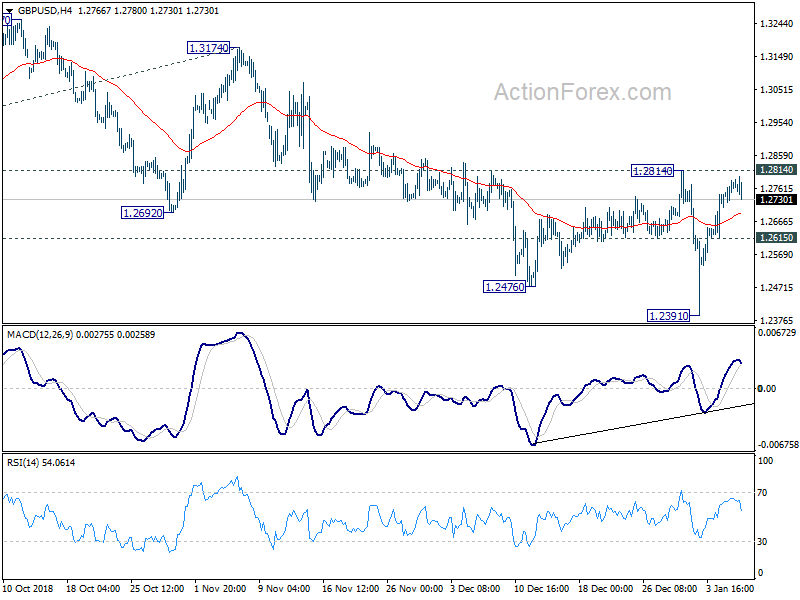
Intraday bias in GBP/USD is turned neutral as it retreats notably after failing to take out 1.2814 resistance. Near term outlook stays bearish for now. On the downside, below 1.2615 minor support will turn bias to the downside for retesting 1.2391 first. Break will extend the down trend from 1.4376 and target 61.8% projection of 1.4376 to 1.2661 from 1.3174 at 1.2114 next. However, firm break of 1.2814 resistance will be an early sign of trend reversal and bring stronger rebound back to 1.3174 resistance next.
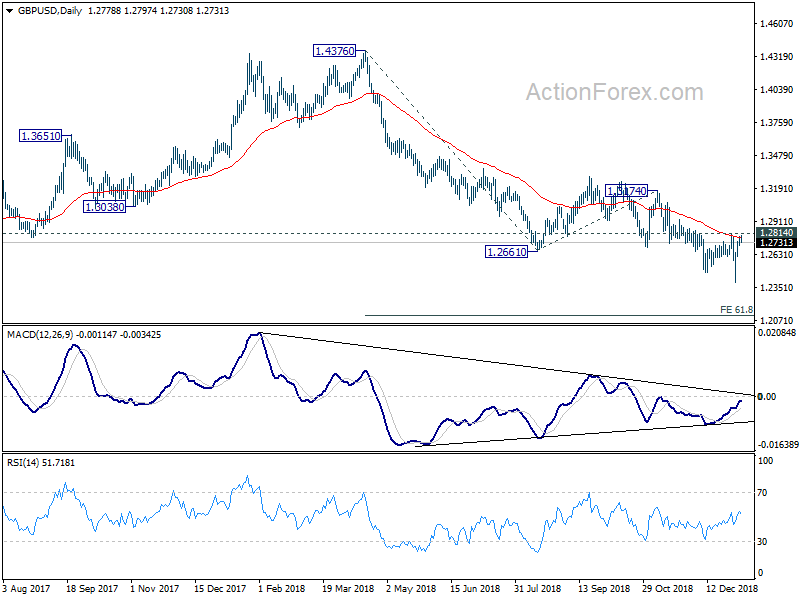
In the bigger picture, whole medium term rebound from 1.1946 (2016 low) should have completed at 1.4376 already, after rejection from 55 month EMA. The structure and momentum of the fall from 1.4376 argues that it's resuming long term down trend from 2.1161 (2007 high). And this will now remain the preferred case as long as 1.3174 structural resistance holds. GBP/USD should target a test on 1.1946 first. Decisive break there will confirm our bearish view.
Dollar Trying to Recover Further as 10-Year Yield Back Above 2.7
Canadian and US Dollar are the strongest ones in a rather quiet day. WTI crude oil stays firm above 49 but there is no buying to push it through 50 handle yet. But that's enough to keep the Loonie buoyed ahead of BoC rate decision tomorrow. Dollar is supported by rebound in treasury yields as 10-year yield is now back above 2.7 handle. On the other hand, New Zealand Dollar and Euro are the weakest ones for today.
US-China trade negotiations are extending into overnight in Beijing today. Markets will be eager to hear some positive comments as the meeting completes. Meanwhile, eyes will also be on Trump's planned speech regarding border wall and government shutdown. But that will come late at around 9pm EST.
In other markets, DOW futures are pointing to another day of higher open. In Europe, FTSE is currently up 1.04%, DAX is up 1.24%, CAC is up 1.62%. German 10 year yield is up 0.0141 at 0.238. Earlier in Asia, Nikkei gained 0.82%, Hong Kong HSI rose 0.1%, Singapore Strait Times rose 0.65%. But China Shanghai SSE dropped -0.26%. Japan 10-year JGB yield attempted to turn positive but closed at -0.003, up 0.0115.
UK confirmed arranging Brexit parliament vote on Jan 15, subject to approval
UK Prime Minister Theresa May's spokesman James Slack confirmed today that a vote is scheduled in the parliament on Tuesday, January 15 on the Brexit agreement. He told reporter that "Subject to parliament approving a business motion, the debate will be opened tomorrow ... The prime minister said that she would close the debate next Tuesday, which is January 15, when the vote will take place,"
Also he added that May is not trying to delay Brexit by extending Article 50 withdrawal notice. And, the idea may have been discussed by EU officials but not by British officials.
UK Barclay denied discussing Article 50 extension on Brexit
UK Brexit Minister Stephen Barclay denied the Daily Telegraph report that they're discussing the possibility of withdrawal request with EU. He told BBC radio that "I've had no discussions with the European Union in terms of extension."
When he's explicitly asked if he could deny the report, Barclay said "Yes, because I can be very clear that the government's policy is to leave on March 29, the prime minister has made that clear on numerous occasions to parliament."
Separately, Irish Prime Minister Leo Varadkar pledged to try to give UK the reassurances needed for getting the Brexit agreement through the parliament. Varadkar said "We don't want to trap the UK into anything – we want to get on to the talks about the future relationship right away," And, "I think it's those kind of assurances we are happy to give."
Eurozone economic sentiment dropped, weakened in all five largest economies
Eurozone economic confidence (ESI) dropped "markedly" by 2.2 to 107.3 in December, below expectation of 108.9. Eurostats noted that "the deterioration of euro-area sentiment resulted from lower confidence in industry, services, construction and among consumers, while confidence improved slightly in retail trade."
Also, the ESI weakened in all five largest economies, including Spain (−3.0), France (−2.0), Germany (−1.9) and Italy (−1.4) and, marginally so, in the Netherlands (−0.3).
Industrial confidence dropped to 1.1, down from 3.4 and missed expectation of 3.1. Services confidence dropped to 12.0, down from 13.4, and missed expectation of 12.3. Consumer confidence was finalized at -6.2.
Eurozone business climate dropped to 0.82, down from1.09 and missed expectation of 0.99.
Elsewhere, German industrial production dropped -1.9% mom in November versus expectation of 0.3% rise. Swiss unemployment rate was unchanged at 2.4% in December. Japan consumer confidence dropped -0.2 to 42.7 in December. Australia trade surplus narrowed slightly to AUD 1.93B in November, and missed expectation of AUD 2.18B.
GBP/USD Mid-Day Outlook
Daily Pivots: (S1) 1.2726; (P) 1.2756; (R1) 1.2806; More....
Intraday bias in GBP/USD is turned neutral as it retreats notably after failing to take out 1.2814 resistance. Near term outlook stays bearish for now. On the downside, below 1.2615 minor support will turn bias to the downside for retesting 1.2391 first. Break will extend the down trend from 1.4376 and target 61.8% projection of 1.4376 to 1.2661 from 1.3174 at 1.2114 next. However, firm break of 1.2814 resistance will be an early sign of trend reversal and bring stronger rebound back to 1.3174 resistance next.
In the bigger picture, whole medium term rebound from 1.1946 (2016 low) should have completed at 1.4376 already, after rejection from 55 month EMA. The structure and momentum of the fall from 1.4376 argues that it's resuming long term down trend from 2.1161 (2007 high). And this will now remain the preferred case as long as 1.3174 structural resistance holds. GBP/USD should target a test on 1.1946 first. Decisive break there will confirm our bearish view.
Economic Indicators Update
| GMT | Ccy | Events | Actual | Forecast | Previous | Revised |
|---|---|---|---|---|---|---|
| 00:30 | AUD | Trade Balance (AUD) Nov | 1.93B | 2.18B | 2.32B | 2.01B |
| 05:00 | JPY | Consumer Confidence Dec | 42.7 | 42.8 | 42.9 | |
| 06:45 | CHF | Unemployment Rate Dec | 2.40% | 2.40% | 2.40% | |
| 07:00 | EUR | German Industrial Production M/M Nov | -1.90% | 0.30% | -0.50% | |
| 10:00 | EUR | Eurozone Business Climate Indicator Dec | 0.82 | 0.99 | 1.09 | |
| 10:00 | EUR | Eurozone Economic Confidence Dec | 107.3 | 108.9 | 109.5 | |
| 10:00 | EUR | Eurozone Industrial Confidence Dec | 1.1 | 3.1 | 3.4 | |
| 10:00 | EUR | Eurozone Services Confidence Dec | 12 | 12.3 | 13.3 | 13.4 |
| 10:00 | EUR | Eurozone Consumer Confidence Dec F | -6.2 | -6.2 | -6.2 | |
| 11:00 | USD | NFIB Small Business Optimism Dec | 104.4 | 103.6 | 104.8 | |
| 13:30 | CAD | International Merchandise Trade (CAD) Nov | -2.1B | -1.9B | -1.2B | -0.9B |
Canadian Dollar Rally Continues as US-China Talks Renew Optimism
The Canadian dollar started the week with strong gains, as the rally continues. In the Tuesday session, the pair is trading at 1.3293, down 0.04% on the day. It’s a quiet day on the release front – Canada will post trade balance and the U.S publishes JOLTS Job Openings. USD/CAD has now posted losses for four straight days, losing 2.4% in that period.
The U.S. dollar was broadly lower on Monday, as fallout from Fed Chair Powell’s recent remarks continues to weigh on the greenback. Powell engaged in some damage control, seeking to reassure the financial markets that was listening to market concerns about continuing to tighten policy. The markets had given Powell a thumbs-down after the Fed’s December rate statement was on the hawkish side, and stocks plummeted. Powell was dovish in his remarks, saying that he was aware of the risks of a slowdown in the U.S. economy and that the Fed would be patient in its policy decisions.
Risk appetite is higher, as investors are pinning hopes on the outcome of this week’s meeting between U.S and Chinese officials. The teams are holding two days of talks, in an effort to reduce global trade tensions. The ongoing trade war has rocked equity markets, which had their worst year in 2018 since the 2008 financial crisis. The world’s two largest economies have engaged in tit-for-tat tariffs, and President Trump has threatened to impose additional tariffs on March 1 if the sides don’t reach a deal. If this set of talks points to progress, traders can expect risk appetite to improve, which would be bullish for the Canadian dollar.
UK confirmed arranging Brexit parliament vote on Jan 15, subject to approval
UK Prime Minister Theresa May's spokesman James Slack confirmed today that a vote is scheduled in the parliament on Tuesday, January 15 on the Brexit agreement. He told reporter that "Subject to parliament approving a business motion, the debate will be opened tomorrow ... The prime minister said that she would close the debate next Tuesday, which is January 15, when the vote will take place,"
Also he added that May is not trying to delay Brexit by extending Article 50 withdrawal notice. And, the idea may have been discussed by EU officials but not by British officials.