Sample Category Title
DAX Heads Higher on Optimism over U.S-China Talks
The DAX index has posted strong gains in the Tuesday session. Currently, the index is at 10,840, up 0.83% on the day. On the release front, there are no major German or eurozone indicators. German industrial production posted a sharp decline of 1.9%. On Wednesday, the eurozone releases the unemployment rate and the Federal Reserve will publish the minutes of its December meeting, when it raised interest rates for the fourth time in 2018.
The New Year has greeted investors with swings and the market volatility continues this week. The DAX rocketed 3.7% on Friday, following dovish comments from Fed Chair Jerome Powell. Investors were unhappy with the Fed’s December rate statement, which was less dovish than expected, as the Fed said it would continue raising interest rates in 2019. Powell tempered this stance on Friday with a more cautious outlook over rate policy. He said that he was aware of the risks of a slowdown in the U.S. economy and that the Fed would be patient in its policy decisions.
There is renewed optimism among investors, as the U.S. and China are meeting for two days of talks, in an effort to reduce global trade tensions, which have rocked equity markets, which had their worst year in 2018 since the 2008 financial crisis. The world’s two largest economies have engaged in tit-for-tat tariffs, and President Trump has threatened to impose additional tariffs on March 1 if the sides don’t reach a deal. If this set of talks points to progress, traders can expect risk appetite to improve and boost the stock markets.
The German manufacturing sector has taken a hit due to ongoing global trade war, and this week’s manufacturing numbers are pointing to a slowdown. On Monday, Factory Orders fell 1.0%, well of the estimate of -0.2%. This was followed by a decline of 1.9% in Industrial Production, much weaker than the forecast of 0.3%. This marked the fifth decline in the past six months. Unless the ongoing trade war eases soon, we can expect German manufacturing data to struggle.
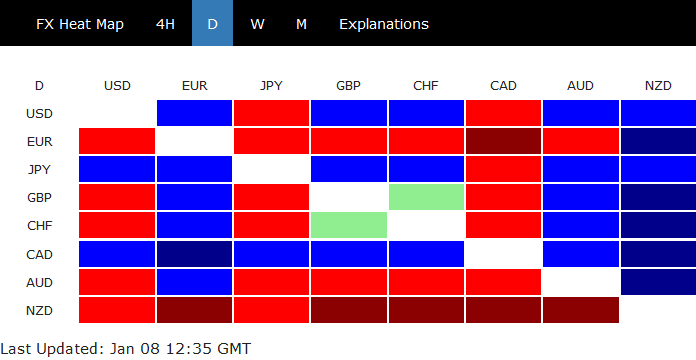
Into US session: Canadian Dollar strongest, NZD, AUD and EUR soft
Entering into US session, major pairs and crosses are generally staying in tight range. New Zealand Dollar, Euro and Australian Dollar are the "relatively" weaker ones. Meanwhile, Canadian Dollar and Yen are the strongest ones. But after all, with the exception of pre-BoC strength of the Loonie, the picture is not too representative.
US-China vice ministerial trade talk is extending into the evening but no more news is released on the topic. US and Canada trade balance will be released but are unlikely to trigger any responses. The more interesting could be Trump's planned speech regarding border wall and government shutdown. But that will come late at around 9pm EST.
In Europe, at the time of writing:
- FTSE is up 0.93%
- DAX is up 0.88%
- CAC is up 1.45%
- German 10-year yield is up 0.008 at 0.231
Earlier in Asia:
- Nikkei closed up 0.82%
- Hong Kong HSI rose 0.15%
- China Shanghai SSE dropped -0.26%
- Singapore Strait Times gained 0.65%
- Japan 10-year JGB yield attempted to turn positive, but ended at -0.003, up 0.0115
Euro Makes Push Towards 1.15, German Manufacturing Data Slips
EUR/USD has posted slight losses in the Tuesday session, after starting the week with considerable gains. Currently, the pair is trading at 1.1455, down 0.17% on the day. On the release front, there are no major events. German industrial production produced a sharp decline of 1.9%. The U.S releases JOLTS Job Openings, which is expected to tick lower to 7.07 million. On Wednesday, the eurozone releases the unemployment rate and the Federal Reserve will publish the minutes of its December meeting, when it raised interest rates for the fourth time in 2018.
The U.S. dollar was broadly lower on Monday, as fallout from Fed Chair Powell’s recent remarks continue to weigh on the greenback. Powell engaged in some damage control, seeking to reassure the financial markets that was listening to market concerns about continuing to tighten policy. The markets had given Powell a thumbs-down after the Fed’s December rate statement was on the hawkish side, and stocks plummeted. Powell was dovish in his remarks, saying that he was aware of the risks of a slowdown in the U.S. economy and that the Fed would be patient in its policy decisions.
The Fed seems to be lowering expectations for additional rate hikes. Recent Fed forecasts have indicated two rate increases next year, but on Monday, Atlanta Fed President Raphael Bostic said that the economy would need only one rate hike. Some analysts have gone further, projecting a rate cut in 2019, which has put a chill on sentiment towards the U.S. dollar.
The German manufacturing sector has taken a hit due to ongoing global trade war, and this week’s manufacturing numbers are pointing to a slowdown. On Monday, Factory Orders fell 1.0%, well of the estimate of -0.2%. This was followed by a decline of 1.9% in Industrial Production, much weaker than the forecast of 0.3%. This marked the fifth decline in the past six months. Unless the ongoing trade war eases soon, we can expect German manufacturing data to struggle.
Eurozone economic sentiment dropped, weakened in all five largest economies
Eurozone economic confidence (ESI) dropped "markedly" by 2.2 to 107.3 in December, below expectation of 108.9. Eurostats noted that "the deterioration of euro-area sentiment resulted from lower confidence in industry, services, construction and among consumers, while confidence improved slightly in retail trade." Also, the ESI weakened in all five largest economies, including Spain (−3.0), France (−2.0), Germany (−1.9) and Italy (−1.4) and, marginally so, in the Netherlands (−0.3).
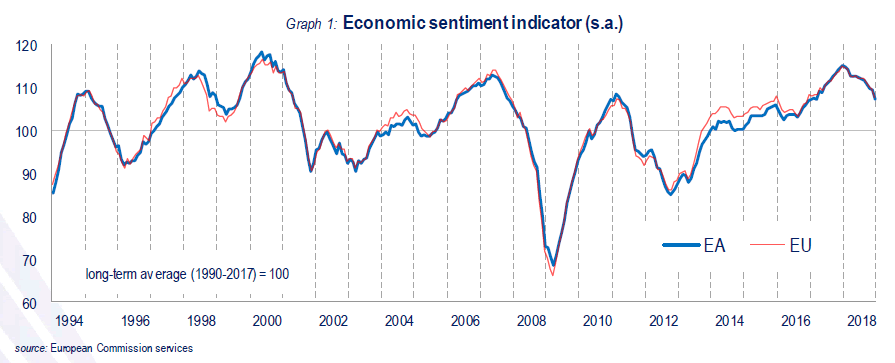
Industrial confidence dropped to 1.1, down from 3.4 and missed expectation of 3.1. Services confidence dropped to 12.0, down from 13.4, and missed expectation of 12.3. Consumer confidence was finalized at -6.2.
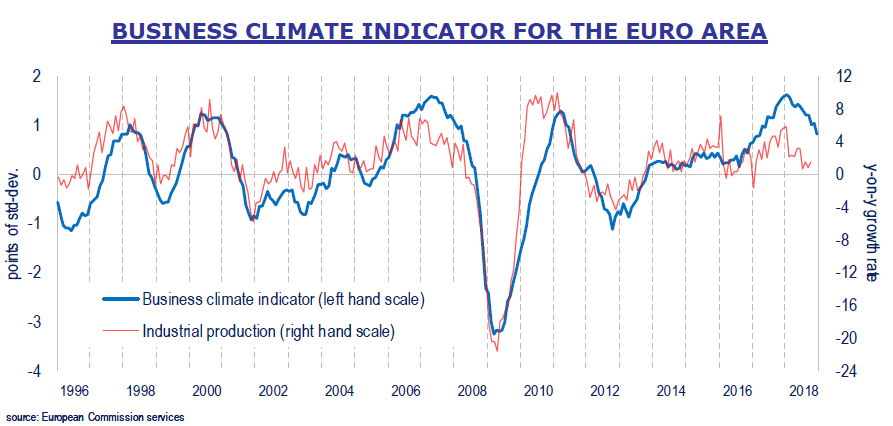
Also, Eurozone business climate dropped to 0.82, down from1.09 and missed expectation of 0.99.
GBPUSD Bulls Still In Control Of Price Action
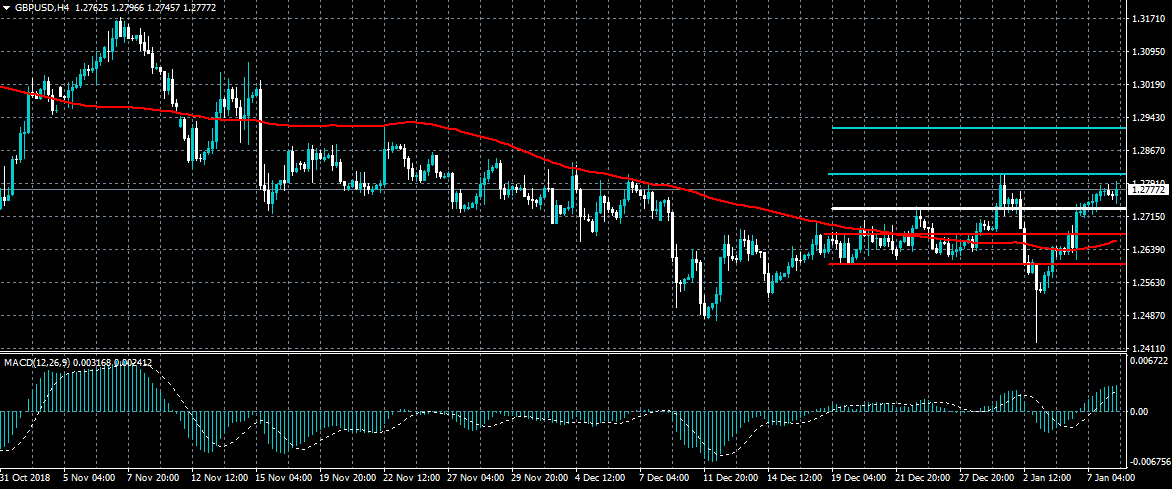
The British pound continues to trade around the best levels of the year so far against the greenback, with bulls retaining firm control of price action during the European trading session. Further intraday gains remain likely while price trades above the GBPUSD pairs daily pivot point, which is located at the 1.2762 level. Buyers ideally need a strong move above the 1.2810 resistance level to trigger heavy technical buying.
The GBPUSD pair strongly intraday bullish while trading above the 1.2810 level, key technical resistance is found at the 1.2860 and 1.2900 levels.
If the GBPUSD pair trades under the 1.2760 level, sellers are likely to test the 1.2740 and 1.2700 levels.
USDJPY Bulls Testing 109.00 Level
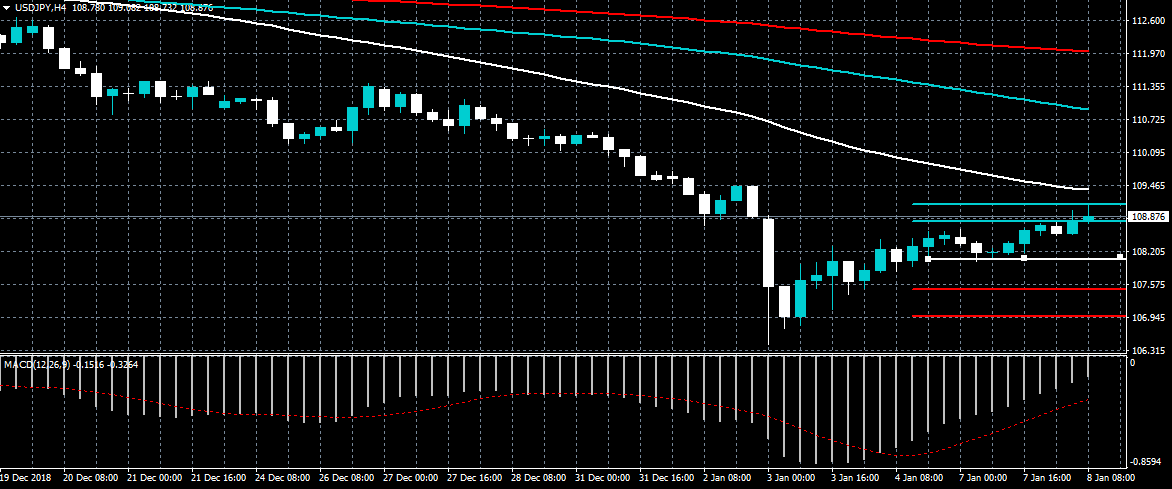
The US dollar has continued to advance higher against the Japanese yen, with price briefly trading above the 109.00 resistance level. Despite the strong correction higher in the USDJPY pair, the MACD indicator on the four-hour time frame has yet to reach overbought trading conditions. A sustained break above the 109.00 level may expose further upside towards the 109.40 level, while sellers need a bearish close below the 108.10 level.
The USDJPY pair is strongly bullish while trading above the 108.80 level, key technical resistance is found at the 109.40 and 110.00 levels.
If the USDJPY pair falls below the 108.80 level, sellers may test towards the 108.60 and 108.10 support levels.
Swiss Economy Peaks?
Swiss economy peaks?
The State Secretariat for Economic Affairs (SECO) has revised Switzerland's economic forecast downward: GDP growth eased to 2.6% in 2018 (estimated 2.9% in September), while in 2019 the economy should expand 1.5% (estimated 2% in September). Although the economy has been on solid footing amid global growth, clouds gathered in the last few months: the trade war between the US and China and lasting political uncertainty in the euro zone (Brexit, Italy's budget clash with the EU, French protests). Moreover, QT (quantitative tightening) in the US – the Fed is withdrawing $50bn of liquidity every month – and the end of the European Central Bank's quantitative easing in December 2018, will force the economy to deleverage and get rid of unprofitable businesses. Switzerland will come under pressure over the next few years as global growth slows.
Meanwhile, Switzerland's unemployment rate fell to 2.6% (yearly average) in 2018, compared to 3.2% in the previous year, the lowest level in ten years. In December, the rate fell to 2.4% (seasonally adjusted), matching its forecast and unchanged from the previous month. Strong acceleration of the economy over the first half of 2018 lowered unemployment rolls to 118,000, down 17.5% from 2017.
Pound rollercoaster restarts
Britain's parliament is back from holiday, and next week the House of Commons is expected to debate and vote on the European Union Withdrawal Agreement. It seems clear that they will reject it, despite the effort made by Prime Minister Theresa May to receive concessions from Brussels and her talks with President of the EU Council Donald Tusk and President of the EU Commission Jean-Claude Juncker. Whither the pound? Probably a sharp drop following the vote; the next step will depend on whether the EU or the UK will provide a constructive solution thereafter. Short-term, we see a drop in GBP/USD to 1.2745.
No alternatives to PM May's proposed deal have emerged so far. A disorderly Brexit (i.e. hard Brexit) would not be in the UK's or the EU's interest, so a preferred solution might be to extend the Brexit deadline of 29 March. This would ultimately allow both the EU and the UK to find a sustainable solution.
U.S Dollar Reprieve
Tuesday January 8: Five things the markets are talking about
European equities have found some support along with U.S stock futures overnight as investors’ await developments on trade talks between the world’s two largest economies. While in Asia, equities traded mixed as a rebounding U.S dollar put some pressure on emerging markets.
The ‘mighty’ dollar has recovered a tad after losing ground Monday, rising against most G10 currency pairs, with some positive signs from the first day of Sino-U.S trade negotiations in Beijing (a two-day trade affair).
Despite stronger job numbers stateside and news that Fed may be turning more “dovish,” investors still have plenty to worry about in the short-term – the outcome of U.S-China trade talks remain precarious, as too does U.S lawmakers reaching an agreement on a budget, leaving parts of the federal government shut down for a third consecutive week, while in Europe, the Brexit outcome consumes almost everyone.
On tap: President Trump plans to deliver a prime-time televised address this evening – topics include his ‘wall’ and the U.S government shutdown. Tomorrow sees the release of minutes from the Fed’s Dec. 18-19 policy meeting, while Fed Chair Powell will speak to the Economic Club of Washington D.C on Thursday. In the U.K, the British Parliament resumes a debate on the Brexit withdrawal bill.
1. Stocks mixed results
In Japan, despite the Nikkei loosing nearly half of its intraday gains in the last hour of trading, it was the best performer in Asia for a second consecutive session. The benchmark finished up +0.8%, while nearly half of the broader Topix (+0.5%) subsections ended lower.
Down-under, Aussie stocks ended higher overnight, tracking Wall Street, on hopes that Sino-U.S trade talks will succeed in ending a trade war. At the close, the S&P/ASX 200 index rose +0.7%. In S. Korea, stocks slumped as Samsung flagged an earnings warning that cooled investor sentiment. The Kospi fell -0.58%.
In China, stocks closed slightly lower overnight amid investor caution as U.S and Chinese officials seek to reach a trade deal in Beijing. The blue-chip CSI300 index fell -0.2%, while the Shanghai Composite Index lost -0.3%.
In Hong Kong, stocks rallied a tad. The Hang Seng index rose +0.2%, while the China Enterprises Index gained +0.1%.
In Europe, bourses have gained ground this morning, boosted by optimism over trade talks between the U.S and China.
U.S stocks are set to open in the ‘black’ (+0.42%).
Indices: Stoxx600 +0.48% at 344.52, FTSE +0.55% at 6,848.12, DAX +0.10% at 10,759.35, CAC-40 +0.50% at 4,743.00, IBEX-35 +0.34% at 8,806.35, FTSE MIB -0.01% at 18,950.50, SMI +0.55% at 8,584.80, S&P 500 Futures +0.42%
2. Oil prices steady on trade talk hopes and OPEC cuts, gold lower
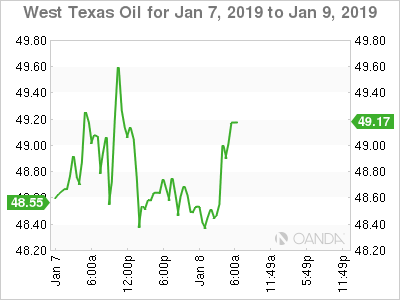
Oil prices are stable ahead of the U.S open, supported by hopes that Sino-U.S talks in Beijing might defuse a trade dispute between the world’s biggest economies, while OPEC-led supply cuts also tightened markets.
Brent crude futures are at +$57.42 per barrel, up +9c, or +0.2% from Monday’s close, while U.S West Texas Intermediate (WTI) crude oil futures are at +$48.56 per barrel, up +4c, or +0.1%.
So far in 2019, crude oil prices have benefited from OPEC+ production cuts and steadying equities markets. However, capping prices for the moment is a surge in U.S oil supply, driven by a steep rise in onshore shale oil drilling and production.
Note: According to EIA data, U.S crude oil production rose by an aggressive +2M bpd in 2018, to a world record +11.7M bpd and with U.S drilling activity to remain high, U.S oil production is expected to grow.
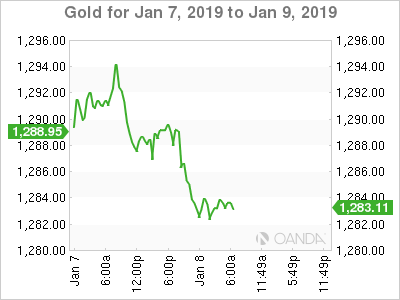
Gold is a tad weaker overnight as bets that the U.S Fed will halt its rate-hike cycle and growing optimism over a Sino-U.S trade deal has pushed the U.S dollar higher, while an improved risk appetite by investors is limiting gains for the safe haven metal. Spot gold is down -0.6% at +$1,281.32, while U.S gold futures are -0.5% lower at +$1,283.10 per ounce.
3. Sovereign yields climb
Hopes of a trade deal between the U.S and China is boosting risk appetite and driving German Bund yields slightly higher in a sign of somewhat less demand for safe havens. The 10-year Bund yield is trading at +0.22%, up +0.6%.
Note: Supply will be a key mover of Bunds this week with auctions in Dutch and Austrian bonds, and in German inflation-linked bonds, while Belgium is expected to go ahead with a 10-year syndication (Tuesday).
Elsewhere, the yield on 10-year Treasuries fell less than -1 bps to +2.70%, while in the U.K, the 10-year Gilt yield has gained +2 bps to +1.275%.
Tomorrow, the Bank of Canada (BoC) delivers its monetary policy announcement (10:00am EDT) – according to Bloomberg the chance of a cut from the BoC is up from +17% last week to +20.5%.
At the end of Nov 2018, the market saw a +66% chance of a BoC hike. However, consensus does not expect Governor Poloz to hike rates any time soon.
4. U.S dollar reprieve
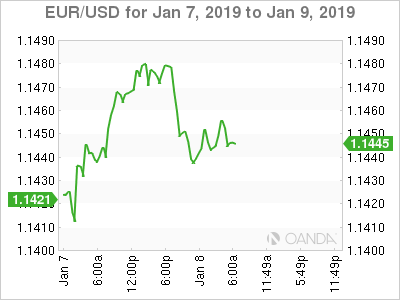
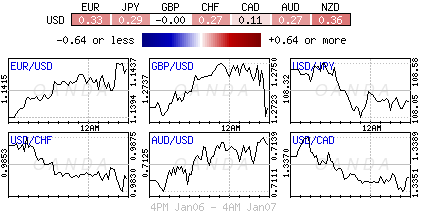
The U.S dollar is making a recovery after losing ground on Monday; rising against most major currencies this morning, with some positive signs from day one of the U.S-China trade negotiations lifting it particularly against the safe-haven yen (¥108.80).
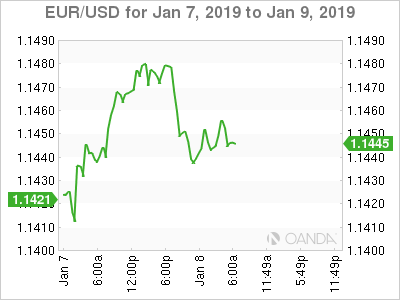
The EUR is weaker, trading down by -0.3% at $1.1447 outright. The ‘single’ currency also fell after German industrial production showed an unexpected fall for November (see below), although it has pared losses since then.
Sterling continues to trade without a firm direction ahead of the U.S open, with GBP/USD flat at £1.2782 and EUR/GBP falling -0.1% to €0.8966 as the euro is pressured by weak German industrial output data. Exactly one week before the U.K. parliament is due to vote on the Brexit withdrawal bill (Jan 15), the pound remains driven by Brexit developments.
5. German industrial production
Data this morning showed that German industrial production unexpectedly slumped in November, adding to recent evidence that a nine-year recovery in Europe’s largest economy is misfiring.
Production in Germany’s key industrial sector, adjusted for inflation and seasonal swings, fell -1.9% in November m/m. The market had expected a +0.3% gain.
Note: It was the second consecutive monthly fall and comes after data yesterday showed an ongoing decline in new manufacturing orders.
The disappointing data would suggest that trade tensions and weaknesses in EM are putting a brake on Germany’s long running economic upswing, and could delay any move by the ECB to lift short-term interest rates any time soon.
Stocks Up, Crude Oil Stable And Dollar Moves Higher
The US futures are looking solid today because investors are hopeful that Trump will use his televised address as an opportunity that the government is ready to break the current shackles. If Trump is able to break the current government shutdown, we could see some more gains for the US indices. So far, the S&P 500 index is up 1.75% year to date, the Dow Jones has jumped 0.87% and the NASDAQ index has soared the most with a gain of 2.84%. Clearly, the tech sector is driving the moves once again.
Stocks in Europe are trading higher and this is despite the fact there is no clear outcome from the fresh talks which are taking place between the US and China over the current trade war. It appears that traders have already priced in a lot of good news and the only outcome they are expecting out of this is mostly positive. Trump administration is oozing optimism and they are hopeful that a reasonable deal will be done with China. The dollar index has clearly broken its three days of sell-off and resumed its upward trend while the move in the Treasury market over in the States is mostly steady.
The bigger question for investors is if the current momentum will continue as the earning season could change everything. Well, it is true that the earning season could change everything if there are any adverse changes in the future outlook. If the only concern is about the US and China trade war, then there may not be that much of problem because of Washington and Beijing are likely to put this issue behind them. However, if the sentiment still doesn’t show any sign of confidence and investors remain worried because of the change in the monetary policy of the Fed and lack of any bullets left in Trump machine gun to stimulate the economy, then we have a bigger problem.
Back in the currency market, traders are focused on the fact if the Prime minister is going to water down the current threat of the UK thrashing out the EU without any deal. She is going to put her deal to a crucial vote in parliament next week and it is widely expected that she is going to lose this vote as we said yesterday. No deal is not better than a bad deal but the prime minister thinks the only way to get things her way is to put pressure by saying that this is the only deal and there is no other alternative.
As for the commodity market, crude oil is holding above the $48 level or in other words, we are experiencing the longest rally in nearly one year and six months. Of course, the reason behind the current move is the positive mood about the ongoing trade negotiation between the US and China. As long as we get a reasonable outcome from the current negotiations between the US and China, the path of least resistance for oil could be to the upside.
AUD/USD Outlook: Bulls Are Consolidating Ahead Of Key Barriers
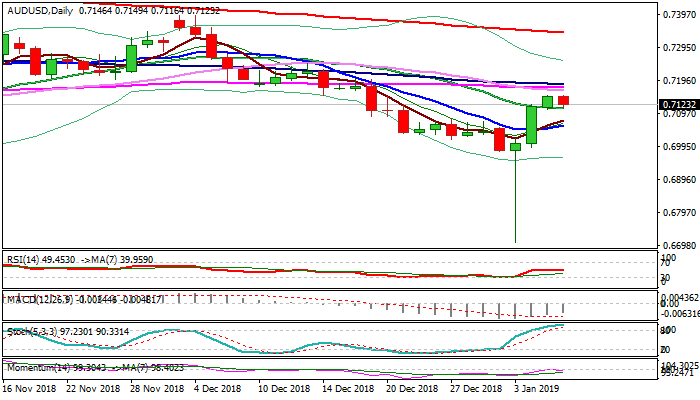
Strong three-day recovery rally is pausing on Tuesday and consolidating under three-week highs at 0.7149 (Mon/Tue). Bulls are taking a breather ahead of strong barriers at 0.7166/85 zone (30/55/100SMA's / daily cloud base) as slow stochastic is strongly overbought on daily chart, but overall sentiment remains positive on hopes of resolution of US/China trade dispute, as well as weaker greenback on fears that Fed is on track to pause its rate hike cycle. Near-term action is for now held by broken 20SMA (0.7110) and underpinned by thick rising hourly cloud (cloud top lays at 0.7108), which should ideally contain, however, deeper correction cannot be ruled out. Daily 10SMA turned north and marks next solid support at 0.7060, with deeper dips expected to find ground above 0.6980 (Fibo 38.2% of 0.6706/0.7149 recovery leg). Only firm break here would neutralize bulls.
Res: 0.7149, 0.7166, 0.7185, 0.7222
Sup: 0.7110, 0.7060, 0.7000, 0.6980