Sample Category Title
Risk Sentiment Up On Possible ‘Reasonable’ Trade Deal
Market movers today
It is a relatively quiet day on the data release front and hence market attention will be on political signals, notably from the trade talks between the US and China and the Brexit debate starting up in the UK.
In Japan, we will get November cash earnings overnight. After the summer's large bonus payments, cash earnings have lost momentum again and y/y real earnings have been hovering around zero. Cash earnings are key for the inflation outlook to brighten and Bank of Japan governor Haruhiko Kuroda has highlighted that they will follow wage developments closely in order to spot future tendencies in inflation. Falling oil prices should be supportive and push real wages back into a positive trend.
Danish December CPI inflation is due today. We expect inflation to decrease slightly from 0.8% to 0.7% in November. See more on page 2.
In Norway, November manufacturing production is due to be released today.
Selected market news
Trade talks between the US and China top officials continue today in Beijing. US and Asian equity indices are up 0.5-1.0% this morning after the Trump Administration indicated that a 'reasonable' deal could be reached. This followed an unexpected appearance by China's most senior economic official Liu He, President Xi Jinping's top economic advisor, among the Chinese delegation. The gains appeared despite another disappointing print of US economic indicators, with the ISM Non-Manufacturing Index down to 57.6 (expected 58.5). Risk sentiment is up somewhat in equity markets after the People's Bank of China's decision to lower reserve requirements and Fed Chair Powell's comments on Friday.
The short end of US yield curves is becoming less inverted with 5Y US treasury yields up another 2bp, thus erasing the large drop in yields seen at the beginning of the year. The longer trades are roughly unchanged.
British Prime Minister Theresa May's cabinet is due to meet this morning to discuss a proposal that could potentially limit the British Treasury's tax raising powers should the divorce with the EU end without a deal. It is as yet uncertain whether the proposal, which is an amendment to the Prime Minister's own budget legislation, will be selected for a parliamentary vote, but the fact that the cabinet is considering this proposal highlights the weakness of Theresa May's position within the government. Should the proposal turn into law, it would lower the risk of a no-deal Brexit, the latter being the preferred alternative for the Prime Minister herself should her Brexit deal not pass.
Global Housing Is Hurting, Onto ISM Services
A soft weekend on UK housing on the weekend adds to a growing list of places where home prices are suffering. USD is is lower across the board ahead of key US data with CHF leading and CAD lagging as we turn to Monday's ISM non-manufacturing index (more details below).
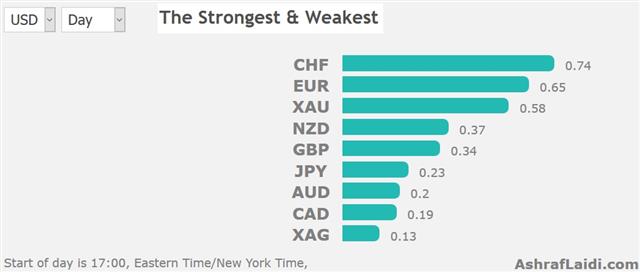
Powell's Friday comments reignited risk assets but this episode has likely capped interest rates for the cycle. What's troubling is that even with rates at these historically low levels, there are a handful of places with surprising weakness in housing. This highlights the fact that we should focus on the incremental increase in interest rates since Dec 2015 instead of the aboslute levels.
On the weekend, Nationwide reported that UK house prices fell 2.1% in the past year. They had been forecast to rise 0.5%. More worrisome is that prices are down 1.6% and 0.7% in the past two months alone.
It's far from isolated with home prices suffering in the US, parts of Canada and nearly 10% in Australia. Luxury markets have been under particular pressure with Manhattan, Vancouver, London and Sydney hard hit.
The common theme might be China where apartment prices in parts of the country are down nearly 50%. It begs the question of how much Chinese wealth was support markets elsewhere. It also adds to the worries that China's consumer is tapped out. In the bigger picture, the malaise in the housing market is another reason for central banks to keep rates where they are or lower even if the US and China settle their trade dispute.
On that front, mid-level officials are set to meet this week in Beijing and Trump signaled more progress on the weekend.
Looking to Monday's US session, the highlight is the ISM non-manufacturing index at 1500 GMT. The market is extremely sensitive to economic data at the moment and a miss would raise new questions about the US economy. The consensus is for a small dip to 59.0 from 60.7.
Euro-Zone’s Sentix Investor Confidence Index Eased To A Four-Year Low Level In January
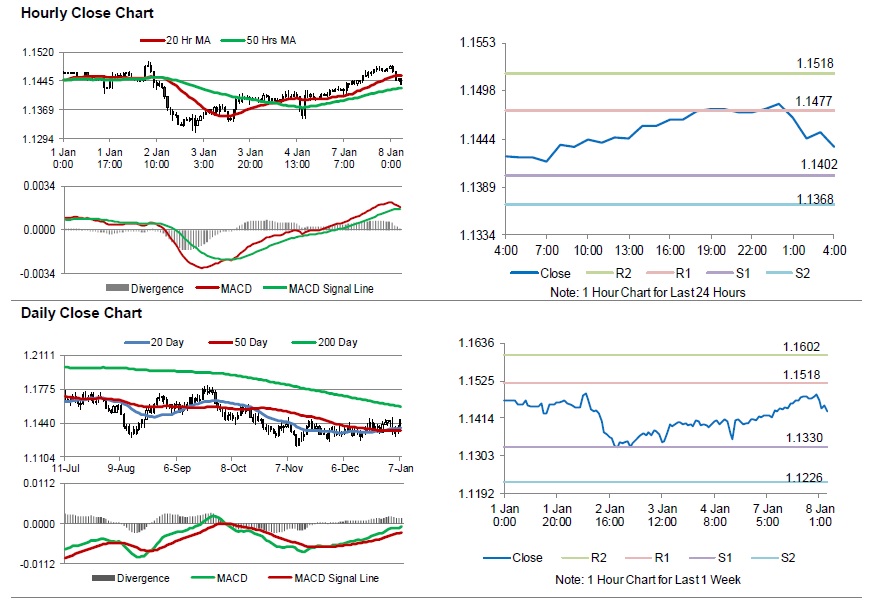
For the 24 hours to 23:00 GMT, the EUR rose 0.60% against the USD and closed at 1.1478.
On macro front, the Euro-zone's Sentix investor confidence index fell for the fifth consecutive month to a four-year low level of -1.5 in January, compared to a level of -0.3 in the prior month. Market participants had expected the index to drop to a level of -2.0. On the other hand, the region's seasonally adjusted retail sales climbed 1.1% on a yearly basis in November, rising for the second straight month and overshooting market consensus for a gain of 0.4%. Retail sales had recorded a revised rise of 2.3% in the previous month.
Separately, in Germany, retail sales unexpectedly rose 1.1% on an annual basis in November, advancing at its strongest pace in seven months and cofounding market anticipations for a decline of 0.4%. Retail sales climbed 5.0% in the prior month. Meanwhile, the nation's seasonally adjusted factory orders retreated 1.0% on a monthly basis in November, declining for the first time in four-months and more than market expectations for a drop of 0.1%. In the previous month, factory orders had registered a revised rise of 0.2%.
In the US, data revealed that the US non-manufacturing PMI declined to a 5-month low level of 57.6 in December, compared to a level of 60.7 in the previous month. Market participants had anticipated the PMI to decrease to a level of 58.5.
In the Asian session, at GMT0400, the pair is trading at 1.1435, with the EUR trading 0.37% lower against the USD from yesterday's close.
The pair is expected to find support at 1.1402, and a fall through could take it to the next support level of 1.1368. The pair is expected to find its first resistance at 1.1477, and a rise through could take it to the next resistance level of 1.1518.
Looking ahead, traders would await the Euro-zone's consumer confidence, economic confidence, industrial confidence and business climate indicator, all for December, along with Germany's industrial production November, all set to release in a few hours. Later in the day, the US trade balance and consumer credit data, both for November, along with the NFIB small business optimism index for December, will garner significant amount of investor attention.
The currency pair is trading between its 20 Hr and 50 Hr moving averages.
Sterling Trading Lower In The Asian Session
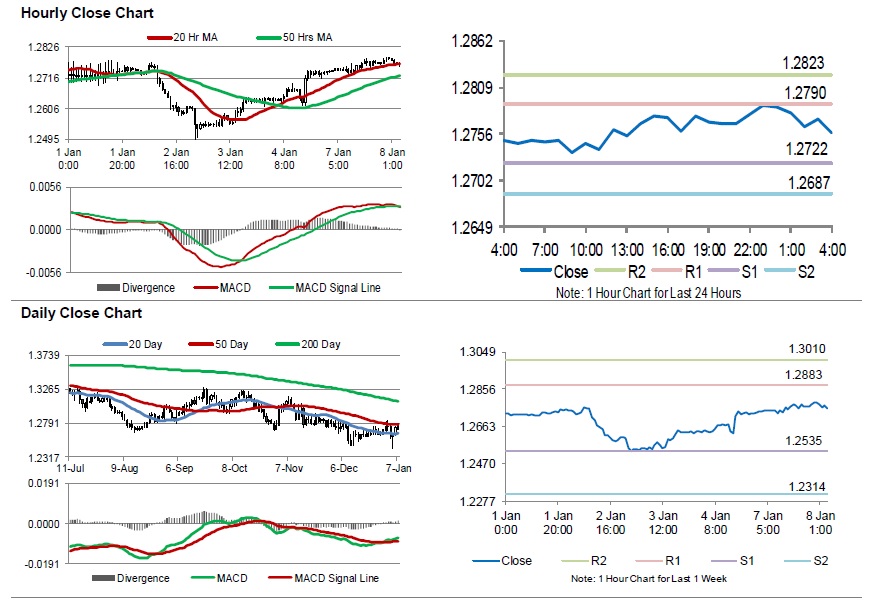
For the 24 hours to 23:00 GMT, the GBP rose 0.45% against the USD and closed at 1.2788.
In the Asian session, at GMT0400, the pair is trading at 1.2756, with the GBP trading 0.25% lower against the USD from yesterday’s close.
The pair is expected to find support at 1.2722, and a fall through could take it to the next support level of 1.2687. The pair is expected to find its first resistance at 1.2790, and a rise through could take it to the next resistance level of 1.2823.
Moving ahead, traders would closely monitor UK’s Halifax house prices for December, slated to release in a few hours.
The currency pair is showing convergence with its 20 Hr moving average and trading above its 50 Hr moving average.
Japanese Yen Extends Its Losses In The Morning Session
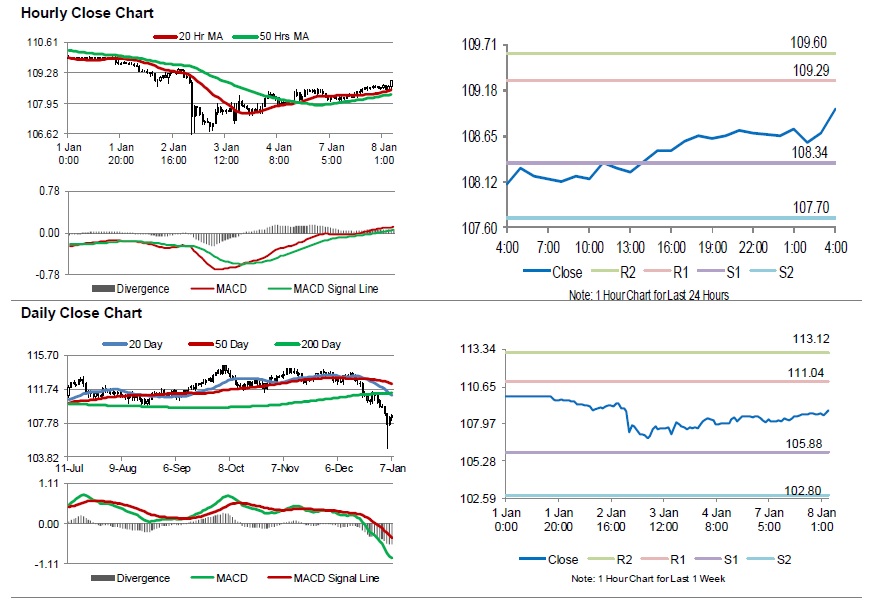
For the 24 hours to 23:00 GMT, the USD rose 0.25% against the JPY and closed at 108.67.
In the Asian session, at GMT0400, the pair is trading at 108.97, with the USD trading 0.28% higher against the JPY from yesterday’s close.
Early morning data showed that, Japan’s consumer confidence fell to a level of 42.7 in December, compared to reading of 42.9 in the preceding month
The pair is expected to find support at 108.34, and a fall through could take it to the next support level of 107.70. The pair is expected to find its first resistance at 109.29, and a rise through could take it to the next resistance level of 109.60.
In absence of key economic releases in Japan today, investor sentiment would be determined by global macroeconomic events.
The currency pair is trading above its 20 Hr and 50 Hr moving averages.
Swiss Franc Reverses Its Gains In The Morning Session
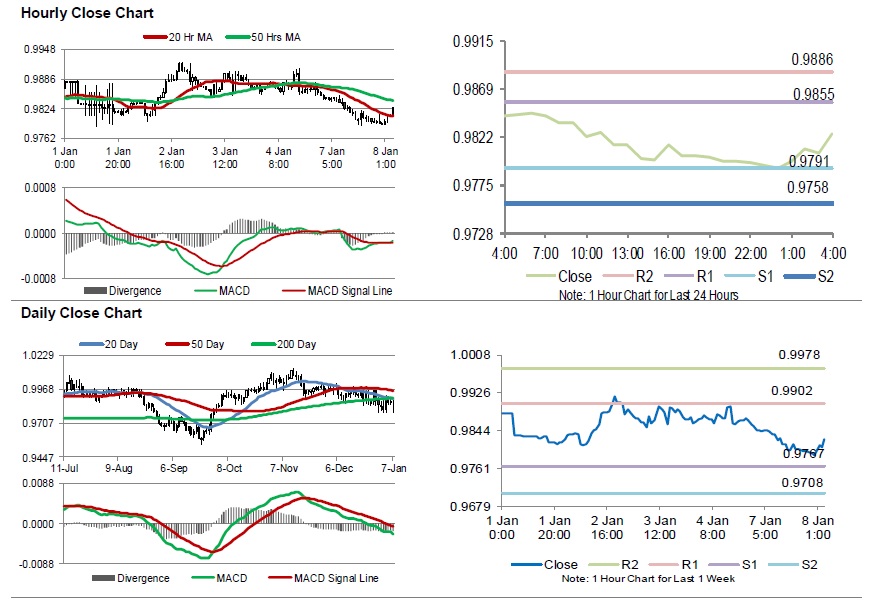
For the 24 hours to 23:00 GMT, the USD declined 0.72% against the CHF and closed at 0.9794.
In economic news, Switzerland’s total sight deposits eased to a level of CHF574.0 billion in the week ended 04 January, from CHF574.2 billion in the previous week.
In the Asian session, at GMT0400, the pair is trading at 0.9825, with the USD trading 0.32% higher against the CHF from yesterday’s close.
The pair is expected to find support at 0.9791, and a fall through could take it to the next support level of 0.9758. The pair is expected to find its first resistance at 0.9855, and a rise through could take it to the next resistance level of 0.9886.
Trading trend in the Swiss Franc today is expected to be determined by the release of Switzerland’s retail sales for November, scheduled to release in a while.
The currency pair is showing convergence with its 20 Hr moving average and trading below its 50 Hr moving average.
Loonie Trading A Tad Higher In The Asian Session
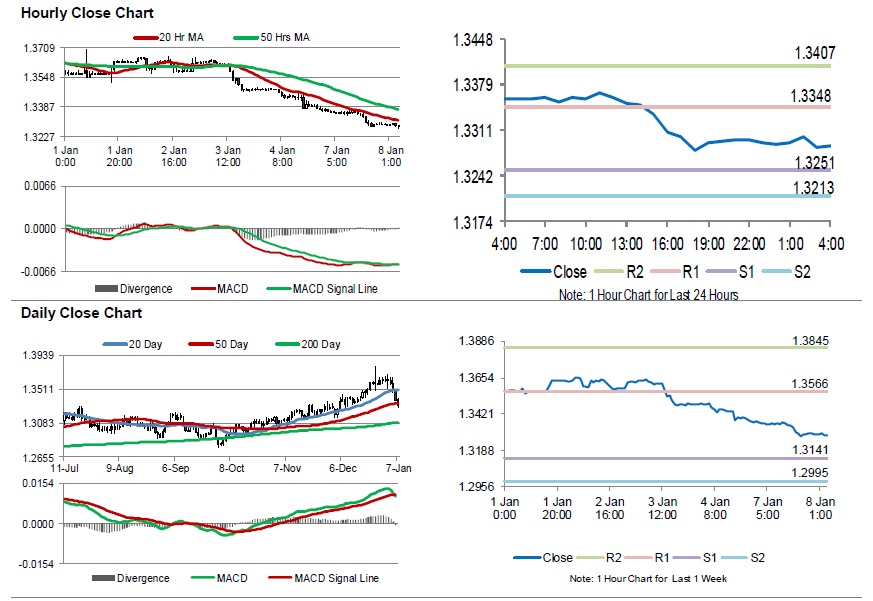
For the 24 hours to 23:00 GMT, the USD declined 0.61% against the CAD and closed at 1.3292.
Data showed that Canada’s seasonally adjusted Ivey PMI climbed to a level of 59.7 in December, compared to a level of 57.2 in the prior month.
In the Asian session, at GMT0400, the pair is trading at 1.3288, with the USD trading slightly lower against the CAD from yesterday’s close.
The pair is expected to find support at 1.3251, and a fall through could take it to the next support level of 1.3213. The pair is expected to find its first resistance at 1.3348, and a rise through could take it to the next resistance level of 1.3407.
Trading trend in the Loonie today is expected to be determined by the release of Canada’s trade balance data for November, slated to release, later in the day.
The currency pair is trading below its 20 Hr and 50 Hr moving averages.
Australia’s Trade Surplus Narrowed More Than Expectations In November
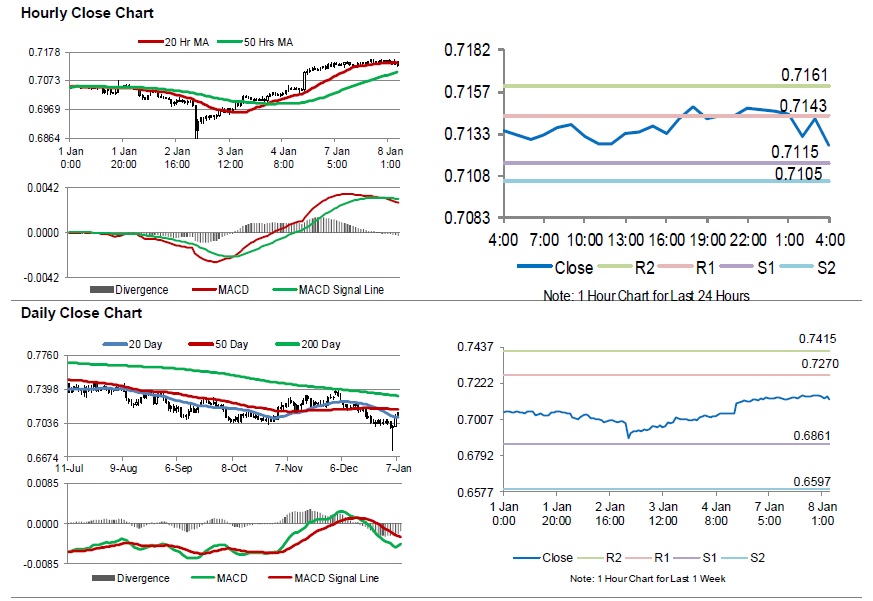
For the 24 hours to 23:00 GMT, the AUD rose 0.35% against the USD and closed at 0.7147.
LME Copper prices rose 0.9% or $49.5/MT to $5889.5/MT. Aluminium prices declined 1.1% or $21.0/MT to $1858.0/MT.
In the Asian session, at GMT0400, the pair is trading at 0.7126, with the AUD trading 0.29% lower against the USD from yesterday's close.
Overnight data showed that Australia's seasonally adjusted trade surplus narrowed to A$1925.0 million in November, compared to a surplus of A$2316.0 million in the previous month. Market participants had envisaged the nation to record a surplus of A$2175.0 million.
The pair is expected to find support at 0.7115, and a fall through could take it to the next support level of 0.7105. The pair is expected to find its first resistance at 0.7143, and a rise through could take it to the next resistance level of 0.7161.
Moving forward, investors would keep an eye on Australia's AiG performance of service index for December and building approvals for November, slated to release overnight.
The currency pair is showing convergence with its 20 Hr moving average and trading above its 50 Hr moving average.
Gold: Yellow Metal Reverses Its Gains In The Morning Session
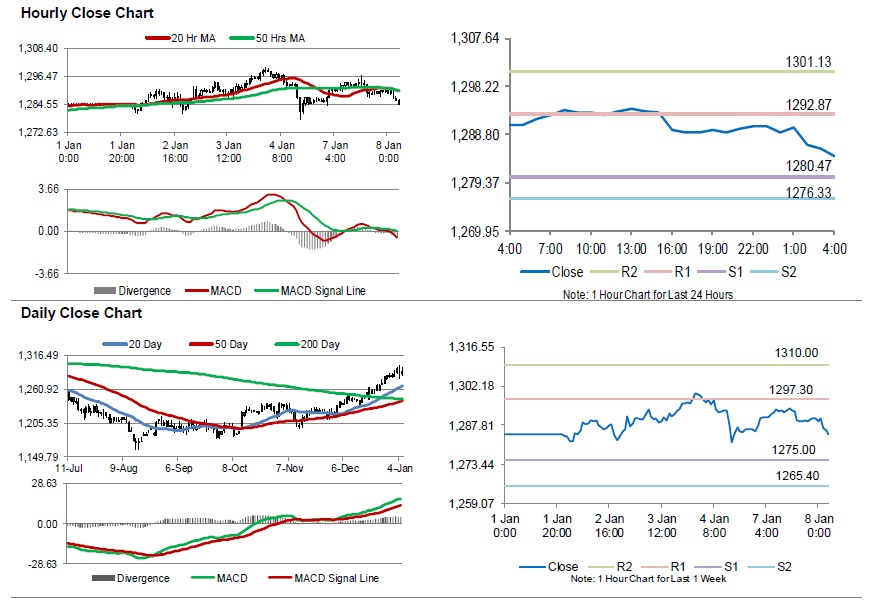
For the 24 hours to 23:00 GMT, Gold rose 0.32% against the USD and closed at USD1290.30 per ounce, amid weakness in the US dollar.
In the Asian session, at GMT0400, the pair is trading at 1284.60, with gold trading 0.44% lower against the USD from yesterday’s close.
The pair is expected to find support at 1280.47, and a fall through could take it to the next support level of 1276.33. The pair is expected to find its first resistance at 1292.87, and a rise through could take it to the next resistance level of 1301.13.
The yellow metal is trading below its 20 Hr and 50 Hr moving averages.
Silver: White Metal Extends Its Losses This Morning
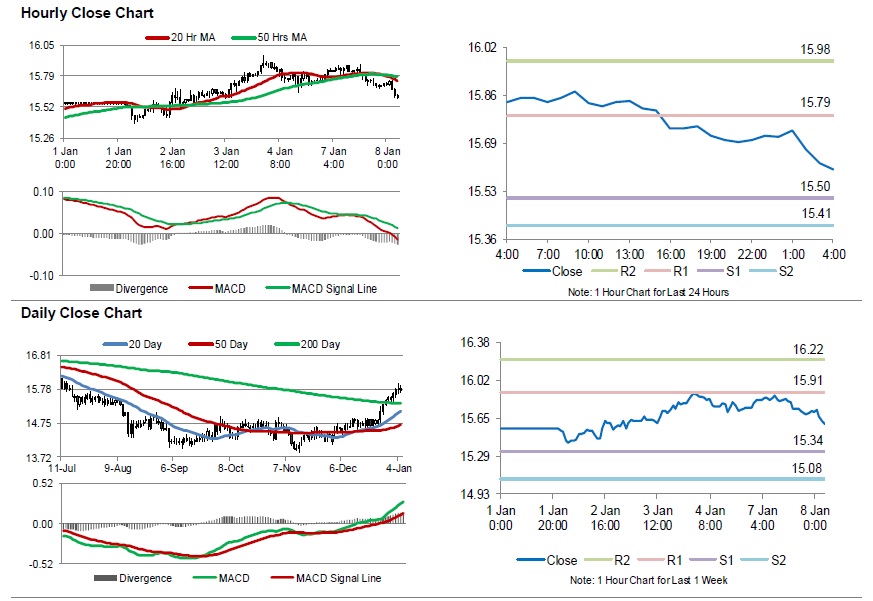
For the 24 hours to 23:00 GMT, Silver declined 0.22% against the USD and closed at USD15.72 per ounce.
In the Asian session, at GMT0400, the pair is trading at 15.60, with silver trading 0.76% lower against the USD from yesterday’s close.
The pair is expected to find support at 15.50, and a fall through could take it to the next support level of 15.41. The pair is expected to find its first resistance at 15.79, and a rise through could take it to the next resistance level of 15.98.
The white metal is trading below its 20 Hr and 50 Hr moving averages.