Sample Category Title
EU mulling reassurances to help UK PM May get Brexit deal approved
Reuters reported, with unnamed sources, that the EU is considering ways to help UK Prime Minister Theresa May to secure support from the parliament for the Brexit agreement. The Irish backstop is the key issue in focus. It's politically a solution to avoid a hard Irish border that is not intended to be triggered. Even if it's triggered, the backstop would be temporary. However, legally, UK is not allowed to quit the backstop unilaterally. EU officials are said to be considering the reassurances needed. One resolution is a commitment by EU to have a UK-EU free trade agreement in place by the end of 2021. That would help avoid triggering the backstop.
Separately, there are rumors that UK and EU officials are discussing the possibility of extending the Article 50 withdrawal notice, if the Brexit deal cannot be approved by the parliament by March 29 Brexit date. But the Prime Minister office reiterated to Telegraph that "The PM has always said that we would be leaving the EU on 29 March 2019, and we would not extend Article 50."
Debate on the Brexit agreement will resume in Commons this Wednesday. A meaningful vote is scheduled for Tuesday, January 15.
Asian update: JGB yield turned positive, Yen regains some grounds
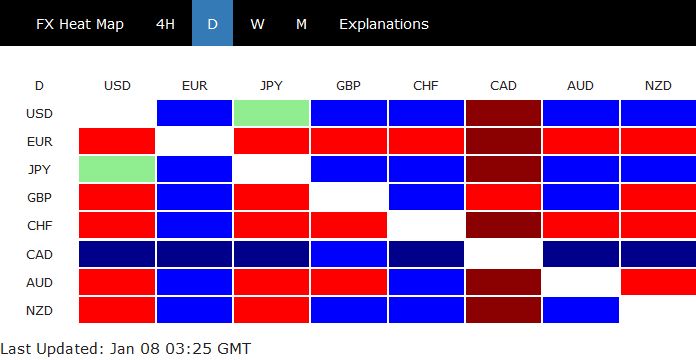
After yesterday's rally attempt, Euro is trading as the weakest one in Asian session today, together with Swiss Franc. Both are yet to find sustainable buying.
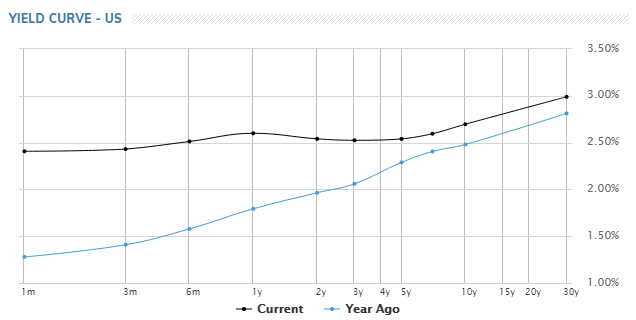
On the other hand, after a breather, Canadian Dollar is extending last week's rally and is trading as the strongest one for today at this point. Dollar is helped by rebound in treasury yields. Yield curve also flattened in the "inverted" range. Yen also regains some grounds today.
Asian markets are mildly higher, expect in China. At this point:
- Nikkei is up 0.80%
- Hong Kong HSI is up 0.25%
- China Shanghai SSE is down -0.34%
- Singapore Strait Times is up 0.30%
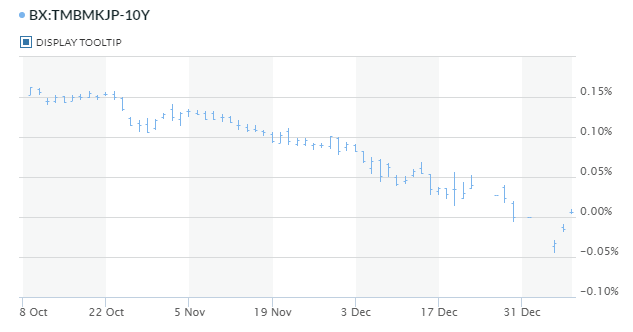
Japan 10 year JGB yield turns positive today, up 0.021 at 0.007. It reached as low as -0.045 just last week.
Overnight:
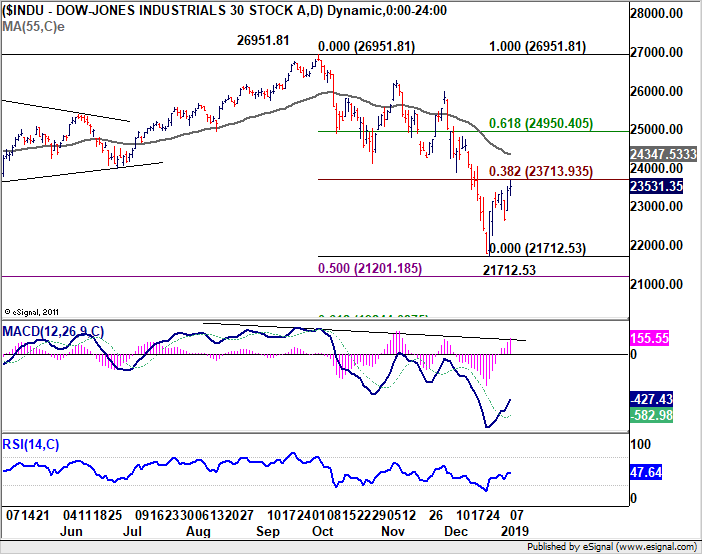
- DOW rose 0.42% to 23531.35
- S&P 500 rose 0.70% to 2549.69
- NASDAQ rose 1.26% to 6823.47
- 10 year yield rose 0.23 to 2.682
DOW is still limited by 23713.93 fibonacci level. S&P 500 is held by equivalent level at 2537.61. Also NASDAQ is kept relatively far below equivalent level at 6932.44.
Yield curve is still inverted from 1-year (2.600), 2-year (2.541), 3-year (2.525) to 5 year (2.539). But they are now back above Federal funds rate target of 2.25-2.50%.
A Bit Of The Feel-Good Factor Has Temporarily Abated
Markets
A bit of the feel-good factor has temporarily abated for local equity markets after Samsung Electronics quarterly sales missed the mark in what is yet another casualty of US-China tensions which has triggered a drop-in demand for memory chips and flat mobile device sales in China.
When Apple sounded the alarm bells this quarter, there was some thought the drops in China sales was an anti-Apple backlash due to escalating US-China tensions. But these Samsung results are quite damning suggesting there are a broader-based retail and manufacturer slowdown afoot.
Currency Market Updates
Local Asia currency traders are looking to confirm yesterday’s bearish break on USDCNH which was established with a close below 6.85. But today the dollar is trading on better footing as some predictable jitters are appearing ahead of US-China trade negotiations.
The difficulty trading the USD is trying to factor in just how much of a driver the balance sheet will be going forward. It’s not only the dots traders are contending with as the Fed is now juggling two tightening paths, one is the balance sheet the other is rates. Given we are nearing the end of the rate hike cycle the balance sheet runoff will be the crucial catalyst for dollar sentiment kick off 2019. So even if the Fed is willing to trim their rate hike forecasts, an orderly run-off on the balance sheet will ultimately keep USD dollar in short supply and most likely in demand if global central bank policy remains as is.
Oil Market Updates
Despite OPEC officials suggesting that the Kingdom may be contemplating more significant cuts in a bid to support higher oil price, the market is sputtering out of the gates in Asia. The sentiment is driven by a combination of pre-US-China trade negotiation jitters and the usual assortment of what-ifs: is China economy stagnating after HK horrible retails sales prints while doubts if the US economy is rolling over or coming out of a soft patch linger. Also, prices while losing a bit of background support from global equity markets which are trading a bit wishy-washy today.
However, with the Pboc and now the Fed providing an adequate backstop to risk sentiment, coupled with OPEC clear commitment to push prices higher, dips should remain in demand.
Gold
Gold is trading lower today on the back of the US dollar showing early signs of shaking off its recent bout of Fed-induced weakness. On the topside, the positive chatter around US-China trade tensions will temper expectations.
Daily Markets Broadcast
Wall Street extends payrolls gains
Wall Street continued Friday's gains yesterday, though closed off intra-day highs. There wasn't much news from the two-day US-China trade talks for markets to latch on to, though the US expressed some confidence that a deal could be struck the both parties could “live with”.
US30USD Daily Chart
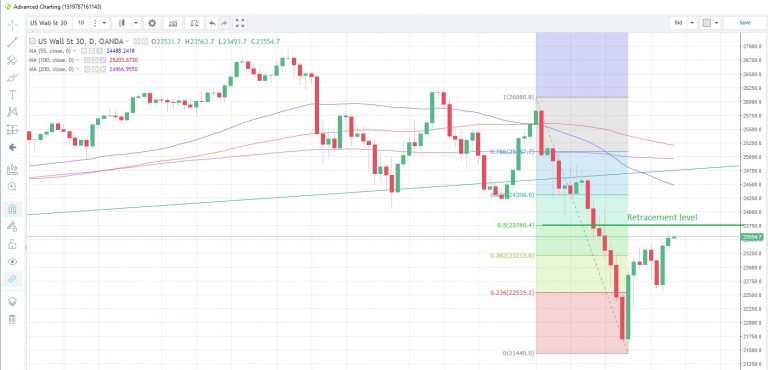
The US30 index looks set to advance for a third straight day amid hopes for progress in the Sino-US trade talks
The index is still eyeing the 50% retracement level of the December drop, which is at 23,760
The ISM non-manufacturing PMI for December came in worse than expected 57.6, echoing weakness in the manufacturing sector. There are no tier-1 data releases scheduled for today.
DE30EUR Daily Chart
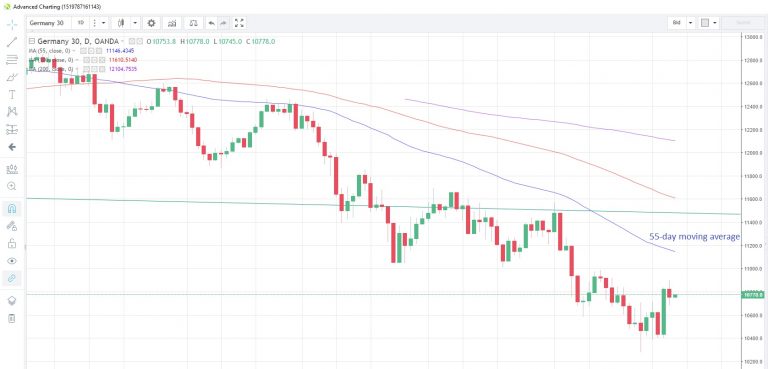
The Germany30 index's advance faltered yesterday, closing down on the day after touching a three-week high
The 55-day moving average is at 11,146. This average has capped prices on a closing basis since August 29
ECB's De Guindos reiterates the Council's view that the central bank will continue to provide substantial accommodation.
WTICOUSD Daily Chart
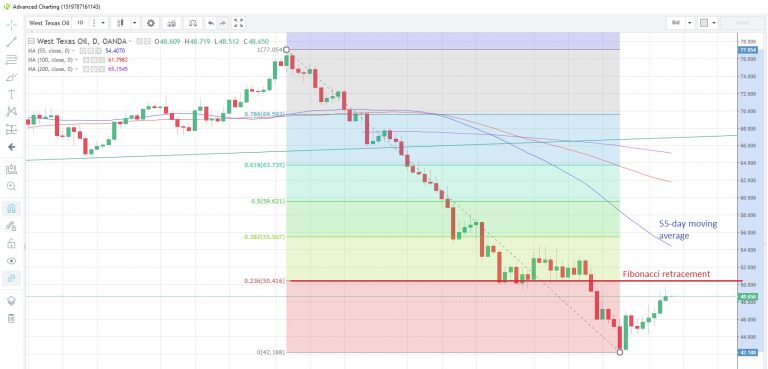
West Texas Intermediate advanced for a fifth straight day yesterday amid reports Saudi Arabia had scaled back production in December, as it had promised
The 23.6% Fibonacci retracement of the October-December drop is at $50.416. The 55-day moving average is at $54.407
American Petroleum Institute weekly crude stocks data as of Jan 4 are due today. Last week saw a draw-down on inventories of 4.5 million barrels, the first in three weeks.
The Powell ‘Put’ Continues To Resonate
Global equities were in modest demand throughout Monday and continued to bolster ASIA FX EM and G10 commodity currencies. Small-cap and technology companies led gains as optimism over a hopeful compromise on trade resonated. But given the uncertainty over trade, the current momentum suggests the market is still feeding off the Fed who is prepared to give the market precisely what they want, at least for the next few months. After Chair Powell suggested, the Federal Reserve is listening to the concerns of markets and open to changing its policy views next year. Powell’s magic words should continue to support risk sentiment near-term.
The Russell 2000 index is having its best start to a year since 1988. Bottom-line, Fed Chair Powell’s Friday messaging remains front and centre on everyone’s minds quelling fears by conceding the recent moves in equities and a readiness to turn off the ‘autopilot’ on balance sheet normalisation
Despite the positive vibe, the day did not pass without the regular bout of hesitations and supposing regarding the plethora of global risk with more focus on the US shutdown after Atlanta Fed Pres Bostic says if it lingers, it could become more material referring to the number o Federal employees without a paycheck.
Of course, US-China trade was never far from the discussion but with no real updates on that front traders were then resigned to mull over the US service ISM data which came in weaker than expected but was just good enough to hold the markets bears at bay. However, the ISM data is a reliable barometer for economic health which continues to raise doubts if the economy is rolling over or coming out of a soft patch. This is where it gets rather delicate for both Global equity market and the US dollar as we could see more outsized downside move to weaker data than upside gains to stronger data given the markets bearish tendencies. But until otherwise proven wrong I’m very much in much in the soft patch camp given that the latest surveys are driven by the doom and gloom outlooks over tariffs and energy prices.
Oil Markets
Although falling from overnight highs, Crude is starting the week on the front foot as a positive vibe in risk assets continues to be helped along by a softer Fed ton a weaker USD and more stable equity markets.
A few what-ifs were entering the picture regarding global market risks as trader mulled over the US shutdown, US-China trade and the weaker services ISM data which triggered some profit taking this despite declining OPEC production providing fundamental support for the market.
Traders are quicker to take profits on long positions as the global growth narrative and US supply overhang continues to weigh on near-term sentiment. This is even in the face Saudi oil headlines via OPEC officials, suggesting that the Kingdom may be contemplating more significant cuts in a bid to support higher oil prices not just stabilize the market
The headlines indicate a high level of specifics which should keep Oil supported on dips near-term.
DJ SAUDIS PLAN AGGRESSIVE EXPORT CUTS IN EFFORT TO LIFT OIL PRICES -OPEC OFFICIALS
DJ SAUDIS PLAN TO CUT CRUDE EXPORTS TO 7.1 MILLION DAILY BARRELS -OPEC OFFICIALS
DJ SAUDIS PLAN EXPORT CUT OF 800,000 BARRELS A DAY FROM NOV LEVELS -OPEC OFFICIALS
DJ SAUDIS TO MAKE NEW EXPORT CUTS, HOPING FOR $80 OIL -OPEC OFFICIALS.
Gold Markets
Gold is caught again between duelling narratives getting support from a weaker USD while getting squeezed by more stable risk footings. Demand remains robust as the Gold appears to be continually bid well beyond the usual narratives put forth, weaker USD forward, China and global stability etc. Indeed, the rapid price increase has left many in a bit of a puzzle as Gold bulls have had little to cheer about most of 2018 as a strong US dollar drove market sentiment.
With the Fed sounding the dovish alarm bells this is positive for Gold as this shift should lead to a lower glide path for US interest rates as a softer dollar. But even with equity markets stabilising gold has held a bid suggesting that there’s sovereign buying in the background.
And indeed, China added gold for the first time in two years to its FX reserves which go a long way to explain the surging prices over the last 20-30 days. Its a bullish near-term signal for gold, just like when other Central Banks were hovering up gold below 1200 last year.
Currency Markets
The market is leaning lower USD so no need to fight this one. The softer Fed tone and the markets shifting more positive on US-China trade talks suggest commodity currencies could be in for a significant bounce. Even the Euro, which has its own economic and political woes to deal with is also trying to break out. But I think a lot of the USD weakness is emanating from the rate curve which is now implying rate cuts by the Fed going forward and a 25% chance of a cut as early as Dec 2019, which is more paranoia than logic in my view. But price action must be respected
The Malaysian Ringgit
And as expected with a softer Fed interest rate outlook, thawing US-China tension and higher oil prices, the USDMYR trade through a significant support level and impressive staging move versus the USD, stronger by 0.60%. With Fed Chair Powell dovish comments on Friday green lighting risk, Asia EM Fx should continue to perform well in this environment. Predictably 5-year bonds have been extremely active as a positive sentiment continues to permeate local bond markets.
First Impressions: Australian November Trade Balance, +$1.9bn
Surplus little changed. Both imports (+1.7%) and exports (+1.4%) advance.
Detail
- Imports: rose by 1.7%, +$0.6bn (vs forecast -2.1%).
- Exports: advanced by 1.4%, +$0.5bn (vs forecast -2.6%).
Additional detail
- The main surprise – on both the import and export side – was the resilience of fuel despite the sharp fall in global energy prices. The upshot, both imports and exports advanced rather than declining as we anticipated.
- Import strength: capital goods +6.5%, $433mn; consumption goods +2.3%, $202mn;
- Export strength: gold, +$681mn (off a low base); metal ores, +$317mn
- Export weakness: coal, -$543mn, as expected, on lower volumes.
Comments
For the December quarter to date, the trade figures have been a little disappointing, with the surplus running at a monthly average of $2.0bn. This is down from a $2.2bn average in the September quarter.
On our preliminary figuring, the terms of trade increaased modestly in the December quarter, supported by higher commodity prices. This will tend to underpin an improvement in the trade balance.
By implication, net exports appear to be running as a modest negative (to date) in the quarter, whereas we were expecting a broadly neutral result. We look to the final month of the quarter to turn this it around.
Eco Data 1/8/19
[php_everywhere instance="1"]
U.S. Non-Manufacturing Sector Expansion Slows in December
The Institute for Supply Management's (ISM) non-manufacturing index fell by 3.1 points to 57.6 in December. The headline print undershot consensus expectations, which called for the index to pull back to 58.5.
Details of the report were also on a soft side. Aside from new orders, which ticked up to 0.2 points to 62.7, the remaining four of the index's five subcomponents that make up the headline number declined on the month.
Business activity subcomponent fell from its cyclical high level, declining by 5.3 points to 59.9. Meanwhile, the employment subcomponent deteriorated for the third consecutive month (-2.1 to 56.3). Supplier deliveries declined five points to 51.5, indicating faster deliveries. Prices pressures have also eased meaningfully, with the prices paid subcomponent falling by whopping 6.7 points to 57.6. Computers and peripherals, gas and oil products, lumber products, and steel products were reported to be among commodities where prices fell on the month.
Trade-related components (which are not seasonally adjusted), registered slight improvement, with export orders rising (+2.0 to 59.5) and import orders growth slowing (-1.0 point to 53.5).
Comments from business owners suggest that they remained upbeat on their year-end performance, but the outlook for 2019 is marked by worries, including trade, higher interest rates, labor shortages, and higher material prices.
Key Implications
As is often the case, the ISM non-manufacturing index joined its manufacturing counterpart last month, with the pace of expansion slowing in December. After staying above 60-points for three consecutive months – the best three month streak since its inception – some payback was expected. Overall, the index remains at a high level, but the decline underscores that the high water mark in economic growth may be behind us.
Not all news was bad. Encouragingly, new orders managed to edge higher from the already elevated level. Falling oil prices, a temporary truce in a trade dispute with China, and a renegotiated NAFTA agreement with Canada and Mexico also provided some reprieve from rising input prices that have been squeezing profit margins. It remains to be seen if recent declines will be sustained. In the meantime, comments from businesses suggest that they are hoping for the best, but are preparing for further price increases in 2019.
Firms continue to report challenges in filling positions, with the employment subcomponent declining for the third month in a row. While last week's payroll report delivered an impressive headline, the slowdown in the employment subcomponent suggests that this may be the last hurrah before supply constraints begin to weigh on job creation.
Pound Edges Higher in Quiet Start to Week
GBP/USD has edged higher in the Monday session. In North American trade, the pair is trading at 1.2761, up 0.28% on the day. On the release front, it’s a quiet start to the week. There are no British events on the schedule. The sole U.S. indicator, ISM Non-Manufacturing PMI, dropped to 57.6 in December, down from 60.7 in November. The reading points to strong expansion, but missed expectations. On Tuesday, the U.S. releases JOLTS Job Openings.
With Britain due to leave the European Union in less than 90 days, it’s still unclear if the sides will split with a withdrawal agreement in place. On Sunday, Prime Minister May reaffirmed that she would bring the withdrawal agreement to a vote in parliament next week. However, the deal will have a tough time passing in parliament, and the government has given no indication that it has a plan B if lawmakers reject the deal. The Europeans have insisted that they will not renegotiate a new agreement, so if the deal fails, a no-deal Brexit becomes a strong possibility. Such a scenario would have a negative effect on the British economy and send the pound lower.
Federal Reserve Chair Jerome Powell made a concentrated effort to ease the volatility in the markets on Thursday. The markets had dropped sharply after the Fed’s December rate statement, which was less dovish than expected, as the Fed said it would continue raising interest rates in 2019. Powell tempered this stance with a more cautious outlook over rate policy. He said that he was aware of the risks of a slowdown in the U.S. economy and that the Fed would be patient in its policy decisions. The Fed is currently forecasting two rate hikes next year, but some analysts have forecast a rate cut next year, with the U.S. economy expected to slow down, compared to its torrid pace in 2018.
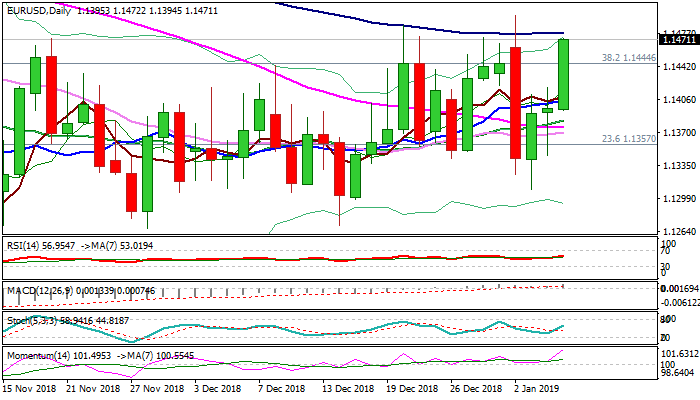
EURUSD – Bulls Eye Daily Cloud Top after 1.1444 Fibo Barrier Taken Out
The Euro remains bid in early American session on Monday and establishes above broken 1.1444 pivotal Fibo barrier.
The pair advanced 0.6% since Monday’s opening and pressures initial target at 1.1478 (100SMA) with pivots at 1.1496/1.1515 (2019 high, posted on 02 / daily cloud top / 50% retracement of 1.1815/1.1215) coming in focus.
Bullish setup of daily tech supports the action, but bulls need break out two-week 1.1309/1.1496 congestion and lift above the top of thick daily cloud, to confirm reversal from 1 ½ year low at 1.1215 (12 Nov).
Weaker US dollar across the board after dovish comments from Fed chief Powell last Friday soured the sentiment, also helps Euro bulls, which for now look more than just short-covering.
Res: 1.1478; 1.1496; 1.1515; 1.1550
Sup: 1.1444; 1.1394; 1.1383; 1.1370