Sample Category Title
Euro Shrugs Off Deteriorating Investor Confidence, Rises Together With Swiss Franc
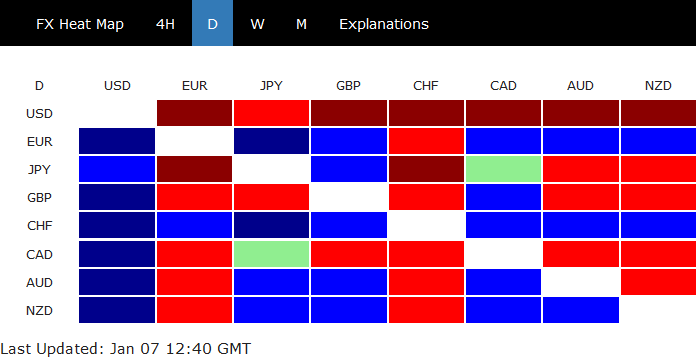
Swiss Franc and Euro are the strongest major currencies in a rather quiet day today. Mild recovery in German bund yield is giving the common currency a little lift. But the main drive in the forex market is Dollar's weakness. The greenback is trading as the worst performing one. Yen follows closely as it continues to pare back last week's gain. Canadian Dollar is the third weakest even though oil price is extending recent corrective rebound. Nevertheless, movements in the Loonie are relatively limited ahead of BoC rate decision later in the week.
Technically, for now, EUR/USD is staying in range below 1.1499 near term resistance. Recent price actions from 1.1215 are still viewed as a consolidation pattern. Outlook in EUR/USD will stay bearish unless there is sustained break of 1.1499. Similarly, GBP/USD is also held below 1.2814 resistance, which keeps its outlook bearish. A focus ahead is whether USD/CHF would reversal from 0.9765/8 fibonacci cluster support, and whether USD/CAD would rebound from 1.3327 Fibonacci level.
In other markets, at the time of writing, FTSE is down -0.62%, DAX is down -0.70%, CAC is down -0.83%. German 10 year bund yield is up 0.0054 at 0.216. Earlier in Asia, Nikkei rose 2.44% and reclaimed 20000 handle. Singapore Strati Times rose 1.42%. But Hong Kong HSI and Shanghai SSE rose 0.82% and 0.72% respectively only. Investors are cautious as US-China trade talk resumes. Japan 10 year JGB yield rose 0.0173 to 0.016, staying negative.
Eurozone Sentix Investor Confidence dropped for the fifth month, neither politicians nor central banks are reacting
Eurozone Sentix Investor Confidence dropped to -1.5 in January, down from -0.3 but beat expectation of -2.0. Still, that's the fifth decline in a row and situation and expectation fell slightly once again. Sentix noted that "What is worrying about the current loss of momentum is the policy's unwillingness to react, which is obviously unaware of the possible implications. Investors do not expect a quick reaction from the central banks either."
Also, Sentix added that "The US President, too, is becoming increasingly entangled in a secondary war theatre, and the US shutdown is strengthening the downward momentum in the USA as well. The US overall index falls for the third time to only 6.6 points. Eastern Europe and, above all, Latin America are viewed somewhat more positively."
On Eurozone, Sentix warned that "the eurozone is dangerously close to stagnation". And, "Neither politicians nor central banks seem to have really grasped the extent of this loss of momentum. The EU Commission's agreement with Italy in the trade dispute is on the credit side. But the continuing protest of the yellow vests in France could weigh more heavily. The possible "hard Brexit" and the lack of support from the global economy remain negative factors."
Also released from Eurozone, retail sales rose 0.6% mom in November, above expectation of 0.2% mom. German factory orders dropped -1.0% om in November, below expectation of -0.2% mom.
Brexit parliamentary vote to be held on Jan 15
BBC reported that the Commons will vote on Prime Minister Theresa May's Brexit deal on Tuesday January 15. And May will give her last efforts to give further assurances that the controversial Irish backstop solution is only temporary. MPs are invited to meet with May tomorrow.
Over 200 MPs had signed a letter to May urging her to rule out a no-deal Brexit. However, former foreign minister Boris Johnson wrote in Daily Telegraph arguing that no-deal Brexit, "otherwise known as coming out on World Trade terms" is "closest to what people actually voted for" in the 2016 EU referendum.
Separately, a YouGov poll published on Sunday should that if a referendum were held immediately, 46% of Britons would vote to remain in the EU, 39% would vote to leave. Removing those undecided or refused to answer, the split was 54-46 in favor of remaining.
European Commission repeats there won't be Brexit renegotiations
European Commission chief spokesman Margaritis Schinas said regarding the Brexit agreement. He said, "the deal that is on the table is the best and the only deal possible." And, "this deal will not be renegotiated." Additionally, there is no more scheduled negotiation talks as "negotiations are complete".
Schinas described the phone call between EC President Jean-Claude Juncker and UK Prime Minister Theresa May last Friday as "friendly". The two would speak again this week.
China-US trade talk resumed, Xi's top aide Liu attended
US-China trade negotiation resumed in Beijing today. It's originally arranged as a vice ministerial level meeting. But Vice Premier Liu He, Xi's top official on trade, surprisingly attended the meeting too. Liu's participation is seen by some that China is putting much effort to make a deal.
Foreign Ministry spokesman Lu Kang said that "From the beginning we have believed that China-U.S. trade friction is not a positive situation for either country or the world economy. China has the good faith, on the basis of mutual respect and equality, to resolve the bilateral trade frictions."
Lu added, "As for whether the Chinese economy is good or not, I have already explained this. China's development has ample tenacity and huge potential". And, "We have firm confidence in the strong long-term fundamentals of the Chinese economy."
Trump said on Sunday that "I think China wants to get it resolved. Their economy's not doing well… "I think that gives them a great incentive to negotiate."
EUR/USD Mid-Day Outlook
Daily Pivots: (S1) 1.1356; (P) 1.1387; (R1) 1.1430; More.....
EUR/USD rebounds to as high as 1.1468 so far today but stays well below 1.1496 resistance. Intraday bias remains neutral first. Also, price actions from 1.1215 are still viewed as a corrective pattern. Thus, downside breakout is favored. On the downside, break of 1.1307 minor support will turn bias back to the downside for 1.1215 low. Break will resume down trend from 1.2555 to 1.1186 key fibonacci level. Nevertheless, sustained break of 1.1499 resistance will suggest near term reversal and bring stronger rebound back to 1.1621 resistance first.
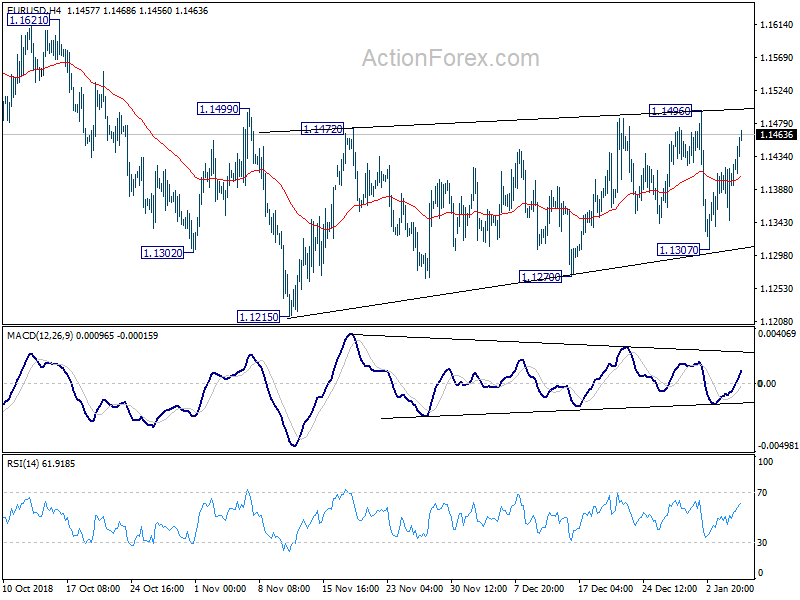
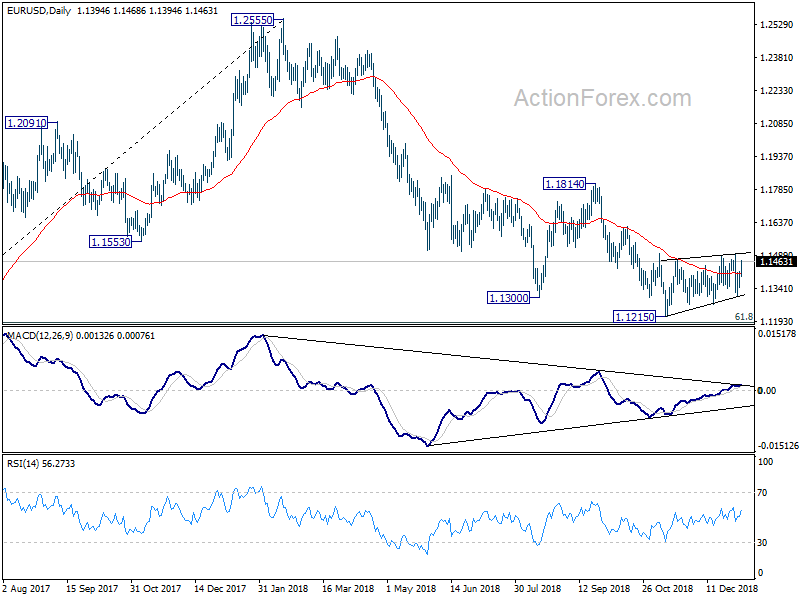
In the bigger picture, as long as 1.1814 resistance holds, down trend down trend from 1.2555 medium term top is still in progress and should target 61.8% retracement of 1.0339 (2017 low) to 1.2555 at 1.1186 next. Sustained break there will pave the way to retest 1.0339. However, break of 1.1814 will confirm completion of such down trend and turn medium term outlook bullish.
Economic Indicators Update
| GMT | Ccy | Events | Actual | Forecast | Previous | Revised |
|---|---|---|---|---|---|---|
| 21:30 | AUD | AiG Performance of Manufacturing Index Dec | 49.5 | 51.3 | ||
| 23:50 | JPY | Monetary Base Y/Y Dec | 4.80% | 5.80% | 6.10% | |
| 7:00 | EUR | German Factory Orders M/M Nov | -1.00% | -0.20% | 0.30% | 0.20% |
| 9:30 | EUR | Eurozone Sentix Investor Confidence Jan | -1.5 | -2 | -0.3 | |
| 10:00 | EUR | Eurozone Retail Sales M/M Nov | 0.60% | 0.20% | 0.30% | 0.60% |
| 15:00 | CAD | Ivey PMI Dec | 58.1 | 57.2 | ||
| 15:00 | USD | ISM Non-Manufacturing/Services Composite Dec | 59.4 | 60.7 |
US 30 Stock Index Bullish Correction in Progress; Medium Term Bias Remains Negative
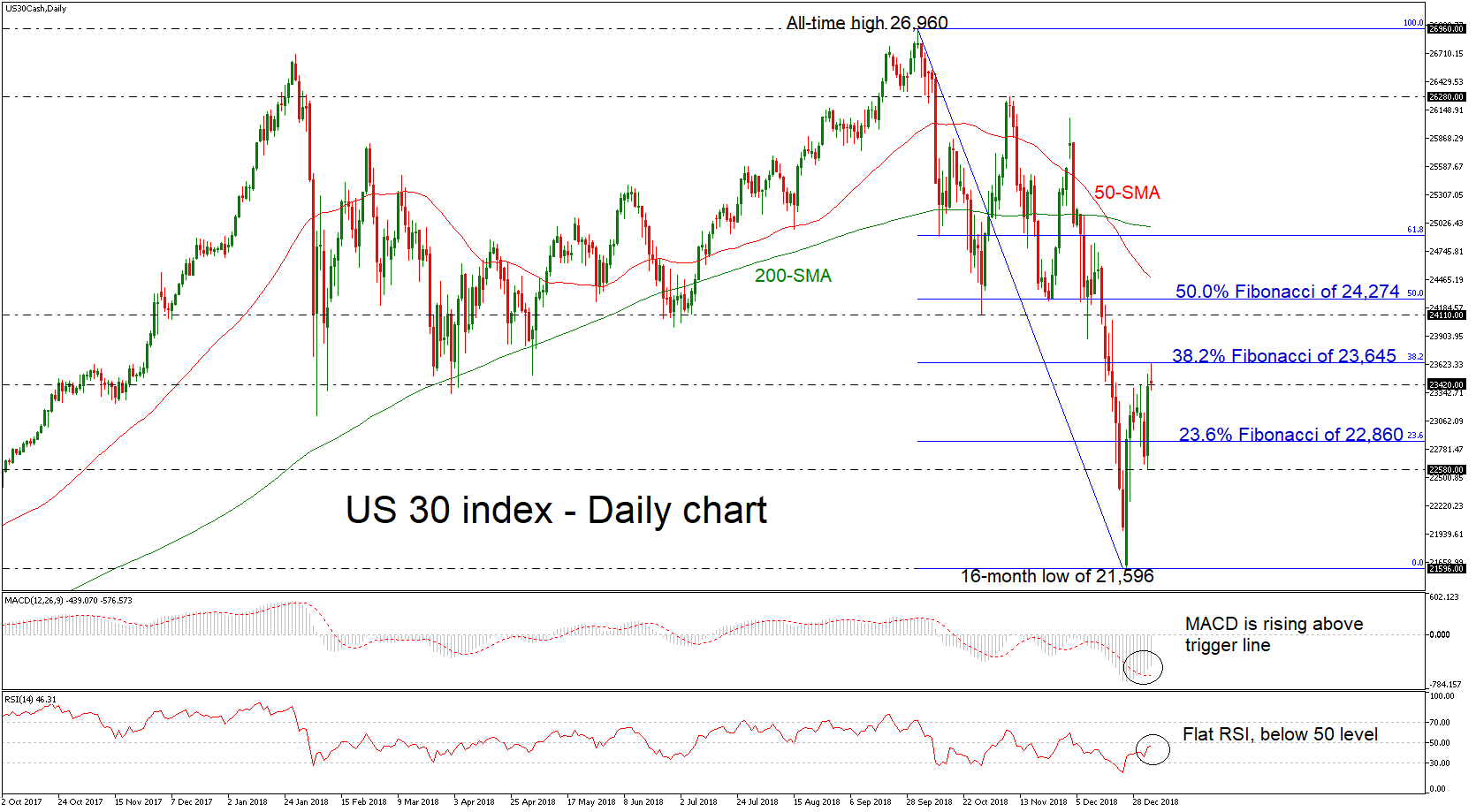
The US 30 stock index managed to test the 38.2% Fibonacci retracement level (23,645) of the downward move from 26,960 to 21,596 today after a buoyant rally last Friday. Technical indicators are suggesting more gains in the short term, with the MACD jumping above its trigger line in negative territory and the RSI approaching its 50 neutral level, though with weaker momentum.
On the upside, traders would be eagerly looking for a break above today’s top of 23,637 to increase buying orders. If that’s the case, the rally could last until 24,110, taken from the low on October 29. If bullish forces appear even stronger, the 50.0% Fibonacci of 24,274 should be another resistance to keep in mind.
Should the price retreat, the 23.6% Fibonacci of 22,860 could provide immediate support, while lower, the focus could shift to the 22,580 restrictive area. A violation of the latter may increase speculation that the bullish correction has ended, and more selling is ahead, with losses probably extending towards the 16-month low of 21,596.
In brief, the very short-term bias looks cautiously positive, but the broader picture remains negative as long as the downtrend off 26,960 holds.
Canadian Dollar Had Stellar Week, Will Rally Continue?
The Canadian dollar posted its best week since June, jumping 1.9%. On Monday, the pair is trading at 1.3351, down 0.18% on the day. It’s a quiet start to the week, with just two events. Canada releases Ivey PMI, which is expected to improve to 58.1 points. The U.S. posts ISM Non-Manufacturing PMI, which is forecast to dip to 59.6 points. On Tuesday, Canada posts trade balance and the U.S publishes JOLTS Job Openings.
After a bumpy start to the week, risk appetite improved, helping boost the Canadian dollar. Investors were pleased with dovish comments from Fed Chair Jerome Powell on Thursday. The markets had dropped sharply after the Fed’s December rate statement, which was less dovish than expected, as the Fed said it would continue raising interest rates in 2019. Powell tempered this stance on Thursday with a more cautious outlook over rate policy. He said that he was aware of the risks of a slowdown in the U.S. economy and that the Fed would be patient in its policy decisions. The Fed is currently forecasting two rate hikes next year, but some analysts have forecast a rate cut next year, with the U.S. economy expected to slow down, compared to its torrid pace in 2018.
The Canadian dollar posted strong gains on Friday, after solid employment numbers. The economy created 9.3 thousand jobs, beating the estimate of 6.8 thousand. The unemployment rate remained pegged at 5.6%, edging below the forecast of 5.7%. U.S. employment numbers were sharp. Nonfarm payrolls jumped to 312 thousand, its highest level since February, while wage growth improved to 0.4%, up from 0.2% in the previous release.
The markets are keeping a close eye on U.S.-China trade talks, which started on Monday in Beijing. With the threat of more U.S tariffs on March 1, negotiators will be under pressure to produce some results after a bruising trade war that has shaken global equity markets and has slowed down the giant Chinese economy. If the sides report any progress, risk appetite will improve and the Canadian dollar could respond with gains.
DAX Dips as Market Swings Continue, Investors Eye U.S-China Talks
Equity markets continue to be marked by volatility. After sparkling gains on Friday, the DAX has reversed directions on Monday. Currently, the index is at 10,709, down 0.54% since the Friday close. On the release front, German and eurozone retail sales beat their estimates. However, German Factory Orders disappointed, posting its first decline in four months. In the U.S., the sole event is ISM Non-Manufacturing PMI is expected to dip to 59.6 points. On Tuesday, Germany releases Industrial Production.
The New Year has greeted investors with sharp swings in the equity markets. The year started on a dismal note, as Apple shocked the markets when it lowered its sales forecast for this quarter, blaming a drop in sales of iPhones in China. This panicked investors and sent the markets sharply lower.
Risk appetite improved late in the week, after dovish comments from Fed Chair Jerome Powell. Investors were unhappy with the Fed’s December rate statement, which was less dovish than expected, as the Fed said it would continue raising interest rates in 2019. Powell tempered this stance on Thursday with a more cautious outlook over rate policy. He said that he was aware of the risks of a slowdown in the U.S. economy and that the Fed would be patient in its policy decisions. The Fed is currently forecasting two rate hikes next year, but some analysts have forecast a rate cut next year, with the U.S. economy expected to slow down, compared to its torrid pace in 2018. There was more good news for investors on Friday, as U.S. employment numbers were sharp. Nonfarm payrolls jumped to 312 thousand, its highest level since February, while wage growth improved to 0.4%, up from 0.2% in the previous release.
Will investor optimism continue this week? The markets are keeping a close eye on U.S.-China trade talks, which started on Monday in Beijing. With the threat of more U.S tariffs on March 1, negotiators will be under pressure to produce some results after a bruising trade war that has shaken global equity markets and has slowed down the giant Chinese economy. If the sides report any progress, traders can expect the DAX to move higher.
Into US session: Dollar sold off broadly, Swiss Franc and Euro strongest
Entering into US session, Dollar continues to be under broad selling pressure. Expectation that Fed is unlikely to raise interest rate again this year, with some chance of even a cut towards the year end, is weighing down on the greenback. Today's ISM services and Wednesday's FOMC minutes are unlikely to alter such speculations. Dollar will instead look into Friday's CPI release for rescue.
Canadian Dollar follows as the second weakest even though WTI crude oil is still extend near term rebound. Yen is the third weakest as corrective pull back continues. On the other hand, Swiss Franc is the strongest one for today so far. Euro is ignoring deterioration in investor confidence and follows as second strongest. New Zealand Dollar is the third best performer for now.
In European markets, at the time of writing:
- FTSE is down -0.49%
- DAX is down -0.50%
- CAC is down -0.51%
- German 10 year bund yield is down -0.010 at 0.201
Earlier in Asia:
- Nikkei rose 2.44% to 20038.97, reclaimed 20k handle
- Singapore Strait Times rose 1.42%
- But Hong Kong HSI rose 0.82% only
- China Shanghai SSE rose 0.72%
Chinese investors are cautious as US-China trade negotiation resumed in Beijing today. It's originally arranged as a vice ministerial level meeting. But Vice Premier Liu He, Xi's top official on trade, surprisingly attended the meeting too. Liu's participation is seen by some that China is putting much effort to make a deal.
European Commission repeats there won’t be Brexit renegotiations
European Commission chief spokesman Margaritis Schinas said regarding the Brexit agreement. He said, "the deal that is on the table is the best and the only deal possible." And, "this deal will not be renegotiated."
Additionally, there is no more scheduled negotiation talks as "negotiations are complete".
Schinas described the phone call between EC President Jean-Claude Juncker and UK Prime Minister Theresa May last Friday as "friendly". The two would speak again this week.
WTI OIL Outlook: Recovery Extension Eyes Pivotal Barriers at $49.89/$50.00
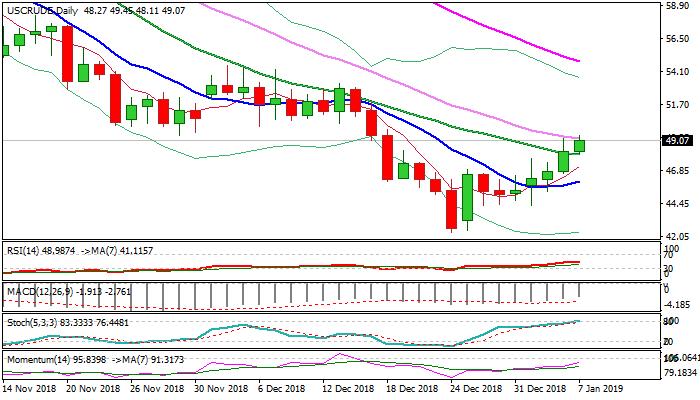
WTI oil holds in green for the fifth consecutive day on Monday, in extension of recovery from December's multi-month low at $42.36.
Fresh advance probes through $49.00 round-figure barrier and cracked falling 30SMA ($49.23) after Friday's close above 20SMA ($48.02 which now acts as initial support) generated bullish signal.
Hopes that OPEC production cut would stabilize oil market which was in free fall since early October (down 44%) support recovery (oil is up 13% from 24 Dec low).
Recovery eyes pivotal barriers at $49.89/$50.00 (Fibo 61.8% of $54.54/$42.36/psychological barrier), with sustained break to open falling 10SMA ($50.90) and 200SMA ($52.25) in extension. Improving daily techs and completion of Morning Doji Star reversal pattern on weekly chart add to positive outlook.
Res: 49.89; 50.00; 50.90; 51.67
Sup: 48.11; 48.02; 46.63; 46.11
Improved Risk Appetite Supports Dollars Demise
Monday January 7: Five things the markets are talking about
In Asia overnight, investors' appetite for risk was boosted by ‘dovish' comments from the Fed, positive U.S jobs data and China's monetary policy easing on Friday.
However, market enthusiasm has waned a tad in the handover to the European session as U.S stock futures pared some of the overnight gains as dealers await word of progress from trade negotiations that begin today between the U.S and China in Beijing.
The improved appetite for risk has pushed the U.S dollar to two-month lows against G7 pairs, while sterling has eased against the euro as U.K lawmakers seek to avoid a no-deal Brexit. Elsewhere, U.S treasuries edged up a tad after Friday fall that backed up 10's to to +2.67%.
Note: U.S 10-year yields remain more than -50 bps lower than where they peaked in mid November.
Some events that the market will be focusing on this week will include the two-day trade meeting in Beijing between the U.S and China beginning today.
On Wednesday, the market will see the release of minutes from the Fed's Dec. 18-19 policy meeting (02:00 pm EDT) and the Bank of Canada (BoC) monetary policy announcement (10:00 am EDT). Fed Chair Powell will speak to the Economic Club of Washington D.C. on Thursday.
In the U.K, Parliament resumes a debate on the Brexit withdrawal bill, with PM Theresa May seeking to avoid defeat in a vote set for sometime next week (rumoured to be Jan 15).
1. Friday's U.S stock rally supports global bourses
Shares in the Asia-Pacific region started the week with large gains, after U.S. stocks surged in the previous session on fresh signs of economic strength, coupled with Fed Powell's comments that officials are “listening carefully” to financial markets.
In Japan, the Nikkei 225 led the rally. The benchmark closed +2.4% higher, more than offsetting a -2.3% slide from Friday. Equities were helped by a calmer yen, which trades steady atop of ¥108.20 after sharply appreciating last week. The broader Topix was +2.8% higher.
Down-under, Australia's S&P/ASX 200 benchmark rallied +1.1% to a five-week high, supported by mining companies and energy stocks, as oil prices continued to rebound. In S. Korea, the Kospi climbed +1.3%, with heavyweight Samsung Electronics Co. gaining +3.5%.
In China and Hong Kong, equities ended higher overnight after the People's Bank of China (PBoC) moved to support economic growth with a broad cut in the amount of cash banks must hold as reserves. However, gains have been capped by domestic economic uncertainty. At the close, the Shanghai Composite index was up +0.72%, while the blue-chip CSI300 index was up +0.61%.
In Hong Kong, at the close of trade, the Hang Seng index was up +0.82%, while the Hang Seng China Enterprises index rose +0.94%.
In Europe, shares edged lower, tracking lower U.S futures following a strong session in Asia.
U.S stocks are set to open small in the ‘red' (-0.5%).
Indices: Stoxx600 -0.31% at 342.32, FTSE -0.43% at 6,808.25, DAX -0.26% at 10,739.49, CAC-40 -0.42% at 4,717.34, IBEX-35 -0.10% 8,725.00, FTSE MIB +0.19% at 18,867.50, SMI -0.74% at 8,548.60, S&P 500 Futures -0.05%
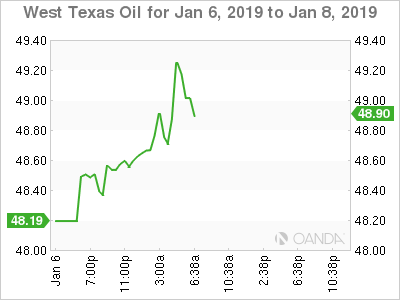
2. Oil prices rally on Sino-U.S trade hopes, supply cuts, gold higher
Oil prices have rallied overnight on hopes that talks in Beijing can resolve a trade war between the U.S and China, while supply cuts by OPEC+ is also supporting crude. However, expect gains to be capped by U.S supply numbers.
Brent crude futures are at +$58.04 per barrel, up +98c, or +1.7%, from Friday's close. U.S West Texas Intermediate (WTI) crude oil futures are at +$48.85 per barrel, up +89c, or +1.9%.
This relief rally is being supported by market expectations that Sino-U.S trade talks, beginning today in Beijing, would lead to an easing in tensions between the world's two largest economies.
Despite the markets fears of a pending economic slowdown beginning this year, crude prices are also being supported by supply cuts started late last year by OPEC+.
OPEC oil supply fell last month by -460K bpd, to +32.68M bpd, led by cuts from top exporter Saudi Arabia.
Note: The cuts are aimed at reining in swelling supply, especially in the U.S.
Because of record U.S crude oil production, EIA of +11.7M bpd, U.S fuel stockpiles are rising. Data last week by the EIA showed that oil inventories rose by +7K barrels in the week that ended on Dec. 28, to +441.42M barrels, more than +5M barrels above their five-year average.
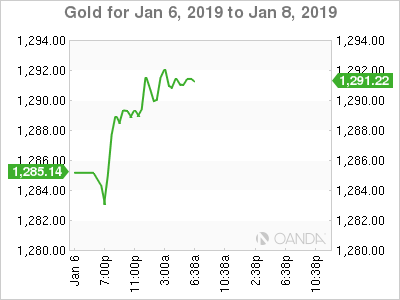
Ahead of the U.S open, gold is rallying this morning, helped by a weaker U.S dollar on expectations that the Fed may ‘apply the brakes' on further rate hikes, although an improved investor risk appetite should limit gains for the safe haven metal. Spot gold is up about +0.4% at +$1,290.42 per ounce, while U.S gold futures have gained +0.5% to +$1,291.90 per ounce.
3. Sovereign bonds steady as worst fears about growth ease
Sovereign bond yields have fallen sharply since the beginning of December 2018 on concerns about the outlook for the global economy.
However, bond yields in Europe and the U.S found support last Friday, jumping higher as U.S data showed stronger-than-expected jobs growth in December and Fed chief Powell said the U.S central bank “will be patient and sensitive to market risks.”
The yield on U.S 10-year Treasuries fell -1 bps to +2.65%. In Germany, the 10-year Bund yield decreased less than -1 bps to +0.21%, while in the U.K, the 10-year Gilt yield dipped -1 bps to +1.262%.
Note: Euro-fixed income dealers will be shifting their focus to this week's heavy government bond supply – Netherlands, Austria, Germany, France and Italy are all expected to sell bonds – Dealers will be expected to back up their curves to take down supply.
On Wednesday (10:00 am EDT), the Bank of Canada (BoC) announces its monetary-policy decision. The market widely expects the central bank to keep its benchmark interest rate at +1.75%.
4. Dollar trades on the soft side
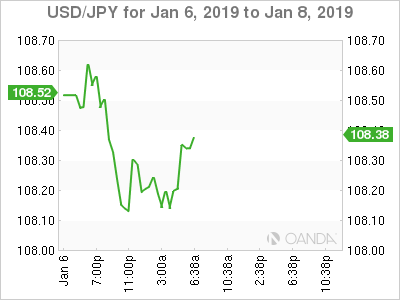
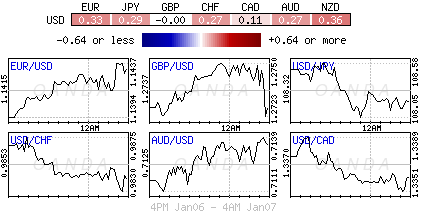
The ‘mighty' USD remains on soft footing for a third consecutive session after Fed Chair Powell signalled last week a change in the policy reaction function of the Fed to being more “nimble and flexible.” Fixed income dealers were beginning to price in no rate hikes for 2019, in contrast to the feds dot-plot plan of two rate hikes announced in late Q4. Also cramping the U.S dollars style is the resumption of U.S/China trade talks, which are helping to shed of some the dollars safe-haven appeal.
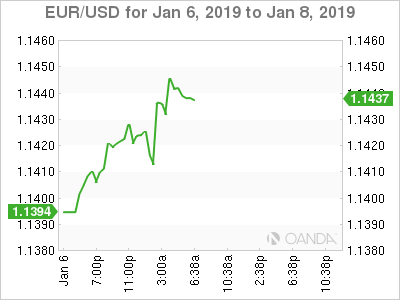
EUR/USD (€1.1441) is higher by almost +0.4% as the pair approaches the mid-€1.14 region. Analysts believe a move above €1.15 handle could trigger some strong stop-loss buying, which would definitely cause some technical damage to the greenbacks bull-run.
GBP/USD (£1.2736) is a tad lower as investors turn their attention to the UK Parliament, which has returned from the Christmas recess. The highly anticipated vote appears to be set for next Tuesday Jan 15. The market will be looking for clarity whether PM May's Brexit deal would pass to avoid a potential hard-Brexit for Britain. Sterling's direction is likely to remain unclear while implied sterling volatility stays elevated.
5. German factory orders fall
Data this morning showed that German manufacturing orders posted an unexpectedly sharp drop in November amid weak demand from other eurozone countries.
New German factory orders fell -1% in November compared with the previous month in adjusted terms, coming in below the -0.4% decline expected by the street.
Digging deeper, the decline was driven by weak foreign orders, which fell -3.2% on month in contrast to domestic orders, which increased by +2.4%.
New orders from the euro area were down -11.6%, while new orders from other countries increased +2.3% compared with October's data, 2018.
EUR/USD – Euro Gains Ground On Strong German Retail Sales
EUR/USD has started the week with gains. Currently, the pair is trading at 1.1434, up 0.35%. On the release front, German and eurozone retail sales beat their estimates. German Factory Orders disappointed, posting its first decline in four months. In the U.S., the sole event is ISM Non-Manufacturing PMI is expected to dip to 59.6 points. On Tuesday, Germany releases Industrial Production and JOLTS Job Openings.
The euro showed strong swings in the first week of 2019. The currency plunged over 1% on Wednesday stunning announcement from Apple, which cut its sales forecast for this quarter, blaming a drop in sales of iPhones in China. This was more negative fodder for investors, who are increasingly worried about the economic toll of the ongoing U.S-China trade war, which is has already caused a slowdown in China. The Apple announcement panicked investors, sending the safe-haven yen sharply higher, and the fallout pushed the euro and other currencies sharply lower.
Risk appetite rebounded late in the week, after Fed Chair Jerome Powell engaged in damage control, seeking to reassure the financial markets with regard to rate policy. The markets gave Powell a thumbs-down after the Fed’s December rate statement was on the hawkish side, and the equity markets reacted with sharp losses. Powell was much more cautious in remarks on Thursday, saying he was aware of the risks of a slowdown in the U.S. economy and that the Fed would be patient in its policy decisions. The Fed is currently forecasting two rate hikes next year, but some analysts have forecast a rate cut next year, with the U.S. economy expected to slow down, compared to its torrid pace in 2018.
Eurozone Economic Sentiment Index To Mark A Negative Year
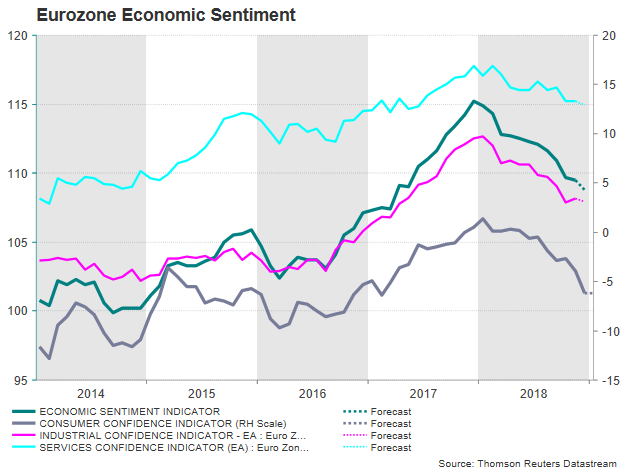
The European Commission is publishing its final Business and Consumer Survey for 2018 on Tuesday at 1000 GMT. While the numbers stood at 18-year highs at the end 2017, creating euphoria that the uptrend would continue in the near future, the confidence indicators moved to the downside during 2018 and are now forecasted to finish the year even lower.
The economic sentiment index which measures confidence in five areas (industrials, services, consumers, construction, retail sales) is projected to drop by 0.7 points to 108.8 in December, registering a 5.8-point loss for 2018. The industrial and services sub-measures which hold the largest weights in the index are forecasted to decline to 3.1 and 12.9 respectively, from 3.4 and 13.3 before, while final estimates on consumer confidence are expected to confirm that consumers’ pessimism deteriorated to two-year lows.
Another discouraging data set would muddy the already clouded growth outlook for the euro area in the fourth quarter and feed fears that the bloc’s weakening economic performance in 2018 could stretch into 2019. Indeed, if a hard Brexit occurs in March and trade talks between the US and the rest of the world remain in the dark, the eurozone will likely move down another gear, with Italy struggling the most as the government will be fighting to deliver its revised spending plans in a risky euro environment. Falling economic activity in France could also bring more damage to Macron’s administration which already faces the anger of the public because of its policy tactics.
On the monetary front, a disappointing survey on Tuesday would give more reasons to the European Central Bank to continue supporting the bloc after terminating its three-year asset purchasing program last month. Friday’s flash core CPI figure showed that the ECB failed to push up inflation this year, adding to the growing evidence that the economy is facing headwinds that don’t allow inflationary pressures to strengthen. Hence as the central bank cannot lower its already ultra-low interest rates, while bringing QE back into play would harm its credibility, reinvesting maturing bonds will likely be the main tool to boost liquidity until the first rate hike and as long as it’s needed according to ECB.
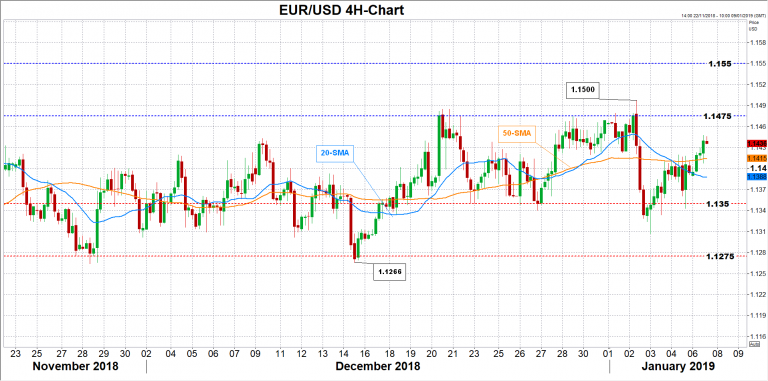
In FX markets, EURUSD may retest the area around the 50-period simple moving average, currently at 1.1415, if economic confidence shrunk faster than analysts forecast, raising a warning flag for growth outlook. Breaking below that zone, the pair could fall towards 1.1350 where some support was identified during December, while if this fails to hold, then the next stop could be between 1.1275 and 1.1266.
Alternatively, and in the absence of any important headlines, better-than-expected results could shift some funds into the euro, driving the pair up to the 1.1475 resistance. Higher, the bulls may pause around the 1.1500 peak before hitting 1.1550.