Sample Category Title
Sunset Market Commentary
Markets
Global core bonds were mixed today in a relatively calm trading session. Investors turned more defensive following Friday’s market rally caused by Fed chairman Powell’s reassuring comments and solid US data. Both US Treasuries and German Bunds moved higher. Focus of today was/is the start of face-to-face trade talks between the US and China. No news of progress was released up until now. However, the fact that Chinese VP Liu He unexpectedly joined the negotiations did stress the importance of the ongoing talks. With the US government still shut down, no US economic data is set to be released today except the Non-Manufacturing ISM. A small negative surprise didn’t really bother markets. The US yield curve edges lower at the time of writing with changes in the range of -1.4 bps (2-yr) to -3.1 bps (30-yr). German data printed mixed, keeping the German Bund around opening levels. The yield curve edged little up with changes varying between +0.6 bps (10-yr) to +1.2 bps (2-yr). The Belgian government announced the issuance of a new 10-yr benchmark bond for tomorrow, causing Belgian bonds to slightly underperform other (semi-)core EMU bonds.
The post-Powell rebound of EUR/USD took a breather at the start of the European trading. Mixed German data maybe caused some temporary caution among euro bulls. European equities failed to maintain opening gains, but the softer risk sentiment didn’t hurt the euro in a profound way. On the contrary, dollar weakness prevailed. Investors continued selling the dollar as the they saw growing chances of the Fed turning more cautious on policy normalization in a context of risks to global growth and higher market volatility. Friday’s indication from Fed’s Powell on a flexible Fed policy approach raised chances of the dollar losing more interest rate support in the future. Interest rate differentials between the US and Germany again narrowed slightly after Friday’s (temporary) widening. EUR/USD soon started a new intraday upleg and is currently trading in the 1.1465 area. USD/JPY showed no clear trend. The pair hovered in the lower half of the 108 big figure. The ISM non-manufacturing ISM to be published later today is the next point of reference for USD traders. A soft figure might reinforce the USD downside momentum.
UK politicians returned from their New year holdings today, causing some kind of a revival of Brexit headlines. However, there was no indication that the political stalemate is coming closer to any kind of solution. New headlines on all kind of Brexit contingency plans being put in place were no help for sterling. Last Friday, sterling profited temporary from an improvement in global risk sentiment, but this factor also petered out today. EUR/GBP was also slightly supported by the rise in the EUR/USD headline pair. The pair trades currently in the 0.8975/80 area. Cable rebounded to the1.2775 area but this was USD weakness rather than sterling strength.
News Headlines
The US non-manufacturing ISM declined more than expected in December: from 60.7 to 57.6 (vs 58.5 forecast). The decline was less outspoken than last week’s manufacturing gauge. Importantly: new orders remained strong (62.7).
In its first official estimate, India’s statistics ministry forecasted 2019 growth at 7.2%, matching consensus. It would make India one of the world’s fastest growing major economies in an environment marked by rising global (growth) risks. The positive growth outlook is considered a boost to PM Narendra Modi ahead of the 2019 general elections.
Euro zone retail sales rose by 0.6% M/M in Nov., beating 0.2% M/M consensus following an upwardly revised 0.6% M/M in Oct. Sales were driven by non-food products and petrol stations. Only food, drink and tobacco (-0.9% M/M) contributed negatively with textiles, clothing and footwear (+2.7% M/M) showing a significant rise. German factory orders fell for the first time in 4 months (-1% M/M) in November, but data were biased by October airplane orders.
Yen Unchanged, US Services PMI Slips
The Japanese yen has started the new trading week with a yawn. In Monday’s North American session, USD/JPY is trading at 108.46, down 0.05% on the day. The sole U.S indicator, ISM Non-Manufacturing PMI, dropped to 57.6 in December, down from 60.7 in November. The reading points to strong expansion, but missed expectations. There are no major Japanese events. On Tuesday, Japan releases consumer confidence and income numbers. The U.S. will post JOLTS Job Openings.
The yen continues to surge, posting strong gains for a third consecutive week. USD/JPY has fallen 4.3% since mid-December, as turmoil in the equity markets has spooked investors and sent the yen surging higher. After a break for New Years’, the markets were blindsided when Apple announced a revenue warning, lowering its sales forecast for the fourth quarter. Panicky investors looked for safety and snapped up the Japanese yen, which gained momentum during the week, gaining 1.60%.
Federal Reserve Chair Jerome Powell made a concentrated effort to ease the volatility in the markets on Thursday. The markets had dropped sharply after the Fed’s December rate statement, which was less dovish than expected, as the Fed said it would continue raising interest rates in 2019. Powell tempered this stance with a more cautious outlook over rate policy. He said that he was aware of the risks of a slowdown in the U.S. economy and that the Fed would be patient in its policy decisions. The Fed is currently forecasting two rate hikes next year, but some analysts have forecast a rate cut next year, with the U.S. economy expected to slow down, compared to its torrid pace in 2018.
The ongoing global trade war has taken a bite out of the Japanese export sector. China, which is Japan’s largest trading partner, has begun to experience a slowdown. There are hopes that trade talks between the U.S. and China, which began on Monday, will ease tensions between the two largest economies. If the sides makes significant progress, risk appetite could rise and dampen the yen’s impressive rally.
ISM non-manufacturing dropped to five month low, growth rate cooled
US ISM non-manufacturing composite dropped to 57.6 in December, down from 60.7 and missed expectation of 57.6. It's also the lowest level in five months. Employment component dropped -2.1 to 56.3.
ISM noted in the release that "The non-manufacturing sector's growth rate cooled off in December. Respondents indicate that there still is concern about tariffs, despite the hold on increases by the U.S. and China. Also, comments reflect that capacity constraints have lessened; however, employment-resource challenges remain. Respondents are mostly optimistic about overall business conditions."
Stocks Pause as Focus Shifts to Trade Talks
Last week’s stock market rally stemmed from the PBOC’s RRR cut, outstanding US employment numbers and Powell’s comments on patience and ability to shift stance quickly. Soothing comments from the Fed were the primary driver for equities, but that momentum is stalling at current levels as the focus shifts back to trade wars.
Mergers and acquisitions are a big theme this week as we are seeing continued consolidation in the healthcare sector. Early in NY, Lilly announced a definitive agreement to acquire Loxo Oncology for $235.00 per share in cash, or approximately $8.0 billion. The deal follows last week’s new Bristol Meyers deal to buy Celgene in a $74 billion dollar, one of the top three healthcare M&A statements ever. The Bristol-Meyers/Celgene deal was the first M&A domino of the year and we could continue speculative bets on the next major transformational deal to come into play.
This week’s brief two-day of talks were suppose to be led by low-ranking officials, but Chinese Vice Premier Liu He surprised the Beijing meeting and attended. The news of his presence could be positive and a sign that China is looking to move talks forward. The path for further progress is likely to be bumpy as China, as expectations are low for China to deliver on specific details and follow through on implementing promises.
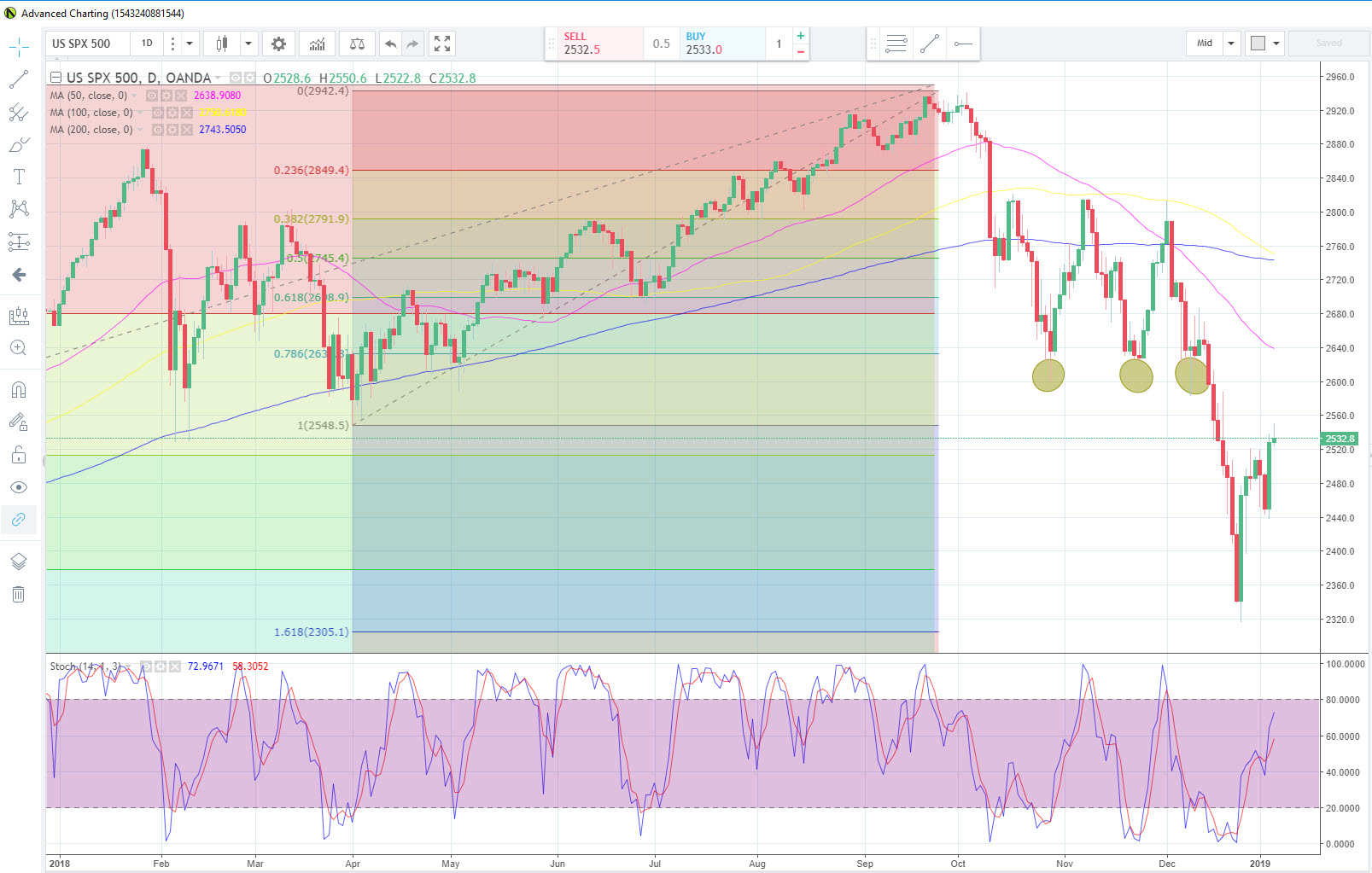
The S&P 500 is trading little changed and yields have come down from last week’s surge. The 10-year yield on US Treasuries is down 2.1bps to 2.646%. The dollar is softer against the majors, with the euro and sterling outperforming.
EURAUD Moves Below Decade High; Strongly Bullish in Long Term
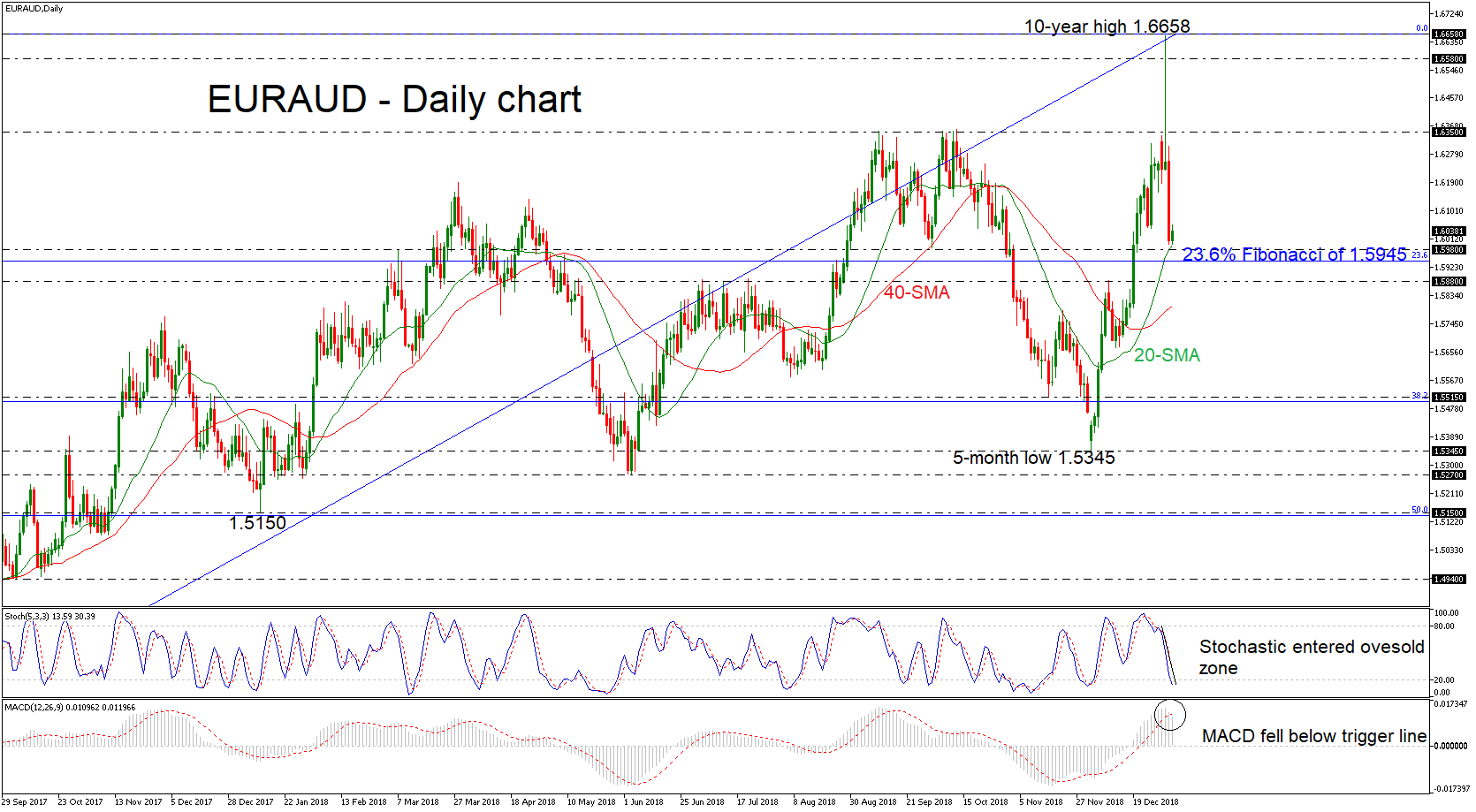
EURAUD retreated after it found strong resistance on the almost 10-year high of 1.6658, returning below the 1.6350 strong barrier. The downfall in the price action is confirmed by the technical indicators. The MACD continues to head downwards after creating a bearish cross with its trigger line, while the stochastic oscillator weakened to enter oversold zone, with the latter supporting that a rebound could be around the corner. The positive cross between the 20- and 40-simple moving averages (SMAs) hints that the market trend might remain on the upside in the short term.
If the price continues to stand above the 20-day SMA and the 1.5980 support, the focus will shift up to 1.6380, taken from the highs on October 11. Moving higher, the bulls might find resistance around the decade peak of 1.6658.
Below that line though, the price could retest 1.5945, the 23.6% Fibonacci of the upleg from 1.3620 to 1.6658, before dropping lower towards the 1.5880 obstacle. Steeper declines may challenge the 40-day SMA near 1.5800 at the time of writing.
Concluding and looking at the long-term timeframe, EURAUD has been strongly positive creating higher highs and higher lows since February 2017.
GBPUSD Sets Up To Recover Further Higher On Bull Pressure
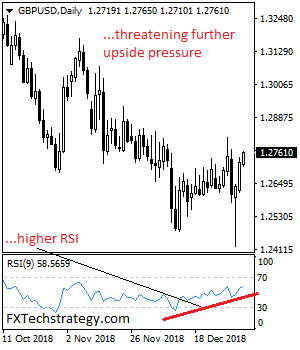
GBPUSD sets up to recover further higher on bull pressure following its Friday positive close. Support is seen at 1.2700 level. Further down, support comes in at the 1.2650 level where a break will turn focus to the 1.2600 level. Further down, support lies at the 1.2550 level. Below here will set the stage for more weakness towards the 1.2500 level. On the upside, resistance stands at the 1.2800 with a turn above here allowing for additional strength to build up towards the 1.2850 level. Further out, resistance stands at the 1.2900 level followed by the 1.2950 level. On the whole, GBPUSD faces further upside pressure on recovery.
USD/JPY Mid-Day Outlook
Daily Pivots: (S1) 107.82; (P) 108.21; (R1) 108.90; More..
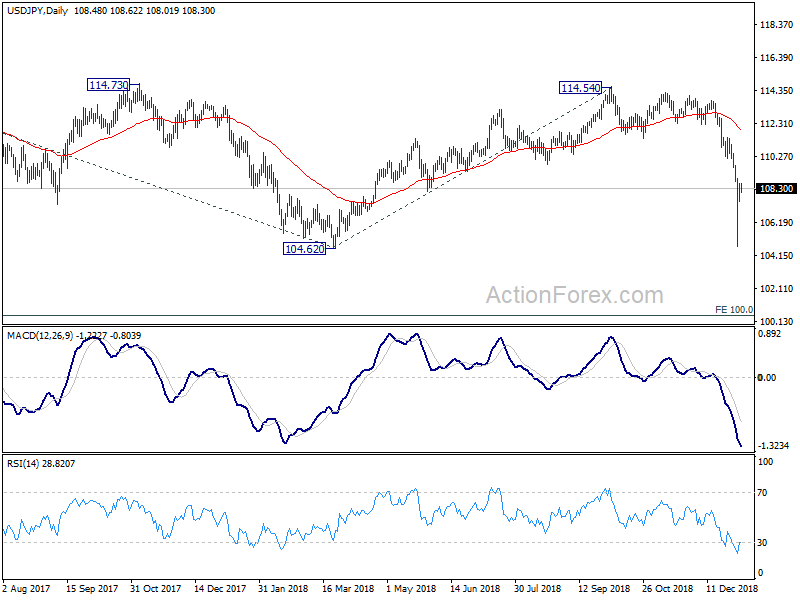
USD/JPY's rebound from 104.69 could extend higher and intraday bias remains mildly on the upside. But still, upside will likely be limited by 109.46 minor resistance. On the downside, below 106.74 minor support will turn bias to the downside for 104.62 low. Overall, larger downtrend from 118.65 (2016 high) is expected to resume finally through 104.62 after current consolidation from 104.69 completes.
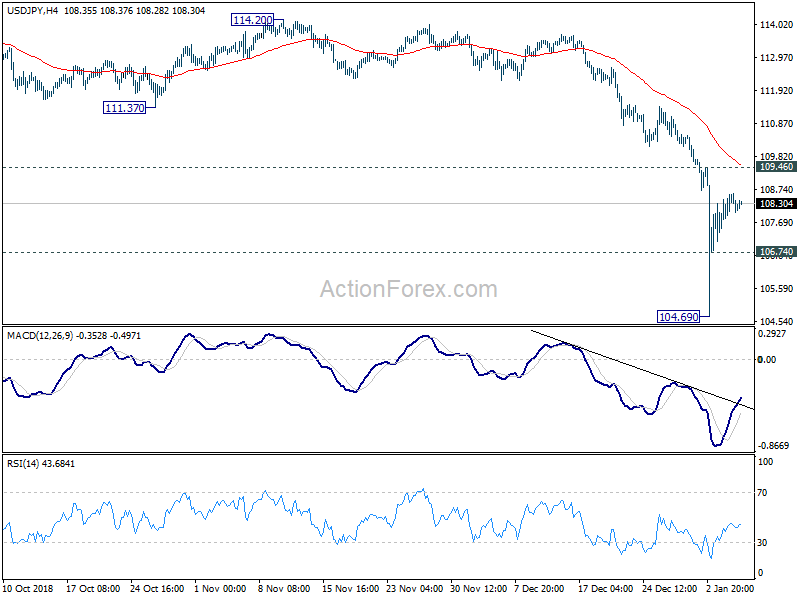
In the bigger picture, price actions from 125.85 (2015 high) are seen as a long term corrective pattern, no change in this view. Apparently, such corrective pattern is not completed yet. Fall from 114.54 is seen as part of the falling leg from 118.65 (2016 high). Break of 104.62 will target 100% projection of 118.65 to 104.62 from 114.54 at 100.51, which is close to 100 psychological level. But in that case, we'd expect strong support from 98.97 to contain downside to bring reversal. Also, this bearish case will remain the preferred one as long as 114.54 resistance holds.
USD/CHF Mid-Day Outlook
Daily Pivots: (S1) 0.9842; (P) 0.9876; (R1) 0.9899; More...
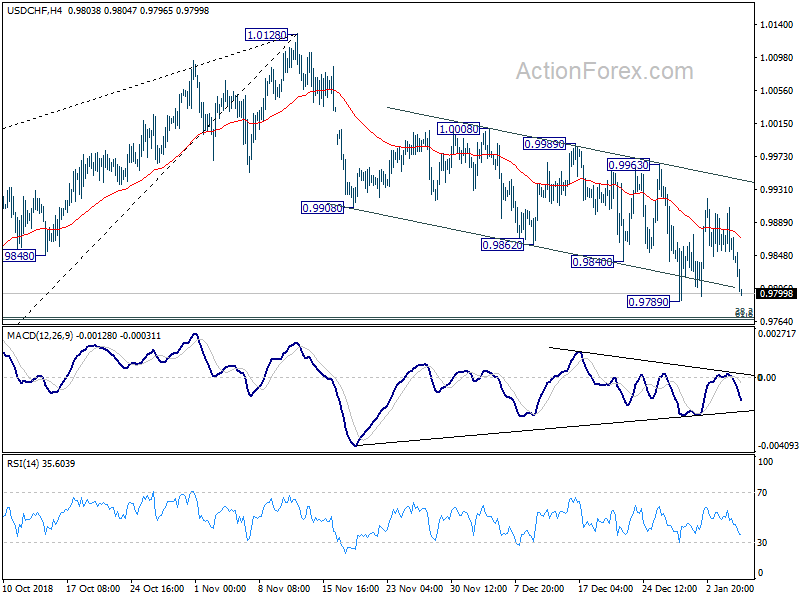
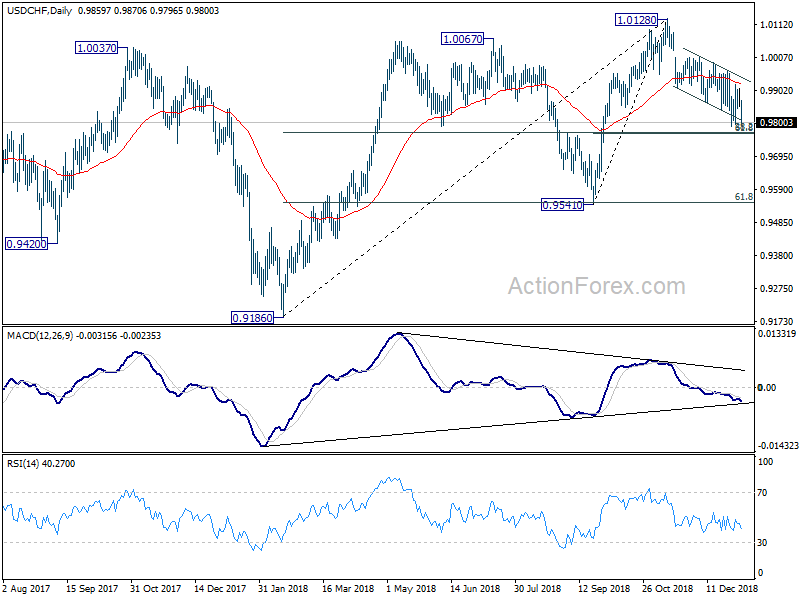
Intraday bias in USD/CHF remains neutral as it's staying above 0.9789 low. Also, fall from 1.0128 is seen as a correction. Thus, in case of another decline, downside should be contained by 0.9765/8 cluster support (61.8% retracement of 0.9541 to 1.0128 at 0.9765, 38.2% retracement of 0.9186 to 1.0128 at 0.9768) to bring rebound. On the upside, break of 0.9963 resistance will suggest that such correction has completed and turn bias to the upside for retesting 1.0128 resistance. However, sustained break of 0.9765/8 will bring deeper fall back to 0.9541 support next.
In the bigger picture, while the fall from 1.0128 was slightly deeper than expected, the structure suggests it's a corrective move. As long as 0.9765/8 cluster support (61.8% retracement of 0.9541 to 1.0128 at 0.9765, 38.2% retracement of 0.9186 to 1.0128 at 0.9768) holds, we'd expect up trend from 0.9541 and 0.9186 to resume later through 1.0128. However firm break of 0.9765/8 will argue that the trend has reversed. Further break of 0.9541 support will confirm this bearish scenario and bring deeper fall back to 0.9186 low.
GBP/USD Mid-Day Outlook
Daily Pivots: (S1) 1.2649; (P) 1.2697; (R1) 1.2779; More....
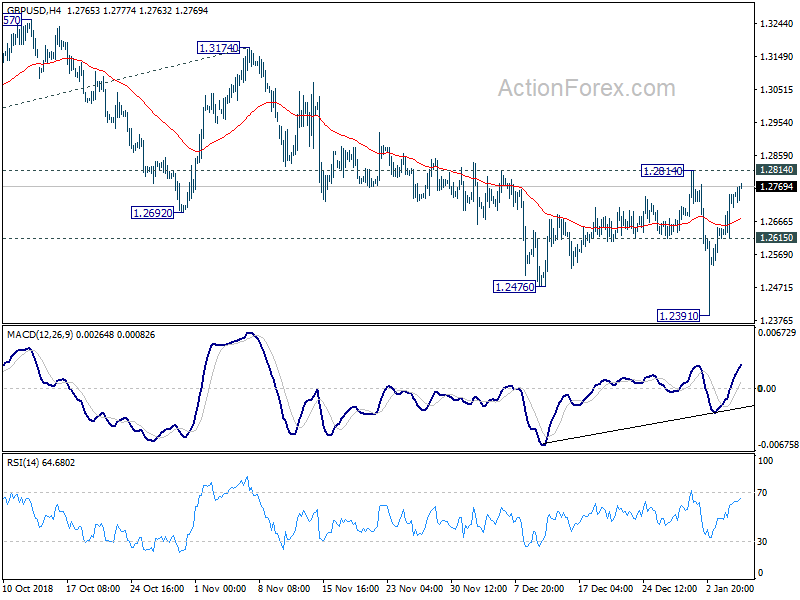
GBP/USD's rebound from 1.2391 is still in progress and intraday bias stays mildly on the upside. But still, near term outlook remains bearish as long as 1.2814 resistance holds. On the downside, below 1.2615 minor support will turn bias to the downside for retesting 1.2391 first. Break will extend the down trend from 1.4376 and target 61.8% projection of 1.4376 to 1.2661 from 1.3174 at 1.2114 next. However, firm break of 1.2814 resistance will be an early sign of trend reversal and bring stronger rebound back to 1.3174 resistance next.
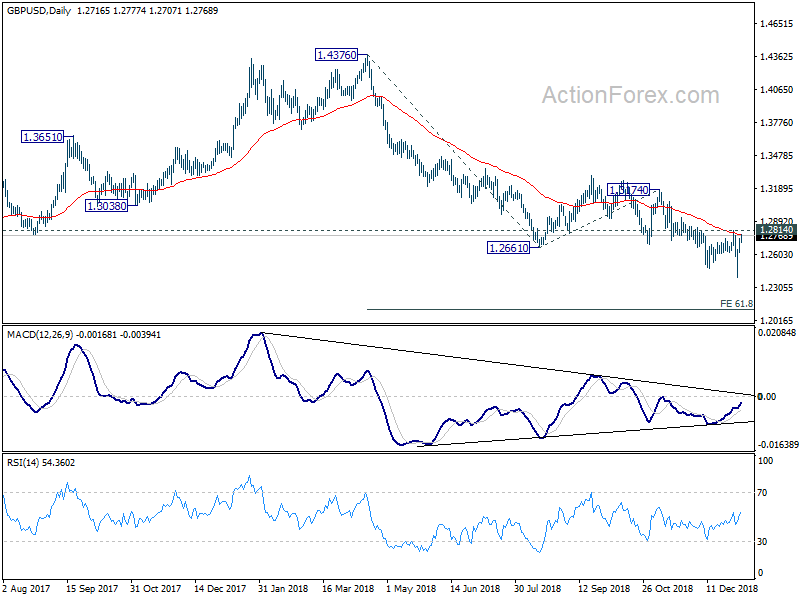
In the bigger picture, whole medium term rebound from 1.1946 (2016 low) should have completed at 1.4376 already, after rejection from 55 month EMA. The structure and momentum of the fall from 1.4376 argues that it's resuming long term down trend from 2.1161 (2007 high). And this will now remain the preferred case as long as 1.3174 structural resistance holds. GBP/USD should target a test on 1.1946 first. Decisive break there will confirm our bearish view.
EUR/USD Mid-Day Outlook
Daily Pivots: (S1) 1.1356; (P) 1.1387; (R1) 1.1430; More.....
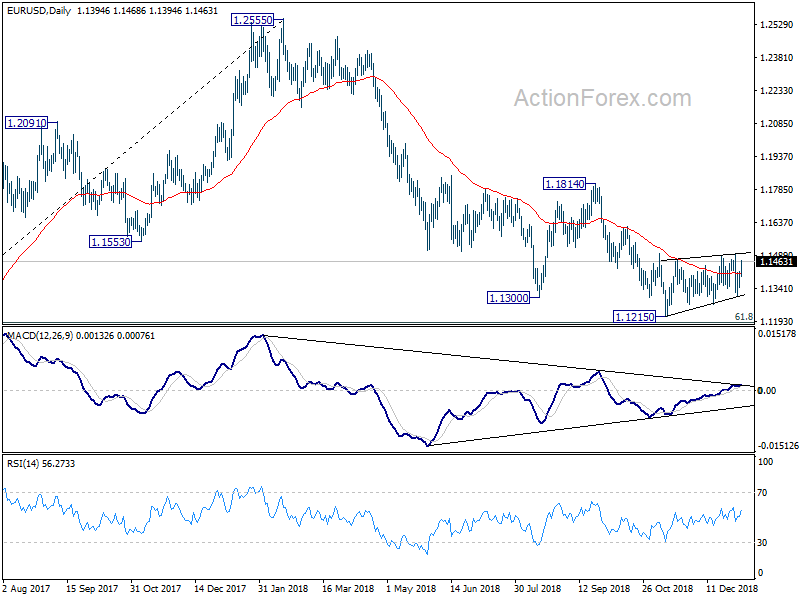
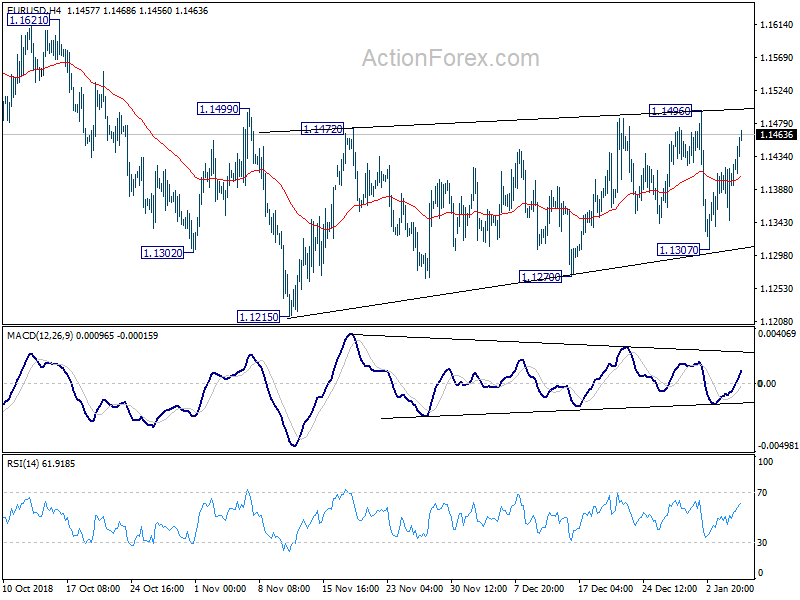
EUR/USD rebounds to as high as 1.1468 so far today but stays well below 1.1496 resistance. Intraday bias remains neutral first. Also, price actions from 1.1215 are still viewed as a corrective pattern. Thus, downside breakout is favored. On the downside, break of 1.1307 minor support will turn bias back to the downside for 1.1215 low. Break will resume down trend from 1.2555 to 1.1186 key fibonacci level. Nevertheless, sustained break of 1.1499 resistance will suggest near term reversal and bring stronger rebound back to 1.1621 resistance first.
In the bigger picture, as long as 1.1814 resistance holds, down trend down trend from 1.2555 medium term top is still in progress and should target 61.8% retracement of 1.0339 (2017 low) to 1.2555 at 1.1186 next. Sustained break there will pave the way to retest 1.0339. However, break of 1.1814 will confirm completion of such down trend and turn medium term outlook bullish.