

Sample Category Title
BoJ Minutes: Global economy to grow firmly on whole with increasing disparities
In the minutes of October 30/31 BoJ meeting, there consensus that the global economies continued to grow "firmly on the whole" However, there had been "increasing disparities of growth" among countries and regions. Some members urged to pay attention to slowing pace of improvement in business sentiments, as seen in PMIs in "declining trend". One member noted due to trade friction and rising US interest rates, overseas economies were "beginning to level off".
On Japan's price developments, members believed that the "continued relatively weak developments in prices compared to the economic expansion and the labor market tightening largely had been affected by the deeply entrenched mindset and behavior". But year-on-year change in CPI was "likely to increase gradually toward 2 percent, mainly on the back of the output gap remaining positive and medium- to long-term inflation expectations rising. "
On risks to baseline scenario of economic activity and prices, the minutes pointed to four upside and downside risk factor : (1) developments in overseas economies; (2) the effects of the scheduled consumption tax hike; (3) firms' and households' medium- to long-term growth expectations; and (4) fiscal sustainability in the medium to long term. On specific risks to prices, members pointed to the following three factors: (1) developments in medium- to long-term inflation expectations; (2) the responsiveness of prices to the output gap; and (3) developments in foreign exchange rates and international commodity prices.
Trump said it’s a tremendous opportunity to buy dip
Trump continued his criticism on Fed this week. He said "They're raising interest rates too fast because they think the economy is so good. But I think that they will get it pretty soon." Earlier, he also said "the only problem our economy has is the Fed."
On the economy and stock markets, he hailed that American companies are the "greatest in the world, and they're doing really well." And even after the stock market plunge, Trump said the companies have "record kinds of numbers. So I think it's a tremendous opportunity to buy. Really a great opportunity to buy."
On government shutdown, Trump warned that "it's not going to reopen until we have a wall, a fence, whatever they'd like to call it. I'll call it whatever they want, but it's all the same thing. It's a barrier from people pouring into the country, from drugs."
Growth Assets Are Spiralling Out Of Control
Markets
Growth assets are spiralling out of control amid a synchronised global growth retreat concerns as Wall Street is amid its worst run in a decade with the market is on course to have it’s worst December since 1931 during the Great Depression, let that sink in for a minute.
Against that backdrop, the financial world was astonished that Treasury Secretary Steve Mnuchin tweeted, with little rhyme or reason that he was convening the PPT (Plunge Protection Team) while making an individual call with CEO of the countries largest banks. Which triggered memories of 2008 GFC as investors asked themselves, what does the US Treasury see that no one else does? Which likely did more harm than good to investor sentiment.
But there’s an endless laundry list of concerns, Trump berating the Fed, Trade Wars, China slowing growth, Brexit casualties, EU slowdown. But when you factor in a downturn in the US economy, this is when things get ugly. We knew China and EU were struggling, but now the markets are in panic mode that the US economy is tanking expecting the benefit of Trump’s fiscal stimulus will falter in 2019. After all, it was the US market that was carrying the weight of global risk sentiment on its shoulder. If the US economy turns south, Global capital markets are in for a world of hurt.
While investors are right to get concerned about a slowdown in economic growth, but making things worse is the turmoil in Washington be it a government shut down over a Border Wall, more key Whitehouse staff vacancies or Trump constantly berating the Fed. The bottom line: Investors are losing faith because Trump is turning into the type of president many always feared: unpredictable, unsettled and unrestrained.
These are incredibly tricky markets to decipher as the outsized moves are not reflective of the current US economic landscape, but that seems to matter little so far as fear mongering continues to permeate every pocket of global capital markets. And while it does look like some substantial post-Xmas holiday sales are on offer in global equity markets. However, given the unfavourable climate, it’s still unclear if investors cheerless mood will improve before the end of the year. While US futures have stabilised in early APAC trade as we’ve seen so often over the last three months downside momentum has a way of building through the day.
Oil Markets
US equity futures are trading a bit firmer this morning triggering some little buying interest in the Oil markets. But at this point, unless OPEC pulls a rabbit out of the hat and reassure markets the viability of their supply cuts and even impose deeper ones as some members have suggested, global macroeconomic fears will continue to wear like and an anvil around the oil markets neck.
Gold Markets
Holiday thin trading conditions are likely to prevail, but with US equity market futures showing a bit of life this morning, long gold positions are taking profit. So far today risk assets are trading peacefully but as we’ve seen so often over the last three months downside momentum has a way of building through the day which should keep a gold bid on dips as markets remain on very shaky grounds.
But the downdraft in Global equity markets has firmed up the major support level to $ 1255 levels.
But overall the latest move on gold should be a stark reminder to investors that Gold in any form should be an essential part of any long-term investment strategy as again they yellow metal has proven its weight when markets turn turbulent.
Currency Markets
US Political uncertainty continues to weigh on the USD, but we should continue to see outsized USD moves vs JPY and CHF trading in consort with the S&P correlation as US market exceptionalism under fire.
Euro: the jury is out on this one US political uncertainty vs weak EU economy. Most day I would favour the weak EU economy, but the swamp and numerous pollical sinkholes in Washington are too hard to ignore.
Malaysian Ringgit: With oil prices trading lower and markets still fretting about global growth concerns, triggering intense sell-off in global equities it’s unlikely the Ringgit will make any significant headway into the New Year as risk sentiment remains incredibly weak.
Eco Data 12/26/18
[php_everywhere instance="1"]
GBPUSD Continues To Retain Its Bearish Threats
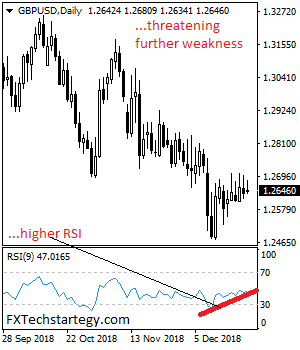
GBPUSD continues to retain its bearish threats as it looks to resume broader medium term weakness. Support is seen at 1.2600 level. Further down, support comes in at the 1.2550 level where a break will turn focus to the 1.2500 level. Further down, support comes in at the 1.2450 level. Below here will set the stage for more weakness towards the 1.2400 level. On the upside, resistance stands at the 1.2700 with a turn above here allowing for additional strength to build up towards the 1.2750 level. Further out, resistance stands at the 1.2800 level followed by the 1.2850 level. On the whole, GBPUSD faces further downside pressure.
USD/CAD Climbs above 1.36 as Canadian Dollar Falters
USD/CAD is unchanged in the Monday session. Currently, the pair is trading at 1.3592, up 0.07% on the day. There are no Canadian or U.S. events on the schedule.
The Canadian dollar recorded sharp losses on Friday, after posting mixed numbers. GDP for October rebounded with a gain of 0.3%, after a decline of 0.1% in September. This beat the estimate of 0.2%. However, retail sales disappointed. Core retail sales were flat in October, down from 0.1% a month earlier and shy of the forecast of 0.2%. Retail sales improved from 0.2% to 0.3%, but missed the estimate of 0.4%.
U.S numbers were also a mixed bag on Friday. Final GDP came in at 3.4%, revised slightly from the initial reading of 3.5% in November. This was shy of the estimate of 3.5%, but still points to healthy economic growth in the third quarter. Durable goods reports were well short of their estimates. Core durable goods orders declined 0.3%, short of the estimate of 0.3%. This marked the first decline since May. There was better news from durable goods, which rebounded with a gain of 0.8%, after a plunge of 4.3% a month earlier.
The Canadian dollar has dropped to its lowest level since May 2017, as the currency continues to head south. USD/CAD jumped 1.62 percent last week and has climbed 2.3 percent in December. With global equity markets falling to their lowest level since 2008, high trader apprehension has made the Canadian dollar less attractive, as investors stick with safe-haven assets. A quiet Christmas week could halt the steep slide, but further headwinds await the Canadian dollar in January unless risk appetite improves.
Market’s Misery Translates into Gold Luster
After posting strong gains last week, gold prices continue to move higher in the Monday session. In the North American session, the spot price for one ounce of gold is $1265,65, up 0.77% on the day. There are no U.S releases on the schedule.
Gold prices jumped 1.40% last week and the base metal has climbed to 6-month gains on Monday. The equation for the sharp gains has been straightforward – a meltdown in the equity markets has sent jittery investors flocking to safe-haven assets such as gold.
U.S numbers were mixed on Friday. Final GDP came in at 3.4%, revised slightly from the initial reading of 3.5% in November. This was shy of the estimate of 3.5%, but still points to healthy economic growth in the third quarter. Durable goods reports were well short of their estimates. Core durable goods orders declined 0.3%, short of the estimate of 0.3%. This marked the first decline since May. There was better news from durable goods, which rebounded with a gain of 0.8%, after a plunge of 4.3% a month earlier.
Investors were braced for a rate hike last week from the Federal Reserve, but had hoped for some “compensation” in the form of a dovish rate statement, given the turmoil in equity markets and signs that the U.S. economy may not be able to continue its red-hot performance. Instead, policymakers maintained plans to continue raising rates. Most significantly, policymakers did not remove the critical phrase “further gradual increases” from their statement. At the same time, the dot plot forecast was lowered for 2019, from three rate rises to two. Just a few months ago, there was talk of a “rate hike every quarter” for 2019, but the Fed has made a U-turn in monetary policy. The policy of gradual rate hikes bears much of the responsibility for the volatility in the markets, and the message from the Fed that more hikes are coming could mean more turmoil in the equity markets and further gains for the gold.
Eco Data 12/25/18
[php_everywhere instance="1"]
EURUSD Is Ready For Christmas
At the beginning of another December week, EURUSD is slowly rising and trading close to 1.1395. investors’ response to the US Federal Reserve decisions helped the instrument to reach 1.1485, the highest level over the previous trading week.
In general. December turned out to be a very volatile month for the major currency pair. Investors had to consider OPEC+ meetings, the FOMC meeting, and the QE program elimination. There was too much fundamental news, forcing a lot of fluctuations in EURUSD and a veritable firestorm of emotions among investors.
This week, the macroeconomic calendar is almost empty. The only active day will be Friday. The USA will report on the Goods Trade Balance and the Wholesale Inventories in November. On the same day, the US Federal Reserve Chairman Jerome Powell is going to speak. There will be hardly anything else to make the currency market move.
On Christmas Eve and Christmas, no activity is expected on the market, that’s why the major currency pair will probably consolidate in the range. There might be some quick movements on a “thin” market with a handful of investors, such things happen from time to time, but it’s very unlikely.
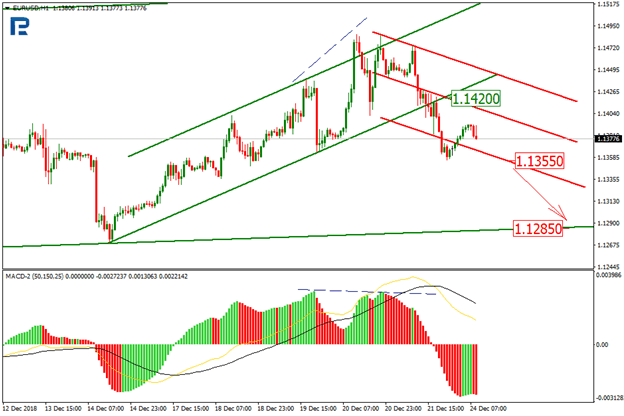
Looking at the H1 chart of EURUSD, one can see the mid-term correction to the upside. The current short-term decline may reach the support level of the mid-term projected channel at 1.1285, but only after the price breaks the low at 1.1355. In the nearest future, the instrument is expected to start a new pullback towards the resistance level at 1.1420.
FX Year Ahead 2019: End of Dollar Dominance?
As 2018 draws to a close, the heavily sold currencies are set to end the year off their lows, while the US dollar – one of the biggest winners of 2018 – appears on track to start 2019 on a negative footing. While it’s too early to predict a new downtrend for the dollar, expectations that US interest rates are nearing their cycle peak could provide the greenback’s peers some much-needed relief. Yet, several risks remain – ranging from the Sino-US trade war to Brexit to a global economic slowdown – so any decline in the US currency may be limited should the latest bout of risk aversion linger.
Are the days of “king dollar” behind us?
Following a year of broad dollar strength – due to widening interest rate differentials, the US economy outperforming, and investors often seeking the reserve currency’s safety – the risks surrounding the greenback in 2019 may be tilted to the downside. The Fed is now approaching “terminal” rates at a period when other central banks are preparing to start their own tightening cycles. Hence, the monetary policy divergence theme may have largely run its course, and the dollar’s carry appeal could gradually lessen.
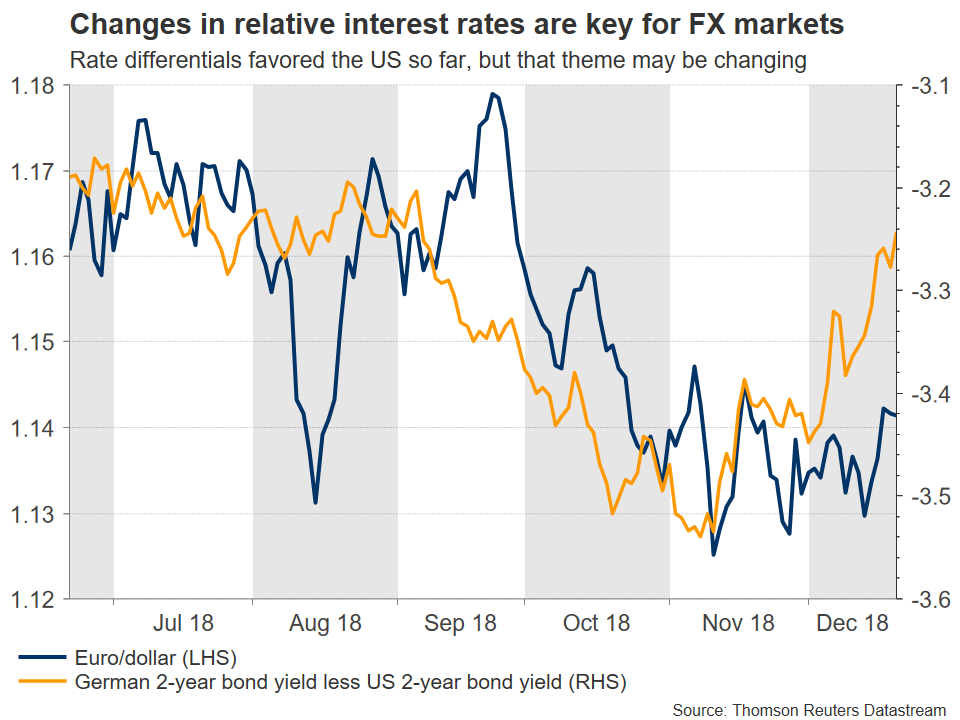
Separately, although markets have turned a blind eye lately, attention may soon shift back to the twin fiscal and current account deficits as well as the nation’s unsustainable debt trajectory. Political gridlock in Washington and the occasional threat of a government shutdown could also haunt the US currency.
Note two upside risks, though. A collapse in the US-China trade talks that gives way to a re-escalation in tensions, may see the greenback attract safe-haven bids. Likewise, if the US launches a massive infrastructure program that lifts economic growth and inflation, it could be a game-changer.
Euro waiting for ECB normalization train – delays possible
Despite starting 2018 on a strong note, the euro’s gains quickly evaporated, and the currency is set to close the year much lower amid cautious forward guidance by the ECB, slowing economic momentum, Italian and Brexit risks, as well as global trade worries. While things currently don’t look good for the common currency, better days may lie ahead. The Italian crisis seems to be subsiding, and more importantly, the ECB is preparing to lift rates late next year.
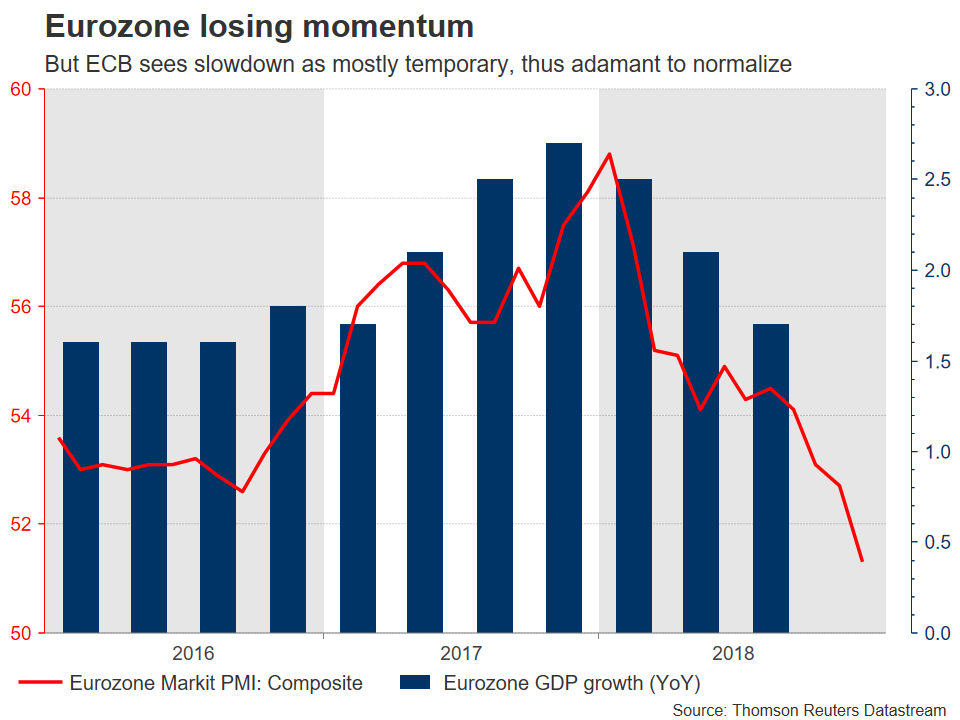
Markets still haven’t priced in much tightening by the ECB. This suggests the euro has lots of room to run higher if economic data pick up some steam again and allow the Bank to ‘take the next step’, especially since the Fed will be near “peak” rates by then. A potential euro comeback may also be amplified by an unwinding of heavy speculative net-short positions. The obvious risk is that the data don’t recover, leading the ECB to delay its tightening plans. A disorderly Brexit could also derail any euro rebound.
Pound to stay prisoner to Brexit headlines
Delivering Brexit will be the British government’s top priority in 2019, and hence the primary driver for the pound. In mid-January, the deal agreed between Theresa May and the EU will head to the UK Parliament for a vote, where it may only pass if it contains strong assurances the Irish backstop will indeed be temporary, potentially lifting the pound towards the key $1.3300 resistance. Alternatively, a rejection could increase calls for a second referendum, simultaneously postponing the exit date scheduled for March 29.
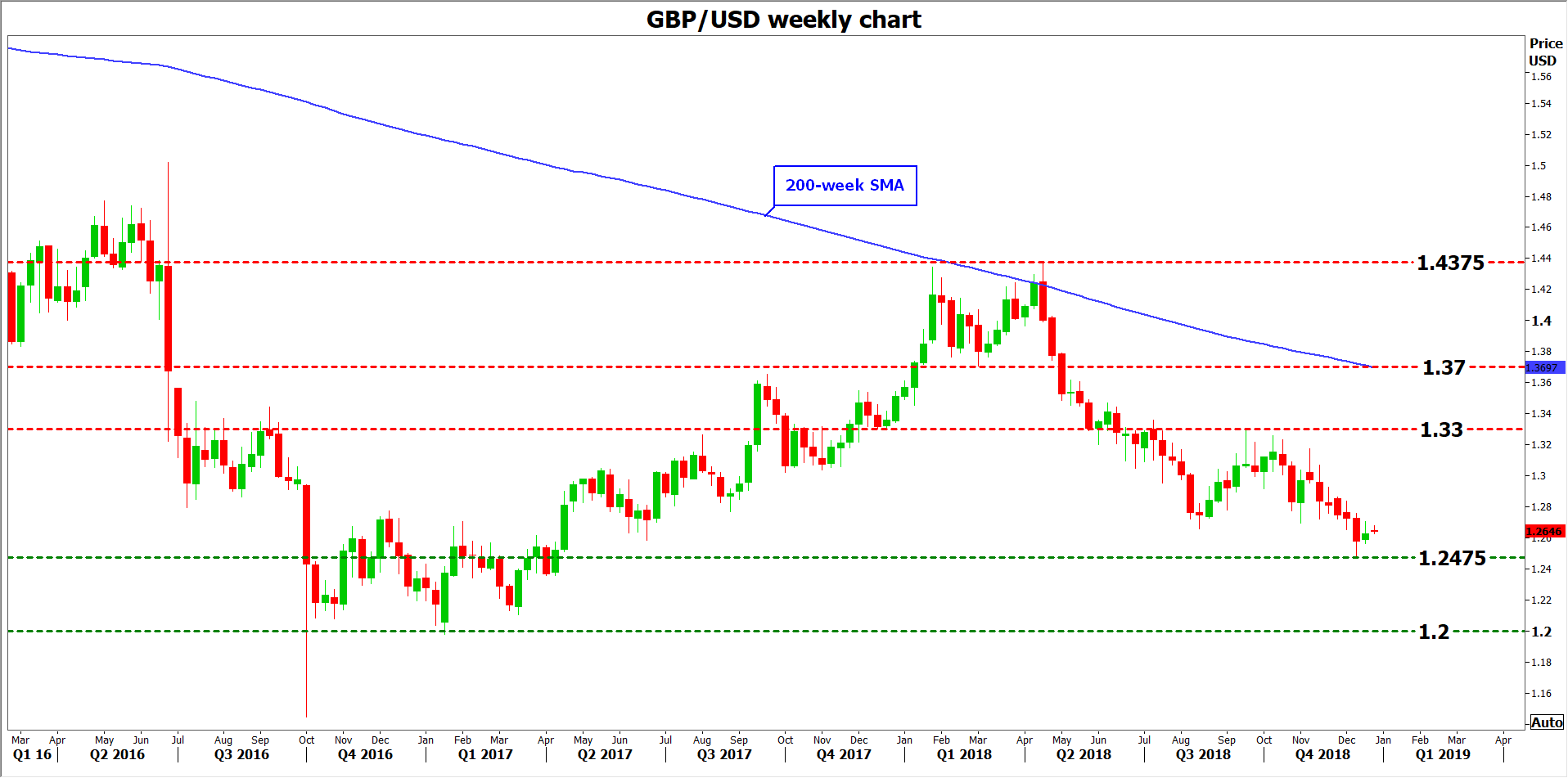
Otherwise, the UK may leave without a deal, creating chaos in the UK economy, with May likely facing another leadership challenge – this time from opposition parties. Consequently, traders would probably see the pound revisiting the 1.2000 area.
On the monetary policy front, the Bank of England said a disorderly exit could cause a devastating recession, hence rate hikes would be off the table in this case. If, however, May persuades the EU to make further concessions that appease British lawmakers, and if the data allows, then the Bank could even deliver more than one hike next year.
Yen traders not holding their breath for BoJ normalization
The Japanese economy remains stuck in “low gear”, which has kept the BoJ from considering any major changes to its massive stimulus program. Consequently, the defensive yen has been trading mainly as a function of global risk appetite, paying little attention to economic data.
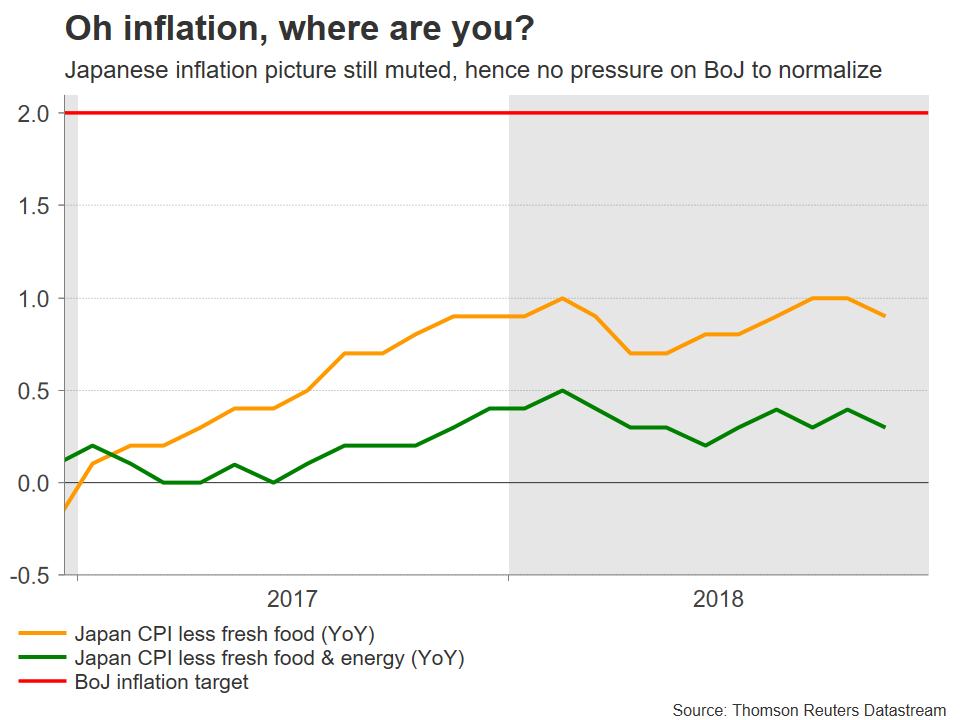
Although market chatter suggests the BoJ could start normalizing next year, that prospect remains remote. The economy contracted in Q3, underlying inflation is muted, and the government plans to raise the consumption tax in October 2019. The last time it hiked this tax, a recession ensued, so the BoJ will probably avoid any bold moves ahead of it. Hence, rate differentials between Japan and other economies may stay wide or widen further, which in isolation argues for a weaker yen over time. For the currency to soar, it may require an unexpected pickup in inflation, or more realistically, a sustained period of global risk aversion.
Franc stuck in the shadow of the ECB
For the franc, the most important drivers will be the SNB’s policy stance, and safe-haven flows. The SNB seems unlikely to dare making a hawkish turn anytime soon; Swiss data continue to tread water and the Bank will probably want to avoid tightening its policy in any manner before the ECB does, for fear of a drastic franc appreciation. Hence, absent some major deterioration in risk sentiment that generates haven-demand for the Swiss currency, the risks surrounding euro/franc may be skewed to the upside over the coming year, as markets increasingly price in ECB normalization prior to the SNB’s.
Loonie, aussie, and kiwi in the eye of the US-China trade storm
The loonie, aussie, and kiwi all had a difficult time in 2018 amid struggling commodity prices, a resurgent US dollar, and most importantly, flaring trade tensions between the US and China. Given that these economies (Canada, Australia, New Zealand) are heavily export-oriented, dwindling global trade volumes could impact them severely. For the loonie, collapsing oil prices were crucial too.
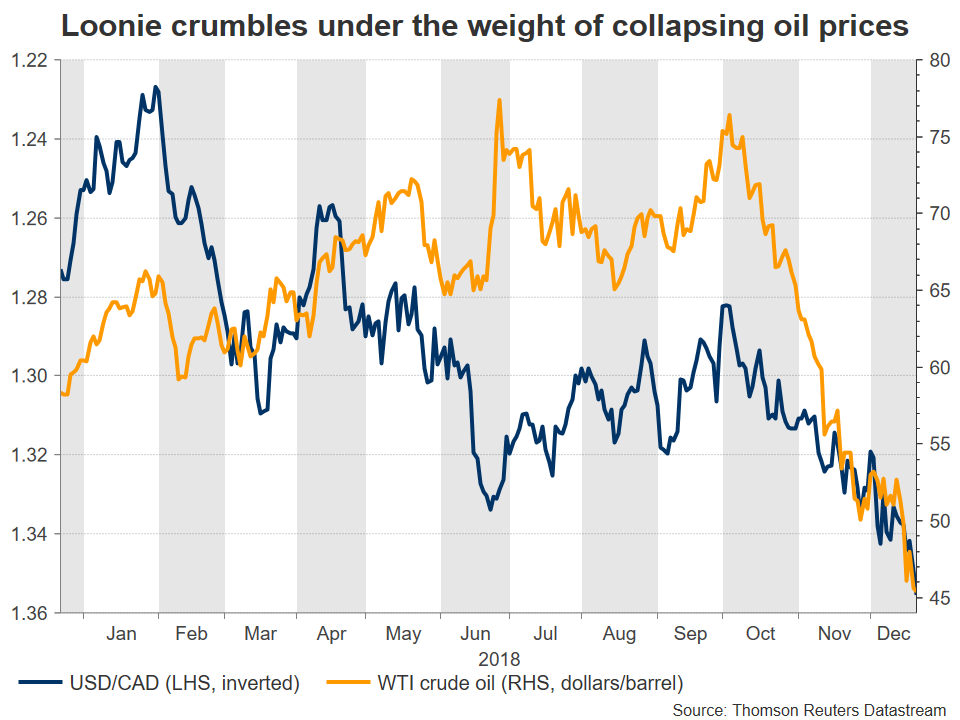
Does 2019 promise to be any better? That may depend predominantly on whether the US-China trade negotiations ultimately bear fruit, or fall apart. In terms of monetary policy, no rate hike is expected by either the RBA or RBNZ, and in fact, market pricing implies a small probability for a rate cut (~20%) by both amid slowing growth. Meanwhile, half a 25bps rate increase is priced in by the BoC, which seems overly dovish and assuming even a mild recovery in oil prices, argues for a firmer loonie.