Sample Category Title
Japanese Industrial Output and Retail Sales to Weaken in November as Yen Enjoys Revived Safe-Haven Status
Economic data out of Japan – the only major releases of the week – are anticipated to point to further trouble for the Japanese economy on Friday (local time). Like much of the rest of the world, growth in Japan slowed down considerably in 2018, with GDP contracting in the first and third quarters. While a modest recovery is expected in the fourth quarter, unemployment, industrial output and retail sales figures will likely point to more weakness ahead.
The jobs data are out first at 23:30 GMT on Thursday. Japan’s unemployment rate is forecast to have remained at 2.4% in November. Although the jobless rate has edge up from the 26-year low of 2.2% recorded in May, it remains near historic low levels. However, the labour market’s strong run could be nearing an end, as apart from the small pick-up in the unemployment rate, the jobs/applicant ratio appears to be peaking. The jobs/application ratio, which measures the number of job openings per applicant, inched lower to 1.62 in October. It’s forecast to edge up to 1.63 in November, but its rise has been slowing in recent months.

The industrial output and retail sales numbers will follow shortly after at 23:50 GMT. Industrial production rebounded by a strong 2.9% month-on-month rate in October. However, the positive growth isn’t expected to last as output is projected to drop by 1.9% m/m in November. Retail sales are also forecast to moderate, with annual growth easing from 3.5% to 2.2% in November. Consumer spending in Japan hasn’t fared too badly since late summer, but this may not be strong enough to support the rest of the economy.
A further worsening in these key gauges in December, which is possible given the deteriorating sentiment over the last few weeks, could tip Japan into a technical recession if GDP shrinks for a second consecutive quarter in Q4. However, the yen is unlikely to turn lower even if the data do cast gloom over the outlook as the Japanese currency has been benefiting from safety flows over the past month. With global stock markets still in turmoil and heightened fears of an economic downturn next year, the only way can be up for the yen.

Dollar/yen could fall below immediate support at the 38.2% Fibonacci retracement of the upleg from 104.55 to 114.54, around 110.73, should the greenback continue to come under downside pressure. A drop below this mark would bring the 50% Fibonacci at 109.55 into scope. Alternatively, an improvement in risk sentiment, as well as worse-than-expected data out of Japan could help dollar/yen rise towards the 23.6% Fibonacci at 112.18. A break above this level would open the prospect of a fresh attempt to challenge the October top of 114.54.
Euro Edges Higher ahead of Christmas Break
EUR/USD has started the week with slight gains. Currently, the pair is trading at 1.1402, up 0.28% on the day. There are no eurozone or U.S. indicators, so the markets are likely to be subdued as we head into Christmas.
U.S numbers were a mix on Friday. Final GDP came in at 3.4%, revised slightly from the initial reading of 3.5% in November. This was shy of the estimate of 3.5%, but still points to healthy economic growth in the third quarter. Durable goods reports were well short of their estimates. Core durable goods orders declined 0.3%, short of the estimate of 0.3%. This marked the first decline since May. There was better news from durable goods, which rebounded with a gain of 0.8%, after a plunge of 4.3% a month earlier.
The euro took investors on a roller-coaster ride late last week. EUR/USD climbed on Thursday, as the markets responded with a thumbs-down to the Federal Reserve’s rate statement. The statement was less dovish than the markets wanted, as policymakers said they would continue to adhere to their policy of gradual increases. Investors were looking for a Christmas gift from the Fed, in the form of a dovish rate statement. There was speculation that the Fed would “compensate” investors for the rate hike, given that the markets have been in turmoil for weeks and the U.S. economy appears to be cooling down.
However, the Fed was not in a giving mood, signaling that it plans to continue raising rates in 2019. Policymakers did not remove the phrase “further gradual increases” from their statement, and Fed Chair Jerome Powell added that the “lower end” of the neutral rate range has been achieved.
EURUSD Catches a Bid after a Negative Week
EURUSD changed direction to the upside after touching the upper surface of the Ichimoku cloud in the four-hour chart but stronger evidence is needed to support that the recovery could hold for longer, as the RSI is still close to its 50-neutral mark. The MACD has also yet to give positive signs, as the indicator continues to fluctuate far below its red signal line.
Moving south, the 50% Fibonacci of the rally from 1.1269 to 1.1485 at 1.1376 could provide nearby support ahead of the 61.8% Fibonacci of 1.1351, which is not far below the 200-period simple moving average. If the latter fails to halt downside movements, the door could open for the 1.1300 barrier, while even lower, all eyes will turn to the 1.1269 bottom.
In case the rebound continues, resistance could come around the 23.6% Fibonacci of 1.1433. Even higher, the area between 1.1470 and 1.1500 may attract bigger interest as any significant violation of this region would bring the bullish outlook back into play, increasing speculation that the recovery may keep on, probably until 1.1550.
In the bigger picture, EURUSD maintains a relatively neutral outlook, within the 1.1269 and 1.1485 walls.

Muted Trading While US Political Uncertainty Has Potential to Deliver Coal in Markets’ Stockings
Notes/Observations
- US political uncertainty a headwind for USD for the time being
- Holiday thin trading week; muted trading; European markets are softer in quiet trade with several markets closed or finish early ahead of Christmas.
- Asia closed mixed in holiday thin trade (Note: Nikkei225 was closed for public holiday)
Asia:
- China Finance Ministry stated that progress being made in trade talks with US last week. MOFCOM announced it would not levy tariffs on 94 items, including fertilizer and iron ore, in addition to adjusting or eliminating other import/exports tariffs
Americas:
- Treasury Secretary Steven Mnuchin called top executives from the six largest U.S. banks over the weekend regarding market stability
- Congress still searching for a spending deal as partially govt shutdown underway; President Trump says the govt shut down could be "a long stay"
- Treasury Sec Mnuchin: Trump "never suggested firing" Fed Chair Powell, Trump did not believe he has the right to fire Powell
- US Sec of State Pompeo: "counting on" a second summit between Trump and N. Korea's Kim, there has been some progress on denuclearizing North Korea despite the perception otherwise
Energy:
- UAE Energy Min (OPEC president) Mazrouei: OPEC and non-OPEC monitoring committee to meet in Baku at the end of February or the start of March; additional measures could be discussed that extends the recent production cut deal for an additional 5-months Macro
SPEAKERS/FIXED INCOME/FX/COMMODITIES/ERRATUM
Equities
Indices [Stoxx600 closed, FTSE -0.49% at 6,688.25, DAX closed, CAC-40 -0.93% at 4,650.66, IBEX-35 -0.59% at 8,505.90, FTSE MIB -0.97% at 18,397.19, SMI closed, S&P 500 Futures +0.46%]
Market Focal Points/Key Themes: Equities European Indices trade lower across the board in light trade, following on from weakness in Wallstreet on Friday and mixed Asian markets. US futures are pointing higher in a holiday shortened week. On a light morning for corporate news Playtech shares trade lower after new Italian Gambling taxation laws is set to reduce EBITDA for next year. Chamberlin and Marie Brizard Wine and Spirits are among other notable fallers after earnings and guidance. Meanwhile Gama Aviation trades higher after a contract win with April Group rises after a tax reassessment notification. In the US shares of DellTech trades sharply lower after stockholders approve Class V transaction.
- Consumer discretionary: Gama Aviation [GMAA.UK] +3.5% (awarded few contract)
- Financials: Euronext [ENX.FR] -1% (update on Oslo Børs VPS cash tender offer), April Group [APR.FR] +1.5% (affirms outlook)
- Healthcare: Novacyt [ALNOV.FR] -1.5% (trading update)
- Technology: Playtech Ltd [PTEC.UK] -8% (Italian gambling taxation update)
- Materials: Chamberlin [CMH.UK] -13% (earnings), Nanoco Group [NANO.UK] +6.5% (completed significant milestone)
Speakers
- Italy PM Conte: Govt will keep pursuing its expansionary economic policy; vowed that govt to serve out its full 5-year term
- Israel Central Bank Gov Yaron: Forex rate should be set by market forces with minimal intervention
Currencies/Fixed Income
- US political uncertainty a headwind for USD for the time being due to continued concerns over the Fed autonomy and the reality of a partial shutdown of US govt underway
- EUR/USD still within recent ranges but probing the 1.14 handle in dull trade. USD/CHF 0.9945 and GBP/USD at 1.2660
Economic Data
- (NL) Netherlands Q3 Final GDP Q/Q: 0.2% v 0.2% prelim; Y/Y: 2.4% v 2.4% prelim
- (TW) Taiwan Nov Industrial Production Y/Y: 2.1% v 3.3%e
- (CH) Swiss Weekly Total Sight Deposits (CHF): 575.5B v 576.3B prior; Domestic Sight Deposits: 474.5B v 471.6B prior
**Fixed Income Issuance**
- (HK) Hong Kong sold total HK$53.9B in 3-month, 6-month and 12-month bills
Looking Ahead
- (UR) Ukraine Central Bank (NBU) Dec Minutes
- 05:25 (BR) Brazil Central Bank Weekly Economists Survey
- 06:00 (IL) Israel to sell Bonds
- 06:00 (RO) Romania to sell RON300M in 3.5% 2022 Bonds
- 06:45 (US) Daily Libor Fixing
- 07:00 (IN) India announces details of upcoming bond sale (held on Fridays)
- 07:00 (CL) Chile Nov PPI M/M: No est v 0.9% prior
- 08:00 (PL) Poland Nov M3 Money Supply M/M: 0.8%e v 1.3% prior; Y/Y: 8.5%e v 8.3% prior
- 08:30 (US) Nov Chicago Fed National Activity Index: 0.20e v 0.24 prior
- 08:50 (FR) France Debt Agency (AFT) cancels BTF Bill auctions
- 09:00 (MX) Mexico Nov Unemployment Rate (Seasonally Adj): 3.2%e v 3.2% prior; Unemployment Rate (unadj): 3.2%e v 3.2% prior
- 09:30 (EU) ECB announces Covered-Bond Purchases
- 11:30 (US) Treasury to sell 3-Month and 6-Month Bills
- 13:00 (US) Treasury to sell 2-Year Notes
USDJPY Meets 200-day MA in Oversold Area
USDJPY closed marginally above the 200-day simple moving average (MA) last week, marking its second worst weekly performance for this year. With the RSI moving around its 30 oversold threshold and the Stochastics being ready to post a bullish cross below 20, a rebound could take place in the coming sessions, though the MACD suggests that bearish forces will dominate in the short term as the indicator continues to strengthen to the downside and below its red signal line.
Should the price bounce up, immediate resistance is expected to appear between the 111.38 barrier and the 50% Fibonacci of the upleg from 109.76 to 114.54, at 112. Above that area, the bulls could test the 38.2% Fibonacci of 112.70 before heading up to the 114.00 key level.
Alternatively, if the price manages to drop below the 200-day MA currently at 111, traders could unlock additional selling orders, driving the market probably down to 110.38. Even lower, the way could open towards the 109.76 bottom where the market strongly rebounded in August.
Turning to the medium-term picture, the outlook remains neutral as long as the price holds within the 109.76-114.54 range. However, it’s worth noting that the 200-day MA has already started to curve up to meet the 50-day MA which looks to be losing steam, a sign that the market may soon resume its bearish profile.
Summarizing, USDJPY holds a negative bias in the short term, while in the medium-term the pair is neutral.

Stock Carnage Deepens; Yen Extends Hains
- US stock indices extend losses, Nasdaq enters bear market as concerns around future growth feed risk aversion
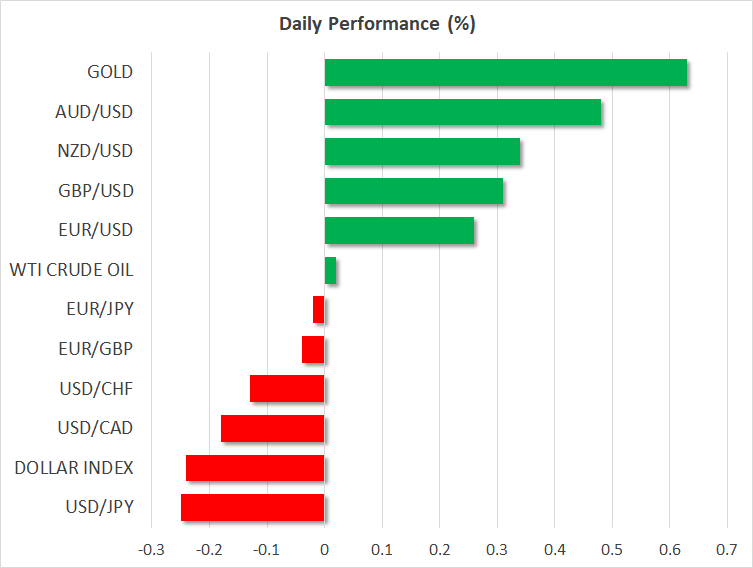
- Dollar and yen outperform on safe-haven demand, but are giving back some gains on Monday amid encouraging trade headlines
Equities drop to fresh lows as uncertainty reigns
US stock indices closed with sharp losses once again on Friday, in an environment characterized by thin liquidity, as investors attempted to protect their profitability heading into the New Year via liquidating more of their prior long positions. Technology stocks bore the brunt of the pain, with heavyweights such as Apple (-3.89%), Amazon (-5.71%), and Facebook (-6.33%) leading the way lower. Consequently, the tech-heavy Nasdaq Composite (-2.99%) officially entered a bear market, characterized as a 20% drop from its highs, while the benchmark S&P 500 (-2.06%) was not far away from entering its own bearish waters.
While the catalyst behind the latest leg lower was not clear, the main culprits seem to have been the partial US government shutdown that started on Friday coupled with the ongoing worries that the Fed is making a policy error by hiking rates further. Most striking was the fact that equities struggled even after New York Fed President Williams shifted to a more dovish tone, highlighting that rate hikes could slow further should growth disappoint.
Taking a step back, investors seem increasingly concerned 2019 may indeed be a year during which growth slows severely, not least due to fiscal stimulus fading, and hence are positioning accordingly. Yet, US economic data outside of the housing market remain solid, so it remains to be seen whether the economy will ultimately evolve as markets seem to expect. For now, though, the adage of “don’t try to catch a falling knife” is likely the most prudent approach, as the sell-off may still have legs to run before valuations reach levels attractive enough to lure investors back in.
Dollar and yen shine as investors seek safety
The dollar was the second-best performer on Friday, behind the Japanese yen, with both of these defensive currencies benefiting from the latest bout of risk aversion in markets. Sentiment seems to have turned around on Monday, albeit only slightly, likely helped by some encouraging news on the trade front that China and the US had a “deep exchange of views” on intellectual property protection. Separately, China also announced it will lower import taxes on roughly 700 products starting from January 1, as part of the ongoing effort to open up its economy.
On a different front, the dollar reacted very little to reports over the weekend that President Trump is considering whether to fire Fed Chair Powell, which was later denied both by Treasury Secretary Mnuchin and acting White House chief of staff Mulvaney.
As for the dollar and yen, given how light the economic calendar is over the coming days, their near-term direction may hinge primarily on how risk sentiment develops. Should the mood remain in risk-off territory, these two defensive assets could finish the year on a high note in the midst of safe-haven demand. On the contrary, risk-sensitive currencies such as the aussie, kiwi, and loonie, may remain broadly on the back foot in such conditions.
US Govt Shutdown & Trump May Fire Fed President
Donald Trump thinks he can fire the president of the Federal Reserve Bank and Investors are concerned about the partial US government shutdown
When you don’t do what your boss has asked you to do, your boss starts to talk about firing you. This has alarmed the market participants today. The Federal Reserve has increased the interest rates four times this year and the Fed president, Jerome Powell is confident that the economy is in good shape. The committee thinks that two more rate hikes are on the table for 2019.
Donald Trump, president of the US, isn’t pleased with this condition at all. He has warned the Fed not to raise the interest rates several times. Investors are worried about his conversation over the weekend during which it is believed that he has talked about firing Jerome Powell. It is unusual for the US president to dictate the Federal Reserve department and it is harmful for Trump to look into the ways of firing the Chairman of the Fed. It will only shatter the market confidence further.
US futures are trading lower as investors focus on the US partial government shutdown. The disappointing fact is that there is no immediate end in sight for this resolution. Trading volume is going to remain very thin today as most of the traders are out for the holiday season. We do not expect any major moves in the market. The ongoing downtrend would continue to dominate today and markets are likely to close lower again.
Investors are wondering what the US treasury secretary has to say to the top executives from the six largest US banks over the bank. Of course, the agenda for him is to stabilise the markets going into 2019 because the current heavy losses are going to undo all the work they have done.
CRYPTOS: Ethereum Up 86% From Its Recent Low
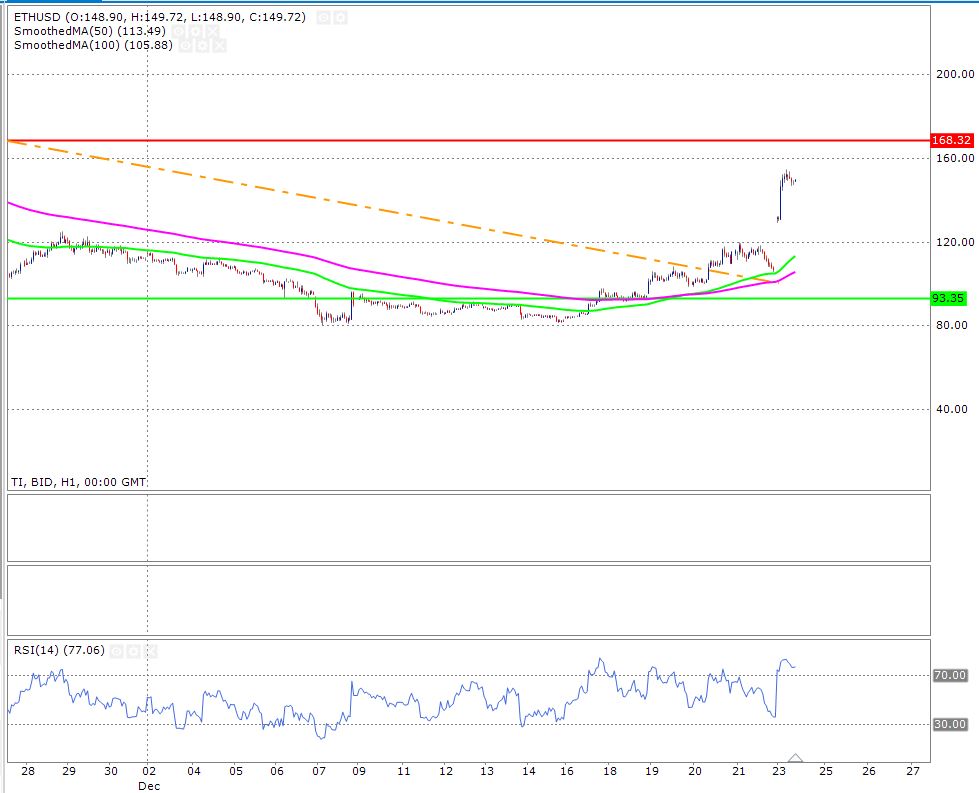
Ethereum has a remarkable recovery during the month of December
As for Bitcoin, bulls are confident that path of the lest resistance may be skewed towards the upside as the Bitcoin price has decided to stay above the 4000. As long as the price holds this level, the chances of bitcoin price dropping below the 3000-mark are minimal and the chances of price touching the level of 2500 are negligible. The cryptocurrency which stands the tallest among the top three coins is Ethereum. It is up 86% from it recent low of 81 formed on the December 07th.
Looking at the hourly chart for Ethereum it is clear that the downtrend is clearly over and the bulls have taken the control. This is because the price has broken the downward trend line shown in orange colour. The further evidence of the uptrend comes from the fact that the price is trading above the 50 and 100-day moving averages (50-day shown in green and 100-day shown in pink).
The RSI is clearly showing extreme overbought signal and this may just make the bulls to take some profit off the table.
The near-term support is shown by the green horizontal line
The near-term resistance is shown by the red horizontal line
EUR/USD Weekly Outlook
EUR/USD rebounded to as high as 1.1485 last week but couldn't break through 1.1499 resistance and then retreated sharply. Intraday bias is now neutral first. On the upside, break of 1.1485 resistance will revive the case of near term reversal. Intraday bias will be turned back to the upside for 1.1621 resistance first. Break will target 1.1814 key resistance next. On the downside, break of 1.1270 will, instead, revive the bearish case that down trend from 1.2555 is still in progress. Intraday bias will be turned back to the downside for 1.1186 key fibonacci level.
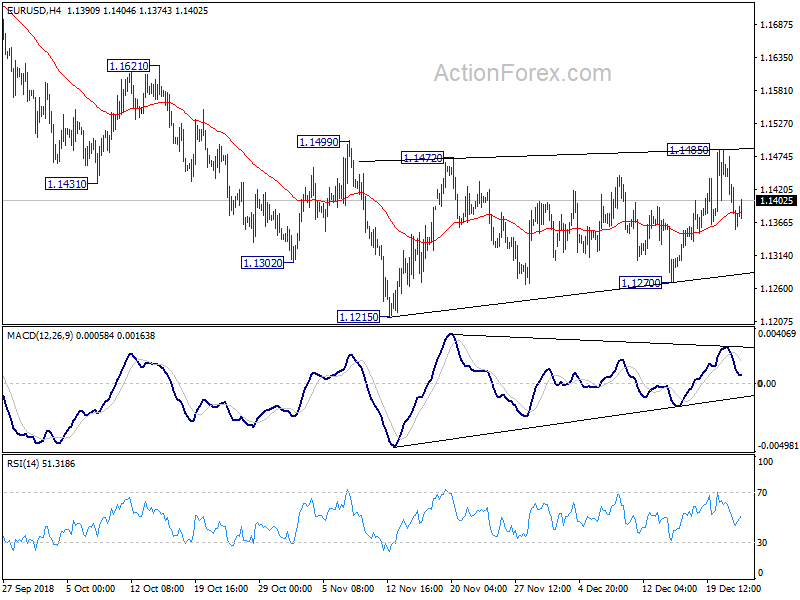
In the bigger picture, as long as 1.1814 resistance holds, down trend down trend from 1.2555 medium term top is still in progress and should target 61.8% retracement of 1.0339 (2017 low) to 1.2555 at 1.1186 next. Sustained break there will pave the way to retest 1.0339. However, break of 1.1814 will confirm completion of such down trend and turn medium term outlook bullish.
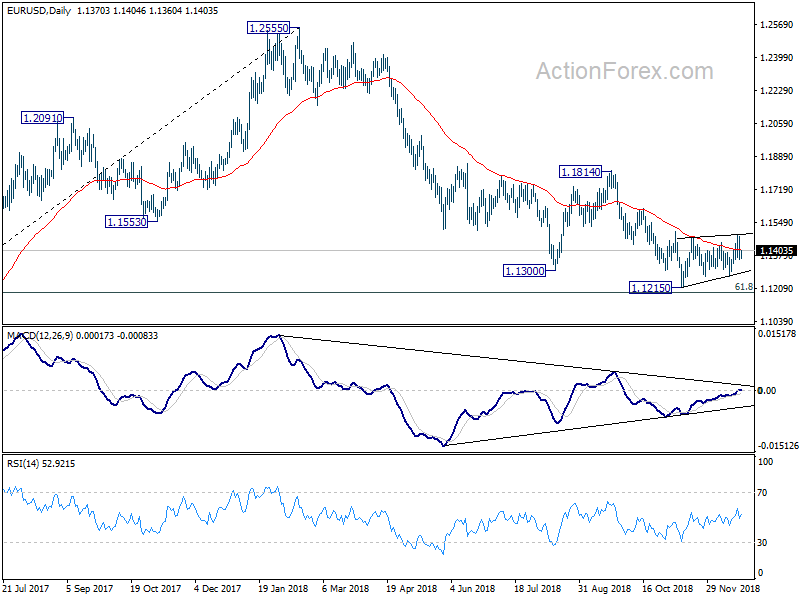
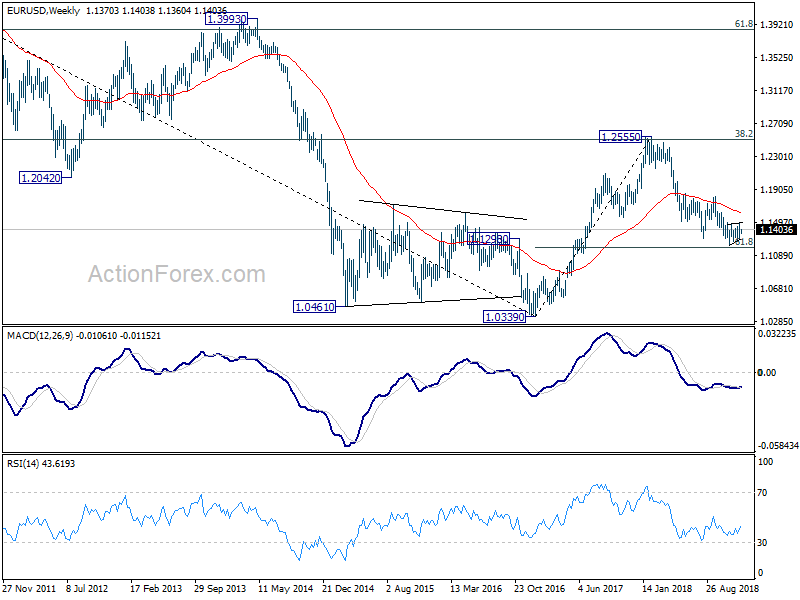
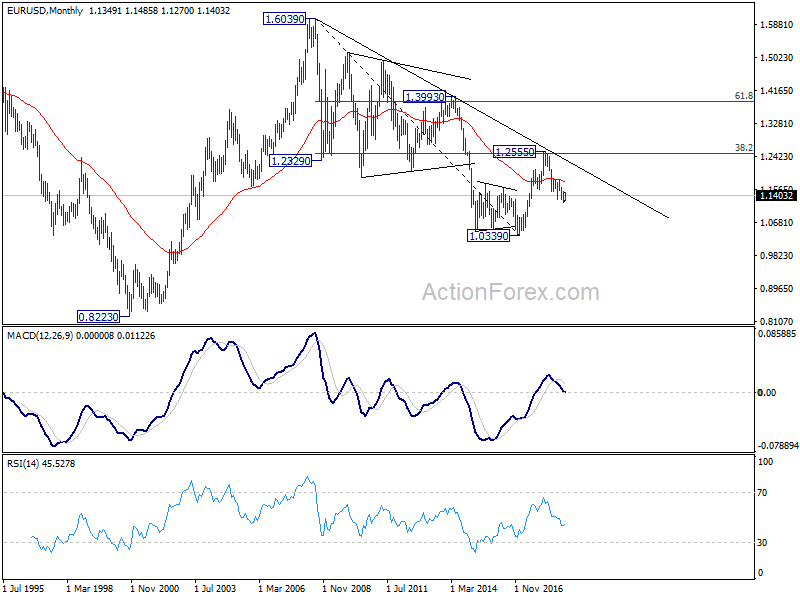
In the long term picture, the rejection from 38.2% retracement of 1.6039 to 1.0339 at 1.2516 argues that long term down trend from 1.6039 (2008 high) might not be over yet. EUR/USD is also held below decade long trend line resistance. Firm break of 61.8% retracement of 1.0339 to 1.2555 at 1.1186 should at least bring a retest on 1.0339 low. This will remain the favored case as long as 1.1814 resistance holds.
USD/JPY Weekly Outlook
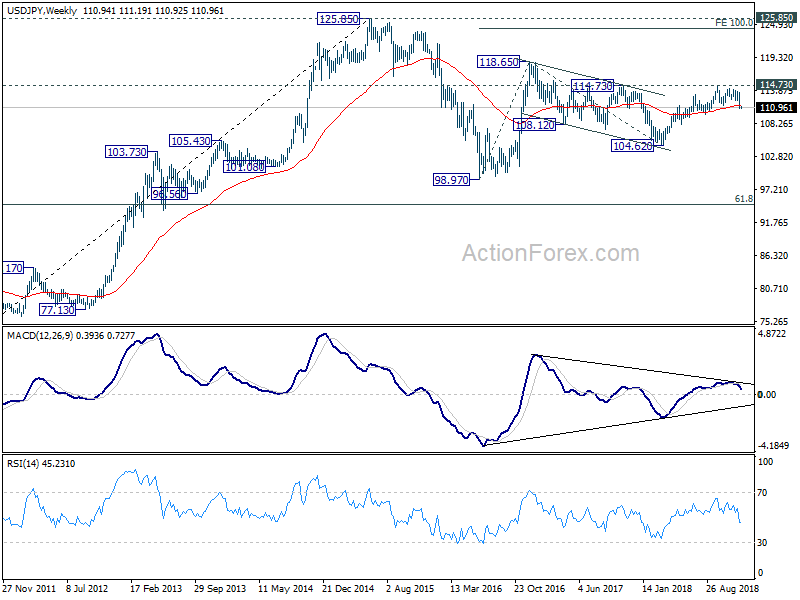
USD/JPY dropped to as low as 110.81 last week as the corrective pattern from 114.54 extended. While further decline cannot be ruled out yet, we'd continue to expect strong support from 38.2% retracement of 104.62 to 114.54 at 110.75 to bring rebound. On the upside, break of 111.84 resistance will turn bias back to the upside for 114.20/54 resistance zone. However, sustained break of 110.73 will put focus on 109.76 support next.
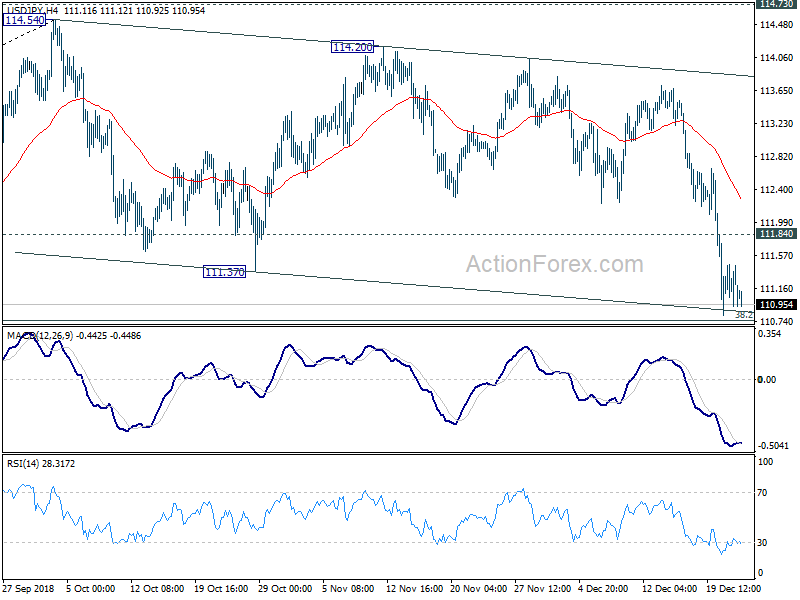
In the bigger picture, corrective fall from 118.65 (2016 high) should have completed with three waves down to 104.62. Decisive break of 114.73 resistance will likely resume whole rally from 98.97 (2016 low) to 100% projection of 98.97 to 118.65 from 104.62 at 124.30, which is reasonably close to 125.85 (2015 high). This will stay as the preferred case as long as 109.76 support holds. However, decisive break of 109.76 will dampen this bullish view and could extend the corrective pattern from 118.65 with another decline.
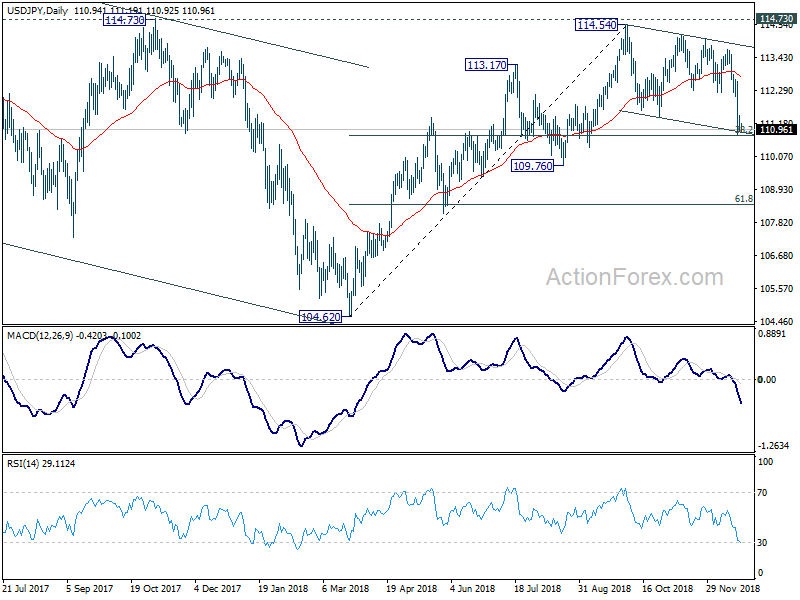
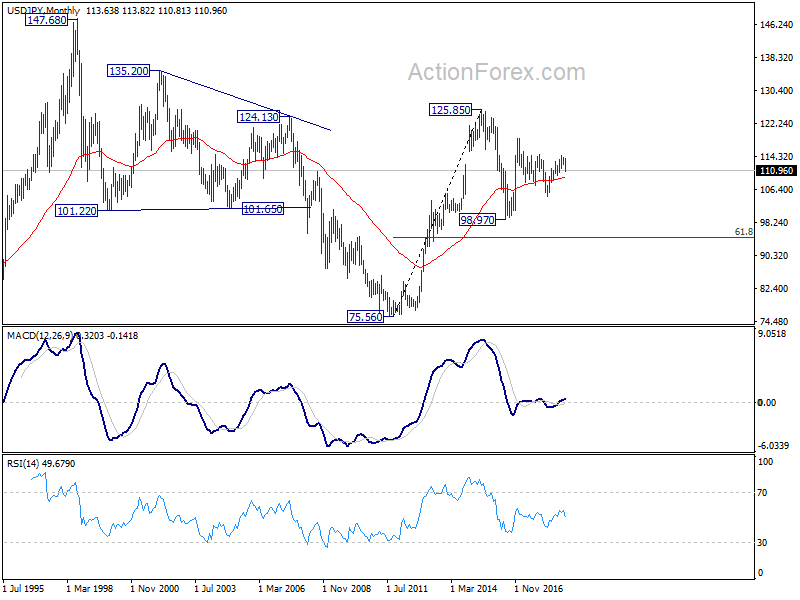
In the long term picture, the rise from 75.56 (2011 low) long term bottom to 125.85 top is viewed as an impulsive move, no change in this view. Price actions from 125.85 are seen as a corrective move which could still extend. In case of deeper fall, downside should be contained by 61.8% retracement of 75.56 to 125.85 at 94.77. Up trend from 75.56 is expected to resume at a later stage for above 135.20/147.68 resistance zone.