Sample Category Title
Investors Expect G20 Summit
The US dollar has not changed a lot against a basket of major currencies. Financial market participants took a wait-and-see position before the G20 summit. First of all, the attention of investors will be focused on the meeting between the US President Donald Trump and China's leader Xi Jinping. The US dollar index (#DX) closed the trading session with a slight increase (+0.02%).
Yesterday, weak economic statistics from the United States were published. Thus, pending home sales index fell by -2.6% in October, while experts expected an increase of 0.8%. Also, investors assess the published FOMC minutes, according to which the Fed leaders consider the need to raise the base interest rate in December. At the same time, the regulator may open a question of slowing down the monetary policy tightening in the future.
Today, weak economic data from China have been also published during the Asian trading session. The index of economic activity in the manufacturing sector (PMI) counted to 50.0 in November, although investors forecasted 50.2.
The "black gold" prices are recovering. At the moment, futures for the WTI crude oil are testing the mark of $51.25 per barrel.
Market Indicators
- Yesterday, sales prevailed in the US stock market: #SPY (-0.23%), #DIA (-0.10%), #QQQ (-0.33%).
- The 10-year US government bonds yield has stabilized. Currently, the indicator is at the level of 3.01-3.02%.
The news feed on 2018.11.30:
- Consumer price index in the Eurozone at 12:00 (GMT+2:00);
- GDP data in Canada at 15:30 (GMT+2:00).
GBPJPY Trades In Upward Sloping Channel In Near-Term But Lacks Long-Term Direction
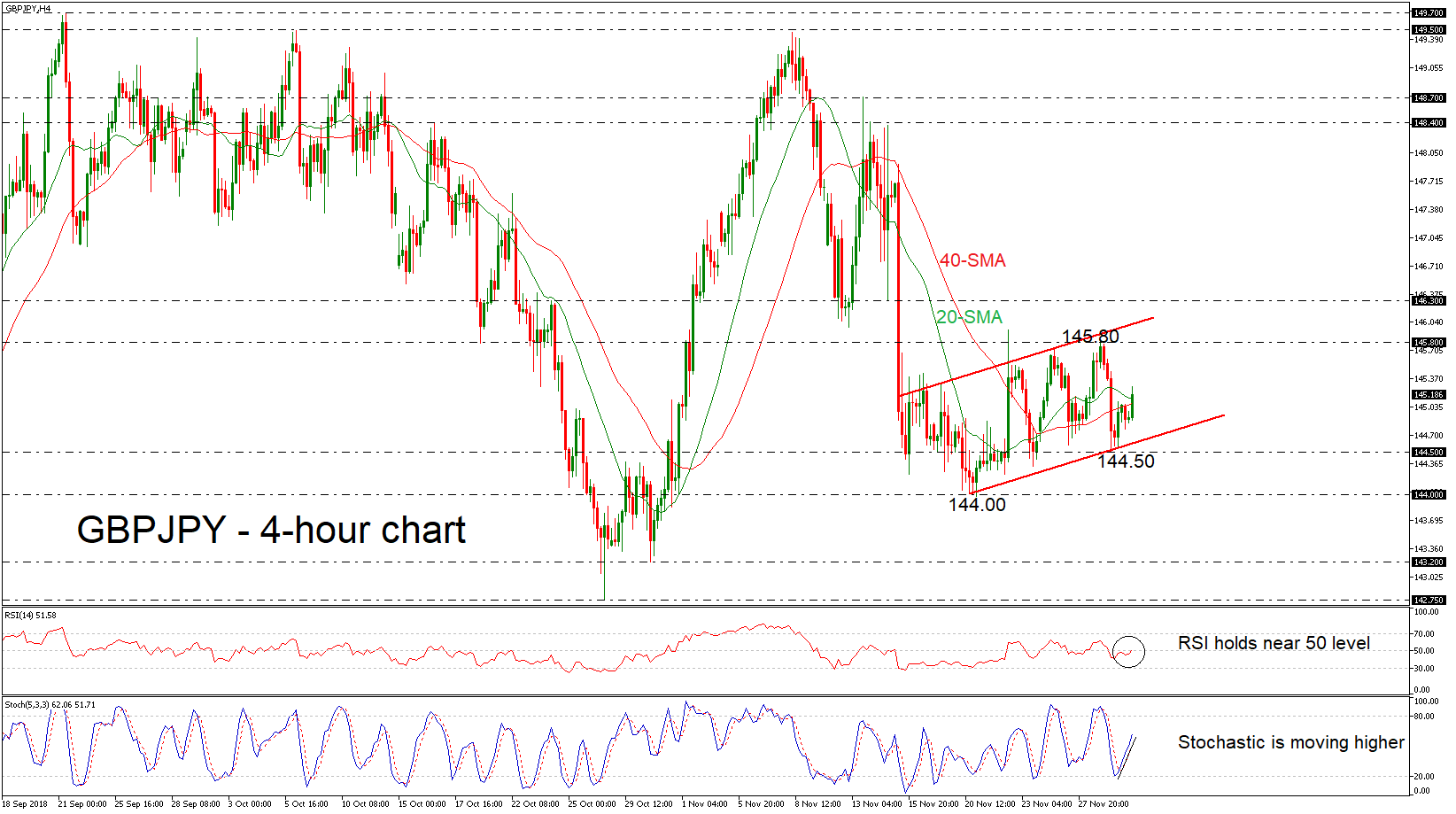
GBPJPY has been developing within an upward sloping channel over the last couple weeks, following the bounce off the 144.00 support level. Moreover, in the daily chart the pair remains in a consolidation area over the last three months with upper boundary the 149.50 resistance and lower boundary the 142.75 support.
Looking at the short-term indicators, the RSI is pointing marginally up in the positive area, while the stochastic oscillator is moving higher, approaching the 80 level.
If there is a successful attempt higher, the next resistance would be at the 145.80 level, taken from the recent highs. A jump above this barrier and an exit from the upward sloping channel would drive prices towards the 146.30 hurdle, achieved by the inside swing bottom on November 14.
On the flipside, immediate support is coming from the 144.50 key level, while even lower, a drop below the channel would send prices until the 144.00 psychological level.
To conclude, GBPJPY entered in a short-term ascending range, trying to pare some losses. Also, in a longer view, the pair lacks a clear directional tendency.
DAX At 1-Week Low As Tension Builds Ahead Of Trump-Xi Meeting
The DAX index has been under pressure throughout the week, and this is the story again in the Friday session. Currently, the DAX is trading at 11,241, down 0.62% on the day. Earlier on Friday, the index dipped to 11,224, its lowest level since November 21. On the release front, German retail sales fell to a 3-month low, with a reading of -0.3%. This was well off the estimate of 0.4%. In the eurozone, inflation levels dipped in November. CPI Flash Estimate dipped to 2.0%, shy of the estimate of 2.1%. Core CPI Flash Estimate followed the same trend, edging lower to 1.0%. This reading missed the forecast of 1.0%. The eurozone unemployment rate remained pegged at 8.1% for a third straight month, the lowest level since December 2008. This was above the estimate of 8.0%. Later in the day, the G-20 summit kicks off in Argentina.
Germany is the locomotive of the eurozone, and when the locomotive loses a gear, the entire train is in trouble. This has been the story in the third and fourth quarters, as weaker German growth has affected the rest of the eurozone. There was more grim economic news on Friday, as retail sales posted its first decline since July. Consumers are holding tighter to the purse strings, which is hurting economic growth. Unsurprisingly, consumer confidence softened in November – the reading of 10.4 points was its lowest level since May 2017.
The ongoing U.S-China trade war has dampened the German export sector, as German companies that export to both the U.S. and China are now facing higher tariffs. Germany’s economy posted a rare decline in the third quarter, with a contraction of 0.2%. Another problem is lower eurozone growth, as weak economic activity in the third quarter appears to have continued into in the fourth quarter. As well, the looming departure of Britain from the European Union and the crisis over the Italian budget have weighed on business and consumer confidence levels in Germany.
Next up, it’s a tête-à-tête between President Trump and Chinese President Xi Jinping in Buenos Aires. The two leaders will meet on the sidelines of the G-20 summit, with the two leaders sure to discuss the full-blown trade war between the world’s two largest economies. President Trump has taken a tough line ahead of the summit, threatening to raise the tariffs from 10 percent to 25 percent on $250 billion worth of Chinese goods. If Trump makes good on his threat, we could see a sharp downturn in the stock markets. However, the unpredictable Trump is known to prefer to reach a deal whenever possible, so his sharp rhetoric could be some grandstanding ahead of his crucial meeting with Xi. If the meeting goes well and the U.S. desists from further tariff action, risk appetite will improve and the stock markets would likely climb.
EUR/USD – Euro Shrugs Off Soft German Retail Sales
EUR/USD has ticked lower in the Thursday session, after posting slight losses on Wednesday. Currently, the pair is trading at 1.1378, down 0.13% on the day. On the release front, German retail sales fell to a 3-month low, with a reading of -0.3%. This was well off the estimate of 0.4%. In the eurozone, CPI is expected to edge lower to 2.1% and the unemployment rate is forecast to dip to 8.0%. In the U.S., there are no major indicators. Chicago PMI is expected to edge up to 58.6 points. As well, the G-20 begins a 2-day summit in Argentina.
German numbers have been sagging, and there was more grim news on Friday, as retail sales posted its first decline since July. Consumers are holding tighter to the purse strings, which is hurting economic growth. Unsurprisingly, consumer confidence softened in November – the reading of 10.4 points was its lowest level since May 2017.
The ongoing U.S-China trade war has dampened the German export sector, as German companies that export to both the U.S. and China are now facing higher tariffs. Germany’s economy posted a rare decline in the third quarter, with a contraction of 0.2%. Another problem is lower eurozone growth, as weak economic activity in the third quarter appears to have continued into in the fourth quarter. As well, the looming departure of Britain from the European Union and the crisis over the Italian budget have weighed on business and consumer confidence levels in Germany.
Surprise! Federal Reserve Chair Jerome Powell caught the markets off guard on Wednesday. Powell was unexpectedly dovish in his remarks at an event in New York, saying that the current benchmark rate of 2-2.5 percent is “just below” the neutral range. This is in sharp contrast to Powell’s remarks just last month, when he said that rates were “a long way from neutral”. The obvious U-turn is likely due to the change in economic conditions in recent weeks – GDP has been slowing, the stock markets are down and oil prices have fallen. The Fed may have decided that this required an easing up on rate hikes in 2019, and Powell delivered this message to the markets. Just a few weeks ago, there was talk of up to four rate hikes in 2019, but this could be scaled back to just one or two rate increases. Despite Prowell’s new dovish stance, the odds of a hike in December have actually increased this week, with the CME pegging the odds at 82%.
The Fed Changes Strategy
The Fed changes strategy
The US Federal Reserve Bank has not put an end to its rate-hike cycle, it is just moving away from well-telegraphed moves. After eight hikes over the last three years, the Fed is at an inflection point against the backdrop of slowing global growth and weaker inflation pressures. The Fed's is switching from well-telegraphed monetary decisions to a more data dependent, on-the-go approach. Starting next year, Jerome Powell will hold eight press conferences, compared to only four this year.
Investors have become increasingly negative about inflation. The 2-year breakeven inflation rate eased more than 50bps to 1.285% in less than two months. Against such a backdrop, investors are switching attention towards the other central banks and more particularly the European Central Bank, which is expected to end its quantitative easing program by the end of the year. EUR/USD bounced back and stabilised around 1.14 over the last couple of days. We maintain our bullish EUR/USD view; however, one should keep an eye on the ongoing Brexit negotiations and Italy/EU clash.
October's core personal consumption expenditure – the Fed's favourite gauge of inflation – eased to 1.8% annually versus 1.9% expected and a downwardly revised figure of 1.9% in the previous month. And not just inflation has been disappointing. Last week, the economic surprise index went negative for the time since October 2017.
EU shares hold, despite trade tension
On the verge of closing the week in positive territory following two negative weeks, European equities are trading in negative territory. Investors hope a deal on the Italian budget is coming, as the Italian lower house of parliament is expected to vote on 3-4 December on the 2019 budget plan. Procedural sanctions from the EU Commission are not expected to come into effect before January, leaving a little room for Italian Premier Giuseppe Conte to secure agreement from deputies Matteo Salvini and Luigi Di Maio. We don't expect the Italian Eurosceptic coalition to make large concessions. Despite a positive closing for Asian shares in advance of the G20 summit, European indexes are heading lower on Friday. The Euro Stoxx 50 is trading at -0.28%, UK FTSE 100 -0.53%, French CAC 40 -0.42% and German DAX -0.42%. EUR/USD is losing ground, trading at 1.1386 (-0.06% intraday) and heading along 1.1350 short-term.
EUR/JPY Slight Downside Momentum Likely
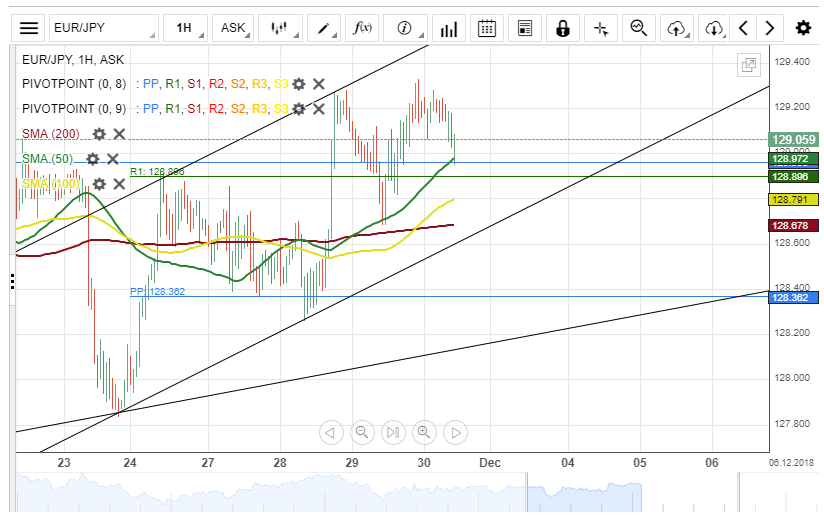
The EUR/JPY currency pair tested the 50-hour simple moving average at 128.67 on Thursday.
As apparent on the 1(H) chart, the currency pair could not dash through the SMAs at the beginning of today's session. Presently, the exchange rate is moving toward the upper boundary of a one-week ascending channel pattern at 129.40.
Everything being equal, it is likely that the common European currency could aim for a re-tests of the 50-, 100-, and 200-hour SMAs within this session.
However, it is important to note that a support cluster formed by the combination of the weekly and the monthly PPs at 128.93 could hinder such move today.
AUD/USD Traded Sideways
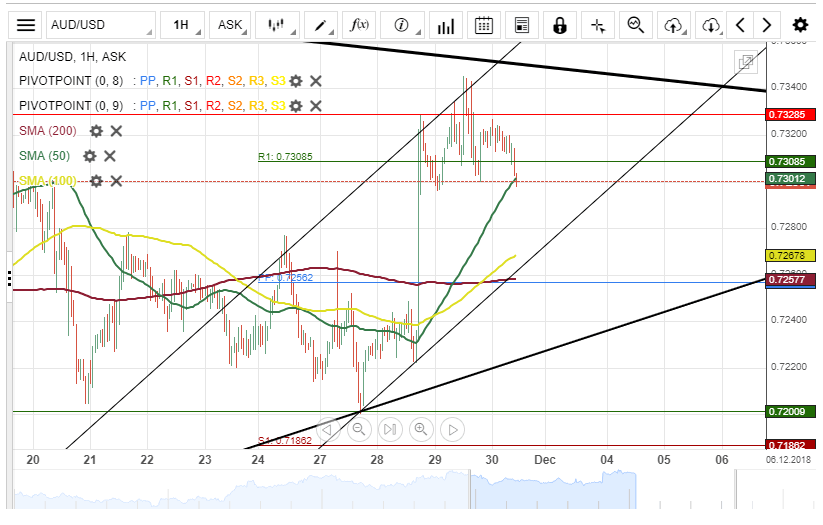
The Australian Dollar is trading between the monthly pivot point at 0.7328 and the weekly R1 at 0.7308 against the US Dollar.
The exchange rate reversed from the upper boundary of a one-week ascending channel pattern at 0.7340 during the end of Thursday's session. However, the currency pair is still pressured north by the three SMAs, which are located below the price level.
Furthermore, technical indicators suggest that the currency exchange rate will continue its upside movement today.
The potential target for the pair will be near a psychological resistance level at the 0.7400 area.
USD/CAD Moving Toward Next Swing High
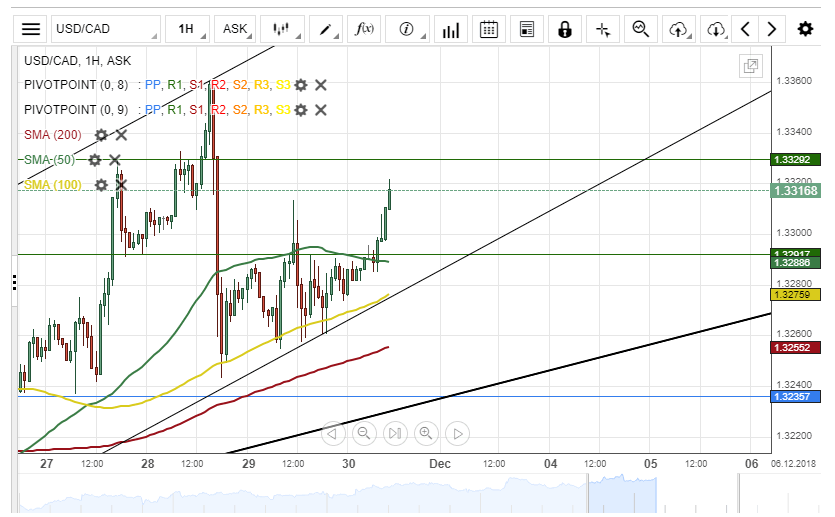
The USD/CAD currency pair has been trading in an ascending channel pattern since the beginning of this week.
As shown on the chart, the exchange rate was stranded between SMAs during the morning hours of Friday's session. However, the pair is currently testing the resistance level formed by the 50-hour simple moving average and the monthly PP at 1.3289.
Moreover, technical indicators suggest that bullish momentum might continue to dominate the currency exchange rate today. The potential target will be at a swing high of 1.3360.
NZD/USD Surge Still Likely
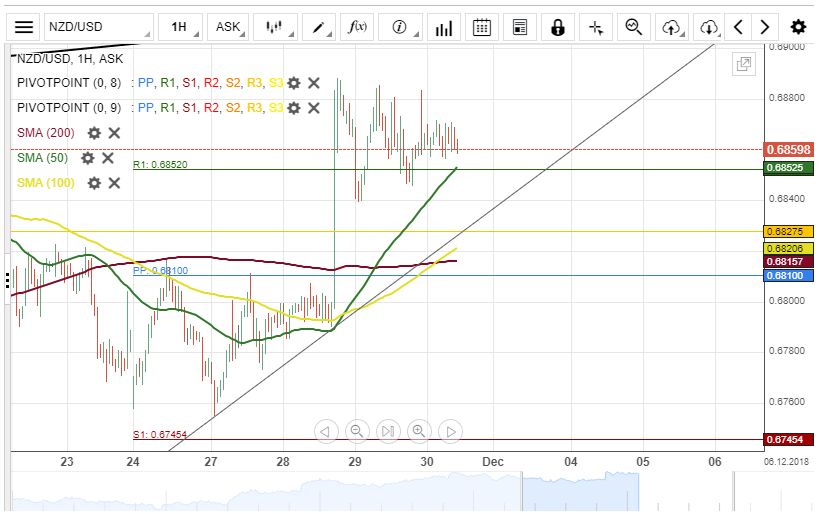
The New Zealand Dollar versus the US Dollar traded above the weekly R1 at 0.6852 during Thursday's session.
Currently, the 50-hour simple moving average is guiding the NZD/USD currency exchange rate toward the upper boundary of a medium-term ascending channel at 0.6900.
By and large, it is expected that the Kiwi continues to gain strength against the Greenback today.
The potential target for the exchange rate will be near a psychological resistance level at the 0.6900 mark.
Elliott Wave Analysis: EURUSD Update
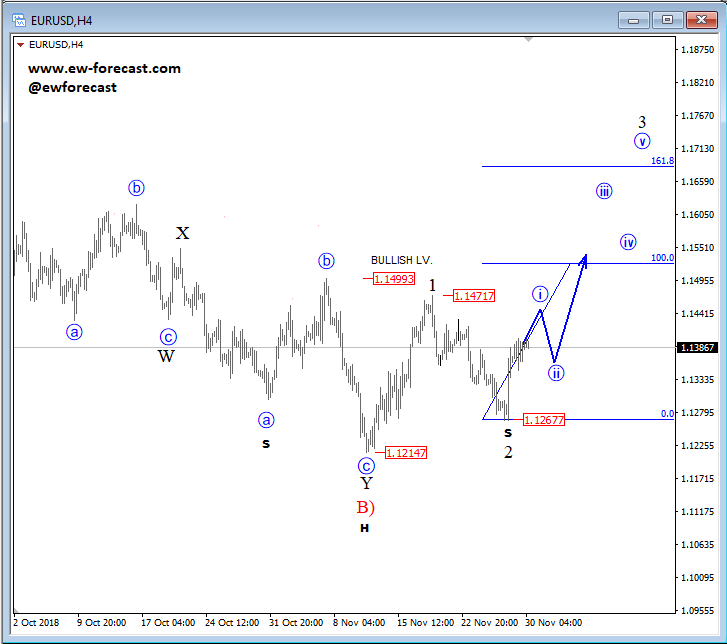
EURUSD has turned nicely higher recently from the 1.127 level which was quite expected as we were tracking a minor pullback labelled as wave 2. Current rally we now labelled as start of a new, five-wave cycle which can unfold in the next couple of days or weeks, labelled as wave 3 that can take price towards the 1.170 region. That said a break above the 1.150 region will confirm more upside.
EURUSD, 4h