

Sample Category Title
GBP/USD Mid-Day Outlook
Daily Pivots: (S1) 1.2743; (P) 1.2797; (R1) 1.2839; More...
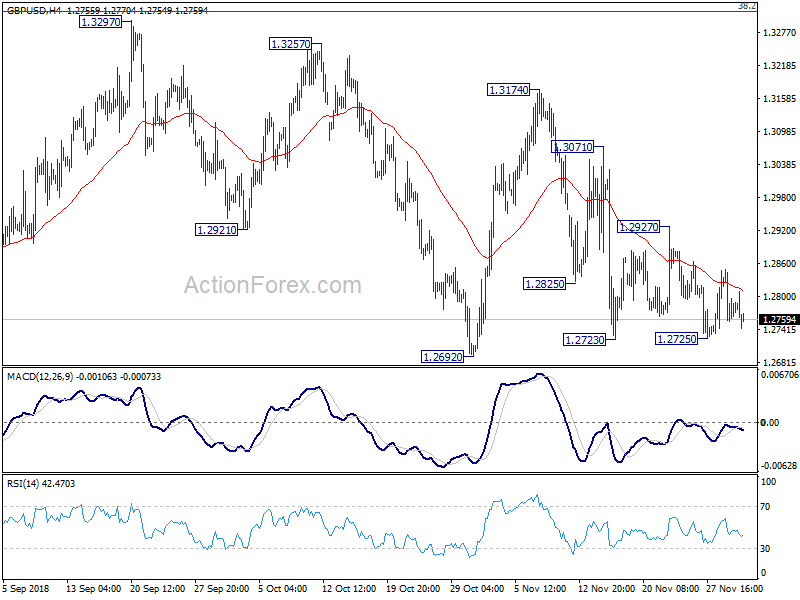
No change in GBP/USD's outlook as it's staying in range of 1.2725/2927. Intraday bias remains neutral first. On the upside, above 1.2927 resistance will bring stronger rebound to 1.3071 and possibly above. On the downside, break of 1.2725 should extend recent fall to retest 1.2661 key support. After all, price actions from 1.2661 are viewed as a consolidation pattern. Even in case of strong rebound, upside should be limited by 1.3316 fibonacci level to bring down trend resumption eventually.
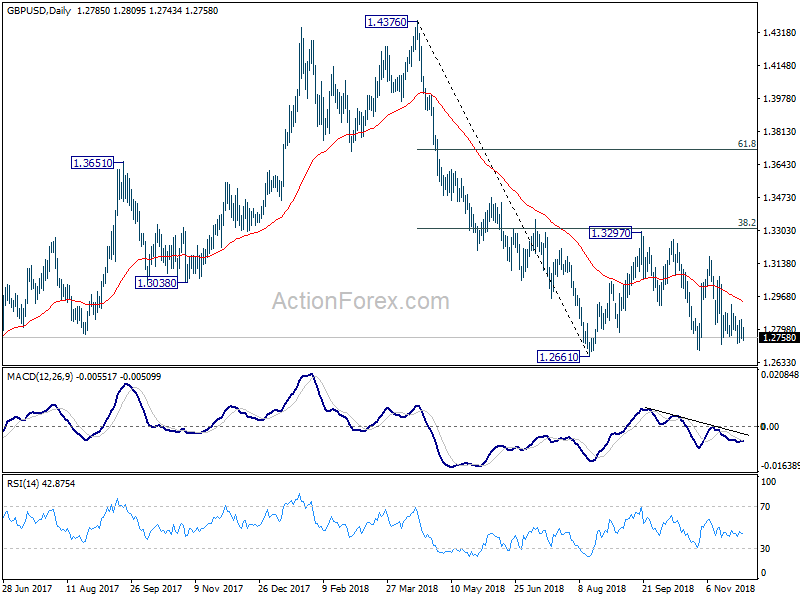
In the bigger picture, whole medium term rebound from 1.1946 (2016 low) should have completed at 1.4376 already, after rejection from 55 month EMA. The structure and momentum of the fall from 1.4376 argues that it's resuming long term down trend. And this will be the preferred case as long as 38.2% retracement of 1.4376 to 1.2661 at 1.3316 holds. However, firm break of 1.3316 would bring stronger rebound to 61.8% retracement at 1.3721. And, the eventual depth of the fall from 1.4376, and the chance of hitting 1.1946 low, will depend on the strength of the interim corrective rebound from 1.2661.
Canada: Ok Headline, Not-So-Ok Details in Third Quarter GDP
Canada's economy grew 2.0% (q/q annualized) during the third quarter of 2018. This was broadly in line with both market and our expectations. Healthy price gains, notably for exports and business investment, helped send nominal GDP growth to 5.0%.
International trade was again in the driver's seat. In contrast to the prior period, it was less about export strength (Q3: 0.9%; down from 13.0% in Q2), and more about import weakness (Q3: -7.8%, Q2: +5.9%). Softness in imports can be put down to large contractions in refined energy products as well as aircraft and other transportation equipment. With imports down, less production went into inventories, with this category subtracting 1.3 percentage points from growth.
Consumer spending moderated, as overall household consumption rose just 1.2%, held back by durable goods spending (-2.7%) as Canadians bought fewer vehicles for a third straight quarter.
The biggest surprise in this report was a marked pull-back of non-residential business investment (-7.1%). Investment in non-residential structures fell 5.2% q/q, while machinery and equipment spending was down 9.8%. Despite a marked recovery in sales activity, residential investment fell by 5.9% as both new construction and renovation activity pulled back.
On the income side, compensation of employees rose 2.7% (4.0% on a year-on-year basis), leaving overall wage gains over the quarter at a modest 2.2% year-on-year. The household savings rate rose to 4.0% from an upwardly revised 3.4% in Q1.
Looking at the monthly data for September, there was not much momentum going into the end of the year. GDP pulled back -0.1% as just half of major industries expanded. It was largely down to goods production (-0.7%) as oil and gas extraction pulled back, hit in part by maintenance work. Solid gains in services (+0.2%) was not enough to keep the headline in positive territory.
Key Implications
Gulp. The headline may have matched expectations, but the details definitely disappointed. It is hardly an encouraging sign when the bulk of your growth comes from a contraction of imports, leaving final domestic demand negative for the first time since early 2016.
If there is an area of particular disappointment in this report, it has to again be business investment. Some headwind due to USMCA was to be expected, but the sizeable contraction was not, particularly in light of strong sentiment indicators and elevated capacity utilization. If there is a silver lining, it is that investment in the very volatile aircraft and other transportation equipment was a significant drag, an area that we don't consider as providing a signal regarding the underlying trend.
This report was pretty much spot on Bank of Canada expectations, at least for the headline, but will likely have less bearing than normal on their deliberations. Sure to be front and center instead are commodity price developments that are hammering Canadian producers. As discussed in our recent report, we expect the resulting production cuts to hit Q4 growth, with a full recovery not expected until at least mid-2019. This creates a risk to the outlook which means that not only is December's decision bound to be a hold, odds are January 2019 will see a pause as well. That the details of today's report are so soft only serves to reinforce this view.
EUR/USD Mid-Day Outlook
Daily Pivots: (S1) 1.1361; (P) 1.1381; (R1) 1.1415; More.....
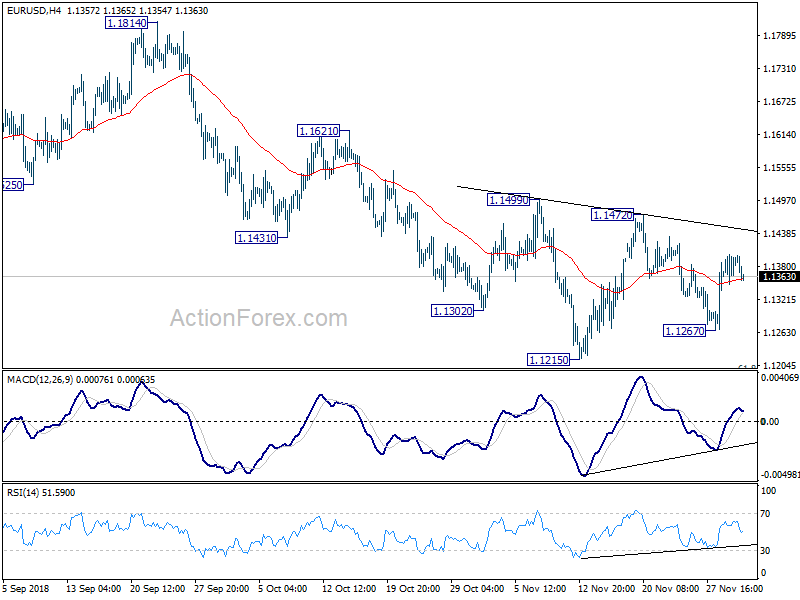
EUR/USD weakest mildly today but it's after all, staying in range of 1.1267/1472. Intraday bias remains neutral for the moment. On the upside, decisive break of 1.1472 resistance will complete a head and shoulder bottom pattern (ls: 1.1302; h: 1.1215; rs: 1.1267). That will indicate near term reversal and bring stronger rise back to 1.1814 resistance. On the downside, below 1.1267 will turn bias back to the downside for 1.1215 low.
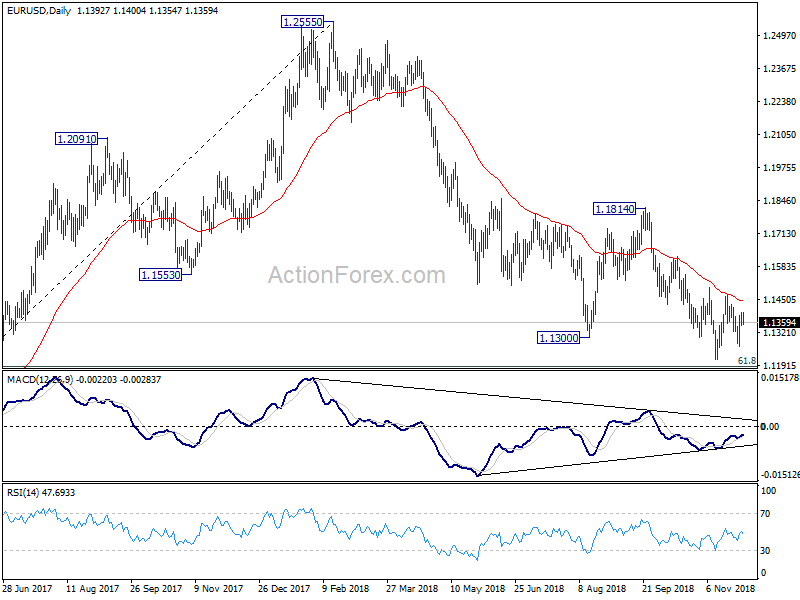
In the bigger picture, down trend from 1.2555 medium term top is still in progress and should target 61.8% retracement of 1.0339 (2017 low) to 1.2555 at 1.1186 next. Sustained break there will pave the way to retest 1.0339. On the upside, break of 1.1814 resistance is now needed to confirm medium term bottoming. Otherwise, outlook will stay bearish in case of strong rebound.
Euro Lower after Inflation Data, Dollar Pare Losses ahead of Trump-Xi Meeting
The forex markets are generally staying in familiar range as traders turn cautious ahead of G20 summit and, of course, the highly anticipated Trump-Xi summit. There are rumors flying around on whether there will be a deal of no deal. But it's no to productive to guess at this point. We'll see soon. For today, New Zealand Dollar is the strongest one. Dollar follows as it continues to pare Powell inspired losses. Euro is the weakest one for today after weaker than expected inflation and employment data. Sterling and Swiss Franc follow as the next weakest.
In other markets, major European indices are trading generally at the time of writing. FTSE is down -0.59%, DAX down -0.38%, CAC down -0.20%. German 10 year yield is down -0.012 at 0.312. Italian 10 year yield is down -0.002 at 3.199. Spread remains below 300. Earlier today, all major indices closed with gains. Nikkei rose 0.40%, Hong Kong HSI rose 0.21%, China Shanghai SSE rose 0.81%, Singapore Strait Times rose 0.26%.
Released in US session, Canadian GDP dropped -0.1% mom in September, below expectation of 0.1% mom rise. IPPI rose 0.2% mom in October while RMPI dropped -2.4% mom. Canada, Mexico and the US have just signed the USMCA agreement formally.
Euro mildly lower as inflation slowed, unemployment rate unchanged
Euro dips mildly against Dollar and Yen after weaker than expected inflation reading. But it's so far steady against others. Eurozone headline CPI dropped to 2.0% yoy in November, down from 2.2% yoy and missed expectation of 2.0% yoy. CPI core slowed to 1.0% yoy, down from 1.1% yoy and missed expectation of 1.1% yoy.
Also Eurozone unemployment rate was unchanged at 8.1% in October, missed expectation of 8.0%. Highest unemployment rates were seen in Greece at 18.9% in August, and Spain at 14.8%.
Italian Conte and Tria working with EU to avoid excessive deficit procedure
Italian newspaper Il Messaggero reported that Prime Minister Giuseppe Conte and Economy Minister Giovanni Tria are working on a proposal to lower 2019 budget deficit target from 2.4% of GBP to 2.0%. The proposals could involve delaying the citizen's income program by several months.
The Corriere also reported that Tria said "we can still avoid an infringement procedure", and the coalition government is discussing the budget proposal with European Commission.
European Commission President Jean-Claude Juncker also said in a press conference that the "atmosphere is good" regarding the discussion with Italy. And, he added "we are making progress".
Swiss KOF dropped to 99.1, foreign demand to weaken in coming months
Swiss KOF economic barometer dropped to 99.1 in November, down from 100.2 and missed expectation 99.8. It's the second consecutive month of decline and is now below long term average again.
KOF noted that "this month's decline was in particular due to less favourable export prospects. The impetus from foreign demand is likely to weaken somewhat in the coming months." Also, "the development in the banking and insurance sector may lose some of its momentum." On the other hand, there's "slight support" from construction sector and private consumption. And, manufacturing is also "resisting downward tendency".
Japan industrial production rose 2.9%, strongest since Jan 2015
Japan industrial production rose strongly by 2.9% mom in October, way above expectation of 1.2% mom. It's also more than enough to reverse the -0.4% mom contraction in September. Besides, it's the fastest month-on-month gain since January 2015. Nevertheless, it's noted by economists that the strong reading was mainly a reaction to supply-chain disruptions caused by natural disasters. The rebound should be considered a one-off and outlook remains dim ahead on global slowdown.
Also from Japan, unemployment rate edged up to 2.4% in October, above expectation of 2.3%. Tokyo CPI core was unchanged at 1.0% yoy in November, matched expectations. Consumer confidence dropped -0.1 to 42.9 in November. Housing starts rose 0.3% yoy in October.
Released in Asian session, China PMI manufacturing dropped -0.2 to 50 in November. PMI non-manufacturing dropped -0.5 to 53.4. Australia Private sector credit rose 0.4% mom in October. New Zealand building permits rose 1.5% mom in October. UK Gfk consumer sentiment dropped -2 to -13 in November.
EUR/USD Mid-Day Outlook
Daily Pivots: (S1) 1.1361; (P) 1.1381; (R1) 1.1415; More.....
EUR/USD weakest mildly today but it's after all, staying in range of 1.1267/1472. Intraday bias remains neutral for the moment. On the upside, decisive break of 1.1472 resistance will complete a head and shoulder bottom pattern (ls: 1.1302; h: 1.1215; rs: 1.1267). That will indicate near term reversal and bring stronger rise back to 1.1814 resistance. On the downside, below 1.1267 will turn bias back to the downside for 1.1215 low.
In the bigger picture, down trend from 1.2555 medium term top is still in progress and should target 61.8% retracement of 1.0339 (2017 low) to 1.2555 at 1.1186 next. Sustained break there will pave the way to retest 1.0339. On the upside, break of 1.1814 resistance is now needed to confirm medium term bottoming. Otherwise, outlook will stay bearish in case of strong rebound.
Economic Indicators Update
| GMT | Ccy | Events | Actual | Forecast | Previous | Revised |
|---|---|---|---|---|---|---|
| 21:45 | NZD | Building Permits M/M Oct | 1.50% | -1.50% | -1.30% | |
| 23:30 | JPY | Jobless Rate Oct | 2.40% | 2.30% | 2.30% | |
| 23:30 | JPY | Tokyo CPI Core Y/Y Nov | 1.00% | 1.00% | 1.00% | |
| 23:50 | JPY | Industrial Production M/M OCt P | 2.90% | 1.20% | -0.40% | |
| 00:01 | GBP | GfK Consumer Confidence Nov | -13 | -11 | -10 | |
| 00:30 | AUD | Private Sector Credit M/M Oct | 0.40% | 0.40% | 0.40% | |
| 01:00 | CNY | Manufacturing PMI Nov | 50 | 50.2 | 50.2 | |
| 01:00 | CNY | Non-manufacturing PMI Nov | 53.4 | 53.8 | 53.9 | |
| 05:00 | JPY | Consumer Confidence Index Nov | 42.9 | 43.3 | 43 | |
| 05:00 | JPY | Housing Starts Y/Y Oct | 0.30% | 0.20% | -1.50% | |
| 08:00 | CHF | KOF Leading Indicator Nov | 99.1 | 99.8 | 100.1 | 100.2 |
| 10:00 | EUR | Eurozone Unemployment Rate Oct | 8.10% | 8.00% | 8.10% | |
| 10:00 | EUR | Eurozone CPI Estimate Y/Y Nov | 2.00% | 2.10% | 2.20% | |
| 10:00 | EUR | Eurozone CPI Core Y/Y Nov A | 1.00% | 1.10% | 1.10% | |
| 13:30 | CAD | GDP M/M Sep | -0.10% | 0.10% | 0.10% | |
| 13:30 | CAD | Industrial Product Price M/M Oct | 0.20% | -0.50% | 0.10% | 0.20% |
| 13:30 | CAD | Raw Materials Price Index M/M Oct | -2.40% | -5.20% | -0.90% | -1.00% |
| 14:45 | USD | Chicago PMI Nov | 58.5 | 58.4 |
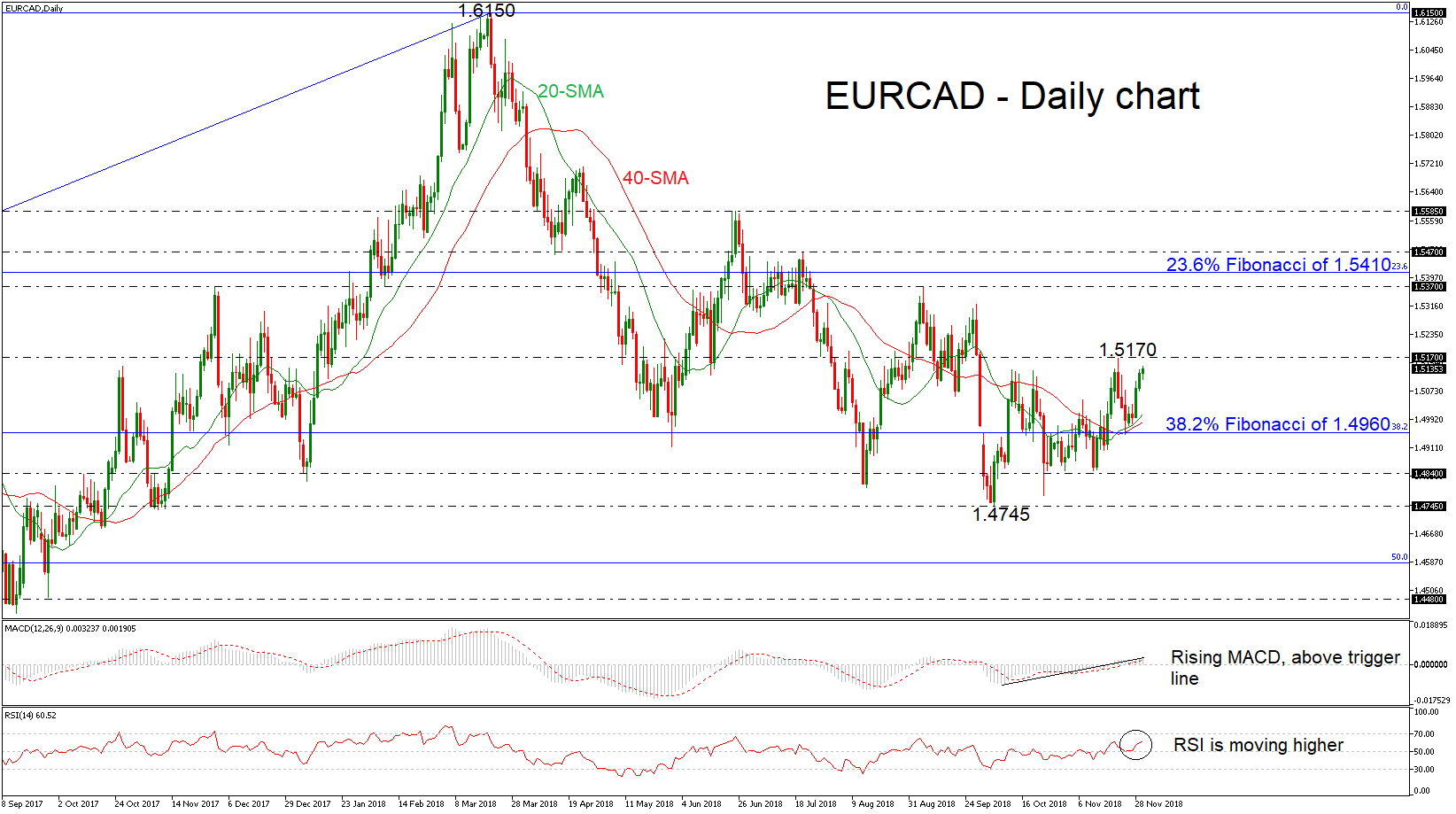
EURCAD Shows Strength But Outlook Still Negative
EURCAD is looking more positive over the last couple of days as prices have climbed back above the 20- and 40-simple moving averages (SMAs) in the daily timeframe. The rebound on the 38.2% Fibonacci retracement level of the upleg from 1.3020 to 1.6150, near 1.4960 drove prices higher in the near term, but the main structure remains negative.
Technically, the pair could gain further upside in the short-term as the MACD oscillator is strengthening its bullish momentum above the zero line and the RSI indicator is heading higher above its neutral threshold of 50.
If prices are able to break the 1.5170 resistance level, identified by the latest highs in the past few sessions, the risk would shift to the upside, with the 1.5370 barrier coming into focus. Slightly higher, the 23.6% Fibonacci mark of 1.5410 could come under the radar as well.
Should the pair manage to drop lower, immediate support could come from the 38.2% Fibonacci of 1.4960. A break below this region may open the way towards the 1.4840 mark and then until the 1.4745 support.
To summarize, EURCAD looks slightly bullish in the very short-term, while in the long-term the picture is seen bearish.
British Pound Dips, Investors Eye Trump-Xi Meeting
GBP/USD has edged lower in the Friday session, repeating the trend seen on Thursday. Currently, the pair is trading at 1.2756, down 0.26% on the day. In economic news, it’s a quiet end to the week. British Nationwide HPI improved to 0.3%, above the estimate of 0.1%. In the U.S., Chicago PMI is expected to edge up to 58.6 points.
It is no secret that a hard Brexit will cause a significant downturn in the British economy. This was reiterated on Wednesday by the BoE financial stability report. The report painted a dismal economic picture if Britain and the EU cannot reach a withdrawal agreement. The BoE warned that a no-deal Brexit would cause the economy to decline by 8 percent, with unemployment rising to 7.5 percent and interest rates jumping to 4 percent. As well, the British pound could shrink by some 25 percent. Bottom line? A hard Brexit would be disastrous for the British economy, triggering a recession worse than the one triggered by the financial crisis back in 2008. On the brighter side, the report noted that GDP would actually rise if the U.K. maintained close economic links with the continent after Brexit.
Money FM View from London with Craig Erlam
G-20 leaders have gathered in Argentina for their annual summit, but it’s a critical one-on-one meeting that has the attention of the markets. President Trump and Chinese President Xi Jinping will have a dinner meeting on Saturday. The full-blown trade war between China and the U.S. has taken a bite out of both economies and threatens to derail global economic growth. Will the sides make some progress, or will Trump make good on his threat to slap China with higher tariffs? Given Trump’s unpredictability, it’s anyone’s guess how the meeting will go, but good or bad, traders can expect the equity and currency markets to respond on Monday.
Canadian Dollar Breaks above 1.33, GDP Next
The Canadian dollar has recorded losses in the Friday session. Currently, USD/CAD is trading at 1.3296, up 0.33% on the day. On the release front, Canada releases GDP, a monthly indicator. The markets are predicting a small gain of 0.1% in September, unchanged from the August release. The Raw Materials Price Index is expected to nosedive, with a forecast of -5.2%. In the U.S., Chicago PMI is expected to edge up to 58.6 points. As well, the G-20 begins a 2-day summit in Argentina.
Canadian officials are keeping a nervous eye on the G-20 summit in Argentina. The highlight of the 2-day meeting promises to be the tête-à-tête on Saturday between President Trump and Chinese President Xi Jinping. The full-blown trade war has taken a bite out of both economies and if threatens to dampen global economic growth. Will the sides make some progress, or will Trump make good on his threat to slap China with higher tariffs? Given Trump’s unpredictability, it’s anyone’s guess how the meeting will go, but good or bad, traders can expect the equity and currency markets to respond on Monday.
The Federal Reserve has made a sharp U-turn on monetary policy, catching the markets off guard. Powell was unexpectedly dovish in his remarks at an event in New York, saying that the current benchmark rate of 2-2.5 percent is “just below” the neutral range. This is in sharp contrast to Powell’s remarks just last month, when he said that rates were “a long way from neutral”. The backtrack is likely due to the change in economic conditions in recent weeks – GDP has been slowing, the stock markets are down and oil prices have fallen. The Fed may have decided that this required an easing up on rate hikes in 2019, and Powell delivered this message to the markets. Just a few weeks ago, there was talk of up to four rate hikes in 2019, but this could be scaled back to just one or two rate increases. Despite Powell’s new dovish stance, the odds of a hike in December have actually increased this week, with the CME pegging the odds at 82%.
Italian Conte and Tria working with EU to avoid excessive deficit procedure
Italian newspaper Il Messaggero reported that Prime Minister Giuseppe Conte and Economy Minister Giovanni Tria are working on a proposal to lower 2019 budget deficit target from 2.4% of GBP to 2.0%. The proposals could involve delaying the citizen's income program by several months.
The Corriere also reported that Tria said "we can still avoid an infringement procedure", and the coalition government is discussing the budget proposal with European Commission.
European Commission President Jean-Claude Juncker also said in a press conference that the "atmosphere is good" regarding the discussion with Italy. And, he added "we are making progress".
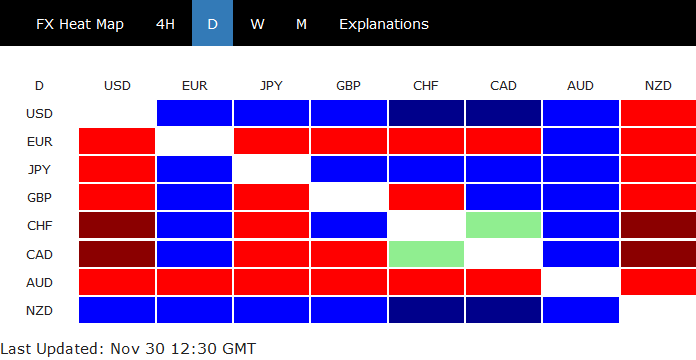
Into US session: Traders turn cautious ahead of Trump-Xi meeting, Aussie and Euro weakest
Entering into US session, New Zealand Dollar is the strongest one for today. It's followed by Dollar, which pares back some of this week's losses. Yen follows as the third strongest. On the other hand, Australian Dollar is the weakest one, partly because traders turn cautious ahead of the Trump-Xi meeting. The outcome of the meeting is highly uncertain and we could seen a lot of volatility next week. Euro is the next weakest following weaker than expected inflation data.
In other markets, major European indices trade broadly lower at the time of writing.
- FTSE is down -0.79%
- DAX is down -0.77%
- CAC is down -0.53%
- German 10 year yield is down -0.013 at 0.311
- Italian 10 yea yield is up 0.008 at 3.209
- German-Italian spread remain below 300
- WTI oil is staying above 50 but lacks momentum for more rebound
- Gold hovers in tight range above 1225
Earlier in Asia
- Nikkei closed up 0.40% at 22351.06
- Hong Kong HSI rose 0.21% to 26506.75
- China Shanghai SSE rose 0.81% to 2588.19
- Singapore Strait Times rose 0.26% to 3177.61
Canadian Prime Minister Justin Trudeau, Mexican President Pana Nieto and US President Donal Trump sign USMCA deal.
Canadian Prime Minister Justin Trudeau, Mexican President Pana Nieto and US President Donal Trump sign USMCA deal.
https://www.youtube.com/watch?v=Z_CnCD54L_M