Sample Category Title
Wall Street Decline Continues As Traders Worry About Growth
The AUD/USD pair was unchanged today after the Reserve Bank of Australia (RBA) released the minutes for the monetary policy meeting held this month. The minutes showed that officials remained optimistic about the country’s economy. This was boosted by recent employment data, which shows a significant increase in the number of people employed. The GDP forecast was left unchanged at 3.5% for 2018 and 2019. It will start to ease at the end of 2020 as the Liquefied Natural Gas (LNG) exports reach capacity. Concerns remain about the low rate of inflation caused partly because of a large policy-induced decline in childcare prices. This month, the Aussie was the second-best performing currency after the Kiwi.
The Wall Street decline continued yesterday as global concerns rise. The biggest decline was in the technology sector, which dropped by 3.79% and was led by chip stocks like NVIDIA and AMD. Other big losers were companies like Apple, which has been cutting orders for the latest iPhones. The only bright spots were in the utilities and real estate industries. This decline will lead to contagion around the world today with the DAX and STOXX set to fall by 60 and 40 points respectively.
Sterling traded higher than yesterday’s intraday low of 1.2720. Its volatility increased as investors remained concerned about Brexit. Talks regarding the UK’s departure from the EU will continue today. Traders will also focus on BOE governor, Mark Carney, who is expected to be questioned by parliament. The governor will answer questions regarding inflation, and what he thinks about the Brexit talks so far.
EUR/USD
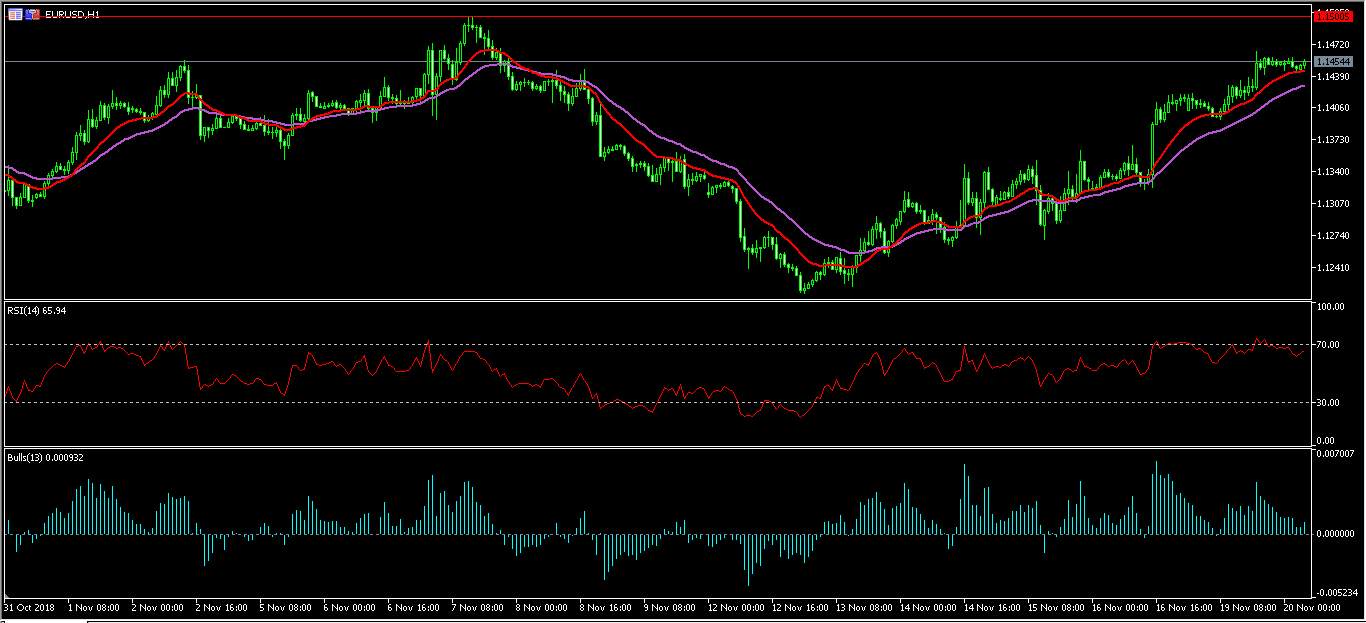
The EUR/USD pair was little moved in the Asian session. The pair is trading at 1.1455, which is near the highest level since November 8. This level is close to the important support level of 1.1500. The double EMA indicators show that the pair will likely continue the upward trend, albeit at a slower rate. The RSI is at 65, which is relatively unchanged. While the upward trend could continue, the pair could also start declining as it nears a key resistance level.
GBP/USD
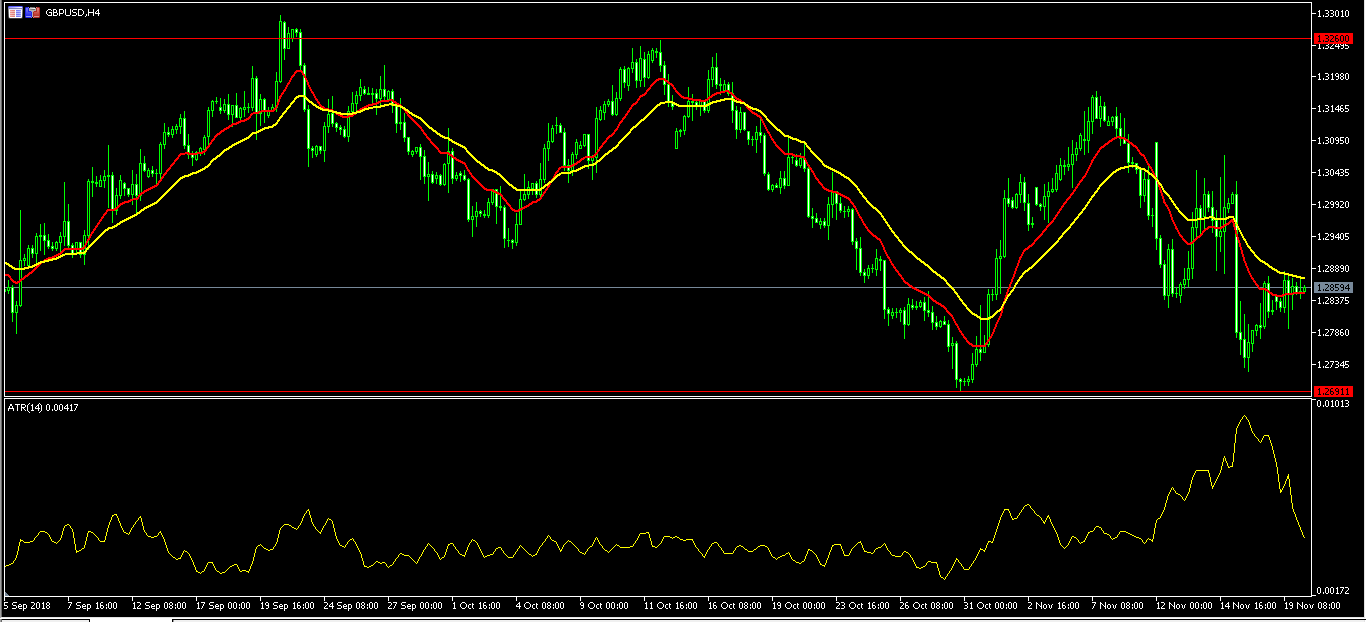
The GBP/USD pair was little moved from yesterday’s close. The pair’s Average True Range (ATR), which measures volatility, declined sharply as shown below. The current price is along the 30 and 15-day exponential moving average. As it has done in the past one week, the pair will likely continue to react to the news on Brexit.
NAS100
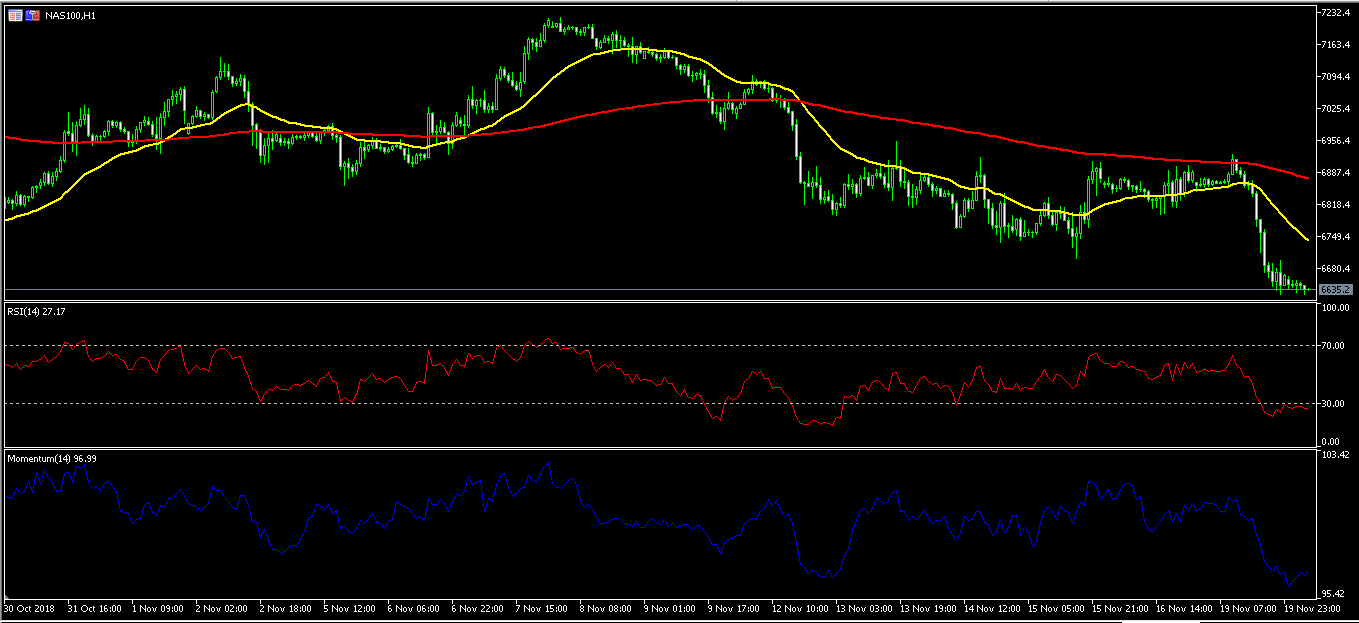
The Nasdaq index continued to decline led by Apple and chip stocks. In recent weeks, Apple’s market capitalization has dropped by more than $200 billion. The Nasdaq’s RSI is currently at 27 on the hourly chart below. The current price is below the 200 and 50-day EMA. The momentum indicator has also fallen sharply as shown below. There is a likelihood that it will get worse for the index before it gets better. The index will likely test the previous low of $6575 before starting to move up.
Currencies: US Stays In The Defensive As Markets Ponder Fed Rate Hike Intentions
Rates: US yield support holds amid sell-off on stock markets
US Treasuries ended near opening levels, finding a balance between technical considerations (key US yield support) and a tech-induced sell-off on US stock markets. Today's eco calendar suggests more meaningless intraday gyrations on core bond markets, caused by the same drivers.
Currencies: US stays in the defensive as markets ponder Fed rate hike intentions
Yesterday, a risk-off sentiment and a poor US NAHB indicator weighed further on the dollar. Today's eco calendar is thin. US housing data might have some more intraday impact than is usually the case. Sterling traders will look out for the BoE assessment/framework in different Brexit scenario's as Carney and Co will defend policy before a Parliamentary committee
The Sunrise Headlines
- US equities opened yesterday's session in deep red as all indices lost ground. Tech shares underperform (Nasdaq -3.03%) as Facebook, Apple and Amazon plunge. Asian stock markets continued the sell-off. China is underperforming.
- Rebels of UK PM May's Tory party seemed to have failed to collect the necessary 48 votes to call for a no-confidence vote, keeping May in place (for now). Today, she will visit Brussels to discuss the direction of future trade
- After Spain stated that it seeks more assurance on Gibraltar before it could back the Brexit deal, France suggested separate EU statements who set out the EU's red lines more clearly than in the current formal political declaration.
- Randal Quarles, a US Fed governor, will become the new chair of the Financial Stability Board for the first three years, followed by Klaas Knot, head of the Dutch Central Bank. Carney, BoE governor, steps down as FSB chair next month.
- US President Trump considers to restrain exports of advanced technologies, going from Artificial Intelligence to Robotics as they are essential to the national security of the US. Trump wants to protect American leadership in innovation.
- In the US, the NAHB Housing Market Index dropped to 60 in November, the lowest in more than two years and down from 68 in October and adding to signs of a slowdown in the US housing market. Markets expected a decrease to 67.
- Today's economic calendar is thin with US housing market data and German PPI. BoE's heavyweights Carney, Haldane and Saunders testify before UK parliament. ECB Weidmann,, Nowotny and Nouy speak
Currencies: US Stays In The Defensive As Markets Ponder Fed Rate Hike Intentions
Fed doubts continue to weigh on USD
Markets still tried to find out yesterday whether the Fed might slow the pace of rate hikes as the policy rate is coming closer to a neutral level. These doubts weighed on the dollar last week and persisted yesterday. The NAHB housing index tumbled from 68 to 60 (67 expected). Is this another indication of a loss of momentum? US yields and USD declined further after the release. A risk-off sentiment, reinforced by selling in the tech sector, supported core bonds. In the current environment, a decline in US yields and tighter interest rate differentials between the US and Germany/Japan are a USD negative. The dollar doesn't profit from the risk-off context. EUR/USD jumped higher after the NAHB housing release and closed at 1.1454. USD/JPY finished at 112.55. This morning, Asian equities join the decline from the US yesterday. The dollar remains in the defensive (DXY near 96.20; EUR/USD near 1.1450; USD/JPY 112.50). Later today, US housing starts and permits might get some more attention than is usually the case after yesterday's NAHB release. Another negative surprise might reinforce market uncertainty on the room for further Fed rate hikes and weigh on the dollar. We had a neutral bias on EUR/USD of late.The USD clearly lost momentum as investors doubt whether the US economy remains strong enough to support 3 additional Fed rate hikes next year. We assume it's too early for a sustained market repositioning away from the USD. US data remain solid, interest rate differentials remain wide and the news from Europe remains mixed at best. We keep the working hypothesis that EUR/USD 1.15/1.1621 resistance won't give away anytime soon. That said some USD warning signs are starting to kick in.
Yesterday, sterling remained in the defensive, but selling was less aggressive than at the end of last week. For now, UK PM May survived the storm and it looks that rebels in her party are not able to trigger a formal leadership vote right now. A difficult road is still ahead for May's Brexit plan, but for now, there is no further escalation. Today, the CBI order data will be published. Several BoE MPC members including BoE's Carney will defend the inflation report before Parliament. Politicians will ask the BoE to clarify its reaction function in case of different Brexit scenarios. We have the impression that the BoE is inclined to guide rates higher in several different scenarios. However, it is far from sure this will help sterling short-term. We stay cautious on sterling going into the Parliamentary vote expected early December
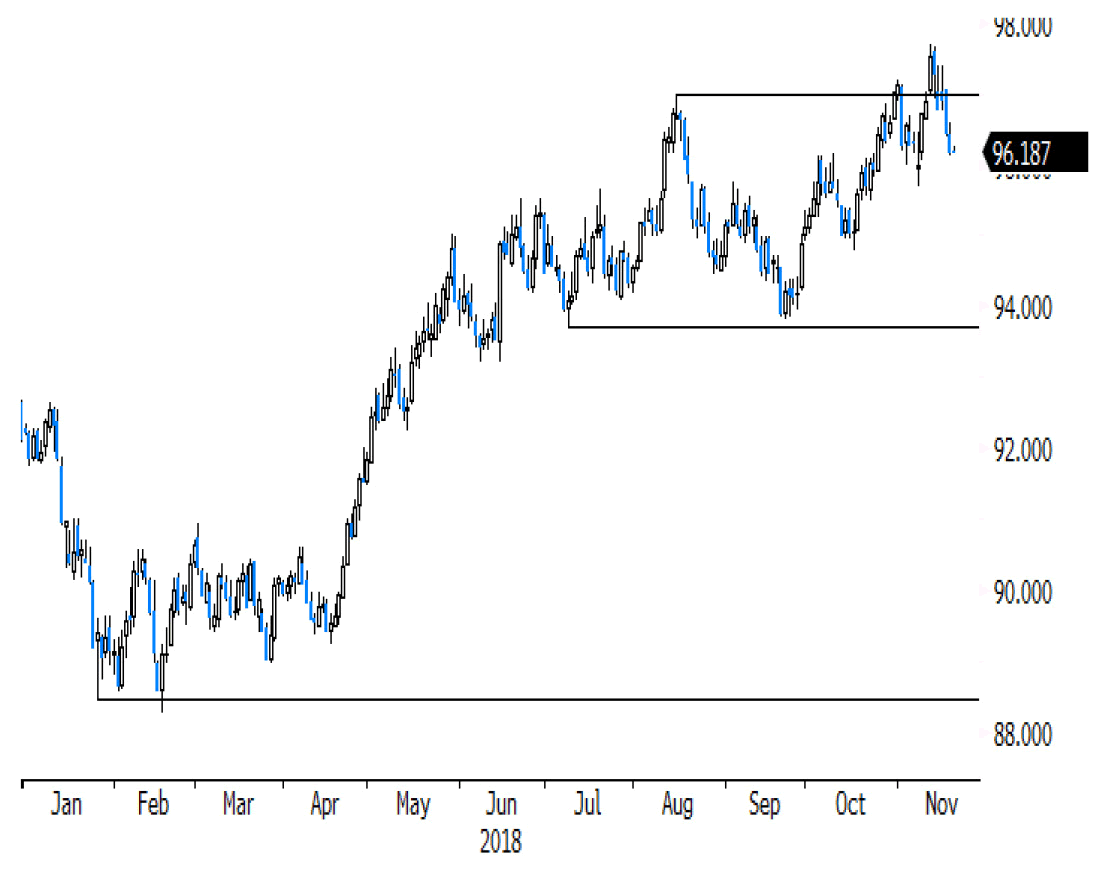
USD (trade-weighted): dollar rally running into resistance
GBPUSD Retains Sideways Movement Between 1.2690 – 1.3255
GBPUSD remains under negative pressure as it declined below the 23.6% Fibonacci retracement level of the downleg from 1.4375 to 1.2660, around 1.3065. Momentum indicators, signal that the market holds in a consolidation mode in the short-term as the RSI indicator is flattening below its threshold of 50, while the MACD oscillator stands below the trigger and zero lines with weak movement.
A bounce up could see immediate resistance at the 20-day simple moving average (SMA), which hovers near the 1.2900 handle, while even higher the 40-day SMA around 1.2985 could act as major resistance as well. Slightly higher, the 23.6% Fibonacci could be the next level to have in focus, while if this fails to hold, bullish actions may then try to overcome the previous peak and touch the 1.3170 resistance.
On the flipside, the focus will shift to the immediate support area between the 14-month low of 1.2660 and the 1.2690 level. Further declines may open the way towards 1.2580 where the price registered significant rebound on June 2017.
Having a look at the longer picture, GBPUSD retains the neutral outlook over the past four months, ranging between 1.2690 and 1.3255. Any penetration of this regions would adjust the market sentiment accordingly; a close above 1.3255 would bring a more bullish view back into play, however a daily closing candle below 1.2690 would resume the bearish phase.

Tech Sector Drives Stocks Lower
What was expected to be a muted trading week ahead of the Thanksgiving holiday in the U.S. turned out to be a massive selloff in the equity markets led by the Tech sector. The Dow Jones Industrial Average plunged 395 points yesterday, while the S&P 500 and Nasdaq composite fell 1.66% and 3.03% respectively. With all three major indices trading below their 100- and 200-days moving averages and all the FAANG stocks in bear territory, it now requires a solid shift in fundamentals to revive confidence.
The earnings season has almost come to an end with more than 470 companies on the S&P 500 reporting results. According to Factset, the blended earnings growth rate has been 25.7%, marking the highest earnings growth in eight years. U.S. 10-year Treasury yields fell 20 basis points from its October high to trade near 3.06%. Oil prices have declined more than 20% from theirpeak. If all these factors didn’t help boost risk appetite - what will?
It seems investors have two key concerns. One is the anxiety over the trade tensions narrative, and two, what will the Fed do next? U.S. President Trump needs to resolve the trade dispute between the U.S. and China as soon as possible so he can Tweet again about rising U.S. stock markets. Many hope to see a breakthrough at the G20 summit when Presidents Trump and Xi meet at the end of this month. Unfortunately, there’re no encouraging signs yet after a delegation from Beijing canceled plans to visit the U.S. to negotiate a trade deal.
The Federal Reserve also needs do their part in calming the markets, and I do expect to see a change in tone. It’s going to be a little tricky game. On one hand, the Fed needs to slow down the monetary tightening cycle, but on the other, policymakers need to show confidence in the economy. The best way to do it is by raising rates in December but lowering the terminal rate and hinting at two more rate hikes to come in 2019, instead of three.
Markets in Asia followed Wall Street lower today with most major indices falling more than 1%. However, there doesn’t seem to be flows to the safe havenDollar, in a sign that the Greenback's rally is getting closer to an end. However, if the selloff in equity markets turns out to be more aggressive, I think the Dollar may continue to hit new highs for 2018.
US Tech Selloff Extends To Asia
General Trend:
- Hong Kong’s Hang Seng underperforms amid lingering trade concerns, Tencent declines over 3%
- Apple said to cut orders from certain suppliers in China, AAC Technologies declines over 3%
- Large caps and property shares weigh on the Shanghai market
- Nissan drops over 5% following arrest of Chairman, alliance partner Mitsubishi Motors declines over 6%
- Arrest of Ghosn putting the future of Renault/Nissan/Mitsubishi alliance in question; respective boards all meeting this week to discuss the developments
- US equity Futures extend declines from Monday
- Energy and telecom shares decline in Australia
- Australia bond yields remained higher following RBA minutes, Q3 GDP growth seen ‘solid’
- NZD supported by declines in AUD/NZD
- BoJ Gov defends negative interest rate policy, little market reaction seen
- China investigators find "massive evidence" that Samsung, Hynix and Micron engaged in anti-competitive behavior
Headlines/Economic Data
Japan
- Nikkei 225 opened -1.1%
- 7201.JP CEO: affirms Nissan found serious, unacceptable misconduct; confirms both Chairman Ghosn and Director Kelly been arrested - press conference comments
- (JP) Japan Fin Min Aso: PM Abe has ordered compilation of second extra budget for FY18/19, will have disaster relief and sales tax measures
- (JP) Japan Trade Min Seko: Expect Renault/Nissan alliance members to keep talking; Japan credit card fees are higher than abroad
- (JP) Bank of Japan Gov Kuroda: In 2013 there was a need for bold monetary policy, now we need to persistently continue policy, there is no need to take additional measures now
- (JP) Japan MoF sells ¥1.0T v ¥1.0T indicated in 0.70% (prior 0.70%) 20-yr bonds; avg yield 0.6120% v 0.6830% prior; bid to cover 3.91x v 4.23x prior
Korea
- Kospi opened -1.2%
- (KR) South Korea Oct PPI Y/Y: 2.2% v 2.7% prior (1st decline in almost a year)
- (KR) South Korea and China hold talks over how to ease trade disputes and expand investments between the two countries – Yonhap
- (KR) South Korea and US launch working group on how to aid North Korea on getting rid of its nuclear weapons this week – Yonhap
- KEP Moody's: Company faces increased credit challenges from heightened safety controls on nuclear power
China/Hong Kong
- Hang Seng opened -1.3%, Shanghai Composite -0.7%
- (CN) Yuan is less likely to fall past 7 level against USD - China Securities Journal
- (CN) According to China Banking and Insurance Regulatory Commission (CBIRC) Q3 NPL ratio for commercial banks 1.87% v 1.86% prior
- (CN) China PBoC Research Head Xu Zhong: Cannot mix up short-term macro policies with reform goals; downward pressure on China's economy has significantly increased, caused partially by prior policy adjustments
- (CN) China PBoC Open Market Operation (OMO): v skipped prior (18th straight skip)
- (CN) China PBoC sets yuan reference rate: 6.9280 v 6.9245 prior
- (CN) China PBOC Adviser Liu Shijin: China market economy is at a low level and imperfect; China cannot go backward on market reform
- (CN) China Foreign Ministry: APEC failure to agree on a communique was caused by certain countries “excusing” protectionism and trying to force their views on others - press
Australia/New Zealand
- ASX 200 opened slightly lower
- (AU) Australia ANZ Roy Morgan Weekly Consumer Confidence: 117.8 v 119.8 prior
- WES.AU De-merger of Coles effective, Coles to start trading on ASX Wednesday
- (AU) Reserve Bank of Australia (RBA) November Meeting Minutes: Reiterates next move in interest rate more likely to be up than down
- (AU) IMF recommends Australia not to withdraw macroeconomic policy support - IMF annual review
Other Asia
- (TW) Taiwan expected to ease certain restrictions on cross-border remittances - Local Press
- (IN) Reserve Bank of India gives to Govt pressure and will re-assess management of its reserves and treatment of troubled banks
North America
- AAPL Said to cut orders by 30% from 2 China component supplies due to slow demand for iPhone XR - SCMP
- PCG Lawmakers in California might introduce bill related to the utility by as early as Dec 3rd - US financial press (+5% after hours)
- (MX) Mexico said to expect for steel and aluminum tariffs to be lifted as part of the signing of the previously announced trade deal between US/Mexico and Canada - US Press
- Bitcoin falls below $5,000 for the first time since Oct 2017 (overnight)
Europe
- (EU) EU Budget Commissioner Oettinger: plans to deliver new EU budget proposal in a few days
- (UK) Reportedly PM May has provisional agreement with EU to scrap Ireland backstop in order to win support from Brexiteers – Sun
- (UK) France Foreign Min Le Drian: EU has made its final offer regarding Brexit; now it's up to the UK to decide
Levels as of 12:50ET
- Hang Seng -2.1%; Shanghai Composite -1.7%; Kospi -1.0%; Nikkei225 -1.1%; ASX 200 -0.4%
- Equity Futures: S&P500 -0.3%; Nasdaq100 -0.4%, Dax -0.3%; FTSE100 -0.3%
- EUR 1.1394-1.1464; JPY 112.40-112.66; AUD 0.7268-0.7301;NZD 0.6835-0.6855
- Dec Gold -0.2% at $1,223/oz; Jan Crude Oil -0.3% at $57.02/brl; Dec Copper -0.6% at $2.78/lb
EUR/USD Builds Final Wave 5 in ABC Zigzag
The EUR/USD bullish break back above the key level of 1.13 is indicating that the end of the downtrend is likely. A new bearish move is expected once price completes wave W (purple) but the price action should be corrective and form an ABC correction.
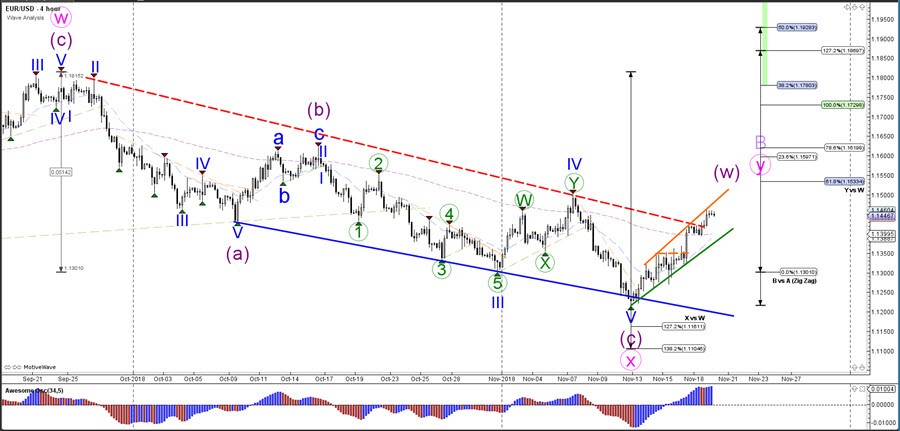
The EUR/USD seems to be building a final wave 5 (green) within wave C (blue). One more push is possible but runs the risk of hitting and bouncing at the Fibonacci targets.
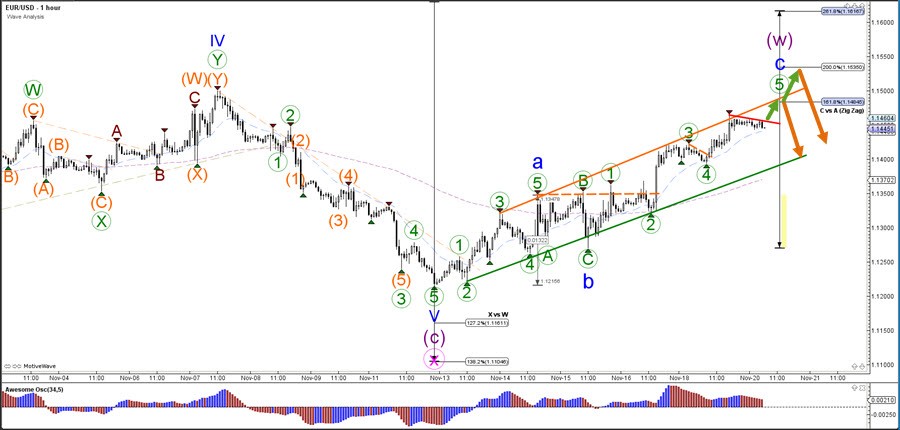
Elliott Wave Analysis Calling EURUSD To Resume Lower After Flat Correction
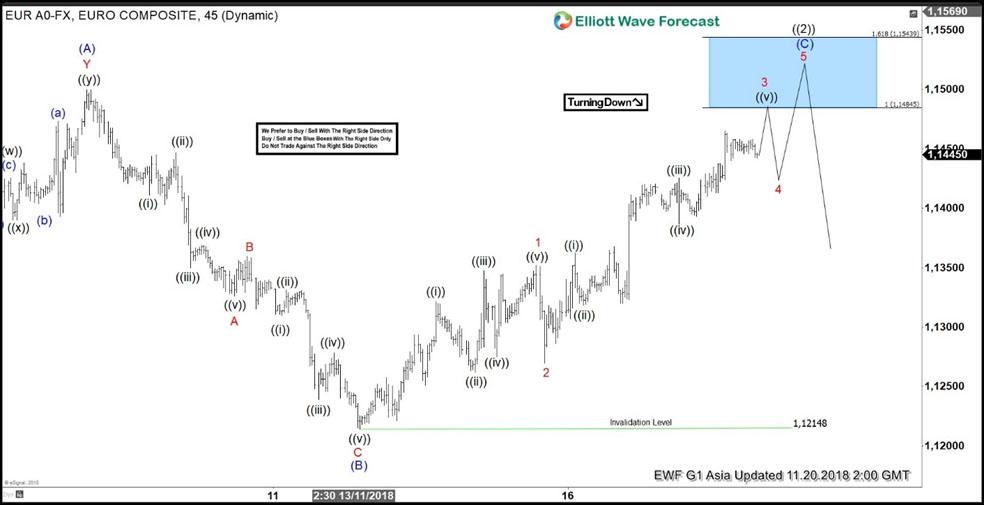
Short Term Elliott Wave View on EURUSD suggests that pair is currently in Primary wave ((2)) rally to correct cycle from Sept 24 high (1.1815) before the decline resumes. Internal of Primary wave ((2)) is unfolding as a Flat Elliott Wave structure where Intermediate wave (A) ended at 1.15 and Intermediate wave (B) ended at 1.1214. A Flat is a 3-3-5 Elliott Wave structure, thus we should expect Intermediate wave (C) to be unfolding as 5 waves.
Intermediate wave (C) rally higher is taking the form of a 5 waves impulse Elliott Wave structure. Minor wave 1 of (C) ended at 1.135 and Minor wave 2 of (C) ended at 1.127. Near term, expect the pair to end Minor wave 3 of (C) soon, then it should pullback in Minor wave 4 of (C) before doing another leg higher in Minor wave 5. The move in Minor wave 5 should also end Intermediate wave (C) with projected target at 1.148 – 1.154.
More important than the target area however is the momentum divergence. Minor wave 5 should show momentum divergence with Minor wave 3 before pair ends the 5 waves move. As far as momentum does not show any divergence, we can assume that EURUSD still remains to be in Minor wave 3. As far as pivot at Sept 24 high (1.1815) remains intact, pair is expected to resume lower or at least pullback in 3 waves once the 5 waves move is over. We don’t like buying the pair.
EURUSD 1 Hour Elliott Wave Chart
Sour Risk Sentiment Amid Continuing Brexit Turmoil
Market movers today
In the UK, focus remains on Brexit and any news regarding Theresa May's uncertain future as PM and party leader. May is expected to travel to Brussels today to discuss trade. Apart from politics, markets will also keep an eye on any changes in the BoE's rhetoric, when Carney, Haldane, Cunliffe and Saunders testify before the UK Parliament's Treasury Committee today.
In the US, housing starts and building permit data for October is due. Recently, the housing market has looked a bit shaky, but numbers for September were probably influenced by the hurricane season. Hence, we will keep an eye on whether we see a recovery in October and the coming months.
Selected market news
Risk sentiment was sour yesterday with equities down across the globe. Despite the very weak risk sentiment, US treasuries were only able to stage a very modest yield decline last night. The market continued to pare back on the Fed pricing and the curve 2s10s steepened further to 27bp. ECB pricing also declined marginally yesterday, with 5bp now priced in for September 2019 and 12bp for December 2019. The front of the EUR curve continues to be driven by the long end of the curve. In the overnight session, Asian equities declined more than 1.5%.
As we argued in Brexit Monitor: Decent Brexit is still base case but uncertainty has risen , 16 November 2018 , the two main things to look out for in the near-term are whether there will be a no confidence vote in Theresa May and whether the supporting party, Ulster's DUP, will pull its support for the government. With respect to the former, it is proving more difficult for the Brexit hardliners to secure the 48 'no confidence' letters than they had imagined. We still think a leadership challenge is likely, but the difficulties support our view that Theresa May is likely to survive it. With respect to the latter, the DUP chose to abstain from the budget votes last night, which is against the confidence and supply deal between May and the DUP, which indicates that the DUP will support the government on (among other things) the budget and finance bills (see the GOV.UK s Cabinet Office link to the agreement here ). The big question we need an answer to is whether this is just a warning shot, or whether the DUP is indeed about to pull its overall support.
In the US, the NAHB housing market index dropped to 60 in October from 68 in September. The level remains high but the trend is not good. Many housing indicators are turning around and while the interpretation is difficult given the extremely high volatility in most of them, it seems as though the housing market is cooling, perhaps because mortgage rates have hit 5%. We think it is increasingly important to look out for how the housing market is doing. This market is a very important driver of overall economic activity.
Italy was not discussed at yesterday's Eurogroup meeting. The DE-FR proposal of an EU budget gathered steam, and while no size or further guidance was given on the proposal, this seems more like a symbolic rather than substantial win to Macron (and to some degree Merkel)
Will Goldilocks Inflation Stay in 2019?
Not Too Hot, Not Too Cold but Just Right
Inflation has reached a Goldilocks state as far as the Fed is concerned. Both headline and core PCE inflation are up 2.0% over the past year, exactly in line with the FOMC's target. That follows six years in which the core—the FOMC's preferred barometer of trend inflation—undershot the committee's goal. Multiple bouts of disinflation, like in 2015 and again in 2017, had many questioning whether the Fed's 2% goal was achievable (Figure 1). The FOMC pressed ahead with normalizing anyway, but at a historically slow rate. Further tightening has continued on gradually as inflation has firmed without showing signs of becoming unhinged. Yet could the Goldilocks scenario change and cause the Fed to either quicken its pace of policy tightening or ease up on the brakes?
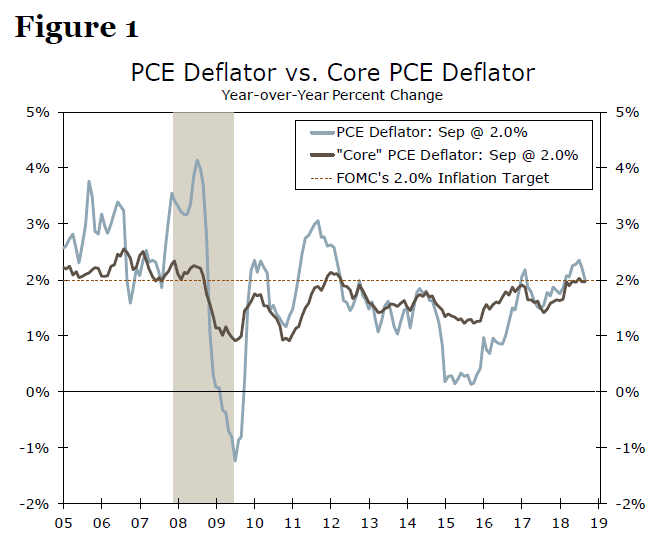
In a report last year, we focused on five specific inflation surprises for the upcoming year. This year, we take a more thematic approach and look at the factors we view as most likely to lead inflation away from its current sweet spot of 2.0%. While we see a number of scenarios that would cause inflation to veer either above or below 2%, we believe that ultimately, solid U.S. growth and upward pressures from tariffs will push core PCE inflation to 2.2%. That would be moderate enough to where the Fed is likely to hike a few more times next year. But where might things go wrong?
Upside Risk I: Capacity Constraints Come to a Boil
The United States is on course for one of, if not the, best years of the current expansion. Strong growth alone is not sufficient for inflation, but 2018's solid performance registers at a time when there is very little excess capacity in the economy. Given inflation's tendency to lag growth, the economy's impressive performance this year may only now be starting to rev up inflation.
Capacity constraints are particularly evident in the labor market, where the unemployment rate is already below "full employment." Job openings are near record highs, while finding qualified labor is small businesses' single most important problem. Wages are rising as a result. While still modest compared to the later stages of previous cycles, research suggests that the relationship between unemployment and wages is nonlinear.1
The pass-through between wage costs and inflation may not be as strong as it once was2, but there is still a positive link between a tight labor market and inflation. Labor is the largest cost for most companies, particularly in the service sector, which accounts for 75% percent of core inflation. With order books full and companies seeing take-home pays rise as they cut bigger checks to their employees, businesses may be emboldened to raise prices. The share of businesses that is raising compensation and prices has jumped over the past year to the highest level of the expansion (Figure 2).
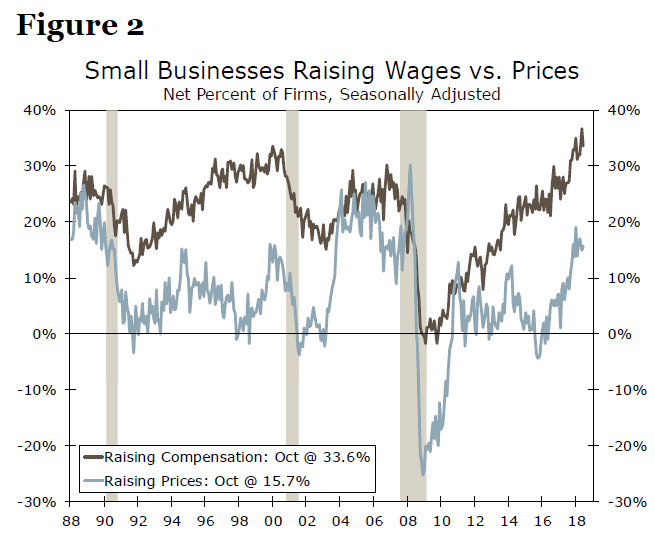
The tighter labor market and increased willingness for firms to raise prices is part of our baseline call for modestly higher inflation next year, but a steepening of the Phillips Curve and/or faster tightening in the labor market may lead inflation to rise more strongly. That could lead the FOMC to tighten rates faster and/or more than the three quarterly 25 bps hikes in our current forecast.
Upside Risk II: Tariff Trouble
Labor costs are not the only thing pressuring business profits and prompting firms to raise prices. Tariffs on about $300 billion worth of goods are pushing up production costs for U.S. firms and allowing others to raise prices. Even though goods account for only 25% of the core CPI index, we estimate that the tariffs that have been put in place by the Trump administration thus far will add approximately a couple tenths to inflation.
More tariffs, however, may very well be in store. Not only are tariffs on $200 billion of imports from China set to jump from 10% to 25% at the start of the year, but the administration has threatened 25% tariffs on remaining imports from China, worth about an additional $267 billion. While talks between the United States and China look poised to resume, there are major grievances regarding China's trade practices that make a quick fix look difficult.
In an environment where margins are already coming under pressure as labor costs rise, there may be little scope for firms to absorb prices (Figure 3). The reduction in corporate tax rates may have given firms some cushion in 2018, but tougher base comparisons for 2019 profit growth may lead firms to finally pass on related costs. Retaliatory tariffs that depress prices at home for U.S. goods will provide at least some offset. However, at the end of the day, the United States still runs a trade deficit with China, leading to more imports exposed to tariffs (Figure 4). Retaliatory tariffs from all countries have been placed on about $135 billion worth of U.S. goods this year versus the $300 billion in tariffs on imports.
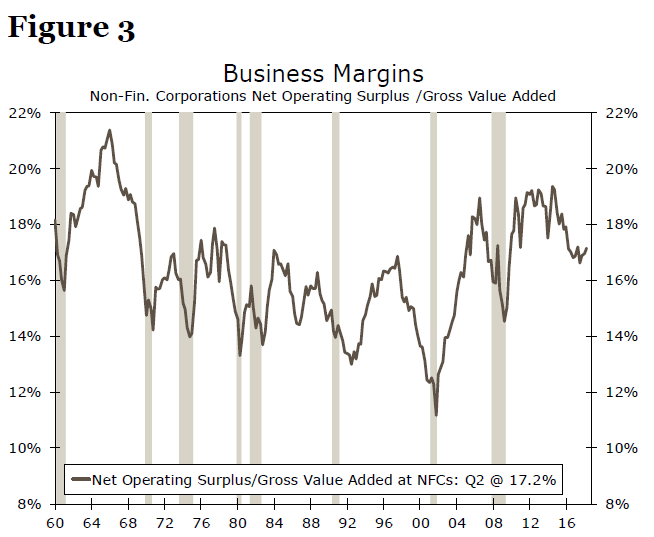
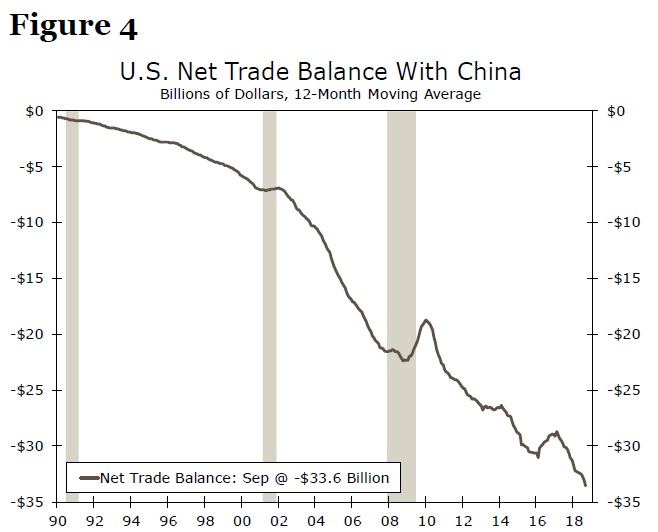
Were the trade spat to deepen, or extend to more countries, inflation is likely to rise more than we currently forecast. While that may erode real household income and investment returns, the Fed would likely look through the increase since it is likely to be a one-time level shift in prices. The risk, however, is that the proliferation of tariffs would cause inflation expectations to become unmoored, generating the need for the Fed to react to the higher path of inflation.
Downside Risk I: Slower Global Growth Overrides U.S. Strength
An escalating trade war brings us to our first downside risk. The trade battle with the United States may already be taking a toll on growth in China. Third quarter GDP slowed more than expected, coming in at 6.5% year-over-year, while other measures of activity have also cooled. That has begun to weigh on many of the country's other trading partners. Pared-back expectations for global growth have hit commodity prices. Oil has tumbled more than 20% since early October, while spot prices for industrial metals have fallen since the summer. At the same time, declining agricultural prices point to pressure on consumer food inflation in the year ahead (Figure 5).
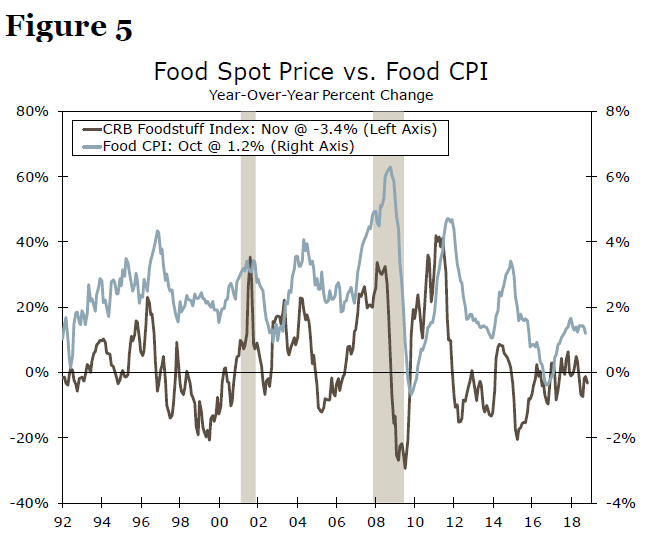
Commodity prices have been pressured not only by a deteriorating outlook for global demand, but by the unwavering strength of the dollar. We expect the dollar to edge lower in early 2019. That call is contingent on growth and monetary policy beginning to converge between the U.S. and other major economies. If that dynamic takes more time, the dollar and commodity prices would put ontarget inflation in jeopardy.
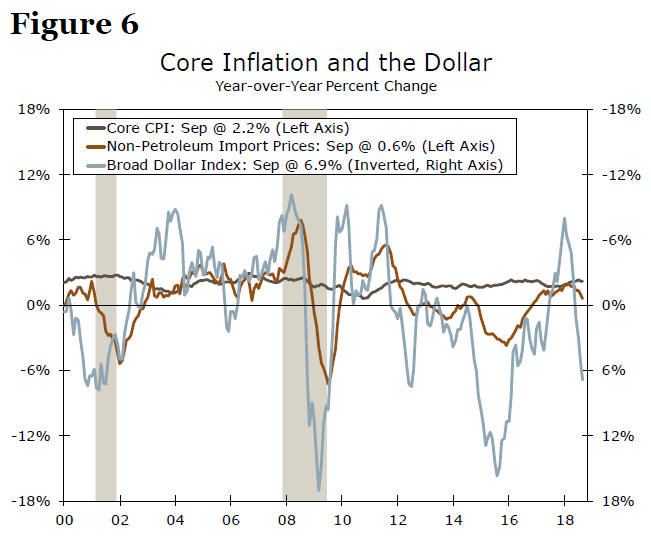
If headline inflation were to fall below target because of declining prices for energy and food commodities, the FOMC would likely be unfazed. In the short-run, energy and agricultural prices are less influenced by monetary policy than by politics and weather. The bigger risk for Fed policy is if moves in commodity prices and the dollar are sharp enough to filter into core inflation. Yet there is only a very small link between core inflation and the price of oil or the value of the dollar (Figure 6).3 The effects of oil and the dollar are primarily concentrated in the goods portion of core inflation, which, as we previously mentioned, is only 25% of the index. As a result, it would take some fairly big moves in commodity prices and the dollar to move core inflation enough for the Fed to rethink its policy path.
Downside Risk II: Just as Other Sectors Heat Up, Housing Cools
Most areas of the U.S. economy have boomed this year with one notable exception: housing. Affordability concerns have come to the forefront after years of prices outpacing income growth. The affordability challenge has grown more acute this past year as mortgage rates have jumped by about 100 bps. Home sales have fallen over the past six months as a result, and price growth is beginning to moderate. That could spell trouble for inflation. Shelter accounts for just over 40% of core CPI and almost 20% of core PCE. Not only is housing a sizeable portion of inflation indices, but it has consistently risen faster than overall inflation (Figure 7). If the softness in home prices filters into the CPI, the inflationary pressure from a "hot" economy elsewhere might not be enough to offset weakening in such a juggernaut.
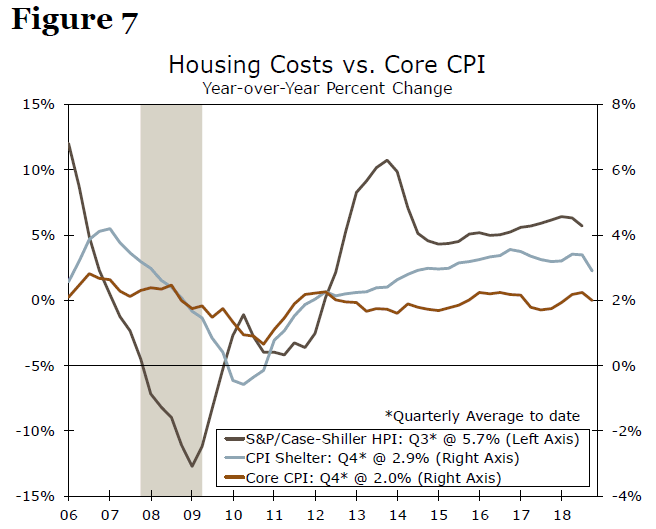
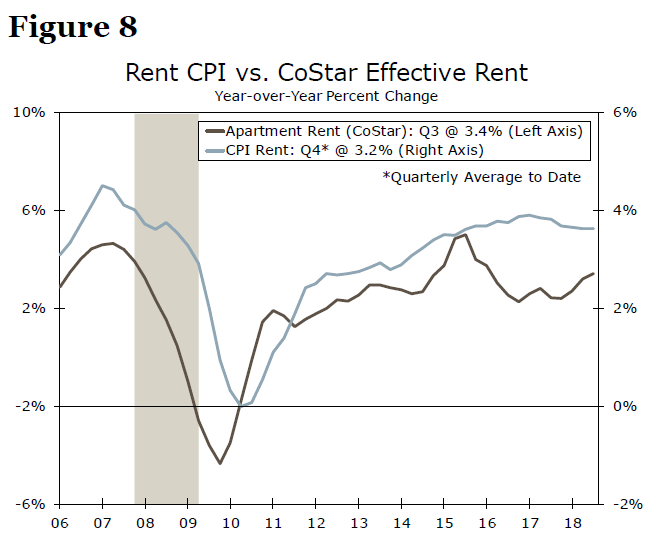
The largest part of the shelter index, the imputed rent of owner-occupied homes, is derived from asking homeowners how much they think their home would rent for in the current market. The shelter component therefore lags sales-based measures of home prices by about 18 months. As such, we believe softening home prices won't be a problem for official inflation in 2019 as much as it will be in 2020. At the same time, the price of rented housing has been growing at a fairly steady rate and suggests that that fraction of shelter should hold up (Figure 8). A weakening in prices or faster pass-through to inflation, however, is not out of the question.
Will the Inflation Bears Return Home in 2019?
With recent economic developments pointing toward both U.S. and global growth slowing in the year ahead, concerns have reemerged about the FOMC maintaining its inflation target. The sharp decline in oil prices over the past month has lowered expectations for headline inflation next year. It has also raised concerns about core inflation wobbling as it did in 2015. Oil, however, is down a little less than 30% from its recent peak compared to a 60% year-over-year decline at the worst of the 2014-2016 oil rout. The price break that falling oil prices offers to transport-related costs for core goods and services is also likely to be offset by worker shortages in the sector that have pushed up labor costs.
The recent strength of the dollar points to more tepid inflation, all else equal, again similar to 2015. The increase in the dollar over the past year, however, has been more moderate than at the height of the 2014-2015 run-up, even if on a level basis the dollar's value is close to a 16-year high. At the same time, cheaper import prices due to the stronger dollar will at least in part be negated by tariffs raising the costs of some imported items and their domestically-produced alternatives.
On net, we see core inflation drifting higher in the year ahead. Solid economic growth this past year when labor availability and capacity has become constrained is likely to be still filtering through to inflation. Tariffs are pressuring costs for some businesses and giving firms a clear reason to raise prices. Barring a significant escalation in trade disputes, the pickup in inflation should remain fairly modest, however. Inflation expectations have remained little changed over the past few years, which suggests that price increases are likely to be restrained. The pullback in commodity prices, a strong dollar, retaliatory tariffs and the housing slowdown are also expected to keep domestic inflation pressures from generating a clear breakout in inflation. Therefore, while core inflation is likely to stray a bit above the FOMC's target in 2019, we expect the committee to slowly raise rates a few more times next year. There are plenty of risks around inflation, however, that could lead the Fed to change course.
1 Nalewaik, Jeremy. (2016). "Non-linear Phillips Curves with Inflation Regime Switching." Finance and Economics Discussion Series, Divisions of Research & Statistics and Monetary Affairs, Federal Reserve Board, Washington, D.C. 2016-078.
2 Peneva, Ekaterina V. and Jeremy B. Rudd (2015). "The Passthrough of Labor Costs to Price Inflation," Finance and Economics Discussion Series 2015-042. Washington: Board of Governors of the Federal Reserve System, http://dx.doi.org/10.17016/FEDS.2015.042.
3 See "Do Oil and Dollar Effect Core Inflation?" Apr. 27, 2015, available on request.
GBP/JPY Daily Outlook
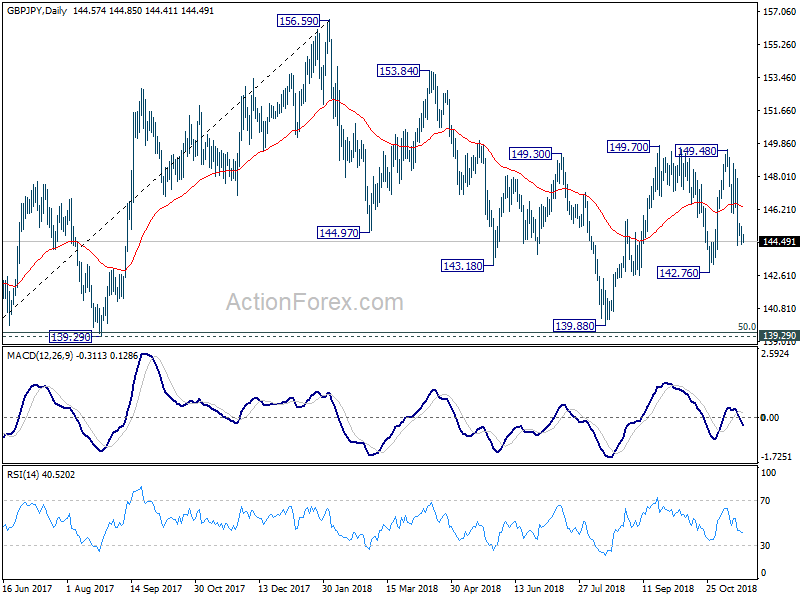
Daily Pivots: (S1) 144.28; (P) 144.80; (R1) 145.18; More...
With 145.99 minor resistance intact, intraday bias in GBP/JPY remains on the downside for 142.76 support. Sustained break there will bring retest of 139.39/47 key support zone. On the upside, above 145.99 support turned resistance could bring stronger rebound. But near tem outlook will be neutral at best as long as 149.70 key resistance holds.
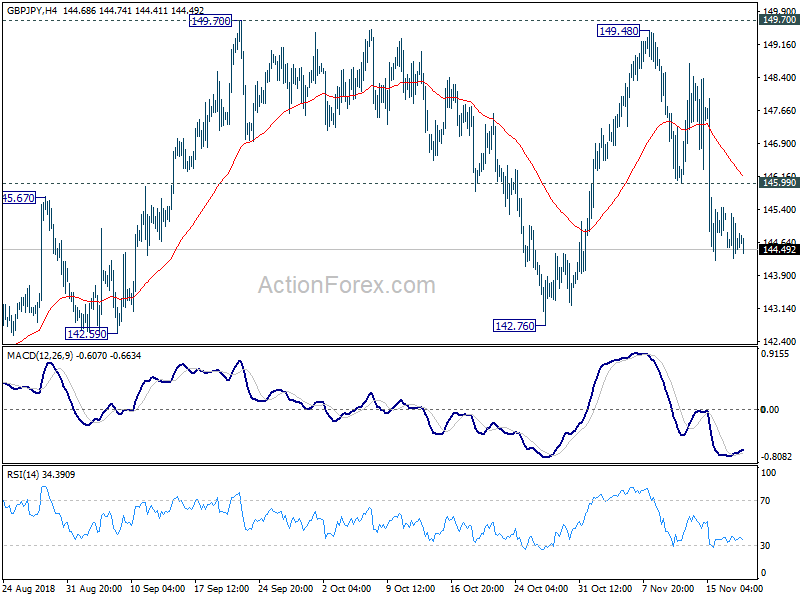
In the bigger picture, as long as 139.29 cluster support (50% retracement of 122.36 to 156.59 at 139.47) holds, up trend from 122.36 (2016 low) would still extend beyond 156.69 high. However, decisive break of 139.29/47 will suggest that such up trend is completed and turn outlook bearish. In that case, next target is 61.8% retracement at 135.43.