Sample Category Title
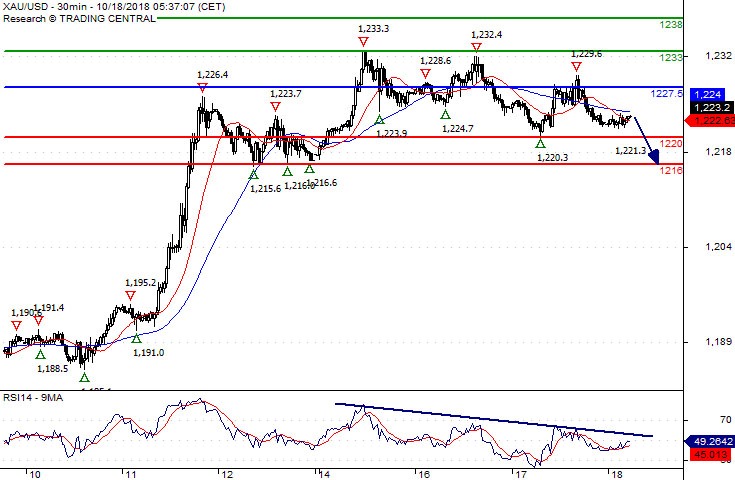
Gold Spot Consolidation In Place
Pivot (invalidation): 1227.50
Our preference Short positions below 1227.50 with targets at 1220.00 & 1216.00 in extension.
Alternative scenario Above 1227.50 look for further upside with 1233.00 & 1238.00 as targets.
Comment The RSI is capped by a bearish trend line.
EURUSD Outlook: Strong Bearish Signals On Close Below Daily Cloud / Fibos For Test Of Key 1.1432 Support, Cloud...
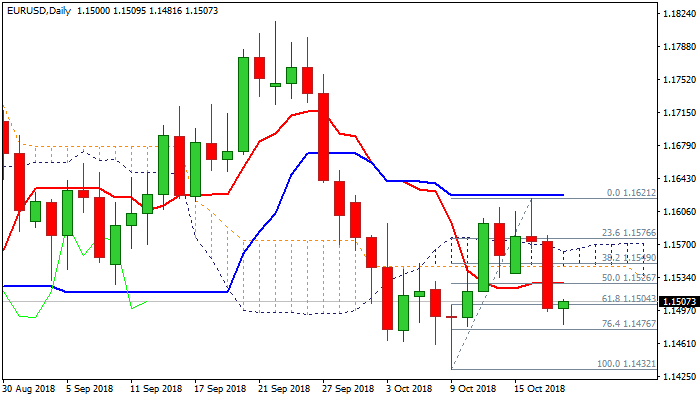
The Euro extended weakness to new one-week low at 1.1418 in early European trading on Thursday but bears face headwinds from nearby target at 1.1476 (Fibo 76.4% of 1.1432/1.1621 upleg).
Strong fall on Wednesday (the biggest one-day loss in Oct), fueled initially by rise in Italian yields and boosted by hawkish Fed, generated bearish signals on extension deeply below daily cloud and close below 1.1504 (Fibo 61.8% of 1.1432/1.1621).
Bearishly aligned daily techs, along with US/EU interest rate divergence, Italy issue still being on the table and vulnerable German political situation, continuing to weigh.
Bears could extend to key near-term support at 1.1432 (09 Oct spike low), with daily cloud base expected to cap corrective upticks and maintain bearish tone.
Res: 1.1526, 1.1545, 1.1562, 1.1580
Sup: 1.1476, 1.1463, 1.1432, 1.1400
Fed Minutes Boost Dollar, UK Retail Sales Eyed
Here are the latest developments in global markets:
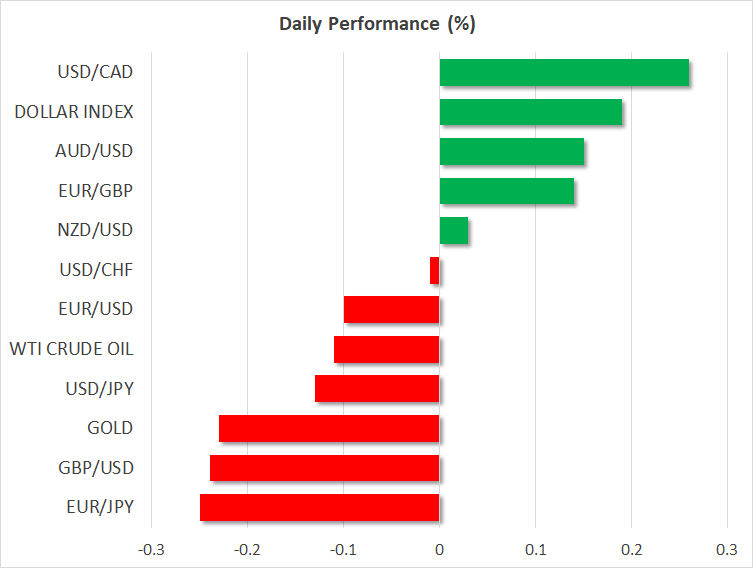
FOREX: The dollar index is up by nearly 0.20% on Thursday, building on the spectacular gains it recorded yesterday, aided by a hawkish tone in the latest Fed minutes. Meanwhile, the worst performers on Wednesday were the euro and loonie, amid Italian budget concerns and a sharp drop in oil prices respectively. The pound traded choppy and lower overall, weighed on by soft UK inflation data and the absence of real progress in the EU summit.
STOCKS: US markets closed lower, albeit only modestly, with a relatively hawkish tone in the FOMC minutes and signals that the US-China trade conflict may escalate further weighing on appetite for risk. The Dow Jones (-0.36%) tumbled the most, dragged lower mainly by Home Depot (-4.34%). Both the S&P 500 and the Nasdaq Composite inched lower by roughly 0.03%. However, sentiment seems to have turned even more sour, as futures tracking the Dow, S&P, and Nasdaq 100 are pointing to a much lower open today. Indeed, the negative mood was also evident in Asia, which was a sea of red. Japan’s Nikkei 225 (-0.80%) and Topix (-0.54%) dropped, alongside the Hang Seng in Hong Kong (-0.54%). Europe was set for a mixed open today, futures suggest.
COMMODITIES: Oil prices plunged on Wednesday, with WTI dropping by more than $2, weighed on by a surprisingly large build in the weekly EIA inventory data. It likely came as a major upset, as the private API figures one day earlier pointed to a drawdown. Poor risk appetite in markets and a stronger dollar may have also contributed to the drop. WTI is also lower today by 0.11% at $69.63 per barrel, while Brent is down by 0.42% at $79.71/barrel. In precious metals, gold is lower by 0.23% on Wednesday at $1221 per ounce. The dollar-denominated metal declined yesterday as well, but only marginally, and certainly much less than one would expect given the surge in the dollar. This resilience reaffirms that demand is slowly picking up, and that gold may have carved out a bottom.
Major movers: Dollar extends gains after “hawkish” FOMC minutes
The greenback was by far the best performer in Wednesday’s session even ahead of the release of the FOMC minutes, extending its gains in the aftermath. The minutes revealed a hawkish tilt, with the Committee appearing increasingly confident that interest rates will eventually need to be pushed above the level which they consider “neutral”. This was hardly surprisingly, considering their latest rate-path projections anticipated rates to move above the longer-run neutral rate 3.0% by the end of 2019. Still, investors took the opportunity to push US bond yields and the dollar a little higher, which likely illustrates that some expected a more cautious commentary.
Overall, officials appeared more optimistic on inflation, and little concerned by trade risks. The key takeaway was the Fed remains committed to raising rates in a gradual manner – perhaps once a quarter – until the “neutral” level of roughly 3.0% is reached, after which a couple of more rate increases may be appropriate, albeit in a slower manner. Yet, market participants don’t appear that confident, having fully priced in only two quarter-point hikes between now and June 2019, which suggests they expect a pause of one quarter in the meantime.
On the Brexit front, the working dinner between EU leaders yesterday yielded little of real substance, though the broader tone was quite upbeat, leaving the impression that both sides are committed to reaching a deal. The pound traded lower for the most part, weighed on by disappointing UK inflation data. Elsewhere, the worst performers on Wednesday were the euro and loonie. The Canadian currency tracked oil prices lower, while the euro remained soft amid reports that the EU will – to the suprise of nobody – reject Italy’s draft budget proposal.
In the broader market, risk appetite remained on shaky legs. Major US equity indices struggled after the Fed minutes amid an uptick in bond yields. Some aggressive moves by President Trump against China didn’t help. The White House announced the US will withdraw from the Universal Postal Union, a 144-year treaty which allegedly enables China to ship goods at unfairly low prices, putting American businesses at a disadvantage. Separately, the US Treasury refrained from labeling China as a currency manipulator in its biannual report, but made it clear it’s watching the yuan closely.
Day Ahead: UK retail sales & Philly Fed Business index awaited; EU summit eyed
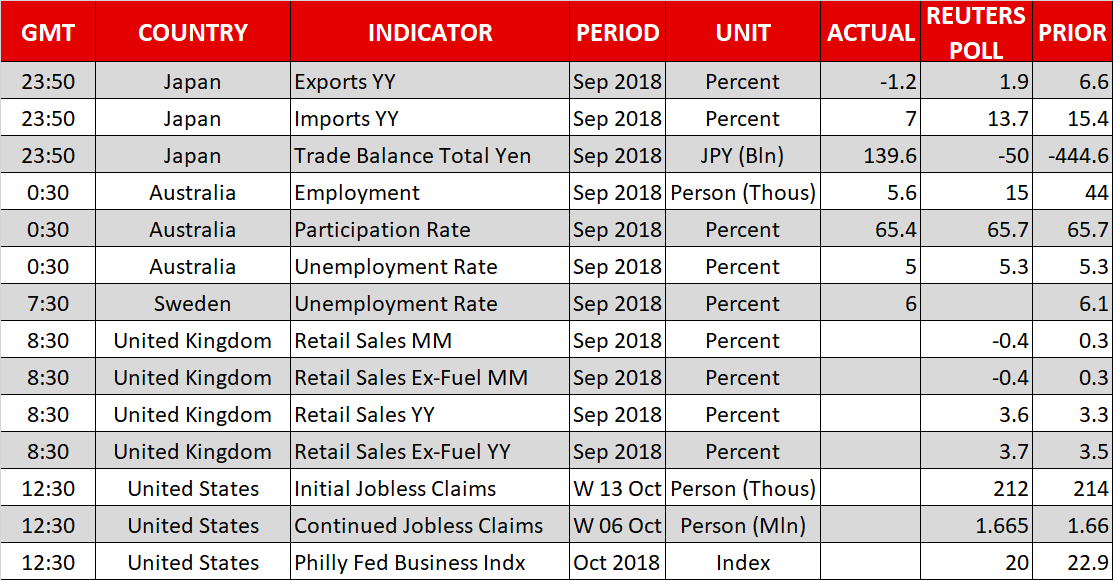
While EU leaders are struggling to find a common ground on the Brexit front in Brussels, with the EU negotiator, Michel Barnier supporting that more time is needed for progress and the UK Prime Minister showing willingness to expand the transition period, investors will turn attention to the calendar during the early European session. At 0830 GMT, retail sales out of the UK are expected to decline by 0.4% on a monthly basis in September after inching up by 0.3% in August, though the annual growth is projected to come higher by 0.3 percentage points at 3.6%. Washing out volatile components such as automobiles and fuels the monthly core measure is said to fall by 0.4% as well, while the yearly gauge is projected to rise by 3.7% compared to 3.5% before. Should the data beat forecasts, indicating that British consumers feel more comfortable to shop as wage growth picks up steam and inflation slides towards Bank of England’s 2.0% price target, the pound could rebound.
In the US, Federal Reserve of Philadelphia will update its Business index for the month of October at 1230 GMT, where any upside surprise could boost investors optimism about the health of the US economy and thus raise stakes for additional rate hikes in coming years. In the aftermath, better than expected readings could spark a stronger rally for the greenback. Looking at forecasts, analysts anticipate the index to ease from 22.9 to 20.
At the same time initial jobless claims for the week ending October 13 will come public as well.
Meanwhile in the Eurozone, besides Brexit, Italy’s spending plans is another worrying issue for traders as recent comments from EU officials including the President of the European Commission, Jean-Claude Junker were discouraging hopes for a lull in the EU-Italian tensions.
As of public speeches scheduled for today, ECB Governing Council member Ewald Nowotny will be talking on “the future of financing and currencies” at 0800 GMT, while ECB Executive Board Member Benoit Coeure and ECB President Mario Draghi are due to speak in the Euro Summit which concludes today in Brussels. In the US Federal Reserve Bank of St. Louis President James Bullard will be giving a presentation on the U.S. economy and monetary policy before the Economic Club of Memphis. In Nw York Fed Vice Chairman for Supervision Randal Quarles will be commenting before an Economic Club of New York luncheon.
Technical Analysis – GBPJPY in neutral mode; risk tilted to the downside
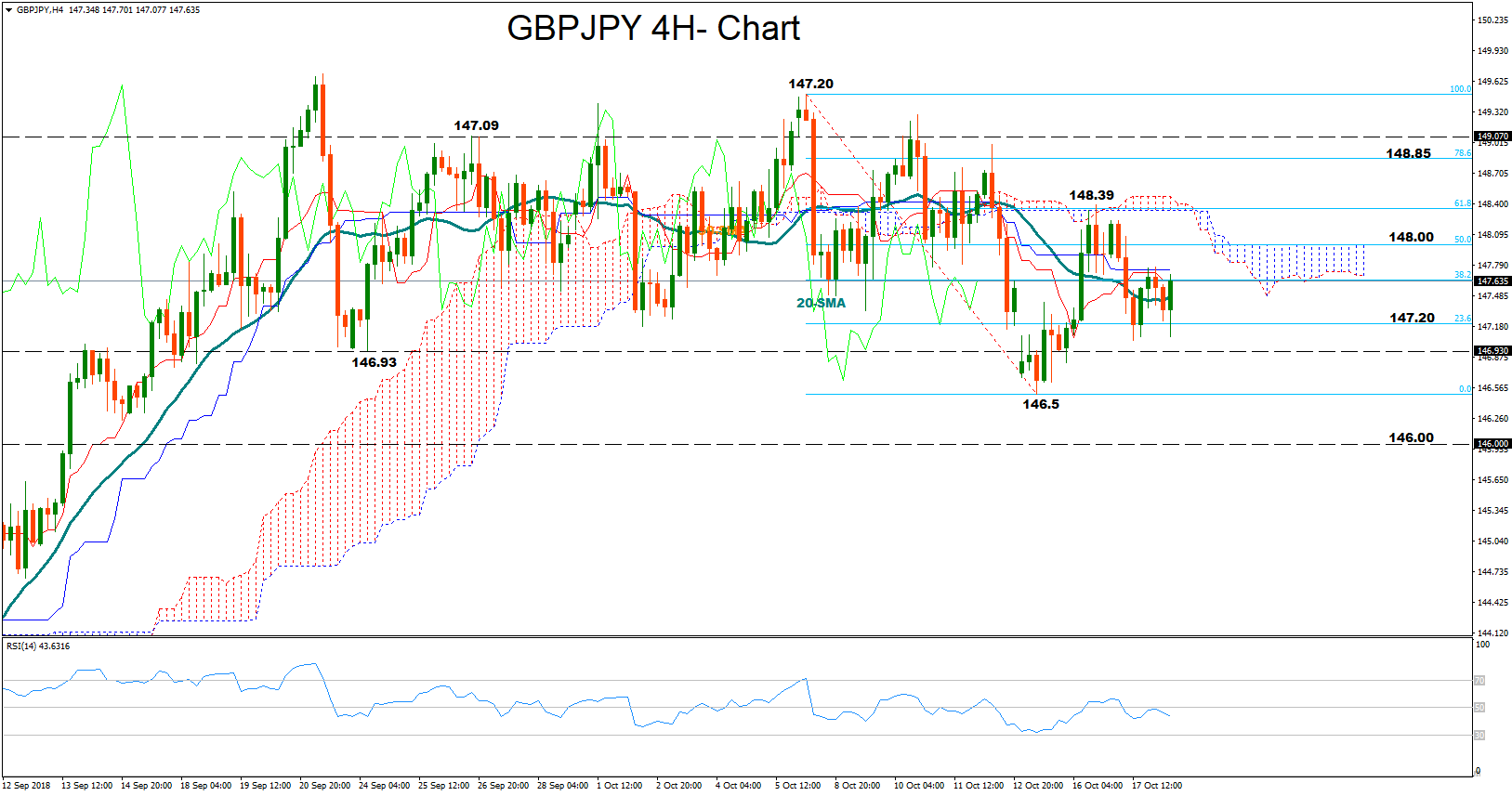
GBPJPY returned to neutrality after the rebound on the one-month low of 146.5 on October 15, though downside risks remain in the short-term as the RSI heads south below its 50 neutral mark.
Should the market weakens in the wake of disappointing UK retail sales or discouraging Brexit news, the price could slip towards 147.20, the 23.6% Fibonacci of the downleg from 149.50 to 146.5 which has been a main support since the start of the month. Moving lower, bearish actions could retest September 24’s low of 146.93 before hitting the 146.5 bottom. Stepper declines below the latter, could bring the 146 round level into view.
Alternatively a beat in data, would probably drive the price up to 148, where the 50% Fibonacci stands, while if this level fails to hault upside movements, the next stop could be around the previous peak of 148.39 which is slightly above the 50% Fibonacci. Even higher, resistance is expected to come between the 78.6% Fibonacci of 148.85 and September 26’s high of 149.07.
GBPUSD Outlook: Extended Weakness Eyes Daily Cloud Top, UK Retail Sales/Brexit Talks In Focus
Cable holds in red for the second consecutive day and extends previous day’s 0.51% fall, driven by UK inflation miss and weakness of the Euro.
In addition, hawkish tone from minutes of Fed’s Sep meeting, which confirmed that the central bank remains on path for more rate hikes, inflated dollar, increasing pressure on pound.
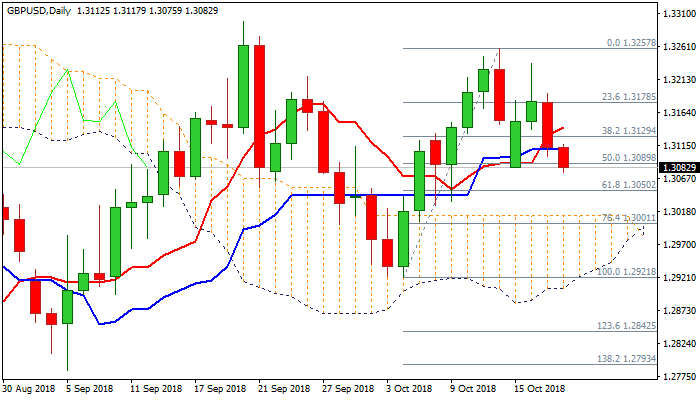
Bears probed below key near-term supports at 1.3089/83 (50% retracement of 1.2921/1.3257 upleg / Monday’s low), with firm break here to open way towards 1.3050 pivot (Fibo 61.8%) and 1.3012/00 (daily cloud top / psychological support), as daily cloud twists next week and could attract bears.
Daily MA’s are turning to bearish configuration, with 5/10SMA bear-cross seen as initial negative signal, but momentum is flat at the midline and lacking signal for now.
Negative near-term sentiment favors further downside, with focus on UK retail sales data release.
Forecasts for September are negative (m/m -0.4% f/c vs 0.3% prev / core m/m -0.4% f/c vs 0.3% prev) and could further pressure sterling on release at / below consensus.
UK PM May told EU leaders that Brexit deal can still be reached despite talks stalled over the weekend on conflict over Irish border and received positive respond.
Markets continue to closely watch Brexit talks and look for fresh signals.
Res: 1.3099, 1.3117, 1.3143, 1.3192
Sup: 1.3075, 1.3050, 1.3012, 1.3000
Earnings Vs. Interest Rates: Who Wins The Fight?
Global equity markets failed to resume their strong rebound following Tuesday's surge. Asian equity indices are deep in the red today with Chinese stocks leading the decline. The Shanghai Composite dropped by 2% while the CSI 300 fell 1.5%. The selloff in Asia comes after a turbulent session on Wall Street where the Dow Jones Industrial Average, S&P 500, and the Nasdaq all fell heavily at the beginning of Wednesday's trading session but all managed to close well above their lows.
If earnings were the key factor driving investor decisions, stocks should be rallying by now. Fifty-five companies out of 504 S&P 500 companies have announced their Q3 results with 80% managed to surpasson EPS. If this trend continues, earnings growth will easily beat the projected 20%. However, if this is still not helping, it suggests that investors are becoming ever more convinced that we have reached the peak of the current economic cycle.
Minutes from the FOMC's September meeting reaffirmed the Fed's hawkishness. The minutes were even more hawkish than what investors were expecting with some suggesting pushing interest rates into restrictive territory: in other words, beyond their neutral rate. This suggests that monetary policymakers are becoming increasingly worried about inflation rising above its target, given the strength of economic expansion and the low unemployment rate.
U.S. Treasury Bond yields pushed higher after the FOMC news with 10-year yields back above 3.2% early today. If interest rates continue to move higher from their current levels, investors will become even more reluctant to buy the dips in stocks.
Economic data also didn't help yesterday with U.S. housing fell 5.3% in September. Weekly mortgage applications also fell 7.1% - the steepest drop since July 2017. With interest rates seemingly continue to be on the rise, housing activity in the U.S. should be expected to fall further.
The Greenback was the primary beneficiary of the spike in interest rates. The Dollar index rallied above 95.7 early todayin another attempt to retest October's high. A break above 96.15 may lead to retest the 97 critical level.
The Yuan fell to a 21-month low after the U.S. Treasury refrained from labeling China as a ‘currency manipulator'. With the dollar continuing to march higher, it's becoming a question of when and not if the Yuan will break 7 per Dollar. The Chinese economy requires a weaker currency to offset the current weakness in growth. However, officials will also be considering the impact on outflows if the currency continues to depreciate further. Finding this balance is tricky, but I don't think the Chinese will aggressively defend a break above 7.
XAUUSD Intraday Analysis
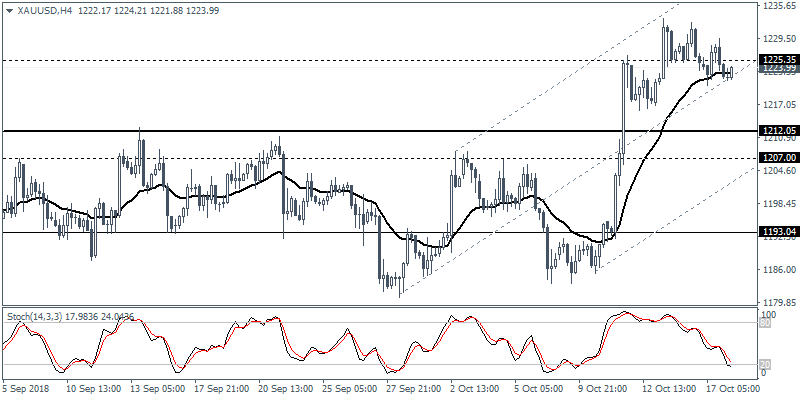
XAUUSD (1223.99): Gold prices were seen easing back on the bullish momentum. Price action is currently attempting to retrace some of the losses. However, we expect the minor resistance level at 1225.35 to hold the gains in the short term. A reversal off this level could trigger the downside. Gold prices will most likely fall back to retest the breached resistance level region of 1212.05 - 1207.00 ahead of further gains. Alternately, if price action breaks past 1225.35, then gold prices could be seen resuming the bullish momentum.
GBPUSD Intraday Analysis
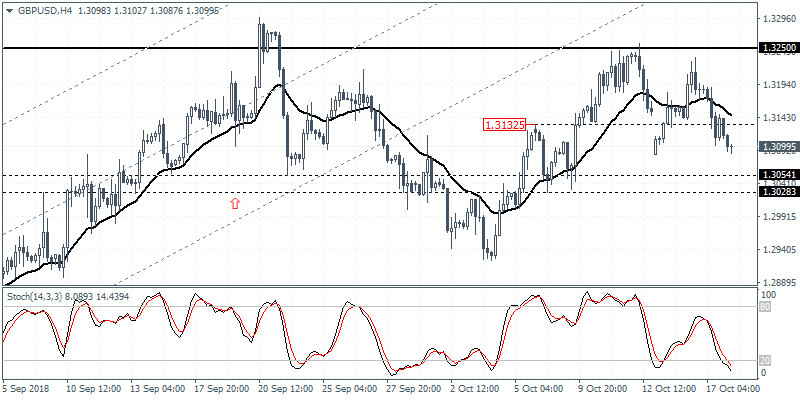
GBPUSD (1.3099): The GBPUSD currency pair closed below the 1.3132 level of support following the failure to post a new high on the rebound. The declines could send the British pound lower as price action could test the support level at 1.3054 - 1.3028. In the short term, we expect the currency pair to maintain a range within the said levels. A breakout from these levels could trigger further direction. To the downside, the next lower support at 1.2808 remains in focus, while to the upside, the price will need to break past 1.3250 resistance to post further gains.
EURUSD Intraday Analysis
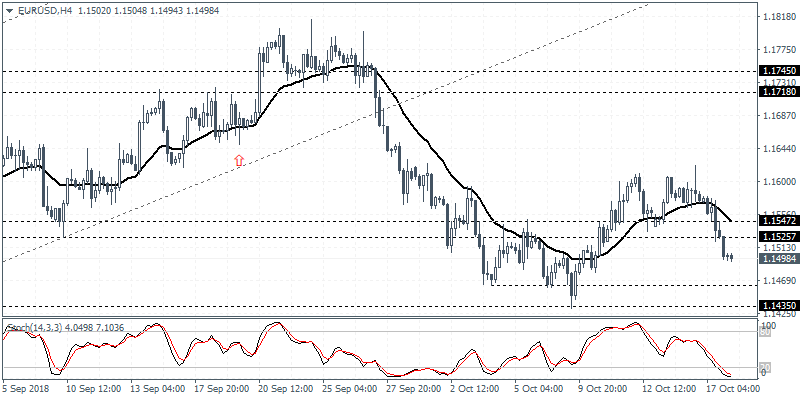
EURUSD (1.1498): The EURUSD was bearish yesterday as price action fell past the support level of 1.1547 - 1.1525. We expect the declines to push the common currency down to the lower support level at 1.1435. This would mark a retest of this level that was previously established. The declines are most likely to stall at this point following which the EURUSD currency pair could be seen attempting to post a rebound.
The Hawkish Tone Of The Minutes Sent The USD To Rise
The Fed released its meeting minutes yesterday covering the monetary policy meeting from September. Officials maintained the view that further gradual rate hikes were necessary. The hawkish tone of the minutes sent the USD to rise.
UK's inflation data released yesterday showed that consumer prices rose at a much slower pace. Headline inflation was seen rising 2.4% on an annualized basis in August. This was slower than the median forecasts of 2.6%. Inflation eased from 2.7% in August. Core CPI which excludes the food and energy prices rose 1.9% down from 2.1% in August.
Australia's unemployment data showed that the official unemployment rate fell to a six-year low at 5.0%. This beat estimates of no change at 5.3%. The number of jobs added was slower at 5.6k which was below estimates of 15.2k.
In Japan, the export data showed a decline for the first time in two years. The decline in exports came amid the business concerns about the trade wars as well as natural disasters.
The day ahead will see the retail sales figures from the UK coming out. Headline retail sales are forecast to fall 0.4% on the month following an increase of 0.3% previously.
The EU's economic summit continues for the second day today. On the agenda will be the Brexit issue. The NY trading session will see the release of the Philly Fed manufacturing index. Economists forecast that the Fed manufacturing index eased to 18.7 from 22.9 previously.
USDJPY Regains Some Ground After Touching 1-Month Low
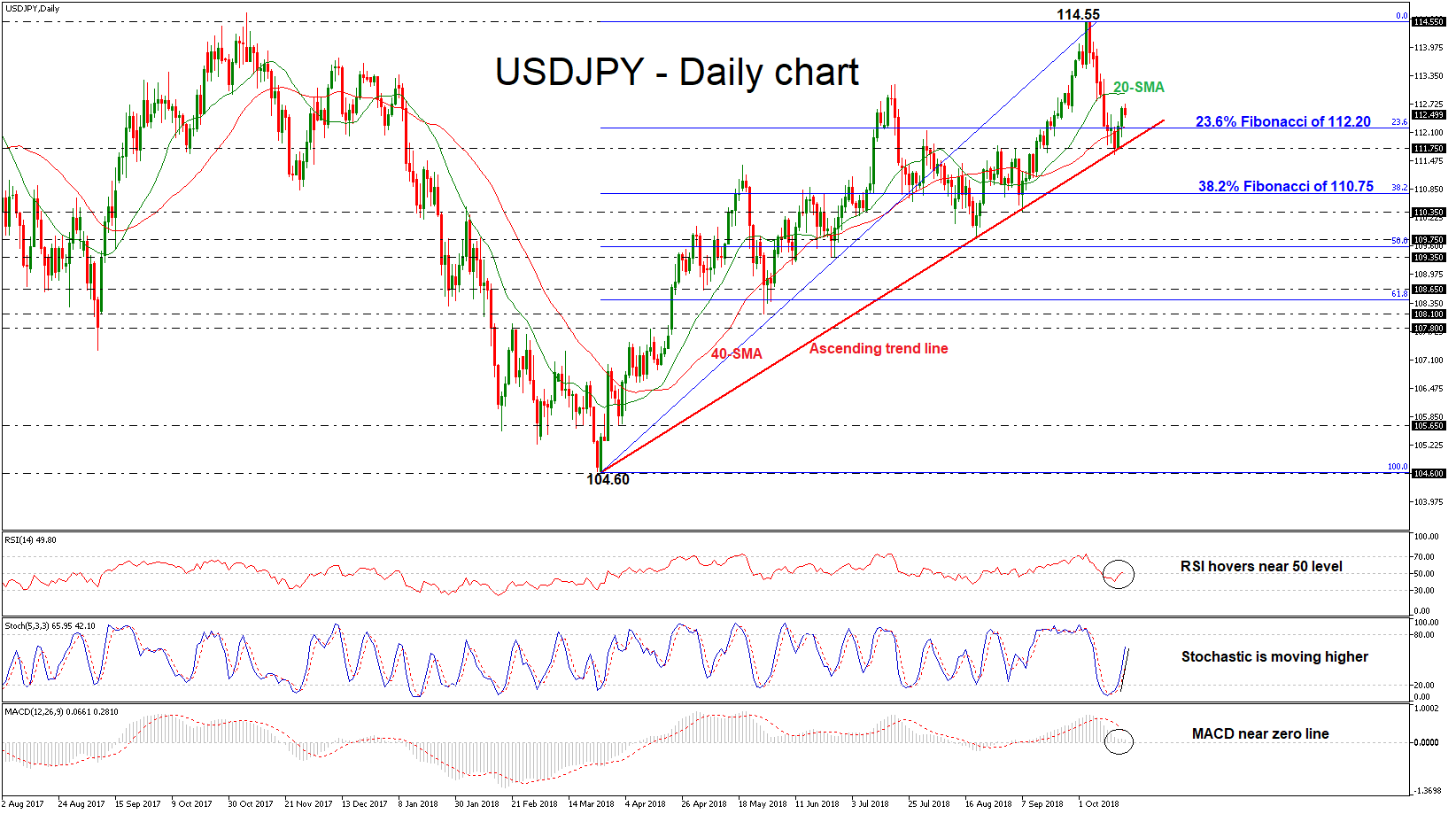
USDJPY posted a rebound after the bounce off the medium-term ascending trend line in the previous two days, surpassing the 23.6% Fibonacci retracement level of the upleg from 104.60 to 114.55, around 112.20. The price continues the bullish outlook in the daily timeframe as it failed to slip below the diagonal line, however the technical indicators are sending soft signals.
The RSI indicator is flattening near the threshold of 50, while the blue %K line of the stochastic oscillator completed a bullish crossover with the %D line in the oversold zone and are moving higher, suggesting further upside retracement in the market. The MACD oscillator is moving sideways below the trigger line and slightly above the zero line.
If the market manages to pick up speed, the price could re-touch the 20-day SMA around the 113.00 round number. A significant jump above this barrier, traders could find resistance at the 11-month high of 114.55. Even higher, the pair could move towards the 115.50 high, reached on March 2017, posting a new peak.
However, should the price decline further and drop below the 23.6% Fibonacci, it could re-challenge the 111.75 support. A dive below the rising trend line could send prices until the 38.2% Fibonacci mark near 110.75.
In the medium-term, the outlook remains positive since prices hold above the uptrend line, which has been standing since March 26. If USDJPY breaks below this significant level, it would change the outlook to a more neutral to negative one.