

Sample Category Title
Canadian Dollar Lower, Manufacturing Sales Next
The Canadian dollar has edged lower in the Wednesday session. Currently, USD/CAD is trading at 1.2974, up 0.31% on the day. On the release front, there are key indicators on both sides of the border. Canada releases Manufacturing Sales is expected to decline by 0.6%. In the U.S, the focus is on construction data. Building Permits are expected to rise to 1.28 million, while Housing Starts are forecast to slip to 1.21 million. As well, the Federal Reserve releases the minutes of its September policy meeting. On Thursday, the U.S publishes Philly Fed Manufacturing Index and unemployment claims.
The Canadian dollar gained ground early this week. The currency received a boost from an optimistic Bank of Canada business survey on Monday. The poll found that businesses expect higher sales for both domestic and foreign customers. Companies are reporting increased investment and hiring, and the mood is optimistic in the business sector. Investors are keeping an eye on the BoC, which set the benchmark rate next week. The markets are widely expecting the BoC to raise rates by a quarter-point, which would match the Fed rate hike in September.
U.S indicators were a mixed bag on Monday, as retail sales were soft but manufacturing data was solid. Retail Sales posted a meager gain of 0.1%, shy of the estimate of 0.4%. Core Retail Sales surprised with a decline of 0.1%, compared to an estimate of 0.4%. This marked the first decline since June 2017. There was better news from the manufacturing front, as Empire State Manufacturing Index strengthened to 21.1, above the estimate of 20.4 points.
Into US session: Dollar and Yen high as markets might finally get a direction
While the forex markets have been directionless for a while, Dollar's rally entering into US session, together with Yen, could finally bring back lives. In particular, EUR/USD breaks 1.1534 minor support which suggests completion of corrective rebound from 1.1431. We might see retest of this low soon. Ideally, we should see break of 0.9954 resistance in USD/CHF, 1.0381 minor support in GBP/USD and 0.7098 in AUD/USD to confirm the underlying strength of the greenback.
For now, Sterling is trading as the weakest one for today after weaker than expected September CPI in UK. New Zealand Dollar is the second weakest, followed by Euro.
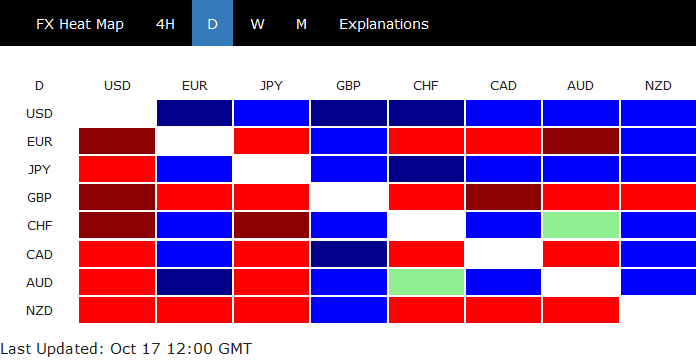
In other markets, European markets opened higher but turned south quickly. At the time of writing:
- FTSE is up 0.25%
- DAX is down -0.48%
- CAC is down -0.21%
- German 10 year yield is down -0.029 at 0.465, moved further away from 0.5 handle.
- Italian 10 year yield is up 0.041 at 3.501. That is, German-Italian spread is back above 300
- Gold is staying above 1225 in spite of Dollar's rebound
In Asian, China Shanghai SSE initially extended recent down trend to as low as 2517.57, but staged a strong rebound in late trading.
- Nikkei closed up 1.29%
- Singapore Strait Times closed up 1.21%
- Hong Kong HSI closed up 0.07%
- China Shanghai SSE closed up 0.60% at 2561.61.
Pound Faces Headwinds as Inflation Disappoints; FOMC Meeting Minutes Awaited
Here are the latest developments in global markets:
- FOREX: Worse-than-expected CPI readings out of the UK drove sterling lower early in the European session after September’s data showed an annual inflation rate of 2.4%, below the consensus of 2.6% and under the previous mark of 2.7%. This is the lowest annual price growth in three months. Pound/dollar dropped by 0.61% to 1.3100, paring the gains it posted on Tuesday, while pound/yen declined by 0.55% and euro/pound edged higher by 0.21%. Rising concerns over the EU summit not providing a breakthrough on Brexit were weighing on the sentiment as well. In the eurozone, the annual inflation rate was confirmed steady at 2.1% in September, while on a monthly basis the gauge increased to 0.5% versus 0.2% before. Euro/dollar fell by 0.36% to 1.1530 barrier. Worries over Italy’s draft fiscal plans, whether those would be accepted by the EU, and a potential credit downgrade by rating agencies next week were weighing on the single currency. Meanwhile, the US dollar index moved higher by 0.36% on Wednesday before the release of FOMC minutes later in the day, however, dollar/yen steadied at 112.28. The antipodean currencies were on the back foot, with aussie/dollar losing 0.29% and kiwi/dollar down by 0.36%. Dollar/loonie was last seen at 1.2970 (+0.30%).
- STOCKS: European stocks were mixed on Wednesday at 1000 GMT. The UK’s FTSE 100 traded higher by 0.21% amid a modest downfall in sterling. Since the index is constituted mainly by large multinational companies that earn most of their revenues abroad, a weaker pound benefits the FTSE, and vice versa. The Spanish IBEX 35 was underperforming, falling by 0.41%, while the German DAX 30 was retreating by 0.39%. Italy’s FTSE MIB fell by 0.32%, while the French CAC 40 moved marginally higher by 0.05%. The STOXX 50 and the STOXX 600 edged down by 0.04% and 0.10% respectively. In the US, job openings hit another record high in August and industrial production picked up steam, data showed yesterday, sending S&P 500, Dow Jones, and Nasdaq 100 sharply higher. However, futures tracking these indices are pointing to a lower open today.
- COMMODITIES: Oil prices posted some losses during the European session despite an unexpected drop in API weekly US crude oil inventories. WTI crude oil ticked lower by 0.50% to $71.56/barrel and the London-based Brent crude declined by 0.31% to $81.16/barrel. Note that the US prepares a second round of sanctions against Iran on November 4, a threat to oil exports. Gold rebounded towards an intra-day high of $1228/ounce before it slipped to $1,225/ounce (+0.08%).
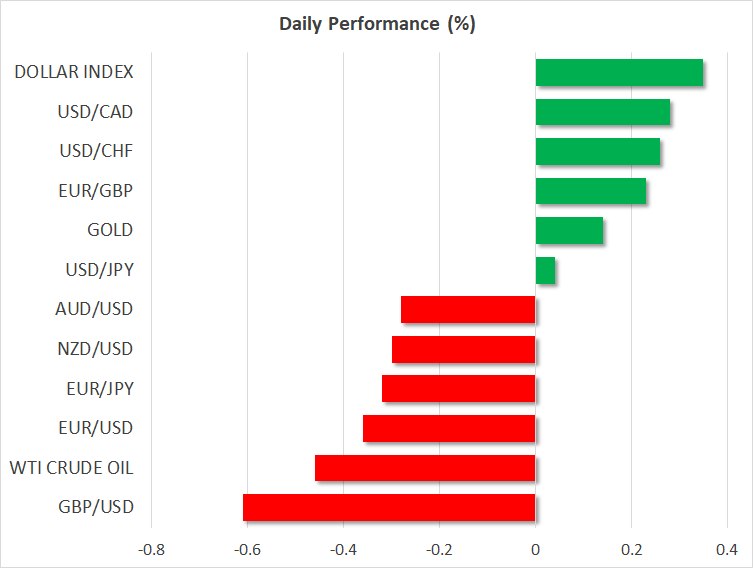
Day ahead: FOMC delivers meeting minutes; Australia reports on employment
The Federal Open Market Committee (FOMC) is due to publish minutes of its September 25-26 policy meeting at 1800 GMT, probably to remind investors that another rate hike is in on the way as soon as December, while three more increases should be expected in 2019 but in a gradual pace.
Any reference to neutral rates and particularly where these are estimated according to policymakers would be a valuable information to determine the path of rate rises after the Fed chief said that “interest rates are still accommodative, but we’re gradually moving to a place where they will be neutral”. He also added that the central bank might go past neutral in the future. Views on trade are likely to attract attention as the bitter US-Sino trade war continues, though given the solution in NAFTA a few weeks ago, statements might be outdated and thus the dollar might not show much reaction. Stock and bond markets will be closely watched as well.
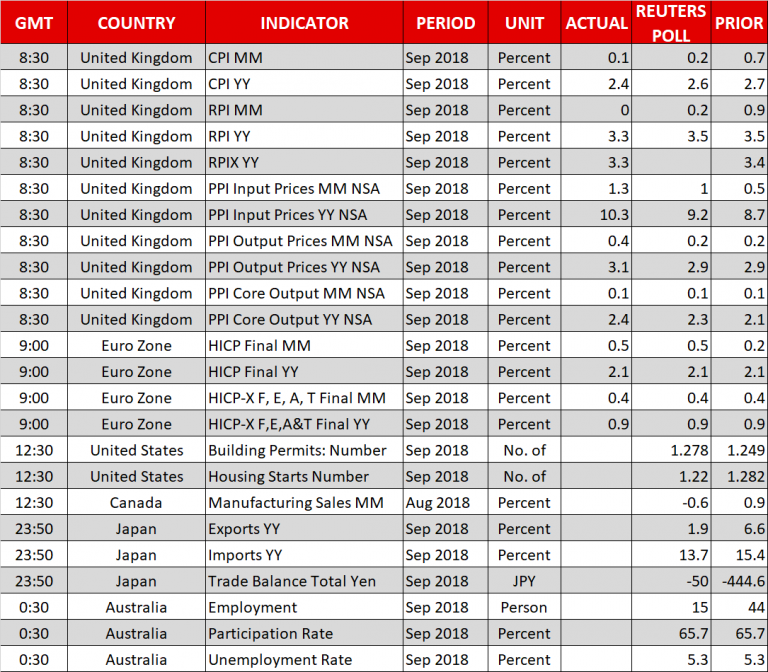
Prior to the FOMC meeting minutes, US building permits and housing starts for the month of September will become public at 1230 GMT, with the former forecasted to improve, whilst the latter is projected to slow down.
Canadian manufacturing sales for August will be available at the same time.
Elsewhere, Japan will release trade numbers for September at 2350 GMT, but the safe-haven yen might respond little as per usual. Still, the data could provide evidence on how pressured producers in the export-oriented country are under steel and aluminum tariffs from the US. Analysts believe that export growth softened significantly on a yearly basis, falling to 1.9% from 6.6% in August. Imports are said to have eased too, from 15.3% to 13.7%, probably causing a much narrower trade deficit of JPY 50 billion compared to JPY 438.4bn previously.
In other data of interest, Australian employment figures are likely to move the aussie overnight. At 0030 GMT on Thursday, the Australian Bureau of Statistics is expected to say that the number of employees increased by 15k in September, much less the 44k rise in August. The unemployment and the participation rates, however, are said to have remained steady at 5.3% and 65.7% respectively, potentially hinting that the slowdown in job creation might not be that important for now. Should the figures appear more encouraging than projected, the aussie could head north.
Following the API weekly report which indicated a decline in US crude inventories in the week ending October 13, the EIA is the next in line to provide clues on weekly US oil stocks today at 1430 GMT. If these are confirmed negative as well, oil prices will likely face upside pressures.
As for public appearances scheduled for today, Bank of England Deputy Governor Jon Cunliffe reappointment hearing before the Parliament’s Treasury Committee is at 1315 GMT. Permanent FOMC voting member Brainard will be also talking about “Fintech and Financial Inclusion” at 1410 GMT.
In equities, Alcoa is among corporations releasing earnings results after the closing bell on Wall Street.
Brexit could make headlines as the EU summit in Brussels starts today with investors looking eagerly to see whether the eurozone and the UK can deliver progress on the divorce terms. If the sides fail to break the deadlock especially on the Irish border front, November’s summit might not even take place. In fact, sources stated today that the EU is looking to arrange a meeting next month in order to step up preparation for a no deal exit instead.
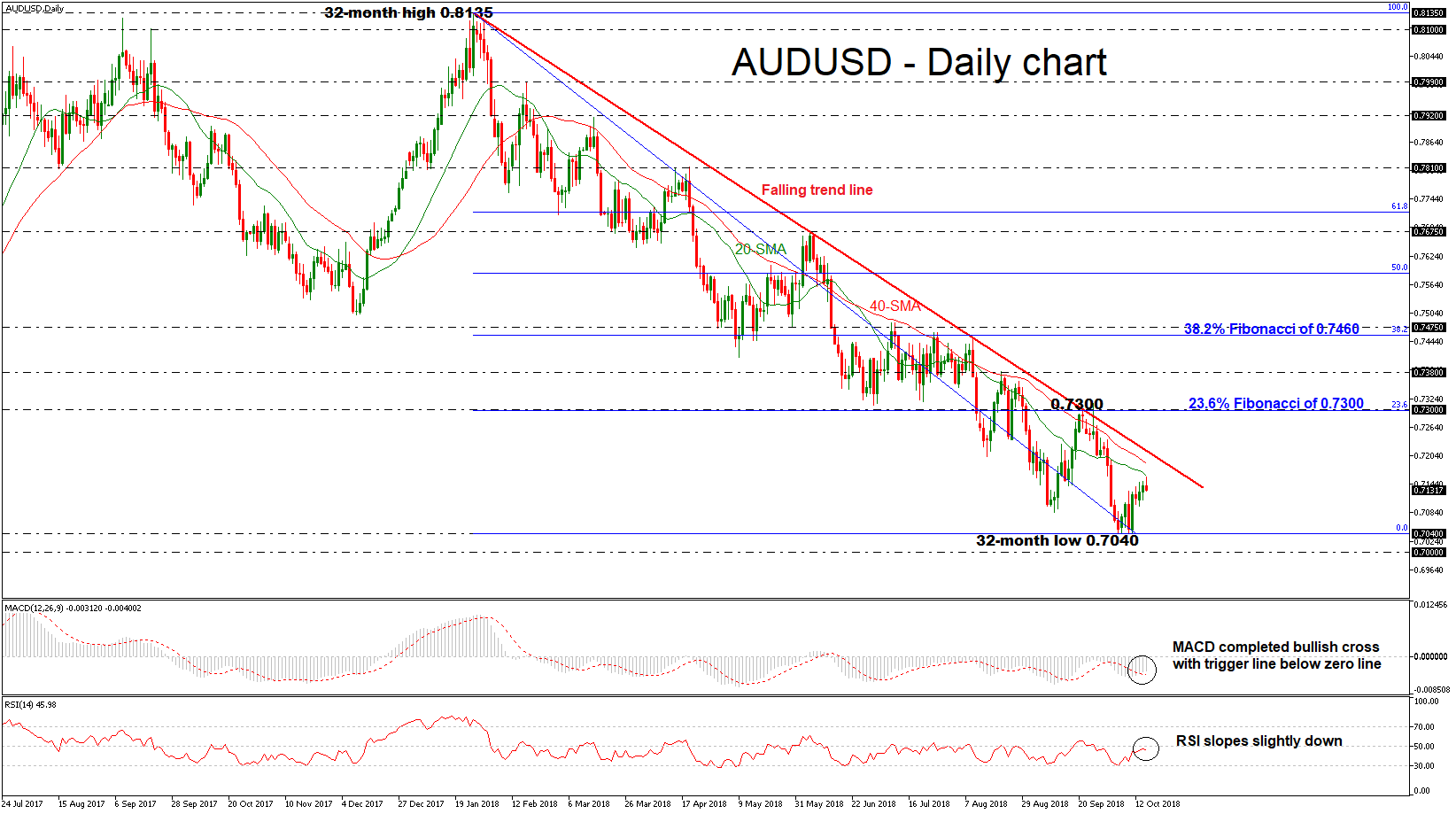
AUDUSD Edges Lower Below Moving Averages, Outlook Still Strongly Bearish
AUDUSD is holding above the 32-month low of 0.7040 but remains under pressure as it has failed to climb above the 20-simple moving average (SMA) in the daily timeframe. The price is trying to post a bullish correction and may challenge again the long-term descending trend line, which has been holding since January 26. The technical picture supports that the next movement is not clear yet. The RSI indicator is pointing slightly to the downside in the negative territory, while the MACD oscillator posted a bullish crossover with the trigger line in the bearish zone.
If there are further positive pressures, a re-touch of the diagonal line to the upside is possible, but first the pair needs to surpass the 20- and 40- SMAs at 0.7163 and 0.7190 respectively in the short-term. A break to the upside of the aforementioned key line would shift the bearish view to a more neutral one and bring the 0.7300 psychological level into view, which coincides with the 23.6% Fibonacci retracement level of the downleg from 0.8135 to 0.7040. More advances could open the way towards the 0.7380 barrier, taken from the high on August 21.
Alternatively, should a downside tendency take form again, immediate support will likely come from the 32-month low of 0.7040. A drop below this level would reinforce the downside risk and send prices until the 0.7000 round number, last reached in January 2016, creating a lower low in the downward trend.
To summarize, the very short-term bias is tilted slightly to the upside, while in the long-term, AUDUSD maintains a clear bearish outlook.
Asia Market Closing View: Fumbling Into The EU Summit
Currencies
Currency markets have been relatively quiet in Asia ahead of the US Treasury FX report an no doubt markets will be eager to view the FOMC minutes where there is a considerable risk for a hawkish lean. Even more so after the subtly hawkish warm-up ahead of tonight’s FOMC minutes delivered by San Francisco’s new President Daly which is creating some noise today but turnover light. Long USD is not my base case view given the upcoming US elections risk, but a hawkish affirmation of Fed policy in the minutes will probably send the dollar bears back to their cages for the rest of the week and provide a boost to US dollar sentiment.
Gold
Gold prices have reversed earlier losses as the enormity of the significant tail risks around the US midterm elections, and escalating pockets of geopolitical angst make gold appeal a favourable tail hedge against these escalations. But on a near-term break of the signification $ 1234-1236 zone and given the bearish Hedge Fund compositions and structures on the Comex will come under intense pressure and we could see $1250+ in a heartbeat if these established short positions show signs of buckling.
Oil prices
Oil prices have been steady in Asia but remain primarily supported Iran sanction as traders await the final EIA weekly petroleum status report due out later in the US session.
Equities
Not too surprisingly the effervescent bounce back in Asia equity sentiment has cooled as markets fumble into the EU summit But the enormity of global risk suggest the isolated US growth theme will come to an end like synchronised global growth theme, at least until US-China trade dispute is settled. On the trade war front especially, it’s too early in the game to build up Asian equity position with that enormous weight hanging over market sentiment. Although markets did rebound in Asia, participation an turnover was that big.
But with FANNG earings showing a solid result yesterday, US equities should hold up ok today.
US Treasury FX report
There may be too much overconfidence due to the recent equity market meltdown, that the President will accept the US treasury decision not to call China a currency manipulator. There’s a significant tail risk if the President doesn’t recognise the US Treasury findings at face value which should see the RMB complex sell off and equity markets buckle as trade war tension by implication will rocket significantly higher.
Brexit
While avoiding all the headline bluster as much as possible, regardless I do not think the market will adjust their Brexit view until it is an obvious done deal because it is hard to PnL fissures to due headline risk. For some, that that will keep them sidelined but for those wearing UK risk or the few brave souls considering entering the mix, it could result in one of those rare home runs in both currency and rates markets for the not so meek of heart. This is as close to a real money dream set up as you can get in today’s market
President Trump
US President Trump is out with another headline, which is creating some financial markets waves. “My biggest threat is the Fed,” Trump said on Tuesday during an interview with FOX Business. “Because the Fed is raising rates too fast, and it’s too independent,” he complained. Of course, nothing new but this noise does tend to make market participants extremely nervous when the Presidents do question the Fed mandate while wading into waters Presidents have typically considered out of bounds, specifically the Federal Reserve Boards independence.
But in the all too familiar good cop, bad cop routine is back in play. The frequency Fed-bashing has increased in recent days. US Treasury Secretary Mnuchin has also tried to comfort market participants at times by saying Trump respects the independence of the Fed.
EU Malmstrom: US not shown any big interest in trade negotiation yet
EU Trade Commissioner Cecilia Malmstrom responded to questions on US Trade Representative's statement on starting negotiation with Japan, EU and UK. Malmstrom said the EU "see this merely as preparations being made by the U.S. to negotiate with them and others." And she added "we have not started negotiating yet".
Also, Malmstrom said "we are prepared to start the scoping exercise on a limited agreement focus on industrial goods ... so far the U.S. has not shown any big interest."
Regarding UK, she said "the U.K. cannot negotiate any trade agreement as long as they are a member of the European Union."
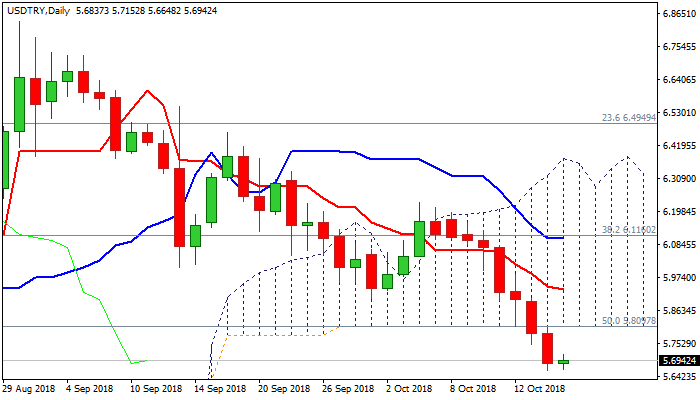
USDTRY Outlook: Probe Below Key 5.6875 Support Could Be Strong Bearish Signal On Sustained Break
The USDTRY pair holds in narrow consolidation on Wednesday, after 8 straight days in red, which resulted in break below key supports at 5.8097 (daily cloud base) and 5.6875 (16 Aug low of pullback from new all-time high).
Violation of 5.6875 pivot could be a key if the pair manages to sustain break, which could result in further correction of 4.5121/7.1043 rally) and expose its Fibo 61.8% level at 5.0353.
Daily techs in bearish mode support scenario, but bears may take a breather and signal hesitation at 5.6875 support on overbought slow stochastic.
On the other side, risk of recent downtrend stall exists, as Turkish lira stands on shaky ground.
CBRT’s ultra-tight monetary policy could have a negative impact, as Turkey’s GDP has slowed, data showed contraction in the economy as industrial production is the weakest in two years, inflation rising above interest rates and high unemployment which could contribute in slowing down lira’s recovery from record lows.
Adding to negative signals are higher oil prices and Fed’s intention to further increase interest rates.
Weekly close will be closely watched as close below daily cloud would add to positive signals for lira, with corrective actions to be ideally capped by cloud base.
Res: 5.7152, 5.8097, 5.9040, 5.9354
Sup: 5.6617, 5.5336, 5.5035, 5.4242
Directionless Markets Amid Lack Of Clear Driver
EUR/USD lacks direction as political uncertainties persist
Since the beginning of the week, US rates have finally taken a breather in the aftermath of a violent equity sell-off. The 2-year treasury yield traded in a tight range - between 2.82% and 2.87% - as investors take a step back to revaluate the rate outlook. On the longer end of the curve, the 10-year yield moved between 3.14% and 3.18%. Market participants will be able to get further information on the Fed thinking this afternoon as the minutes of the September FOMC meeting are due release later today. Back in June, it wasn’t clear whether the Fed would go with four or three rate hikes this year. In light, of the last FOMC meeting it looks like the market will get its fourth hike finally. In our opinion, the market is done pricing this eventuality and is now hoping to get some hints from the ECB.
Indeed, even though market participants might get further clarity from Fed minutes, which we doubt, the attention will now start to shift towards the upcoming ECB meeting that will take place next week (October 25). The September ECB minutes showed that European policymakers were concern by a potential slow-down in growth, mostly due to rising trade tensions. Investors have high expectations for next week meeting. In the absence of clear driver, EUR/USD has been trading sideways since the beginning of the week and should continue on that road until next week. Meanwhile, investors will keep an eye on both Brexit and Italy’s budget developments.
Brexit running short
The European Council Meeting in Brussels starts today and Brexit negotiations will resume at night. Now the arrangement lies in the hands of all 27 EU members that will vote tomorrow. Further progress today is not expected. However, the likelihood is of an extension to a special Brexit summit by November. US officials have also affirmed their interest to make a trade deal with the UK once the Brexit case is solved.
Accordingly, EU chief negotiator Barnier offered an extension of the transition period by 21 months, along with a two-tier backstop, which would allow both the UK and Northern Ireland to remain in the Customs Union in the case of a no-deal. This would allow more time for an EU–UK trade relationship to be built while avoiding a particular arrangement for Northern Ireland.
For now, the USD/GBP is expected to trade lower, as uncertainties continue to spread across the marketplace. A bounce could be practicable in the announcement of an extension. Today’s September data are expected to show a slowdown in inflation, which is expected to be published at 2.60% (prior: 2.70%). GBP/USD is currently trading at 1.3150, approaching the 1.3140 range.
EURUSD Subdued As Eurozone Inflation Matches Forecast
EUR/USD is steady in the Wednesday session, after posting slight gains to start the week. Currently, the pair is trading at 1.1579, unchanged on the day. On the release front, German ZEW Economic Sentiment plunged to a level of -24.7, well below the estimate of -12.3 points. Eurozone ZEW Economic Sentiment followed a similar trend, falling to -19.4, compared to a forecast of -9.2 points. In the U.S, JOLTS Job Openings is expected to dip to 6.90 million. The markets are still waiting for the U.S Treasury to release its semi-annual currency report, which may occur later on Tuesday. The U.S will release Building Permits and Housing Starts, and the Federal Reserve will publish its minutes from the September policy meeting.
Confidence in the German economy continues to sputter, as German ZEW Economic Sentiment dropped sharply to -24.7 in October, after a reading of -10.6 a month earlier. The ZEW assessment noted that there is increased pessimism over the German economy due to the escalating trade war between China and the United States. A second factor is worries over Brexit, with fears that the U.K will depart from the EU without an agreement in place. Both issues have dampened export expectations. The indicator finds itself in negative territory for a seventh straight month. Investor sentiment in the eurozone economy also is weak, with the ZEW Economic Sentiment dropping to -19.4, its lowest level since August 2012.
EU leaders are meeting in Brussels, and officials had hoped that the summit would include a draft statement on Brexit, but this plan has been shelved due to a deadlock over the Irish border. The EU is insisting that it will not sign a withdrawal agreement with Britain, unless there is a backstop which allows Northern Ireland to remain in a customs union with the EU after Brexit. However, the British government is unlikely to agree to such a move, since it would require regulatory barriers within the United Kingdom. With plans for a Brexit statement at Wednesday’s meeting on hold, a Brexit statement with have to wait until EU leaders meet in November or even December, which is extremely close to the Brexit deadline in March 2019.
Fed Minutes Eyed As Markets Recover
US futures are trading slightly in the red on Wednesday, paring gains from the previous day as risk appetite continues to improve.
Fed minutes in focus as markets rebound following sell-off
A decent rebound in the US on Tuesday on the back of strong earnings numbers has gone some way to allaying fears about last week’s sell-off. The results are a timely reminder about the strength of the US economy right now and despite the large amount of underlying risk that still exists, investors have plenty to be optimistic about.
Considering the fact that a major contributor to the sell-off appeared to be rising US bond yields – which have come off as risk appetite has returned – today’s FOMC minutes should be very interesting. Given the events of the last couple of weeks, there is a chance that the minutes are a little outdated, but that won’t stop people pouring over them for clues about where exactly we are in the tightening cycle and how much further there is to go.
Powell was a primary catalyst for the spike in yields a couple of weeks ago when he declared that we’re not yet near the neutral rate and could go beyond, which flies in the face of the belief of many that we’re in the latter phase of the tightening cycle. It will be interesting to see whether others share the views of Powell, although we may be better informed by the comments of the many policy makers that are speaking this week, including Lael Brainard today.
The return of grey skies and dark evenings has been a timely metaphor for the mood in Brussels right now
For the UK, this week may be dominated by what’s happening in Brussels but the current state of the economy will also be a focal point for traders, with today’s CPI data being the second of three notable releases. Inflationary pressures moderated once again in September after a brief summer spike that accompanied a surge in activity as consumers made the most of the good weather and the country’s unexpected World Cup success.
The return of grey skies and dark evenings has been a timely metaphor for the mood in Brussels right now, with good will wearing thin and the two camps becoming increasingly hostile towards each other despite only a small number of issues remaining. Theresa May heads to Brussels today in the hope of bridging the divide over these issues but any agreement this week is extremely unlikely with attention now switching to an emergency summit in November.