Sample Category Title
Asia Market Update : Focus On Yuan
Surprising busy start even with the absence of Hong Kong in the mix
The hawkish warm-up ahead of tonight's FOMC minutes delivered by San Francisco's new President Daly is creating some noise today after she said late in the NY session she does think it's a balance between hiking too fast and getting behind the curve but her remarks on the economy are strong. On inflation, the Fed is “effectively at the 2.0% target.” For potential tailwinds, however, she does name three: financial conditions, global growth, and fiscal stimulus. Indeed there will be an intense focus on the new FOMC members to gauge the hawkish vs dovish composition of the new FOMC and this is weighing across the regional sentiment as she is camped on the hawkish end of the scale.
The Yuan fix
USDCNY fixed at 6.9103 today, -16 pips from last fixing and -83 pips from the previous closing at 6.9186 on 16:30 Beijing time. The fix is much lower than market expectations triggering a sell-off below 6.91, while the usual assortment of bids was absent on the fix, but the buy on dip mentality should prevail until a definite solution on the US-China trade front is offered up. The current playbook remains intact.
Via Deutsche Bank
Going over some market notes today: Sameer Goel at Deutsche bank suggests the divergence in trend between China's estimated intervention activities and its holding of US Treasuries is increasingly notable as Deutsche bank has rated roughly US 17 billion in FX markets intervention was offset by US 18 billion in US Treasury sales. So, this is different to my morning thoughts that the Pboc were adding to their intervention war chest, but instead, they are selling US Treasuries for currency smoothing policy.
Oil prices
Oil prices came off at the Shanghai open on profit-taking, but Brent crude remains well bid after a test of the downside for the third consecutive day on Tuesday, given the bulls some room on stops likely layered between 79.50 and 79. Geopolitical tensions amidst reports that Iranian crude oil exports have continued to decline helped support the price. But again, local Asia sentiment is wobbly as Asia equity dealers can't shake the overhang from US-China trade tensions. But given the prevailing bullish market lean we should expect these dips to be well supported.
Gold Prices
A case of the nervous Nellies is impacting freshly minted long gold positions as US equity futures continued to move higher in early trade. Indeed, there is still some overhanging sentiment that Golds strongest correlation is a communication of the overall health of the US economy as the SPX /XAUUSD correlation should carry. So, if the US economy is doing well as transmitted through the SPX bullishness, gold will sell off. But absent in this argument is the US midterm elections which will pose a significant risk to both equity and USD sentiment.
But perhaps the hawkish warm-up ahead of tonight's FOMC minutes delivered by San Francisco's new President Daly is weighing on Gold market sentiment.
Asia equities
Perhaps a bit surprising is that local equity markets are not exactly knocking it out of the park this morning. I suspected they would take their lead from the US equity froth. But again, local dealers remain a better seller of risk until a definitive shift in US-China trade tensions is offered up.
You Just Know That Something Good Is Going To Happen
US markets
In the span of a mere 24 hours two of my most pressing question may have been answered, correctly, can the anomalously robust US equity market hang on in the face of mounting global risks? And are we entering a period of drawn-out USD selling?
Mind you, with many distractions on the radar, there are two not so subtle, under-the-radar distractions sending global trading floors abuzz this morning. Specifically, the astonishing outperformance in both US equities and emerging markets.
US equities markets soared to their biggest gain in six months following strong earnings and uplifting reports on the economy.
The Labor Department reported that U.S. employers posted the most jobs in two decades in August as expectations around hiring continued to outpace while US industrial pace and the Federal Reserve said output by U.S. factories, mines and utilities climbed in September despite the effects of Hurricane Florence.
Equity investors took their cue from the industrial production report which indicated inflation isn’t picking up, triggering another Goldilocks economy rally. But whatever signal convinces investors the Fed will not move interest rates up quicker than expected will be latched on to the big time especially in the face of robust US data.
But let’s take this move in context, sure +2 % gain on the S&P is astonishing in anyone’s book, but significant indexes are still broadly lower for the month following last week 2-day meltdown as investors fretted over a fast pace of Fed policy normalisation.
However, it is the best of both worlds for US equity markets, with the economy in full swing but nary a sign of inflation as Goldilocks returns for yet another day. Which is providing a much need diversion from trade tensions and concerns about global growth downtrend. Also, the dollar fell overnight as traders are contemplating the Greenback fate ahead of the US midterm elections.
Nothing like a robust US market and a USD lacking any momentum to trigger the Asian market into action!
Oil Markets
The American Petroleum Institute figures for the week ended October 12 showed an unexpected 2.1 million barrels per day decline in US crude oil inventories even as stocks at the Cushing, Oklahoma delivery point for NYMEX WTI futures increased by another 1.5 million barrels per day. But the headline did catch momentum speculators wrong-footed who were expecting another build.
Prices were also bolstered by rising US stock market providing a welcome distraction from trade tensions and concerns about global growth as investors are back focusing on tighter global supply due to Iran sanctions. It’s widely expected that Iranian exports, which are already dropping, will fall quite sharply from November onwards, and even if Saudis and other OPEC bodies have compensated the anticipated shortfall to some degree there will undoubtedly be a near-term imbalance which will pressure prompt prices
On a side note regarding a slower global growth narrative or an adverse knock demand side effect from weaker the US emerging market currencies, there’s no definitive, quantifiable data to support this view, as global energy demand remains robust by any demand-side measure.
None the less Brent prices risk is skewed higher as Venezuela, other the Middle East concerns, North and West Africa remain hotspots for supply disruptions in coming months. And with traders all too aware that we are little more than one supply disruption away from a move above $ 85 Brent, prices remain very well supported on pullbacks after reaching four-year highs last week.
Gold Markets
Given the political firestorm igniting around the US Midterms, Italy, and US-Saudi tensions, gold’s upside is looking favourable as a tail hedge against these escalations. The mid-term elections in themselves will provide more than enough political fodder to keep the flames going, not to mention the possible equity market drawdowns from a shift of power in the “house” if a Blue wave takes control.
Gold did back off from intersession highs as US equity markets rallied convincingly, which was triggered by a more robust US Industrial production data. But with inflation absent from the report, it doesn’t shift the Fed dial. This view is significant for Gold prices as it suggests without an uptick in US Inflation for the USD to tether itself to in the run you to the US election, we could see the dollar sell-off as US political headline risk is expected to escalate and should lead to Gold outperformance.
But on a near-term break of the signification $ 1234-1236 zone and given the bearish Hedge Fund compositions and structures on the Comex will come under intense pressure and we could see $1250+ in a heartbeat if these established short positions show signs of buckling.
However, perhaps a hawkish warm-up ahead of tonight’s FOMC minutes San Francisco’s new President Daly said she does think it’s a balance between hiking too fast and getting behind the curve but her remarks on the economy are strong. On inflation, the Fed is “effectively at the 2.0% target.” For potential tailwinds, however, she does name three: financial conditions, global growth, and fiscal stimulus.
Currency markets
The Yuan
The CNH will be closely watched in Asia today after some shifting sentiments were observed in the NY market. But the latest China inflation prints were failing to highlight just how problematic higher prices are for Chinese consumers while only suggesting that producers are unable to pass on higher cost from the weaker Yuan and or tariffs impact.
The US Dollar
Traders will be watch USD housing starts intently, remembering that the housing industry has been the most disappointing segment of US data in 2018.
While the TIC data has taken on a secondary level of importance in recent years, one question mark China’s holding of US Treasuries fell for a third consecutive month in August. I don’t believe there is anything sinister in this trend other than the fact the Pboc could be building their USD war chest to intervene if the Yuan moves too quickly above 7? Or its little more than prudent reserve management policy with the markets expecting the USD to struggle in 2019
We are starting to see signs of a USD capitulation ahead of the US midterms as dollar bulls are becoming increasingly nose-ringed to the US midterms elections.
The Euro
Currency markets are cautiously busy with most of the focus on JPY and EUR in New York, but well-worn ranges held
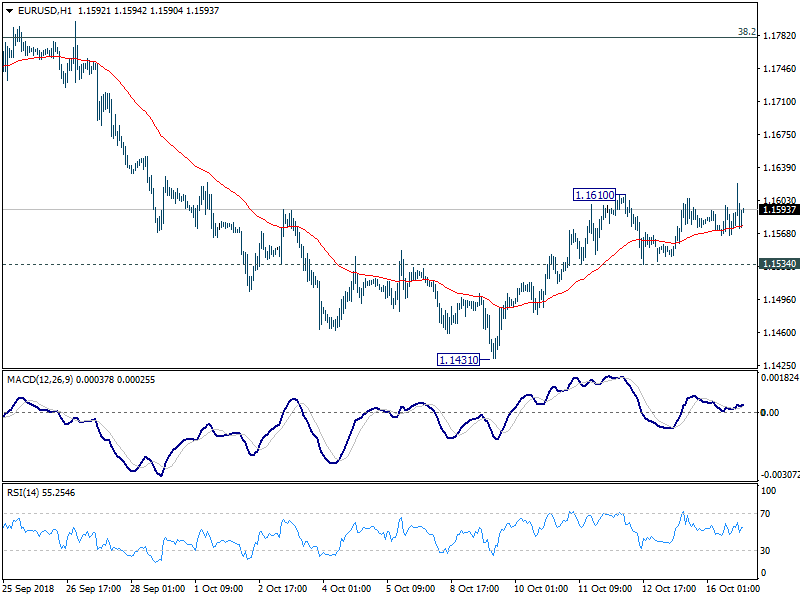
Little has changed from last week view that was dominated by risk reduction of USD long positions. In the meantime, the EURUSD is struggling to break through a wall of offers between 1.1600 -25. None the less, when EURUSD eventually breaks it’s 1.1450 1.1750 range, it will be through the top of the range, but given the temperament and choppy nature of trading the EURUSD these days, it will require a great deal of patience.
The Japanese Yen
The USDJPY moved convincingly lower on last week US equity led meltdown. Traders are monitoring the scope of the latest US equity market recovery. But on another equity market wobble risks remain more significant to the downside for USDJPY as the midterm US elections near.
The British Pound
Sterling has been weighed down by virtually every conceivable negative Brexit headline, but there is no denying the latest employment report that is signalling ages are now growing faster than prices!! The Pound continues to grind higher even although a Bank of England rate hike is very much dependant on Brexit going through
The Malaysian Ringgit
With China trade headlines mostly absent, regional markets have been much calmer this week. But oil has been sending mixed signals but remains well bid on dips, which should be supportive of the Ringgit, But the focus will be on the CNH today( see above)
Eco Data 10/17/18
[php_everywhere instance="1"]
Mid-US update: Dow rises 360 pts, EUR/USD back in range after brief spike
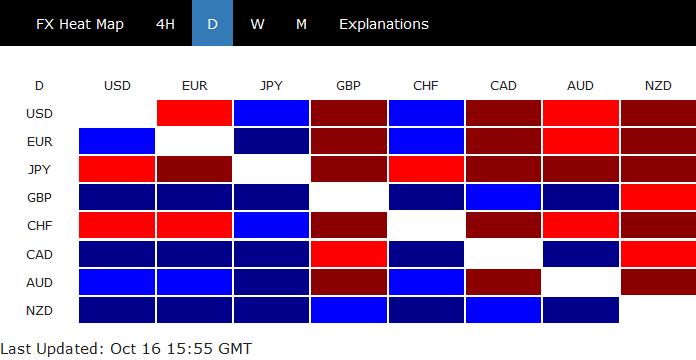
Yen and Swiss Franc are trading as the weakest ones as risk appetite return to the markets today. Dollar gets no support from the strong rebound in US equities, as treasury yields are essentially flat.
Meanwhile, New Zealand Dollar, Canadian Dollar and Sterling are the strongest ones.
Dollar was sold off in early US session as EUR/USD broke 1.1610 minor resistance. But the pair quickly lost steam and is now back in familiar range.
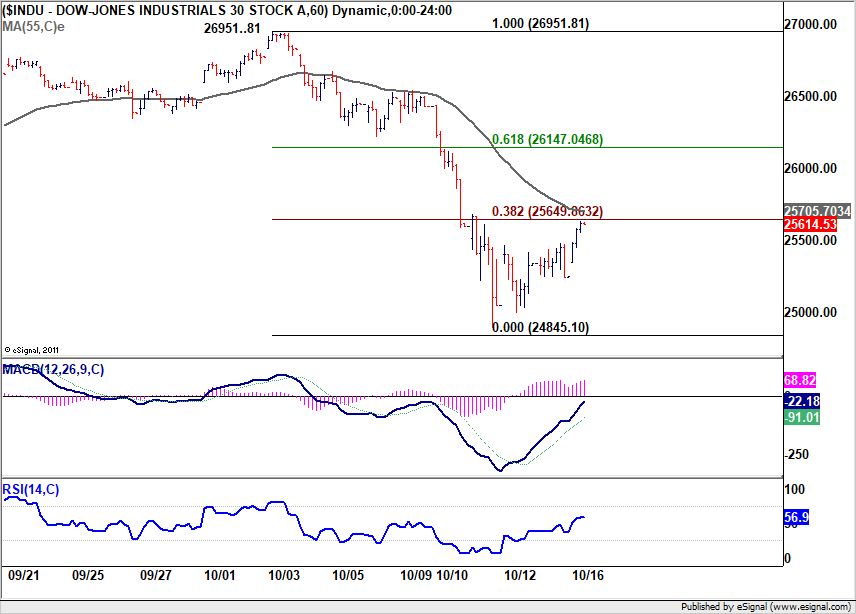
At the time of writing, DOW is trading up 1.38%, S&P 500 up 1.43% and NASDAQ up 1.84%. Five-year yield is up 0.004, 10-year yield down -0.002, 30-year yield down -0.003. While DOW's rebound is strong, it should be reminded that it's more likely a corrective move than not. And, it's already close to first hurdle of 38.2% retracement of 26951 to 24845.10 at 25649.86, which is close to 55 H EMA at 25706. We'll see whether DOW could extend the rebound through this hurdle, or get an instant rejection from it before today's close.
In Europe, stock closed broadly higher on late buying.
- FTSE rose 0.43% to 7059.40
- DAX rose 1.40% to 11776.55
- CAC rose 1.53% to 5173.05
- German 10 year yield dropped -0.0102 to 0.495
- Italian 10 year yield also dropped -0.0928 to 3.462
EU Tusk: No optimism on tomorrow’s summit on Brexit
European Council President Donald Tusk said that the reports from chief Brexit negotiator Michel Barnier "give me no grounds for optimism before tomorrow's European Council on Brexit." And he said, on Wednesday, he's "going to ask Prime Minister May whether she has concrete proposals on how to break the impasse. Only such proposals can determine if a breakthrough is possible." Tusk also added that the unscheduled Brexit summit in November only makes sense if there negotiation is really close to a breakthrough.
Separately, it's reported that German Chancellor Angela Merkel described the effort on Brexit negotiation as "squaring the circle". And she emphasized that the EU is aiming to avoid a "hard" Irish border. And, it's clear the the border between Ireland and Northern Ireland would not disappear completely.
EURUSD Unfolding a Three-Wave Recovery Towards 1.17 – Elliott Wave Analysis
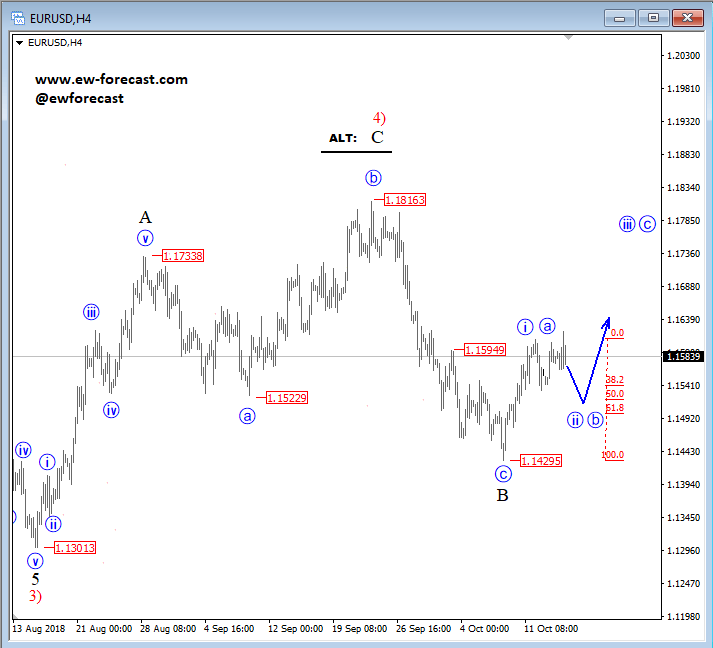
EURUSD has made five waves up from August lows which we labelled as wave A of a bigger three-wave upcoming reversal. Afterwards we also labelled wave B, which ufolded a possible three-wave flat correction that looks to have found a base at the 1.1429 level, from where price is now turning higher. If a flat correction is completed then a minimum three-wave rally is expected to begin which can take price towards the 1.17 area and beyond.Now, this is our primary view that points higher, however we also labelled an alernate scenario, where the bigger A-B-C correction is already completed at current 1.1816 highs. If that is the case, more weakness may follow, however a minimum three-wave rally is also to be expected as a corrective, temporary rally to the previous fall, that found a low at the 1.1429 level. In both cases we expect a minimum three-wave rally towards the 1.17 area.
EURUSD, 4h
Fed Minutes Next on the Plate for Dollar
The Fed will release the minutes of its September meeting, where policymakers raised rates for a third time this year, on Wednesday at 1800 GMT. Investors may focus mainly on the discussion around how far above “neutral” officials are willing to raise rates. Considering current market pricing, a confident tone that reaffirms the Fed remains on track to meet its own rate projections could help the dollar rebound, and in turn spell more trouble for stocks.
Back at the September gathering, the Fed raised interest rates by 25bps, though it maintained its future rate-path projections largely unchanged and delivered almost no new fresh policy signals. Of note was the removal of a phrase that previously read “policy remains accommodative”, which initially generated worries that the pace of hikes may slow. While Chairman Powell later downplayed this change as merely cosmetic and not a signal per se, investors will still scrutinize the minutes for some more color on that debate.
Another discussion markets will focus on is what officials consider to be the “neutral” rate of interest, whether most participants are willing to raise rates above it – and if so, by how much. To put things into context, “neutral” is theoretically the interest level that neither stimulates nor restricts economic activity, which most Fed calculations place around the 2.5% – 3.5% neighborhood. Once that level is reached, any rate increases beyond it to keep inflation under control would be seen as posing risks to growth, implying policymakers may start becoming hesitant to pull the hike trigger.
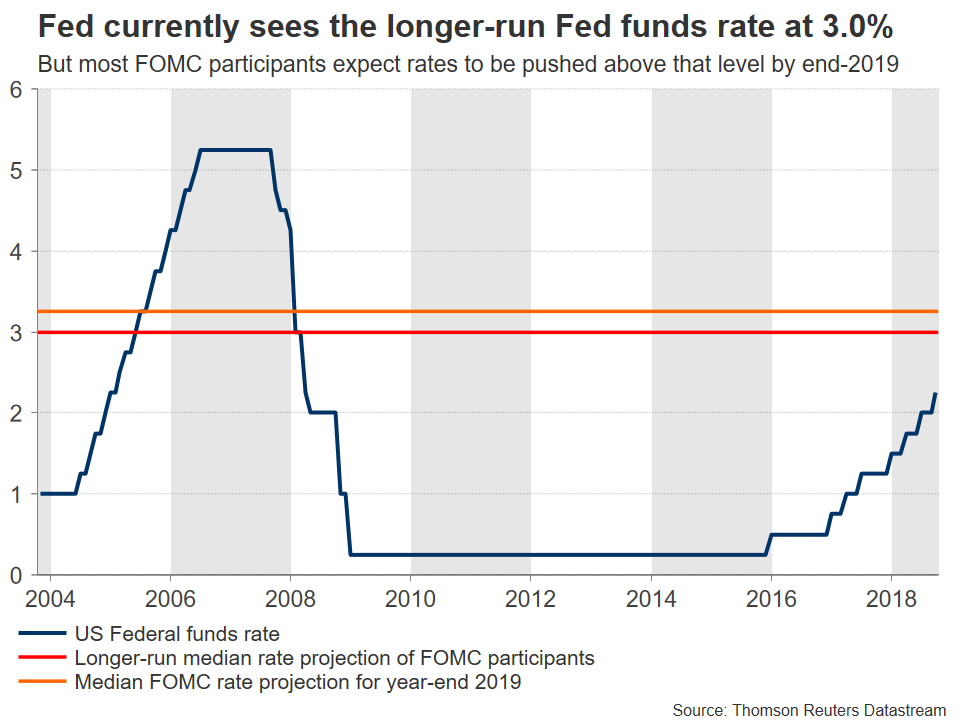
The latest rate-path projections show nearly all officials expect policy rates to be in restrictive territory by 2020, though there’s considerable dispersion among them on how much higher rates should go. In this respect, it’s noteworthy that Chicago Fed President Charles Evans – a typically dovish official – recently said he thinks two 25bps hikes above “neutral” would be appropriate. It will be interesting to see whether something similar is echoed by the broader Committee, with the risk being that most members are even more hawkish in their views.
On a different note, the conversation around trade tensions and the risks they pose could also attract attention. That said, judging by how Chair Powell brushed them aside during the press conference as being merely a risk that hasn’t actually shown up in the data yet, the Fed doesn’t appear to be particularly worried thus far.
All in all, the key message may be that the Fed remains committed to raising rates in a gradual manner – perhaps once per quarter – until it has a reason not to, and that trade risks are not dire enough (yet) to delay these plans. Market participants don’t seem quite as confident though, having priced in only two quarter-point hikes between now and June 2019, which implies they expect the Fed to pause for one quarter in the meantime. Hence, a confident tone in the minutes that reaffirms the Committee remains on track to meet its own rate projections could push US bond yields higher, potentially helping the dollar to claw back some of its latest losses.
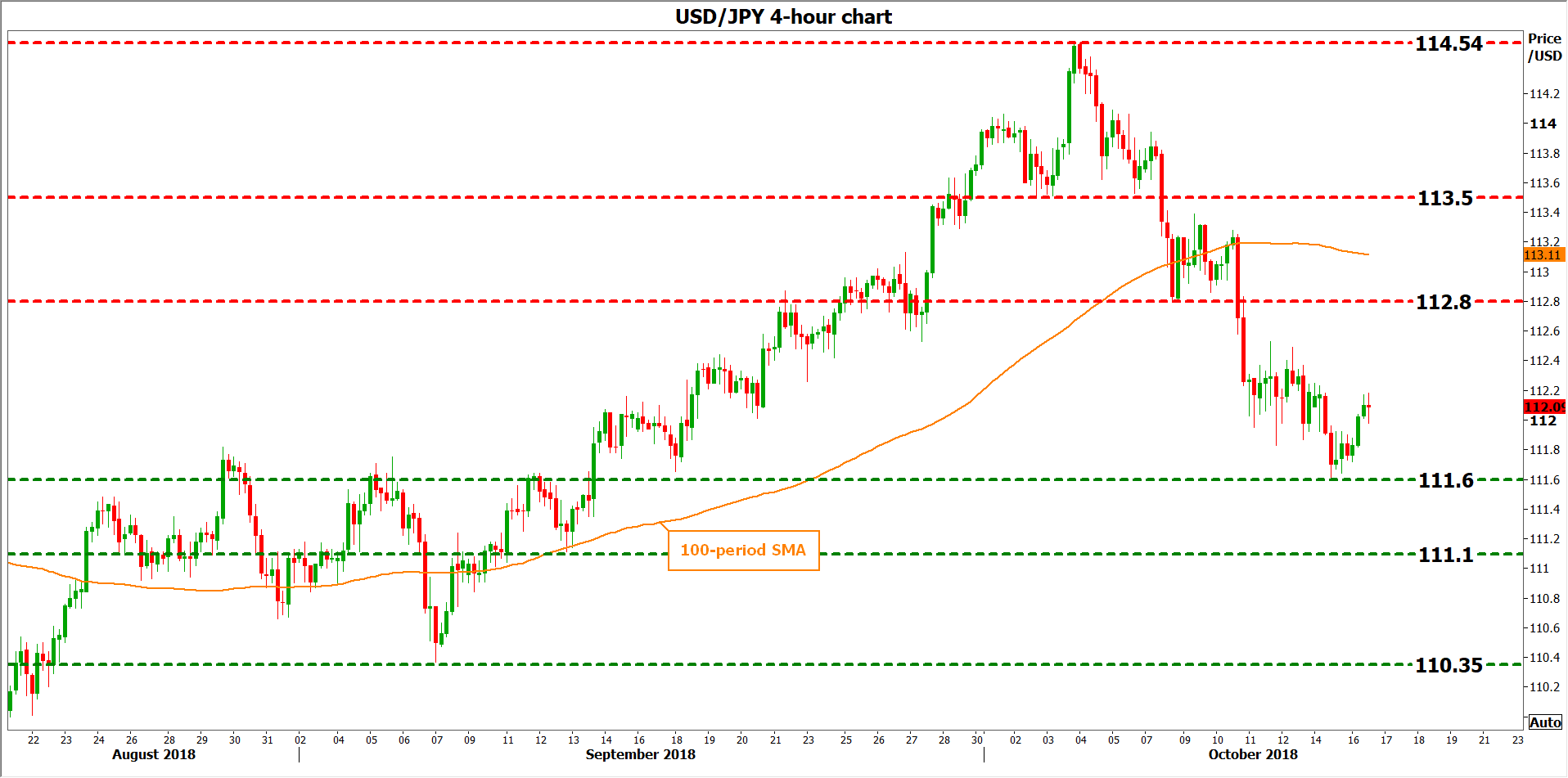
Technically, advances in dollar/yen could encounter a first wave of resistance near 112.80, the inside swing low of October 8. An upside break may open the way for a test of 113.50, the area that halted the decline on October 2, before the one-year high of 114.54 comes into view.
On the contrary, declines in the pair – perhaps on a Fed that focuses more on trade risks or downplays hiking beyond “neutral” – may stall initially around 111.60, the October 15 low. Even lower, the September 12 trough of 111.10 may attract attention, ahead of the September 7 bottom of 110.35.
Beyond the dollar, US stocks will also be in the spotlight, considering that the recent bout of equity-weakness was brought about by a surge in US bond yields. Bonds are considered safer than stocks, and as they begin to offer a higher return they become more attractive to hold relative to equities. Hence, a confident tone by the Fed that boosts bond yields could spell more pain for stocks, whereas a more cautious-sounding narrative could help US indices to recover.
Australian Employment Report Expected to Remain Solid; Unlikely to Excite Aussie Traders
Australia’s employment report for September is likely to attract investors’ attention and is scheduled for release on Thursday at 0030 GMT. The aussie is on the receiving end of considerable downside pressure stemming from growing concerns about a full-blown trade war between the US and China, as well as on the back of domestic drivers. Stronger data later in the week may provide some short-term relief to the currency.
The Australian economy is anticipated to have created 15,200 jobs in September, 28,800 jobs less than the previous month. Moreover, the unemployment rate matched a low last experienced in November 2012 in the previously tracked month and is forecast to remain at the same 5.3% level in August, as the previous two months. This is positive, given that the participation rate is predicted to hold steady at 65.7% in September.
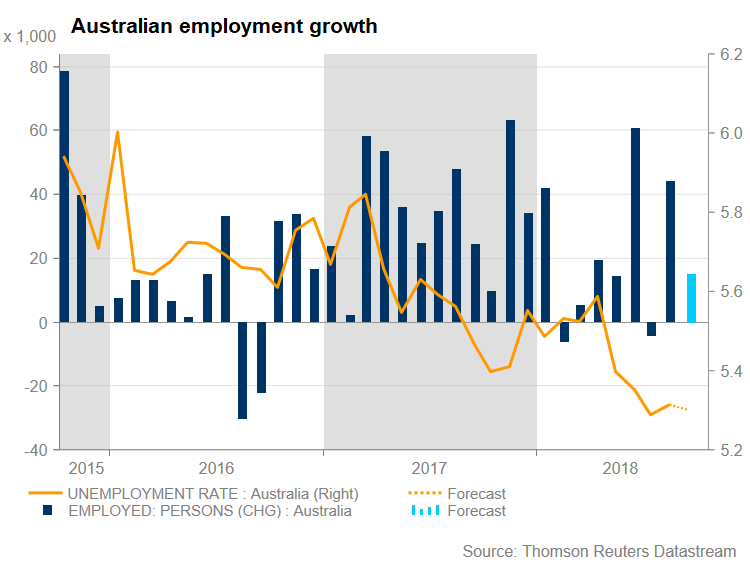
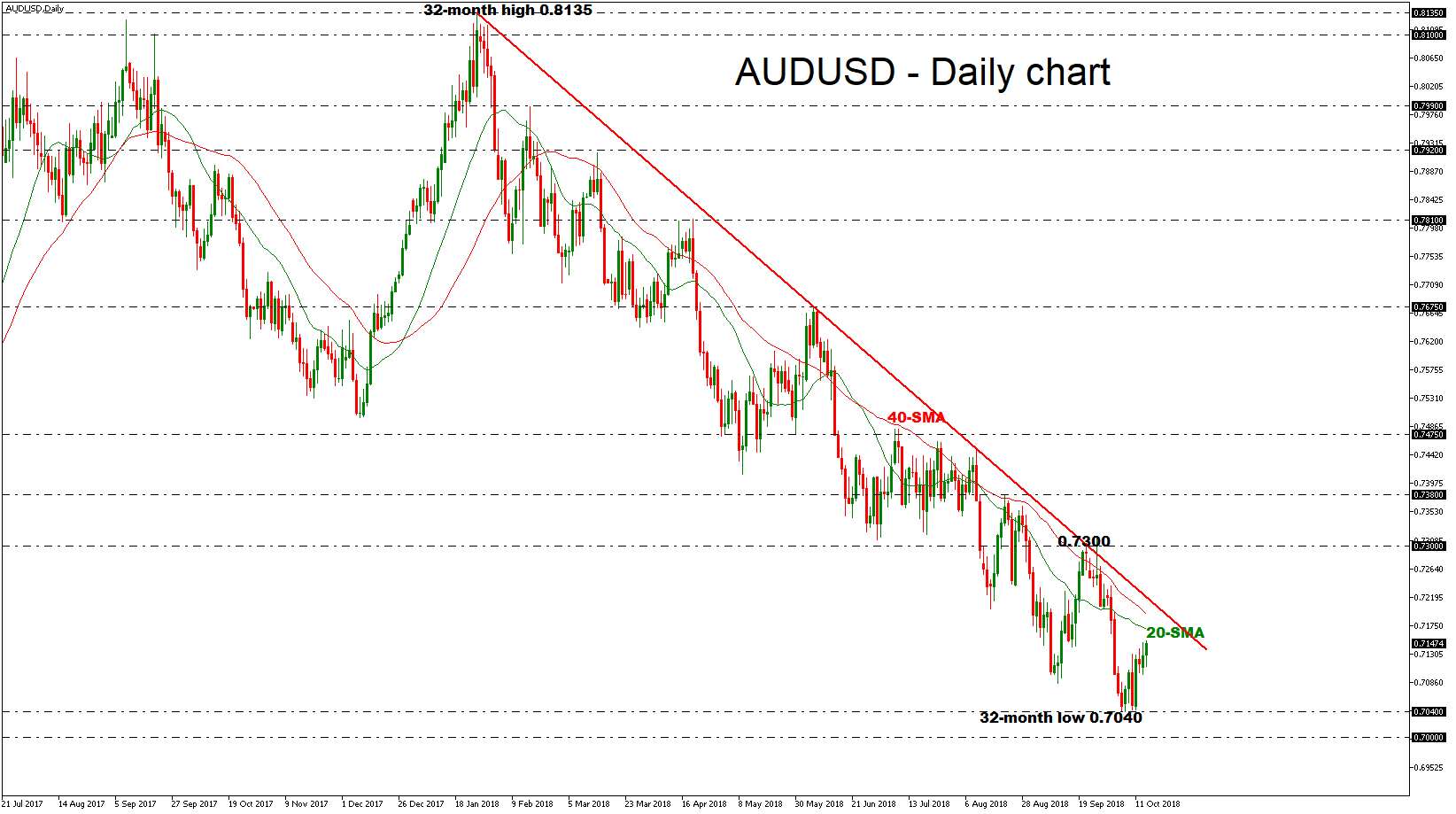
Stronger than expected figures on Thursday may provide a lift to the aussie, which is trading slightly above the 32-month low levels versus the greenback. Minutes of the monetary policy meeting of the Reserve Bank of Australia (RBA) that took place on October 2 referred that the GDP inched up by 0.9% in the quarter, and the upward revision to growth in earlier quarters drove GDP growth to the June quarter to 3.4%, which was the highest year-ended rate of growth since 2012. Also, members mentioned that “employment had risen strongly in August, driven by full-time employment, and employment growth had been stronger than population growth over the year”.
Turning to monetary policy in Australia, the minutes mentioned that the Australian dollar had tumbled more than 8% versus the US dollar during 2018 so far. This was the result of US long-term bond yields having moved above those in Australia over this period despite the rise in commodity prices recently. Meanwhile, the RBA kept the cash rate at a record low of 1.5% at its October meeting, as widely expected, extending its record period of policy inaction beyond two years, amid sluggishness in inflation and wages as well as the risk to global growth from trade policy by the US.
From the technical point of view, upbeat numbers on employment are likely to propel AUDUSD higher. Resistance to a rising pair may take place around the 0.72 round figure, which coincides with the 40-day SMA. More bullish movement would shift the focus to the region around the 0.7300 psychological level, which stands above the medium-term descending trend line that has been holding since January 26.
On the downside and in case of disappointing figures or rising trade risks, price action is likely to challenge again the 32-month low (0.7040). A drop below this level would reinforce the downside risk and send prices until the 0.7000 round number, last reached in January 2016, creating a lower low in the downward trend.
Sunset Market Commentary
Markets
Global core bonds booked small gains today, ignoring the further gradual rebound of European stock markets and positive sentiment on peripheral bonds markets. German Bunds outperformed US Treasuries. Disappointing German ZEW investors sentiment offers a plausible explanation, but the timing doesn’t fit. Both the current assessment and forward looking expectations component of the ZEW dropped more than forecast with ZEW referring to the global trade dispute with starts biting into German exports, the heightened risk of a hard Brexit and Germany’s fragile ruling coalition. Whatsoever, core bonds gained some momentum going into the US open. Moves are technically insignificant. US industrial production was too closely to expectations to surprise investors. US yields add between 0.5 bps (30-yr) and 1.2 bps (5-yr) at the time of writing. The German yield curve flattens with yield changes varying between+0.2 bps (2-yr) and -1.3 bps (30-yr). Peripheral yield spread changes vs Germany narrow by 5 bps for Portugal, 9 bps for Italy and 10 bps for Greece.
Market settings played in the advantage of the single currency today, with European equity markets gaining around 1% and peripheral spreads narrowing. The eco balance on the other hand lifted in favour of the dollar with marginally stronger industrial production weighing against weak German ZEW investor sentiment. Whatsoever, EUR/USD hovered in a narrow sideways range between 1.1570 and 1.16 for the largest part of the day. Things changed at the start of the US session as the trade weighted dollar gave away minor support (95; past trading day lows), lifting EUR/USD above 1.16 as well. USD/JPY is the exception to the rule today, settling back above 112, suggesting that positive risk sentiment is probably today’s main trading rationale. US stock markets opened 0.75% to 1% higher.
Over the previous days, the sterling rebound/short-squeeze halted. Markets saw the Brexit glass again a bit more half empty rather than half full as meetings/negotiations between high level EU and UK officials this weekend didn’t yield any progress. EUR/GBP yesterday rebounded above the 0.88 big figure. Even so, sterling losses remained contained. Markets apparently hope that a ‘last minute’ deal will prevent a disorderly crash from the UK out of the EU. Brexit headlines remained diverse today as stakeholders stick to their positions. Even so, sterling rebounded. The move was supported by higher than expected UK wage growth data (3.1% Y/Y vs 2.9% expected). It remains unlikely that the BoE will take further action until there is substantial progress on Brexit. EUR/GBP eventually made an intraday U-turn ahead of the US opening after EU chief negotiator Barnier warned that it could take weeks before a deal can be reached. European Council President Tusk sounded even more worried, saying that only new proposals by UK PM May can break the brexit impasse. Expectations going into this week’s EU Summit were already low, but now seem definitely buried.
News Headlines
Rating agency S&P is concerned about China’s “debt iceberg with titanic credit risks”. For years local governments were forbidden to raise debt, thus creating special financing vehicles (LGFV) to collect off balance funding. Most of this debt is held by small(er) local banks. S&P estimates the amount of ‘hidden’ debt in these LGFV’s at an “alarming” 60% of GDP.
The European Commission has one week to review Italy’s draft budget. Yet its President, Juncker, already hinted at a rejection, saying Rome’s spending intentions risk breaching the rules and that an approval could trigger a “revolt from other governments”. The EC could ask for amendments within two weeks.
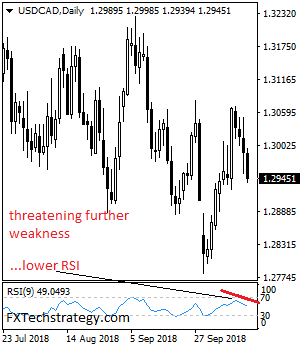
USDCAD Remains Vulnerable Towards 1.2926/00 Zone
USDCAD remains vulnerable towards 1.2926/00 zone as it retains its pullback pressure. Support lies at the 1.2900 level where a break will aim at the 1.2850 level. Further down, support comes in at the 1.2800 level where a turn lower may occur. But if further weakness occurs support comes in at the 1.2750 level. Its daily RSI is bearish and pointing lower suggesting further weakness. On the up, resistance comes in at the 1.3000 level where a violation will target the 1.3050 level. Further up, resistance resides at the 1.3100 level and then the 1.3150 level. All in all, USDCAD looks to weaken further on correction.