

Sample Category Title
EURUSD Analysis: Is Expected To Decline
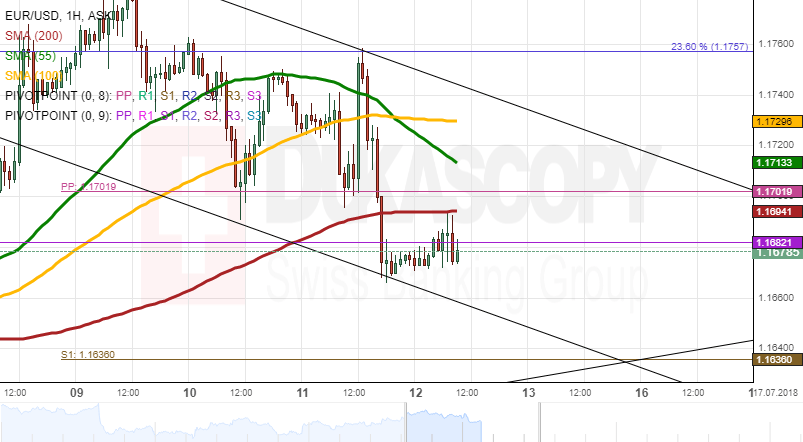
After the recent fundamental events and releases a broader review of the EUR/USD currency pair was conducted on Thursday. Namely, all previous patterns were deleted and a fresh look was taken at the situation to capture the new fundamental information.
It was discovered that the currency pair is trading in massive scale descending pattern, in which there exists a long term ascending channel. In the medium pattern a descent is taking place in a channel down pattern.
Meanwhile, note that recently the pair bounced into a strong resistance cluster, and it has almost no support down to the 1.1640 mark.
GBPUSD Analysis: New Pattern Spotted
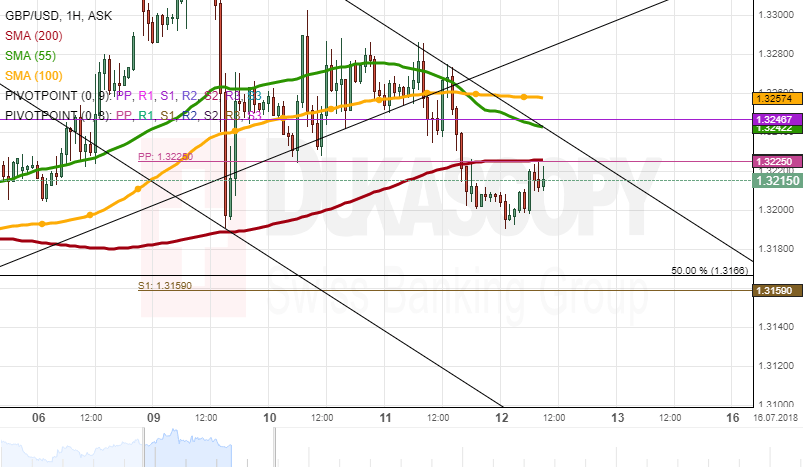
On Wednesday the Pound passed a significant support level against the US Dollar, which marked the full breaking of a previously active medium term ascending channel pattern.
The event resulted in the pair declining down below various levels of significance on Thursday. Namely, on Thursday the currency rate had no support down to the 1.3160 mark, where close by the 50.00% Fibonacci retracement level together with the weekly S1 are located at.
Meanwhile, note that a new medium term pattern has been drawn. It is set to guide the rate lower until the end of July.
USDJPY Analysis: Continues To Gain
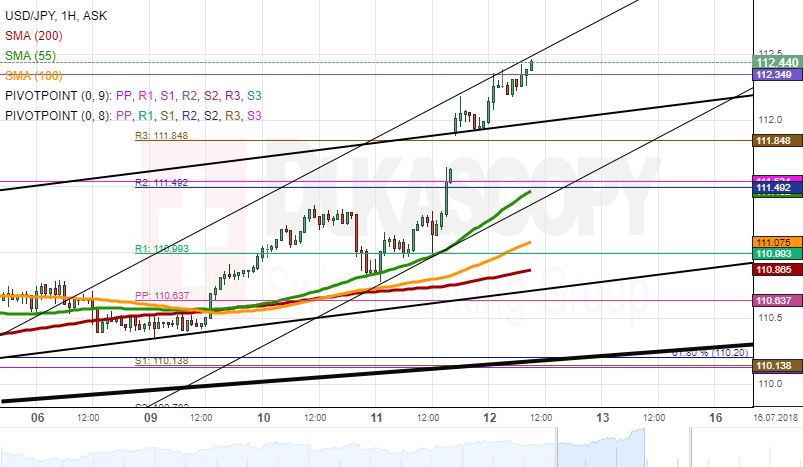
The US Dollar has jumped against the Japanese Yen in the second part of Wednesday's trading session. The jump resulted in the pair suddenly being above the upper trend line of a medium term ascending pattern.
It was immediately noticed that the rate had begun to use the resistance of the medium pattern as support by midnight.
However, note that a rather week ascending pattern was drawn on Thursday. In addition, as the pair faces no other resistance but the upper trend line of the new junior pattern, it is highly possible that a rise of the US Dollar is set to continue soon.
XAUUSD Analysis: Regains Some Losses
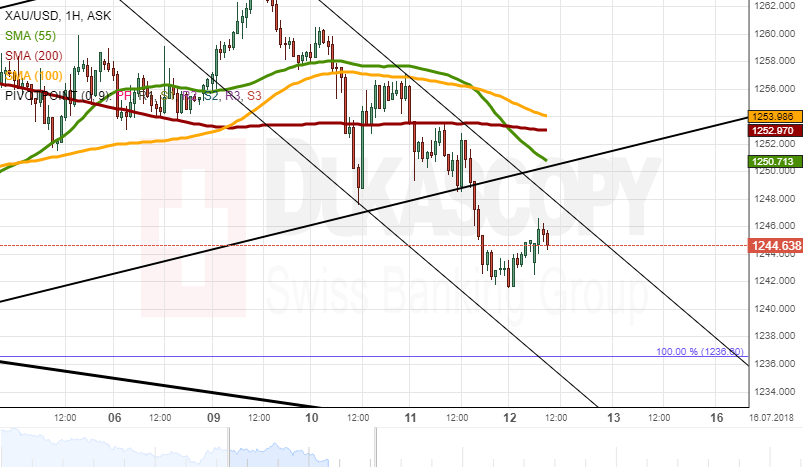
The yellow metal's price began to surge at midnight to Thursday, which lasted until the middle of the day's trading session. However, that was not expected to last.
On the hourly chart it could be clearly observable that the commodity still remained in a junior descending pattern, whose upper trend line was set to provide resistance to the bullion. Moreover, the various hourly simple moving averages were approaching the trend line from the north.
Due to these reasons combined it is assumed that the 1,236.00 mark, where a historical low is located at, will be targeted next.
EUR/USD – Euro Stems Slide, German CPI Matches Forecast
EUR/USD is almost unchanged in the Thursday session. Currently, the pair is trading at 1.1678, up 0.04% on the day. On the release front, German Final CPI slipped to 0.1% in June, down from 0.5% a month earlier. Still, the reading matched the estimate. Eurozone Industrial Production rebounded with a strong gain of 1.3%, edging above the forecast of 1.2%. The ECB released the minutes of its June policy meeting. In the U.S, the focus is on consumer inflation. CPI and Core CPI are expected to remain pegged at 0.2%. Unemployment claims is expected to fall to 226 thousand. On Friday, Germany releases the Wholesale Price Index and the U.S publishes the UoM Consumer Sentiment report.
With the ECB poised to wind up its asset-purchase program in September, attention is now focusing on the timing of a rate hike by the central bank. In June, the ECB said it would keep hold rates at current levels “through the summer” of 2019, but this wording is vague, leaving the precise timing open to debate. Does this phrase mean that that the ECB will wait until the October meeting, or could the ECB raise rates during the summer, if conditions warrant a hike? It would seem unlikely that policymakers will raise rates before the asset-purchase program is terminated, but the ECB has not shut the door on such a scenario. The ECB is forecasting that inflation will reach 1.7% in 2o18, which is not far from its target of just below 2 percent. If oil prices were to surge and send inflation higher, there will be more pressure on policymakers to raise rates, which would be bullish for the euro.
Investors remain uneasy about the tariff battle being waged between the U.S and its major trading partners, particularly China. After the U.S and China imposed tariffs on each other of some $30 billion, the Trump administration has raised the ante, threatening to hit China with further tariffs on $200 billion worth of Chinese goods. China cannot retaliate in kind, since it does not import that amount of goods from the U.S. Still, the Chinese can take steps which will make it more difficult for U.S companies to do business in China. The U.S dollar has benefited from the recent trade battles, and if this trend continues, the euro could be facing some substantial headwinds.
Risk Management in Forex Trading: Tips & Tricks
Clearly, any trading operation on the financial market is somehow connected with risk. Risk management becomes more and more popular not only among traders, but also companies and individuals whose job is related to management and business administration. It is extremely hard to keep business afloat without professional risk management. As for traders, it helps them increase efficiency in terms of cutting losses of their trading operations.
To be a successful trader, you should learn how to identify risky operations, estimate the risk level and reduce it so that it will allow them to earn stable incomes. Here are the list of useful tips & tricks for better risk management.
1. Cut your losses
The loss control system is a common type of risk management in the Forex sphere that helps traders fix their losses. Everyone heard about Stop loss (“mental stop”) option – an automated indication to the broker to close the deal when the price is approaching to the certain level of loss. The “stop” should be located and fixed so that emotions won’t interfere in real-time. Pay attention at the proportions between stop-order and profit-taking levels. Keep the ratio of potential profits and losses in the proportion of at least 1:3.
2. Track the trends and follow them
Try not to work in the opposite direction of the trend. Make sure you had discovered enough about currency pair growing trend before opening a position in order not to contradict it.
3. Don’t be hurry with successful deals
Until the goal is achieved, do not close the deal, because you will reduce the future income. This, in turn, will reduce your amount of backup funds for the next operations.
4. Limit potential losses per transaction
Try to determine the level of maximum losses on the transaction of the total deposit. For instance, maximum loss per transaction shouldn’t exceed 5%. It will help to compensate the loss from follow-on deals.
5. Diversify your capital
Don’t put all your eggs in one basket. This method helps traders not to lose everything at once. Leave some part of your balance as a reserved summ. At the same time, the rest should be divided between several currency pairs, where currencies don’t overlap.
6. Get rid of emotions
Keep a cold head during trading. Don’t let emotions spoil your trading plans. Stick to the selected strategy. Many traders record their thoughts into a special diary so that it will help to make the right decision when they’re stressed out.
7. Avoid the “paid-off” intention
In cases your trading operation seems to fail, don’t add anything immediately in the hope of compensate for a loss. It is better to analyze the errors before a new round.
Stick to this simple rules and you’re likely to succeed in forex trading.

Is it Real to Earn on Forex Without Investments?
A currency speculation is the basis of earnings on Forex. That is traders trade according to a simple principle "buy cheap, sell expensive". The positive difference between buy and sell prices is the desired profit of a trader.
You can earn in the Forex market without investments. Clearly, on your trading account should be the initial sum to open transactions. But in addition to trading, there are other alternatives for obtaining income on Forex. Some are directly related to trading, others do not have anything in common with it.
JustForex team decided to tell you about the most popular alternatives of earnings in the Forex market.
Participation in affiliate programs
Affiliate programs are one of the most popular ways of profit-making which do not require investments. You can become a partner and receive a stable income by participating in the affiliate programs. The partner attracts active clients to the broker through the specialized resources: site or blog, social networks, advertising platforms, etc. The partner's profit depends on the activity of the attracted clients. The reward is expressed either in percentage or in fixed amount. The more trading lots are made by an attracted client, the higher is the revenue.
Contests on demo accounts
Brokers often hold competitions on demo accounts. Such competitions are an excellent opportunity to get additional profit without risking own capital. Trading is conducted on virtual money, and the winner gets a withdrawable cash reward or valuable prizes.
No deposit bonuses
No deposit bonuses can be used as starting capital. Brokers offer no-deposit or welcome bonuses to attract potential clients to the company. They deposit the trader's account with a small amount for the registration. Bonus funds are not available for withdrawal and can be used only for trading. But the profit earned using bonus funds can be withdrawn. No deposit bonuses allow traders to try real trading and test the conditions of a new broker without expenses.
PAMM accounts
PAMM-accounts or trust management is a kind of cooperation between a trader and an investor. The investor trusts his own funds to the managing trader, and the trader makes the transactions on these funds and receives a predetermined percentage of profit. PAMM-accounts are beneficial for both parties: for investors, PAMM-accounts are a profit without deep knowledge in the Forex sphere, for managers – an additional profit without investing own funds. But note, this method is opened only for professional traders with profitable trading strategies.
Forum posting
Paid posts on specialized forums or blogs are available to any Internet user. Forum posting does not require special skills and financial investments. You post messages and get paid. But your posts should correspond to the subject of the forum and be informative, otherwise, they can get into spam.
Forex offers many ways of earnings without investment. Some methods require professionalism and skills, others – access to the Internet and the desire. Everyone can choose the right variant for themselves and start making money.

US Inflation Eyed As Markets Pare Losses
- Markets pare tariff losses;
- US inflation seen rising further;
- ECB minutes eyed after dovish tightening last month.
It's been a more positive start to trade on Thursday, with equity markets in the green and paring Wednesday's losses as investors continue to weigh up what impact the latest trade tariffs will have on the global economy.
While markets have typically reacted negatively to any escalation on trade, the overall impact has been relatively modest under the circumstances which suggests investors are far from panic mode right now. Many agree that tariffs will ultimately be bad for the global economy and therefore markets but there still seems to be some hope that common sense will prevail and a full blown trade war will be averted.
With Donald Trump now pursuing another $200 billion in tariffs against China though, we may have to wait a while as he is not easing up and China – and others – is determined to prove it will not be bullied into submission. Perhaps if the economy starts to suffer or the Republicans do badly in the midterms in November Trump will be forced to consider an alternative approach.
As it stands though, the economy is doing very well – aided by last year's tax reforms – and the Federal Reserve is on course to raise interest rates twice more this year, having increased them on two occasions already. The central bank is clearly more concerned about the economy overheating right now than the prospect of a trade war – although this is also on their radar – and the inflation data we've seen very much justifies their view.
While CPI is not the Fed's preferred measure of inflation, it does provide valuable insight and is typically released a couple of weeks before the core PCE price index. Today's release is expected to show prices rising by 2.9% in June compared to a year earlier, with core inflation having risen by 2.3%, above the Fed's 2% target. The core PCE price index may be a little behind this at 2% but this is at target and on the rise. Any unexpected increase today may suggest a similar rise is on the cards for the PCE numbers as well.
The minutes from the most recent European Central Bank meeting will also be released today. The ECB confirmed at the last meeting that it will end its quantitative easing program at the end of the year and won't raise interest rates until at least the middle of 2019, which was largely in line with expectations. The dovish spin that was put on it though weighed on the euro at the time and it will be interesting to see whether the minutes have a similar impact.
Trump said NATO members agreed to rise defense spending substantially
Trump holds an unscheduled press conference after an "emergency" NATO meeting. He reiterate that the US commitment to NATO "remains very strong". And he's "extremely happy" that all members have agreed to raise their defense spending.
Trump said in the conference that "everyone has agreed to substantially up their commitment. They're going to up it at levels that they never thought of before." And, "I told people that I'd be very unhappy if they didn't up their financial commitments substantially" "I let them know that I was extremely unhappy with what was happening, and they have now substantially upped their commitment."
Answering CNN's question on whether his insulted Germany by saying they're a "captive" of Russia, Trump said it's a very effective way to deal," "it's a very effective way of negotiating."
Global Markets Consolidate, But Sentiment Remains Shaky
Global equity bulls fought back on Thursday as investors re-evaluated the possibility of Washington imposing 10% tariffs on another $200 billion worth of Chinese imports.
Market speculation over the unpredictable Trump administration making a last-minute U-turn before the tariffs come into effect in August has left investors hopeful. The prospects of possible trade talks between the United States and China have also soothed concerns over trade tensions escalating further. While this false sense of optimism over the two largest economies in the world finding a middle-ground on trade may continue supporting risk sentiment, investors need to avoid complacency. It must be kept in mind that the trade war battle lines have already been drawn, with both nations showing no signs of back down, there will be no winners – only losers.
The volatility witnessed across global stocks this week continues to highlight how markets have become increasingly sensitive to global trade developments. Although Asian and European markets have rebounded higher today, overall sentiment remains shaky and this could end up limiting upside gains.
Dollar higher ahead of US CPI release
Market expectations could heighten over the Federal Reserve adopting a more aggressive approach towards monetary policy normalization if inflationary pressures in the United States continue to build.
Today's main event risk for the Dollar will be the release of US CPI figures for June, which could shape US rate hike expectations for the second half of 2018. Markets are expecting inflation to rise 0.2% month-on-month and 2.9% annually. A figure that meets or exceeds projection is likely to boost expectations of higher US interest rates, consequently supporting the Dollar.
In regards to the technical picture, the Dollar Index remains bullish on the daily charts. The breakout above 94.50 could open a path towards 95.00 and 95.25, respectively.
Sterling wobbles above 1.3200
The British Pound has been punished by political risk in the United Kingdom and Brexit uncertainty for the most part of the trading week.
An appreciating Dollar has rubbed salt on the wound with the GBPUSD struggling to keep above 1.3200 as of writing. With expectations deteriorating by the day over the Bank of England raising interest rates amid the chaos and uncertainty, Sterling may be destined for steeper declines.
Focusing on the technical picture, the GBPUSD remains bearish on the daily charts with sellers eyeing 1.3190. A solid breakdown below this level could inspire a decline towards 1.3130 and 1.3000, respectively.
Commodity spotlight – Oil
The fact that Oil prices have depreciated sharply following news that Libya will restore its oil production continues to highlight how bulls remain heavily dependent on geopolitics to sustain the rally. There is a strong possibility that geopolitical risk factors play a significant role in where Oil concludes this quarter.
Falling production from Venezuela and Canada, coupled with looming sanctions on Iran, have provided a solid argument for Oil to remain at such elevated levels. However, speculation is in the air that Saudi Arabia will be tapping into its spare capacity of 2 million bpd to add more Oil to the markets, while US Shale production remains as robust as ever. This could be a volatile trading quarter for Oil markets, as investors juggle with the various themes driving prices. It should be kept in mind that a trade war is seen as a threat to global growth, which in turn may negatively impact demand for commodities. A possible fall in global demand for Oil could present downside risks to oil prices.