

Sample Category Title
EUR/JPY Decline Looks Real, Can 131.50 Hold Losses?
Key Highlights
- The Euro traded lower recently and declined below 133.00 against the US Japanese Yen.
- There is a significant declining channel forming with resistance at 132.60 on the 4-hours chart of EUR/JPY.
- The Euro Area Construction Output increased 0.1% (seasonally adjusted) in Dec 2017, better than the forecast of -0.7% (MoM).
- Today, the German PPI report for Jan 2018 will be released, which is forecasted to increase by 0.3% (MoM), more than the last 0.2%.
EURJPY Technical Analysis
The Euro remained in a bearish bias during the past few days against the Japanese Yen. The EUR/JPY pair declined and it remains at a risk or more losses, with resistances on the upside at 132.60 and 133.00.
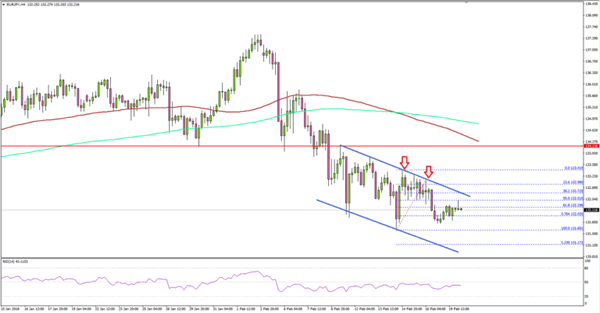
Looking at the 4-hours chart of EUR/JPY, there is a clear bearish trend in place. There was a break below a major support at 134.15, which opened the doors for more declines and the pair fell by more than 200 pips.
The recent low formed was 131.60 from where the pair started an upward correction. However, the upside wave faced sellers near 133.20-40. The pair is currently under pressure and is trading well below 133.00.
The pair remains in a downtrend as long as it is following a significant declining channel forming with resistance at 132.60. On the downside, supports are at 131.80 and 131.60. Below the stated 131.60, the pair could decline sharply towards 131.00.
Euro Area Construction Output
Recently in the Euro Area, the Construction Output figures for Dec 2017 were released by the Eurostat. The market was looking for a decline in the output by 0.7% compared with the previous month.
However, the actual result was better as there was a rise of 0.1% in the Construction Output (seasonally adjusted). Looking at the yearly change, there was a growth of 0.5% in the production, which was less than the forecast of +2.7%. The report added:
The average production in construction for the year 2017, compared with 2016, increased by 2.4% in the euro area and by 3.5% in the EU28. The increase of 0.1% in production in construction in the euro area in December 2017, compared with November 2017, is due to building construction rising by 0.5%, while civil engineering fell by 1.1%.
Overall, the Euro remains at a risk of more declines versus the Japanese Yen as long as it is below 133.00. On the other hand, EUR/USD may correct higher above 1.2450 in the near term.
Market Morning Briefing: The Dollar-Yen Saw A Low Of 105.55
STOCKS
Dow (25219.38,+0.08%) could move up towards 26000-26500 on a break above interim resistance near 25500. Medium term looks bullish.
Dax (12385.60, -0.53%) has resistance near 12600 and while the index trades below 12600, near to medium term looks bearish. Trade within 12600-12300 region looks likely in the near term.
Nikkei (21884.21, -1.20%) is down slightly after trying to move up yesterday. A break above 22200-22400 could take it higher towards 22800 levels else a fall back to 21400 or lower is possible in the coming sessions.
The resistance near 10680 on Nifty (10378.40, -1.58%) seems to be holding well. Currently trading near the 10260-10320 support region, if the index fails to bounce back immediately, it could be vulnerable to a further fall towards 10080 in the next few sessions. Else a bounce, if seen could take it higher towards 10680 levels again.
It would be important to see if Sensex (33774.66, -1.52%) breaks below 33500 in the coming sessions or attempts a bounce back towards 35000 or higher.
COMMODITIES
Overall the metals are trading lower today while the crude prices have inched up a bit.
WTI (62.17) may test decent resistance near current levels and could possible again come off towards 62-61 in the next few sessions, A break above 63 if seen would turn bullish for the medium term.
Brent (65.38) on the other hand needs to move above 66 to rise further in the near term. Else a pause near current levels could keep prices stable for now.
Gold (1343.50) saw a rejection from 1365-1367 levels and while that holds, a test of lower levels of 1340-1330 looks likely. Near term looks bearish.
Copper (3.1950) has come off from just below important resistance near 3.30 as seen on the 3-day charts. The price may head towards 3.15- 3.10 in the near term. Near term looks bearish.
FOREX
Support near 88.5 on daily candles has held well for the Dollar Index (89.33) and it is now seeing a bounce towards 90. It should test important resistance just above 90 on the weekly candles this week (daily candles also show resistance near 90).
As per expectations, Euro (1.2385) didn’t rise beyond 1.2556 (close to its previous high at 1.2537) and is now coming off towards support near 1.235 on the daily candles, which it might test in the next couple of sessions. Lower support is seen near 1.23 on the weekly candles, which could be tested later this week.
The Dollar-Yen (106.72) saw a low of 105.55 (support on daily candles – earlier mentioned as 106) from where it is now bouncing. Its next target could be 107.0-107.5 which is seen as resistance on the daily and 3 day candles.
The Euro-Yen (132.17) is again testing crucial support near 132 on the 3 day candles. For the Euro Yen to break this crucial support, the Euro should test 1.23 later this week while the Dollar Yen stays below 107.5, which is a possibility.
Pound (1.3975), as per our expectation, is dipping from resistance on 3 day candles and 3 day line chart near 1.42-1.43 and might now test immediate support near 1.39 on the daily candles soon. Test of lower support near 1.38 on daily and 3 day candles is also likely this week.
Dollar-Rupee (64.215) may see 64.30-35 this week and maybe higher by the end of the month.
INTEREST RATES
US 10 Year Yield (2.8968), US 30 year Yield (3.1431), US 5 year yield (2.6582), US 2 year yield (2.222) : The 2 Year Yield is slightly above our earlier mentioned long term resistance level near 2.2%. It will be important to see if it goes up further since a further upmove could pull up the other yields beyond their long term resistances as well. However, our preference still remains for a dip in the 2 year yield in the next couple of days below 2.2%.
(Long term resistance levels for the 4 yields earlier mentioned are as follows: 2.85-2.90, 3.20, 2.7 and 2.2 respectively - we have been expecting these levels to hold in this month.)
The 10-5 Year Spread (0.25) is testing the 21 day moving average on the short term chart and should move up in the next few sessions, indicating a likely dip for the 5 year yield from 2.65%.
USDJPY – Bullish, Triggers Further Correction
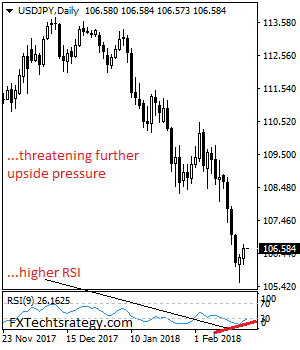
USDJPY - The pair closed higher on the back of its Friday gain on Monday. On the downside, support lies at the 106.00 level where a break if seen will aim at the 105.50 level. A cut through here will turn focus to the 105.00 level and possibly lower towards the 104.50 level. On the upside, resistance resides at the 107.00 level. Further out, we envisage a possible move towards the 107.50 level. Further out, resistance resides at the 108.00 level with a turn above here aiming at the 108.50 level. On the whole, USDJPY faces further downside pressure but with caution
Intermezzo
Intermezzo
It was a predictable snoozefest in FX overnight as global holiday sessions crimped activity. And adding to the void, there was scant data during European hours which severely nipped action as traders had few if any fundamental guideposts.
But the markets interlude included the usual holiday- liquidity induced mystery move as the dollar went bid at the NY open. But the step was humble and little more than an attempt to trigger some stops in low liquidity market conditions. But all near-term support levels held and the move and quickly retracted as there was no news to support the quickstep sell-off. Chalk it up to the ghosts of presidents past.
Currency markets have remained relatively muted with few if any headlines to sink one’s teeth into but as the markets pivot to Fed speak and the FOMC minutes this week, “deficit mania” is sounding a few decibels lower this morning.But none the less, ongoing concerns about swelling deficit’s and the Feds sequence of interest rate normalisation should be the markets key focus this week and the primary drivers of near-term volatility.
Oil Markets
Oil prices have started the week on a positive note.With risk aversion abating, equity markets have remained guardedly positive. Also, an escalation of middle east tensions on the back of Israeli Prime Minister Benjamin Netanyahu beating the war drums by suggesting that Isreal could act against Iran alone has nudged prices higher. Predictably this warmongering has put the region on a state of readiness fearing a head to head incident and boosted oil prices due to the fear of sizable supply disruptions. Of course, when Isreal comes into the equation it could spark contagion across a region
Also, convincing signals from OPEC and their partners to extend production cuts continues to resonate with investors.
Gold Markets
Gold prices slid lower overnight on a drop in volatility and a slightly stronger dollar. Selling pressure emerged after USD speculative buyers emerged along with some position short covering ahead of the plethora of critical Fed speak and of course the FOMC minutes. But given the late-January Fed meeting was primarily interpreted as Hawkish; the bar is high for the minutes to sound an even more Hawkish note, but they will still attract the lions share of attention.
Given that the sun seldom shines on a capital hill along with escalating middle east tension, on the first sign of a dollar downdraft gold with ratchet higher.
G-10
The Japanese Yen
Markets are focusing on Friday’s crucial Japan CPI print, and with all the recent chatter about the BoJ extending YCC in perpetuity given the stronger Yen, short-term traders are paring back bearish dollar bets. And with a relative sense of calm in overall volatility, dollar bears are taking an interlude in holiday thinned-trading conditions
The Euro
Very little buying interest yesterday after Friday’s sell-off so given the lack of demand the Euro could fall to low 1.23 on even minor unexpected hic-up on news flow given thin liquidity conditions. But dips should look attractive for long-term players.
The Malaysian Ringgit
Very quiet trading session to start the week with local trader biding time until the FOMC minutes release. In the meantime, the broader USD sentiment will dictate the pace of play for regional currencies and imparticular the USDJPY which is moving towards 107 which is mildly negative for the MYR
On a favourable note, Oil prices remain robust on the escalation of middle east tension and production cut compliance among OPEC members which should provide support for the MYR.
Gold Trading Sideways In Thin Holiday Trade
Gold prices are trading sideways in the Monday session. Currently, the spot price for an ounce of gold is 1347.25, down 0.02% on the day. There are no US releases on Monday, as bank and stock markets are closed for Presidents Day.
Volatility in the stock markets last week translated into gains for safe-haven assets such as gold. The base metal gained 2.3%, as nervous investors lost their appetite for risk. On Friday, gold lost ground but managed to briefly push above $1360, for the first time since late January. US fundamentals have been generally strong, pointing to a robust US economy. This has raised speculation of a quicker pace of rate hikes from the Fed, but gold has managed to hold its own against the US dollar, largely due to the recent stock market correction.
The US posted sharp housing and consumer confidence reports on Friday, but the dollar failed to make headway against the surging Japanese yen. Building Permits jumped to 1.40 million in January, up from 1.30 million in December. This easily beat the estimate of 1.29 million. Housing Starts followed suit and improved to 1.33 million in January, up from 1.19 million a month earlier. This was well above the forecast of 1.28 million. There was more positive news from consumer confidence, as UoM Consumer Confidence climbed to 99.9, well above the estimate of 95.4 points.
Pound Dips At Start Of Week
The British pound is trading quietly in the Monday session. In North American trade, GBP/USD is trading at 1.4002, down 0.21% on the day. On the release front, there are no US events, with US markets closed for Presidents’ Day. In the UK, Rightmove HPI gained 0.8%, its strongest gain in four months. On Tuesday, the UK releases CBI Industrial Order Expectations.
GBP/USD gained 1.3% last week, as the dollar continued to lose ground to its major rivals. However, the dollar rebounded with gains on Friday, following strong US housing and consumer confidence reports on Friday. Building Permits jumped to 1.40 million in January, up from 1.30 million in December. This easily beat the estimate of 1.29 million. Housing Starts followed suit and improved to 1.33 million in January, up from 1.19 million a month earlier. This was well above the forecast of 1.28 million. There was more positive news from consumer confidence, as UoM Consumer Confidence climbed to 99.9, well above the estimate of 95.4 points. Despite stock market volatility, consumer confidence was boosted by the recent tax reform package and a red-hot labor market.
Should cryptocurrencies be regulated? Bitcoin has seen wild fluctuations in recent months, ranging from under $1000 to just under $20,000. There are growing calls for these currencies to be regulated, and central banks could play a key role in such a move. However, last week, ECB President Mario Draghi poured cold water on any ECB involvement, saying that it was not the ECB’s responsibility to ban or regulate Bitcoin. Draghi added that the ECB was exploring the use of blockchain, a digital technology to monitor bitcoin transactions. Still, with Bitcoin gaining more and more popularity, the Bank of England and other central banks will have to pay greater to attention to the impact of Bitcoin on the currency markets.
Yen Edges Lower In Thin Holiday Trade
The Japanese yen has posted slight losses in the Monday session. In North American trade, USD/JPY is trading at 106.54, up 0.23% on the day. On the release front, there are no US events, with US markets closed for Presidents’ Day. In Japan, the current account surplus jumped to JPY 0.37 trillion in January, up from JPY 0.09 trillion a month earlier. This easily beat the estimate of JPY 0.14 trillion. On Tuesday, Japan releases Manufacturing PMI and All Industries Activity.
The US posted sharp housing and consumer confidence reports on Friday, but the dollar failed to make headway against the surging Japanese yen. Building Permits jumped to 1.40 million in January, up from 1.30 million in December. This easily beat the estimate of 1.29 million. Housing Starts followed suit and improved to 1.33 million in January, up from 1.19 million a month earlier. This was well above the forecast of 1.28 million. There was more positive news from consumer confidence, as UoM Consumer Confidence climbed to 99.9, well above the estimate of 95.4 points.
The yen enjoyed a banner week, as the currency climbed 2.5% this week. This marked the strongest weekly gain since July. Nervous investors continued to snap up the safe-haven yen, as stock markets across the globe continued to show volatility, draining risk appetite. On Friday, the dollar dropped below 106 yen for the first time since November. If the markets continue to fluctuate during the week, the yen rally could continue.
Bank of Japan Governor Harohiko Kuroda has been reappointed to another 5-year term, the first time a BoJ governor has received a second term in 60 years. The move is a clear message from the Bank that it is no rush to make any change to the massive stimulus program, a key component of Abenomics. Kuroda has made it a priority to raise inflation, but this has proven a daunting task, as inflation is still below of the BoJ’s inflation target of 2%. In this period of strong volatility in the currency markets, Kuroda’s re-election may have a calming effect on the markets. What’s next for the BoJ? With the yen continuing to rise, policymakers may contemplate further easing in order to curb the yen’s value and protect the export sector, which has improved due to stronger global demand.
Elliott Wave Analysis: NZDJPY Update
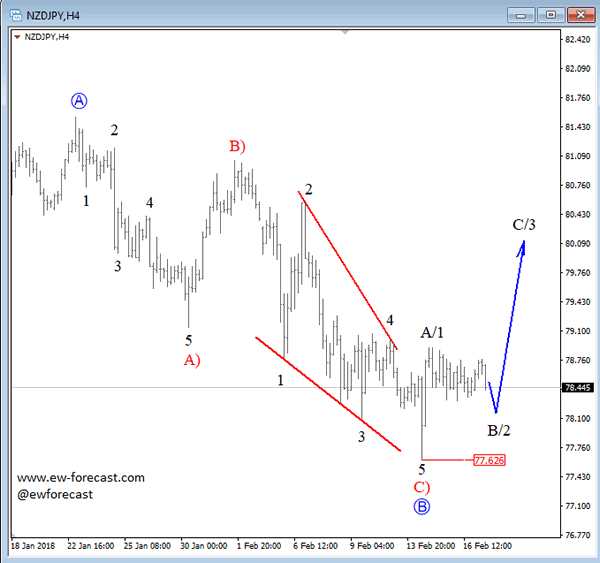
NZDJPY may have recently completed a three-wave decline labeled as A)-B)-C) at the 77.63 level, from where a new intra-day bounce followed. This bounce can be start of minimum three-wave reversal with wave A/1 leading the way. That said, we can see that an ending diagonal unfolded within final leg C) of a decline, which means that current recovery can go as high as to the starting point of this pattern, meaning price can reach 81.10 level in upcoming sessions.
NZDJPY, 4H
Sunset Market Commentary
Markets
US markets are closed for President's Day, resulting in a very low volume trading session. The EMU eco calendar only contained second tier eco data, resulting in sentiment-driven trading. Negative underlying core bond sentiment caused a small sell-off in Bunds with the curve bear steepening. German yields increase by 0.3 bps (2-yr) to 4.3 bps (30-yr). On intra EMU-bond markets, 10-yr yield spread changes versus Germany increase by 3 bps for Spain and Italy. Spain announced the launch of a new 30-yr benchmark, likely tomorrow. Italian BTP's lose some ground as media report about cracks in the centre-right coalition. Greece outperforms (-6 bps) after Fitch upgraded the country's rating from B- to B (positive outlook).
The dollar entered calmer waters today. Traded volumes were subdued with US markets closed. Even so, USD selling already eased at the end of last week and the US currency stayed off the recent lows today. There were only second tier eco data in Europe. European risk sentiment turned less positive than last week. In line with the recent market dynamics, this was slightly supportive for the dollar, even for USD/JPY. EUR/USD trades in the 1.2380 area. USD/JPY is changing hands around 106.75. There is no sign of a sustained USD rebound yet. That said, there was also no additional damage for the dollar. Looking at where we were on Friday morning, this might be a minor relief for USD bulls.
Sterling traded with a slightly negative bias today, both against the dollar and the euro. Trading was mostly technically in nature. There were no important UK eco data except for the Rightmove house prices published overnight. EUR/GBP trades in the 0.8860 area. Cable dropped back below the 1.40 handle. Markets are looking forward to the CBI order data tomorrow and, even more, UK wage data scheduled for release on Wednesday.
News Headlines
"Signs are mounting that the German economy is increasingly confronted with bottlenecks with regard to highly skilled staff, which could become an obstacle for an even stronger expansion," the Bundesbank says in its monthly report.
IHS Markit said its UK Household Finance Index, a monthly gauge of financial well-being, fell to a seven-month low of 42.2 from 42.9 in January. British households became more pessimistic about their finances this month. Most now expect borrowing costs to rise again within six months after the Bank of England raised interest rates in November, a survey showed on Monday.
The European Monetary Fund being planned to replace the euro zone bailout fund should be an intergovernmental body controlled by EMU member states and independent of the EC, the Fund's head Klaus Regling said. The Commission wants the ESM to become an EU institution governed by a separate treaty signed by EMU countries.
German Chancellor Merkel put forward her close ally Annegret Kramp-Karrenbauer, premier of the state of Saarland, to take over as secretary general of her Christian Democratic Union (CDU), party sources said.
Irish Finance Minister Donohoe said Irish central bank governor Philip Lane's name will be withdrawn for the vice presidency of the ECB. Donohoe said he'll support Spanish Economy Minister Luis de Guindos
Canadian Dollar Unchanged, No Fundamentals to Start Off Week
The Canadian dollar is almost unchanged in the Monday session, after posting losses on Friday. Currently, USD/CAD is trading at 1.2493, up 0.07% on the day. On the release front, there are no Canadian or US events on the schedule, so traders can expect the pair to have a quiet day. In the US, banks and stock markets are closed for Presidents' Day.
The Canadian dollar posted losses on Friday, but managed to post slight gains last week. The currency weakened on Friday, after the US posted sharp housing and consumer confidence reports. Building Permits jumped to 1.40 million in January, up from 1.30 million in December. This easily beat the estimate of 1.29 million. Housing Starts followed suit and improved to 1.33 million in January, up from 1.19 million a month earlier. This was well above the forecast of 1.28 million. There was more positive news from consumer confidence, as UoM Consumer Confidence climbed to 99.9, well above the estimate of 95.4 points. This marked a 4-month high. On Wednesday, the Canadian dollar recorded its best one-day performance in 2018, gaining close to 1 percent against the greenback. The US dollar sagged as investors focused on poor retail sales reports in January. Retail Sales was flat at 0.0%, short of the estimate of 0.5%. Core Retail Sales declined 0.3%, well off the forecast of +0.2%.
Should cryptocurrencies be regulated? Bitcoin has seen wild fluctuations in recent months, ranging from under $1000 to just under $20,000. There are growing calls for these currencies to be regulated, and central banks could play a key role in such a move. However, last week, ECB President Mario Draghi poured cold water on any ECB involvement, saying that it was not the ECB's responsibility to ban or regulate Bitcoin. Draghi added that the ECB was exploring the use of blockchain, a digital technology to monitor bitcoin transactions. Still, with Bitcoin gaining more and more popularity, the Bank of Canada and other central banks will have to pay greater to attention to the impact of Bitcoin on the currency markets.