Sample Category Title
Central Banks Dictate FX Moves While Stocks Rock
Tuesday January 23: Five things the markets are talking about
Global equities have found fresh impetus for another attempt at new record highs, as investor optimism has again surged amid corporate earnings and the end of the U.S government shutdown.
And this despite U.S President Trump imposing, thus far, selected tariffs (on solar panels and washing machines) to achieve his own ‘level' playing field. Next step for investors is to see how markets will respond to Trumps selective protectionist policies.
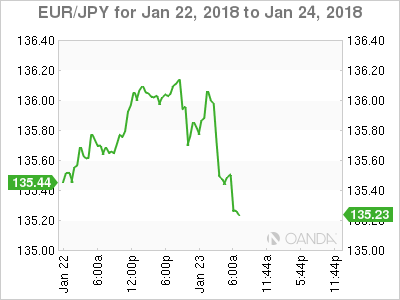
The U.S dollar has found some traction against the EUR and GBP, along with U.S treasuries and gold. The outlier is JPY, which has rallied after the Bank of Japan (BoJ) dampened market speculation that Japanese policymakers are close to reducing monetary stimulation.
U.S government employees return to work after their three-day partial shutdown on Trumps signing of a temporary government-spending bill.
Note: Barring any last minute changes in Washington, President Trump is expected to join world leaders in Davos for the annual World Economic Forum.
1. Stocks ‘rock'
Equities probe fresh highs after U.S. government shutdown ends.
Fresh yen strength did nothing to deter Japanese stock investors, with the Nikkei closing above 24,000 for the first time since November 1991. At the close, the index was +1.3% higher.
Down-under, Aussie shares ended higher on Tuesday, snapping a five-session losing streak following Wall Street after U.S. senators struck a deal to end a three-day government shutdown. The S&P/ASX 200 index rallied +0.75%. In S. Korea, the Kospi added +1.4%.
In Hong Kong, stocks hit a fresh record, helped by Chinese money inflows. The Hang Seng index ended up +1.7%, while the China Enterprises index rallied +2.2%.
In China, banks and property firms powered China stocks to fresh two-year highs. At the close, the Shanghai Composite index was up +1.3% while the blue-chip CSI300 index was up +1.08%.
In Europe, Germany's DAX index has hit an all-time peak, and France's CAC is heading for its highest close in 12-years.
U.S stocks are set to open in the black (+0.2%).
Indices: Stoxx600 +0.3% at 403.4, FTSE +0.3% at 7730, DAX +0.8% at 13576, CAC-40 +0.1% at 5550, IBEX-35 +0.4% at 10625, FTSE MIB +0.3% at 23952, SMI +0.6% at 9583, S&P 500 Futures +0.2%
2. Oil supported by economic growth
Oil prices are on the march again, lifted by healthy economic growth as well as the ongoing supply curtailments by OPEC and Russia.
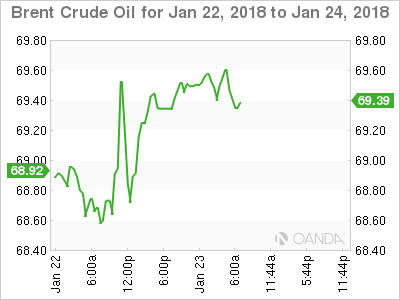
Brent crude futures are at +$69.38 a barrel, up +35c or +0.5% from Monday's close, not far off their three-year high of +$70.37 reached on Jan. 15. U.S West Texas Intermediate (WTI) crude futures CLc1 is at +$63.93 a barrel, up +36c, or +0.6% from their last settlement. WTI rose to its highest since December 2014 on Jan. 16 at +$64.89.
Traders said oil markets were generally well supported by healthy economic growth.
Note: The International Monetary Fund (IMF) on Monday revised upward its forecast for world economic growth in 2018 and 2019, to +3.9% for both 2018 and 2019, a +0.2% point increase from its last update in October.
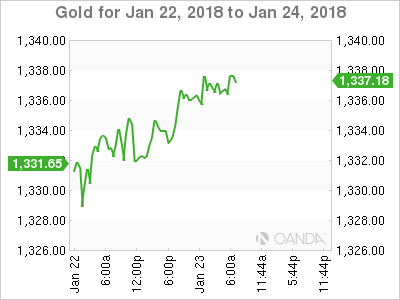
Gold prices have edged up overnight as the U.S dollar hovers atop of its three-year lows, with a surge in global equities capping further gains. Spot gold has rallied +0.2% to +$1,336.26 per ounce, up for a third straight session.
3. Sovereign yields fall after BoJ decision
Global bond yields have edged down overnight after the BoJ played down speculation that it was close to ending its stimulus, raising hopes that the European Central Bank (ECB) may follow suit Thursday.
The BoJ kept its policy steady, as expected and left Interest Rates on Excess Reserves (IOER) unchanged at -0.10%, while maintaining its policy framework of “QQE with Yield Control' around 0.00% and asset purchases at annual pace of ¥80T.
The vote to keep policy steady was again 8 to 1. There were no surprises that Kataoka issued his “dovish' dissent for a fourth consecutive meeting and called for further JGB purchases so that bond yields of maturities of 10-year+ fall broadly.
Note: The bond markets have been hit in recent weeks by growing talk that central banks in Japan and Europe could end monetary stimulus sooner rather than later.
The ECB meets on Thursday against a backdrop of heightened speculation over when it will end its QE program and signal a rise in interest rates from record lows.
The yield on 10-year Treasuries have fallen -3 bps to +2.62%, the biggest tumble in almost four-weeks, while in Germany, the 10-year Bund yield has declined -2 bps to +0.55%, the lowest in almost two weeks.
4. Dollar sits atop of three-year lows
The USD is a tad firmer against a number of currencies, aside from JPY, as political developments helped to support the greenback. The U.S Senate helped to pass legislation to fund the government until Feb. 8th.
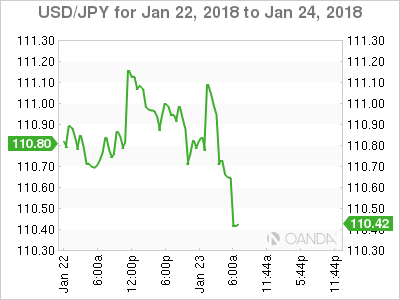
The U.S dollar has dipped -0.33% to ¥110.55 after the BoJ maintained its short-term interest rate target at -0.1% and a pledge to guide 10-year government bond yields around zero percent. Governor Kuroda also said, “inflation expectations have moved sideways recently,' offering a slightly more upbeat view than three-months ago when he said they were on a “weak' note.
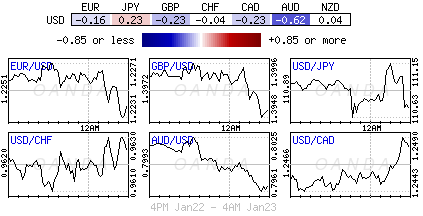
The EUR (€1,2255) continues to hover in yesterday's range as the market showed little enthusiasm to Sunday's German coalition developments in its effort to forge together a grand coalition. Market focus will now switch to the ECB's rate decision on Thursday for hints on forward guidance.
Bitcoin (BTC) was down -4.5% on the Bitstamp exchange at +$10,320.13 following news that S. Korea will ban the use of anonymous bank accounts in cryptocurrency trading from Jan. 30.
5. German ZEW survey handily beats expectations
Data this morning showed that German economic sentiment rose in January and that investors remained optimistic about Germany's near-term growth prospects despite the country's struggle to form a governing coalition.
The ZEW headline measure of economic expectations rose +3 points to 20.4, beating market forecasts of 17.5 points.
Digging deeper, financial analysts and investors polled were also more upbeat about Germany's current situation and the corresponding ZEW measure hit its highest level in 26-years.
The survey shows that Europe's largest economy continues to prosper despite its difficulties forming a governing coalition.
Netflix And SKY Makes Noise | US Back To Work | Sterling Flirts With 1.40 | German ZEW Under...
Investors have one less thing to worry about, the US government shutdown is over. President Trump has signed the stoppage bill and kicked the can until the Feb 8th. The drama could potentially return at a later stage (February 8) and the dollar index would see an impact of this.
The BOJ kept its monetary policy steady and this kept the bulls in check. However, this doesn't mean that the Yen bulls have gone to sleep. The devil is in detail, the bigger message from the BOJ is that there is no need to further loosen up the monetary policy. And if this is the scenario which the BOJ is looking at, then surely the next move would be to start following up the footsteps of other central banks such as the European Central Bank. The ECB started their tapering process last year and it is highly likely that the ECB would be able to wind up the tapering process this year. The BOJ is comfortable with the concept that the price has stopped falling and this is the area of their focus.
While the Sterling-Dollar pair is still recording its best level and marching towards 1.40, the EU has made it clear that the U.K. will never be given a chance to cherry pick the products that they desire. Theresa May hasn’t shown her plan for the financial sector after Brexit, but her team hopes that the UK would get fuss access to the EU. The businesses over in the UK are seeking clarity and the government is constantly failing to provide that. This dampens the business growth perspective and their ability to initiate any measure to stimulate the growth in the country.
Trade wars are highly unproductive but surely Trump doesn't think that way. By adopting this strategy the message is clear that the US leader has no concerns in achieving global peace and growth. The trade war is on, the president of the US increased the duty on solar panels. Foreign solar panel producers could shrug this off by focusing on other markets while the price of solar over in the US would rise considerably, putting renewable energy at disadvantage.
Solar panels have been the area of growth. Slamming a 30% import tax on the solar panel is going to create more obstacles and unfortunate circumstances for Americans because nearly 80% parts are foreign imports. President Trump notched up the trade war by increasing duties on imported washing machines by nearly 50% and the policy is aimed to dent Samsung and LG's presence in the local market.
The Euro-dollar pair is showing its strength against the dollar ahead of the European Central Meeting which is on Thursday. The upcoming ZEW survey for Germany would provide further evidence of strength the improvement in the current and expected situation. The German ZEW number provided a lot of tailwind during the third quarter of 2017 for the German GDP growth.
Netflix has flexed its muscles last night and the company has shown its investors that the competition doesn’t bother them. From their earnings, it shows they are the king of the entertainment business. The firm is execution on its plans which is yielding impressive growth. Netflix is taking an advantage of cheap money to fund its projects, however, if their access to capital is restrained, it could have problems
Regulators over in the UK has sent a clear message to Fox News owner, Rupert Murdoch that they are not ready for this kind of takeover bid. The memo was clear that the deal is not in the interest of the public because this gives Fox News owner more control over them UK media. Fox's stock is loved among analyst with 13 buy ratings, 9 hold and 1 sell. Over the year, insiders have built their position by 0.32%. Among its peers, the stock trades at 12% premium (over a 2-year time frame). As for sky, it isn't the most famous company with buy ratings, only 6 analysts have a buy rating and most of them are waiting for the takeover situation to be resolved. Hence the hold rating is 12. In comparison with its peer, it is trading at 6% premium.
Caution Ahead Of ECB Meeting: Will Draghi Talk Down The Euro?
The European Central Bank holds a two-day monetary policy meeting this week with its first policy decision of the year due at 12:45 GMT on Thursday. Following surprisingly hawkish minutes of the December meeting and a series of data beats, expectations have risen that the ECB will end its asset purchase program (APP) when the current one expires at the end of September 2018. However, a stronger euro could pose a threat to the Eurozone’s improving growth and inflation outlook, prompting the ECB to strike a more cautious tone with its plans to wind down its stimulus program.
In December, most Governing Council members agreed that the Bank’s communication should “evolve gradually” to reflect the progress made with inflation. The minutes suggested policymakers were considering revising the forward guidance in early 2018 so as to shift the focus from bond purchases to interest rates. This fuelled speculation that the ECB is unlikely to extend the APP beyond September 2018 and that rates could begin to rise at the end of 2018 rather than in 2019.
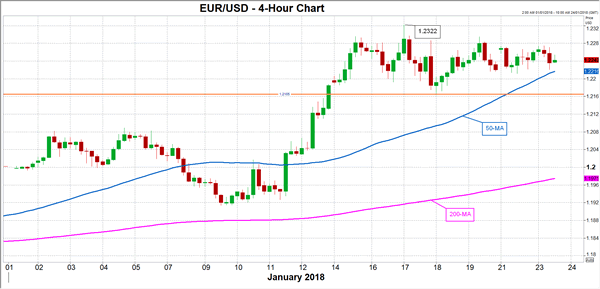
The minutes, released on January 11, added fresh impetus to the euro’s end of year rally, helping the single currency break above the $1.23 level for the first time since December 2014. But the euro’s impressive streak has already caught the attention of ECB policymakers as several have come out during the past week to warn against an excessive rise in the exchange rate. The what appeared to be coordinated comments were followed by a Reuters story that according to ECB ‘sources’ the central bank is not planning on making any changes to its forward guidance just yet.
This indicates the ECB will be sticking to its existing language on Thursday and President Mario Draghi will likely use his press conference to quash speculation of an early exit from QE and to indirectly raise concerns about the negative effects of a sharp appreciation of the euro. With Eurozone inflation still running below the ECB’s target of close but below 2% (1.4% in December), Draghi will not want to risk upsetting the recovery by driving up the euro.
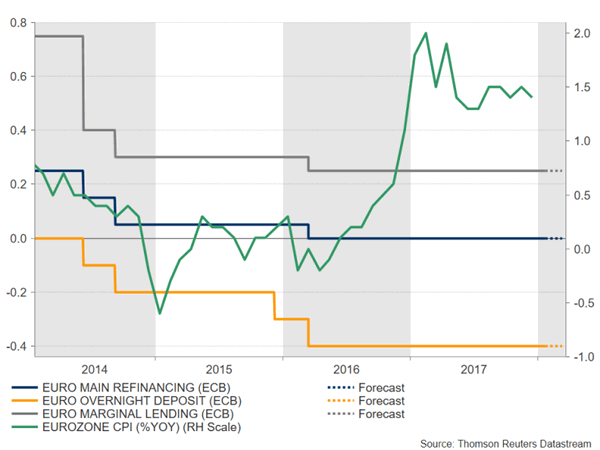
The recent surge in oil prices raises the possibility of CPI meeting the 2% target sooner than anticipated. However, some of those gains will be offset by the stronger exchange rate, whose effects could be more pronounced in the core CPI rate, which the ECB puts more focus on for assessing the underlying trend of inflation. Investors could therefore be complacent about the impact of the euro’s strength on ECB policy and underestimating the risk of a rising currency prolonging the QE exit timeline.
If the ECB keeps monetary policy and its forward guidance unchanged on Thursday as expected, the euro’s response will depend on whether Draghi will flag the March 7-8 policy meeting as the likely date when it will revise its communication. This is very probable given that new staff forecasts will be available by then. The euro could jump to $1.25 in such an event. A more limited upside move is likely if Draghi gives little away regarding future policy direction but refrains from using strong verbal intervention to put a cap on the euro’s gains.
However, the single currency could come under selling pressure if the ECB sticks to a cautious price outlook and reiterates the importance of maintaining its asset purchases until inflation is on a sustained upward path. Any signs that the ECB is abandoning the link between bond purchases and inflation in its guidance would only fuel the euro rally and Draghi would not want to be seen raising such expectations prematurely. A dovish stance on Thursday could push the euro below recent support near $1.2165.
Technical Outlook: Spot Gold Stands On Front Foot On Tuesday Despite Firmer Dollar
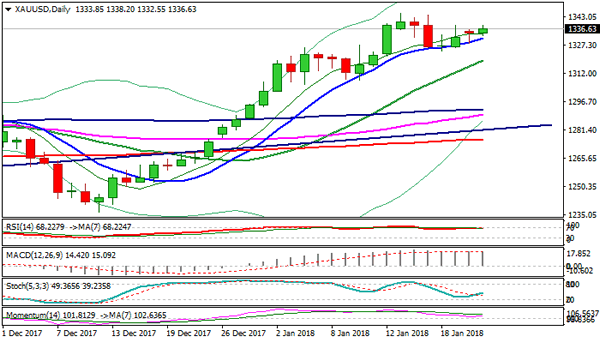
Spot Gold remains constructive on Tuesday and retested last Friday’s recovery high at $1338, signaling extension of recovery leg from $1324 (low of $1344/$1324 correction). The yellow metal maintains positive tone despite the greenback fresh strength on deal of US lawmakers to end crisis on government shutdown. Daily techs remain in full bullish setup and favor further advance for regain of $1344 pivot, break of which would signal continuation of broader uptrend. Rising 10SMA contained recent correction and continues to track the rally, offering initial support at $1331 which guards key near-term support at $1324.
Res: 1338, 1344, 1350, 1357
Sup: 1331, 1326, 1324, 1319
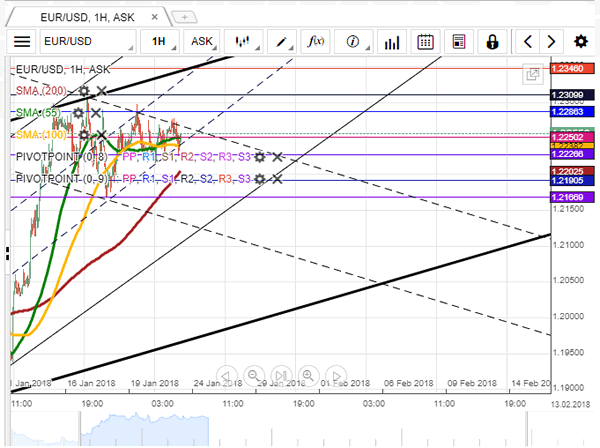
EUR/USD Returns Near Notable Support
The Euro remained stable against the US Dollar during the previous session. The expected decline was restricted by a massive support cluster in the 1.2250/25 area.
However, the pair has likewise failed to overcome the 1.2270 mark, thus confirming the upper boundary of a one-week descending channel. It showed low volatility early today, as the 55– and 100-hour SMAs limited any attempts to edge lower.
The Euro's movement during the previous sessions demonstrates that bears are restlessly trying to push the rate below this massive support. Thus, it is more likely that the pair remains tended southwards in this session.
Given the strength of this support, the rate might continue its movement sideways. Upside target for today should be the weekly R1 at 1.2305.
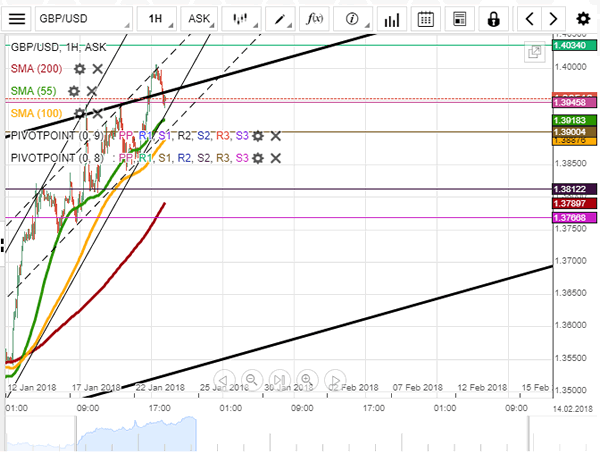
GBP/USD Breaches Three-Month Channel
The Pound was driven by strong upside momentum against the Greenback on Monday, thus closing the session with a 94-pip gain. As a result, the pair breached the combined support of the weekly R1 and the upper boundary of a three-month ascending channel near 1.3960.
Shorter-term patterns, however, demonstrate that the strong movement north apparent during the previous week is starting to allay. Thus, the Sterling moving above the 1.3960 level might actually be a false breakout.
Technical indicators suggest that the pair could trade lower within the following days. This session, however, might still mark a slight up-move towards the weekly R2 at 1.4061.
Subsequently, the rate is expected to edge lower towards the 55– and 100-hour SMAs circa 1.39.
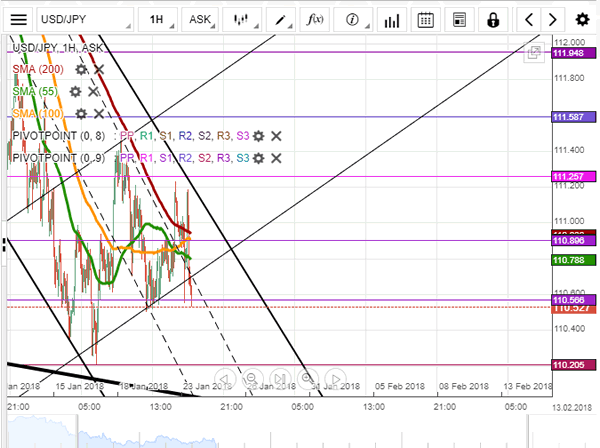
USD/JPY Shows Mixed Signals
USD/JPY was struggling to move past the 100-hour SMA and the weekly PP during the first half of Monday. However, strong hourly surge mid-session resulted in a breakout of the aforementioned levels and the 55– and 200-hour SMAs.
The Yen strengthened early today in the wake of BOJ comments about upbeat inflation outlook. This fundamental advantage, however, did not hold strong, as the US Dollar returned to test yesterday's peak of 111.15.
The pair being located above all three SMAs flashes bullish signals; however, other indicators favour a decline in price. In case this bearish scenario occurs, the Greenback should be limited by the monthly S2 and the weekly S1 circa 110.20.
Conversely, the prevalence of bulls would send the rate for a test of the weekly R1 and the monthly S1 near 111.50
XAU/USD Flashes Bullish Signals
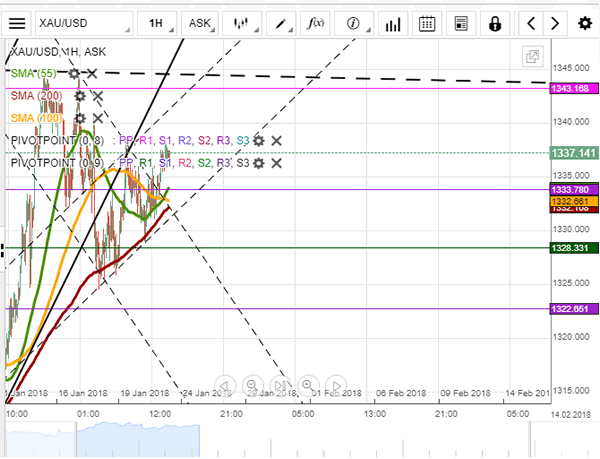
XAU/USD spent Monday's trading session within the bounds of the 100– and 200-hour SMAs and the weekly PP in the 1,329.07/1,334.85 area. The pair, however, managed to accelerate early today and thus breach a one-week descending channel.
Being supported by the 55-, 100– and 200-hour SMAs circa 1,332.00 is likely to pressure the rate upwards in this session. Gains, however, are expected to be limited, as the nearest resistance is set by the weekly R1 and a four-month high circa 1,344.00.
By and large, Gold's appreciation during the past trading sessions was driven by the strong support of the 200-hour SMA. It is likely that this moving average continues to provide unbreakable support this week, thus sending the pair above its four-month high.
USD/CAD: Canadian Wholesale Sales
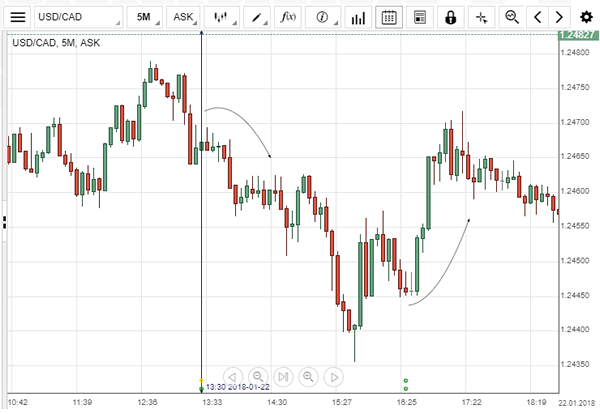
The Canadian Dollar was almost unchanged against the Greenback on the country's wholesale sales report. The USD/CAD currency pair ignored the report to rise 1 base point, remaining in the 1.2465 area.
The value of Canada's wholesale sales increased for the second month in succession in November amid wide gains across food, vehicle and other sectors. Statistics Canada stated that the country's wholesale trade expanded 0.7% in the reported month, which was shy of expectations for a 1% rise, following an upwardly revised 1.6% previously. The wholesale sales report tends to be overlooked by markets, despite its bigger weight in the country's GDP than the closely monitored retail sales. Canadian retail sales data is due on Thursday.
USD/JPY: Bank Of Japan Interest Rate Decision
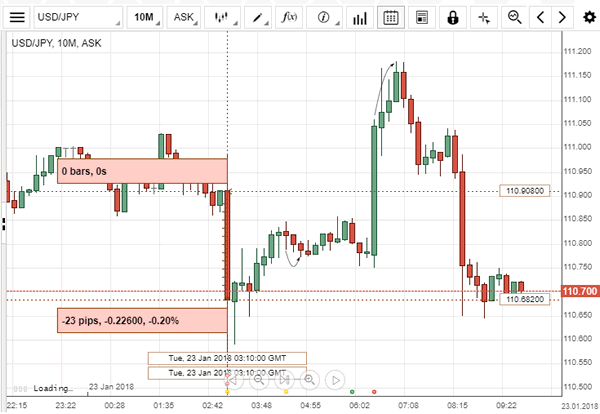
The USD/JPY exchange rate depreciated 23 base points to the 110.68 level, following the BoJ monetary policy statement and the outlook report. Though, the pair managed to recover in the next couple of hours to be above the 111.00 mark, as the Bank's Governor made dovish remarks, sending rate higher.
The Bank of Japan kept the interest rate unchanged at a negative 0.10%, as widely anticipated, offering a more optimistic view on consumer inflation projections, underscoring the conviction that the Japan economy was making moderate, but steady progress to the 2% CPI growth target. Later, the BoJ Governor Haruhiko Kuroda indicated that the Bank was not in a position to consider the QEE quit.