Sample Category Title
New Zealand CPI Forecast Remains Within RBNZ Target; Will Kiwi Continue Bullish Run?
The focus on Thursday will be on New Zealand's headline consumer price index number at 2145 GMT. New Zealand will release its fourth-quarter of 2017 CPI that is forecasted to show an increase of 0.4% from 0.5% in the previous quarter. Also, the attention will turn on the kiwi as there is plenty of room for a surprise if the release beats expectations.
Consumer prices in New Zealand ticked higher to 1.9% year-on-year in the third quarter from 1.7% in the prior period and for the Q4 is predicted to remain unchanged at 1.9%. For now, inflation sits comfortably in line with the Reserve Bank of New Zealand's (RBNZ) 1-3% target band.
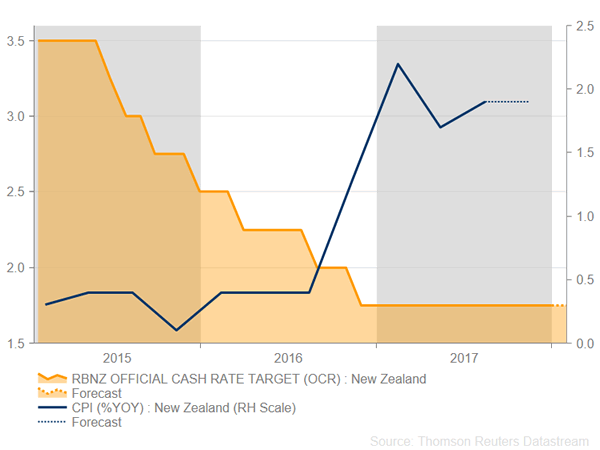
Shifting to monetary policy, the RBNZ kept its official cash rate unchanged at record low of 1.75% in November 2017, as widely expected. The key rate last moved in November 2016 from 2.00% to 1.75%. and during the last meeting, the central bank stated that economic growth has continued to improve, although inflation and wages remain subdued.
Also, the gross domestic product growth rate for the third quarter advanced to 0.6%, slowing down after an upwardly revised reading of 1.0% expansion before. The RBNZ also mentioned that monetary policy will remain accommodative for a considerable period, as numerous uncertainties hold, and policy may need to adjust accordingly. It is worth mentioning that the country's hourly wages increased to 30.51 NZD/hour in the third quarter of 2017 from 30.15 NZD/hour in the second quarter of 2017. The next policy meeting will take place on February 8 and the bank is widely expected to adopt a wait and see stance and keep the interest rate unchanged at 1.75% until June 2019 at the earliest.
Despite the relatively solid economic data however, businesses have become more pessimistic about the economy since the general election in September 2017. The elections showed a victory for the ruling National Party and the previous Prime Minister Bill English, with the Party winning 46% of the votes compared to 35.8% gained by the opposition Labour Party, but New Zealand's proportional representation system means neither won enough seats in parliament to govern alone. A month later Jacinda Ardern, Leader of the Labour Party, became the 40th Prime Minister after the securing the backing of the country's third largest party – the New Zealand first.
The country's ANZ business sentiment remained negative for the third month in a row, while in December the index remained close to an 8-year low at -37.8 from -39.3 in November, on lingering uncertainty about policy direction under the new Labour-led government.
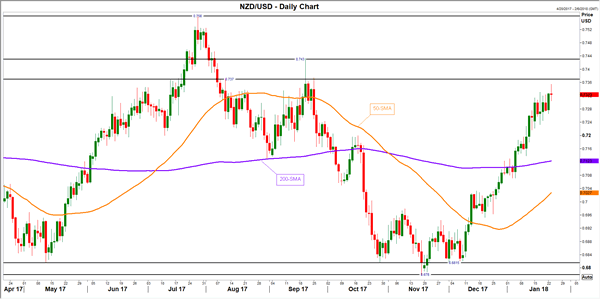
From the technical point of view, kiwi/dollar skyrocketed over the previous six weeks after the strong rebound on the 0.6815 support level. The pair has risen more than 7% since December 10 as the US dollar has come under broad pressure.
In addition, the price climbed to a fresh 4-month high of 0.7353 today, and if the consumer price index surpasses the consensus, then the expectation is a run until the 0.7370 resistance level. A break above the aforementioned obstacle could open the door towards the next immediate resistance of 0.7430 taken from the significant top on September 20.
A worse-than-expected figure could create a downward pressure for the pair and would retest the 0.7210 support level, which holds near the 200-simple moving average in the daily timeframe.
Will UK Jobs Data Boost or Temper Sterling’s Rally?
UK employment data for November are due to be released on Wednesday at 09:30 GMT. Looking simply at economic forecasts, one may be tricked into thinking this data set represents little risk for sterling, as every indicator is projected to remain unchanged. The unemployment rate is forecast to have held steady at 4.3%, while average weekly earnings (both including and excluding bonuses) are anticipated to have grown at the same pace as previously.
What will markets focus on? Assuming the unemployment rate remains unchanged as anticipated, investors are likely to turn their attention to average weekly earnings, for any potential surprises. Wages are extremely important, especially in the context of the UK economy. Following the Brexit vote, inflation accelerated sharply, but wage growth remained largely flat, leading to a squeeze in the real incomes of UK consumers. This is one of the key factors that has deterred the Bank of England (BoE) from raising interest rates too much.
The Bank considers the surge in inflation to be a transitory effect that will fade over time, caused by the depreciation in GBP back in 2016. As such, it is reluctant to raise rates in order to fight high inflation, as that could weigh further on incomes and thereby, hurt consumption and the broader economy. Thus, an acceleration in wages would probably be a very pleasant development for policymakers, as it could open the way for the Bank to hike rates at a faster pace. Conversely, any slowdown in wages would probably keep the BoE sidelined for even longer.
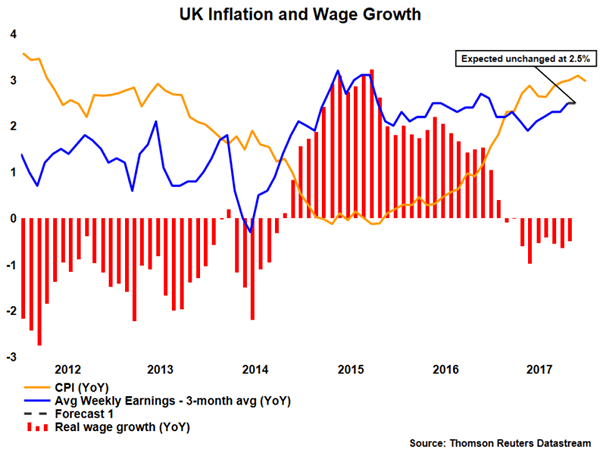
So, what do gauges of the labor market suggest? The Markit UK report on jobs painted a relatively upbeat picture in November, indicating that staff appointments rose at the quickest pace for three months, and supporting the forecast for the unemployment rate to hold steady. In terms of earnings, it noted that despite easing slightly since October, wage growth remained sharp, amid strong demand for staff and a shortage of skilled workers.
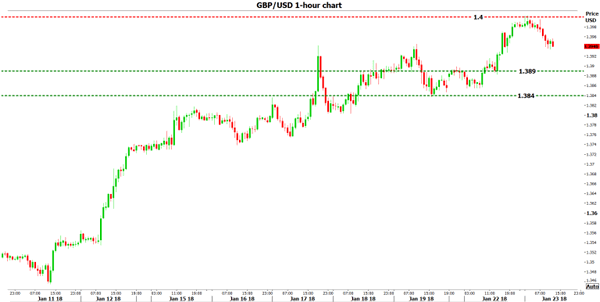
A stronger-than-anticipated employment report, particularly on the wages front, could add to speculation that the BoE may raise interest rates faster than what is currently expected over the coming years. Something like that could add fuel to sterling's recent rally, with sterling/dollar likely to surge and target its recent highs at 1.4000. A potential upside break of that territory could open the way for the 1.4050 zone, marked by the lows of March 2016.
On the contrary, a disappointment in this data set could cause sterling/dollar to give back some of its recent gains. Immediate support may be found near 1.3890, but if the bears are strong enough to overcome that hurdle, the next area that could come into play is 1.3840.
COPPER – Surge in Inventories Sparks Fresh Sell-off
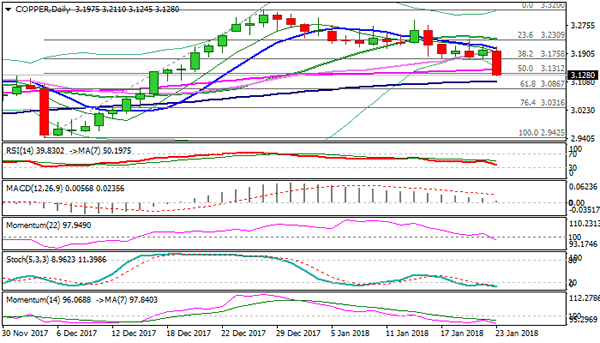
Copper price accelerated lower on Tuesday, signaling extension of pullback from $3.3200 high on break below four-day congestion floor at $3.1790.
Fresh weakness was sparked by surge in copper inventories which signal healthy supplies and pressuring metal's price.
Bearish acceleration took out support provided by 55SMA ($3.1418) and dented Fibo support at $3.1312 (50% retracement of $2.9425/$3.3200 rally), eyeing next support at $3.1066 (100SMA) and $3.1000 (top of daily Ichimoku cloud).
Daily cloud twists next week and could attract for further weakness, with extended dips expected to find footstep above $3.0867 (Fibo 61.8%) to keep bulls intact.
Daily indicators are heading south, with momentum deeply in the negative territory and slow stochastic being strongly oversold, showing space for further fall but suggesting that corrective bounce could be expected in the near-term. Bearish scenario sees close below $3.0867 pivot as negative signal for deeper correction.
Res: 3.1312; 3.1418; 3.1758; 3.1973
Sup: 3.1066; 3.1000; 3.0867; 3.0525
Sunset Market Commentary
Markets
Global core bonds corrected higher today with US Treasuries outperforming German Bunds. The move is mainly technically inspired. The newly approved short term funding bill triggered a test of key resistance levels in US yields (eg 2.42% for 5-yr and 2.63%/2.64% for 10-yr), but a sustained break didn't occur and caused some return action. German Bunds had a small upward bias as well with markets taking into account that the ECB probably won't change its communication policy already at Thursday's meeting. A very strong German ZEW-indicator (both current situation and expectations) couldn't change that. The German curve flattens at the time of writing with yield changes ranging between +0.1 bp (2-yr) and -1.9 bps (30-yr). From a technical point of view, the German 10-yr yield remains in the narrow 0.50%-0.60% channel. The US yield curve drops 1.2 bps (2-yr) to 3.1 bps (10-yr) lower. 10-yr yield spread changes versus Germany range between +1 bp (Ireland) and -2 bps (Portugal/Italy/Spain). Greece outperforms (-5 bps). Markets digested huge new supply quite well. The Kingdom of Spain raised €10bn with a new 10-yr bond (Apr2028) at MS +46 bps. Order books exceeded €45bn. Friday's rating upgrade by Fitch to A- (stable outlook) couldn't have come on a better time.
The price action in EUR/USD was similar to yesterday. EUR/USD hovered in the 1.22 big figure. Both the US government shutdown and its solution were no big issue for FX trading. German ZEW economic sentiment was very strong, but had little impact on the euro. EUR/USD trades is in the 1.2260 area, little changed from the start in Europe. Market statistics suggest that investors are positioned long euro ahead of the ECB meeting. For now, there is no trigger to change this positioning in a profound way. USD/JPY faced some intraday repositioning after the BOJ's policy meeting. Initially, it seemed that soft speak of BOJ Kuroda would push USD/JPY north of 111. However, an easing of global risk sentiment later in the session,and an overall softer dollar pushed USD/JPY back lower in the 110 big figure. Both EUR/USD and USD/JPY hold within the established ranges, but the overall picture of the dollar looks fragile. Especially USD/JPY and the trade-weighted dollar fail to move away from ST support levels.
Over the previous days, sterling was in good shape even as there was little hard news to support the move. The sterling rebound ran into resistance today. UK eco data were not to blame. The UK December budget deficit was small. CBI order data suggest a constructive momentum in the manufacturing sector and rising pricing power. However, it didn't help any further sterling gains. EUR/GBP regained a few ticks, but holds below the 0.88 mark (currently 0.8775 area). Cable trades slightly off the 1.40+ peak despite overall USD softness.
European equities show modest gains (0.25%-0.50%) as momentum eased after a strong start. US indices open little changed as the earning season gears up. Is time ripe for the impressive 2018 rally to shift into a lower gear?
News Headlines
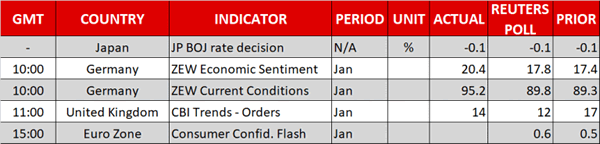
British manufacturing grew strongly in January, helped by export demand. At the same time, the proportion of factories expecting to raise prices hit a 34-yr high, a CBI survey showed. The CBI order book balance eased to +14 from a peak of +17 in December. The CBI's prices balance rose to +40 from +23, its highest since January 1984.
German ZEW investor sentiment improved further in January, ignoring the political stalemate in the formation of a new government. ZEW economic sentiment rose to 20.4 from 17.4. The index measuring investors' assessment of the economy's current conditions rose to 95.2 from 89.3, the highest level since the survey began in 1991.
Brazil's inflation returned within the official targeted range for the first time in six months. Consumer prices tracked by the benchmark IPCA index rose 3.02% Y/Y in January, according to state statistics agency IBGE.
Yen Gains Ground Despite Dovish Kuroda; European Stocks Hit New Highs
Here are the latest developments in global markets:
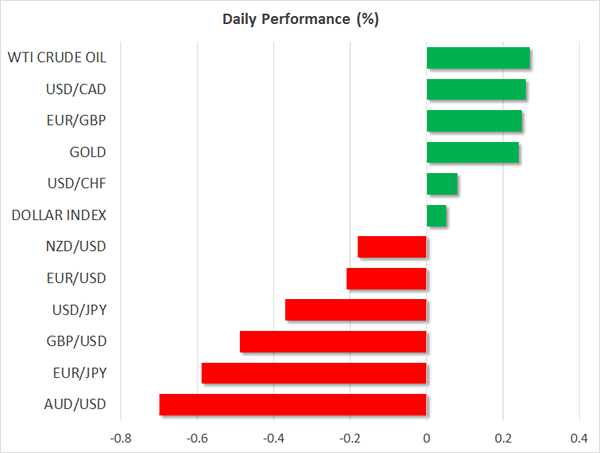
FOREX: The yen posted a strong rally towards an intra-day high of 110.38 (+0.38%) per dollar during early European trading hours. This came after a decline earlier in the day when the BOJ chief, Haruhiko Kuroda, downplayed plans on stimulus reduction. Upbeat data on Eurozone's ZEW economic sentiment offered little for the euro, with euro/dollar recovering to 1.2256 (-0.13%). Pound/dollar dipped into losses, falling to 1.3944 (-0.30%) after touching 1.4000 during the Asian session. The bigger loser, though, was aussie/dollar which dropped to 0.7961 (-0.65%) as protectionist trade measures in the US threatened global trade activities and signaled an equivalent response by China. The dollar index was steady at 90.42.
STOCKS: European stocks jumped to new highs on Friday as the US government was in the process to reopen, while optimism on earnings releases gave fresh legs to the markets. The pan-European STOXX 600 hit a fresh 2 ½ -year high, trading 0.30% higher at 1045 GMT. The index was driven by Carrefour's shares which increased by 6.5% after the company announced its plans to cut costs and launch a new partnership with its Chinese groups. The blue-chip Euro STOXX 50 climbed by 0.30% as well. The French CAC 40 inched up by 0.14% to 11-year peaks, while the German DAX and the British FTSE 100 surged to record peaks, rising 0.83% and 0.14% respectively.
COMMODITIES: Oil prices gathered tailwinds after the IMF revised its growth prospects to the upside for the Saudi Arabian economy in the face of rising oil prices. It also raised its growth forecasts for the world economy. WTI crude went up by 0.47% on the day to $63.47 per barrel and Brent increased by 0.35% to $69.27. Gold rose by 0.26% to $1,337.50 per ounce.
Day ahead: Eurozone flash consumer confidence pending; Eyes in Davos
In the Eurozone, preliminary readings on consumer confidence – due at 1500 GMT – are said to remain in positive territory in January for the third consecutive month, edging up by 0.1 points to +0.6. Note that, the index, which tracks future economic prospects, has been below 0 since 2001.
In oil markets, investors will be looking forward to the API weekly report delivered at 2135 GMT to see whether US crude oil inventories continue to fall, giving a further boost to oil prices.
However, the ongoing World Economic Forum annual meeting in Davos, Switzerland, will be of greater importance for market watchers over the next four days as world leaders and business delegates are gathering to discuss on global topics. Investors are potentially widely expecting a speech by the US President, Donald Trump, who recently achieved his first legislative victory in office, promising massive tax cuts for businesses and individuals, thereby creating a more attractive US business environment. Still, Trump's attendance has not been confirmed yet, with the House Press Secretary, Sarah Saunders saying on Monday that the president will travel to Davos only if the" government reopens as expected".
In Montreal, representatives of Canada, the US, and Mexico, are scheduled to begin the sixth round of NAFTA negotiations, which will conclude next Monday. The outcome of these negotiations could play a large role in determining the near-term bias of both the Canadian dollar and the Mexican peso. Let's not forget that the Bank of Canada described the future of NAFTA as the most significant downside risk the economy faced, after hiking its benchmark interest rate last week.
In other economic events, the US Senate Banking Committee will hold a hearing on the nomination of Marvin Goodfriend to be part of the FOMC board at 1500 GMT. Later in the day, the Chicago Fed President will give introductory remarks before the Chicago Council on Global Affairs conference: "The Future of Monetary Policy: Embracing the Unconventional" at 2330 GMT.
Formal coalition talks in Germany are expected to start this week after Merkel's Conservatives (CDU) and Social Democrats (SPD) approved a deal to form a new government on Sunday.
In stock markets, earnings releases today include quarterly reports from Johnson & Johnson, Procter & Gamble, and Verizon before the US market opens.
US Futures Reverse Earlier Gains
Indices Remain Near Record Highs as US Government Shutdown Ends, For Now
US futures have turned lower ahead of the open on Tuesday having earlier been indicating a higher open on Wall Street. Dow futures had been pointing to a more than 60 point gain prior to the 100 point drop. Still, futures are now only marginally lower and come following new records being set on Monday.
Monday's gains came as the government shutdown came to an end after only three days, two of which occured over the weekend. A spending bill passed through the Senate and the House on Monday which will enable furloughed workers to return to work, albeit temporarily, giving officials another couple of weeks to find a longer term solution. With Senate Republicans and Democrats seemingly no closer to an agreement on core immigration issues though, there's a good chance that we'll be back to square one on 8 February.
While markets were given a small boost as it became clear that the bill would pass through the Senate, there was never any real fear that a continued slowdown would have any significant negative impact on the economy. That has been the experience previously, although the country has never experienced a long shutdown that may bring more significant consequences.
Tuesday is looking a little quiet on the economic data side, with eurozone consumer sentiment the only notable release. From a US perspective, there'll be more attention on earnings with 16 S&P 500 companies reporting on the fourth quarter including three from the Dow 30. It's been a good start to earnings season, with those that have already reported having broadly speaking lived up to high expectations.
JPY Higher as BoJ Leaves Monetary Policy Unchanged
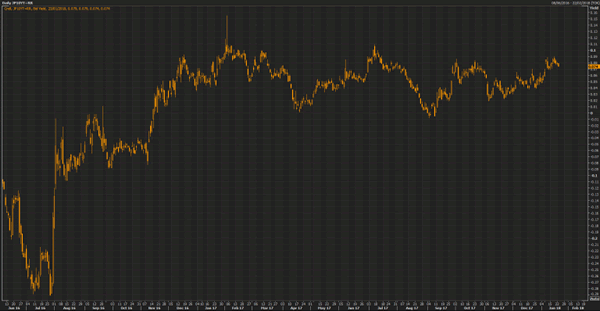
The Bank of Japan monetary policy announcement went largely as expected overnight, with the central bank making no changes while downplaying small variants in purchases each month. It also stressed its commitment to maintaining its policy of keeping the 10-year yields around 0% until inflation returns to target, which it's far from doing now.
10-Year JGB Yield Daily Chart
Source – Thomson Reuters Eikon
At the same time, it did sound a little more upbeat than previously on inflation expectations which appears to have lifted the yen, with the dollar down around half a percent, the euro a little more and the pound more again. I'm not convinced we can read too much into this though with expectations still very low and unlikely to rise to target any time soon.
Bitcoin Eyeing Sub-$10,000 as Sell-Off Continues
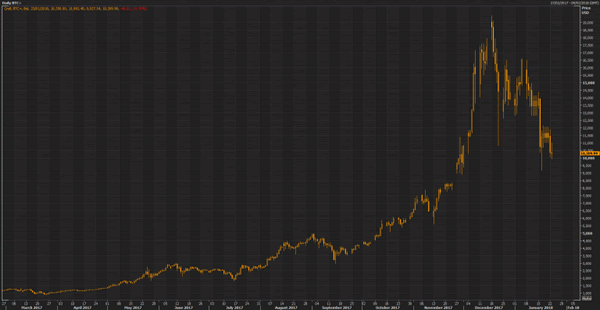
Bitcoin is trading in the red for a third session and is threatening to break back below $10,000 again today, having done so last Wednesday for the first time since the start of December. It would appear that despite losing half its value since peaking on 17 December, the rout may not be over. It's not just bitcoin that's having a bad day, similar losses are being seen throughout the cryptocurrency space with speculators clearly not as keen to buy the dips as they were in early December.
Global Stocks Boosted by Renewed Risk Appetite
Investors marched into Tuesday's trading session adopting a "risk-on" attitude after US lawmakers reached a deal to end a government shutdown.
Asian stock markets ventured higher during early trading on Tuesday, following Wall Street's record gains overnight. In Europe, shares climbed to fresh highs as optimism over sustained global growth continued to boost risk sentiment. With Wall Street powering to all-time highs on Monday as markets cheered the end of a three-day government shutdown, US stocks could remain buoyed by the positive sentiment this afternoon.
Dollar struggles to hold ground
It's remarkable how the Dollar still remains mired near three-year lows despite President Trump signing a bill to end a US federal government shutdown. There is a suspicion that one of the culprits behind the Dollar's weakness could be mounting concerns over the United States stance on global trade. With the Greenback still susceptible to further losses, as other major banks gradually tighten monetary policy, the Dollar Index remains heavily bearish. Taking a look at the technical picture, the Index is under pressure on the daily charts with technical lagging indicators such as the MACD and 50 Simple Moving Average going in line with the bearish bias. The 91.00 level is in the process of transforming into a new lower high. A breakdown below 90.30 could encourage a decline towards 90.00 and 89.60, respectively.
Currency spotlight - GBPUSD
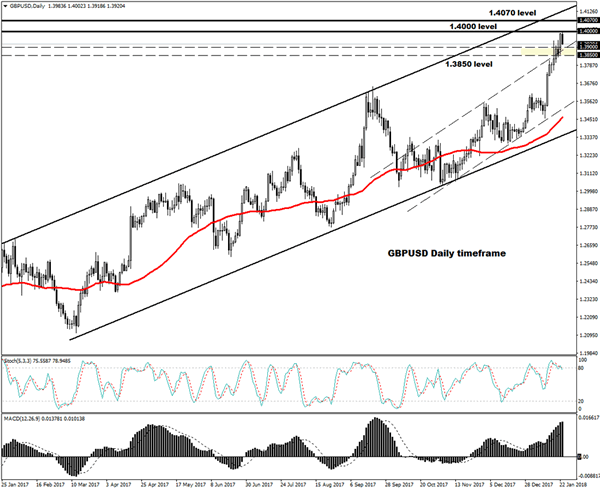
A renewed sense of optimism over the Brexit negotiations pushed Sterling above 1.40 during Tuesday's trading session.
While the lion's share of Sterling's gains this year can be attributed to ongoing Dollar weakness, the gains could partially be due to the renewed hopes of a "soft Brexit". With the economic calendar fairly light today, price action is likely to dictate where the GBPUSD trades. From a technical standpoint, the currency pair is firmly bullish on the daily charts. The breakout above 1.3850 resulted in prices trading towards 1.3920 and 1.4000, respectively. A technical correction could be in the process with the next level of interest at 1.3900. Alternatively, a daily close above the 1.4000 could invite an incline towards 1.4070.
Commodity spotlight - Gold
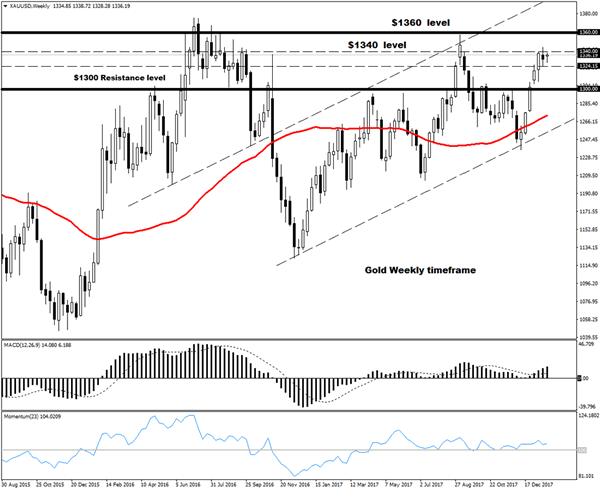
Gold had a slight sparkle on Tuesday as the Dollar remained depressed around three-year lows.
The yellow metal remains bullish on the daily charts and has the potential to venture higher amid the weakening US Dollar. From a technical standpoint, the fact that there have been consistently higher highs and higher lows verifies the bullish bias on the daily charts. A technical breakout and solid weekly close above the $1340 level could encourage a further incline higher towards $1360. Bulls remain in firm control above the new $1324.15 higher low.
CRUDE OIL: Sets Up To Resume Uptrend
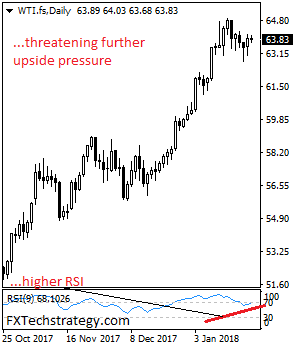
CRUDE OIL - The commodity looks to resume its upside pressure. On the downside, support resides at the 63.50 level where a break will expose the 63.00 level. A cut through here will set the stage for a run at the 62.50 level. Further down, support resides at the 62.00 level. On the upside, resistance resides at the 64.50 level. Further out, resistance comes in at the 65.00 level. A break above here will aim at the 65.50 level and then the 66.00 level followed by the 66.50 level. Its daily RSI is bullish and pointing higher suggesting further strength. All in all, CRUDE OIL remains biased to the upside long term
EURUSD Declines Likely Below 1.2258 Level
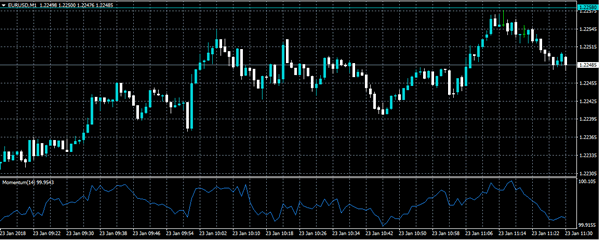
The euro is slowing moving lower against the U.S dollar, with price-action again struggling to find meaningful buying interest above the key 1.2258 pivot area. The EURUSD pair earlier looked past strong ZEW data from German and eurozone economies, with price continuing to hold in a tight trading range between 1.2230 and 1.2270. Going forward, a strong technical breakout looms for the EURUSD pair, ahead of the all-important European Central Bank policy meeting this coming Thursday.
The EURUSD pair will see downside pressures building while price-action trades below the key 1.2258 level. Key technical support is found at 1.2200 and 1.2150.
Should the EURUSD pair move above the 1.2258 level, buyers will look to attack the 1.2270 and 1.2320 resistance points.
USDJPY Now Intraday Below 110.80 Level
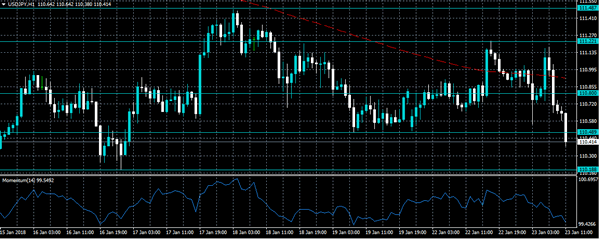
The U.S dollar has slipped sharply lower against the Japanese yen during the European trading session, after a bearish higher-time frame close below the 110.80 level. Price-action on the USDJPY currently trades around the 110.40 level, as sellers start to take control of the pairs intraday directional bias. The move lower in the pair was sparked by a reversal in stocks, and a minor bounce higher in the U.S dollar index. Traders now look to Manufacturing data coming from the United States, and the key 110.00 technical support level on the USDJPY pair.
USDJPY intraday sellers have now taken control of the pair below 110.80 level, downside targets remain 110.00 and 109.80.
Should USDJPY buyers push price-action back above the 110.80 level, strong resistance is then found at the 111.22 and 111.48 areas.