

Sample Category Title
Eco Data 10/23/17
[php_everywhere] [/php_everywhere]
Summary 10/23 – 10/27
Monday, Oct 23, 2017
[php_everywhere] [/php_everywhere]
Tuesday, Oct 24, 2017
[php_everywhere] [/php_everywhere]
Wednesday, Oct 25, 2017
[php_everywhere] [/php_everywhere]
Thursday, Oct 26, 2017
[php_everywhere] [/php_everywhere]
Friday, Oct 27, 2017
[php_everywhere] [/php_everywhere].
Weekly Economic and Financial Commentary: Despite Hurricane Winds, Fed on Course for December
U.S. Review
Despite Hurricane Winds, Fed on Course for December
- Domestic economic data, unsurprisingly, continues to display the disruptive effects of the recent hurricanes. The Fed will likely look through the winds and stay the course for a December rate hike.
- Both industrial production and housing starts were muffled because of the storms, an indication that we may see payback in the next couple of months.
- Despite the relatively soft production and housing data, the Fed was likely encouraged by the rise in the better-thanexpected import price data.
Despite Hurricane Winds, Fed on Course for December
Domestic economic data, unsurprisingly, continue to display the disruptive effects of the recent hurricanes. Both industrial production and housing starts were muffled because of the storms, an indication that we may see payback in the next couple of months. Despite the relatively soft production and housing data, the Fed was likely encouraged by the rise in the better-thanexpected import price data. And while, yes, a jump in petroleum prices helped push prices higher in September, nonfuel import prices also continue to firm.
Hurricane Winds Still Disrupting Data
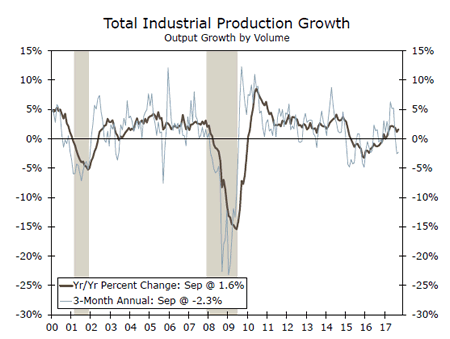
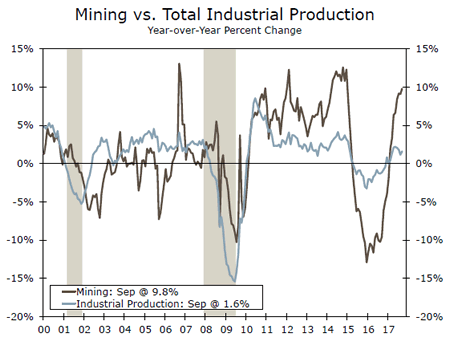
The modest 0.3 percent gain in industrial production for September would have likely been larger had it not been for the quarter percentage point drag from Hurricanes Harvey and Irma. Industrial production fell at a 1.5 percent annualized rate in the third quarter, but according to Fed estimates, this figure would have been an increase of at least 0.5 percent had it not been for the weather disruptions. Looking into the few remaining months of the year and assessing the outlook for 2018, we look for industrial production to accelerate modestly. The dollar's early strength in 2017 has largely reversed, which will likely boost investment plans for export-dependent producers. Moreover, energy prices have broadly stabilized, which has lifted mining output once again.
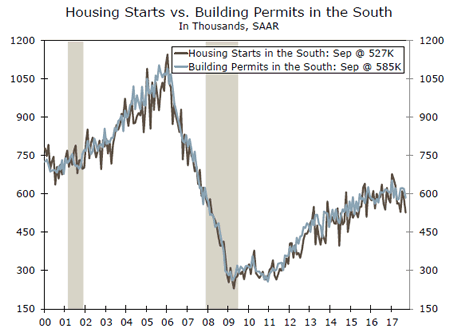
Housing starts were also unable to escape the wrath of the storms, declining 4.7 percent in September, much more severe than the consensus estimate of -0.4 percent. Likewise, permits fell 4.5 percent but remain nearly 8 percent above starts and set the table for a rebound in the coming months. While repairs on damaged homes are not counted as starts, they may impact starts by worsening labor shortages and driving material prices higher. It is likely that some projects may simply have been put on hold. September's drop in starts highlights the significance of Florida and Houston as huge housing growth markets. Housing starts in the South comprise nearly 50 percent of all starts in the nation. Existing home sales, released this morning, surprised to the upside, rising 0.7 percent month over month. However, sales in the South were -0.9 percent on the month, coming at the heels of a 5.7 percent contraction in August.
Weakening Dollar Putting Pressure on Import Prices
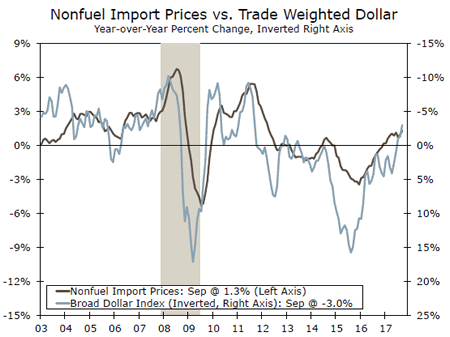
Import prices rose 0.7 percent in September, buoyed by a 4.5 percent increase in petroleum prices. Excluding fuel, prices rose 0.3 percent in September and are up 1.3 percent over the past year. The rise in nonfuel products was fairly broad, with industrial supplies, foods, capital goods and autos all posting gains. The firming in import prices can partially be traced to weakening in the broad trade weighted dollar over the past nine months. However, prices for U.S. exports also continued to move higher in September. The rebound over the past year has largely been driven by a recovery in commodity prices as well as capital goods exports as the global economy has strengthened.
While the Fed likely does not weigh import price inflation as heavily as the PCE deflator as a gauge of price growth in the economy, members of the FOMC are likely encouraged by the firming in nonfuel import price growth as they look to raise rates in December.
U.S. Outlook
Durable Goods • Wednesday
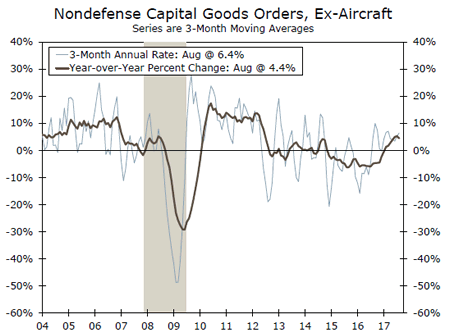
August's durable goods orders indicated continued strength in the manufacturing sector, beating expectations by rising 2.0 percent on the month. New aircraft orders led gains in the month, increasing by 44 percent. The strongest takeaway from August's reading, however, was in new orders for nondefense capital goods exaircraft, which grew by 0.9 percent over the month following a strong 1.1 percent gain in July. This "core" measure was at a 6.4 percent annualized growth rate over the past three months, signaling strength in the capital goods sector.
We maintain our call of solid equipment spending for Q3-2017 as we look ahead to September's report. We expect a gain of 6.9 percent in this component of fixed investment for the quarter, and the positive momentum of the core measure of durable goods orders indicates a strong Q4 as well.
Previous: 2.0% Wells Fargo: 1.0% Consensus: 1.0% (Month-Over-Month)
New Home Sales • Wednesday
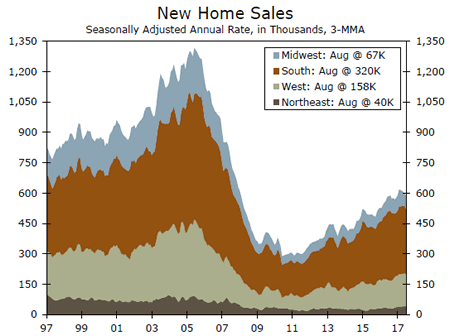
New homes sales slipped 3.4 percent in August to a seasonally adjusted annual rate of 560,000 units. Much of this drop can be attributed to hurricanes Harvey and Irma that made landfall in the month in Houston and many parts of Florida. The impacted counties account for about 14 percent of single-family permits, therefore any disruption in that market will be felt in the national headline. While inventory of new homes for sale remain historically low, inventory did spike in August, however much of the increase was in homes not yet started or under construction. Lean inventories of completed homes and strong demand in higherpriced metro areas are keeping prices high.
We expect new home sales to be stronger in Q4 as demand, wages and household formation continue their upward momentum. For the full year, we expect to see new home sales of 610,000 units, with further strengthening in 2018 and 2019.
Previous: 560K Wells Fargo: 556K Consensus: 555K
GDP • Friday
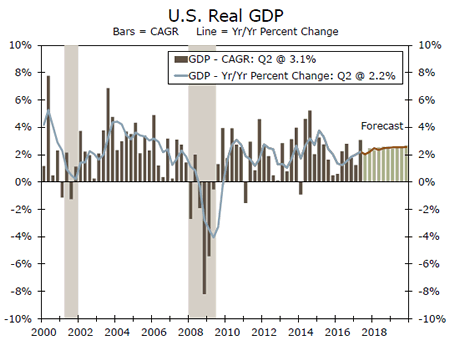
Following a soft quarter of GDP growth of 1.2 percent in Q1, GDP rebounded to 3.1 percent in Q2-2017. The nearly 2 percentage point jump in GDP growth in Q2 can be at least partially attributed to seasonality, particularly in personal consumption, thanks to gains in disposable personal income of 3.3 percent.
We expect GDP growth of 2.1 percent in Q3 and 2.5 percent in Q4, which would amount to full year GDP growth of 2.1 percent in 2017. Storm disruptions in Houston and Florida slashed job gains and shut down business activity temporarily in important metro areas. While our call is below consensus, these hurricane effects bring heightened uncertainty to Q3 GDP, as some drivers of growth were pulled forward and some were pushed back. With output rebounding relatively quickly and expectations of some sort of tax cut enacted, we project GDP growth to increase to 2.4 percent in 2018.
Previous: 3.1% Wells Fargo: 2.1% Consensus: 2.6% (Annualized Quarter-Over-Quarter)
Global Review
Chinese Economic Growth Steady in Q3
- With the 19th Party Congress ongoing in China, data released this week on Chinese real GDP growth met expectations at 6.8 percent year-over-year growth. The deceleration in fixed investment spending in China continued, however, as a result of both secular and cyclical trends.
- Inflation in the United Kingdom remained above the Bank of England's target in September, while wage growth remained lackluster.
- Canadian CPI generally remained on trend in September and within the Bank of Canada's target band, while retail sales surprised to the downside.
Chinese Economic Growth Steady in Q3
Data released this week showed the Chinese economy growing 6.8 percent on a year-ago basis in Q3, matching the Bloomberg consensus forecast (see chart on front page). The print marks a 0.1 percentage point slowdown from the 6.9 percent pace registered through the first two quarters of the year. Economic growth in China has firmed in 2017 relative to last year's pace amid the stronger global growth environment. At present, we expect real global GDP growth to accelerate about half a percentage point in 2017, to 3.5 percent year over year.
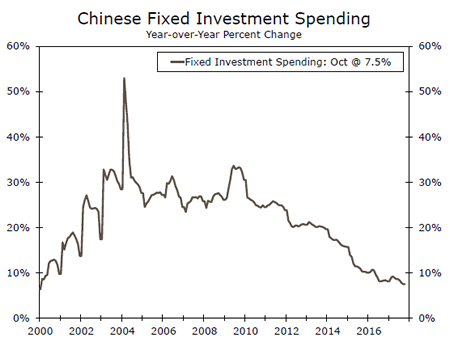
Even with the faster growth at home and abroad, fixed investment spending in China has continued to decelerate (top chart). Growth in the secondary industry, which includes mining/quarrying, manufacturing, construction and utilities production, ticked lower by 0.1 percentage points to 6.3 percent this year through Q3, compared to the same period a year ago. Some of the slowdown has been the continuation of a secular trend; investment spending has decelerated for most of this cycle as the Chinese economy continues the steady transition towards a more consumption-oriented growth model. To that point, retail sales data released this week showed continued double-digit yearto- date growth through the month of September. More recently, investment spending growth has continued to slow as Chinese policymakers have moved to tighten policy amid concerns that the expansion in credit that occurred when the economy was slowing might lead to debt imbalances.
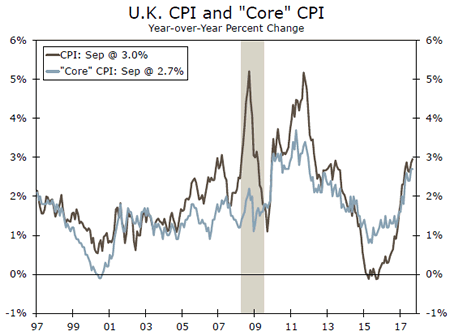
Elsewhere, economic data released out of the United Kingdom suggest that the woes facing the U.K. economy have remained in place. The consumer price index rose 0.3 percent in September and 3 percent over the year, while the core index held steady at 2.7 percent (middle chart). Both of these measures are in excess of the Bank of England's 2 percent inflation target, which has been exceeded largely due to the depreciation in the pound in the wake of last year's Brexit vote.
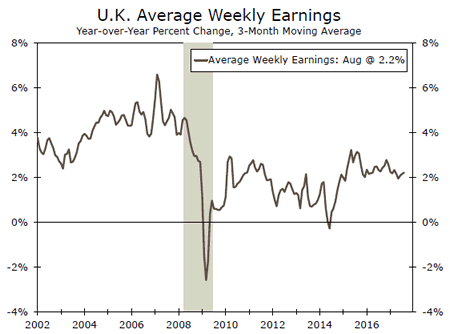
Despite the faster inflation, wages have failed to accelerate in tandem. Average weekly earnings data for August showed another flat reading of 2.2 percent year-over-year growth (bottom chart). Real wage growth, or nominal wage growth minus the inflation rate, has turned negative amid this acceleration in prices and stagnant wage growth, and the loss of purchasing power has weighed on consumers. Real retail sales excluding auto fuel in the U.K. fell 0.7 percent in September. Some of this decline was likely payback from August's large increase, but year-over-year real retail sales are up just 1.2 percent, hampering economic growth.
Canadian CPI rose 1.6 percent year-over-year in September, slightly below the consensus estimate of 1.7 percent. CPI excluding the more volatile food and energy components rose 0.2 percent on a monthly basis, rebounding after back-to-back flat monthly changes. While CPI was generally in line with expectations, Canadian retail sales for August declined 0.3 percent over the month versus the consensus estimate of a 0.5 percent increase. The August reading may be only a temporary pullback, as retail sales growth is in positive territory on a year-over-year basis.
Global Outlook
Mexico Economic Activity Index • Tuesday
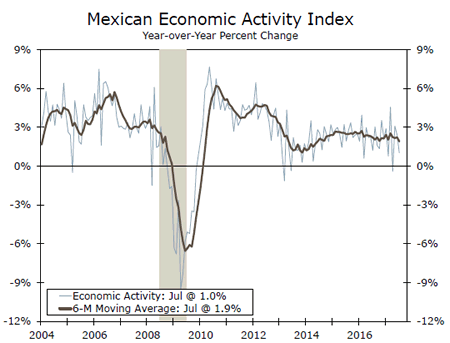
Real GDP in Mexico rose only 1.8 percent on a year-ago basis in Q2- 2017. Growth in the tertiary sector of the economy (i.e., services) was resilient, but growth in the primary sector (agriculture) slowed significantly in Q2. Furthermore, growth in the secondary sector remained lackluster due to contractions in mining, construction and utilities production. The manufacturing sector continued to expand in Q2, albeit at a modest pace.
If the economic activity index is a useful proxy for overall real GDP growth, then the Mexican economy started the third quarter on a soft note as the index was up only 1.0 percent (year-over-year, not seasonally adjusted) in July. Analysts will get some more information on the state of the Mexican economy in Q3 with the release of the economic activity index for August (Tuesday) and retail spending data in August (Wednesday). Previous: 1.0% (Year-Over-Year)
U.K. GDP Growth • Wednesday
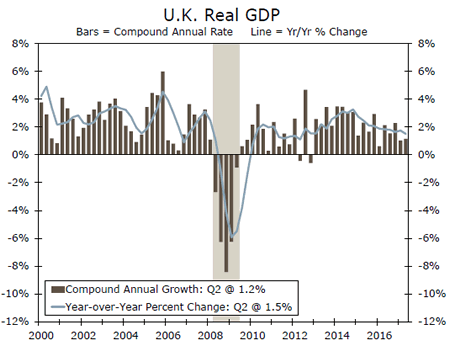
Contrary to some expectations at the time, the British economy remained largely resilient in the immediate aftermath of the Brexit referendum in June 2016. However, some of the effects that the surprising outcome put into train have had economic effects this year. Sterling fell sharply after the Brexit vote, which lifted consumer price inflation, thereby eroding growth in real income and weighing on personal consumption spending. Consequently, real GDP growth slowed to just 1.5 percent on a year-ago basis in the second quarter.
Preliminary GDP data for Q3 are on the docket on Wednesday, and we look for GDP to have risen 0.4 percent (not annualized) on a sequential basis. If our estimate of the sequential rate of growth is correct, it will represent some modest acceleration in the economy after two sluggish quarters in the first half of the year.
Previous: 0.3% Wells Fargo: 0.4% Consensus: 0.3% (Quarter-Over-Quarter)
ECB Policy Meeting • Thursday
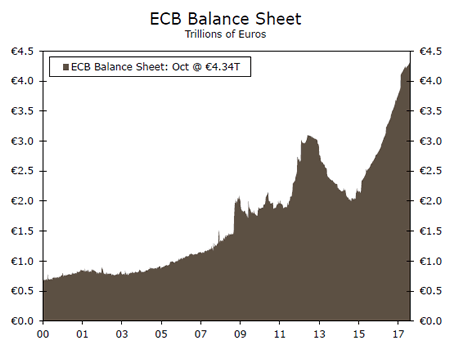
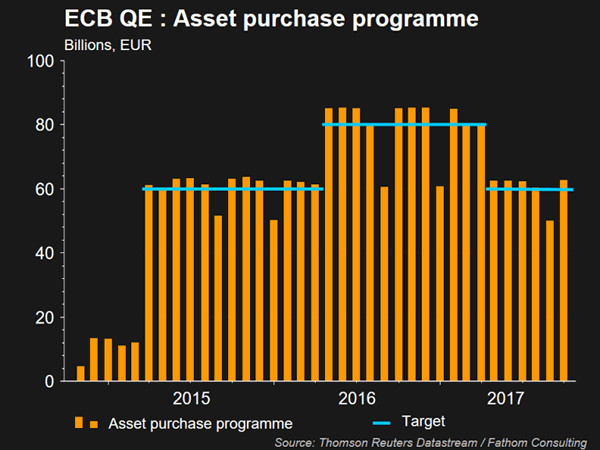
The European Central Bank has administered an extraordinary degree of monetary accommodation to the Eurozone economy over the past few years. Not only did it take its deposit rate into negative territory in mid-2014, but it also embarked on a quantitative easing program in early 2015. At their peak, bond purchases by ECB totaled €80 billion per month, but the Governing Council pared back the monthly purchase rate to €60 billion earlier this year.
The Eurozone economy continues to gather momentum and most analysts, ourselves included, look for the Governing Council to announce another reduction in the bond purchase rate at the policy meeting on Thursday that likely will take effect early next year. In our view, the ECB will cease buying bonds altogether next year, although the exact timing in somewhat uncertain. We also look for the Governing Council to begin a slow process of rate hikes in late 2018.
Previous: €60 billion/mo. Wells Fargo: €40 billion/mo.
Point of View
Interest Rate Watch
The Race Is On
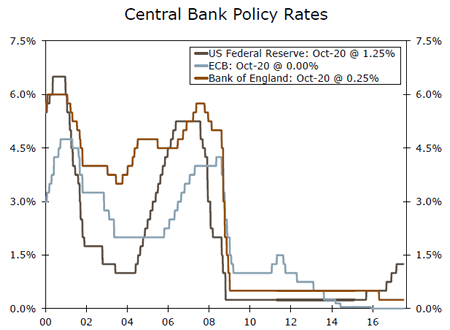
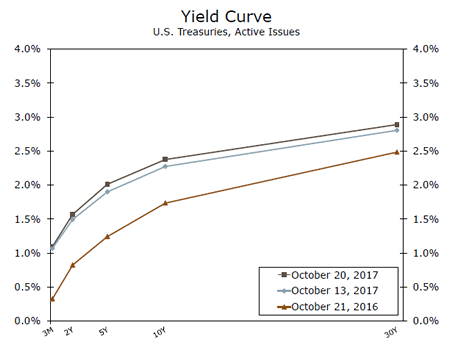
The Trump administration is nearing its decision on who will lead the Fed over the next four years. An announcement is expected before November 3, which would allow time for confirmation hearings prior to Yellen's term ending on February 1.
Trump has been meeting with potential candidates over the past month or so. Yet even as his decision approaches, there remains a wide degree of uncertainty surrounding his pick.
Odds makers currently have Governor Jerome Powell at the top of the list. Powell would offer continuity on the interest rate front, but is reported to favor a lighter regulatory touch—consistent with the Trump agenda.
Stanford University economist John Taylor looks to be another top contender. Taylor has been a critic of the Fed's large balance sheet and his namesake rule suggests the fed funds rate should be above its current level. While he has said that he wouldn't explicitly follow a rules based approach, he would be expected to be more hawkish than the current chair.
Also in the mix are former Fed governor Kevin Warsh and, to a lesser extent, National Economic Council Director Gary Cohn. Warsh is considered to be a hawk, having criticized the Fed for being too accommodative in recent years and paying too much heed to low inflation.
Still in the running, but a longer shot in our view, is current chair Yellen. While a "lowrate person", her commitment to tougher regulation since the crisis is at odds with the President's agenda. Moreover, following the president's lack of legislative victories, we wouldn't be surprised if he took the expiration of her term as an opportunity to put his own stamp on policy and appoint a new chair.
Whoever is chosen, the direction of the FOMC has tremendous potential to shift over the next year. There remain three open seats on the board even after Randall Quarles took office last week. In addition, 2018 will see two new first time voters with Atlanta Fed President Raphael Bostic and a new president at the Richmond Fed.
Credit Market Insights
Credit Card Debt Okay For Now
Consumer consumption growth outpaced disposable income growth for the past two years, and outstanding credit card debt is at an all-time high. Still, consumer confidence about future finances is high, according to recent surveys. We are starting to see an uptick in delinquent credit card accounts, but the level remains historically low. The credit card delinquency rate has risen to 2.5 percent from its trough of 2.1 percent in 2015. As long as incomes continue to rise, the current trend in credit card debt is likely sustainable.
Rising interest rates pose a downside risk to this outlook, however. The interest rate for credit card plans rose 0.5 percentage points over the past year to 13 percent. That rise is also likely manageable, as disposable income rose 2.7 percent over the past year. While the consumers' financial situation is far from precarious on aggregate, higher interest rates could push some more vulnerable households into delinquency.
An uptick in disposable income would help to alleviate some of that risk, though there is little reason to expect income growth to break out from its 2-3 percent range held in recent years. Moreover, while the stock market has played a large role in the recent rise in consumer confidence, proceeds from the bull market are less likely to be the main source of income growth for credit card debtholders close to delinquency.
Topic of the Week
Is Low Capacity Utilization a Cause for Concern?
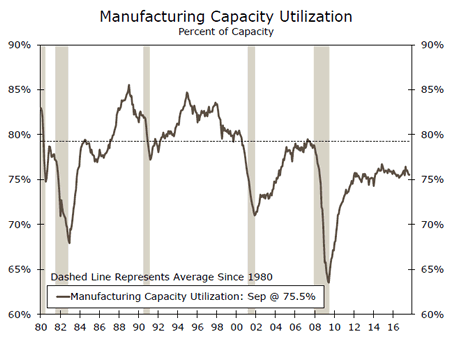
As part of the industrial production data released on Tuesday, manufacturing capacity utilization increased slightly to 75.5 percent. However, throughout the current cycle, capacity utilization, or the share of actual output achieved relative to potential output, has yet to surpass its pre-recession peak (top graph). Capacity utilization has trended downward since the 1980s, while industrial production has accelerated. Should we be concerned about the slowdown in capacity utilization, or simply acknowledge that capacity utilization will likely remain lackluster in future cycles?
The answer to this question lies in the fundamental divergence between manufacturing industrial production and capacity utilization over the past few cycles. Until the most recent expansion, manufacturing industrial production has peaked at higher levels after each recession. However, these periods of strong manufacturing industrial production growth occurred alongside the opposite trend in capacity utilization. In every cycle since 1982, capacity utilization has peaked at a lower level than the previous cycle. In the current cycle, manufacturing capacity utilization is still 4 percent below its pre-recession peak.
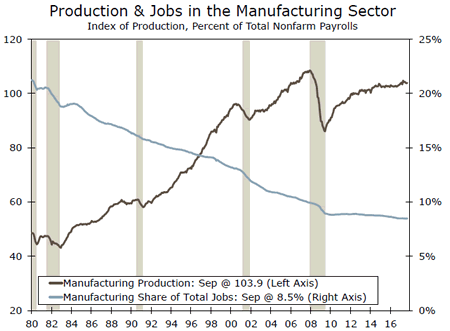
Aside from a temporary peak in industrial production as low oil prices increased mining output in late 2014, manufacturing industrial production is also still 4 percent below its pre-recession peak (bottom graph). Manufacturing is the most heavily weighted industrial group, comprising more than three-quarters of total industrial production.
Although factory hiring has rebounded this year, the broader downward trend in the sector's output after the manufacturing boom of the 1970s will likely continue to weigh on growth. Manufacturing employment has declined from 21 percent of total nonfarm employment in 1980 to 8.5 percent today. Low capacity utilization rates alone may not be cause for concern, but depressed manufacturing output and slow employment growth could weigh on the Fed's 2 percent inflation target.
The Weekly Bottom Line: Wall Street’s Cheerful Mood Continues
U.S. Highlights
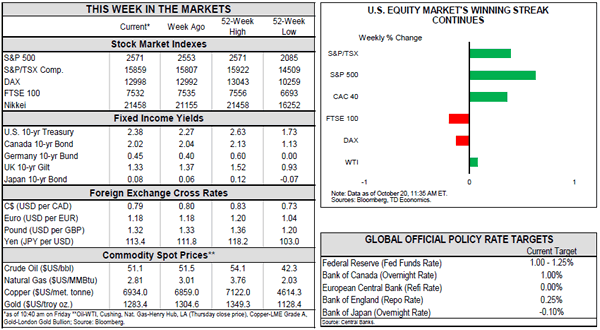
- Equity markets continued their winning streak this week. The economic data was generally supportive of the cheerful mood, with the Empire and Philly Fed indices both posting better-than-expected improvements in October.
- Next week's GDP data is likely to confirm solid growth in Q3, if somewhat dented by Hurricane disruptions. That is consistent with the picture painted by this week's Beige Book.
- There are plenty of potential policy-related moves afoot for markets to speculate on. A Fed Chair appointment is imminent, and GOP tax reform efforts crossed another milestone this week.
Canadian Highlights
- Manufacturing and retail sales moved in opposite directions in August, with factory shipments up 1.6% while retail sales slid 0.3%. Headline inflation was up by 1.6 y/y in September, (from 1.4% y/y). Core inflation was relatively unchanged.
- The Business Outlook Survey showed that sentiment pulled back in the third quarter, but remains positive, consistent with a solid pace of economic growth.
- OFSI released revised "B-20" guidelines for residential mortgage underwriting at federally regulated financial institutions this week, extending the 'stress test' to all borrowers rather than just those requiring mortgage insurance and those with terms of less than five years. This is likely to pour more cold water on an already cooling housing market.
U.S. - Wall Street's Cheerful Mood Continues
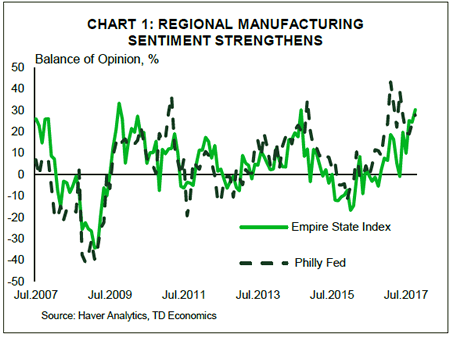
Equity markets continued their winning streak this week, while volatility remains low. Perhaps not surprisingly, businesses and consumers are cheerful too. The latest regional Fed manufacturing surveys - the Empire and the Philly Fed indices - both showed a better-than-expected uptick in October (Chart 1). These readings came after the Michigan Sentiment index, a measure of consumer confidence, reached a new post-recession high last Friday.
Even the one blemish in the economic data this week was pretty small. Housing starts fell further than markets expected in September, but were heavily affected by hurricane disruptions. Permits for single family homes increased, which suggests that the weakness in starts should prove temporary. This notion is further supported by an improvement in homebuilder confidence in October. Conditions in existing home markets also remain tight, further building the case for stronger starts ahead.
The first estimate of real GDP growth for Q3 is released next week. We are tracking growth of around 2 ½%, slightly better than in our recent forecast. That pace will likely be boosted by inventory restocking and net-trade. Growth in final domestic demand is expected to be more modest at 1.6%, reflecting the temporary disruptions from the hurricanes. Domestic demand is expected to rebound 3% in Q4 as rebuilding efforts get underway.
Meanwhile, speculation is rife on who will be the next Fed Chair. Yellen, whose term expires in February, had a meeting at the White house this week. Trump has also met with noted Stanford Professor John Taylor, of the eponymous "Taylor Rule." Also in the running are former Fed governor Kevin Warsh, and current Fed governor, Jerome Powell. Right now online markets show Powell as the odds-on favorite. He is perceived as being least disruptive to markets, while still enabling the President to be seen to put his stamp on the Fed. Taylor and Warsh would represent a bigger change, and are perceived as more hawkish choices, as both likely would have set rates higher than they are now, if they had been Fed Chair.
Many in the GOP have been critical of the Fed, which suggests an outsider like Warsh or Taylor may have a leg up. But, President Trump also has a stated preference for low rates, which may have him lean toward the status quo. Notably, selecting a new Fed Chair would break with 40 years of convention of incoming presidents reappointing Fed Chairs, even if they were appointed by the opposing party. Trump's choice is likely to be named in two weeks.
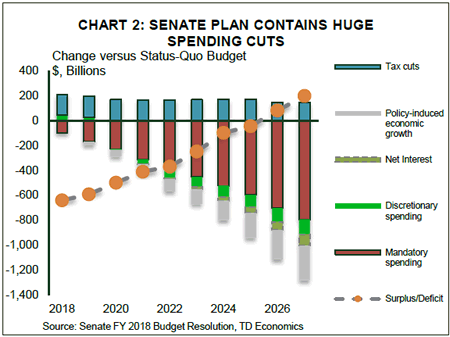
Elsewhere on Capitol Hill, Republican's tax reform efforts passed another milestone this week as the Senate passed its budget resolution. The resolution does not settle the specifics of tax reform, but, it does earmark $1.5 trillion for tax cuts. The work of containing tax cuts to that amount from an estimated price tag of around $2.4 trillion will be done by the tax legislation writing committees in the House and the Senate. While details are scarce, the Senate budget gets back to balance through very steep spending cuts (Chart 2). This could exert a meaningful drag on growth, potentially offsetting any near-term boost from tax reform.
Canada - All About The Data
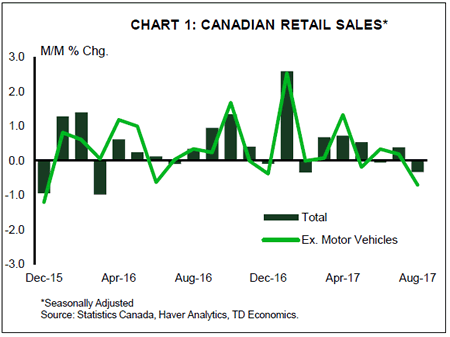
The economic calendar in Canada was quite full this week, with a slew of data released that will ultimately help shape the Bank of Canada's 'data dependent' decision next week. Manufacturing and retail sales moved in opposite directions in August. Following two months of declines, manufacturing sales rebounded by 1.6%, with volumes up 1.2%. The bounce back was due in large part to a 13% jump in auto output, after plants resumed normal operations following summer shutdowns. Meanwhile, sales excluding autos and parts edged up by only 0.2% during the month.
Retail sales, meanwhile fell 0.3% in August, with volumes down 0.7%. Much of the weakness stemmed from industries typically associated with housing, which is consistent with the slowdown in activity in recent months. Overall, this week's data still has the Canadian economy on track for growth of close to 2.5% in the third quarter.
Inflation data out this morning showed that prices were up 1.6% (year-on-year) in September, up from 1.4% in August. However, higher gasoline prices were the main driver of the increase, with core inflation little changed during the month.
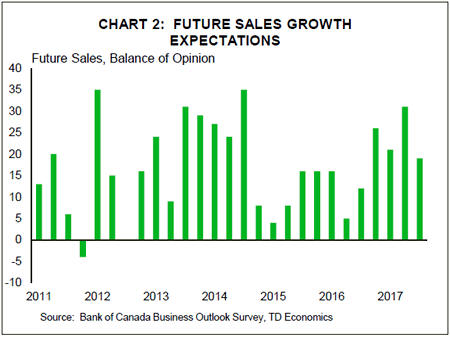
The Business Outlook Survey (BOS) that was released on Monday is perhaps the most important indicator for the upcoming interest rate decision. The Bank of Canada has put a lot of weight on this survey in recent quarters. The BOS showed that sentiment pulled back in the third quarter - which is not surprising given the strength seen through the first half of the year - but remains broadly positive, consistent with solid growth through the rest of the year. The survey results provide some support for the Bank's decision to hike interest rates twice this year already, and will help the Bank maintain its tightening bias. That said, the survey, combined with limited price pressures, suggests that there is no urgency to hike rates further.
What's more, the Office of the Superintendent of Financial Institutions (OSFI) released revised "B-20" guidelines for residential mortgage underwriting at federally regulated financial institutions this week, extending the 'stress test' to all borrowers rather than just those requiring mortgage insurance and those with terms of less than five years. We suspect that the rule change will pull forward some demand ahead of the January 1st, 2018 effective date, and slow housing market activity thereafter. Indeed, we estimate that housing demand could fall by 5-10%, while prices could slide by 2-4% in 2018 relative to baseline, as a result of the change.
Given these mortgage rule changes, combined with other regulatory changes in some regional markets such as Ontario, the Bank of Canada will have to be cautious in its tightening approach, so as to ensure a soft landing in the housing market. As such, all eyes will be on the Bank's Monetary Policy Report that will come alongside its rate decision next Wednesday. At this point, we expect the Bank to remain on the sidelines next week, with the forthcoming communication key in assessing the future path for interest rates.
U.S.: Upcoming Key Economic Releases
U.S. Real GDP - Q3
Release Date: October 27, 2017
Previous Result: 3.1%
TD Forecast: 2.5%
Consensus: 2.6%
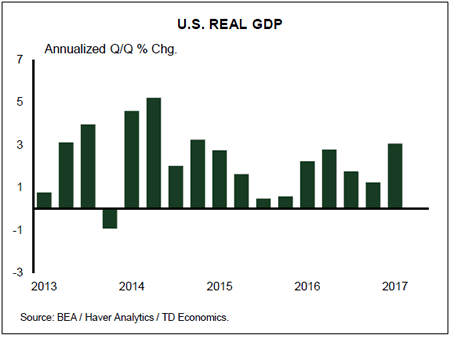
We expect a 2.5% advance in Q3 GDP, with downside risks amid uncertainty surrounding the hurricanes. The storms' negative impact is likely to be concentrated in nonresidential structures and homebuilding, while we see a risk for weaker consumer spending as services could take a hit. However, the Fed is likely to look through any data disappointment that could be attributed to the hurricanes.
Canada: Upcoming Key Economic Releases
Bank of Canada Interest Rate Decision
Release Date: October 25, 2017
Previous Result: 1.0%
TD Forecast: 1.0%
Consensus: 1.0%
We expect the Bank of Canada to keep policy rates unchanged in October. Market reaction will hinge on key elements of the communique, notably the output gap and characterization of recent data. We look for the output gap to continue to close by "late 2017", underpinned by upward revisions to GDP growth. Upbeat data, from business sentiment and housing to wages and core inflation - also call for the data-dependent central bank to present a more upbeat message than in their latest communications. But in light of Poloz's defiantly neutral tone of late and uncertainty over potential output and NAFTA, the risk of a major dovish repricing in rate hike expectations is nontrivial in our view.
Friday’s Finish Line
US equities put in another stellar session hitting the trifecta as all three major indexes ( DJIA, SPX and NASDAQ) synchronously closed at record highs. Likewise, the USD closed the week on a very optimistic note as positive investor sentiment was grounded in the Senate's passage of the budget resolution, clearing a significant hurdle and moving the GOP closer to tax reform. Now it's off to the Congress, but this time around, Trump is very confident The House will pass the resolution, eager to put tax reform behind them
The Fed Chair race remained in focus, but traders are finding it challenging getting off the merry go round after Trump made clear his three top choices are Powel, Taylor and Yellen on Friday. But never the one to miss an opportunity to stir the pot, when asked if Trump could have Powell-Taylor as co-chairs, he said it could be an option. While Powell and Taylor remain the odds-on market favourites, we do know that the President prefers lower rates and a softer US dollar, perhaps forgetting Yellen could prove to be a huge mistake.
FX markets remain choppy with traders reacting to headlines, rumours and at times engaged in a flight of fancy, not allowing the facts to get in the way. But this is more or less typical of trading in politically charged markets where risk quantification is a guessing game at best. But no rest for the weary as politically, it will be a huge week not only for the dollar but the weekend noise from Catalonia, and the Japanese election could make for a rousing start on Monday if the unexpected comes to fruition.
Even if you view the Catalan conflict as inconsequential to the long-term EUR view, headline noise can produce an outsized currency move at the Monday open due to thin liquidity conditions so best be nimble best be quick. But in reality, the primary focus for EURO traders is the ECB meeting on the 26th
PM Shinzo Abe is mostly expected to return to power with a comfortable majority. Given this likely scenario and effervescent risk environment, we should see a move higher on USDJPY as the market prices in short to medium term weaker JPY. His victory all but assures more fiscal stimulus in Japan including a JPY2trn budgetary spending package to ensure the next tax increase slated for 2019 does not result in an economic slowdown like the 2014 tax hike. Also, the Nikkie will continue to play catch up as elections risk premiums unwind and that should provide further upside impetus to USDJPY. Granted there are no election surprises; we should expect any USDJPY dips to be hoovered up at the Monday open
The Canadian Dollar
The Candian dollar tumbled and fumbled its way to the finish line proving to be G-10's worst performer on Friday as CPI, and retail sales both missed the mark. Also, The Bank of Canada Monetary Policy Report and policy statement are due October 25. Today's USDCAD rally indicates traders are looking for a dovish statement and no rate increase. So this wave of negativity should continue next week
The Euro
The long-awaited ECB meeting is upon us. But with the council all but telegraphing their intentions from the mysterious " unknown sources ', a lot of vol has been sucked out of this weeks meeting risk.
With that in mind, I suspect the Euro, as it did on Friday, will take its cue early next week from USD momentum.
The Japanese Yen
The market is bulled up on USDJPY for a favourable Abe election outcome as its expected his policies will continue to weaken JPY.
The New Zealand Dollar
The market has issued a vote of non-confidence for the very muddied NZ political landscape and by extension the Kiwi dollar. While political risk usually has a way of evaporating quickly, but with the NZD getting drawn into the USD vortex, we should expect a more profound current trend extension on a stronger dollar narrative.
The Australian Dollar
The Australian Dollar is one of the G-10 currencies with most to lose from a stronger dollar and a more hawkish Fed. The US dollar appears to be on solid footings into the weekend., but next weeks focus will be the US bond curve. Any aggressive move higher in US yields, especially if President Trump gives Taylor the nod, will put the Aussie at exceptional risk
Week Ahead – ECB Tapering Decision Looms; BoC Also Meets; UK and US GDP Eyed
The European Central Bank will take centre stage next week as it announces its long-awaited decision to scale back its asset purchase program. Central banks in Canada, Sweden and Norway will also be holding their monetary policy meetings. On the data front, the first estimate of third quarter growth in the UK and the US will be in focus. Other major data will include Japanese and Australian inflation and Eurozone PMIs.
Japan's Abe's election gamble likely to pay off
Recent elections in Britain, Germany and New Zealand did not produce the wanted results for the ruling parties. However, Sunday's snap general election in Japan looks set to give Prime Minister Shinzo Abe and his Liberal Democratic Party (LDP) a third consecutive term in government. The latest polls suggest the LDP-led coalition is on track for retaining its two thirds majority in parliament, which would make it easy for Abe to continue with his Abenomics policies, as well as press ahead with his proposed constitutional reforms. A win for Abe won't be positive for the yen however as it would signal a prolonged period of loose fiscal and monetary policies.
A key element of Abenomics is aggressive monetary stimulus, which the Bank of Japan has been engaged in since 2014 in an attempt to lift inflation to 2%. Inflation data on Friday is expected to show Japan's annual CPI rate increasing to 0.8% in September from 0.7% in the prior month.
Australian CPI to reach RBA's target
Australia will also see the release of inflation data next week. Third quarter CPI (due on Wednesday) is forecast to rise to 2.0% year-on-year from 1.9% in the previous quarter. This is just within the Reserve Bank of Australia's 2-3% target band. However, with wage growth still subdued, the data is unlikely to prompt the RBA to raise rates just yet. But a stronger-than-forecast reading could propel the Australian dollar higher, especially after this week's robust jobs figures.
Bank of Canada to pause after two hikes
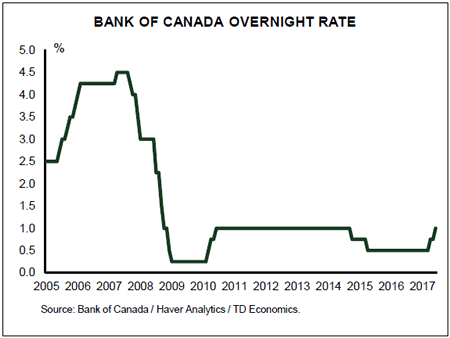
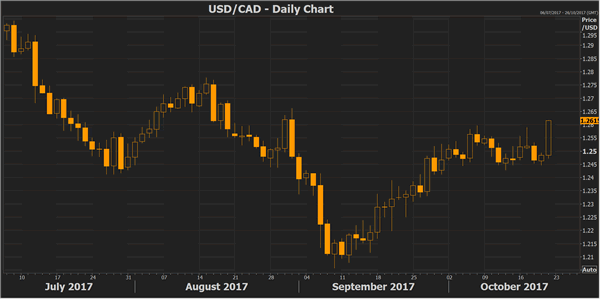
The Bank of Canada meets on Wednesday to decide whether it should raise rates for a third time this year. After two quarter point increases in as many months, the BoC is expected to hold rates at 1.0% in October. However, the announcement statement may contain clues as to the likelihood of a rate hike at the next meeting in December. With the odds of a year-end rate rise currently running just under 50%, investors need some convincing that the BoC will move again this year, especially after this week's disappointing retail sales figures for August. The data pushed dollar/loonie above the C$1.26 level for the first time since late August.
UK growth to remain sluggish in Q3
The preliminary estimate of UK GDP growth in the third quarter is due on Wednesday but is unlikely to bring much cheer to policymakers. The Bank of England is headed for a split vote in November on whether to raise interest rates, as inflation looks set to overshoot 3% - the Bank's upper target limit. But sluggish growth is complicating the BoE's decision making as Brexit has clouded the UK's economic outlook. The British economy is forecast to have expanded by 0.3% quarter-on-quarter in the three months to September, unchanged from the prior quarter, while the annual rate is expected to moderate to 1.4%.
US GDP in focus
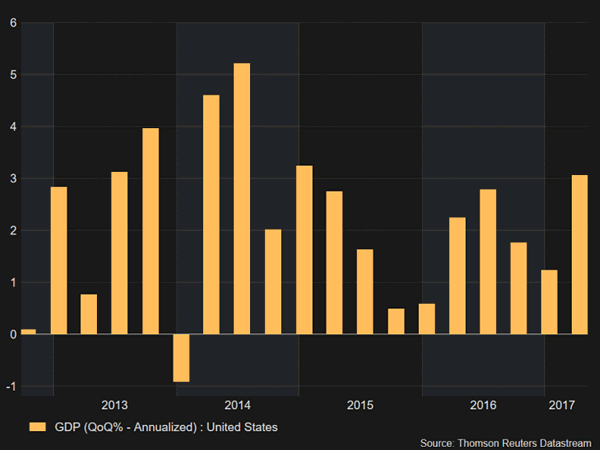
In contrast to the UK, the US is expected to have recorded another solid quarter of growth during the three months ending September. After growing by an impressive 3.1% annualized rate in the second quarter, the economy is forecast to have expanded by 2.6% in the third quarter, with the hurricanes in August/September likely to have caused only a minor dent. Other data to watch out of the US next week are Tuesday's flash PMI's from IHS Markit and Wednesday's durable goods orders. Both the manufacturing and services PMIs are forecast to improve further in October's flash reading, keeping with the trend of other recent survey data. Orders for durable goods however are expected to slow in September compared to August but still increase by a respectable 1.1% month-on-month.
All eyes on ECB meeting
It's going to be an important week for the ECB as the central bank treads a fine line in paring back its asset purchase program while maintaining a position of accommodative monetary policy. The ECB's current program expires in December and according to various reports, policymakers have been debating a reduction in the size of the bond purchases from €60 billion per month to somewhere between €25-€40 billion. The duration will probably be extended by six or nine months. The central bank is under pressure from both the hawks within the Governing Council as well as by its own rules which prohibit it from buying more than one third of any one country's debt, as it comes close to running out of German bunds to buy. Aside from the policy decision itself, the ECB will be very cautious in how it transmits its forward guidance on Thursday as it will not want to be seen as being too hawkish as that could drive the euro even higher in forex markets.
The ECB will not be the only central bank in town that will hold a policy meeting next week. Central banks in Norway and Sweden will also be meeting for their latest rate decisions on Thursday.
In terms of economic indicators, flash PMIs for the Eurozone will be watched. Data out on Tuesday is expected to show activity in the Eurozone's services and manufacturing sectors moderated slightly in October. More business surveys will follow on Wednesday with the release of Germany's Ifo business climate gauge.
Australia & New Zealand Weekly: Inflation – An Inconvenient Truth
Week beginning 23 October 2017
- Inflation - an inconvenient truth.
- RBA: Deputy Governor speaking.
- Australia: Q3 CPI, trade prices.
- NZ: trade balance.
- China: property prices.
- Euro Area: ECB policy decision.
- US: Q3 GDP 1st estimate.
- Canada: BoC policy decision.
- Key economic & financial forecasts.
Information contained in this report was current as at 20 October 2017.
Inflation - An Inconvenient Truth
The key economic event next week will be the release of the September quarter Consumer Price Index.
Westpac's forecasts are: 0.74% for headline; 0.27% for Trimmed Mean; and 0.32% for weighted median.
The jump in the headline is largely driven by sharply rising electricity prices. They are expected to increase by 18% in Sydney; 5% in Melbourne; 12% in Brisbane; 10% in Perth and 20% in Adelaide. The more modest increase in Melbourne is due to the increases being spread over the September and March quarters while Perth is not on the national grid. In the other states energy prices are generally adjusted in the September quarter.
The direct impact of the rise in electricity prices adds 0.47 percentage points to the headline inflation measure.
Of course, policy is impacted by the movements in the underlying measures: the Trimmed Mean and the Weighted Median.
Our estimates indicate that momentum in these core measures is slowing. The six month annualised rate would slow from 2.1% three months ago to 1.7%. Underlying inflation for the first 9 months of the year would be printing 1.3%, making it likely that the actual result will settle below the mid-point of the Reserve Bank's forecast range of 1.5%-2.5% (already 0.5% below the midpoint of the target range).
Key assumptions behind our forecasts include the expectation that margins in food retailing; clothing and footwear; household goods; and recreation will remain under pressure. Health costs are expected to continue to fall while the softening in the Sydney and Melbourne housing markets is likely to take some pressure off housing construction costs (usually the largest component of the Trimmed Mean).
We also note that in the minutes of the October meeting of the Reserve Bank Board it was noted that "liaison with businesses had suggested that a number of firms, particularly in the retail and manufacturing sectors, were largely absorbing increases in energy costs into margins rather than passing them through to final prices."
The surprise 0.6% fall in nominal retail sales in August and the downward revision to the July number (0% to -0.2%) also point to subdued price pressures in the retail sector in the September quarter.
The other issue challenging the outlook for inflation is the expected revisions to the weights to be used in the Consumer Price Index. The revised weights (reviewed every 6 years) are aimed at a more accurate mix of the expenditure patterns of consumers. The net impact is typically negative since consumer spending tends to rise for items where relative prices have declined and vice versa. The Australian Bureau of Statistics estimates that previous changes in weights have lowered the CPI by around 0.2 percentage points.
Our preliminary estimates point to a reduction in the measure of the CPI of a little more than this benchmark with the headline rate being reduced by up to 0.4% and the underlying by 0.3%.
So, if momentum in underlying inflation is slowing into 2018 and there is a technical need to lower the forecasts then the Bank will face a challenge in credibly maintaining its 1.5-2.5% forecast for underlying inflation in 2018 and its 2-3% forecast for underlying inflation for 2019.
Recall the last time the Bank was confronted with the need to significantly revise inflation forecasts. In April 2016 the Bank was expecting an underlying CPI print of around 0.6% and the result was 0.2%. Internally, the Bank lowered its underlying forecast from 2.5% (2-3%) to 1.5% (1-2%). It cut rates in May by 0.25%. That move was followed by another cut of 0.25% in August.
The result of that "pure" response to the inflation shock was to reignite house prices. Macroprudential policies, largely targeting investors, and a rate hike from the banks successfully deflated the booming housing market in 2015. House price inflation in Sydney slowed from 25% (6 month annualised) to -4.4% (April 2016). In response to the subsequent rate cuts house price inflation in Sydney lifted to 22.4% (January 2017). The recent "second round" of macroprudential policies has since slowed house price inflation in Sydney to 1.7% in September 2017. Comparable but less volatile trends were apparent in Melbourne.
This would be a definitive lesson for the new Governor that rigid adherence to an inflation targeting policy is likely to create disturbances in asset markets if inflation is structurally slowing.
We have seen central banks offshore take a similar approach by tending to look through the immediate data on inflation and pitch policy towards a medium term view (although the Bank of England seems poised to make a policy mistake). This is why we are confident that the FED will raise rates in December despite core PCE running at 1.4%.
Chair Yellen continues to voice confidence in the medium term "achievability" of the 2% target, with a particular aim of holding up inflationary expectations.
The FED also has a more difficult task in balancing risks around asset markets than we have in Australia.
Consider the cumulative increases in the various national house price indices since 2010.
Case-Shiller (US): 35%; CoreLogic (Australia) 43%; CREA (Canada): 68%.
Australia has an effective macroprudential policy approach for dealing with housing markets. Four banks control around 90% of the housing assets and there is a central regulator (APRA). In the US, the housing market is much less concentrated with the unregulated sectors also playing a significant role.
The policy mix which the RBA has enunciated of targeting asset markets with macroprudential and growth/inflation with interest rates is, arguably, unavailable to the FED and policy needs to be set with an "eye" on asset markets.
That does not mean that the RBA would risk financial stability in the light of a stubbornly low inflation print but it does mean that raising rates while growth and inflation underperform is also not an attractive or necessary option.
Recall that in the October minutes, the RBA Board specifically noted that moves towards higher interest rates in other economies did not have "mechanical implications" for the setting of policy in Australia. The timing of any changes in interest rates would be dependent on developments in domestic economic conditions.
So, in conclusion, there is a significant risk that inflation falls short of the RBA's current forecasts in 2018 and 2019. However, financial stability risks preclude cutting rates. On the other hand raising rates in such an environment seems equally unnecessary while effective macroprudential tools are available to deal with unwelcome developments in asset markets.
The Week that Was
The past week has been significant because of the events that occurred more so than the data.
From the October RBA minutes, the most significant point was arguably the Board emphasising its independence from policy setting abroad. Notably, "Members observed that moves towards higher interest rates in other economies were a welcome development but did not have mechanical implications" for Australia. Further, as outlined by Deputy Governor Debelle previously, policy in Australia is not 'extraordinarily' easy. Hence, the RBA has time on its side and scope to act in either direction, as befits the outturn. Our view on the economy remains more pessimistic than the RBA. The key differences being their expectation for: strengthening wages and consumption growth; and broadly neutral residential investment. On both fronts, we expect growth in 2018 to disappoint, leaving GDP growth below trend.
The September labour force release continued to show robust momentum in employment. See the chart of the week box below for further detail.
Last for Australia, we have released our preview of next Wednesday's September quarter CPI. This is set to be a very interesting reading for inflation. Our headline forecast of 0.74%, if annualised, would see inflation at the top of the RBA's target band. Yet, 0.47ppts of this outcome will come from the known jump in electricity prices - Sydney prices up 18%, the other capitals between 5% and 20%. Headline inflation (ex energy) and core inflation are both forecast to rise 0.3%, 1.2% annualised. For core inflation, the annual pace will be a benign 1.8%yr, while the six-month annualised pace will slow from 2.1%yr to 1.7%yr. Continued competition in the retail space and soft rent inflation are key trends for core inflation.
Across in New Zealand, a new government has been formed. Labour and New Zealand First have formed a minority coalition Government, with the support of the Greens. See over the page for further discussion.
Turning to China, this week saw the 19th National Congress commence. To date, communication from party officials has focused on the nation's continued development and pursuit of higher living standards as well as their growing geopolitical power. On both fronts the belt and road initiatives of President Xi are key. Also worthy of note was the expansion of the remit of the anti-corruption unit to include government departments and SOEs as well as the party. Here President Xi showing his power as head of the party and the party's position of leadership and authority over the nation.
On the data front, the Q3 GDP and credit data emphasised the position of strength that the nation finds itself in. GDP growth was in line with expectations at 6.8%yr in Q3, but well ahead of the authorities' prior 2017 forecast of "around 6.5%". Notably this has come as the public sector pulled back their support for the economy, and also tightened regulation in the financial sector. The latter has not limited credit growth, which has been sustained at an elevated level through 2017. But it has resulted in a reduced share for the shadow banking system over the past six months.
As noted by PBOC Governor Zhou this week, corporate debt is "very high" and household leverage is growing quickly. The point is not to stop credit growth, but rather to improve its quality and inform the agents involved of the risks. Across the economy, there is clear evidence that investment is slowing; further, from the PMI surveys, employment growth has underwhelmed. The consequence is that GDP growth will slow more materially in Q4 and 2018. Growth of around 6.2% is expected in 2018.
Turning to the US, there is little to report from the data and news flow other than some reports that Jerome Powell is firming as President Trump's pick for the next FOMC Chair. Being more moderate than Taylor and Warsh and having experience with the Federal Reserve as well as markets are key positives.
Northern Exposure takes a long-term perspective this week, highlighting the marked improvement in US household debt to income (a structural tailwind for discretionary spending), but in contrast a material increase in corporate leverage in pursuit of a higher return on equity. That the funds have been used for leveraging the balance sheet more so than capacity expansion restricts productive capacity and income generation for the nation - particularly if the deductibility of interest expenses is removed by President Trump.
The Redbook is also due for release this afternoon, highlighting all the key trends for the consumer and sentiment.
Chart of the Week: Australian employment growth
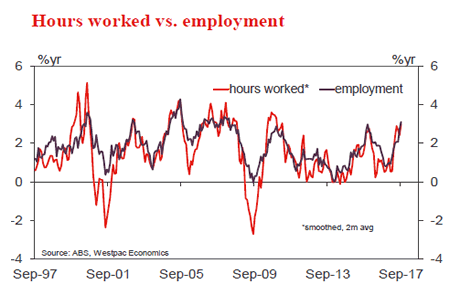
The September labour force release continued to show robust momentum in employment. The 20k headline gain combined with the dip in the unemployment rate to 5.5% was an unquestionably strong update. This is particularly the case given it is the 12th consecutive positive reading for employment - the strongest run of outcomes since 1994. The leading indicators we track for employment suggest that annual employment growth will largely be sustained into year end. However, to our mind the bigger question is the degree of spare capacity that remains in the economy and the industry mix for employment.
On underemployment, the latest data point we have is for August. At 8.6%, it is little changed from a year ago despite 3% jobs growth. On the mix of employment, a piece in the latest edition of Market Outlook highlights that job gains have been heavily concentrated in health, education and construction. With the latter sector to slow, this mix of job creation combined with still significant slack will keep a lid on wage gains and thus on household demand.
New Zealand: Week ahead & Data Wrap
After nearly a month of negotiations, New Zealand finally knows the form of the next Government: New Zealand First will support the Labour Party to form a minority coalition government. The Green Party will support the new government on confidence and supply.
No policy positions have been formally announced yet. However, comments by the various party leaders have highlighted some key areas where we are likely to see changes. These are discussed below.
Policy details so far suggest some downside risk to our GDP forecast for 2018 and upside risk to our GDP forecasts for 2019 and 2020, but this could change as new information comes to light. Labour's planned fiscal stimulus, on its own, could add around 20bps to the RBNZ's longer term forecast for the OCR, although other as yet unannounced policy changes will also have an effect.
Housing, taxation and investment
How the tax treatment of property changes under the new Government is crucial to the outlook - not only for house prices themselves, but also for the economic cycle and the long-run health of the economy.
Labour has said that they plan to convene a tax working group that might recommend some variation on a capital gains tax, land tax or deemed rate of return tax on property excluding the family home. We have long argued that such tax changes would help address some of New Zealand's economic imbalances and housing affordability issues. Such changes could have a material negative affect on house prices, but it is far from certain that the coalition government will go ahead with Labour's plan. The Greens are probably in support, but New Zealand First said before the election that ruling out a capital gains tax would be a bottom line in any coalition negotiation.
Labour has also signalled that it would like to introduce other changes that would affect the attractiveness of residential property as an investment (such as removing property investors' ability to write off losses on rental properties against their personal income). If these measures do survive the coalition negotiations, they might reduce house prices by a little, but the effect would be small.
Labour planned to start an investment fund charged with building 100,000 affordable houses (and the associated infrastructure) over ten years. In our assessment, this would have only a small effect on average house prices, although it would skew the mix of new construction towards smaller/cheaper dwellings. The investment fund would probably cause us to lift our construction forecasts, and therefore our GDP forecasts. But the effect would probably be small in the short run, because in these times of a capacity constrained construction industry some private sector activity will be squeezed out.
The one housing-related policy that has been announced by the Prime Minister elect is a ban on foreign buyers of residential property and tighter restrictions on the sale of rural land. This could have a downward impact on house prices, but based on international experience, the impact is likely to be fairly small.
Closing New Zealand off to foreign direct investment in the farm sector or business sector would be a more worrying development. The OECD has identified that New Zealand's poor productivity performance is partly due to our isolation, and so improving connectivity to larger overseas economies would be of benefit. While lifting exports is part of that, the OECD singled out our restrictive foreign investment regime as a particular impediment to productivity growth. Restricting FDI could isolate New Zealand further.
Migration
Both Labour and NZ First campaigned on reductions in net immigration. Labour estimated that its policies would reduce net immigration by 20,000 to 30,000 people per year, focused on lower skilled arrivals and students. However, net immigration has already turned. Departures have picked up, as those came over in earlier years on temporary visas are now departing. On top of this, new arrivals have fallen. Going forward, we are already forecasting a substantial reduction in net immigration, from over 70,000 now to around 20,000 by the end of 2020. If immigration regulations were tightened, we would reduce our net immigration forecast even further. In turn, this would reduce our GDP forecast.
Fiscal policy
The new coalition looks set to spend more than the previous Government, only partly funded by extra tax. Spending will be weighted towards education and health. It will be partly funded by cancelling the income tax cuts that were legislated to take effect on April 1 and by introducing new taxes. The balance would be funded by an additional $7bn of net core Crown debt over the next four years.
If the coalition sticks roughly to Labour's proposed fiscal policy, the changes would be fairly immaterial for ratings agencies and would not lead to significantly higher government bond rates.
Monetary Policy
Both Labour and New Zealand First campaigned on changing the focus of the Reserve Bank. In particular, New Zealand First had pushed what they termed a "Singaporean" model, requiring the RBNZ to target a favourable level of the exchange rate, rather than the inflation rate. However, in his press conference, Mr Peters said that Labour had not agreed to this model.
Nevertheless, we are likely to see some change in monetary policy on two key fronts. First is a likely broadening of the policy considerations. Labour favours a dual mandate for the Reserve Bank, with a focus on full employment as well as price stability. New Zealand First has long advocated for a greater focus on the export sector. However, in the absence of numerical targets for either unemployment or the exchange rate, requiring the RBNZ to account for these considerations is unlikely to make a significant difference to how monetary policy is run as a whole. The RBNZ already factors in such concerns when it sets policy.
Second, we're likely to see a shift from the single decision maker model to a committee, with Labour proposing a mix of four internal and three external members. Again, this is unlikely to lead to substantially different monetary policy decisions - the RBNZ already operates an internal committee for monetary policy decisions. There has been no mention of raising or widening the existing inflation target range.
Data Previews
Aus Q3 Consumer Price Index
Oct 25 Last: 0.2%, WBC f/c: 0.7%
Mkt f/c: 0.8%, Range: 0.7% to 1.2%
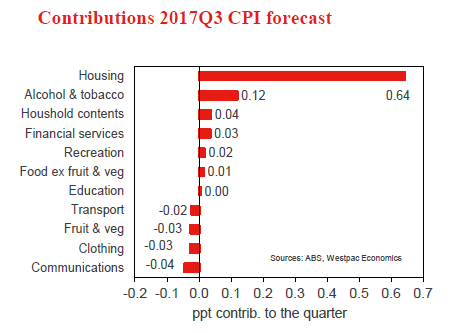
- The Q2 CPI printed 0.2% compared to the market median of 0.5%. The annual rate moderated to 1.9%yr from 2.1%yr in Q1. The core measures rose as expected at 0.5%qtr highlighting just how modest the broader inflation picture is outside of housing or health. The annual pace of the average of the core measures was flat at 1.8%yr.
- Westpac is forecasting a 0.74% Q3 rise in the headline CPI of which, 0.47ppts come from energy. Ex-energy (household electricity and gas) inflation rises 0.27%.
- Core inflation is forecast to print 0.3%qtr (0.29%) holding the annual rate flat at 1.8%yr. The trimmed mean forecast is 0.27% while the weighted median forecast is 0.32%. The two quarter annualised pace of core inflation decelerates to 1.7%yr from 2.1%yr, below the RBA's target band. For more information see the bulletin "Inflation, where art thou?".
Aus Q3 import price index
Oct 26, Last: -0.1%, WBC f/c: -2.0%
Mkt f/c: -1.8%, Range: -3.0% to 0.0%
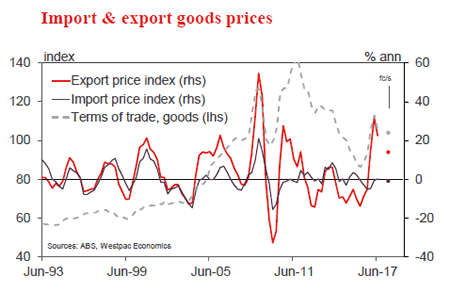
- Import goods prices were little changed over the past year, with a Q2 result of -0.1%qtr, +0.3%yr.
- For the September quarter, goods imports likely became cheaper, declining by a forecast 2.0%qtr, as the currency strengthened.
- In Q3, the Australian dollar increased by 3.0% on a TWI basis and jumped 4¢ to US79¢, a 5% increase. Global energy prices in Q3 fell modestly, in AUD terms, down around 3%.
Aus Q3 export price index
Oct 26, Last: -5.7%, WBC f/c: -3.2%
Mkt f/c: -4.0%, Range: -6.0% to 3.0%
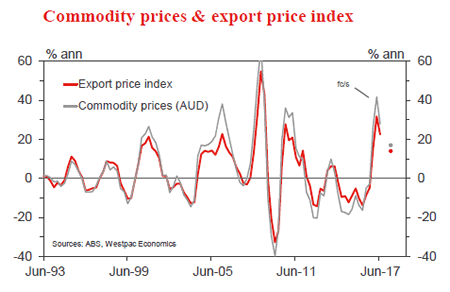
- The sharp rebound in export prices during 2016 and into early 2017 was punctuated by a meaningful fall in the June quarter, as commodity prices eased back from recent highs.
- In Q2, the export goods price index fell by 5.7%, to still be 22.5% above the level of a year earlier.
- For Q3, export goods prices are expected to decline by around 3.2%. The RBA reports that commodity prices were flat in US dollar terms for the period and down around 5% in Aussie dollar terms.
- The terms of trade for goods, on these estimates, fell by a touch over 1% in the third quarter, to be around 11% higher than a year ago. Note, we expect this fall to be partially offset by a rise in the terms of trade for services.
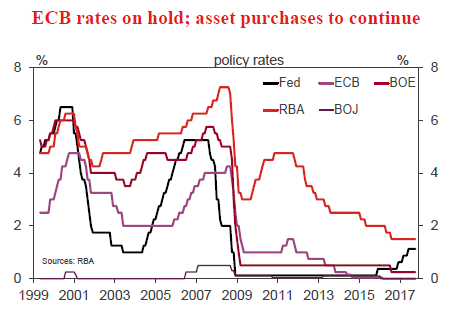
ECB October policy meeting
Oct 26, deposit rate, last -0.40%, WBC -0.40%
- All eyes remain on the ECB Governing Council as they near the end of their current asset purchase program, which is due to expire in December.
- At the October meeting, some formal announcement of an extension of the program for 2018 is anticipated. Whether all the detail is made available remains an open question.
- To our mind, the most logical program structure would be to taper from €60bn to €40bn in the first half of 2018, then to €20bn in the second six months. That would allow a smooth transition to a flat balance sheet come 2019. The alternative would be a circa €30bn pace through the entire year. Either way, some €360bn in additional liquidity would be provided to markets and the economy during 2018. Interest rates will remain unchanged in 2018 and early 2019.
US Q3 GDP
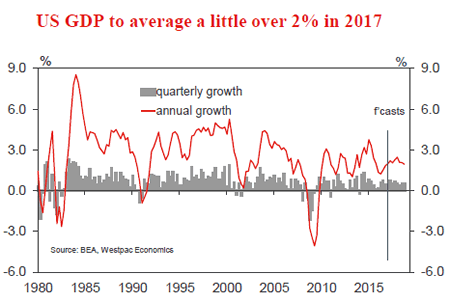
Oct 27, last 3.1%, WBC 2.2%
- The September quarter was a tumultuous time for the US economy, owing to the arrival of Hurricanes Irma and Harvey.
- The largest impact is likely to be seen in household consumption and secondly construction. Consumption growth is expected to be quite modest, while construction's contribution to growth, if any, will be negligible. Recent durables goods data implies equipment spending started the quarter well; so even with the storms, it should provide a solid contribution to growth in the quarter.
- Overall, we look for growth of 2.2% annualised in the quarter, down from 3.1% in Q2. A bounce back towards 3.0% is then anticipated in Q4 as restocking occurs. The posthurricane rebuild will aid growth in 2018, albeit likely only at the margin.
Weekly Focus: ECB, Riksbank and Norges Bank Meetings Coming Up
Market Movers ahead
- In the euro area, we expect the ECB to announce a QE extension by nine months at a pace of EUR30bn. Apart from a scaling down of QE purchases, we do not expect the ECB to make any changes to its forward guidance at the upcoming meeting. For more, see ECB Preview: Ready to scale back QE, 18 October 2017.
- We do not expect changes to the Swedish repo rate forecast when the Riksbank meets.
- In Norway, we expect Norges Bank to stay on hold as it is one of the intermediate meetings without a Monetary Policy Report and a press conference.
- The Chinese 19th Congress of the Communist Party continues and the new Standing Committee (SC) of the Politburo is presented on Wednesday.
- The first estimates of Q3 GDP growth are due out in both the UK and US next week.
Global macro and market themes
- Risk assets are supported by a long list of favourable factors – not least strong profit growth and cautious central banks.
- A moderate slowdown in China will cause some headwind for EM assets but should not derail the global recovery.
- Bond yields and EUR/USD are set to stay range bound in the short term.
Yen Weakens ahead of Japanese Elections; Loonie Falls Sharply as Retail Sales Miss Expectations
As markets head into the weekend, investors during the European session were concentrated on political developments in Spain as well as on Brexit negotiations. Japanese snap elections would be also in focus on Sunday with the yen showing some weakness on Friday. However, the loonie was the worst performer out of majors today after retail sales and inflation figures came in worse than expected.
The dollar index managed to pick up by 0.34% on the day, reaching a two-day high of 93.54 during the session as the Senate's approval of the 2018 budget resolution late on Thursday paved the way for tax cuts and upbeat readings on existing home sales increased investors' confidence in the US economy. The number of existing residential buildings sold the previous month jumped by 0.7%, surprising analysts who expected home sales to contract by 1.0%.
Dollar/yen stretched its uptrend by 0.74% towards a fresh two-week high of 113.41 ahead of snap elections in Japan on Sunday. Latest polls suggest an easy victory for the Japanese Prime Minister, Shinzo Abe, as the opposition party faces internal controversies, while Abe's strong stance on North Korean issues has enhanced public support for his leadership. If he succeeds to maintain his two-third majority and win his party's leadership next year then he will remain on track to lead the country until 2021. Chances for the BOJ chief Haruhiko Kuroda being reappointed for the second term will also rise, pressuring the yen due to Kuroda's ultra-easy monetary policy stance.
Meanwhile, in Spain, the Spanish Prime Minister Mariano Rajoy, has secured support from the opposition Socialists to suspend Catalonia's autonomy on Saturday when ministers will gather to decide on measures to activate Article 155. The plans on the table are said to include regional elections in Catalonia in January, with a government spokesman saying on Friday that "the logical end to this process would be new elections established within the law". However, whether this is part of the plan would be confirmed on Saturday.
The euro breached the 1.18 key-level versus the dollar, edging down by 0.54% to $1.1780.
On the second and final day of the EU summit, conclusions on the state of Brexit negotiations remained in the dark despite EU leaders expressing the willingness to move the talks to the next phase in the coming months. Uncertainty around the UK's financial obligations remained on the horizon as May refused to discuss the exit bill, arguing that the bill "will come as part of the final agreement in relation to the future partnership". Moreover, she reiterated her confidence in the negotiations but she added that "we still have some way to go".
The pound rebounded from a ten-day low touched earlier, gaining 0.26% on the day and rising back to $1.3190.
The kiwi stuck around five-month low levels around $0.6960 due to concerns that the new coalition government led by the Labour party in cooperation with the small New Zealand's First part would impose stricter policies on immigration and foreign investments. Markets were also worried about potential implications on monetary policy.
In Canada, retail sales growth turned negative in September after five consecutive months of expansion, with retail sales declining by 0.3% m/m, while analysts anticipated the figure to rise by 0.1 percentage points to 0.5%. Excluding auto sales and fuel, the core equivalent posted the largest reduction since February 2016, decreasing by 0.7% m/m and missing the forecast of a rise by 0.3%.
In other data, Canadian headline inflation grew in line with expectations by 0.2 percentage points to 1.6% y/y, whereas the core CPI which excludes volatile items fell slightly to 0.8%.
As a response, the loonie fell sharply against the dollar, with dollar/loonie jumping by almost 1% on the day to a 7-week high of 1.2608.
Regarding commodities, oil prices rebounded while gold dipped into losses. WTI crude climbed back to $51.50 (+0.47%) per barrel and Brent recovered to $57.54 (+0.72%). Gold erased earlier gains, sinking to $1,282.20 per ounce.
US: After a Three-Month Losing Streak Existing Home Sales Rise Slightly in September
Existing home sales rose 0.7%m/m to 5.39 million (annualized) in September, following a three-month losing streak. The headline print came in above market expectations which called for a moderate pullback of 0.9%. Despite the monthly advance, activity remained muted on a trend basis with sales down 1.5% from year-ago levels.
The monthly gain was concentrated in the single-family segment where transactions rose to 4.79 million, up 1.1% from 4.74 million in the month prior. Meanwhile, sales in the smaller condo/co-op segment fell 1.6% to 600 thousand.
Regional performances were mixed with activity improving in the West (3.3%) and Midwest (1.6%), holding steady in the Northeast (0.0%), and pulling back for a second consecutive month in the South (-0.9%).
The number of homes available for sale rose 1.6% on the month but remained low by historical standards at a seasonally unadjusted 2.03 million. This is down 6.4% from year-ago levels and accounts for just 4.2 months' worth of supply at the current sales pace, compared to 4.5 at the same time last year. Despite the low inventory, the upward pressure on median home prices continued to moderate, with prices advancing by 4.2% y/y compared to 5.5% in the month prior.
Overall, third quarter existing home sales fell 11.6% q/q (annualized), after declining by 4% in the prior quarter. The last time that activity pulled back for two consecutive quarters was in late 2013 and early 2014.
Key Implications
Today's better-than-expected print is a welcome development, which comes on the heels of an extended losing streak. Existing home sales in September would have likely been somewhat stronger were it not for the hurricane impacts. Activity in the South, which accounts for an outsized 40% of overall sales, fell for a second consecutive month as purchasing decisions and closings were delayed in affected areas.
While volatility could persist in the near-term, we expect to see an improvement in momentum in the final stretch of the year as hurricane impacts fade. A rising trend in mortgage applications in recent weeks suggests that the next report could also see a positive print.
The September report brings the third quarter to a close, with sales activity having pulled back for two consecutive quarters. This trend is somewhat reminiscent of the late-2013 Taper Tantrum experience. Back then, rising mortgage rates were the main force behind the decline, while this time around severe inventory shortages and hurricane impacts are largely responsible.
Ongoing supply shortages will continue to keep a lid on activity, but we expect some improvement in this front as well, albeit very gradually. While moderating, still-robust price growth should help nudge up inventories as existing homeowners continue to warm up to the idea of listing their properties. At the same time, robust demand for homes driven by labor market gains should encourage more homebuilding which will also help ease gridlock in the resale market. The uptick in builder confidence in October provides some evidence in support of this narrative.