

Sample Category Title
Gold Shrugs As Durable Goods Sparkles
Gold is unchanged in the Wednesday session. In North American trade, the spot price for an ounce of gold is $1276.71, up 0.01% on the day. On the release front, US numbers impressed as durable goods orders accelerated in September. Core Durable Goods Orders gained 0.7%, above the estimate of 0.5%. Durable Goods Orders soared 2.2%, crushing the estimate of 1.0%. As well, New Home Sales jumped to 667 thousand, well above the forecast of 555 thousand. On Thursday, the US releases unemployment claims and Pending Home Sales.
Gold prices remain steady this week, after the metal slipped 1.9 percent last week. The sharp drop was in response to solid data last week, as employment, manufacturing and housing data beat their estimates. On Friday, the US releases Advance GDP for the third quarter, and the markets are expecting a strong gain of 2.5 percent. If the GDP reading is not within expectations, we could see some strong movement in gold prices.
Who will take over at the Federal Reserve? The markets are keeping close tabs on the central bank, as Janet Yellen’s 3-year term expires in February. President Trump has said he will nominate a new Fed head in the coming days, and the front runners are economist John Taylor, Federal Reserve Governor Jerome Powell, and Yellen. Taylor advocates a rule in which interest rates could be as high as 3 percent, given current economic conditions. Powell is more closely aligned to Fed Chair Janet Yellen’s monetary stance which advocates an incremental increase in rates. With the two candidates representing sharply differing views on interest rate levels, Trump’s choice for the new Fed chair could have an effect on monetary policy and the strength of the US dollar. Still, most economists are of the view that monetary policy will be largely driven by the performance of the US economy. Inflation levels remain weak and may not reach Fed’s target of 2 percent before 2020, but that has not dampened expectations of a December rate hike. According to CME FedWatch, the odds of a raise in December stand at 96 percent.
The Bank-Of-Can’t Decide
The Bank of Canada put a screeching halt to interest rate hikes Wednesday after two quick hikes in succession. The Canadian dollar was the top performer on the day while the pound surged to lead the way. The ECB decision is up next.
It has been a bizarre year for the Bank of Canada, who is quickly earning a reputation for doing the right thing… only after all the other options are exhausted. Through most of the first half of the year, the BOC was stubbornly dovish, hinting at rate hikes and keep rates low despite months of very strong economic data. Then, days before the July decision, deputy governor Wilkins dropped a hint about a hike.
Despite a weak CPI report afterwards, the BOC surprised markets with a hike. The Bank then hit the mute button and didn't have a single statement or interview until the September meeting when they caught markets largely by surprise with another hike.
Back-to-back hikes are unheard of in the post-crisis era and the message from those actions was that policymakers were worried about inflation. Poloz tried to emphasize data dependence and that cooled expectations for a hike Wednesday but still left the markets expecting something hawkish.
Instead, the BOC delivered a dovish hike saying the Governing Council will be “cautious in making future adjustments”. They cited NAFTA, mortgage rules changes and the Canadian dollar as reasons. None of that will be cleared up by year-end so a 50/50 chance of Dec hike is closer to zero and that's why USD/CAD jumped above 1.28.
At the same time GBP/CAD jumped more than 300 pips as it was also fueled by strong UK GDP numbers and the expectation that Carney will hike UK rates next week. Technically, that pair exploded above the Aug/Sept highs to a test of 1.70. It will likely rise to 1.75 if Carney delivers a hike with a hint of hawkishness.
Before that, the ECB is on deck. Expectations are centered around a taper to 30 billion euros per month of QE from 60 billion starting in December. Many market watchers are also talking about an extension in buying until September but it's highly unlikely that the ECB gives that much clarity. Draghi loves to add a measure of uncertainty and flexibility. Locking himself in with a timeline would be out of character.
The market could interpret the flexibility as dovish and send the euro lower. In addition, the large net-long EUR position could be waiting to 'sell the fact' on a taper announcement. A 3rd euro trade in the Premium Insights will be added ahead of the ECB.
Bank of Canada Leaves Key Rates Unchanged
The euro price was supported by the report on the German business climate index from the Ifo that grew to 116.7, which is 1.5 above the forecasted figure. Investors are in no hurry to open new positions ahead of the statement by ECB President Mario Draghi tomorrow. The upward movement may also be explained by the covering of short positions. On the other side of the ledger, the greenback received support from a number of factors among which are the growth of durable goods orders in the US by 2.2% in September versus the 1.0% forecasted and new home sales increase to 667,000 against the 555,000 anticipated. Hints that the new Fed Chair may be more hawkish than the incumbent, Janet Yellen, have been positive for the US dollar. Another fact that will restrain traders from active actions is the expected release of US GDP data on Friday.
The British pound has shown a sharp rising impulse after the publication of the preliminary report on GDP in the UK for the third quarter which expanded by 0.4% against the 0.3% forecasted. This is giving additional stimulus for an interest rate hike by the Bank of England during the next meeting. Monetary tightening in the UK is highly anticipated due to rising inflation and hawkish statements by the officials of the Bank of England.
The price of the Canadian Dollar experienced an increase in volatility after the release of the decision of the Bank of Canada to leave the interest rate at the 1.00% level. Disappointing retail sales data published in the last week was one of the reasons to hold the rates at the current level.
EUR/USD
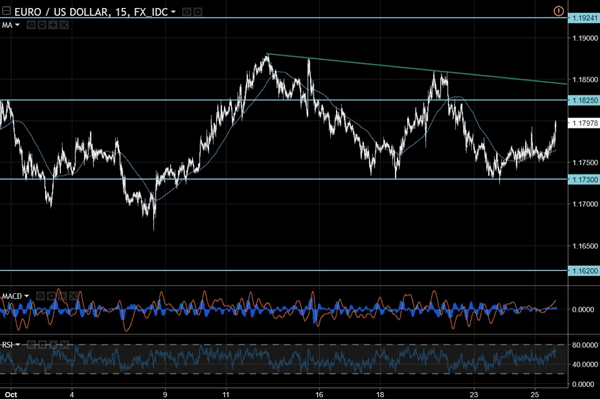
The EUR/USD demonstrates a positive movement after some consolidation above 1.1750. The closest objective within the current impulse is 1.1825 and near the inclined resistance line. On the opposite side, there is a high probability of further price consolidation between the support at 1.1730 and angled resistance line. Volatility is forecasted to increase and stay high until the end of the week.
GBP/USD
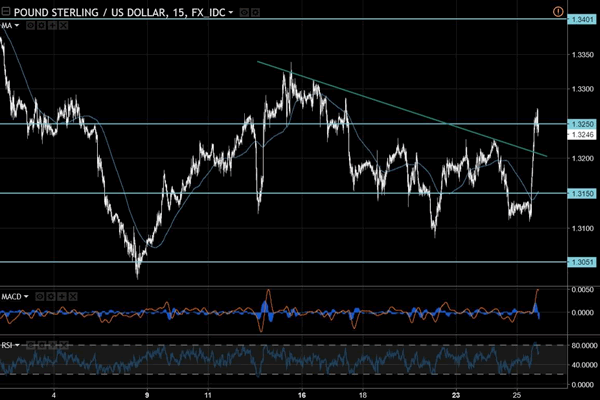
The GBP/USD price has shown a significant rising movement and was able to break through the resistance lines at 1.3150 and 1.3250. Fixing above 1.3250 may become the basis for continued growth with the next targets at 1.3400 and 1.3600. A rollback is possible to 1.3200 and the angled resistance line. The RSI recently touched the oversold zone, which is the basis for a correction soon.
USD/CAD
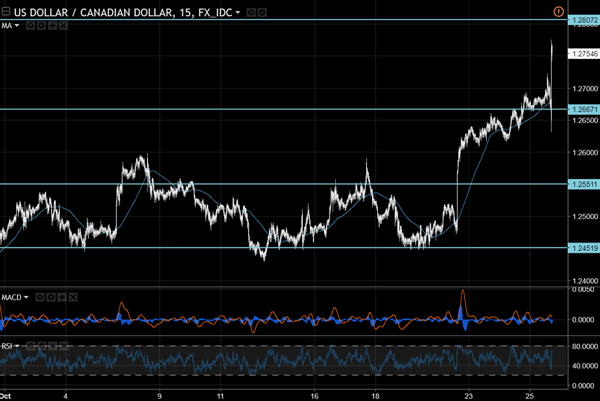
The USD/CAD experienced a high increase of volatility after the publication of the monetary policy statement by the Bank of Canada. The closest objective for growth is at 1.2800 and fixing above it may become the basis for continued growth up to 1.3000. The support is placed at 1.2665 and we do not eliminate a downward price correction after a powerful rising movement.
Pound Jumps as British GDP Beats Estimate
The British pound has posted sharp gains in the Wednesday session. In North American trade, GBP/USD is trading at 1.3295, up 0.95% on the day. On the release front, British Preliminary GDP improved to 0.4%. British High Street Lending and Index of Services both met expectations. US data was sharp, as durable goods orders and housing reports beat the forecasts. Core Durable Goods Orders gained 0.7%, above the estimate of 0.5%. Durable Goods Orders soared 2.2%, crushing the estimate of 1.0%. As well, New Home Sales jumped to 667 thousand, well above the forecast of 555 thousand. On Thursday, the US releases unemployment claims and Pending Home Sales.
British GDP showed the economy expanded 0.4% in the third quarter, its strongest gain since Q4 in 2016. The strong reading has sent the pound sharply higher and raised speculation that the Bank of England will raise rates at its November 2 meeting. Policymakers remain divided over a rate hike, which would be the first in a decade. Proponents of a rate increase point to inflation running at 3.0%, above the Bank's target of 2.0%, but opponents argue that the economy is showing signs of weakness and a rate hike in current conditions would be not be appropriate.
Who will take over at the Federal Reserve? The markets are keeping close tabs on the central bank, as Janet Yellen's 3-year term expires in February. President Trump has said he will nominate a new Fed head in the coming days, and the front runners are economist John Taylor and Federal Reserve Governor Jerome Powell. Taylor advocates a rule in which interest rates could be as high as 3 percent, given current economic conditions. Powell is more closely aligned to Fed Chair Janet Yellen's monetary stance which advocates an incremental increase in rates. With the two candidates representing sharply differing views on interest rate levels, Trump's choice for the new Fed chair could have an effect on monetary policy and the strength of the US dollar. Still, most economists are of the view that monetary policy will be largely driven by the performance of the US economy. Inflation levels remain weak and may not reach Fed's target of 2 percent before 2020, but that has not dampened expectations of a December rate hike. According to CME FedWatch, the odds of a raise in December stand at 96 percent.
Pound Rises on GDP, Hike Speculation; Loonie Declines on BoC Inflation Expectations
The British pound was a notable gainer during today's trading as forex market participants revised upwards their expectations for a quarter percentage point interest rate rise to be delivered by the Bank of England after UK third quarter growth beat expectations. The dollar was gaining ground relative to the loonie, aussie and the kiwi and retreating versus the euro, yen and of course sterling.
At 1542 GMT, the dollar index, which gauges the greenback against the currencies of six major US trading partners, was 0.1% down relative to where it closed yesterday, though not far below the near three-week high that was recorded a couple of days ago. Versus the yen, the dollar was lower by 0.2%, having earlier hit 114.24 yen, its highest since July 11.
Speculation over who's going to be the next Fed chief is mounting (with a Yellen reappointment also a possibility). According to a report by Bloomberg, Trump asked Republican senators at a closed-door lunch on their preference and it was said that Stanford University economist John Taylor emerged as the number-one pick. This has supported the dollar as Taylor is viewed as an inflation hawk, favoring higher interest rates.
September durable goods orders out of the US grew by 2.2% m/m, handily beating expectations of a rise by 1.0%. Core durable goods (which exclude volatile transportation items) over the same month increased by 0.7%, above forecasts of 0.5%. The positive numbers pushed the dollar higher relative to major counterparts including the yen, spurring hopes for a lesser drag on economic activity from the hurricanes that stormed the US in September. The world's largest economy will see the release of Q3 preliminary GDP estimates on Friday.
Later in the day, US September new home sales grew by a whopping 18.9% m/m, reaching a near 10-year high and coming in far above the expected contraction of 0.9% and August's fall of 3.6%. The dollar index advanced within the first minutes of the data release.
According to preliminary estimates, UK GDP grew by 0.4% q/q in the third quarter, above expectations of 0.3% which also coincided with Q2's growth figure. Year-on-year, growth stood at 1.5%, above forecasts of 1.4% and at the same pace as Q2's annual expansion. The stronger-than-anticipated figures pushed sterling higher as expectations that the BoE will hike interest rates upon completion of its meeting on monetary policy on Thursday were on the rise. Pound/dollar was last up 0.8% on the day, having hit an eight-day high of 1.3270 at its peak, with euro/pound being down by 0.4%, recording an eight-day low of 0.8877 earlier in the day.
The Canadian dollar hit a three-month low as dollar/loonie rose to as high as 1.2788 after the Bank of Canada decided to maintain rates at 1.00% upon completion of its policy meeting today. The decision was expected but the central bank's policymakers pushed forward to the second half of 2018 their expectations for inflation to reach the bank's 2% target. Dollar/loonie was last 0.9% up, trading close to the aforementioned high.
Euro/dollar last traded 0.5% up on the day and above the 1.18 handle. The ECB's decision tomorrow on how it will adjust its asset purchase program starting next year is eagerly awaited by market participants. Economists expect a 20-billion-euros-per-month reduction (to 40 billion euros per month). Uncertainty over the program's duration will also clear out tomorrow with reports saying policymakers are split over whether it should last for six or nine months.
The aussie remained significantly down on the day relative to its US counterpart after today's third quarter inflation figures surprised to the downside, scaling back expectations for an interest rate rise to be delivered anytime soon by the RBA. Aussie/dollar was last down 0.9%, having earlier fallen to 0.7696, its lowest since July 13.
Kiwi/dollar remained on a downward path on uncertainty over the economic policies of the new Labour-led government. The pair was 0.3% down, trading near its daily low of 0.6865 which is the lowest the pair has experienced since May 16.
In commodities, gold was 0.05% lower, trading just below $1,275 an ounce. WTI was 0.25% lower at $52.34 per barrel and Brent crude traded 0.4% higher at $58.58. The Energy Information Administration's (EIA) weekly report showed US crude stocks rising by 0.86 million barrels during the previous week. Expectations were for a fall by 2.58 million barrels.
Yen Edges Higher Despite Sharp US Durable Goods Reports
USD/JPY has recorded small losses in the Wednesday session. In North American trade, USD/JPY is trading at 113.78, down 0.18% on the day. On the release front, US data was sharp, as durable goods orders and housing reports beat the forecasts. Core Durable Goods Orders gained 0.7%, above the estimate of 0.5%. Durable Goods Orders soared 2.2%, crushing the estimate of 1.0%. As well, New Home Sales jumped to 667 thousand, well above the forecast of 555 thousand. Later in the day, Japan releases Services Producer Price Index, which is expected to remain unchanged at 0.8%. On Thursday, the US releases unemployment claims and Pending Home Sales, and Japan will publish Tokyo Core CPI.
Japanese Prime Minister Shinzo Abe cruised to victory in the Japanese election on Sunday, and this means 'more of the same' for Japan's ultra-accommodative monetary policy. The Bank of Japan holds a policy meeting next week, and policymakers are expected to maintain its inflation forecasts. At the September meeting, the BoJ stated that it did not expect inflation to reach the Bank's 2.0% target until fiscal year 2020. BoJ Governor Haruhiko Kuroda has long insisted that the bank will not taper its stimulus program until inflation moves higher. Kuroda's 5-year term as governor expires in April 2018, although he remains the top contender for the position.
The guessing game at the Federal Reserve continues, as investors await the next choice for Federal Reserve chair. Janet Yellen's 3-year term expires in February, and President Trump has said he will nominate a new Fed head in the coming days. The front runners are economist John Taylor and Federal Reserve Governor Jerome Powell. Taylor advocates a rule in which rates which be as high as 3 percent, given current economic conditions. Powell is more closely aligned to Fed Chair Janet Yellen's monetary stance which advocates an incremental increase in rates. With the two candidates representing sharply differing views on interest rate levels, Trump's choice for the new Fed chair could have an effect on monetary policy and the strength of the US dollar. Still, most economists are of the view that monetary policy will be largely driven by the performance of the US economy. Inflation levels remain weak and may not reach Fed's target of 2 percent before 2020, but that has not dampened expectations of a December rate hike. According to CME FedWatch, the odds of a raise in December stand at 96 percent.
Trade Idea Wrap-up: USD/CHF – Buy at 0.9840
USD/CHF - 0.9890
Most recent candlesticks pattern : N/A
Trend : Up
Tenkan-Sen level : 0.9913
Kijun-Sen level : 0.9907
Ichimoku cloud top : 0.9862
Ichimoku cloud bottom : 0.9846
Original strategy :
Buy at 0.9840, Target: 0.9940, Stop: 0.9805
Position : -
Target : -
Stop : -
New strategy :
Buy at 0.9840, Target: 0.9940, Stop: 0.9805
Position : -
Target : -
Stop : -
As the greenback has retreated after rising to 0.9940, suggesting consolidation below this level would be seen and pullback to 0.9880, then test of the upper Kumo (now at 0.9862) cannot be ruled out, however, reckon support at 0.9838 would limit downside and bring another rise later, above said resistance at 0.9940 would extend recent rise from 0.9421 low to 0.9970, having said that, overbought condition should limit upside and price should falter well below psychological resistance at 1.0000, bring retreat later.
In view of this, we are looking to buy dollar again on further pullback as said support at 0.9838 should limit downside and bring another rise. A firm break below 0.9830 would defer and risk test of support at 0.9796 but only break of latter level would signal top is formed instead, risk retracement of recent rise to 0.9775-80, however, support at 0.973037 should remain intact.

Trade Idea Wrap-up: GBP/USD – Stand aside
GBP/USD - 1.3247
Most recent candlesticks pattern : N/A
Trend : Near term down
Tenkan-Sen level : 1.3189
Kijun-Sen level : 1.3189
Ichimoku cloud top : 1.3193
Ichimoku cloud bottom : 1.3158
New strategy :
Stand aside
Position : -
Target : -
Stop : -
Despite falling marginally to 1.3110, as cable found decent demand there and has rallied in London session, the subsequent breach of previous resistance at 1.3228 has shifted risk to the upside as this move signals the fall from 1.3338 has ended at 1.3088, hence further gain to resistance at 1.3287 cannot be ruled out, however, break there is needed to provide confirmation, bring a stronger rebound towards 1.3338 resistance.
On the downside, whilst pullback to 1.3228 (previous resistance turned support) cannot be ruled out, recon 1.3190-00 would limit downside and 1.3150 should hold, bring another rebound later. As near term outlook has turned mixed, would not chase this rise here and would be prudent to stand aside for now.

Trade Idea Wrap-up: EUR/USD – Buy at 1.1785
EUR/USD - 1.1815
Most recent candlesticks pattern : N/A
Trend : Sideways
Tenkan-Sen level : 1.1786
Kijun-Sen level : 1.1785
Ichimoku cloud top : 1.1773
Ichimoku cloud bottom : 1.1752
New strategy :
Buy at 1.1785, Target: 1.1885, Stop: 1.1750
Position : -
Target : -
Stop : -
As euro’s intra-day rise has gathered momentum, suggesting low has been formed at 1.1725 and the rebound from there may extend further gain to resistance at 1.1858, break there would signal the fall from 1.1880 has ended and another leg of corrective rise from 1.1669 low is underway for retest of this level, then towards 1.1900 but reckon 1.1930-35 (61.8% Fibonacci retracement of 1.2093-1.1669) would hold, bring retreat later.
In view of this, we are looking to buy euro on pullback as 1.1780-85 should limit downside. Below 1.1750 would risk another test of said support at 1.1725 but only break there would revive bearishness for weakness to 1.1700, however, still reckon said recent low at 1.1669 would hold from here.

BoC: Poloz Hits Pause and Takes Stock
As widely expected, the Bank of Canada held its key monetary policy interest rate at 1.00% this morning.
In the accompanying Monetary Policy Report, the outlook for growth was upgraded somewhat. The Bank now expects growth of 3.1% this year, reflecting the robust growth seen over the first half of the year. Growth of 2.1% is anticipated for 2018 (July: 2.0%), and 1.5% in 2019 (July: 1.6%).
Of note, despite hints at a possible upgrade to estimated economic potential, the Bank left this unchanged overall, bumping up the level by about 0.1 percentage points. As a result, the output gap is seen as being effectively zero, meaning that the economy is running at capacity.
Despite the closure of the output gap, the Bank sees signs of remaining slack in labour markets, suggesting that there may be "room for more economic growth than the Bank is projecting without inflation rising materially above target"
The Bank views recent inflation numbers as in line with its expectations. A number of factors continue to hold back inflation in the near term, offset somewhat by hurricane impacts on gas prices. With core measures drifting higher, consistent with the absorption of economic slack, the Bank see inflation hitting its target in late 2018, and remaining at that pace thereafter.
The Monetary Policy Report again provided an assessment of the risks to the outlook. Front and center was the potential for protectionist trade policies, germane in light of recent weak trade numbers and the heating up of the NAFTA renegotiation process. Second on the list was weaker inflation, revised somewhat to focus on the risk of structural factors in holding back price growth. It was not all downside risks however, as stronger U.S. growth remains a potential positive risk for the Canadian economy.
Key Implications
After the excitement of the summer, Governor Poloz engaged in something of a stock-taking exercise, with today's Monetary Policy Report providing important insight into his thinking in the wake of this summer's back to back rate hikes. As things stand today, it appears that the urgency to increase rates has faded. Indeed, consistent with recent communication, today's statement has a somewhat dovish tilt to it.
A few examples of this tilt are likely worth exploring. High debt levels were again seen as an important factor, implying a higher sensitivity to rates relative to the past. As well, the discussion of the output gap, where closure would normally be taken as an inflationary development, was joined by discussion of perceived labour market softness, suggesting some wiggle room around future price pressures should growth come in stronger than expected. Finally, monetary conditions have become less stimulative as the Canadian dollar has risen, and recent changes to mortgage underwriting guidelines are seen as moderating growth in coming years.
Indeed, it appears that for the Bank of Canada, the economy is in something of a sweet spot: with the output gap closed and growth expected to remain near its longer-term trend, inflationary pressures are likely to remain modest. As a result, there does not appear to be any immediate urgency to further increase interest rates, although this 'sweet spot' also clearly implies that the current low level of rates will become increasingly unneeded.
Note that the Bank of Canada Governor and Senior Deputy Governor will speak at a press conference at 11:15AM EST.