Sample Category Title
Dollar Accelerates after Yellen Comments and Durable Goods
Yesterday the US dollar traded higher against the euro as the German election results continued to shake trader sentiment. A weaker than expected performance of Angela Merkel's conservative party suggests that Europe could face political turbulence in the future. Over the last two days the euro fell 1.4% against the US dollar.
On Tuesday, economic data showed the impact of hurricanes Irma and Harvey. According to the US state commerce department, new house sales declined 3.4% in August, which is the lowest level since December 2016. Consumer confidence also slipped to 119.8 in September as compared to 120.4 in August.
Recent data released today showed that the demand for US factory goods rebounded in August which is pointing to a continued increase in business investment. Orders of durable goods increased 1.7% in August versus the 1.0% expected and as compared to -6.8% in the previous month. Core durable goods orders rose 0.2% as expected.
Demand for the US dollar also increased and strengthened after comments from Janet Yellen. The Chair of the Federal Reserve said in her recent speech that the central bank has to increase the interest rate gradually as it would be unwise to put the monetary policy on hold until inflation is back to 2.0%. She also said that there would be the risk that the labor market could be overheated without further increases in the interest rate over time, which is expected to create inflationary problems that might be difficult to overcome without triggering a recession.
Many investors are looking for any update on a US tax plan that could revamp the stock market. Republicans are expected to release a blue print for tax reform later today that is expected to include a wide range of tax cuts for individuals and businesses, according to speculations. Any signals regarding the tax cut could accelerates the increase in small cap company's share prices, which tend to gain more benefit from tax reductions and generate more revenue domestically.
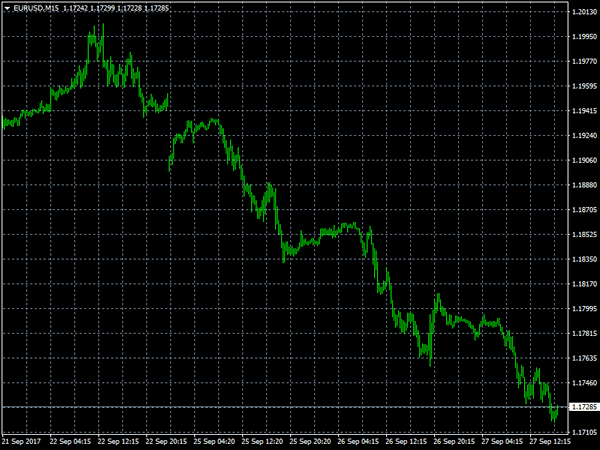
EURUSD
EURUSD is under pressure as it has been capped by a bearish trend line since September 22. Yesterday's high at 1.18609 is playing a resistance role. The relative strength index lacks upward momentum. As long as 1.18609 (yesterday's high) is resistance, look for a new decline towards 1.16616 (last month's low) and 1.1620. Alternatively, above 1.18609 look for 1.19360 (this week's high) and 1.20306 (last week's high).
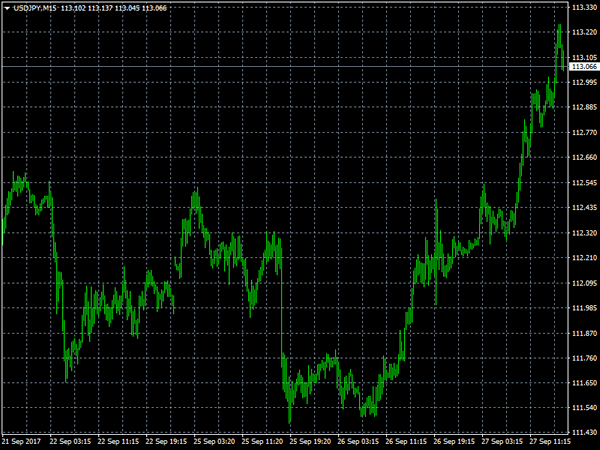
USDJPY
USDJPY is expected to continue to trade its upside movement. The dollar is supported by the recent increase in durable goods order and yesterday's comments from Ms. Yellen. Technically the pair is trading above the 50 day moving average and 20 day moving average, which confirms the bullish outlook. the relative strength index is also above its neutrality area at 50 and lacks downward momentum. As long as the pair is trading above 112.16 (today's low) look for further advancement to 112.50 and 112.80. Alternatively, below 112.16 look for 111.50 (yesterday's low) and 111.00.
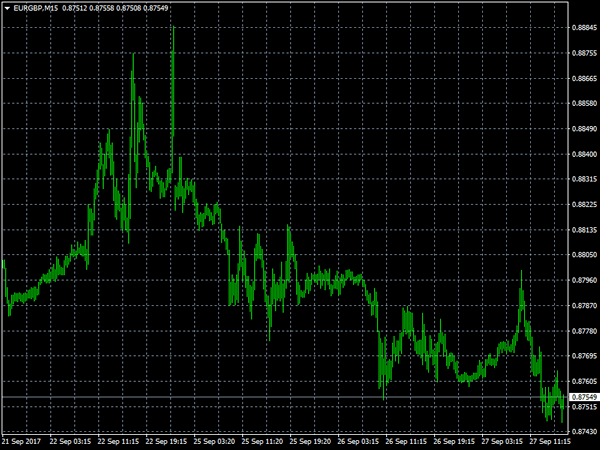
EURGBP
EURGBP is capped by the declining trend line. The 50 day moving average is also in decline, which suggests a break below today's high is highly possible. As long as the pair is trading below 0.8800 (yesterday's high) bearish acceleration towards 0.8730 and 0.8675 is likely. Alternatively, above 0.8800 (yesterday's high) look for 0. 8830 and 0.8898 (last week's high).
Yen Drops to 10-Week Low as US Durable Goods Shine
USD/JPY has posted gains on Wednesday, continuing the upward movement we saw on Tuesday. In North American trade, the pair is trading at 112.81, up 0.54% on the day. On the release front, BoJ Governor Haruhiko Kuroda will speak at a conference in Tokyo. In the US, Durable Good Orders sparkled with a 1.7% gain, well above the estimate of 1.0%. Core Durable Goods slowed to 0.2%, matching the estimate. Pending Home Sales was unexpectedly soft, posting a decline of 2.5%, compared to an estimate of -0.5%. On Thursday, the US will publish Final GDP and unemployment claims.
The BoJ is stubbornly sticking with its ultra-accommodative policy, and this was reiterated in the minutes of the Bank's August policy meeting. Most policymakers remained in favor of continuing present policy, and expressed optimism that inflation levels would move higher. Is there a real basis to this positive sentiment. Inflation remains well short of the BoJ target of just below 2 percent, and in its most recent forecast, the BoJ said that this target would not be met until 2020. Still, the BoJ has so far rejected calls to lower its inflation target, so it's unlikely that the Bank will taper its radical stimulus program anytime soon.
For some time, the markets have been looking for guidance from Fed Chair Janet Yellen regarding interest rate policy. Yellen did not disappoint, as she sent out a surprisingly hawkish message on Tuesday, strengthening the US dollar. Yellen said that she favored gradual rate increases, and voiced confidence that inflation levels would move higher. She added that if the Federal Reserve did not continue to raise rates, the red-hot labor market could become overheated, potentially causing a recession. At the same time, her Fed colleagues remain split on a December rate hike. On Monday, New York Fed President William Dudley made a strong case to raise rates. Dudley cited a soft US dollar and strong global growth as reasons why inflation would increase and also translate into stronger wage growth. Dudley said he expects inflation to reach the Fed's target of 2 percent in the "medium term", and predicted that the Fed would continue to gradually remove monetary accommodation. However, Chicago Fed President Charles Evans sent out a very different message, calling on the Fed to avoid another rate hike until wage and inflation levels moved higher. Evans said that inflation, which is running at around 1.4%, is too low, and wants to see "clear signs" that prices are moving higher before the Fed presses the rate trigger. For their part, the markets are more confident in a December move – the CME Group has pegged the odds of a December raise at 81%, while the odds were mired below 50% just a few weeks ago.
EUR/USD On The Way Down
The currency pair drops like a rock and seems unstoppable on the short term. Price has managed to take out two, very important dynamic support levels and now is targeting another downside obstacle. The dollar has taken the lead on the short term and drives the pair towards new lows. The current drop is natural after the amazing upside movement and after the failure to make new highs and to close above the 1.2041 major horizontal resistance.
The USDX climbed as much as 93.51 level today and will climb much higher in the upcoming hours if the United States data will come in line with expectations or better. Only another disappointment will send the rate down again on the short term.
The Core Durable Goods Orders and the Durable Goods Orders are expected to increase by 0.2%, respectively by 1.0% in August. Moreover, the Pending Home Sales could drop by 0.5%, less versus the 0.8% drop in the former reading period.
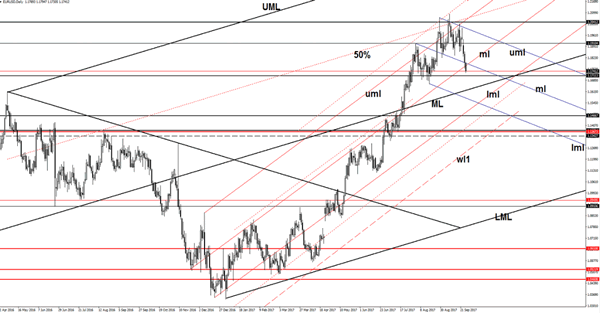
Price is into a corrective phase on the daily chart after the failure to stabilize above the upper median line (uml) of the ascending pitchfork and above the 50% Fibonacci line of the major black ascending pitchfork. EUR/USD has managed to drop below the median line (ml) of the ascending pitchfork and much below the median line (ml) of the descending pitchfork. The next downside target will be at the 1.1711 level, but the next major downside target will be at the median line (ML) of the major black ascending pitchfork.
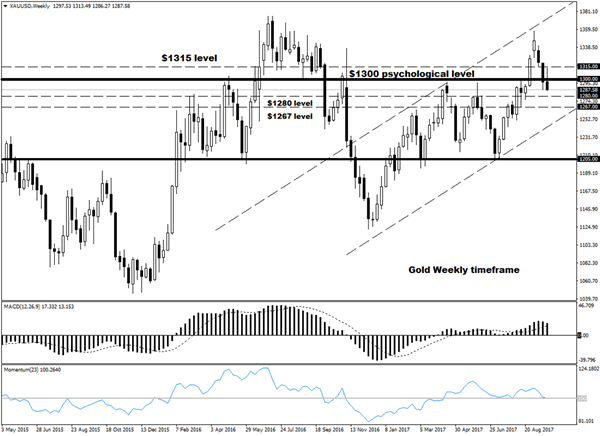
Gold Throwback?
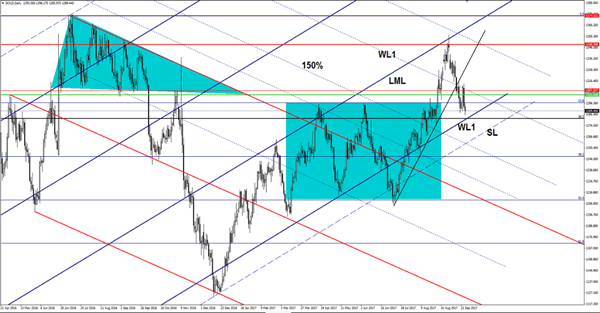
Price drops further and reached new lows. It could slip much lower if will manage to close below the 1288.12 previous low. Gold is expected to touch the confluence area formed between the 38.2% retracement level with the first warning line (WL1) of the ascending pitchfork. A valid breakdown through the mentioned confluence area will accelerate the sell-off, while a rejection or a failure to reach it will send the rate higher again.
NZD/USD RBNZ In Focus
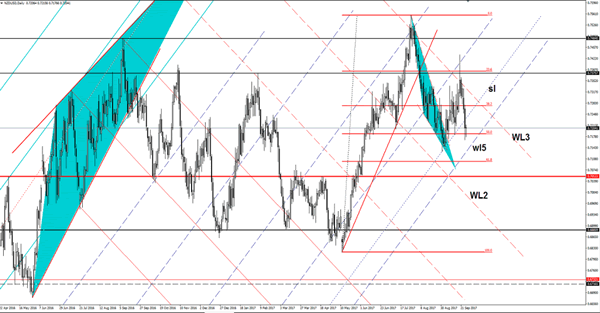
Price dropped today, but failed to reach the 0.7167 yesterday's low, signaling that the bulls can step in again on the short term. NZD/USD failed to stay under the 50% retracement level, announcing a minor increase in the upcoming days. However, remains to see how will react tonight after the RBNZ Rate Statement.
Trade Idea: EUR/GBP – Sell at 0.8890 or buy at 0.8670
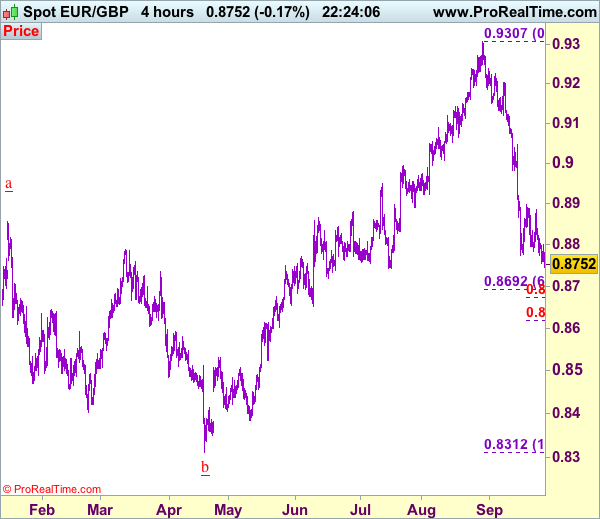
EUR/GBP - 0.8755
New strategy :
Sell at 0.8890, Target: 0.8740, Stop: 0.8930
O.C.O.
Buy at 0.8670, Target: 0.8820, Stop: 0.8610
Position : -
Target : -
Stop : -
Although the single currency has remained under pressure after breaking below support at 0.8774 and near term bearishness remains for the selloff from 0.9307 top to extend weakness to 0.8690-95 (61.8% Fibonacci retracement of 0.8312-0.9307), loss of downward momentum should prevent sharp fall below 0.8670-75 (50% projection of 0.9226-0.8774 measuring form 0.8899) and bring rebound later. Above 0.8815-20 would bring recovery to 0.8850, however, resistance at 0.8899 should cap upside and bring another decline later.
In view of this, whilst we are looking to sell euro on recovery, we are inclined to turn long on subsequent decline as 0.8670-75 should limit downside. Below 0.8640-50 would risk weakness to 0.8600-10 but sharp fall below there should not be repeated and risk remains for another rebound to take place soon.
Our preferred count is that, after forming a major top at 0.9805 (wave V), (A)-(B)-(C) correction is unfolding with (A) leg ended at 0.8400 (A: 0.8637, B: 0.9491 and 5-waver C ended at 0.8400. Wave (B) has ended at 0.9413 and impulsive wave (C) has either ended at 0.8067 or may extend one more fall to 0.8000 before prospect of another rally. Current breach of indicated resistance at 0.9043 confirms our view that the (C) leg has ended and bring stronger rebound towards 0.9150/54, then towards 0.9240/50.
Trade Idea: USD/CAD – Hold long entered at 1.2285
USD/CAD - 1.2372
Trend: Down
Original strategy :
Bought at 1.2285, Target: 1.2450, Stop: 1.2300
Position: - Long at 1.2285
Target: - 1.2450
Stop: - 1.2300
New strategy :
Hold long entered at 1.2285, Target: 1.2450, Stop: 1.2300
Position: - Long at 1.2285
Target: - 1.2450
Stop:- 1.2300
As the greenback has maintained a firm undertone after breaking above previous resistance at 1.2391, retaining our bullishness for the erratic rise from 1.2061 low to bring retracement of recent decline, hence mild upside bias remains for this move to extend gain to resistance at 1.2425-30, then 1.2450, however, near term overbought condition should limit upside and reckon 1.2500 would hold from here, bring retreat later.
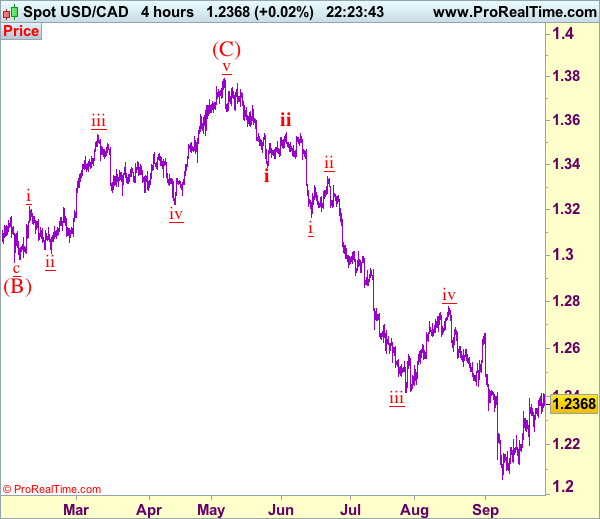
In view of this, we are holding on to our long position entered at 1.2285. Below indicated support at 1.2313 would defer and risk weakness to 1.2254 support (Friday’s low) but only break of latter level would dampen our near term bullishness and signal top is possibly formed, bring test of indicated support at 1.2197, below this level would confirm and bring weakness to 1.2160-65, then towards support at 1.2121, break there would confirm the rebound from 1.2061 has ended and bring retest of this level later, We are keeping our count that wave v as well as wave (C) ended at 1.3794 and impulsive wave (i ii, i ii) is now unfolding with minor wave iii ended at 1.2414, followed by wave iv correction ended at 1.2778, wave v has reached our indicated downside target at 1.2100 and may extend to 1.2000.
To recap, wave B from 1.3066 is unfolding as an a-b-c and is sub-divided as a: 1.2192, b: 1.2716 and wave c is a 5-waver with i: 1.1983, ii: 1.2506, extended wave iii with minor iii at 1.0206, wave iv ended at 1.0781 and wave v as well as wave iii has ended at 0.9931, hence the subsequent choppy trading is the wave iv which is unfolding as (a)-(b)-(c) with (a) leg of iv ended at 1.0854, followed by (b) leg at 1.0108 and (c) leg as well as the wave iv ended at 1.0674. The wave v is sub-divided by minor wave (i): 0.9980, (ii): 1.0374, (iii): 0.9446, (iv): 0.9913 and (v) as well as v has possibly ended at 0.9407, therefore, consolidation with upside bias is seen for major correction, indicated target at 1.3700 and 1.4000 had been met and further gain to 1.4700 would be seen later.
USD Profits as Reflation Trade Resumes
- European equities gain around 0.5% today despite a surge in yields. US equities open with gains between 0.3% and 0.6% as investors look forward to the Trump tax cut plan.
- Growth in the amount of money circulating in the EMU, which is seen as a precursor of inflation, surged last month to 5% Y/Y, while bank lending was little changed. Growth in corporate lending picked up to 2.5% Y/Y in August from 2.4% Y/Y a month ago, moving sideways for much of this year, while household lending held steady at 2.7%.
- US orders for business equipment increased more than forecast in August (1.7% M/M), indicating solid demand is continuing in the third quarter. Shipments of non-military capital goods orders excluding aircraft, which are used to calculate GDP, increased 0.7% M/M (est. 0.1% M/M rise) after a revised 1.1% M/M advance in July.
- The Czech National Bank kept its policy rate unchanged at 0.25% today, but policy makers in Prague indicated that the vote was 4-3 with three governors in favour of an immediate increase to 0.50%. A November rate hike is now nearly certain. EUR/CZK attempts to move below 26.00, but the test fails for now.
- US president Trump is expected to announce in a speech today that American corporations would see their tax rate cut below many of their counterparts elsewhere, under a sweeping White House and Congressional plan that aims to slash the corporate tax from 35% to 20%.
- German Finance Minister Wolfgang Schaeuble is ready to give up his post and become president of Germany's parliament, ending his eight-year term as the euro area's dominant finance chief, a party official said.
Rates
Trump's expected tax reforms revive reflation trade
Global core bonds lost significant ground while the dollar excelled on FX markets. US President Trump is expected to announce his tax reform plan later today which includes slashing the corporate tax rate from 35% to 20%. It revived investor's reflationary spirits with global central banks, the Fed in particular, clearly drawing the card of policy normalization. Strong eco data on both sides of the Atlantic (EMU M3 money supply data and US durable goods orders) supported the reflation trade. US and German yield curves bear steepened. Changes on the US yield curve ranged between +4.3 bps (2-yr) and +7.6 bps (10-yr). The US 2-yr yield approaches 1.5% for the first time since the end of 2008. German yields increase by 3 bps (2-yr) to 7.6 bps (30-yr). On intra-EMU bond markets, 10-yr yield spread changes versus Germany narrow 4/5 bps for Portugal, Spain and Italy. Greece (+6 bps) underperforms.
The US Treasury continues its refinancing tonight with $13B 2-yr FRN auction and $34B 5-yr Note auctions. The WI of the latter currently trades around 1.915%.
Currencies
USD profits as reflation trade resumes
European investors kick-started quite an impressive new leg in the reflation trade today. Yellen's confirmation of the Fed's intention to normalize policy, the prospect of/hope for a US tax proposal and good eco data all added to the overall positive sentiment. The dollar was the main beneficiary among the major currencies, even as US and EMU yields rose more or less in lockstep. The break of EUR/USD below 1.1823 is confirmed. The pair trades currently in the 1.1725 area. USD/JPY regained the 113 big figure.
There was no clear trend on Asian markets this morning. Japanese equities struggled to build out gains even as USD/JPY remained well bid. The pair traded in the mid 112 area. Chinese equities outperformed. Industrial profits rose from 16.5% to 24.0% Y/Y. Brent oil held just below $59/barrel after a modest correction yesterday. EUR/USD traded in the 1.1775 area, marginally lower from yesterday's close. The dollar maintained yesterday's gains.
Contrary to rather directionless trading in Asia, European investors saw enough good reasons to kick-start some kind of new reflation trade. Yesterday's comments from Fed's Yellen finally caused investors to raise the probability of a December rate hike. The Trump administration laying the groundwork for a new tax reduction plan also supported the reflation trade. European equities jumped higher and core US and European yields rose further. The interest rate differential between the US and Europe rose only marginally at best. Even so, the dollar was the major beneficiary of this risk-on market repositioning. EUR/USD traded with a downward intraday bias and changed hands in the 1.1750 area around noon. USD/JPY neared the 113 big figure.
US investors simply build on the trends for Europe. US durable goods orders were strong and reinforced the USD rebound. EUR/USD trades currently in the 1.1720 area. USD/JPY regained the 113 barrier, currently changing hands in the 113.25 area.
Last week it took some time for investors to become convinced that there is a good change for the Fed to continue a gradual policy normalisation. However, sentiment has finally changed. Recent event risk that blocked the reflation trade and the rebound of the dollar is not yet definitively out of the way. Even so, the technical picture of the dollar has improved in a significant way.
Sterling holds strong even as rebound slows
This morning, it looked that the recent sterling short-squeeze could lose further momentum. The rise of the dollar this time also caused a sharp decline in cable. In this move, EUR/GBP was pushed back up to the high 0.87 area. The ongoing stalemate in the new round of Brexit negotiations also caused some sterling profit taking. However, the move was short-lived. EUR/GBP gradually traded again more in line with the overall decline of EUR/USD. At noon, sterling received additional support from the CBI retail data. Reported sales beat the consensus by an astonishing wide margin (42 from -10, 8 expected). The report has often little impact on trading, but this time it couldn't be ignored. EUR/GBP dropped to the 0.8755 area and trades currently around 0.8760. Cable traded with a negative bias for most of the day on overall dollar strength. Even so, the damage for GBP/USD remains modest. The pair trades currently in the 1.34 area.
EURJPY Rebounds after Sharp Drop but Downside Risk Remains
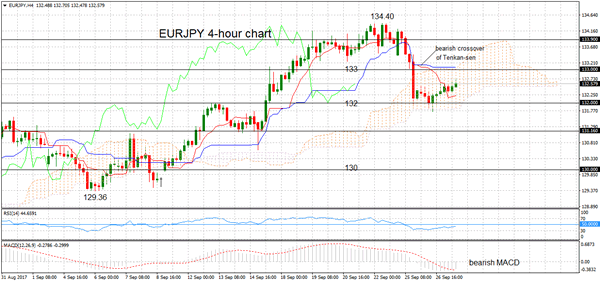
EURJPY paused the downtrend from 134.40 and is making a recovery after a brief dip below 132. Immediate downside pressure has eased but the pair is still at risk for further downside as prices are still within the Ichimoku cloud on the 4-hour chart.
With RSI turning back up, there is room for more upside ahead of round figure resistance at 133. This is close to the top of the cloud and also where the Kijun-sen line currently lies. But only a move above 133.90 would indicate that downside pressure has ended. From this level, EURJPY would re-test the 134.40 peak and then resume the uptrend that started from 129.36 with scope to reach the 135-handle.
If support at 133 fails to hold, then prices would target 131.60 (previous support from early September). Below this, the market would see more weakness and consequently the key psychological level at 130 comes into view as further support ahead of the 129.36 low.
It remains to be seen whether the market is carving out a lower top right now and if the current bounce off 132 is just a corrective move of what could be the start of a new downtrend from 134.40. The odds of another leg lower are still high since short-term momentum oscillators are in bearish territory (both RSI and MACD) and there was a bearish cross of the Tenkan-sen line below the Kijun-sen line on the 4-hour chart.
Greenback Higher ahead of Trump’s Tax Speech
The Dollar made its presence known across the currency markets on Tuesday, after hawkish comments from Federal Reserve Chairwoman Janet Yellen, bolstered expectations of another US rate hike in 2017.
Investors who were anticipating higher US interest rates, cheered after Yellen stated it would be "imprudent" to keep monetary policy on hold until inflation is back to 2%. Yellen also said that she thinks depressed inflation, witnessed in the States this year, is "probably temporary and will likely reach the central bank's golden 2% target over the next few years". With hawkish statements from various Fed policy-makers giving the thumbs up to higher US rates, the Greenback has regained some of its mojo. Dollar bulls are making an appearance, and with the Fed fund futures showing an 83% probability that they will raise rates in December, a further upside is on the cards.
It is remarkable how swiftly the Greenback has returned to favour this week, but it underscores how sensitive the currency has become to monetary policy speculation.
From a technical standpoint, the Dollar Index bounced back to life on the daily timeframe, with bulls steamrolling through the 93.00 resistance level on Wednesday. A breakout above 93.50 may open the gates to 94.00.
Trump's tax plan back in focus
A sense of anticipation can be felt across the financial markets ahead of President Trump's tax proposal in Indiana later today. Although some information has been leaked that corporate tax may be lowered to 20% from 35%, market players are still likely to closely scrutinise the speech for further details on tax reforms. If legislation is passed this year, this should boost sentiment towards the US economy and support the Dollar further.
Currency spotlight - EURUSD
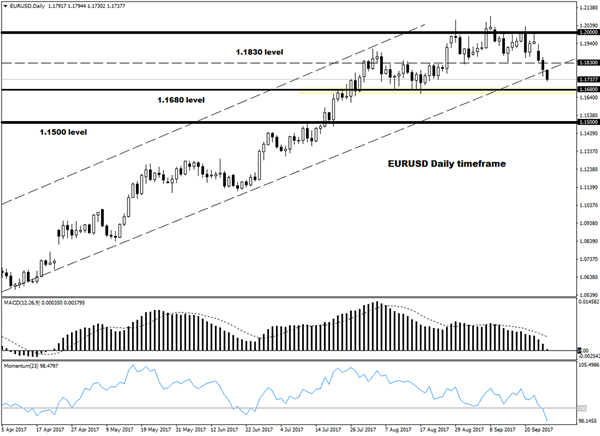
The mighty Euro extended losses against the Greenback during Wednesday's trading session, as sellers exploited the political uncertainty in Europe and the dollar staged a comeback. With the Dollar roaring back to life amid rising rate hike expectations and political uncertainty in Europe pressuring the Euro, could the EURUSD bears make a return in Q4? Prices are currently trading below 1.1750 as of writing, with the downside momentum likely to encourage sellers to target the 1.1680 support.
From a technical standpoint, the bullish trend on the daily charts was invalidated when prices breached and closed below the 1.18320 higher low. Sustained weakness under 1.1680 should open a path towards 1.1500.
Commodity spotlight - Gold
Sellers were given the green light to send Gold prices lower on Tuesday, following Yellen's hawkish comments at Cleveland. With expectations mounting over the Federal Reserve raising US interest rates in December, Gold, which is zero-yielding, is likely to come under renewed selling pressure. Bears remain in control below $1300, with further downside expected as the Dollar continues to appreciate. From a technical standpoint, the yellow metal is coming under increasing selling pressure on the daily and weekly charts. Previous support at $1300 may transform into a dynamic resistance level, and may encourage a decline towards $1280.