Sample Category Title
Trade Idea: USD/CAD – Hold short entered at 1.2240
USD/CAD - 1.2185
Trend: Down
Original strategy :
Sold at 1.2240, Target: 1.2080, Stop: 1.2300
Position: - Short at 1.2240
Target: - 1.2080
Stop: - 1.2300
New strategy :
Hold short entered at 1.2240, Target: 1.2080, Stop: 1.2240
Position: - Short at 1.2240
Target: - 1.2080
Stop:- 1.2240
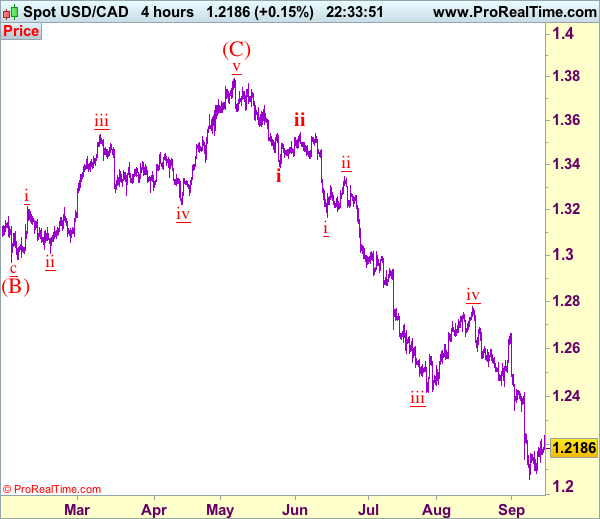
Although the greenback has rebounded in NY morning, reckon upside would be limited and bearishness remains for recent decline to resume after consolidation, below 1.2130 would signal the rebound from 1.2061 has ended, bring retest of this level later, below there would confirm recent decline has resumed and extend weakness towards psychological support at 1.2000 but loss of downward momentum should prevent sharp fall below 1.1950-60, bring rebound later. We are keeping our count that wave v as well as wave (C) ended at 1.3794 and impulsive wave (i ii, i ii) is now unfolding with minor wave iii ended at 1.2414, followed by wave iv correction ended at 1.2778, wave v has reached our indicated downside target at 1.2100 and may extend to 1.2000.
In view o this, we are holding on to our short position entered at 1.2240. Above 1.2240-50 would risk rebound to 1.2300 but only break there would defer and signal a temporary low has been formed, bring a stronger rebound to 1.2335-40, however, upside should be limited to resistance at 1.2429 and price should falter well below 1.2490-00.
To recap, wave B from 1.3066 is unfolding as an a-b-c and is sub-divided as a: 1.2192, b: 1.2716 and wave c is a 5-waver with i: 1.1983, ii: 1.2506, extended wave iii with minor iii at 1.0206, wave iv ended at 1.0781 and wave v as well as wave iii has ended at 0.9931, hence the subsequent choppy trading is the wave iv which is unfolding as (a)-(b)-(c) with (a) leg of iv ended at 1.0854, followed by (b) leg at 1.0108 and (c) leg as well as the wave iv ended at 1.0674. The wave v is sub-divided by minor wave (i): 0.9980, (ii): 1.0374, (iii): 0.9446, (iv): 0.9913 and (v) as well as v has possibly ended at 0.9407, therefore, consolidation with upside bias is seen for major correction, indicated target at 1.3700 and 1.4000 had been met and further gain to 1.4700 would be seen later.
Elliott Wave Analysis: GBPJPY and GBPUSD
Good day traders! Let's take a good look at GBPUSD and GBPJPY, and how they both look similar.
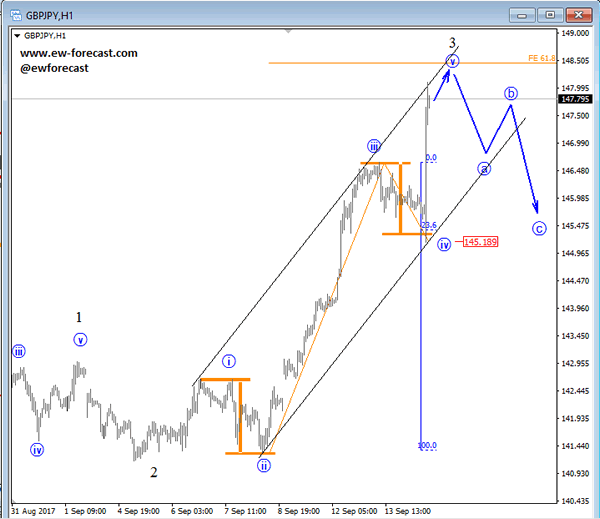
GBPJPY made a new push higher, now a sharp leg into sub-wave v of 3 that can search for resistance near the Fibonacci ratio of 61.8 and near the upper channel line. Once wave 3 finds resistance, a new three-wave temporary correction may come in play, with potential support coming in at 145.19 level.
GBPJPY, 1H
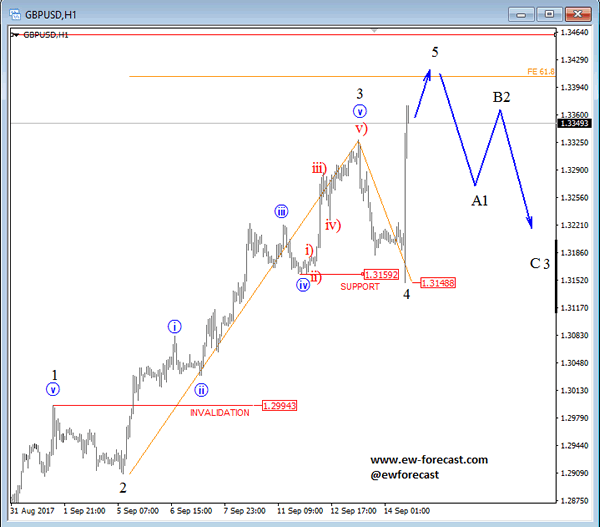
GBPUSD also made a new sharp and strong leg higher, away from the 1.3150 region. We see this bounce as final wave 5, that can search for resistance near the Fibonacci ratio of 61.8. From there a new three-wave drop can come in play.
GBPUSD, 1H
Bank of England Review: November Hike is Now a Close Call
Bank of England sends hawkish signal to markets
As expected, the Bank of England (BoE) maintained the Bank Rate at 0.25% and kept the targets for the government bond purchases and corporate bond purchases at GBP435bn and GBP10bn, respectively. In line with our call, the vote count for the Bank Rate was 7-2, but we were caught by surprise by the warning of a possible forthcoming rate hike 'over coming months' if underlying inflation moves higher and the unemployment rate moves lower.
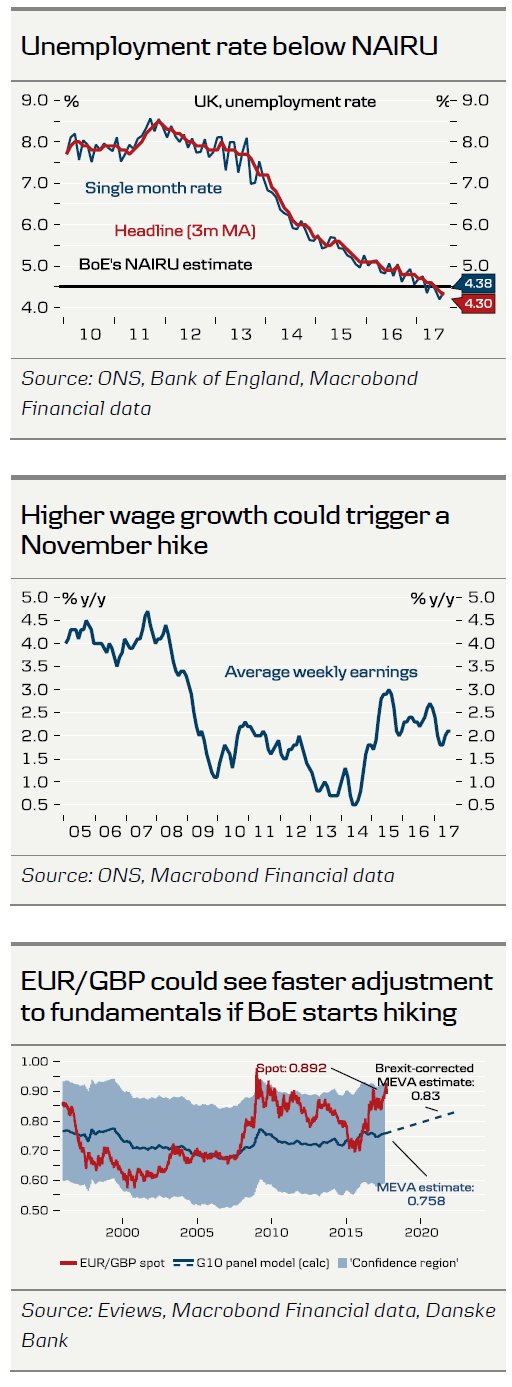
The tightening bias challenges our view that BoE will stay on hold through Brexit negotiations due to high political uncertainty and slower growth. The policymakers have become more concerned about the combination of unemployment below NAIRU and inflation above the 2% target. CPI inflation surprised on the upside in August, as it rose to 2.9% and the unemployment rate dropped to 4.3%, the lowest rate since 1975. While BoE expects growth to remain around 0.3% q/q in the short term, it now expects CPI inflation to rise above 3% in October and the unemployment rate to decline further.
As BoE usually acts on the big meetings, the question is now whether it will hike at the next meeting in November or not. We think a hike in November is a close call but given that one condition is 'a gradual rise in underlying inflationary pressure', which we interpret as higher wage growth, we still think BoE will stay on hold this year. The incoming labour market and inflation data until the November meeting are going to be very important for BoE's decision. That said, BoE has consistently overestimated wage growth in recent years and one important assumption in the projections in the August Inflation Report was higher wage growth. Our base case is now a hike in Q1 18, as BoE is less worried about political uncertainty and more focused on economic data. Market pricing seems fair, as a November BoE hike is priced in by approximately 60% and a full hike is priced in by February.
EUR/GBP: risks more evenly balanced near term
With the prospect of a BoE rate hiking cycle materialising earlier than we previously foresaw, the GBP has been brought back to life. In an environment where the EUR uptick is losing steam and the market remains stretched on GBP shorts, we have to admit that risks in EUR/GBP are now more balanced than what we had laid out (previously saw risks tilted to the upside for the cross near term).
That said, our preposition remains that EUR/GBP will have a hard time breaking significantly lower from here as Brexit uncertainty is set to be a subjugate for the GBP for an extended period of time. Near term, the cross should be capped around the 0.88 level (which prevailed before the summer uptick) but, further out, if the BoE initiates a hiking cycle, the adjustment towards fundamentals – our Brexit-corrected Medium-Term Valuation (MEVA) estimate for the cross is around 0.83 – could take place faster than our current forecasts (0.88 in 12M) project.
CPI Offers Some Relief to Fed Officials Worried About Inflation
In what should temper the concerns of some Fed officials, consumer prices rose 0.4 percent in August. Core prices posted a 0.2 percent increase, but the trend remains tepid relative to the start of the year.
Headline and Core Inflation Strengthen
After three months of lower-than-expected inflation readings, the CPI index came in higher than what markets forecasted. Consumer prices rose 0.4 percent in August, which was the largest monthly jump since January.
Leading the charge was a 2.8 percent rise in energy costs. Prices for gasoline had already been inching higher ahead of the Harvey-related surge late in the month. With gas prices typically falling in August, prices rose 6.3 percent after seasonal adjustment and accounted for half of the headline's gain. Food prices ticked up 0.1 percent as a 0.3 percent increase for food away from home more than offset the 0.2 percent decline at grocery stores. To what will likely be a relief to Fed officials, core inflation rose 0.2 percent in August, which was the largest month gain since February. What's more, the increase has a relatively "high" 0.2 percent, coming in at 0.248 percent before rounding.
The strength can be traced to a rebound in core services. Shelter prices rose 0.5 percent amid a pickup for primary residences (both rented and owned) as well as a full reversal in last month's 4.9 percent drop in hotel prices. Prices for medical and transportation services also advanced. Core goods prices posted another monthly decline of 0.1 percent amid further weakness in vehicle prices.
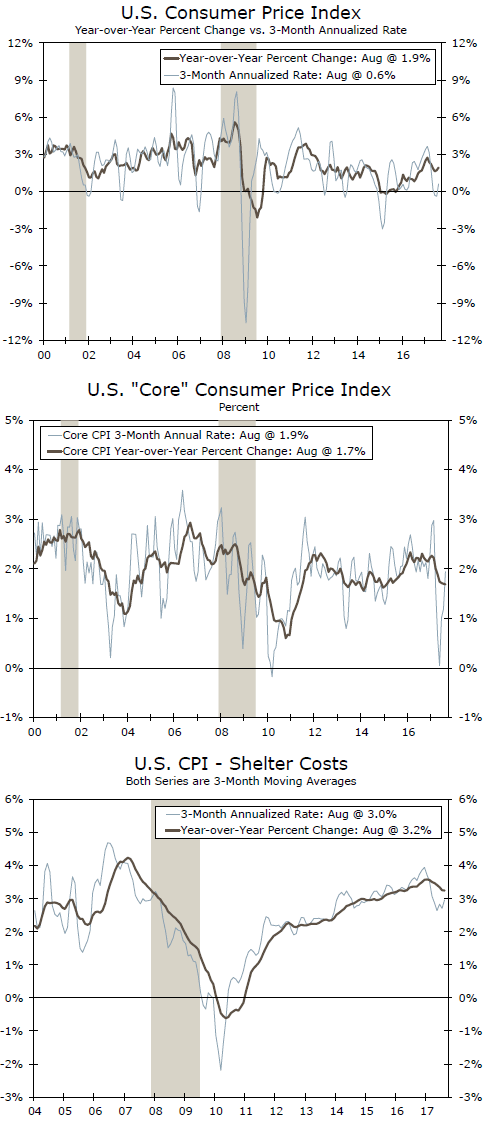
On a year-over-year basis, core inflation continues to look rather anemic. Ex-food and energy, prices were up just 1.7 percent over the past 12 months. Following the August gain, however, the recent trend looks stronger; over the past three months, the core index has risen at a 1.9 percent annualized pace.
Fed Will Still Be Cautious Interpreting Inflation's Recent Trend
August's strong gain should help alleviate concerns among Fed members that the slowdown in inflation that began in the spring is set to continue. That said, with some components like gasoline and hotel prices getting a boost late in the month from storm activity, we suspect Fed members will continue to be cautious in interpreting recent movements.
FOMC members have continued to telegraph that they are set to announce the start of balance sheet normalization at next week's meeting. We do not expect the inflation data to get in the way of that plan. What is likely to be affected, however, is the Fed's Summary of Economic Projections. There will be three more readings on CPI and PCE inflation before the FOMC's December meeting, but the soft patch hit in prior months is likely to lead to lower estimates of year-end core inflation. That could be enough for some officials, worried about inflation's persistent shortfall from the Committee's target, to push out their projections for the timing of the next rate hike.
Pound Jumps after BoE Signals Rate Hike; Dollar Also Up On Strong US Inflation
Central bank meetings dominated today's European session, while US CPI was the main data in focus. The pound soared to a fresh one-year high against the dollar after the Bank of England signalled rates could go up within months. The US dollar also shined as the greenback was lifted by stronger-than-expected inflation data. In contrast, the Swiss franc ended up as one of the worst performers after the Swiss National Bank slightly altered its view on the Swissie's value.
The pound returned to the top of the performance league for the second time this week as the British currency jumped more than 1% after the Bank of England strongly hinted at a rate hike in the near future. At the end of its two-day monetary policy meeting, the BoE kept policy unchanged as expected, with two MPC members dissenting to vote for a rate hike as anticipated. However, in the meeting minutes published immediately after the announcement, the bank said a majority of MPC members thought "some withdrawal of monetary stimulus is likely to be appropriate over the coming months" if underlying inflationary pressures continue to rise.
Sterling powered ahead to fresh highs against both the dollar and the euro, hitting $1.3371 and 0.8876 pounds to the euro. It was also up sharply against the yen, reaching a nine-month high of 148.12.
Earlier in the session, the SNB kept its key rates unchanged as expected but toned down its verbal warning of the exchange rate. In its statement, the bank said the franc remains "highly valued", slightly less strong language to the "significantly overvalued" term used in previous meetings. Pressure on the franc has eased substantially following the euro's 7.5% appreciation against the Swiss currency this year. However, the SNB reiterated that it will remain active in the forex markets as necessary.
The Swissie weakened after the SNB's decision, with dollar/franc climbing to 0.9660 and euro/franc firming to 1.1480 in late trading.
The euro was mostly swayed by the movements of its peers in the absence of any major Eurozone data today. There was little reaction to remarks by ECB board member, Bostjan Jazbec, who said the central bank needs more data before deciding on reducing the size of its asset purchase program, but added that a decision was inevitable. The single currency recovered from a two-week low of $1.1836 touched earlier in the day, to rise to around $1.1880 in late session.
Meanwhile, the dollar was boosted after US inflation rose by more than expected in August. Annual CPI beat estimates of 1.8% to rise to a three-month high of 1.9%, up from 1.7% in July. Prices were driven higher by a jump in gasoline prices and housing costs. The core rate, which excludes volatile food and energy prices, was unchanged at 1.7% in August, though this was above forecasts of 1.6%.
Other data out of the US today included the weekly jobless claims. Initial claims for unemployment benefits rose by 284k last week, an improvement on the prior week's 298k and lower than the expectations of 300k.
The greenback surged to a more than one-month high of 111.02 against the yen, before retreating to around 110.70 at the US open. The dollar index was slightly down however at 92.30, weighed by the stronger pound. The US currency appeared to backtrack as some analysts said Hurricane Harvey may have skewed the CPI numbers at the end of August, while reports that North Korea may be preparing to launch another missile test also unsettled some traders.
The Canadian dollar was unable to benefit from better-than-expected house price data out of Canada today. The loonie was last trading 0.25% down on the day at C$1.2200 to the greenback.
In commodities, base metals continued to slide, with copper prices falling to a one-month low of $2.9180 per tonne. But crude oil extended yesterday's gains, following the IEA's upbeat assessment of the oil market. WTI crude was last up 1.2% at $49.90, while Brent crude was 0.8% higher at $55.61 per barrel.
US CPI Closer to 2% in August But Core Inflation Still Not Going Anywhere
Highlights:
- The all items index rose 0.4% in August, slightly ahead of market expectations. That pushed the year-over-year rate up to 1.9% from 1.7% in July.
- A 6.3% jump in gasoline prices was partly responsible for the headline increase.
- It is likely a bit too soon to attribute rising gasoline prices to Hurricane Harvey-related supply disruptions. That will be a larger factor in September's CPI reading.
- Consumer prices excluding food and energy rose 0.2%, breaking an unusually long five-month stretch of more modest increases. However, the year-over-year rate of core inflation was unchanged at 1.7% for a fourth consecutive month.
- The shelter index was a big contributor to rising services prices. A 0.5% increase in that component was the largest monthly gain in more than a decade.
Our Take:
August's CPI report provided more of the same: steady core inflation alongside an energy-driven move in the headline rate. As the BLS noted, core inflation has been in a 1.6-2.3% range for six years now. Although some transitory factors are responsible for keeping the current rate at the lower end of that range, it is hard to argue we are seeing much in the way of inflationary pressure. Our diffusion index shows only 30% of CPI basket components are rising at or above a 2% year-over-year rate. That is despite clear signs of limited economic slack, including an unemployment rate that is 1/4 percentage point below the Fed's longer run estimate.
Today's inflation readings don't alter our expectations for next week's Fed meeting. We already saw little chance of a rate hike, with policymakers instead focusing on implementing their plan to start shrinking the Fed's balance sheet. Our long-held view has been that December would be the timing of the next rate move although markets remain skeptical of even that. Given some FOMC members' concerns about low inflation, we'll likely need to see higher CPI readings in the coming months to raise the odds of one more rate hike this year.
US: Finally, Inflation Pressures Pick Up in August
The headline consumer price index (CPI) ticked up 0.4% in August, slightly above market expectations. Inflation on a year-on-year basis moved up to 1.9% in August.
Delving into the details, a 2.8% pop in energy prices on the month and a 0.5% increase in shelter costs were the main culprits lifting headline inflation in August. Food inflation remained fairly tame, up just 0.1% on the month, and a mere 1.1% year-on-year.
Core inflation finally broke out of its 0.1% funk, rising 0.2% on the month – and a strong 0.2 at that given the 0.248 print to three decimal points. Still, that left core inflation at 1.7% year-on-year, a pace that has been steady for four months now.
The core measure, along with shelter price increases, was led by motor vehicle insurance (+1.0% m/m), medical care (+0.1% m/m) and recreation (+0.2% m/m). Shelter is highly important for inflation, accounting for one third of the CPI basket. As such, the 0.5% rise carried some weight. Within shelter prices, all categories gained momentum including rent, owned housing and lodging away from home.
The tug of war in core inflation between soft goods prices (-0.1%) and rising services prices (+0.4%) continued in August, with services gaining speed as of late. Still, it wasn't enough to lift the annual pace of core services, at 2.5% y/y in August. Meanwhile core goods prices remain in deflationary territory, down 0.9% from a year ago – a pace that has been reasonably steady over the past year.
The BLS cited that Hurricane Harvey had a very small effect on survey response rates in August, with price collection disrupted in 2 of 87 collection areas.
Key Implications
Phew! The sigh of relief among economists forecasting the U.S. economy is surely audible. Analysts have been increasingly worried that the Phillips curve, or the relationship between the unemployment rate and inflation, might be dead, or at least on life support. August's CPI report provides some reassurance that it may be unwise to write it off yet. However, with core inflation still below 2% it will take more than a month of good data to convince the FOMC that inflation is well on its way to target. Moreover, there may still be poorly understood structural forces restraining inflation.
That said, the uptick in services inflation was most encouraging, as it is most closely tied to conditions in the domestic economy. While goods inflation is still feeling the effects of a stronger U.S. dollar in recent years. We expect those exchange rate impacts will ebb, and goods prices should help lift inflation higher over the coming two years.
Next week, the Fed is expected to starting the process of balance sheet normalization. The likelihood that the Fed would raise rates once more in 2017 had been looking increasingly iffy as the softness in inflation dragged on. Today's CPI report provides some reassurance that there are signs of life in price pressures in the U.S. economy, and makes a December rate hike look more likely.
Sterling Jumps as BoE Sees Strong Case for a Rate Hike
- Risk sentiment on European stock markets soured around the US opening as Japanese newspapers report that North Korea shows signs of preparing a missile launch. Main US stock indices open up to -0.5% lower (Nasdaq).
- The Bank of England signaled that officials are preparing to raise interest rates within months to restrain accelerating inflation, a fresh sign that a decadelong era of ultraloose central-bank policy is slowly drawing to a close. EUR/GBP lost more than one figure, dropping from 0.9020 to sub-0.89 area.
- US CPI beat forecasts in August, ending a 5-month run of misses. Headline CPI rose by 0.4% M/M and 1.9% Y/Y. "Increases in the indexes for gasoline and shelter accounted for nearly all of the seasonally adjusted increase in the all items index," said the Labor Department. Core inflation rose by 0.2% M/M to stabilize at 1.7% on a yearly basis.
- The Swiss National Bank kept its policy rates unchanged, but changed its tone on the franc. The SNB ditched its nearly three-year mantra that the franc was "significantly overvalued", but still thinks that it is "highly valued". The central bank reiterated its commitment to "intervene in the foreign exchange market as necessary".
- Donald Trump has tied a deal to protect undocumented workers who arrived in the US as children with his campaign promise to increase security along the Mexico border, denying he struck a deal with Democrats on legislation legalising the status of so-called "Dreamers".
- North Korea has threatened to destroy Japan with nuclear weapons and "reduce the US mainland to ashes and darkness" in response to the countries' effort to ramp up sanctions on the isolated east Asian nation. "The four islands of the [Japanese] archipelago should be sunken into the sea by the nuclear bomb of Juche".
- Another prolonged bout of wrangling over the debt ceiling in the US could prompt Fitch to review the country's AAA credit rating with "potentially negative implications", the agency said.
Rates
North-Korea limits downside US T's after BoE and US CPI
Global core bonds lost ground as the Bank of England signalled policy normalisation in coming months and after higher-than-expected US CPI data. Reports in Japanese newspapers about a possible near term North-Korean missile launch erased part of core bond losses via safe haven flows. US Treasuries nevertheless still underperform German Bunds, especially at the front end of the US yield curve. At the time of writing, the US yield curve bear flattens with yield changes ranging between +3 bps (2-yr) and flat. The German yield curve trades 1 bp higher across the curve. On intra-EMU bond markets, 10-yr yield spread changes versus Germany range between +2bp and -2bp.
Core bond trading again started on a lethargic footing with small movements in the European session. Things changed as the Bank of England indicated that "some withdrawal of monetary stimulus is likely to be appropriate over the coming months". (see FX). UK Gilts lost significant ground (UK 2y yield +8 bps) and dragged the US Note future and German Bund slightly lower as well with some investors rethinking their dovish stance/positioning. The sell-off in the US Note future accelerated after higher US CPI data. The front end of the curve underperformed as the market implied probability of a 2017 Fed rate hike moved back above 50% for the first time since early July. Reports in Japanese media (Nikkei,…) about a possible near term North Korean ICBM launch created safe haven flows and volatility immediately after the CPI release. However, as the US trading session gets going, investors favour again the downside in US Treasuries.
The Irish Treasury ended this week's scheduled EMU bond with successful taps of two on the run bonds (€0.55B 1% May2026 & €0.45B 1% May2037). The combined amount sold was the maximum target with a good auction bid cover of 2.19. With the completion of today's auction, the NTMA has issued €10.5B benchmark bonds, from its stated target range of €9B to €13Bin the bond markets this year.
Currencies
North Korea threat prevents further USD gains
The dollar couldn't extend sustained gains today. The Interest rate context and the data were supportive. Interest rate markets prepared for a BoE interest rate hike on hawkish BoE speak and the US CPI was higher than expected. However, the positive impact from the eco/monetary news was countered by a flaring up of geopolitical tensions as Japan saw signs of North Korea preparing new offensive actions. This threat prevented the dollar to fully profit from the positive eco news. EUR/USD trades in the 1.1875 area. USD/JPY is changing hands in the 110.75 area in volatile trade.
Asian equities traded mixed. China and Japan mostly showed modest losses. Other regional indices traded with a slightly positive bias. USD/JPY settled in the mid 110 area, nearing 110.67/95 resistance. EUR/USD set a minor correction low in the 1.1865/70 area.
There was hardly any high profile news to guide USD trading during the European morning session. Core yields drifted sideways to marginally higher ahead of the BoE's policy decision and the US CPI release. EUR/USD returned to the 1.19 area. USD/JPY failed to try a real test of 110.67/95 resistance. USD bulls took a more cautious approach after recent gains.
The BoE left its policy rate unchanged but signalled that a rate hike in the near future has become a real possibility. The subsequent rise in core yields also helped to put an intraday floor for the dollar. The US August CPI rose more than expected from 1.7% to 1.9%. Core inflation was stable at 1.7%, while a decline was expected. US/core yields rose further and the dollar spiked higher. EUR/USD filled bids around 1.1840. USD/JPY tested the 111 area. However, the USD soon lost part of the post-CPI gains, just to try another comeback. The volatility in the dollar (and in other markets) was due to headlines on North Korea preparing a new missile launch in the direction of Japan. North-Korea press reports also said the country was ready to use a nuclear weapon. This geopolitical uncertainty partially countered the positive impact of stronger US CPI for the dollar. Currently, the dollar trades quite close to the levels that were on the screens going into the start of European trading this morning. EUR/USD is changing hands in the 1.1875 area. USD/JPY is changing hands around 110.70.
Sterling jumps as BoE sees strong case for a rate hike
Sterling trades were keen to see the BoE's policy assessment as inflation rose sharply in August. The BoE didn't want to shock the market and as expected left its policy rate unchanged. The vote for an unchanged policy rate was 7-2 as was the case in August. However, a majority of the MPC members judged that if the economy continues to follow a path consistent with the prospect of a continued erosion of slack and a gradual rise in underlying inflationary pressure then, with the further lessening in the trade-off that this would imply, some withdrawal of monetary stimulus is likely to be appropriate over the coming months in order to return inflation sustainably to target. So, the BoE's assessment might be considered as hawkish even as the vote remained 7-2. Sterling started a new upleg EUR/GBP declined more than one big figure and is falling below the 0.89 big figure. Cable also set a new ST top north of 1.33 (currently 1.3350) despite overall USD strength after higher than expected US CPI data.
USD/JPY Should Reach New Highs
The currency pair has resumed the upside movement and seems poised to jump much higher after the good United States data. The pair has retreated a little because the traders were a little surprised by some US data.
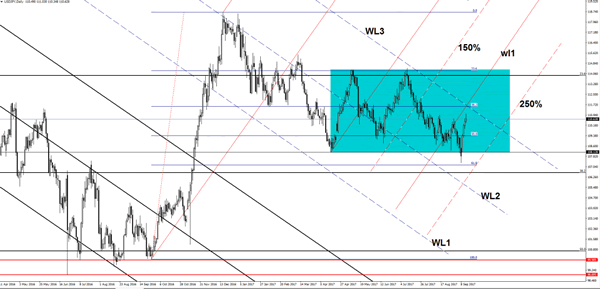
USD/JPY is trading in the green and should resume the upside movement because is expected to reach some important resistance levels. We'll see what will happen because the dollar index is still located under some very important resistance levels. The USDX is now pressuring the 92.49 static resistance, a valid breakout above could confirm a further growth in the upcoming period.
The dollar received a helping hand from the United States data, the Unemployment Claims dropped unexpectedly in the previous week, from 298K to 284K, even if the traders have expected to see an increase to 303K. Moreover, the CPI rose by 0.4%, beating the 0.3% and the 0.1% growth in the former reading period, while the Core CPI surged by 0.2%, matching the 0.2% estimate.
USD/JPY continues to move in range on the short term, remains to see how will react when will hit the warning line (WL3). We'll see if will have enough energy to reach the confluence area formed at the intersection between the 38.2% retracement level with the WL3. Only a valid breakout above the WL3 will confirm a further increase, while a rejection will send the rate tumbling.
USD/CHF On The Run
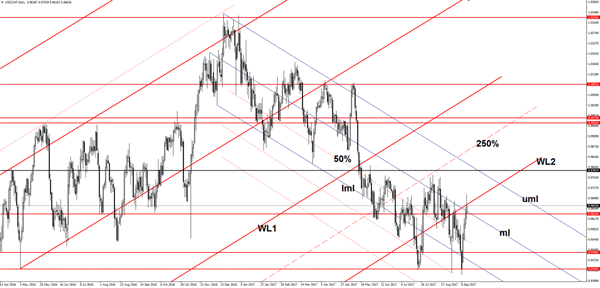
The price is strongly bullish on the short term and seems motivated to jump above the second warning line (WL1) of the ascending pitchfork. A valid breakout will confirm a further increase towards the upper median line (uml) of the minor descending pitchfork. Resistance can be found at the 0.9787 horizontal resistance.