Sample Category Title
Dollar Mixed Despite Positive Job Data
Dollar trades mixed in early US session despite positive job data. Initial jobless claims dropped 12k to 234k in the week ended February 4, below expectation of 250k. Four week moving average dropped to 244.25, lowest since 1973. Continuing claims rose 15k to 2.08m in the week ended January 28. Also released in US session, Dollar index is hovering in tight range around 100.32 at the time of writing. Near term outlook is mixed. On the negative side, it's still struggling below 55 day EMA (now at 100.65). On the positive side, daily MACD crossed above signal line. We'd maintain that there is prospect of a rebound after getting firm support from 100 handle.
Shinzo Abe to Meet Donald Trump
The meeting between US president Donald Trump and Japan prime minister Shinzo Abe in Washington on Friday will be closely watched by the markets. While there are news surrounding Trump's accusation of Japan as currency manipulator and others, the key would be the development in trade relationships of the two countries. Trump dismissed the Trans Pacific Partnership in his very early days in office. And it's known that Abe would like to secure a bilateral trade deal with the US.
BoJ Deputy Naksao: Persistent Powerful Monetary Easing needed
In Japan, BoJ Deputy Governor Hiroshi Naksao said that "it's most important that the BOJ persistently pursue powerful monetary easing." And, he warned of risks of global uncertainties. Naksao noted that "momentum toward achieving our price target, while sustained, isn't sufficient." And he emphasized that "there's still a long way to go to achieve our target."Also, he defended accusation of currency manipulation and said that "the BOJ guides monetary policy solely for the purpose of achieving its inflation target at the earliest date possible. It does not target exchange rates."
Euro Weighed Down by France Uncertainties
Euro is mixed today but trades as the second weakest major currency for the week, next to Kiwi. The common currency is being weighed down by political uncertainties. In particular, in France, after a scandal of conservative candidate Francois Fillon, far-right candidate Marine Le Pen is seen as a serious contender for the presidential elections in April and May. According to latest poll, Le Pen could win the first election round on April 23, but without outright majority. That would put her in a runoff, likely with centralist Emmanuel Macron. Current poll suggests that Marcon would win. But in case of a Le Pen win, the possibility of a "Frexit" could surge sharply.
ECB Draghi to Meet Germany Merkel
ECB president Mario Draghi will meet German Chancellor Angela Merkel for a regular closed dollar meeting. Ahead of the meeting, German finance minister Wolfgang Schaeuble said that "it is an art to carefully prepare and plan an exit from an extraordinary monetary policy to prevent bigger distortions." And he preferred ECB to run a "prudent, carefully balanced monetary policy". But Draghi has been clear in his view that ECB won't react to temporary spike in inflation. No press conference is scheduled after the meeting between Draghi and Merkel.
Kiwi trades lower after RBNZ
As expected, RBNZ left the OCR unchanged at 1.75%, following three rate cuts in 2016. The policy statement has changed to a more neutral tone from an accommodative one previously. Yet, the central bank's rate hike forecasts stay at a slower pace than what the market has priced in. Policymakers acknowledged that economic growth has 'increased as expected and is steadily drawing on spare resources'. The outlook remain s positive. It also acknowledged the return of headline CPI to the target band, and judged it would gradually move to the midpoint of the band. We expect the OCR would stay unchanged for the rest of the year. More in RBNZ's Rate Hike Path Still Lags Market Expectations.
GBP/USD Mid-Day Outlook
Daily Pivots: (S1) 1.2493; (P) 1.2521; (R1) 1.2568; More...
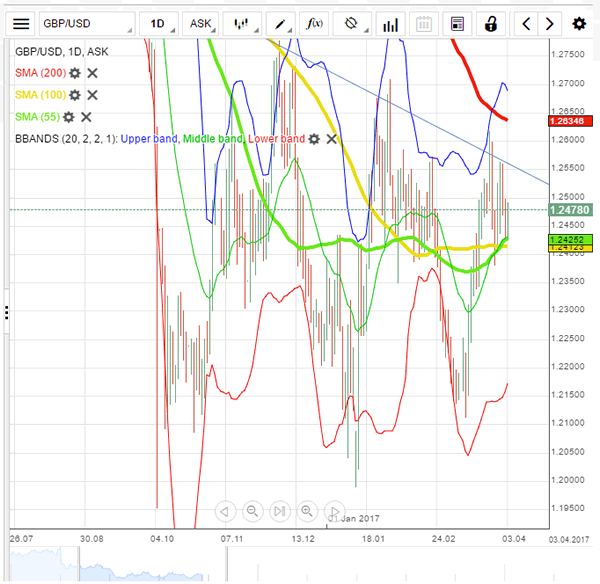
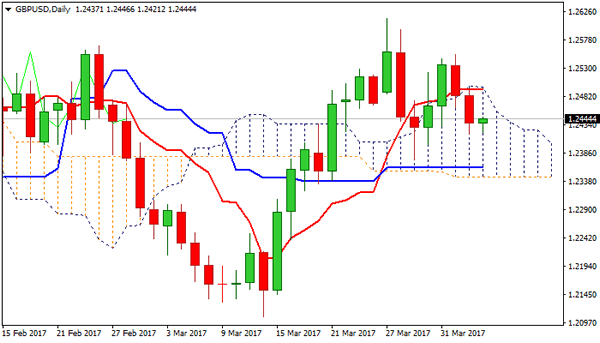
GBP/USD is staying in range of 1.2346/2705 and intraday bias remains neutral for the moment. Price actions from 1.1946 are viewed as a consolidation, no change in this view. In case of another rise, we'd expect upside to be limited by 1.2774 to bring larger down trend resumption. On the downside, below 1.2346 will revive the case that such consolidation is completed at 1.2705 already. In that case, intraday bias will turn back to the downside for retesting 1.1946 low.
In the bigger picture, fall from 1.7190 is seen as part of the down trend from 2.1161. There is no sign of medium term bottoming yet. Sustained trading below 61.8% projection of 2.1161 to 1.3503 from 1.7190 at 1.2457 will target 100% projection at 0.9532. Overall, break of 1.3444 resistance is needed to confirm medium term bottoming. Otherwise, outlook will remain bearish.


Economic Indicators Update
| GMT | Ccy | Events | Actual | Consensus | Previous | Revised |
|---|---|---|---|---|---|---|
| 20:00 | NZD | RBNZ Rate Decision | 1.75% | 1.75% | 1.75% | |
| 21:45 | NZD | Building Permits M/M Dec | -7.20% | -9.20% | -9.60% | |
| 23:50 | JPY | Japan Money Stock M2+CD Y/Y Jan | 4.10% | 4.00% | 4.00% | |
| 23:50 | JPY | Machine Orders M/M Dec | 6.70% | 3.10% | -5.10% | |
| 00:01 | GBP | RICS House Price Balance Jan | 25% | 22% | 24% | |
| 00:30 | AUD | NAB Business Confidence Q4 | 5 | 5 | 6 | |
| 06:00 | JPY | Machine Tool Orders Y/Y Jan P | 3.50% | 4.40% | ||
| 06:45 | CHF | Unemployment Rate Jan | 3.30% | 3.30% | 3.30% | |
| 07:00 | EUR | German Trade Balance (EUR) Dec | 18.4B | 23.2B | 21.7B | 21.8B |
| 13:30 | CAD | New Housing Price Index M/M Dec | 0.10% | 0.20% | 0.20% | |
| 13:30 | USD | Initial Jobless Claims (FEB 04) | 234K | 250k | 246k | |
| 15:30 | USD | Natural Gas Storage | -155B | -87B |
Subscribe to our daily and mid-day newsletter to get this report delivered to your mail box
Dollar Climbs Above 112, US Jobless Claim Next
The Japanese yen has posted small losses on Thursday session, erasing the gains which marked the Wednesday session. Currently, USD/JPY is trading at 112.40. On the release front, it's another light day. Japanese Preliminary Machine Tool Orders posted a gain of 3.5%, a second straight gain after a long streak of declines. In the US, today's highlight is unemployment claims, with the indicator expected to climb to 249 thousand. On Friday, the US releases UoM Consumer Sentiment. The markets aren't expecting much movement, with a forecast of 97.9 points.
On Friday, Japanese Prime Minister Shinzo Abe comes to Washington, where he will hold talks with President Trump. The meeting comes at an important time, as both sides will be hoping to smooth some ruffled feathers. One of Trump's first moves in office was to withdraw the US from the Trans-Pacific Partnership, a trade deal which Japan has strongly endorsed. Trump recently accused Japan of unfair trade practices in its ultra-loose monetary policy, which has kept the yen at low levels and helped boost Japanese exports. The Japanese have argued that they are not targeting the yen's value, but rather trying to combat deflation. Still, Abe will have his work cut out for in trying to assuage Trump, who has shown little patience with US trading partners and has repeatedly made protectionist statements. Japan is heavily reliant on its export sector, and the last thing it needs is a trade war with the United States. Abe is expected to defuse the currency spat by suggesting that the US and Japan discuss currency policy at the next G7 meeting.
Donald Trump hammered away at the economy during the election campaign, but was short on specifics as far as remedies. However, he did promise a significant fiscal boost through infrastructure spending and tax cuts. This led to a post-election euphoria in the markets and boosted the US dollar. Fast forward to February, and optimism has been replaced by caution and unease, as Trump continues to entangle himself in controversy, both with US trading partners and at home, with the media and Supreme Court. The markets are disappointed that Trump has not unveiled an economic plan or blueprint, limiting himself to protectionist rhetoric which has sent alarm bells ringing worldwide. On Wednesday, Goldman Sachs forecast that the administration won't implement tax reform or infrastructure spending before 2018.
Investors Seek Safety as Uncertainty Mounts
The heightened political risks across the globe and persistent Trump uncertainties have sparked a sense of unease which continues to pressure the financial markets. Global stocks remain extremely volatile amid the jitters with gains potentially limited as the era of political uncertainty encourages investors to scatter away from riskier assets. Although Asian shares were slightly higher on Thursday following the rising confidence towards the Chinese economy, the upside should be capped by risk aversion. In Europe, stocks were buoyed by the upbeat earnings reports but concerns over the pending elections in France, Germany, and Netherlands could expose shares to downside losses. Wall Street displayed exhaustion on Wednesday with prices poised to edge lower during trading today if optimism starts to wane over Donald Trump's proposed fiscal policies coming into effect. With political risk and anxiety almost dictating where the markets trade, investors may use this period of uncertainty to seek safety in safe-havens such as Gold.
Dollar Index struggles above 100.00
The mixed signals being sent by the Trump administration on the value of the Dollar coupled with the lack of clarity offered on the market shaking fiscal policies have left the Greenback vulnerable to losses. Sellers may exploit the downside momentum on the Dollar moving forward with further selloffs expected if concerns heighten over Trump's protectionist policies negatively impacting growth in the United States. Although the prospects of higher US interest rates has the ability to protect the Dollar in the longer term, the Trump-off trading environment and sheer uncertainty could expose prices to steeper losses.
With the economic calendar fairly light today, price action should dictate where the Greenback concludes. From a technical standpoint, a breakdown below 100.00 on the Dollar Index could encourage a further selloff lower towards 99.00.
Euro parity dream resurfaces
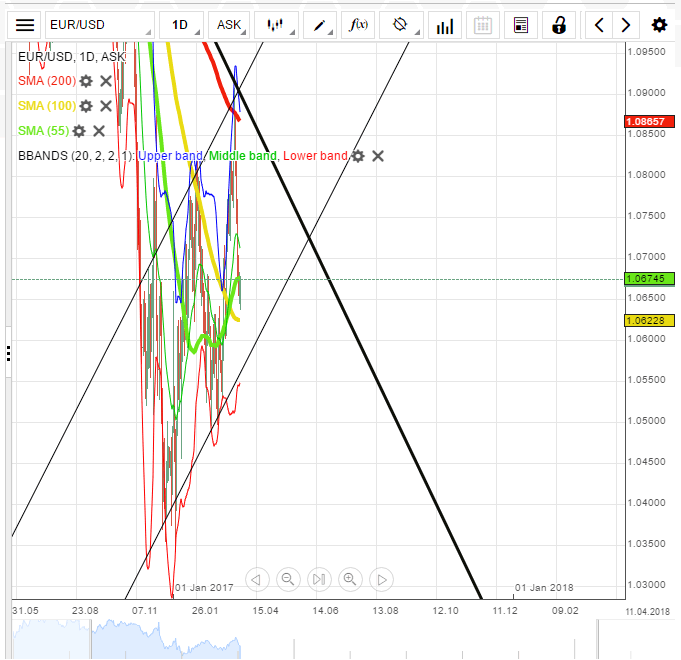
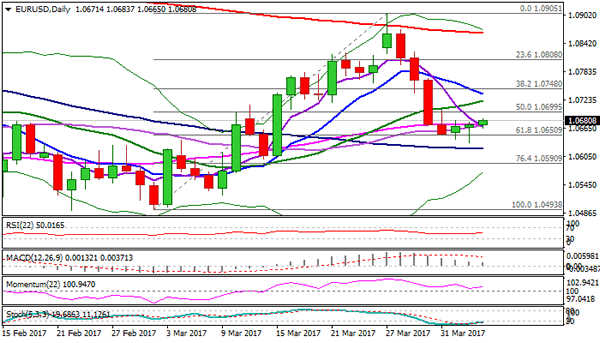
The series of pending elections in Europe which may spark uncertainty, coupled with the threat of Eurosceptic parties gaining ground and destabilising the unity of the Eurozone continues to pressure the Euro. Sentiment remains firmly bearish towards the EUR and recent reports of Greece's debt crisis returning with a vengeance could encourage bearish traders to attack the EURUSD incessantly. The International Monetary Fund has warned that Greece may not achieve the required target to qualify for a cash bailout with discussions already on the rise of a potential Grexit. This terrible cocktail of uncertainty and political risk could ensure the parity dream on the EURUSD becomes a reality in the longer term. From a technical standpoint, the EURUSD remains slightly pressured on the daily charts with a breakdown below 1.0650 sparking a selloff lower towards 1.0500.
Commodity spotlight - Gold
In this period of uncertainty, political risk and market jitters, Gold remains a trader's best companion and such was observed this week when the precious metal charged to a fresh 3 month high at $1244.67. Risk aversion remains rife across the financial markets while developments in the United States and globally have created tension consequently boosting appetite for safe-haven investments. While the prospects of higher US interest rates this year may pressure Gold in the longer term, this yellow metal has risen to prominence in the short term with further gains expected as anxiety intensifies. From a technical standpoint, Gold is bullish on the daily charts are there have been consistently higher highs and higher lows. The current upside momentum could offer enough inspiration for bulls to send Gold higher towards $1250.
RBNZ Retains Easing Bias, Smacks Down the Kiwi
Overnight, the RBNZ kept its policy unchanged, as was widely anticipated. In a surprising twist, at least for us, the final sentences of the meeting statement retained an easing bias despite the latest improvement in economic data. The RBNZ echoed its previous policy statement and indicated that numerous uncertainties persist, particularly in the international outlook, and policy may need to adjust accordingly. In addition, the Bank reiterated that NZD remains higher than desired, and that a decline in the exchange rate is needed. On the bright side, the officials acknowledged the improvement in the domestic economy, though these upbeat points were not enough to offset their pessimistic view on the global outlook and the strength of the Kiwi. Therefore, NZD/USD slid on the decision, and continued even lower during Governor Wheeler's press conference. An interesting point that Governor Wheeler made, was that the biggest risk he sees is US President Trump's potential protectionist trade policies, something that could spark retaliation from other countries, and that may cause the Fed to tighten even faster as prices in the US rise rapidly.
NZD/USD tumbled following the decision, falling below the upside support line taken from the low of the 3rd of January and finding support slightly above the 0.7180 (S1) barrier. This shifts the short-term outlook to negative in our view and as such, if the bears manage to overcome the 0.7180 (S1) hurdle, they may target the 0.7130 (S2) support next.
Despite these dovish signals from the officials, we do not expect them to actually cut rates again in the foreseeable future absent a major shock, such as heightened global protectionism as Governor Wheeler indicated. We think that this dovish forward guidance may be an implicit way to halt any further gains in NZD, at least temporarily. As such, we believe that although the latest pullback in NZD/USD may continue in coming days, the pair's broader outlook remains cautiously positive. New Zealand's economic data are still strong, and as long as the aforementioned shocks do not materialize, we could see the pair turn up again in the foreseeable future. On the daily chart, NZD/USD is back below the downside resistance line drawn from the peak of the 7th of September. However, there is still a strong possibility for a higher low and as such, we would treat the short-term reversal as a corrective move, at least for now.
EUR/USD heads higher, but political risks persist
The US dollar slid yesterday, pushed down by a decline in the yield of US treasuries. This caused EUR/USD to rebound from the diagonal support line drawn from the low of the 16th of January. Nevertheless, given that the financial world has started paying some attention to the upcoming European elections and the political risks they pose to the bloc, we believe that this rebound is likely to remain limited. We expect the pair to come under renewed selling interest soon, and if sellers manage to drive the battle below the aforementioned support line and the 1.0630 (S1) level, we would expect them to initially pave the way for our next support of 1.0590 (S2). With regards to the broader trend, the fact that the recovery which started on the 3rd of January remained limited near the key obstacle of 1.0800 (R3) enhances our view that this was just a corrective move and that the medium-term downtrend remains intact.
Today's highlights:
During the European day, the most noteworthy economic indicator we get is Norway's GDP growth for Q4. The forecast is for growth to have rebounded notably after a decline in Q3, which is likely to be pleasant news for the Norges Bank. Something like that could diminish even further the likelihood for any further easing by the Bank in the foreseeable future and thereby, bring NOK under renewed buying interest.
In Germany, the trade balance for December is due out, though this is usually not a major market mover for the common currency.
From the US, we get initial jobless claims for the week ended on February 3rd and expectations are for an increase in the figure, something that would bring the 4-week moving average down slightly.
We have four speakers scheduled for today: BoE Governor Mark Carney, RBA Governor Philip Lowe, Chicago Fed President Charles Evans and St. Louis Fed President James Bullard.
FX Market Wary of Verbal Intervention
Thursday February 9: Five things the markets are talking about
With currency manipulation trending strongly on Trump's twitter rants, tomorrow's high profile Abe-Trump summit will be closely scrutinized.
Japanese Prime Minister Abe has signaled he is prepared to discuss the currency issues at G20 and will try and convince POTUS to do the same and not just on a piecemeal one-on-one basis. Expect the PM to argue that Japan's monetary policy is aimed at battling deflation and not at weakening the yen.
The BoJ's deputy governor Nakaso also noted that while the central bank is prepared to consider raising long-term rates target in the future, momentum behind inflation does not yet justify the shift.
Yesterday, the U.K's PM Theresa May successfully passed her first hurdle and officially began divorce proceedings. As widely expected, the U.K's lower House of Parliament passed the bill to trigger Article 50, effectively starting Brexit negotiations with the E.U.
The vote was 494 in favor to 122 against; the bill now goes to the House of Lords, which is also expected to pass the bill (will be debated in the upper chamber later this month). The PM also promised that Parliament would get a vote on any Brexit deal before it is presented to the E.U.
1. Equities providing mixed results
Despite mixed results, the bulk of Asian shares climbed overnight, as investors grow somewhat more confident about China.
In Japan, the Nikkei share average fell -0.5% due to pressure from a stronger yen (¥112.28) ahead tomorrow's U.S/Japan summit.
In Hong Kong, shares hit a four-month high with mainland companies outperforming, as expectations of further yuan depreciation continues to nudge Chinese investors into the city's stocks. The Hang Seng index closed up +0.2%.
In Europe, shares are posting modest gains at the open, led by oil and mining companies, as investors seek fresh trading cues. The FTSE 100 was recently up +0.1%, while the Eurostoxx 600 index rose +0.4%.
U.S equities are set to open 'flat.'
Indices: Stoxx50 +0.3% at 3,247, FTSE flat at 7,188, DAX +0.2% at 11,561, CAC-40 +0.3% at 4,781, IBEX-35 +0.1% at 9,336, FTSE MIB -0.4% at 18,696, SMI +0.4% at 8,414, S&P 500 Futures flat
2. Oil higher on gas inventories, but bloated
Oil prices are being supported by an unexpected draw in U.S. gasoline inventories. However, bloated crude supplies should be capable of capping medium term prices.
Brent crude futures are trading up +50c at +$55.62 per barrel, U.S. light crude (WTI) is also up +50c at +$52.84 a barrel.
Yesterday's U.S. Energy Information Administration (EIA) reported a drawdown on weekly gasoline inventories - fell by -869k barrels last week to +256.2m vs. expectations for a +1.1m barrel gain. The report also showed that U.S. commercial crude inventories rose by +13.8m barrels to +508.6m.
Note: High oil inventories continue to undermine efforts by the OPEC and other producers including Russia to tighten the market by cutting production.
Gold continues to hold firm near its three-month highs hit yesterday (+$1,244.78) on dollar strength amid political and economic uncertainty on both sides of the Atlantic - U.S and Europe.
Note: Investors are concerned about the strong showing in the French presidential race of far-right candidate Marine Le Pen, who has promised to take France out of the euro zone and to hold a referendum on EU membership.
The precious metal has gained nearly +5% over the last month, and nearly +7% since the year began.
3. G7 Sovereign yields remain under pressure
The U.S bond market rally continues to question the confidence of three FOMC rate hikes this year. With the market continuing to look for guidance, Fed Chair Yellen's Congressional testimony next week may be a key determinant of near term policy bias.
Yesterday's U.S 10-year Treasury note auction drew an average yield of +2.333% compared to last month's +2.342%. The bid-to-cover was 2.29 vs. 2.22 - the average over past four-auctions is 2.52.
In Europe, yields on 10-year debt in Italy and Spain yields have dropped -3bps, while those in France were little changed.
Down-under, Aussie 10-year bonds have rallied for a fourth consecutive day, driving yields down -5bps to +2.64%, the lowest in three-months, while Kiwi bonds fell -10bps to +3.16% after the Reserve Bank of New Zealand (RBNZ) kept policy steady (as expected), and noted that policy to continue to be accommodative, but noted that global uncertainties remain.
Note: Its interest rate projections for 2017 and 2018 were "less hawkish" than market expectations.
4. FX wary of verbal intervention
With most of the major pairs trading in their 'contained' ranges on global political concerns for now, periphery G20 currencies have seen some volatile intraday swings. The NZD (N$0.7213) was one of the highlights in the overnight session.
With the market preparing for a rate liftoff from the RBNZ, the communiqué of economic projections, and subsequent commentary delivered a squarely "neutral" assessment, pushed the Kiwi down -100pts to trade atop of NZ$0.7200.
The EUR is holding just below the psychological €1.0700 level, with markets getting worried about peripheral spread widening even further on political concerns. The key support at the €1.06 level remains intact for the time being.
USD/JPY is holding above its two-month low print this week (¥111.59). Dealers are seeking guidance from tomorrows US/Japan summit. GBP is up +0.35% at £1.2567.
In China, the PBoC has skipped its reverse repo operations, calling liquidity conditions ample. USD/CNY closed at ¥6.8672.
5. Norway's Economic Recovery picks up, Bank of Mexico to hike
Data this morning shows that Norway's economic recovery picked up in Q4. GDP rose +0.3% on the quarter from a downwardly revised uptick of +0.1% in Q3.
Analysts note that GDP growth looks set to pick up further with the Government planning a fiscal stimulus worth +0.4% of GDP this year - this should favour the NOK in the medium term. EUR/NOK is trading down -0.15% at €8.8807.
Later this afternoon (02:00pm EST) the Bank of Mexico is expected to raise interest rates by +50 bps to +6.25% in order to stem inflation. The MXN, which has recovered ground in recent weeks and is now trading at levels not seen since mid-December, is down -0.15% at $20.5072.
Fed Speeches Eyed, RBNZ Causes a Stir Overnight
It's been another relatively quiet start to trading on Thursday, very much in keeping with what we've seen throughout the week so far with the absence of major economic data or events offering little direction for traders.
The only event of note so far today came from New Zealand where the central bank signalled its intention not to raise interest rates until 2019, catching traders off guard with markets having priced in at least one hike this year. It seems the Reserve Bank of New Zealand is not quite as optimistic on the outlook as markets were expecting and its belief that the currency remains overvalued will only dampen its views. The New Zealand dollar has pared some of its earlier losses but still remains off more than one cent against its US counterpart.
Oil is trading up more than 1% on the day having recovered from its inventory-induced sell-off over the last couple of days. A huge inventory build over the last week, as reported by API and EIA, cast further doubts over whether efforts by OPEC and non-OPEC members to cut production will fully address the oversupply issue that has crushed oil prices in recent years. The re-emergence of US shale oil as prices have rebounded from their lows appears to be offsetting the cuts apparently being imposed as part of the production cut deal and questions are also surfacing about whether demand growth is as strong as expected. Still, oil is edging higher this morning despite all of this having reached the bottom of its trading range. Clearly it's going to take more than a large inventory build to seriously test these lows.
In general we continue to see plenty of caution in the markets which is likely attributable to the large amount of political risk and the unpredictability on Donald Trump is the early days of his tenure. Jobless claims is the only notable economic release to come today but we will also hear from Charles Evans and James Bullard, two Fed officials the first of which is a permanent voter on the FOMC. While markets have all but priced out a rate hike in March, it will be interesting to see if the Fed is on the same page.
Euro Under Pressure as German Trade Surplus Sinks
EUR/USD is showing limited movement on Thursday, as the pair trades at 1.0680. In economic news, it's another light schedule. Germany's trade surplus fell to EUR 18.4 billion, well off the forecast of EUR 23.2 billion. In the US, today's highlight is unemployment claims, with the indicator expected to climb to 249 thousand. On Friday, the US releases UoM Consumer Sentiment. The markets aren't expecting much movement, with a forecast of 97.9 points.
Germany, the eurozone's largest economy, continues to post mixed numbers. On Thursday, Germany's trade surplus dropped sharply to EUR 18.4 billion in December, compared to EUR 21.7 billion a month earlier. This marked the smallest surplus since November 2014. Early on in 2017, Mario Draghi & Co. can sleep easier, as eurozone growth and inflation numbers have been moving higher. Inflation, which has been at low levels for years, has climbed in recent months, buoyed by higher oil prices. This is positive news for the ECB, which has long tried to raise inflation with an ultra-loose monetary policy. Still, inflation levels remain well below the ECB's target of 2 percent. On Monday, ECB President Mario Draghi poured cold water on hopes of a change in monetary policy due to the improved economic climate. Draghi said that the eurozone economy was not yet strong enough to withdraw the bank's stimulus program. Draghi's comments sent the euro lower, as EUR/USD is down 1.2 percent this week. There are also market jitters over the French presidential elections in April. Marie Le Pen, the far-right candidate in the ring, is not only a strong supporter of Donald Trump, but is hoping to pull off a Trump-style upset win. Le Pen has promised a referendum on taking France out of the European Union, which has put further pressure on the euro.
Donald Trump didn't field much of an economic platform during the election campaign, but he did promise a significant fiscal boost through infrastructure spending and tax cuts. This led to a post-election euphoria in the markets and boosted the US dollar. Fast forward to February, and optimism has been replaced by caution and unease, as Trump continues to entangle himself in controversy, both with US trading partners and at home, with the media and Supreme Court. The markets are disappointed that Trump has not unveiled an economic plan or blueprint, limiting himself to protectionist rhetoric which has sent alarm bells ringing worldwide. On Wednesday, Goldman Sachs forecast that the administration won't implement tax reform or infrastructure spending before 2018.
NZD/USD Falls Below 0.72, Banxico On The Hot Seat
News and Events:
NZD/USD tumbles as RBNZ delays tightening
As widely expected the Reserve Bank of New Zealand left its official cash rate unchanged at 1.75% and surprisingly changed the tone of the forward guidance. Indeed, Governor Graeme Wheeler, who is expected to step down at the end of the third quarter, baffled investors by further delaying any tightening move. The announcement had a substantial impact on the New Zealand Dollar as it fell as much as 1.60% against the greenback, down to 0.7192 before consolidating above the 0.72 threshold after bouncing back on the 0.7196 support level (Fibonacci 61.8% on November-December debasement).
The RBNZ’s decision could be confusing, especially against the backdrop of improving inflationary outlook. However, we think the RBNZ is betting on the Fed having to hike rates to control rising inflation pressures caused by the “Trumponomic” effect. In such a scenario, tighter monetary policy in the US would cause the USD to strengthen, which would ultimately allow the NZD to weaken. In addition, the central bank cannot take the risk of starting to tighten too soon as there is no guarantee Trump will be able to deliver on any of its economic promises. We expect the NZD rally to run out of steam; however NZD/USD will remain highly sensitive to any political development in the US as the high yielding currency will again attract investors should Trump disappoint.
Inflation should support MXN
In Mexico today strong January inflation data should be the shove Banxico needs to increase policy rates by 50bp. Annual inflation is expected to climb to 4.71% from 3.36. Unfortunately the hawkish move is geared to address the weaker peso (although selling pressure has abated in recent weeks) rather than accelerating growth outlook. In fact, the politically driven uncertainty has materially deteriorated economic forecasts. US President Trump’s recent comments alluding to sending US troops south of the boarder and Mexican President Nieto cancelling his scheduled trip to Washington only highlight the increasing friction between the two nations. The Mexican MoF provided the final data on public finance for 2016 reporting a deficit of 2.9% of GDP. The outlook was already difficult with oil revenues falling, slowing domestic growth and a strap fiscal budget unlikely to support new growth (rather pay increasing pension expansion) - factoring in the Trump risks only limits upside expectations. Yet, ultimately MXN has been driven less by fundamental weakness but rather political pressure. Barring an escalation, with real actions, higher yields in MXN and a lower probability of a currency collapse will inspire the closing of speculative shorts. The Banxico hike should also further support the MXN rally.
Switzerland: Unemployment rate increases
New Swiss labour data was released this morning. The unemployment rate has increased to 3.7% from 3.5% in January. The data is now at 11-month high and this month’s rise is also the biggest increase in a year.
As a result, if the unemployment rate increases, downside pressures on the inflation should also continue which would put the efficiency of the SNB’s monetary policy at stake. It is clear that the SNB is doing its best to maintain an exchange rate of around 1.0700 CHF for a single euro. Stimulating inflation is going to become more and more difficult.
The conditions for Swiss corporates are becoming extremely difficult. In particular when looking at the cost of labour in Europe. This is why the unemployment rate should continue to grow as companies, in order to face market competition, will try, as much as possible, to push productivity. At some point, the difference in labour cost between Switzerland and its neighbours is too significant to be sustainable over the long haul.

Today's Key Issues (time in GMT):
- Jan Average House Prices, last 2.887m, rev 2.913m SEK / 08:30
- RBA Governor Lowe Speech in Sydney AUD / 09:00
- Dec Mining Production MoM, last -3,90% ZAR / 09:30
- Dec Gold Production YoY, last -9,40%, rev -10,00% ZAR / 09:30
- Dec Platinum Production YoY, last -10,80%, rev -11,40% ZAR / 09:30
- Dec Mining Production YoY, exp -3,80%, last -4,20%, rev -4,50% ZAR / 09:30
- Feb IGP-M Inflation 1st Preview, exp 0,35%, last 0,86% BRL / 10:00
- Bank of Italy Publishes Monthly Report `Money and Banks' EUR / 10:00
- Bank of Russia Governor Nabiullina Meets With Bankers RUB / 10:30
- Dec Manufacturing Prod NSA YoY, exp -0,20%, last 1,90% ZAR / 11:00
- Dec Manufacturing Prod SA MoM, exp 0,10%, last 0,30% ZAR / 11:00
- Feb 3 Foreigners Net Bond Invest, last -$322m TRY / 11:30
- Feb 3 Foreigners Net Stock Invest, last $33m TRY / 11:30
- Feb 3 Gold and Forex Reserve, last 392.5b RUB / 13:00
- Dec New Housing Price Index MoM, exp 0,20%, last 0,20% CAD / 13:30
- Dec New Housing Price Index YoY, exp 3,10%, last 3,00% CAD / 13:30
- Feb 4 Initial Jobless Claims, exp 249k, last 246k USD / 13:30
- janv..28 Continuing Claims, exp 2058k, last 2064k USD / 13:30
- Fed's Bullard Speaks in St. Louis USD / 14:05
- Feb 5 Bloomberg Consumer Comfort, last 46,6 USD / 14:45
- Dec Wholesale Trade Sales MoM, last 0,40% USD / 15:00
- Dec F Wholesale Inventories MoM, exp 1,00%, last 1,00% USD / 15:00
- Bank of Canada Governor Schembri Speaks at Western University CAD / 16:20
- Fed's Evans Speaks on Economy and Policy in Chicago USD / 18:10
- BOE Governor Mark Carney Speaks in London GBP / 18:30
- Jan Foreign Direct Investment YoY CNY, exp 1,40%, last 5,70% CNY / 23:00
The Risk Today:
EUR/USD's selling pressures have increased. It seems that strong hourly resistance area is given around 1.0800. The road is wide-open towards hoourly support at 1.0581 (16/01/2016 low) and 1.0454 (11/01/2017 low). Expected to see continued consolidation. In the longer term, the death cross late October indicated a further bearish bias. The pair has broken key support given at 1.0458 (16/03/2015 low). Key resistance holds at 1.1714 (24/08/2015 high). Expected to head towards parity.
GBP/USD is still trading below resistance given at 1.2771 (05/10/2016 high). The technical structure suggests that the pair should back bouncing lower towards support given at 1.2254 (19/01/2016 low). The long-term technical pattern is even more negative since the Brexit vote has paved the way for further decline. Long-term support given at 1.0520 (01/03/85) represents a decent target. Long-term resistance is given at 1.5018 (24/06/2015) and would indicate a long-term reversal in the negative trend. Yet, it is very unlikely at the moment.
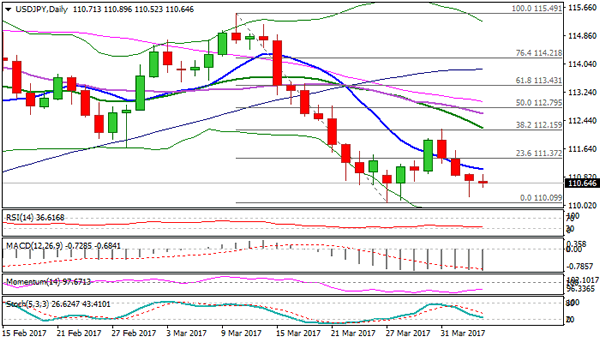
USD/JPY is slowly pushing lower towards support at 111.36 (28/11/2016 low). Hourly resistance is given at 115.62 (19/01/2016 high). The break of hourly support given at 112.57 (17/01/2017 low) has confirmed bearish pressures. We favor a long-term bearish bias. Support is now given at 96.57 (10/08/2013 low). A gradual rise towards the major resistance at 135.15 (01/02/2002 high) seems absolutely unlikely. Expected to decline further support at 93.79 (13/06/2013 low).
USD/CHF's momentum is still bearish despite ongoing increase. Key resistance is given at a distance at 1.0344 (15/12/2016 high). We believe that the road is clearly wide-open for further decline if the pair does not break parity. In the long-term, the pair is still trading in range since 2011 despite some turmoil when the SNB unpegged the CHF. Key support can be found 0.8986 (30/01/2015 low). The technical structure favours nonetheless a long term bullish bias since the unpeg in January 2015.
| EURUSD | GBPUSD | USDCHF | USDJPY |
| 1.1300 | 1.3445 | 1.0652 | 121.69 |
| 1.0954 | 1.3121 | 1.0344 | 118.66 |
| 1.0874 | 1.2771 | 1.0045 | 115.62 |
| 1.0698 | 1.2558 | 0.9953 | 112.22 |
| 1.0341 | 1.2254 | 0.9680 | 111.36 |
| 1.0000 | 1.1986 | 0.9632 | 106.04 |
| 0.9613 | 1.1841 | 0.9522 | 101.20 |
European Market Update: Upcoming Trump-Abe Meeting Eyed For Clarification Of US Policy Stance
Upcoming Trump-Abe meeting eyed for clarification of US policy stance
Notes/Observations
Currency and monetary policy comments from governments will continue to be closely watched; Trump-Abe meeting on Friday
Market watching for the net impact of Trump's economic reflationary ambitions versus his trade protectionist stance.
Overnight:
Asia:
BOJ Dep Gov Nakaso: Economy still needs monetary support as momentum towards price target not yet sufficiently firm; Impact of oil price on CPI to turn positive in FY17.
Japan PM Abe to use upcoming meeting with Trump to propose new cabinet-level framework for US-Japan talks on trade, security, macro issues including currencies
New Zealand Central Bank (RBNZ) keeps policy steady (as expected) and noted that policy to continue to be accommodative but noted numerous uncertainties remained, particularly in respect of the international outlook, and policy might need to adjust accordingly. It interest rates projections for 2017 and 2018 less hawkish than market expectations
Europe:
Germany Fin Min Schaeuble: must maintain pressure on Greece to reform and reiterated view of ruling out a Greek debt cut. Greece would have to leave Euro to win a debt cut. Also reiterated German perspective that Euro exchange rate was too low for German economy
Germany Foreign Min Schaefer refuted speculation that Germany pushed for G20 to back tighter monetary policy; respected Central Bank independence
IMF's Lagarde stated that the IMF tried to be "ruthless truth-teller" in recent Greek review and it would not back down from views on prospects for Greek economy despite objection
Draghi sees the ECB maintaining an accommodative policy until the end of his mandate in October 2019.
Energy:
DOE reportedly plans to sell crude from petroleum reserve (SPR) in Feb
Economic data
(CH) Swiss Jan Unemployment Rate (miss): 3.7% v 3.6%e, Unemployment Rate (Seasonally Adj): 3.3% v 3.3%e
(NO) Norway Q4 GDP Q/Q: 1.1% v 0.7%e; GDP Mainland Q/Q: 0.3% v 0.4%e
(DE) Germany Dec Current Account: €24.0B v €24.8Be; Trade Balance: €18.7B v €20.5Be; Exports M/M: -3.3% v -1.3%e; Imports M/M: 0.0% v -1.1%e
(PH) Philippines Central Bank (BSP) left itsOvernight Borrowing Rate unchanged at 3.00% (as expected)
Fixed Income Issuance:
(LV) Latvia to sell EUR-denominated 30-year bond; guidance seen +100-105bps to mid-swaps
(NG) Nigeria to sell $1.0B in 15-year bond; yield guidance seen 8.50% area
SPEAKERS/FIXED INCOME/FX/COMMODITIES/ERRATUM
Index snapshot (as of 10:00 GMT)
Indices [Stoxx50 +0.3% at 3,247, FTSE flat at 7,188, DAX +0.2% at 11,561, CAC-40 +0.3% at 4,781, IBEX-35 +0.1% at 9,336, FTSE MIB -0.4% at 18,696, SMI +0.4% at 8,414, S&P 500 Futures flat]
Market Focal Points/Key Themes: European equity indices are trading generally higher after a mixed end to the Asian session overnight; Financial stocks mixed after a raft of financial earnings pre-market as shares of SocGen and BNP Paribas trading higher but with shares of Deutsche Bank and Commerzbank trading lower; FTSE MIB the underperformer as the Italian peripheral lenders trade lower despite shares of MedioBanca trade higher after releasing Q2 results; Pharmaceutical stocks trading notably higher in the FTSE 100; Energy stocks also trading high as oil trades higher intraday; Commodity and mining stocks trading lower as copper prices trade near flat on the day; French CAC-40 once again outperforming despite geopolitical uncertainties weighing.
A plethora of upcoming scheduled US earnings (pre-market) include Allegion, BorgWarner, Beazer Homes, Cliffs Natural, Cummins, Coty, CVS Health, Dana Holding, DTE Energy, First Americam, Gannett, Hardinge, Kellogg, Coca-Cola, Masco, Maximus, Nielsen, Occidental Petroleum, Patterson-UTI, Regeneron, Roper Technologies, Sealed Air, Sonoco Products, Teradata, TreeHouse Foods, Timken, Thomson Reuters, TELUS Corp, Twitter, Domtar, Viacom, Vista Outdoor, Willis Towers Watson, VCA, WWE, and YUM! Brands.
Equities (as of 09:50 GMT)
Consumer Discretionary: [Comptel CTL1V.FI +29.2% (to be acquired by Nokia; prelim FY16 results), Heidelberger Druck HDD.DE -3.4% (Q3 results), Pernod-Ricard RI.FR -0.1% (H1 results), Publicis PUB.FR -4.1% (FY16 results), Puma PUM.DE +0.5% (Q4 results), Thomas Cook TCG.UK -6.7% (Q1 results)]
Consumer Staples: [Tate & Lyle TATE.UK -1.1% (trading update)]
Energy: [Total FP.FR +0.8% (Q4 results)]
Financials: [Ashmore ASHM.UK +7.1% (H1 results), Aviva AV.UK +1.0% (Confirms to sell 50% of Antarius JV to Sogecap for £425M), Commerzbank CBK.DE -2.9% (Q4 results, CFO post earnings comments), Gjensidige GJF.NO -6.2% (Q4 results), KBC Groep KBC.BE -0.1% (Q4 results), MedioBanca MB.IT +1.1% (Q2 results), Societe Generale GLE.FR +1.7% (Q4 results), Zurich Insurance Group ZURN.CH -1.3% (FY16 results, affirms med-term targets)]
Healthcare: [Smith and Nephew SN.UK -3.3% (FY16 results)]
Industrials: [Aker Solutions AKSO.NO +1.6% (Q4 results), Faurecia EO.FR -3.9% (FY16 results), RPC Group RPC.UK -4.3% (Acquires Letica Group for $490M, 1 for 4 rights issue), ThyssenKrupp TKA.DE -3.6% (Q1 results)]
Materials: [VoestAlpine VOE.AT -2.4% (9M results)]
Technology: [Betsson BETSB.SE +4.2% (Q4 results), Legrand LR.FR +1.1% (FY16 results), Nexans NEXS.FR -3.4% (FY16 results)]
Telecom: [Eutelsat ETL.FR +5.4% (H1 results)]
Speakers
Turkey Central Bank gov Cetinkaya: Inflation might edge up further in the short. Q3 GDP contraction to be short-lined. Current stance indicates a clear and stable tightening
RBA Gov Lowe stated that the country’s unemployment to remain near current level for some time. Paying close attention to labor market as employment might strengthen but not enough to pull down the jobless rate. Q3 GDP decline was mostly due to temporary factors; drag on economy from decline in mining investment was approx 90% over
Philippines Central Bank policy statement noted that inflation was on track to settle within 2-4% target range for both 2017 and 2018 period but risks did remain on the upside. It slightly raised its CPI forecast for both years from 3.3% to 3.5% in 2017 and from 3.0% to 3.1% in 2018. It saw no reason to cut RRR but such action was always on the table
Thailand Central Bank Gov Veerathai reiterated view that CPI was expected to be back in target range in 2017
Currencies
FX markets remained on guard for verbal intervention. US President Trump to meet Japan PM Abe on Friday on trade and FX issues. Market watching for the net impact of Trump's economic reflationary ambitions versus his trade protectionist stance. On Wed Germany abandoned an effort to push the G20 towards backing tighter monetary policy to promote global financial resilience, indicating that monetary accommodation from the ECB or BoJ was unlikely to be taken away anytime soon (Draghi saw the ECB maintaining an accommodative policy until the end of his mandate in October 2019).
EUR/USD holding just below the 1.07 level and little changed in the session. Dealers have noted that markets were starting to get worried about peripheral spread widening and sold the currency in recent sessions. The key support at the 1.06 level (50-day mvg avg) remained intact for the time being. Dealers noting that technical momentum likely to rise on the break of that level.
USD/JPY holding above its recent 10-week lows of 111.59 seen on Tuesday.
Markets had begun to price in the possibility of RBNZ preparing for a rates liftoff after the latest quarterly inflation data returned to target range for the first time in over 2 year. However today's RBNZ statement, economic projections, and subsequent commentary delivered a squarely neutral assessment. While acknowledging progress on inflation, RBNZ is not convinced the upward pressure can be sustained and also noted elevated uncertainty from external factors. NZD/USD was most volatile among the majors as traders dropped bets for a rate hike as soon as this year
Fixed Income:
Bund futures trade at 164.19 down 3 ticks as futures consolidate above 164 continuing its upward trajectory despite Equity strength. Bunds have rallied some 300 ticks from lows with continued upside targeting 164.94 followed by 165.29. Support moves to 163.83 then 163.44 followed by 162.92.
Gilt futures trade at 126.01 down 7 ticks coming off highs seen yesterday as Futures posted year highs. Analysts see support moving to 125.64 then 125.32 followed by 124.90. Resistance lies at yesterday high at 126.28 followed by 126.70. Short Sterling futures trade flat across the curve after yesterday's flattening with Jun17Jun18 falling to 16/17bp
Thursday's liquidity report showed Wednesday's excess liquidity rose to €1.330T up €11B from €1.319T prior. Use of the marginal lending facility rose to €288M from €245M prior.
Corporate issuance saw $3.45B come to market via 2 issuers headlined by BP Capital markets 4 part $3.1B issue. This has since been followed by a GBP denominated 8 year note. Week to date issuance stands at $12.8B with Feb issuance at $24.3B
Political/In the Papers:
Iran said to have launched another missile from the same launch pad as last month (refuted by Iran State TV)
Looking Ahead
05:30 (HU) Hungary Debt Agency (AKK) to sell 12-bills
05:30 (HU) Hungary Debt Agency (AKK) to sell Floating Bonds
05:30 (UK) DMO to sell £2.5B in 1.5% 2047 Gilts
05:30 (IE) Ireland Debt Agency (NTMA) to sell €1.0-1.25B in 2022 and 2026 IGB Bonds
06:00 (PT) Portugal Dec Trade Balance: No est v -€0.8B prior
06:00 (ZA) South Africa Dec Manufacturing Production M/M: 0.1%e v +0.3% prior; Y/Y: -0.2%e v +1.9% prior
06:00 (BR) Brazil CONAB Report
06:00 (CZ) Czech Republic to sell Bills
06:45 (US) Daily Libor Fixing
08:00 (RU) Russia Gold and Forex Reserve w/e Feb 3rd: No est v $392.5B prior
08:15 (UK) Baltic Dry Bulk Index
08:30 (US) Initial Jobless Claims: 249Ke v 246K prior; Continuing Claims: 2.06Me v 2.064M prior
08:30 (US) Weekly USDA Net Export Sales
08:30 (CA) Canada Dec New Housing Price Index M/M: 0.2%e v 0.2% prior; Y/Y: 3.1%e v 3.0% prior
09:00 (MX) Mexico Jan CPI M/M: 1.7%e v 0.5% prior; Y/Y: 4.7%e v 3.4% prior; Core M/M: 0.5%e v 0.5% prior
09:00 (BR) Brazil to sell 2023 LFT
09:00 (BR) Brazil to sell 2018, 2019 and 2020 LTN Bills
09:10 (US) Bullard (FOMC non-voter, Dovish) speaks in St. Louis
10:00 (US) Dec Wholesale Inventories (Final) M/M: 1.0%e v 1.0% prelim; Wholesale Trade Sales M/M: No est v 0.4 prior
10:30 (US) Weekly EIA Natural Gas Inventories
12:00 (US) USDA World Agricultural Supply and Demand Estimates (WASDE) Crop Report
13:00 (US) Treasury to sell $15B in 30-Year Bonds
13:00 (ZA) South Africa President State of the Nation speech
14:00 (AR) Argentina Jan National CPI M/M: No est v 1.2% prior
14:00 (MX) Mexico Central Bank (Banxico) Interest Rate Decision: Expected to raise Overnight Rate by 50bps to 6.25%
18:00 (PE) Peru Central Bank (BRCP) Interest Rate Decision: Expected to leave Reference Rate unchanged at 4.25%
Forex Technical Analysis
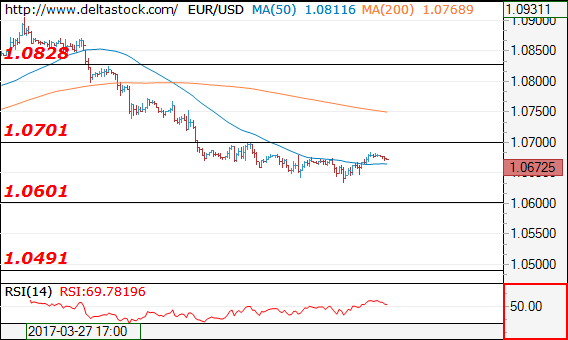
EUR/USD
Current level - 10691
Yesterday's rebound above 1.0640 signals a reversal of th slide form 1.0828 peak and my outlook is already bullish, for a rise towards the mentioned high. Crucial support is still projected at 1.0620.
| Resistance | Support | ||
| intraday | intraweek | intraday | intraweek |
| 1.0700 | 1.0870 | 1.0670 | 1.0620 |
| 1.0828 | 1.0870 | 1.0620 | 1.0350 |

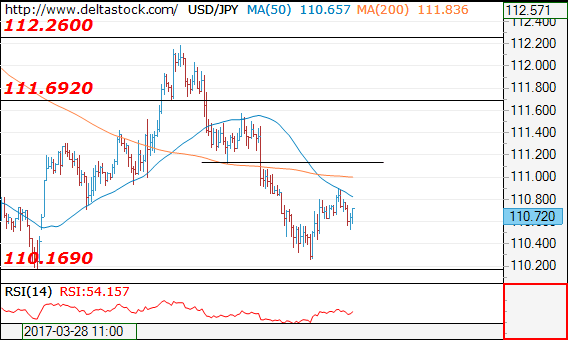
USD/JPY
Current level - 112.33
The rebound above 111.57 low should be considered corrective, preceding a slide towards 109.80 area. Crucial on the upside is 113.50 high.
| Resistance | Support | ||
| intraday | intraweek | intraday | intraweek |
| 112.50 | 118.65 | 111.40 | 111.40 |
| 113.50 | 120.00 | 110.50 | 109.80 |
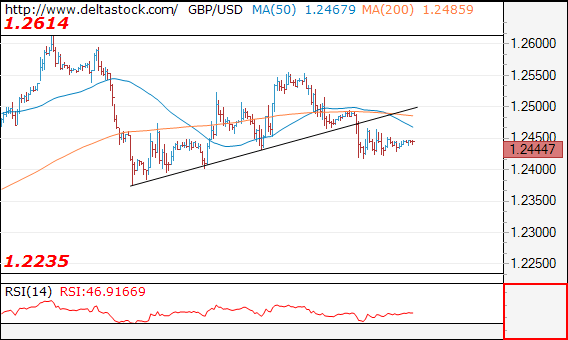
GBP/USD
Current level - 1.2557
The bias is positive, for a rise towards 1.2610, en route to 1.2705 peak. Crucial on the downside is 1.2495.
| Resistance | Support | ||
| intraday | intraweek | intraday | intraweek |
| 1.2535 | 1.2780 | 1.2420 | 1.2230 |
| 1.2610 | 1.2780 | 1.2240 | 1.1984 |