

Sample Category Title
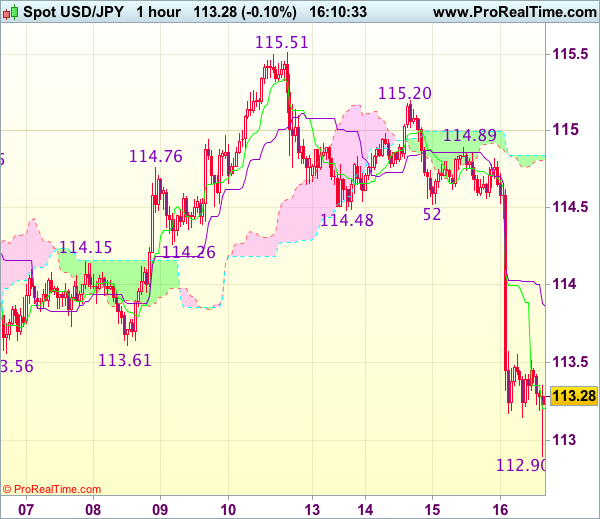
Trade Idea : USD/JPY – Sell at 114.00
USD/JPY - 113.33
Most recent candlesticks pattern : N/A
Trend : Near term down
Tenkan-Sen level : 113.21
Kijun-Sen level : 114.86
Ichimoku cloud top : 114.84
Ichimoku cloud bottom : 114.81
New strategy :
Sell at 114.00, Target: 113.00, Stop: 114.35
Position : -
Target : -
Stop : -
Although the greenback tumbled today and dropped below 113.00 level, lack of follow through selling and current rebound suggest consolidation above support at 112.90 would be seen and recovery to 113.55-60 cannot be ruled out, however, reckon 114.00-05 would limit upside and bring another decline later. A break of said support at 112.90 would extend the fall from 115.51 to 112.76-77, then towards 112.50 but reckon downside would be limited to 112.00-10, bring rebound later.
In view of this, we are looking to sell dollar on recovery as 114.00 should limit upside. Only above previous support at 114.48-52 would abort and signal low is formed instead, risk a stronger rebound to 114.89 resistance first, break there would signal the retreat from 115.51 has ended, then gain to 115.20 resistance would follow.
The Fed Continues To Diverge, But Is In No Hurry!
'Thank you, Janet Yellen,' this is today's market message to the U.S. Fed Chair.
The greenback is falling while everything else is in green today after the Federal Reserve delivered on its promise to hike rates by 25 basis points. While this move was widely expected, many market participants were positioned for a more hawkish language and an upgrade in economic projections which didn't happen.
Yesterday's hike can be described as a 'dovish hike' or 'neutral' at best. The little tweaks in the statement and economic projections suggest that the economy is still moving on the right path, but there's no evidence of overheating economy. Inflation forecasts remained unchanged at 1.9% for 2017, the GDP forecast for 2018 was revised slightly higher by 0.1%, and most importantly the dots didn't move much, indicating that only two rate hikes remain for the rest of the year.
Minneapolis Fed President Neel Kashkari who joined the Fed voting members last year surprised us with his dissent to raising rates, as opposed to 2015 and 2016 where decisions were unanimous.
Thus, markets concluded that tightening in June isn't a done deal and four rate hikes for 2017 are far from reach.
The U.S. dollar took a hit after the decision, tumbling sharply against its major peers as U.S. Treasury yields fell across the yield curve. Apparently, this disappointed dollar bulls but no doubt cheered equity investors who started to become worried most recently by the attractiveness of fixed income markets. One component for a pullback in equities is behind us for now, at least on the short run.
The Bank of Japan monetary policy meeting was a non-event today, as the Central Bank kept interest rates unchanged at -0.1%, asset purchases at ¥80 trillion, and ten-year bond yields capped near zero. However, the Bank of England meeting is likely to be more interesting as we get closer to a 2-year journey which Marc Carney described as ‘unclear', so there will be twists and turns along the way. When looking at economic data, nothing is exciting other than the drop in unemployment rate. Manufacturing, services, and construction sectors all showed signs of cooling. While no changes are expected in policy, the pound will still move on any shift between the hawks and doves.
Netherlands says no to populism
The EUR is benefiting from the Dutch election exit polls which are pointing towards a clear victory for the People's Party for Freedom and Democracy led by current Prime Minister Mark Rutte. The bigger question now is how the Dutch vote will impact the French elections. If today's election results are an indication that the populist spread will stop in the Netherlands, this might provide a further boost to the Euro which was impacted heavily by the change in political environment.
Dollar Declines As Fed Hikes Rates. Euro Gains On Dutch Election Result
Sunrise Market Commentary
- Rates: Fed hikes rates, but markets wanted more
The Fed raised its policy rate by 25 bps to 0.75%-1%, but the median rate projections for 2017-2019 and the long run remained broadly unchanged. While Yellen indicated that the Fed would step up its tightening pace, markets were positioned for a more hawkish message. The US yield curve shifted up to 12.5 bps lower, the belly outperforming. - Currencies: Dollar declines as Fed hikes rates. Euro gains on Dutch election result
The dollar ceded ground across the board after the FOMC decision. The market was apparently positioned for a more aggressive Fed signal. The euro also gained as there is no role for Wilders in the formation of a new Dutch government. How far will the post-FOMC repositioning go? We assume key USD support levels to hold.
The Sunrise Headlines
- US equities rallied after the Fed hiked rates, but without turning hawkish towards the near future. Overnight, Asian stock markets receive a boost with Japan underperforming on the back of a lower USD/JPY
- The Fed said it would raise short-term interest rates and keep lifting them this year, moving the central bank into a new, more aggressive phase of draining easy money from the financial system as the economy improves.
- The BoJ kept monetary policy on hold as it battles to reach 2% inflation. Short-term interest rates will stay at -0.1%, 10y bond yields will be capped near 0%, and asset purchases remain at about ¥80T/year
- Rutte looks certain to form the Netherlands next government, with his party projected to secure a clear victory over rivals including populist challenger Wilders. A scattered political landscape will make it hard to form a coalition.
- China's central bank has raised interbank interest rates in a move designed to limit investors' interest in moving money from China to the US following the Federal Reserve's interest rate rise overnight.
- Australia's jobless rate climbed to a 13-month high in February and employment unexpectedly fell, a risk to the outlook for wage growth and inflation that will likely keep open the possibility of another interest rate cut.
- Today's eco calendar contains final EMU CPI, US initial jobless claims, Philly Fed Business Outlook and auctions in Spain & France. The Swiss National Bank, Norges Bank and Bank of England hold policy meetings.
Currencies: Dollar Declines As Fed Hikes Rates. Euro Gains On Dutch Election Result
Dollar declines as Fed hikes policy rate
Yesterday, the dollar drifted sideways ahead of the FOMC decision. The Fed as expected raised its policy rate by 25 bps. Yellen indicated a further gradual policy normalisation as the Fed meets its objectives. The market was apparently positioned for more aggressive communication. The dollar ceded ground across the board. Later, the euro found support as the first Dutch exit-polls made clear that the populist PVV party has no role in the formation of a new government. EUR/USD closed the session at 1.0734, the highest level in more than a month. USD/JPY finished the session at 113.38 (from 114.75 on Tuesday).
Overnight, Asian markets joined the post-Fed trends from the US. The dollar holds near the recent lows. The decline of core bond yields and of the dollar supports equities. Regional indices gain about 1%. Commodities/commodity related assets perform well. Japan underperforms on USD/JPY weakness (currently in the 113.25 area). The BOJ left its policy rate (-0.1%) and the target level for the 10y government bond yield (0.0%) unchanged. The market reaction was very limited. Eco data in Australia (labour market report) and in New-Zealand (Q4 GDP) disappointed. The Aussie (AUD/USD 0.7690) and the kiwi dollar (NZD/USD 0.70 area) returned a small part of the post-Fed gains. EUR/USD hovers in the 1.0720/45 area this morning, maintaining the post-Fed gain.
Today, the eco calendar is moderately interesting. In EMU, the final February CPI will be published. In the US, the calendar is better filled with the housing starts, building permits, jobless claims and the Philly Fed business outlook. Especially the claims and the Philly Fed survey might have some intraday impact on USD trading. Claims are expected to decline slightly to 240 000. The Philly Fed is expected to decline to 30 from an extremely high 43.3. Recently, confidence indicators remained at fairly strong levels and we expect this to remain the case. The key question is whether markets will continue their soft reaction to the Fed's communication. We are a bit surprised by the substantial decline of US bond yields, even as Yellen suggested that, considering the eco developments, the Fed policy might be relatively close to the 'dot-path'. The Fed also didn't assume much fiscal easing in its assessment. The day-to-day momentum is USD negative, but if US eco data remain OK, the correction doesn't have to go far. EUR/USD might still feel some support from the outcome of the Dutch elections this morning, but we assume that this effect will peter out very soon
EUR/USD 1.0874 resistance remains the line in the sand with intermediate resistance at 1.0829. We maintain the view that a sustained break of EUR/USD above this area will be difficult, even after yesterday's Fed message. The US/German (EMU) interest rate differential remains at an absolute high level. Especially at the short end of the curve, the differential might even re-widen after yesterday's easing. The fundamentals/interest rate differentials are in theory also supportive for USD/JPY, but of late the momentum/technical picture was not really convincing. We maintain the working hypothesis that the 111.60 range bottom should hold.
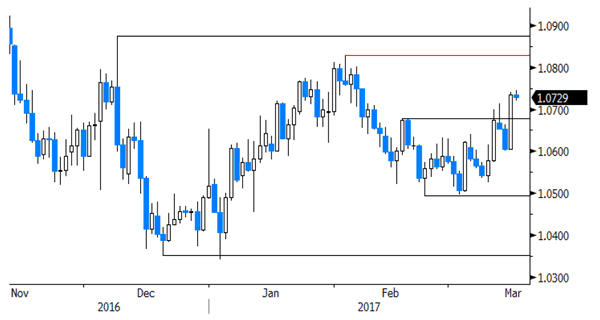
EUR/USD rebounds on after FOMC decision and on pro-European outcome of Dutch elections
EUR/GBP
BoE to keep wait-and-see approach
Yesterday, sterling showed again some sharp swings at the onset of the European session. This time, the UK currency jumped higher, without an obvious driver. Mid-morning, the UK labour market report was fairly strong but sterling traders focused on disappointing wage growth. Sterling reversed part of the earlier gains against the euro and the dollar. After the Fed decision, sterling mostly followed the USD moves. Cable rebounded to the 1.23 area. EUR/GBP didn't profit much from the rise in EUR/USD. The pair closed the session at 0.8733.
Today, the BOE will announce its policy decision and published the meeting minutes. No policy change is expected. Given the recent softening in some UK data, ongoing modest price rises and the Brexit negotiations coming closer, the BOE will feel comfortable with its wait-and-see approach. In theory, this is modestly sterling negative. However, the recent price action suggest that the recent decline of sterling needs a breather. So, we don't expect the BoE meeting to change the broader picture for sterling for the better. Sterling sentiment softened of late. EUR/GBP cleared the 0.8592 resistance, which improved the technical short-term EUR/GBP picture. We don't expect a sustained EUR/USD rebound , but a combination of temporary euro consolidation and ongoing sterling softness as the Brexit negotiations are nearing, might trigger some more ST EUR/GBP gains. The 0.8854 correction top is the next key resistance. The nervous swings over the previous days suggest that a clear break beyond 0.8854 will be difficult without important news.
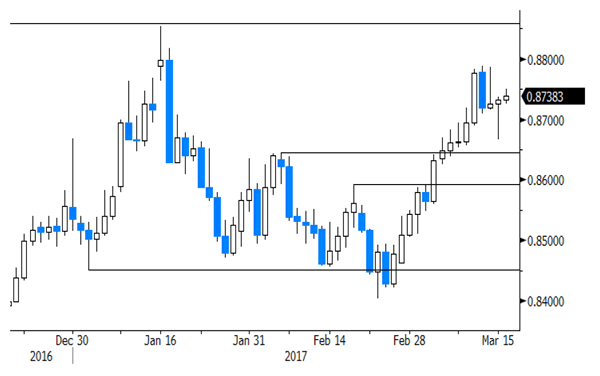
EUR/GBP; sterling shows some nervous swings as formal start of Brexit procedure is nearing
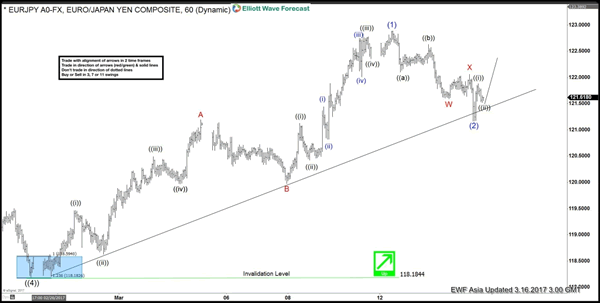
EURJPY Elliott Wave View: Pullback Ended
Short term Elliott Wave view in EURJPY suggests that the decline to 118.18 on 2/24 ended Primary wave ((4)). Primary wave ((5)) is currently in progress higher and the rally from Primary wave ((4)) low at 118.18 is unfolding as an ending diagonal Elliott wave structure where Intermediate wave (1) ended at 122.88. The subwaves of Intermediate wave (1) takes the form of a zigzag Elliott wave structure where Minor wave A ended at 121.19, Minor wave B ended at 119.97, and Minor wave C of (1) ended at 122.88.
Intermediate wave (2) pullback is unfolding as as a double three structure where Minor wave W ended at 121.59, Minor wave X ended at 122.06 and Minor wave Y of of (2) is proposed complete at 121.16. While pullbacks stay above there, and more importantly above 118.18, expect pair to resume the rally higher, provided that pivot at 118.18 stays intact. If pair breaks below 121.16 here, then it’s still within Minor wave Y of (2) and can open extension lower towards 120.45 – 120.75 area before pair turns higher again. We don’t like selling the proposed pullback and favor the longside as long as pivot at 118.18 low stays intact.
EURJPY 1 Hour Chart
AUD/USD: Australia’s Unemployment Rate Surprisingly Jumps To 5.9% In February
For the 24 hours to 23:00 GMT, the AUD rose 1.89% against the USD and closed at 0.7701.
LME Copper prices rose 1.8% or $103.0/MT to $5850.0/MT. Aluminium prices rose 0.7% or $12.0/MT to $1863.0/MT.
In the Asian session, at GMT0400, the pair is trading at 0.768, with the AUD trading 0.27% lower against the USD from yesterday's close, after the release of a downbeat Australian jobs report.
Early morning data indicated that Australia's seasonally adjusted unemployment rate rose to 5.9% in February, hitting its highest level in thirteen months, as the total number of people with jobs fell by 6.4K last month, while the market forecasted a rise of 16.0K. The unemployment rate was expected to remain steady at 5.7%. Further, the nation's consumer inflation expectations advanced 4.0% in March, compared to a gain of 4.1% in the prior month.
The pair is expected to find support at 0.7588, and a fall through could take it to the next support level of 0.7495. The pair is expected to find its first resistance at 0.7746, and a rise through could take it to the next resistance level of 0.7811.
The currency pair is trading above its 20 Hr and 50 Hr moving averages.

EUR/USD: Dutch Exit Polls Show Liberal Win
For the 24 hours to 23:00 GMT, the EUR rose 1.15% against the USD and closed at 1.0730, after Dutch election exit polls suggested that the country's Prime Minister, Mark Rutte's Liberals were on course for a resounding victory over anti-Islam and anti-EU Geert Wilders, thus easing concerns of a wave of populism in the currency bloc.
The greenback nursed losses against its key peers, following a less hawkish policy statement by the US Federal Reserve (Fed), since it did not suggest an acceleration in the pace of interest rate hikes as some experts had predicted.
The US Fed, at its latest monetary policy meeting, lifted the key interest rate by a quarter-point to a range of 0.75% to 1.0%, a move prompted by steady economic growth, improving labour market and a recent uptick in inflation. In a post-meeting statement, the Fed Chairwoman, Janet Yellen, did not signal an intent to increase rates more than three times this year and stressed that the central bank remains data-dependent. However, decision-makers see slightly faster pace of interest rate hikes in 2019, while projections for 2018 and the longer-run remain unchanged. Meanwhile, officials maintained the US economic growth forecast at 2.1% for 2017, but slightly raised the projection to 2.1% from 2.0% for 2018.
Ahead of the rate announcement, investors had been met by a raft of economic releases. The US consumer price index (CPI) recorded an unexpected rise of 0.1% on a monthly basis in February, confounding market expectations for a flat reading. In the prior month, the CPI had registered a rise of 0.6%.
Meanwhile, on an annual basis, the CPI advanced 2.7% in February, in line with market expectations and following a gain of 2.5% in the prior month. Moreover, the nation's advance retail sales rose 0.1% on a monthly basis in February, recording its smallest increase in six months. Advance retail sales had registered a revised rise of 0.6% in the prior month. Also, the nation's NAHB housing market index surprisingly jumped to a level of 71.0 in March, surging to its highest level in almost twelve years, amid actions on regulatory reforms by the US President. Markets anticipated the index to remain steady at a level of 65.0.
In other economic news, the US business inventories rose 0.3% in January, meeting market expectations and following a rise of 0.4% in the prior month. Further, the nation's mortgage applications increased 3.1% in the week ended 10 March 2017, after recording a gain of 3.3% in the prior week.
In the Asian session, at GMT0400, the pair is trading at 1.0721, with the EUR trading 0.08% lower against the USD from yesterday's close.
The pair is expected to find support at 1.0636, and a fall through could take it to the next support level of 1.0551. The pair is expected to find its first resistance at 1.0776, and a rise through could take it to the next resistance level of 1.0831.
Going ahead, investors will focus on the Euro-zone's CPI data for February, scheduled to release in a few hours. In the US, housing starts and building permits, both for February, coupled with initial jobless claims data, will keep investors on their toes. Market participants will also have their eyes on the Trump administration's fiscal 2018 federal budget plan, due later today.
The currency pair is trading above its 20 Hr and 50 Hr moving averages.

GBP/USD: UK’s Unemployment Rate Lowest In 42 Years During The Three Months Ended January
For the 24 hours to 23:00 GMT, the GBP rose 1.13% against the USD and closed at 1.2288, after UK's ILO unemployment rate surprisingly dropped to 4.7% in the November-January 2017 period, reaching its lowest level since 1975, while markets anticipated it to remain steady at 4.8%.
However, the nation's average earnings including bonus advanced less-than-expected by 2.2% on an annual basis in the three months ended January, underlining concerns that consumer spending will be eroded as inflation rises and making it more unlikely that the Bank of England will hike interest rates in the near term. Investors had envisaged average earnings to rise 2.4%, following a gain of 2.6% in the October-December 2016 period.
In the Asian session, at GMT0400, the pair is trading at 1.2262, with the GBP trading 0.21% lower against the USD from yesterday's close.
The pair is expected to find support at 1.2173, and a fall through could take it to the next support level of 1.2085. The pair is expected to find its first resistance at 1.2329, and a rise through could take it to the next resistance level of 1.2397.
Trading trends in the GBP today are expected to be determined by the Bank of England's interest rate decision, scheduled later today. Markets broadly expect the central bank to keep monetary policy unchanged.
The currency pair is trading above its 20 Hr and 50 Hr moving averages.

USD/JPY: Cautious BoJ Leaves Monetary Policy Unchanged
For the 24 hours to 23:00 GMT, the USD declined 1.09% against the JPY and closed at 113.43.
In the Asian session, at GMT0400, the pair is trading at 113.43, with the USD trading flat against the JPY from yesterday’s close.
Earlier in the session, the Bank of Japan (BoJ) opted to leave the benchmark interest rate steady at -0.1% and pledged to guide the 10-year government bond yield at around 0.0%. Also, the pace of annual asset purchases remained unchanged at about ¥80.0 trillion. The central bank further indicated that it will continue with quantitative and qualitative monetary easing with yield curve control, aiming to achieve the price stability target of 2.0%.
The pair is expected to find support at 112.75, and a fall through could take it to the next support level of 112.06. The pair is expected to find its first resistance at 114.50, and a rise through could take it to the next resistance level of 115.56.
The currency pair is trading below its 20 Hr and 50 Hr moving averages.

USD/CHF: Swiss Franc Trading Higher, Ahead Of The SNB’s Interest Rate Decision
For the 24 hours to 23:00 GMT, the USD declined 0.88% against the CHF and closed at 1.0004.
On the macro front, Switzerland's producer and import price index unexpectedly dropped 0.2% on a monthly basis in February, compared with an advance of 0.4% in the prior month, whereas markets were expecting the index to climb 0.4%.
In the Asian session, at GMT0400, the pair is trading at 0.9998, with the USD trading 0.06% lower against the CHF from yesterday's close.
The pair is expected to find support at 0.9953, and a fall through could take it to the next support level of 0.9907. The pair is expected to find its first resistance at 1.0071, and a rise through could take it to the next resistance level of 1.0143.
Ahead in the day, all eyes will be on the Swiss National Bank's (SNB) interest rate decision.
The currency pair is trading below its 20 Hr and 50 Hr moving averages.

USD/CAD: Canada’s Existing Home Sales Reach Highest Level Since April 2016 In February
For the 24 hours to 23:00 GMT, the USD declined 1.36% against the CAD and closed at 1.3297.
In economic news, Canada's existing home sales advanced 5.2% MoM in February, hitting its highest level since April 2016. In the prior month, existing home sales had registered a drop of 1.3%.
In the Asian session, at GMT0400, the pair is trading at 1.3308, with the USD trading 0.08% higher against the CAD from yesterday's close.
The pair is expected to find support at 1.3233, and a fall through could take it to the next support level of 1.3157. The pair is expected to find its first resistance at 1.3431, and a rise through could take it to the next resistance level of 1.3553.
In the absence of any relevant economic releases in Canada today, investor sentiment would be governed by global macroeconomic events.
The currency pair is trading below its 20 Hr and 50 Hr moving averages.
