

Sample Category Title
EUR/GBP Daily Outlook
Daily Pivots: (S1) 0.8636; (P) 0.8645; (R1) 0.8653; More…
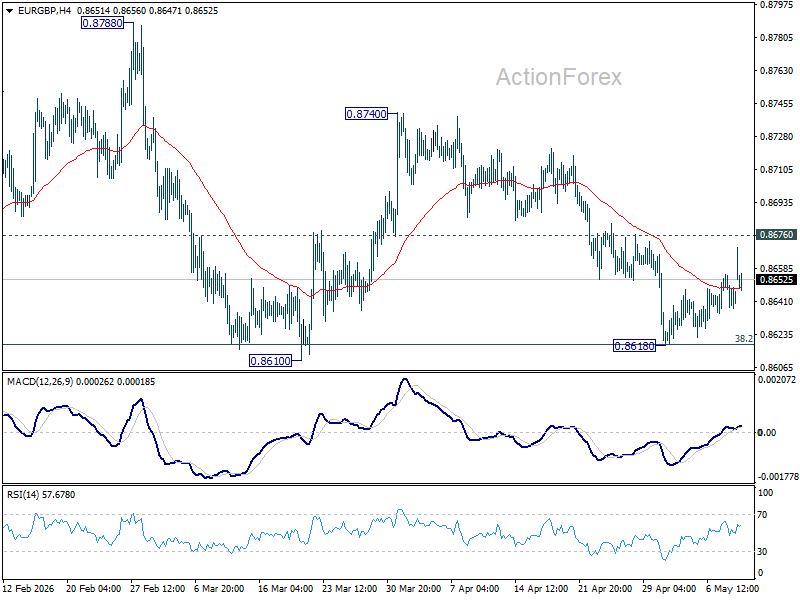
Intraday bias in EUR/GBP remains neutral as consolidations continue above 0.8618. On the downside, firm break of 0.8610 will carry larger bearish implications and pave the way to 0.8466 fibonacci level next. Nevertheless, firm break of 0.8676 will turn bias back to the upside for stronger rebound back to 0.8740 resistance instead.
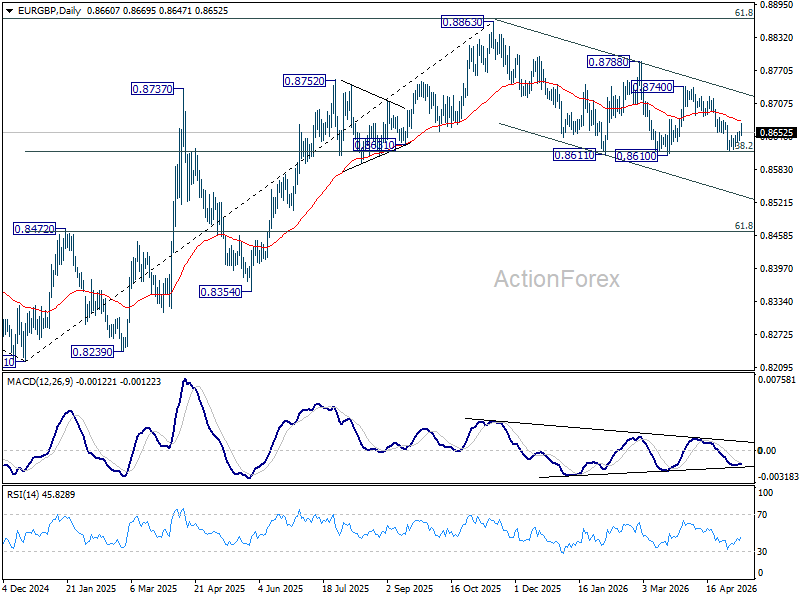
In the bigger picture, focus is back on 38.2% retracement of 0.8821 to 0.8863 at 0.8618. Sustained break there will confirm that whole rise from 0.8221 has completed at 0.8863. Deeper decline should then be seen to 61.8% retracement at 0.8466 at least. For now, risk will stay mildly on the downside as long as 55 D EMA (now at 0.8677) holds, in case of recovery.
EUR/AUD Daily Outlook
Daily Pivots: (S1) 1.6237; (P) 1.6261; (R1) 1.6281; More...
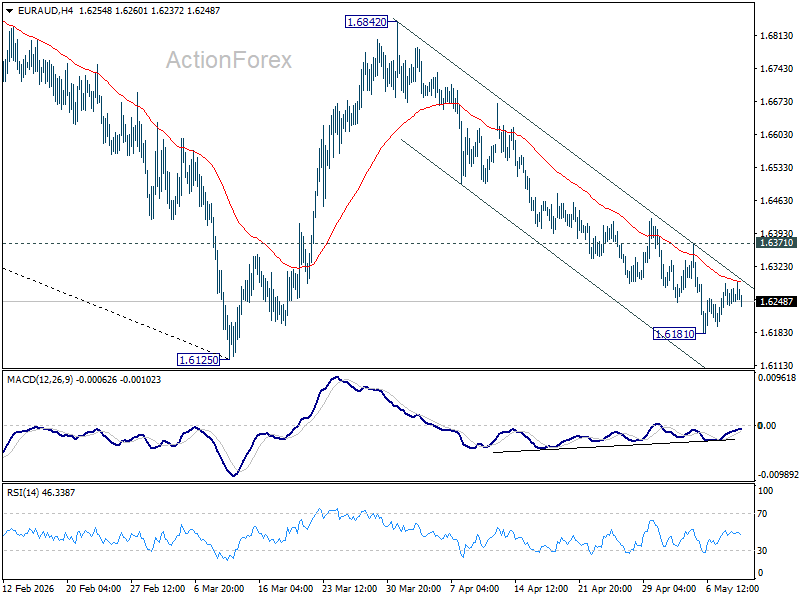
Intraday bias in EUR/AUD remains neutral for consolidations above 1.6181. On the downside, decisive break of 1.6125 will resume larger fall from 1.8554. Nevertheless, break of 1.6371 resistance will indicate short term bottoming, and turn bias back to the upside for stronger rebound to 55 D EMA (now at 1.6516).
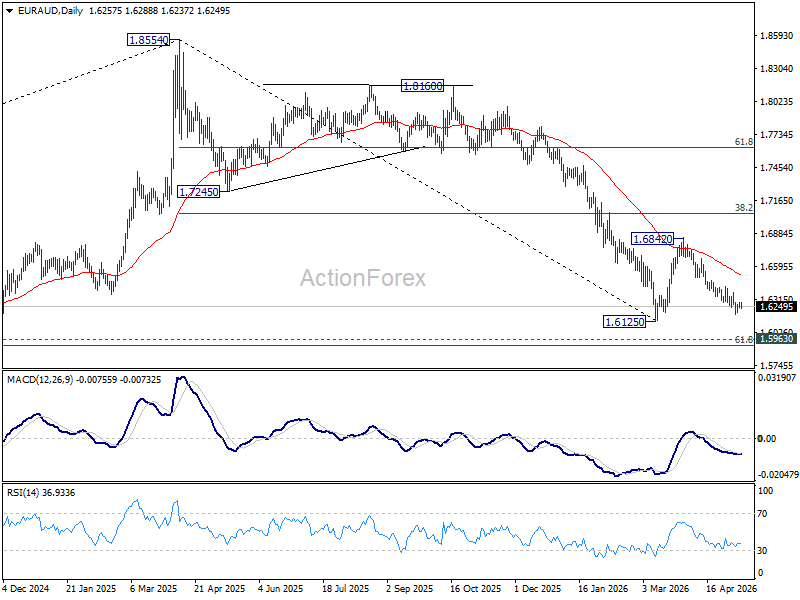
In the bigger picture, fall from 1.8554 (2025 high) is in progress and deeper decline should be seen to 61.8% retracement of 1.4281 to 1.8554 at 1.5913, which is slightly below 1.5963 structural support. Decisive break there will pave the way back to 1.4281 (2022 low). For now, risk will stay on the downside as long as 55 W EMA (now at 1.7039) holds, even in case of strong rebound.
EUR/CHF Daily Outlook
Daily Pivots: (S1) 0.9134; (P) 0.9147; (R1) 0.9161; More....
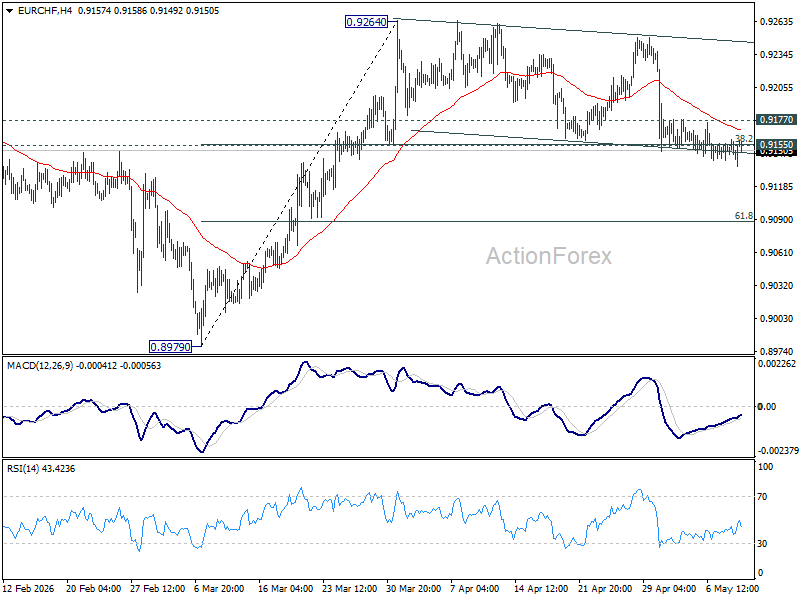
EUR/USD is still struggling in tight range around 0.9155 cluster support (38.2% retracement of 0.8979 to 0.9264 at 0.9155). Intraday bias remains neutral a this point. On the upside, break of 0.9177 minor resistance will turn bias back to the upside for 0.9264 resistance. However, sustained trading below 0.9155 will turn bias back to the downside for deeper pullback to 61.8% retracement at 0.9088 and possibly below.
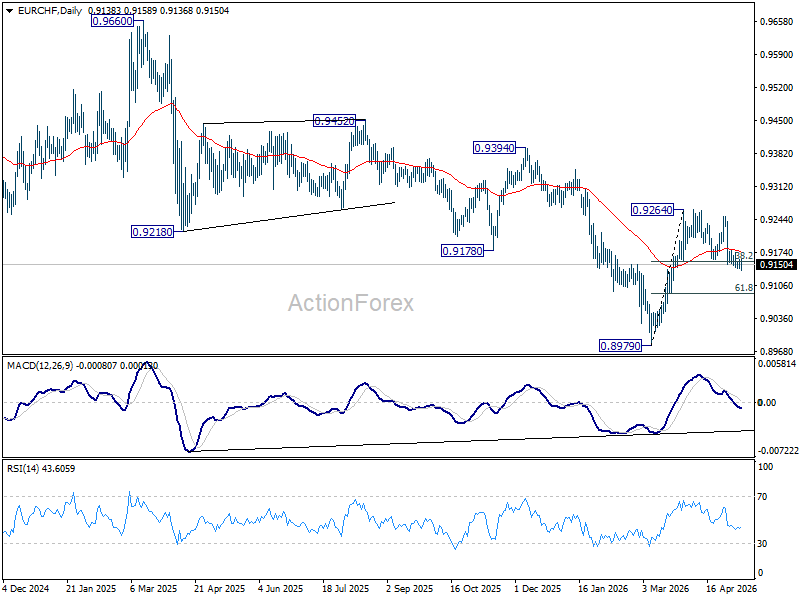
In the bigger picture, considering bullish convergence condition in W MACD, a medium term bottom should be in place at 0.8979. Sustained trading above 55 W EMA (now at 0.9241) will add more credence to this case. Further break of 0.9394 resistance will pave the way to 0.9660 resistance next. However rejection by the 55 W EMA will set up another fall through 0.8979 low at a later stage.
USD/CAD Daily Outlook
Daily Pivots: (S1) 1.3642; (P) 1.3675; (R1) 1.3709; More...
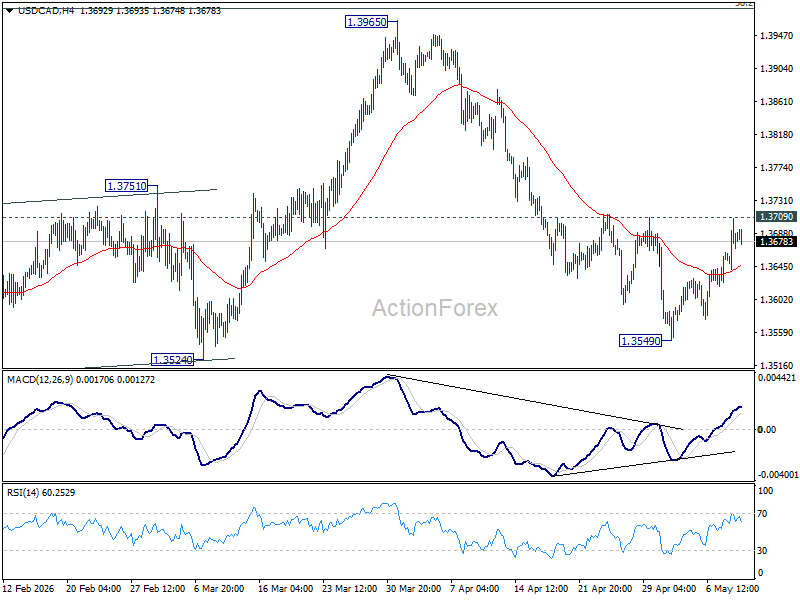
Intraday bias in USD/CAD remains neutral for the moment. On the downside, below 1.3549 will extend the fall from 1.3965 to retest 1.3480 low. Decisive break there will resume whole down trend from 1.4791. However, sustained break of 1.3709 will confirm short term bottoming, and turn bias back to the upside for 1.3965 resistance again.
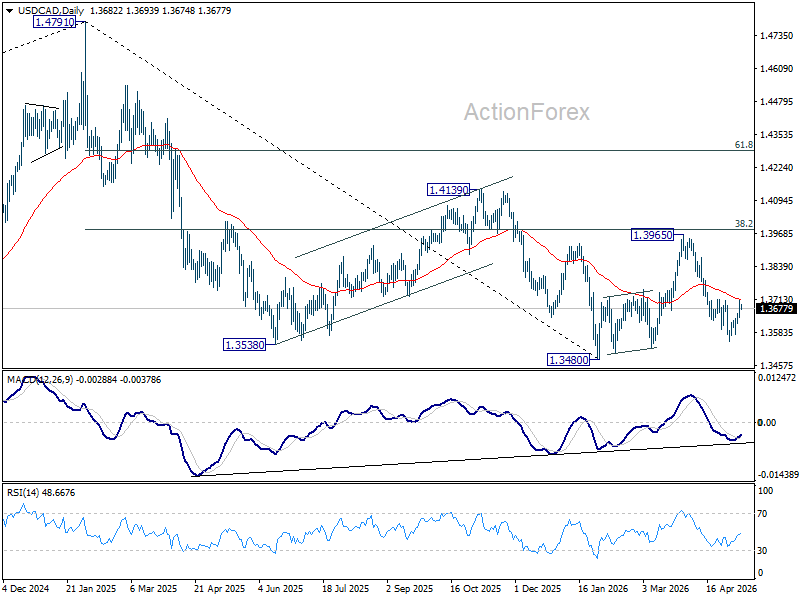
In the bigger picture, price actions from 1.4791 are seen as a corrective pattern to the whole up trend from 1.2005 (2021 low). Deeper fall could be seen, as the pattern extends, to 61.8% retracement of 1.2005 to 1.4791 at 1.3069. However, decisive break of 38.2% retracement of 1.4791 to 1.3480 at 1.3981 will argue that the correction has completed with three waves down to 1.3480 already.
AUD/USD Daily Report
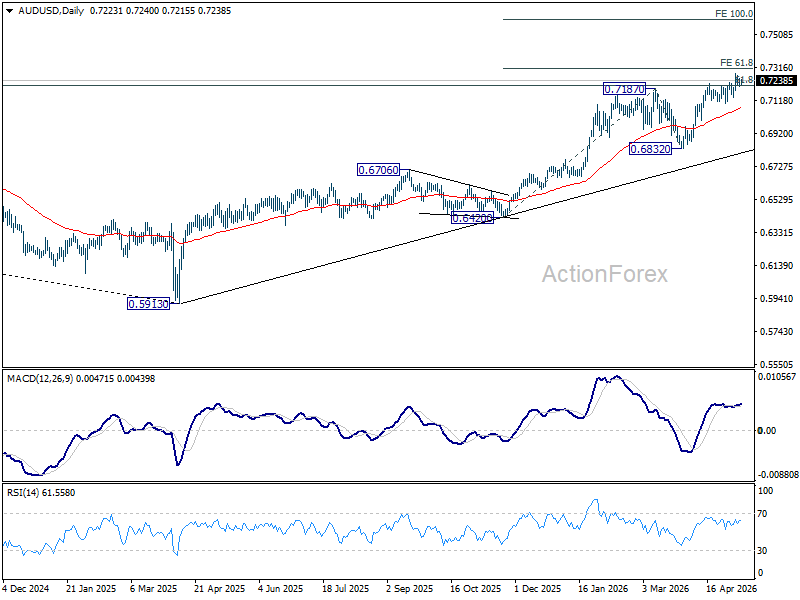
Daily Pivots: (S1) 0.7213; (P) 0.7230; (R1) 0.7262; More...
Intraday bias in AUD/USD remains neutral for consolidations below 0.7277. Further rise is expected as long as 0.7101 support holds. On the upside, above 0.7277 will resume larger up trend and target 61.8% projection of 0.6420 to 0.7187 from 0.6832 at 0.7306.
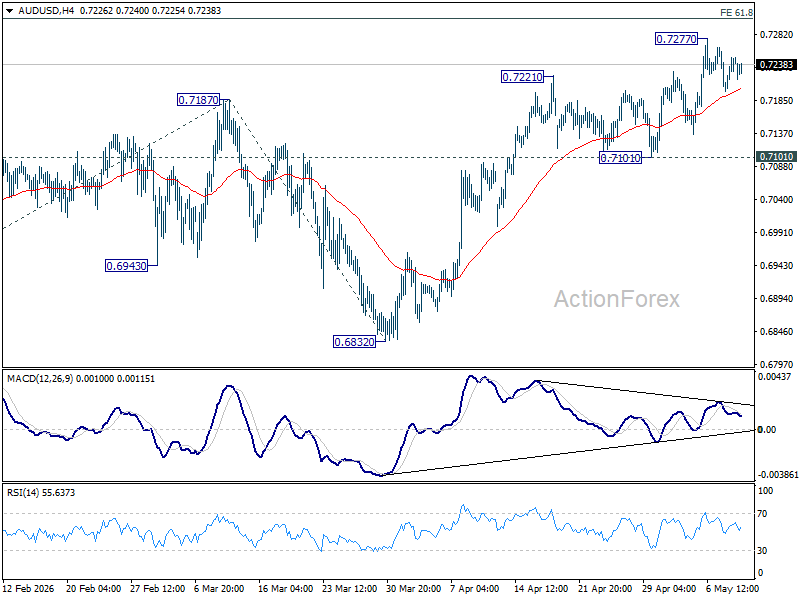
In the bigger picture, rise from 0.5913 (2024 low) is still in progress. Decisive break of 61.8% retracement of 0.8006 to 0.5913 at 0.7206 will solidify the case that it's already reversing the down trend from 0.8006 (2021 high). Further rally should then be seen to retest 0.8006. For now, outlook will remain bullish as long as 0.6832 support holds, in case of pullback.
EUR/USD Daily Outlook
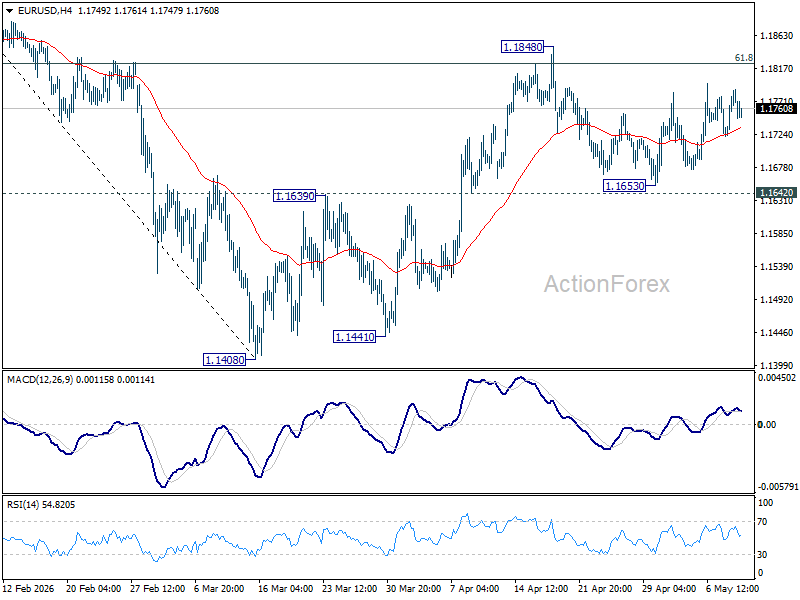
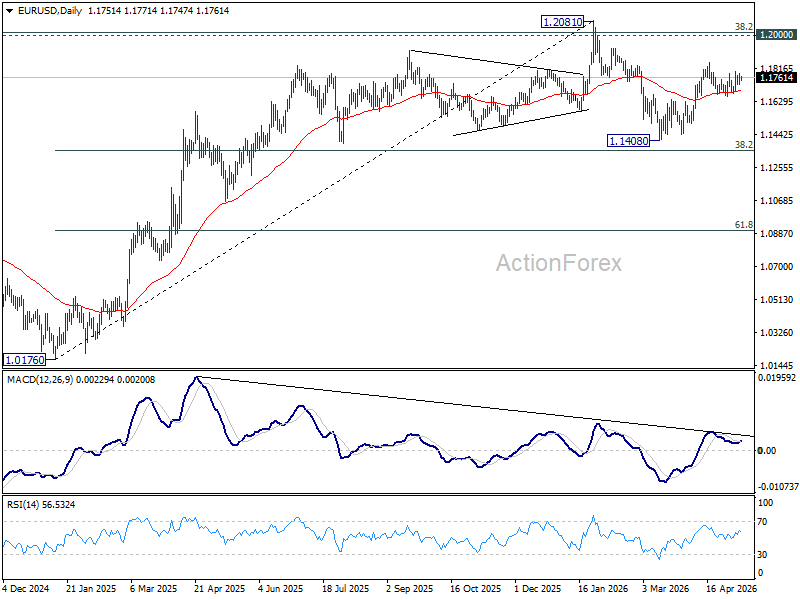
Daily Pivots: (S1) 1.1740; (P) 1.1764; (R1) 1.1806; More….
Range trading continues in EUR/USD and intraday bias remains neutral. Further rise is expected with 1.1642 support intact. On the upside, firm break of 1.1848 will target 1.2081 high next. However, firm break of 1.1662 support will indicate the the rebound from 1.1408 has completed, and bring deeper decline back towards this low instead.
In the bigger picture, the strong support from 38.2% retracement of 1.0176 to 1.2081 at 1.1353 suggests that the pullback from 1.2081 is more likely a corrective move. Strong support was also found in 55 W EMA (now at 1.1539). Focus is back on 1.2 key cluster resistance level. Decisive break there will carry long term bullish implications. Nevertheless, break of 1.1408 support will revive the case of medium term bearish trend reversal.
GBP/USD Daily Outlook
Daily Pivots: (S1) 1.3568; (P) 1.3602; (R1) 1.3659; More...
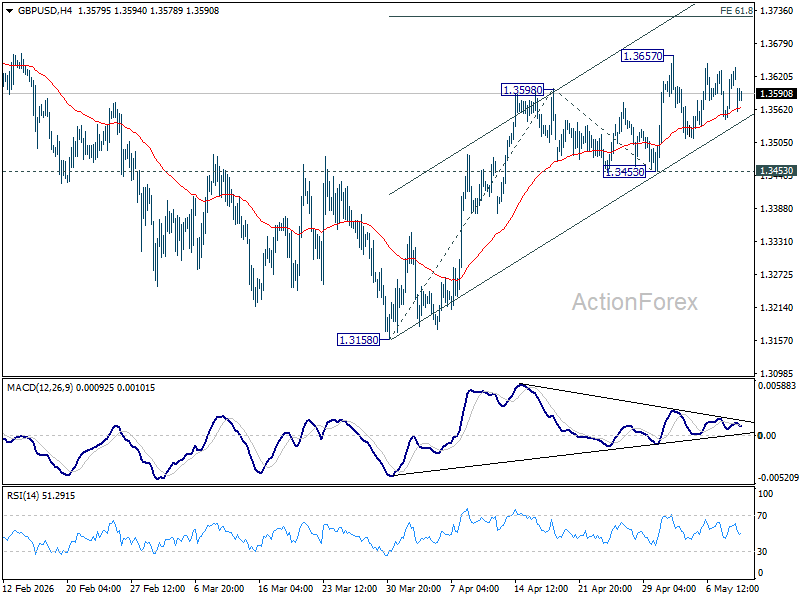
Intraday bias in GBP/USD remains neutral as sideway trading continues. Further rise is expected with 1.3453 support intact. On the upside, break of 1.3657 will target 61.8% projection of 1.3158 to 1.3598 from 1.3453 at 1.3725 first. Firm break there will target a retest on 1.3867 high.
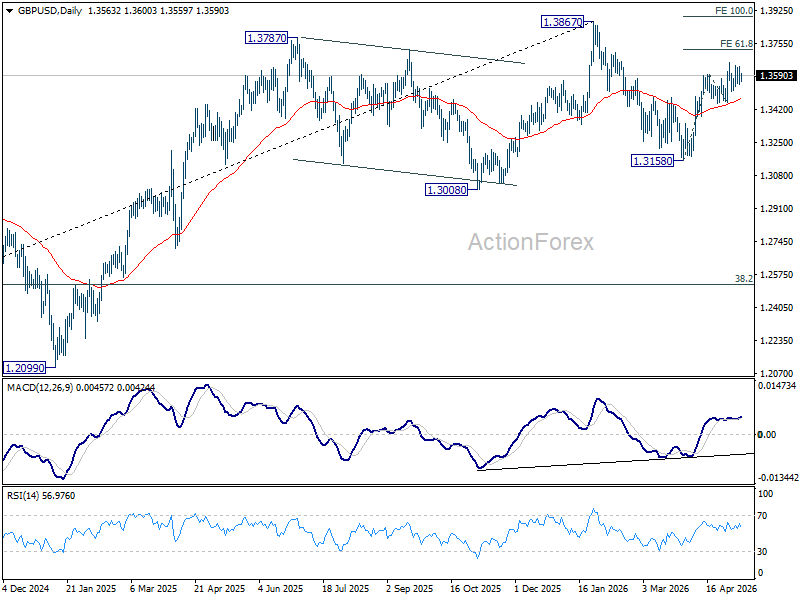
In the bigger picture, current development suggests that price actions from 1.3867 are merely a corrective pattern within the broader up trend from 1.0351 (2022 low). With 1.3008 support intact, medium term bullishness is maintained and break of 1.3867 is in favor for a later stage, towards 1.4248 key resistance (2021 high).
USD/JPY Daily Outlook
Daily Pivots: (S1) 156.41; (P) 156.69; (R1) 156.97; More...
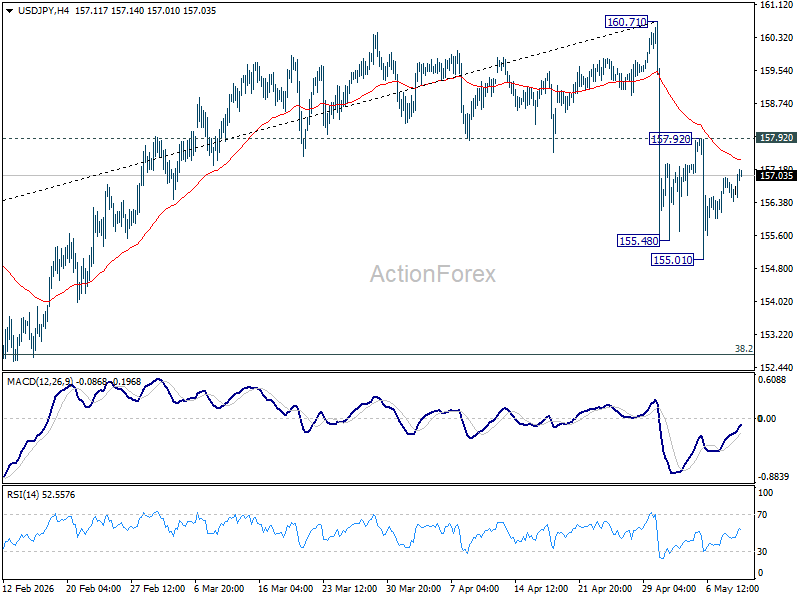
Intraday bias in USD/JPY remains neutral at this point. On the downside, break of 155.01 will resume the fall from 160.71 to 152.25 support next. On the upside, however, firm break of 157.92 will indicate that pullback from 160.71 has completed, and turn bias back to the upside for stronger rebound.
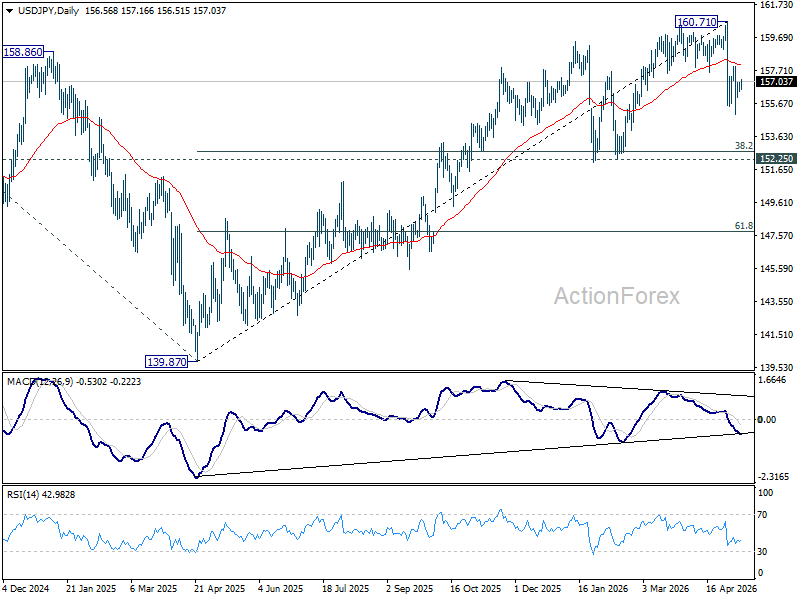
In the bigger picture, for now, corrective pattern from 161.94 (2024 high) is still seen as completed at 139.87. Rise from there is seen as resuming the long term up trend. So, break of 161.94 is expected at a later stage to resume the long term up trend. However, sustained break of 55 W EMA (now at 154.13) will dampen this view and bring deeper fall back towards 139.87 to extend the pattern from 161.94.
Sunrise Market Commentary
Markets
April payrolls in the US were stronger than expected (115k vs 65k) and confirm outgoing Fed chair Powell’s message at the presser of the April policy meeting. He said the labour market is showing “more and more signs of stability” after a year of near-zero job growth. Inflation, by contrast, was “kind of misbehaving”. With upside risks posed by the Iran war looming, there’s no reason to expect any near-term policy easing. Markets price a long rates status quo at least through the end of the year. Treasuries gained ground, outperforming Bunds in the process. US rates lost a couple of basis points, between 2.7 and 3.8 bps. German rates steadied with some minor underperformance at the front end of the curve, where the 2-yr yield added 1.5 bps. Oil prices on Friday weren’t guiding much by flatlining around but above $100. The black gold stayed on the sidelines while awaiting Iran’s response to the latest US proposal to end the war. That finally came over the weekend and received a hard pass from president Trump. "I have just read the response from Iran’s so-called 'Representatives.' I don’t like it — TOTALLY UNACCEPTABLE!” Brent jumps more than 4% at the Asian open today. A barrel currently trades at $105+. Treasury yields erase Friday’s limited gains by adding 3-4.5 bps across the curve. The US dollar recoups some of the losses it incurred end last week. EUR/USD turns lower to 1.175 after having flirted with the 1.18 barrier. The greenback on a trade-weighted basis hovers around 98. USD/JPY finds a short-term equilibrium between 156 and 158 after a series of FX interventions since April 30 by Japanese authorities. Sterling digested Labour’s devastating election blow, which included a historical loss in the Welsh parliament, very well. EUR/GBP depreciated to 0.864. Prime minister Starmer vowed to stay on as prime minister – easing concerns that a change could lead to less fiscal prudence – but he is not out of the woods. He planned a speech today to outline plans to overturn the party’s fate. If deemed insufficient, it might prompt leadership challenges.
The eco calendar today is pretty uninspiring, so we’ll mostly be looking for the fall-out of the US disapproval of Iran’s counterproposal. It leaves president Trump with little, if any, progress in the war with Iran before his closely watched encounter with his Chinese counterpart on Thursday and Friday. Key talking points include trade (truce extension), Tehran and Taiwan but there’s not much expected in terms of a breakthrough. Important economic data later this week is limited to tomorrow’s US April CPI and Friday’s retail sales. The country kicks of its mid-month refinancing operations with a $58bn 3-year bond sale today. A 10-yr and 30-yr bond sale (tomorrow and Wednesday) are the ones to follow-up on closely.
News & Views
KMPG and REC’s monthly UK reports on jobs showed permanent placements falling at a quicker rate in April amid greater market uncertainty. The report, compiled by S&P global, also throw rising business costs in the mix. Although conditions remain more favourable than they were through much of 2025, hiring decisions are being referred because of uncertainty stemming from the war in Iran. While slightly rising temp billings offered some counterweight, total demand for workers was still declining (13th consecutive month). The overall availability of workers continued to increase markedly in April. Redundancies and lower demand were key factors for the latest rise in candidate numbers. Starting salaries for permanent workers increased again, but the rate of pay growth remains below the series long-term average.
Chinese producer prices increased at the quickest pace since October 2021 in April. They rose by 1.7% M/M, up from 1% in March and moving the annual PPI pace from 0.5% to 2.8%, the fastest increase since July 2022. The Iran war is the obvious catalyst of rising factory-gate prices. Consumer price inflation rose by 0.3% M/M and from 1% Y/Y to 1.2% on a headline level. Core CPI went from 1.1% Y/Y to 1.2% Y/Y. Apart from transportation and energy costs, there was a price boost from holiday travel demand. Separate details showed consumer goods inflation picking up from 1.3% to 1.4% Y/Y and services inflation moving from 0.8% to 0.9% Y/Y.
Oil Prices Jump on Iran Counterproposal
In focus today
In Norway, April inflation data is due for release. There are usually large fluctuations in the various price components during the Easter months of March and April. This year, Easter was a week earlier than last year, and many of the offers for typical Easter products were more extensive in March than last year. We expect this to result in a solid lift in the annual growth in food prices in April, but that parts of the service sector such as cultural activities and hotels and restaurants will show the opposite development. We expect core inflation to rise from 3.0% y/y to 3.2% y/y in April. This would be in line with both consensus and Norges Bank's estimate from the MPR in March.
In Denmark, April inflation data is also set for release. We expect headline inflation at 1.4% y/y, up from 1.2% y/y in March, driven by higher fuel prices.
In Japan, Q1 GDP data will be released overnight. Both the Tankan business survey and PMIs suggest the economy was on a decent footing in Q1. Since then, the service sector has slowed down but remains in expansionary territory.
The rest of the week brings a light data calendar, with the most important releases being US April CPI on Tuesday and the Riksbank minutes on Wednesday. Developments in the US-Iran war remain a key focus. In addition, Trump will visit Beijing for meetings with President Xi Jinping on Thursday and Friday.
Economic and market news
What happened overnight
In China, April inflation came in higher than expected on the back of higher global energy prices. PPI rose to 2.8% y/y (cons:1.6%, prior: 0.5%), the highest reading since mid‑2022. CPI also beat expectations at 1.2% y/y (cons: 0.9%, prior: 1.0%), with gains concentrated in gasoline and gold jewellery. The move further distances China from the deflation seen over the past years, but the impulse is largely cost‑push rather than demand‑driven. Against a backdrop of weak domestic demand, today's figures are unlikely to prompt a significant policy shift, though they may slightly reduce the urgency for further monetary easing.
What happened over the weekend
In the Middle East conflict, Iran sent its response to a US proposal for peace talks via mediator Pakistan, reportedly focused on ending the war on all fronts. The Iranian counterproposal includes demands for compensation for war damages, recognition of Iranian sovereignty over the Strait of Hormuz, an end to the US naval blockade, guarantees against further attacks and a lifting of sanctions. President Trump deemed the proposal "totally unacceptable" on Truth Social. Brent crude is up around 6% from Friday's close, trading around USD106/bbl this morning. Despite the month‑old ceasefire, security in the Gulf remains fragile, with reports of hostile drones over the weekend, although a Qatari LNG tanker was allowed to transit the strait to Pakistan.
In the US, the April jobs report came in as a mixed bag. Nonfarm payrolls surprised to the topside at 115k (cons: 62k, Danske: 80k), while the unemployment rate held at 4.3%. Cumulative revisions to NFP were -16k. Wage growth was weaker than expected, with average hourly earnings up by only 0.2% m/m SA (cons: 0.3%). The household survey painted a weaker picture, showing a 226k drop in employment and a 92k decline in the labour force, helping explain why the unemployment rate did not tick down despite the strong NFP. We do not expect the print to have a significant lasting impact on the Fed policy outlook.
Also in the US, consumer sentiment weakened further in May, with the preliminary University of Michigan index declining to 48.2 (cons: 49.5, prior: 49.8). At the very least, inflation expectations ticked slightly lower on both the 1‑year and 5‑year horizons, to 4.5% and 3.4%, respectively.
In Sweden, household consumption rose by 1.4% m/m in March, in line with the forecast, driven mainly by 'Recreation and culture, goods and services' as well as 'Retail trade, mostly food and beverages'. Private sector production (PVI) increased by 2.2% m/m in services and 6.6% m/m in construction, while industry declined by 2% m/m. New industrial orders declined by 1.4% m/m, although most subsectors still recorded monthly increases.
In the UK, local election results confirmed a major set-back for Labour, with the party suffering the worst municipal losses for a governing party since 1995. Pressure on PM Starmer has increased, with more than 20 Labour lawmakers calling for a timetable for his departure. However, Starmer confirmed that he would not stand down. Former minister West said she would challenge him for the Labour leadership on Monday if no other candidate came forward.
Equities: Global equities closed last week on a strong footing, with risk appetite supported by a mixed but ultimately benign April US jobs report. On Friday, S&P500 rose 0.8%, driven yet again by higher tech. Nasdaq rose 1.7%, Russell2000 rose 0.8%. Global equities posted a 1.8% return seen over last week. The weekend news of US dismissal of the Iranian proposal as "totally unacceptable", has pushed oil prices around 4% higher this morning. That said, Asian markets are having a quiet start to the week with limited reactions to this with the exception of tech impacted indices such as Kospi benefiting from Friday's IT rally. US futures are virtually unchanged.
FI and FX: US President Trump's dismissal of the Iranian response to the US peace proposal as 'totally unacceptable' has sparked renewed concerns that a lasting resolution to the war is still some way out. The UAE, Kuwait and Qatar have all reported incidents involving hostile drones over the weekend, leaving the ceasefire in a fragile state. Brent Crude pushed above USD105/bbl. and EUR/USD declined below 1.1760, reversing some of the gains following last week's April NFP print of +115k. Over the last week apparent willingness from both the US and Iran caused the market to slowly reprice the ECB rate path. Bond yields declined with the 10Y German government bond dropping to 3% after testing 3.10%. 30Y Treasuries tested the 5%-level but have now edged down to 4.97%. If deescalation picks back up, we see this move extending. Going into this week, we eye the war in the Middle East and the Trump-Xi Jinping meeting in Beijing on Thursday and Friday, although we do not anticipate any deals to be made. On the data front, our focus will be on the US April CPI tomorrow and the Norwegian CPI figures this morning. The monthly CPI figures out of Norway have become increasingly important following Norges Bank's more neutral post-hike guidance last week.