

Sample Category Title
EUR/USD Daily Outlook
Daily Pivots: (S1) 1.1752; (P) 1.1769; (R1) 1.1799; More….
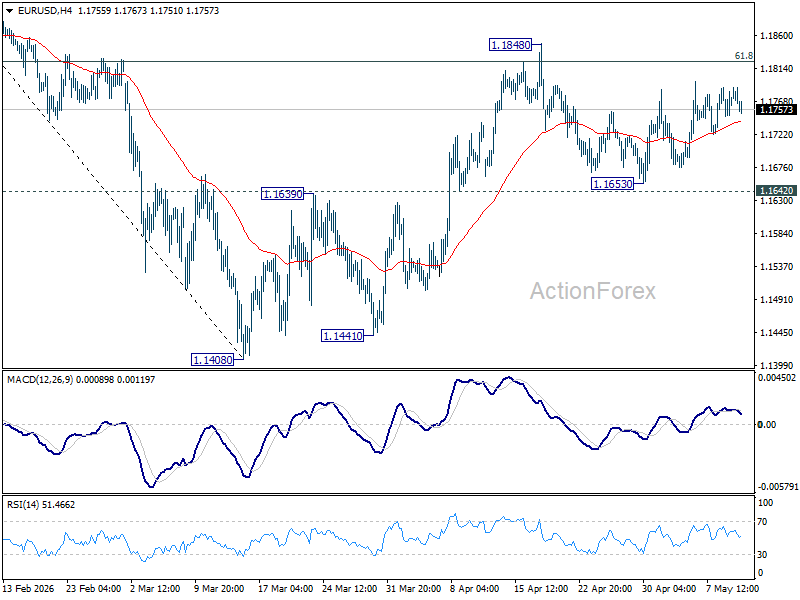
Intraday bias in EUR/USD remains neutral and outlook is unchanged. Further rise is expected with 1.1642 support intact. On the upside, firm break of 1.1848 will target 1.2081 high next. However, firm break of 1.1662 support will indicate the the rebound from 1.1408 has completed, and bring deeper decline back towards this low instead.
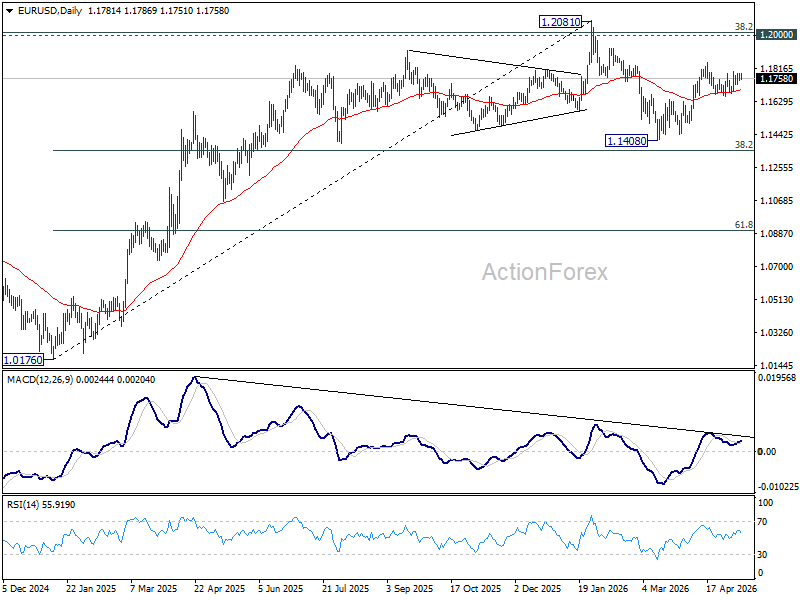
In the bigger picture, the strong support from 38.2% retracement of 1.0176 to 1.2081 at 1.1353 suggests that the pullback from 1.2081 is more likely a corrective move. Strong support was also found in 55 W EMA (now at 1.1539). Focus is back on 1.2 key cluster resistance level. Decisive break there will carry long term bullish implications. Nevertheless, break of 1.1408 support will revive the case of medium term bearish trend reversal.
USD/JPY Daily Outlook
Daily Pivots: (S1) 156.63; (P) 156.94; (R1) 157.46; More...
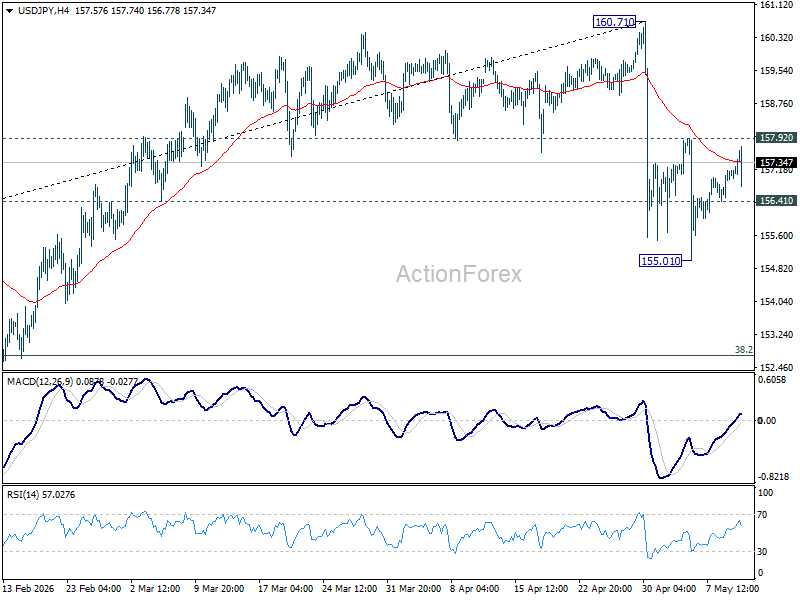
Intraday bias in USD/JPY stays neutral for the moment. On the downside, below 156.41 minor support will bring retest of 155.01. Firm break there will resume the fall from 160.71 to 152.25 support next. On the upside, however, firm break of 157.92 will indicate that pullback from 160.71 has completed, and turn bias back to the upside for stronger rebound.
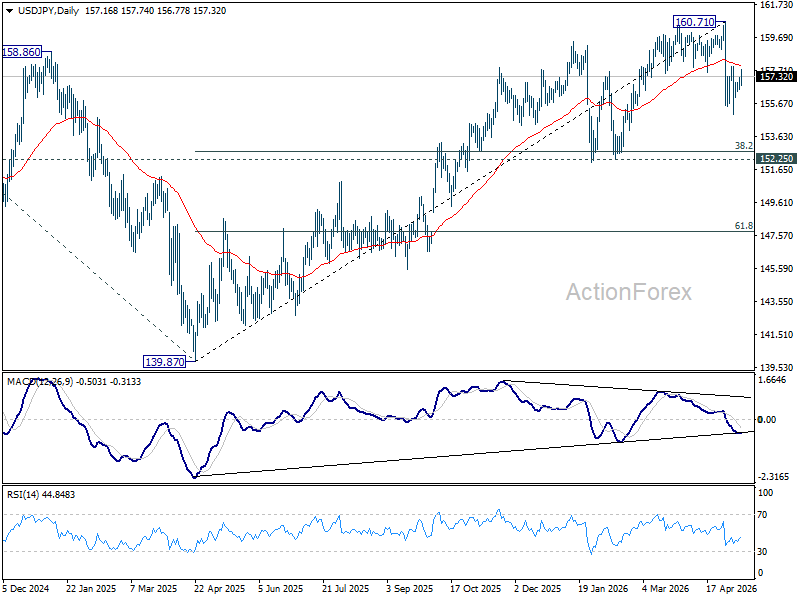
In the bigger picture, for now, corrective pattern from 161.94 (2024 high) is still seen as completed at 139.87. Rise from there is seen as resuming the long term up trend. So, break of 161.94 is expected at a later stage to resume the long term up trend. However, sustained break of 55 W EMA (now at 154.13) will dampen this view and bring deeper fall back towards 139.87 to extend the pattern from 161.94.
GBP/USD Daily Outlook
Daily Pivots: (S1) 1.3555; (P) 1.3603; (R1) 1.3656; More...
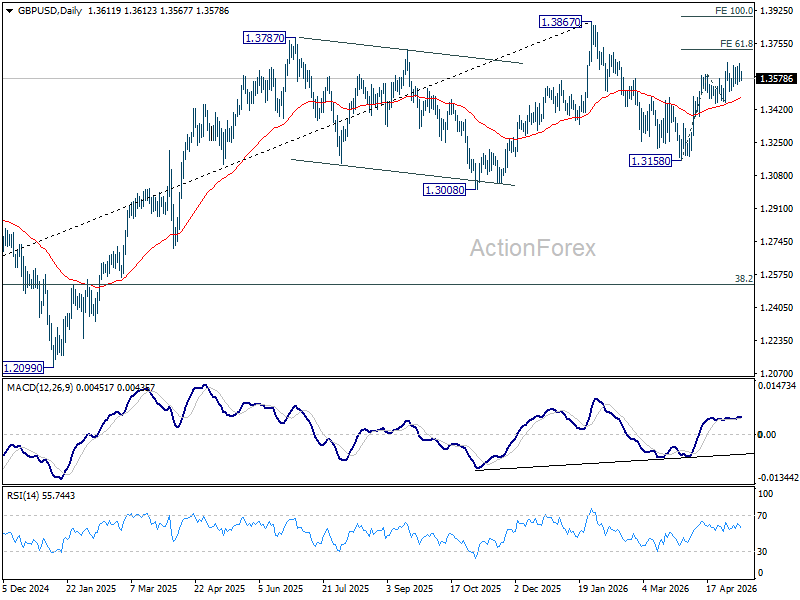
Intraday bias in GBP/USD remains neutral and more consolidations could be seen. With 1.3453 support intact, further rise is expected. On the upside, break of 1.3657 will target 61.8% projection of 1.3158 to 1.3598 from 1.3453 at 1.3725 first. Firm break there will target a retest on 1.3867 high.
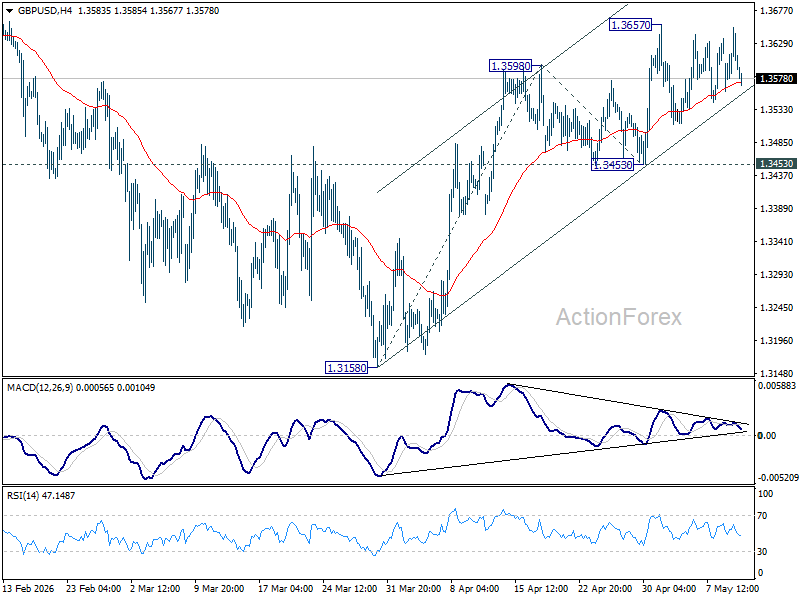
In the bigger picture, current development suggests that price actions from 1.3867 are merely a corrective pattern within the broader up trend from 1.0351 (2022 low). With 1.3008 support intact, medium term bullishness is maintained and break of 1.3867 is in favor for a later stage, towards 1.4248 key resistance (2021 high).
USD/CHF Daily Outlook
Daily Pivots: (S1) 0.7759; (P) 0.7776; (R1) 0.7791; More….
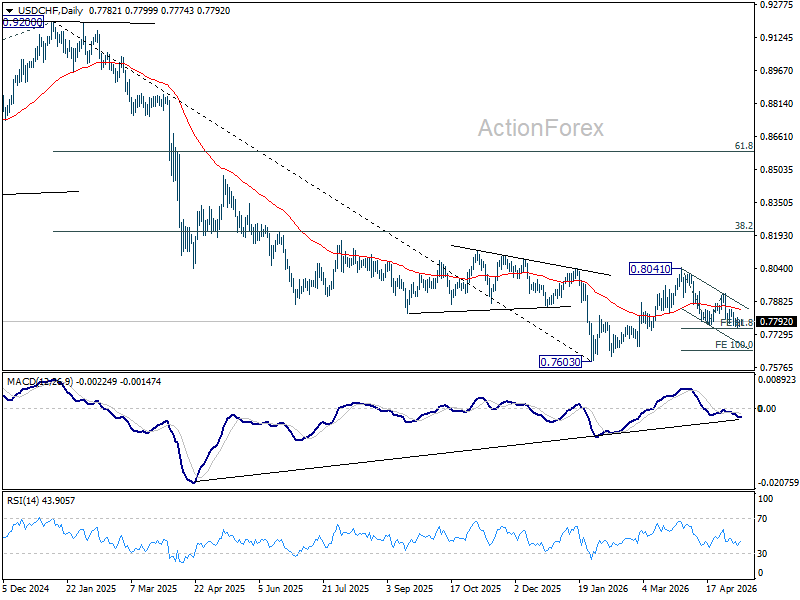
Intraday bias in USD/CHF remains neutral and some more consolidations could be seen. Further fall is expected with 0.7847 resistance intact. On the downside, decisive break of 61.8% projection of 0.8041 to 0.7774 from 0.7923 at 0.7758 will resume the whole decline form 0.8041, and target 100% projection at 0.7656. However, firm break of 0.7847 resistance will indicate short term bottoming, and bring stronger rebound back to 0.7923 resistance.
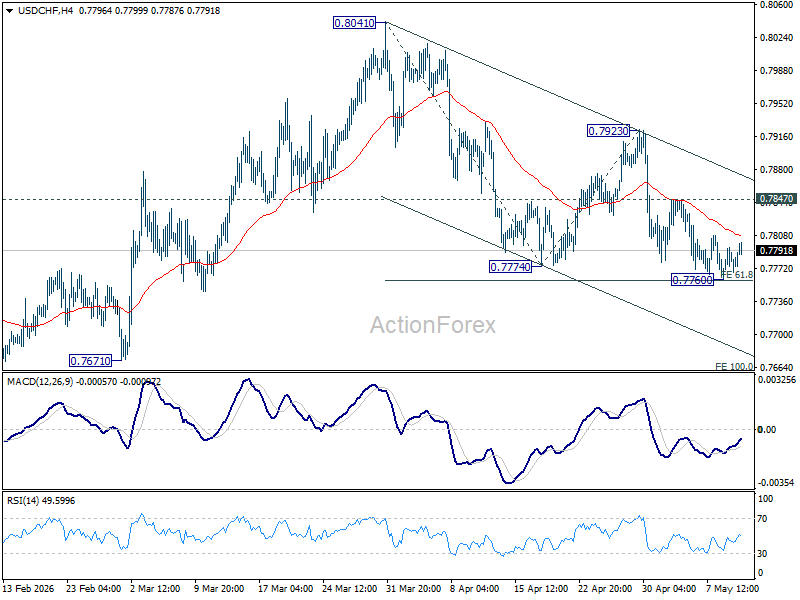
In the bigger picture, as long as 55 W EMA (now at 0.8051) holds, fall from 0.9200 is expected to continue, as part of the larger down trend. Firm break of 0.7603 will target 100% projection of 1.0146 (2022 high) to 0.8332 from 0.9200 at 0.7382.
AUD/USD Daily Report
Daily Pivots: (S1) 0.7222; (P) 0.7240; (R1) 0.7266; More...
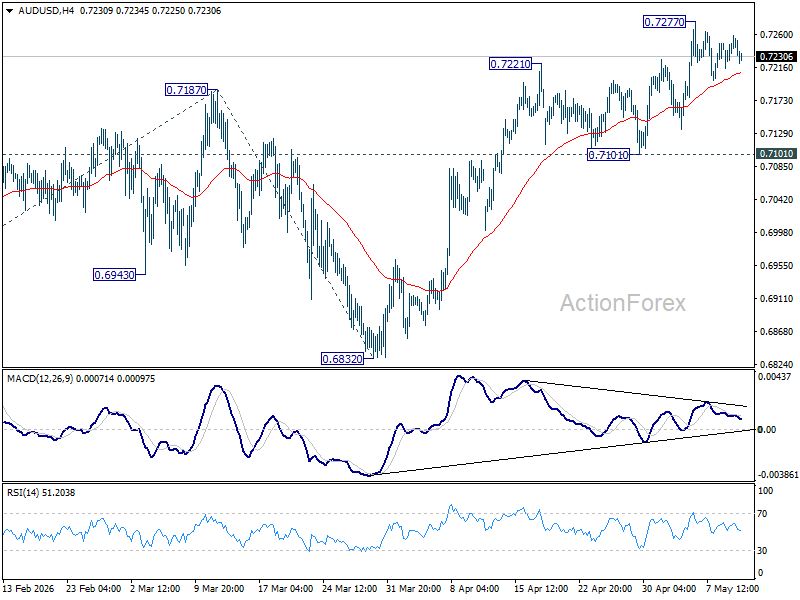
Range trading continues in AUD/USD below 0.7277 and intraday bias remains neutral. Further rise is expected as long as 0.7101 support holds. On the upside, above 0.7277 will resume larger up trend and target 61.8% projection of 0.6420 to 0.7187 from 0.6832 at 0.7306.
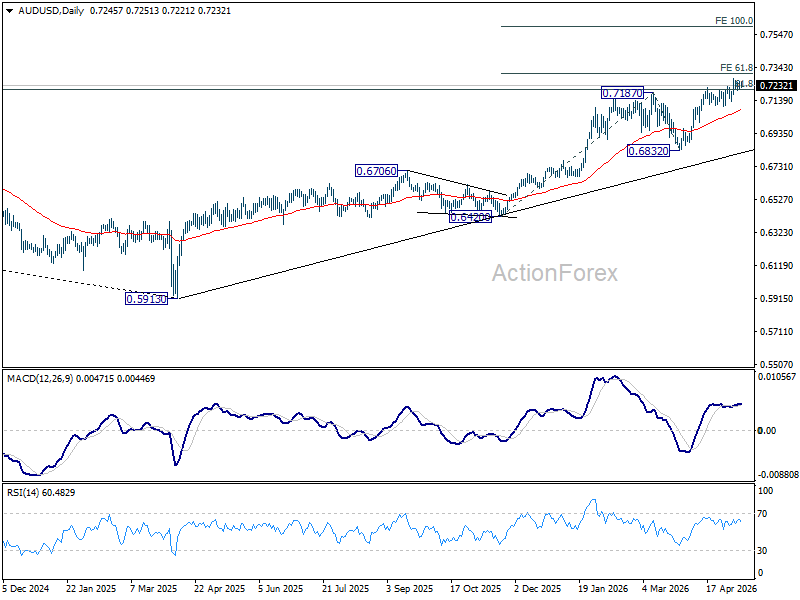
In the bigger picture, rise from 0.5913 (2024 low) is still in progress. Decisive break of 61.8% retracement of 0.8006 to 0.5913 at 0.7206 will solidify the case that it's already reversing the down trend from 0.8006 (2021 high). Further rally should then be seen to retest 0.8006. For now, outlook will remain bullish as long as 0.6832 support holds, in case of pullback.
USD/CAD Daily Outlook
Daily Pivots: (S1) 1.3650; (P) 1.3672; (R1) 1.3697; More...
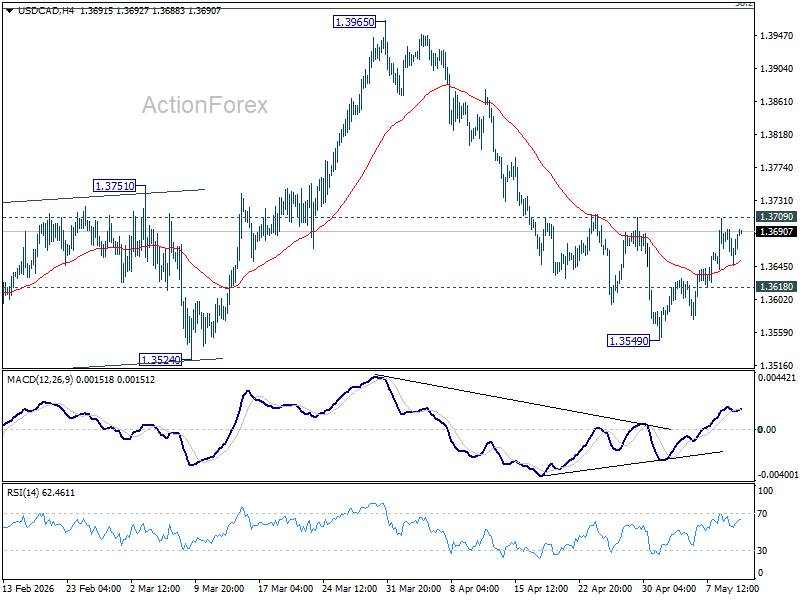
Intraday bias in USD/CAD remains neutral for the moment. On the downside, below 1.3618 minor support will suggest that recovery fro 1.3549 has completed, and turn intraday bias back to the downside. Break of 1.3549 will bring retest of 1.3480 low. However, sustained break of 1.3709 will confirm short term bottoming. Intraday bias will be back on the upside for 1.3965 resistance again, as in the third leg of the corrective pattern from 1.3480.
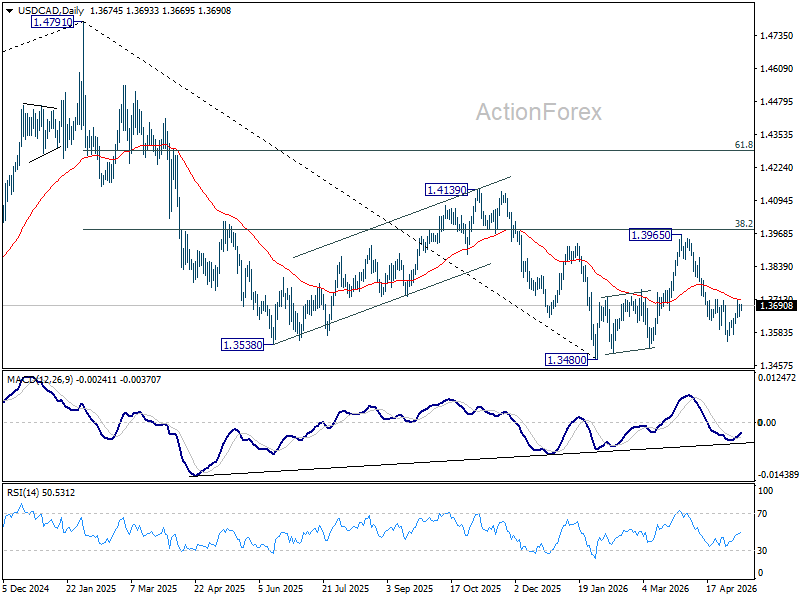
In the bigger picture, price actions from 1.4791 are seen as a corrective pattern to the whole up trend from 1.2005 (2021 low). Deeper fall could be seen, as the pattern extends, to 61.8% retracement of 1.2005 to 1.4791 at 1.3069. However, decisive break of 38.2% retracement of 1.4791 to 1.3480 at 1.3981 will argue that the correction has completed with three waves down to 1.3480 already.
Markets Turn to US CPI as Geopolitical Traders Hold Fire
Markets entered a temporary holding pattern on today as traders largely refrained from making aggressive geopolitical bets ahead of both US inflation data and Thursday’s Trump-Xi summit. Despite hostile rhetoric surrounding the Iran ceasefire, broader market reactions remained restrained, with investors appearing reluctant to commit strongly in either direction until clearer signals emerge later this week.
US President Donald Trump sharply escalated his criticism of Tehran overnight, describing the month-old ceasefire as “unbelievably weak” and effectively “on massive life support” after Iran submitted what he called an “unacceptable” counterproposal to Washington’s latest peace framework. “I would say the ceasefire is on massive life support, where the doctor walks in and says, ‘Sir, your loved one has approximately a 1% chance of living,’” Trump said in the Oval Office. Still, markets showed only measured reactions to the comments.
US equities closed modestly higher overnight, Brent crude stayed capped around the $105 level, and the US 10-year Treasury yield edged up only slightly to around 4.41%. Dollar attempted to extend its recent rebound but remained trapped within familiar trading ranges without decisive follow-through momentum. However, despite the deteriorating rhetoric, markets appear increasingly focused on whether larger geopolitical powers can eventually engineer some form of containment framework.
For now, traders appear unwilling to significantly expand geopolitical positioning before Thursday’s Trump-Xi summit in Beijing. When Pakistan’s mediation stalled last month, it exposed a fundamental wall that Islamabad couldn't climb: Trust and Enforceability. Pakistan has the diplomatic ties, but China has the "checkbook" and the "oil straw" that Iran actually depends on.
China is increasingly viewed as the only party with the leverage to actually reopen the Strait of Hormuz. Recent reports indicate that Iranian officials have been in Beijing specifically to discuss reopening the shipping lanes. Investors likely believe that no matter how much "garbage" (to use Trump's word) is in the current proposal, the real deal will be brokered—or at least green-lit—by Xi and Trump face-to-face.
As a result, markets are temporarily shifting focus back toward more traditional macro catalysts, with today’s US CPI report as the primary near-term volatility trigger. Markets expect headline CPI to rise 0.6% mom in April, lifting the year-on-year rate to 3.7%, which would mark the strongest inflation reading since September 2023. Core CPI is projected to accelerate from 2.6% yoy to 2.7% yoy, partly boosted by a one-time technical adjustment linked to last year’s government shutdown.
The implications for Federal Reserve expectations could be significant. Investors have already been steadily abandoning expectations for rate cuts this year as energy prices rise and inflation risks re-emerge. A hotter-than-expected CPI report could push markets even further toward pricing a prolonged Fed hold — or potentially reopening discussions around additional tightening. The Senate vote on Kevin Warsh’s nomination as Fed Chair is also due today, though markets currently see little chance of surprise around the outcome.
In currency markets, Dollar is currently the strongest major currency for the week so far, followed by Kiwi and Loonie. Yen is the weakest performer, followed by Swiss Franc and Sterling, reinforcing the idea that investors are not yet embracing a full-scale risk-off positioning shift despite lingering geopolitical uncertainty.
In Asia, at the time of writing Nikkei is up 0.42%. Hong Kong HSI is up 0.15%. China Shanghai SSE is down -0.53%. Singapore Strait Times is down -0.08%. Japan 10-year JGB yield is up 0.022 at 2.547. Overnight, DOW rose 0.19%. S&P 500 rose 0.19%. NASDAQ rose 0.10%. 10-year yield rose 0.04 to 4.41.
Silver’s $6 Surge May Be the Start of a FOMO Phase
Silver’s explosive rally may be entering a new phase as investors abandon hopes for a pullback and begin chasing momentum instead. The metal’s breakout above the critical 84.21–84.46 resistance zone, combined with a collapsing Gold-Silver Ratio and persistent global supply deficits, is fueling speculation that the rally could accelerate further toward 92.90. Read More.
BoJ Summary Shows Growing Support for Near-Term Rate Hike
The BOJ’s April meeting summary revealed a noticeably more hawkish debate inside the board, with several policymakers openly discussing the possibility of another rate hike as the Iran-driven oil shock lifts inflation risks. Markets are increasingly pricing a potential move as early as June. Read More.
Australia NAB Survey Shows Cost Growth Jumps to 4.5% as Margin Squeeze Intensifies
Australia’s April NAB survey painted an increasingly stagflationary picture as purchase cost growth surged to 4.5% following the Middle East energy shock. While firms continued facing rising input costs, weaker trading, employment, and activity indicators suggested margin pressure is beginning to weigh more heavily on the broader economy. Read More.
USD/CAD Daily Outlook
Daily Pivots: (S1) 1.3650; (P) 1.3672; (R1) 1.3697; More...
Intraday bias in USD/CAD remains neutral for the moment. On the downside, below 1.3618 minor support will suggest that recovery fro 1.3549 has completed, and turn intraday bias back to the downside. Break of 1.3549 will bring retest of 1.3480 low. However, sustained break of 1.3709 will confirm short term bottoming. Intraday bias will be back on the upside for 1.3965 resistance again, as in the third leg of the corrective pattern from 1.3480.
In the bigger picture, price actions from 1.4791 are seen as a corrective pattern to the whole up trend from 1.2005 (2021 low). Deeper fall could be seen, as the pattern extends, to 61.8% retracement of 1.2005 to 1.4791 at 1.3069. However, decisive break of 38.2% retracement of 1.4791 to 1.3480 at 1.3981 will argue that the correction has completed with three waves down to 1.3480 already.
Elliott Wave Outlook: Silver (XAGUSD) Five Wave Advance Signals Bullish Continuation
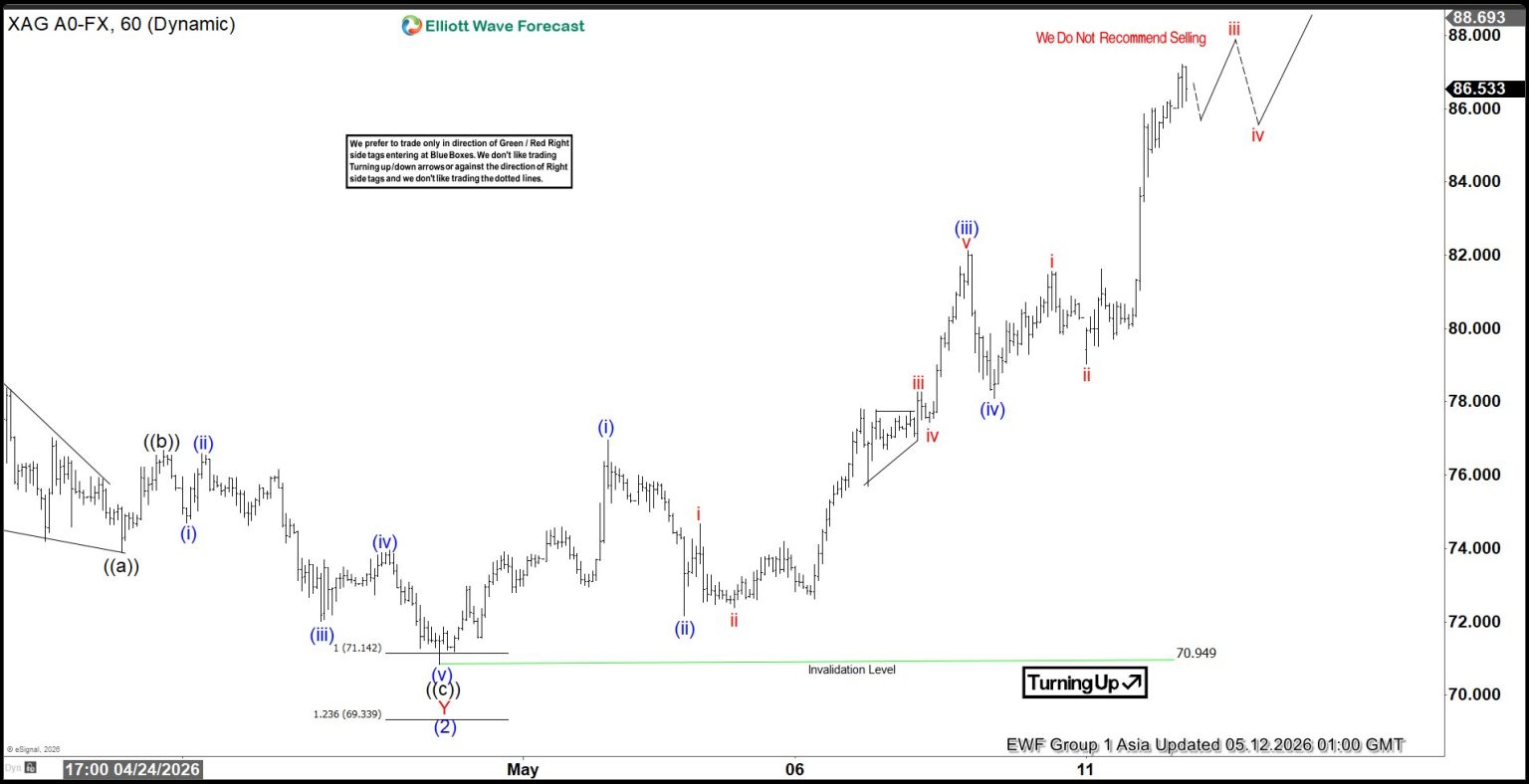
The short‑term Elliott Wave view in Silver (XAGUSD) indicates a constructive bullish sequence after the break above the April 17 peak at 83.05. That move confirmed a higher‑high structure and reinforced the upward bias. From the April 30 low, the rally has unfolded as a five‑wave impulse, a classic Elliott Wave formation that often signals continuation of strength.
Wave (i) advanced to 76.96, while the corrective pullback in wave (ii) found support at 72.16. Momentum then carried the metal higher in wave (iii), reaching 82.12. A modest retracement in wave (iv) concluded at 78.08, preserving the integrity of the bullish sequence. The structure now points toward one final leg higher to complete wave (v). This move should also finalize wave ((i)) of a larger degree, setting the stage for a corrective phase in wave ((ii)). That correction will balance the cycle from the April 30 low before the broader rally resumes.
Near term, the key pivot rests at 70.95. As long as this level remains intact, pullbacks are expected to attract buyers. Corrective sequences may unfold in three, seven, or eleven swings, each offering potential entry points for continuation of the bullish trend.
Spot Silver (XAGUSD) 60-Minute Elliott Wave Chart
XAGUSD Elliott Wave Video:
https://www.youtube.com/watch?v=dLrJP4_qXao
Silver’s $6 Surge May Be the Start of a FOMO Phase
Silver bulls may finally be getting the move they have been waiting for — and the rally could now be feeding itself.
On Monday, Silver exploded higher by more than $6 an ounce at its peak, marking its biggest single-day surge since February. But the most important part of the move may not be the size of the rally itself. It is what the rally says about investor psychology. For weeks, traders kept waiting for a meaningful pullback toward the 70–75 area that never came. Now, the market may be shifting from “wait for the dip” to "fear of missing out".
The clearest sign of that transition is how aggressively Silver is outperforming Gold. Normally, periods of geopolitical stress and inflation fears tend to favor Gold as the safer defensive asset. Instead, Silver is taking the lead. That suggests markets are starting to lean toward growth optimism, industrial demand strength, and the broader AI-electrification story.
The “smoking gun” is the Gold-Silver Ratio. Since mid-April, it has collapsed from above 61:1 to 55, signaling increasingly aggressive relative buying of Silver. In macro terms, that ratio compression strongly suggests investors are pricing economic activity and industrial demand rather than simply seeking shelter from uncertainty.
Fundamentally, the setup has been building quietly for a long time. Global Silver demand is projected to exceed supply for a sixth consecutive year in 2026, creating a structural deficit that many traders believed would eventually matter. For months, however, Silver struggled to fully capitalize on that backdrop because Dollar stayed relatively firm on Middle East tensions and many investors doubted the rally’s durability. The market became crowded with traders waiting for weakness that never arrived.
That hesitation may now be turning into forced participation. Once markets realize the expected pullback is not happening, positioning can shift violently. Silver’s rally increasingly has the feel of a market transitioning from skepticism into momentum chasing — and those phases can accelerate quickly.
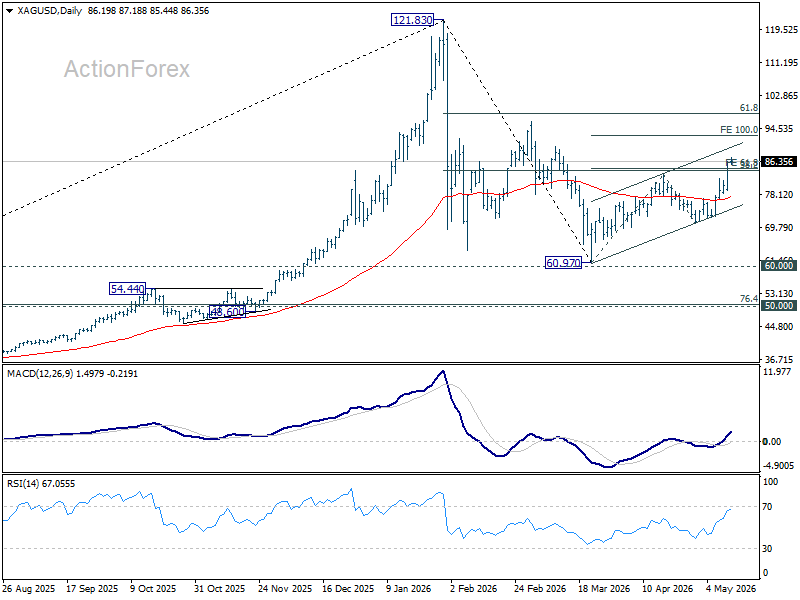
Technically, the breakout was extremely significant. Silver sliced through the major 84.21–84.46 resistance zone without much difficulty, a clear sign that buying pressure overwhelmed supply. That area included both 100% projection of 60.97 to 83.04 from 70.83 at 84.46 and 38.2% retracement of 121.83 to 60.97 at 84.21.
The next major technical target now sits near 100% projection at 92.90. As long as 79.04 support holds, the near-term outlook remains cautiously bullish.
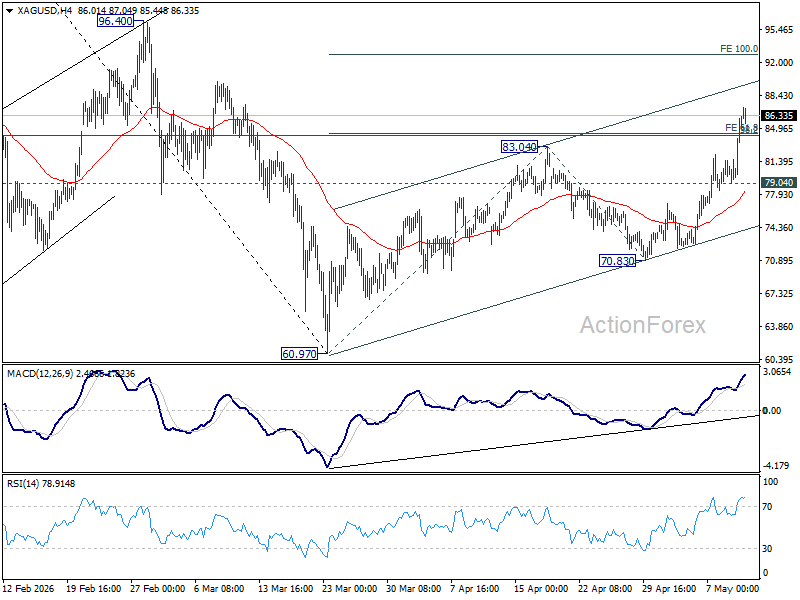
But the bigger long-term question is still unresolved. It remains too early to say whether Silver is truly beginning a new secular breakout through 121.83 record high. The rally from 60.97 could merely be the second leg of the corrective pattern from 121.83.
The answer may depend on what happens next around 92.90. If momentum accelerates further through that level, the psychology of the market could shift again — from FOMO into something much bigger.
AUD/USD Signals Strength, Major Bullish Break May Be Near
Key Highlights
- AUD/USD started a fresh increase above the 0.7200 pivot zone.
- A bullish trend line is forming with support at 0.7190 on the 4-hour chart.
- EUR/USD could gain strength if it clears 1.1800 and 1.1840.
- USD/JPY started a consolidation phase below the 158.00 resistance.
AUD/USD Technical Analysis
The Aussie Dollar remained supported above 0.7120 against the US Dollar. AUD/USD started a fresh increase above the 0.7180 and 0.7200 resistance levels.
Looking at the 4-hour chart, the pair settled above the 0.7200 level, the 100 simple moving average (red, 4-hour), and the 200 simple moving average (green, 4-hour). A high was formed at 0.7278 before there was a pullback.
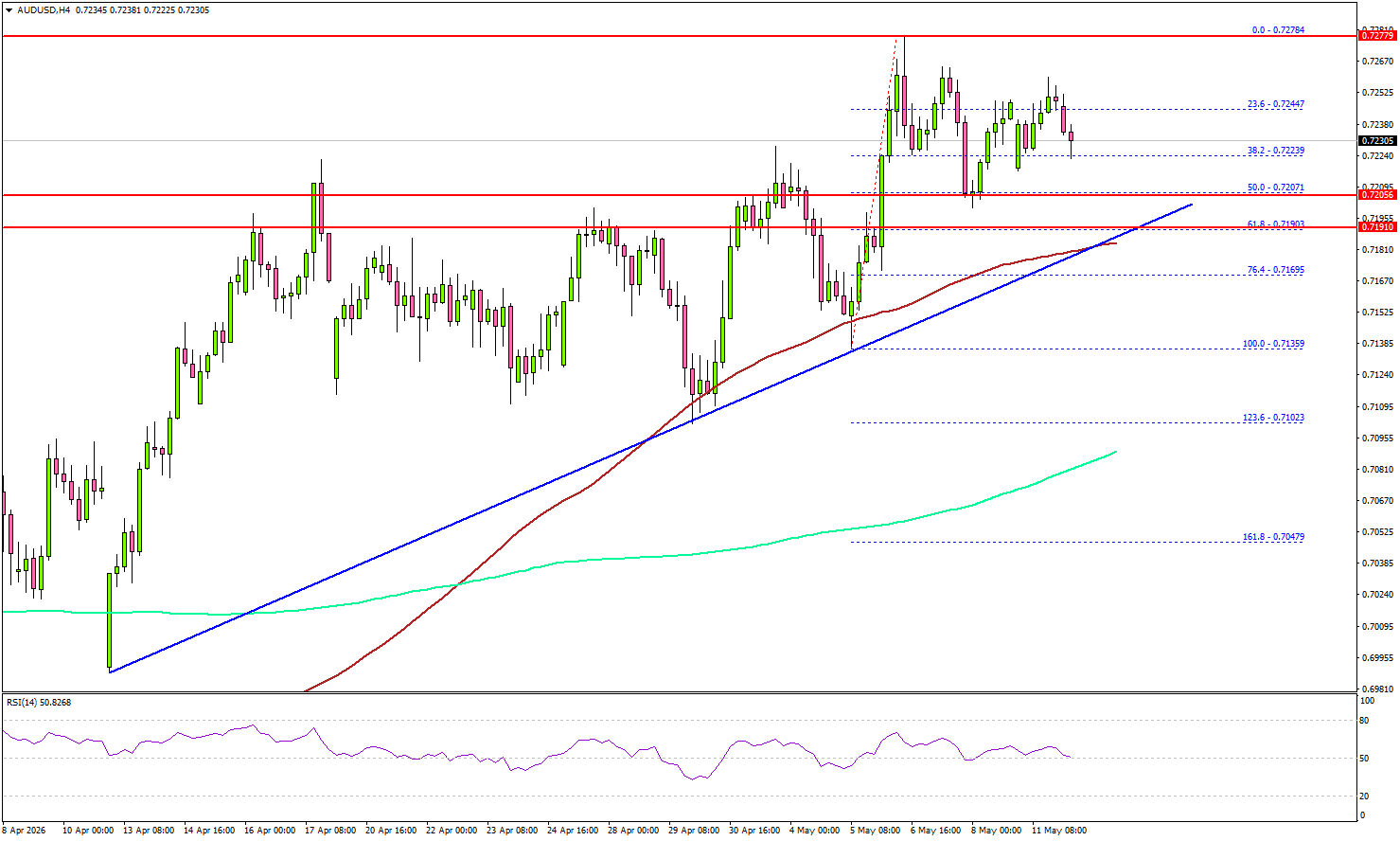
The pair dipped below 0.7250 and tested the 50% Fib retracement level of the upward move from the 0.7135 swing low to the 0.7278 high. The bulls remained active above 0.7200 and the pair recovered losses.
There is also a bullish trend line forming with support at 0.7190. On the upside, the pair faces resistance at 0.7275. The first major resistance sits at 0.7300. The main resistance could be 0.7320.
A close above 0.7320 could open doors for gains above 0.7365. In the stated case, the bulls could aim for a move to 0.7450. If there is a downside correction, the pair could find support at 0.7220. The next support could be near the trend line or 0.7200.
A close below 0.7190 might push the pair toward 0.7135. Any more losses could initiate a fresh move to 0.7080 and the 200 simple moving average (green, 4-hour).
Looking at EUR/USD, the pair is showing positive signs, and the bulls could aim for a move above the 1.1840 resistance.
Upcoming Key Economic Events:
- US Consumer Price Index for April 2026 (MoM) – Forecast +0.6%, versus +0.9% previous.
- US Consumer Price Index for April 2026 (YoY) – Forecast +3.7%, versus +3.3% previous.
- US Consumer Price Index Ex Food & Energy for April 2026 (YoY) – Forecast +2.7%, versus +2.6% previous.