

Sample Category Title
Chart Alert: Nikkei 225 Bullish Run Is Facing Minor Exhaustion Below 64,145
Key Takeaways
- Nikkei 225 continued its strong rally to a fresh record high of 63,788, driven largely by technology-related heavyweights such as SoftBank Group and Murata Manufacturing.
- Despite the broader medium-term bullish trend remaining intact, technical indicators now suggest a near-term corrective pullback risk below the 64,145 resistance level, supported by a developing bearish “Head & Shoulders” pattern.
- Momentum conditions have weakened as hourly RSI bearish divergence and Elliott Wave/Fibonacci analysis point to exhaustion in the recent five-wave bullish impulsive sequence, increasing the probability of a short-term retracement toward 61,945 and lower support zones.
The price actions of the Japan 225 CFD index, a proxy of the Nikkei 225 index futures, have rallied as expected in the past four weeks and surpassed 62,044, as highlighted in our earlier report.
It hit a fresh intraday all-time high of 63,788 on Monday, 11 May 2026, led by technology-related component stocks in the past month, such as SoftBank Group, up 58%, and Murata Manufacturing, up 53%.
However, the price actions of financial assets do not move vertically, as there will be periods of countertrend movements or trend reversals due to changing sentiment.
Right now, the Nikkei 225 faces the risk of a minor corrective countertrend decline within a medium-term uptrend phase.
Let’s unpack in greater detail.
Nikkei 225: Minor Bearish “Head & Shoulders” Sighted
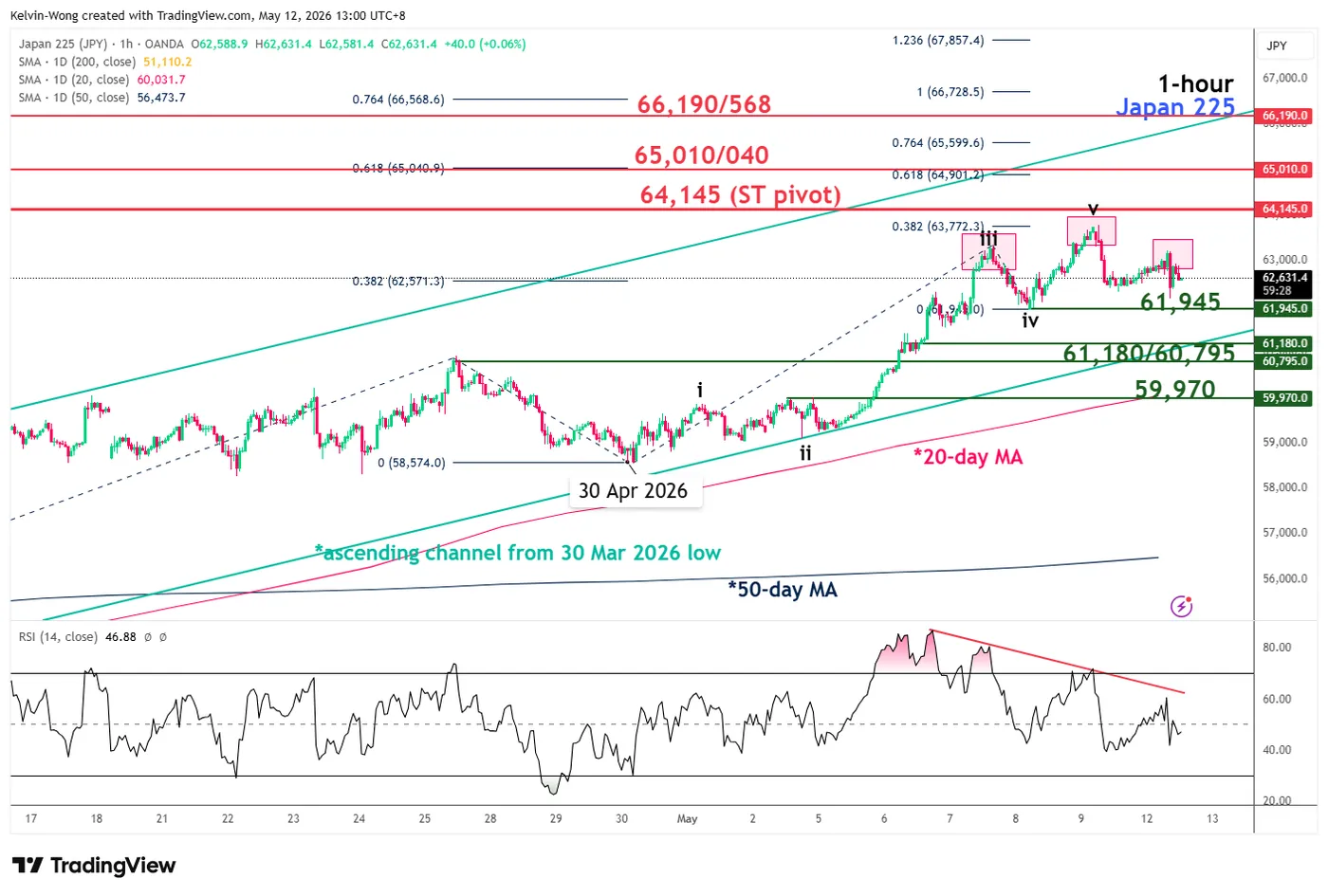
Fig. 1: Japan 225 CFD index minor trend as of 12 May 2026. Source: TradingView.
Trend bias: Minor bearish corrective decline within medium-term uptrend below 64,145 key short-term pivotal resistance.
Supports: 61,945, neckline of “Head & Shoulders”, 61,180/60,795, and 59,970, also the 20-day moving average.
Next resistances: 65,010/65,040 and 66,190/66,568, Fibonacci extension and upper boundary of the medium-term ascending channel from the 30 March 2026 low.
Key Elements to Support the Near-Term Bearish Bias on the Nikkei 225
- Since 7 May 2026, its price action has traced out a minor bearish reversal “Head & Shoulders” configuration, indicating a potential end of its minor uptrend phase from the 30 April 2026 low.
- Based on Elliott Wave Theory and Fibonacci analysis, the price actions have completed a five-wave minor bullish impulsive up move sequence, labelled as i, ii, iii, iv and v, with a potential terminal level at 63,772, based on 0.382 Fibonacci extension from the start of the minor bullish impulsive up move from the 30 April 2026 low. The next probable move is a minor corrective decline to retrace its prior five-wave minor bullish impulsive up move.
- The hourly RSI momentum indicator has shown a bullish exhaustion condition, with bearish divergence since 7 May 2026 at its overbought region, which supports the potential incoming minor corrective decline.
GBP/USD Slides Toward Trendline Support Below 1.3600
- GBPUSD weakens within consolidation.
- Loses ground on US-Iran tensions, UK political pressure, US data in focus.
- Momentum indicators point to a modestly fading positive bias.
GBPUSD is losing ground below the 1.3600 handle, eyeing support at the medium‑term ascending trendline. The pound is under pressure against the dollar amid domestic political uncertainty, lingering Middle East tensions, and ahead of key US CPI data.
Momentum indicators are easing within positive territory, with the MACD muted near its signal line and the RSI drifting toward neutral. This suggests consolidation within the 1.3525-1.3625 range may persist, with downside risks increasing if price breaks below the uptrend line and the 20‑day simple moving average (SMA) at the lower bound of the range.
Below that, further support is seen near 1.3465, followed by the 1.3385-1.3430 zone, which encapsulates the converging 50‑ and 200‑day SMAs and may help shield price action from deeper losses toward the 23.6% Fibonacci retracement of the January-March pullback near 1.3325. A decisive break below this level would expose the multi‑month lows.
On the upside, resistance near the 61.8% Fibonacci and psychological 1.3600 level, alongside the eleven-week high at 1.3625, remains firm. A sustained break above this area could reopen targets at 1.3715 and then the multi‑year high near 1.3985.
Summing up, GBPUSD remains under pressure as it attempts to stabilise around the previously broken uptrend line. Momentum though remains broadly constructive, suggesting that holding this support could still underpin upside attempts in the near term.
Sunrise Market Commentary
Markets
The UK prime minister Keir Starmer is hanging by a thread. A colossal defeat at the regional and local elections last week increasingly looks to be the straw that will break the camel’s back. It is the latest of the multiple hits Starmer took when being in office, ranging from the Mandelson case over policy missteps and dramatic U-turns and near-constant infighting. A speech yesterday by Starmer, in which he also insisted not to leave, failed to persuade many Labour members of his ability to change the party’s fortunes. A formal leadership challenge is triggered when 81 Labour lawmakers (20% of the total) rally behind a single candidate. But fearing for a chaotic process, many MPs prefer Starmer to either quit himself or set out plans for departing. More than 70 of the 403 MPs, among which several senior ministers, have already called on him to do so. According to the Financial Times citing people close, he was weighing things ahead of a crucial cabinet meeting later today. Starmer’s looming exit causes market concern over the UK’s fiscal future when a potential new PM takes over. Gilts underperformed greatly vs global peers yesterday with the 30-yr yield rallying more than 9 bps. Monday’s close at 5.67% is to be compared with the 5.74% multidecade high seen exactly one week ago. Yields rose earlier on the curve too to the tune of 8-8.5 bps, supported by rising oil prices after president Trump dismissed the Iranian counterproposal as “a piece of garbage”. He later called the ceasefire as being on massive life support. Brent finished at $104 and is nearing $105 per barrel this morning. European rates joined the broader move higher with net daily changes varying between 2.7 and 5.5 bps (swap) in a bear flattener. US yields added 5.2-7 bps in a similar curve shift. While most focus is going to its currency lately, Japanese bonds are gradually eroding to their weakest levels in many decades. The 30-yr yield for example rises to 3.8% this morning, extending a bounce higher that started with the Iran war. Closing at that level would only leave January 20 (3.87%) stand in between new record highs. The 10-yr yield (2.55%) is setting a 29-year high as we speak. The yen did show some of the biggest swings on the FX market yesterday with USD/JPY recovering to 157.2 and building on that move this morning (157.7). About half of the intervention impact is being wiped out. Most other currency pairs closed little changed, including sterling – for all of the uncertainty that’s plaguing it.
S April CPI is on tap today. Our in-house headline nowcast stands at a consensus-matching 3.7%, which would mean a quickening from March’s 3.3%. We expect core CPI at 2.6%, the same as in March. For food, after flat monthly growth in March, we cautiously assume 0.2% m/m, implying 2.9% y/y. Energy could rise another 5.4% m/m given further increases in oil and gasoline prices. That would correspond to 19.4% y/y (up from 12.6% in March). We’re particularly interested in the market reaction in an upside surprise. Combined with a labour market in a stable shape, there’s room for US yields rise and the dollar to appreciate. The 2-yr yield is closing in on the 4% barrier.
Supply today includes a $42bn 10-yr US auction and a new syndicated deal in Belgium. The Kingdom intends to issue the last of 2026’s three benchmark deals. This one will have a 5-year maturity and comes after the country raised €8bn and €6bn with the 10-yr and 30-yr deals earlier this year.
News & Views
The British Retail Consortium retail sales monitor shows uncertainty hitting sales in April. UK total retail sales decreased by 3% Y/Y (from +3.6% Y/Y) and by 3.4% Y/Y (from +3.1% Y/Y) on a like-for-like basis. The CEO at BRC said that April’s sales fall was largely driven by the Easter shift, with food hit hardest (food sales -2.5% Y/Y from +6.8% Y/Y). Non-food sales decreased by 3.3% Y/Y (from +0.9% Y/Y). Taking March and April together, and comparing them with the same two-month period in 2025 (to account for the timing of Easter), UK total retail sales increased by 1.5% Y/Y. Weak consumer confidence also played a role in April as fears about the Middle East conflict driving up living costs led shoppers to rein in. Big-ticket purchases fell, with the recent recovery in furniture losing steam, and uncertainty around summer holidays hitting discretionary spend.
South Korean presidential policy chief Kim Yong-beom triggered wild swings in local trading this morning. His suggestion to pay a dividend to South Korean citizens using taxes on AI profits sent the leading Kospi index initially more than 5% lower. He later clarified that he wanted to tap “excess tax revenue” instead of implementing a new windfall tax on corporate profits, but that offered only partial relief. The Kospi currently loses 2.75%. Just ahead of the comments, the index was within reach of the 8k mark for the first time ever.
GBP/JPY Daily Outlook
Daily Pivots: (S1) 212.51; (P) 213.46; (R1) 214.81; More...
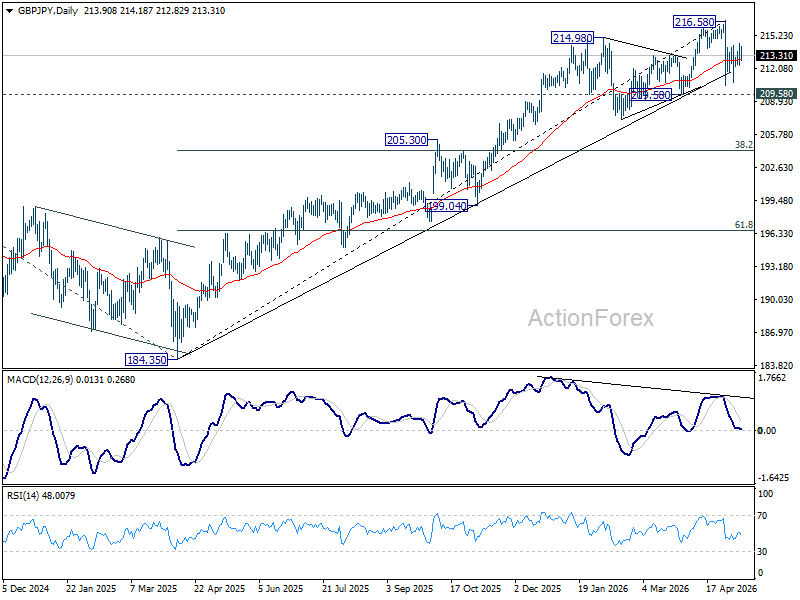
Intraday bias in GBP/JPY is mildly on the upside with breach of 214.21 resistance. Pullback from 216.58 could have completed at 210.43. Further rise would be seen towards retesting 216.58. However, break of 212.35 will turn bias back to the downside for 210.43 again.
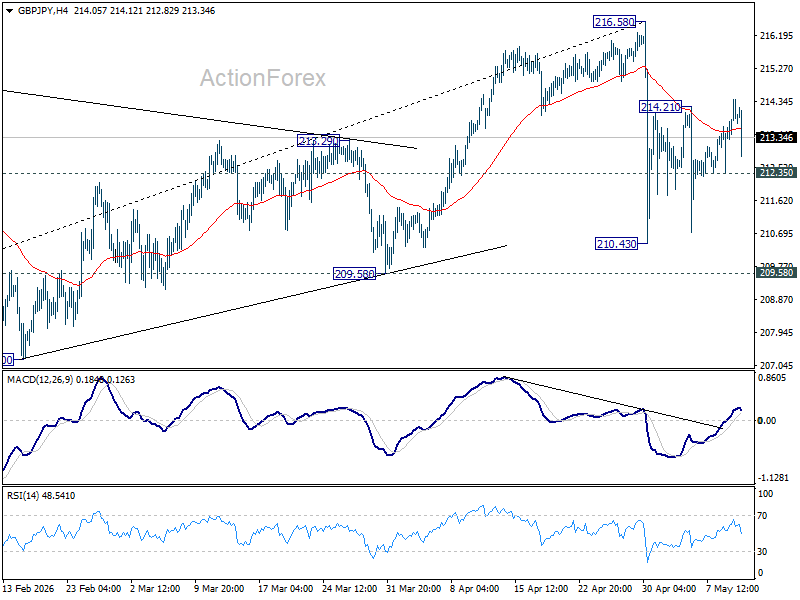
In the bigger picture, while the fall from 216.58 is steep, there is no clear sign of trend reversal yet. The long term up trend could still extend to 61.8% projection of 148.93 (2022 low) to 208.09 (2024 high) from 184.35 at 220.90 on resumption. However, sustained break of 55 W EMA (now at 205.75) will argue that it's already in medium term down trend for 184.35 support.
EUR/JPY Daily Outlook
Daily Pivots: (S1) 184.26; (P) 184.75; (R1) 185.65; More...
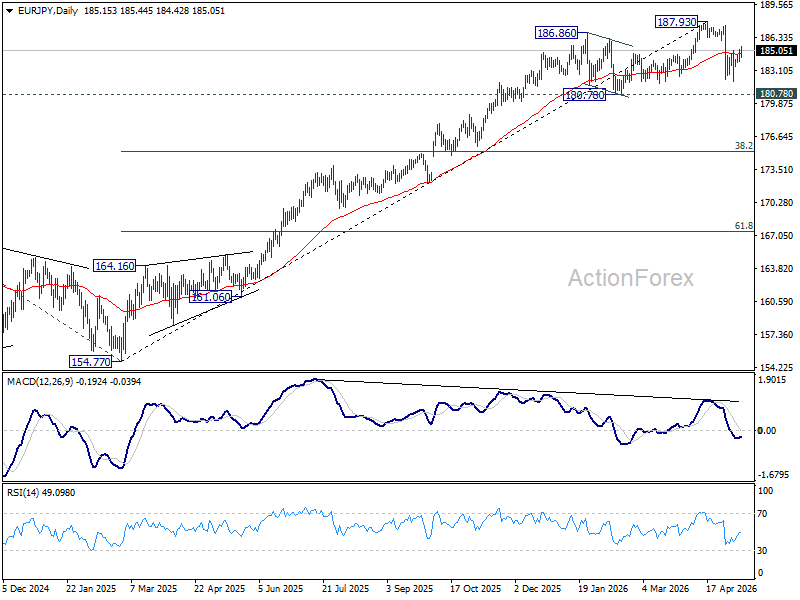
Intraday bias in EUR/JPY is mildly on the upside with break of 185.02 resistance. Pullback from 187.93 could have completed at 182.01 already. Further rise would be seen back to retest this high. Nevertheless, break of 184.02 minor support will turn bias back to the downside towards 182.01 again.
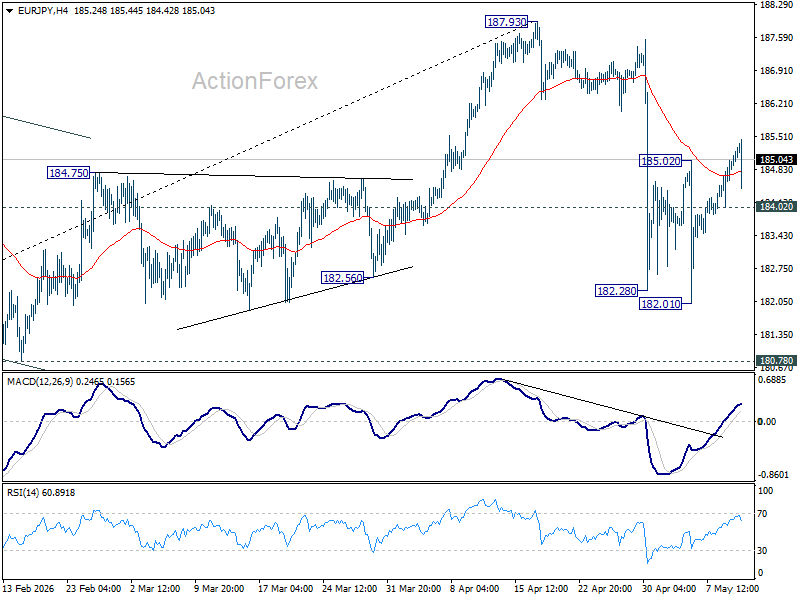
In the bigger picture, the pullback from 187.93 is steep, there is no sign of reversal yet. Uptrend from 114.42 is still expected to resume at a later stage to 78.6% projection of 124.37 (2022 low) to 175.41 (2025 high) from 154.77 at 194.88. However, sustained break of 55 W EMA (now at 178.04) will argue that it's already in a medium term down trend to 175.41 resistance turned support and below.
EUR/GBP Daily Outlook
Daily Pivots: (S1) 0.8632; (P) 0.8651; (R1) 0.8673; More…
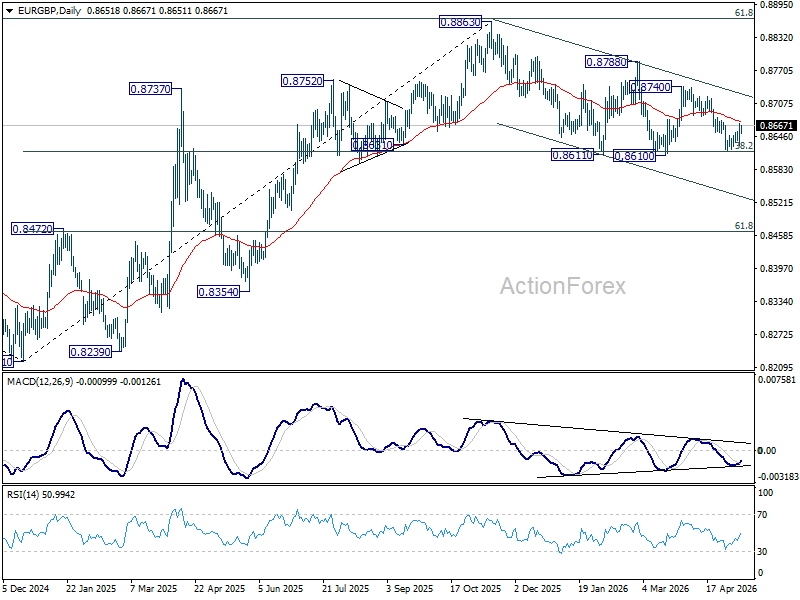
EUR/GBP is still bounded in established range above 0.8618 and intraday bias remains neutral. On the downside, firm break of 0.8610 will carry larger bearish implications and pave the way to 0.8466 fibonacci level next. Nevertheless, firm break of 0.8676 will turn bias back to the upside for stronger rebound back to 0.8740 resistance instead.
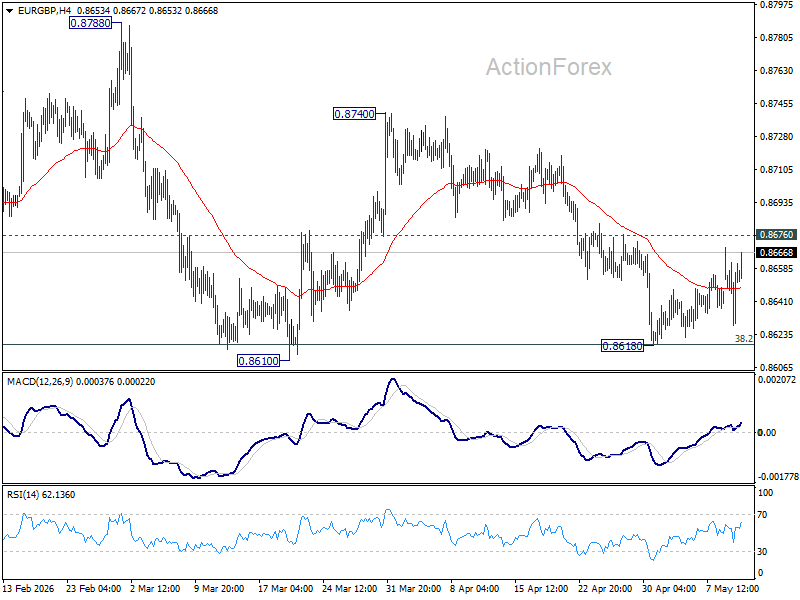
In the bigger picture, focus is back on 38.2% retracement of 0.8821 to 0.8863 at 0.8618. Sustained break there will confirm that whole rise from 0.8221 has completed at 0.8863. Deeper decline should then be seen to 61.8% retracement at 0.8466 at least. For now, risk will stay mildly on the downside as long as 55 D EMA (now at 0.8677) holds, in case of recovery.
EUR/AUD Daily Outlook
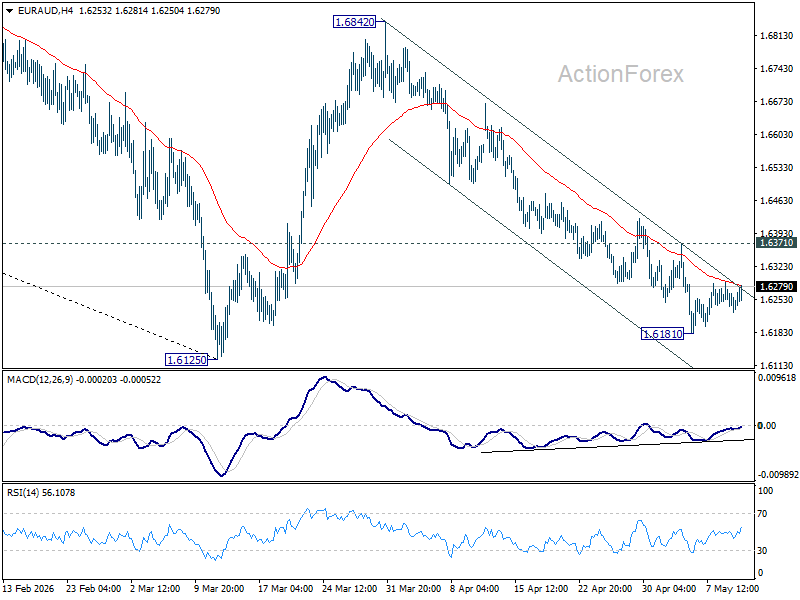
Daily Pivots: (S1) 1.6220; (P) 1.6254; (R1) 1.6280; More...
Intraday bias in EUR/AUD stays neutral at this point. On the downside, decisive break of 1.6125 will resume larger fall from 1.8554. Nevertheless, break of 1.6371 resistance will indicate short term bottoming, and turn bias back to the upside for stronger rebound to 55 D EMA (now at 1.6507).
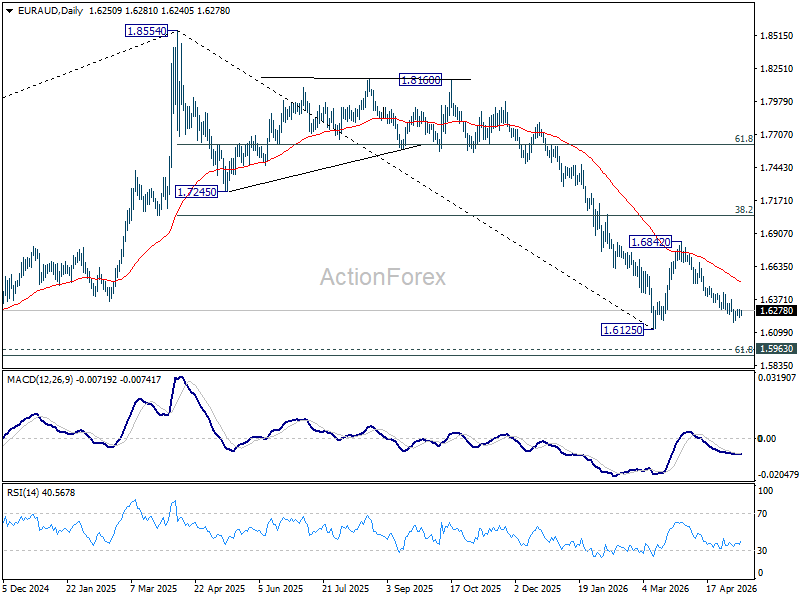
In the bigger picture, fall from 1.8554 (2025 high) is in progress and deeper decline should be seen to 61.8% retracement of 1.4281 to 1.8554 at 1.5913, which is slightly below 1.5963 structural support. Decisive break there will pave the way back to 1.4281 (2022 low). For now, risk will stay on the downside as long as 55 W EMA (now at 1.7039) holds, even in case of strong rebound.
EUR/CHF Daily Outlook
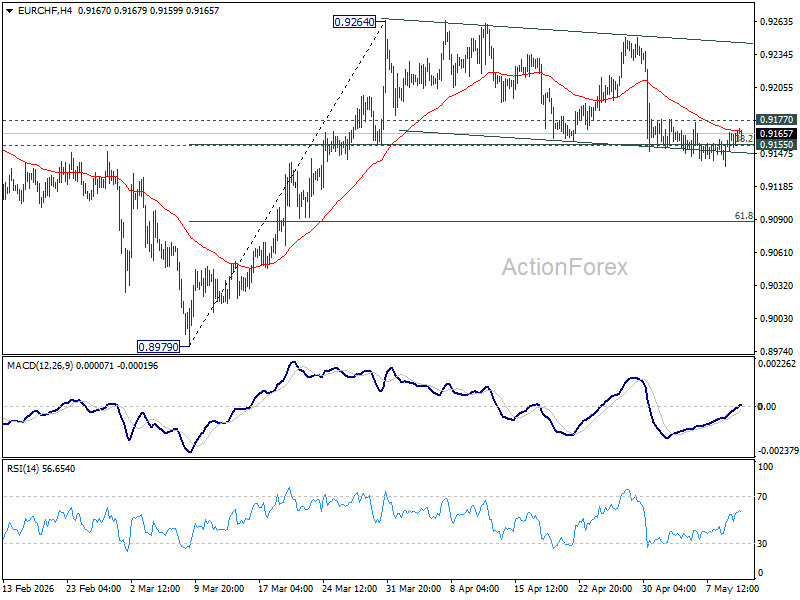
Daily Pivots: (S1) 0.9138; (P) 0.9152; (R1) 0.9178; More....
Intraday bias in EUR/CHF stays neutral for the moment. On the upside, break of 0.9177 minor resistance will turn bias back to the upside for 0.9264 resistance. However, sustained trading below 0.9155 cluster support (38.2% retracement of 0.8979 to 0.9264 at 0.9155) will turn bias back to the downside for deeper pullback to 61.8% retracement at 0.9088 and possibly below.
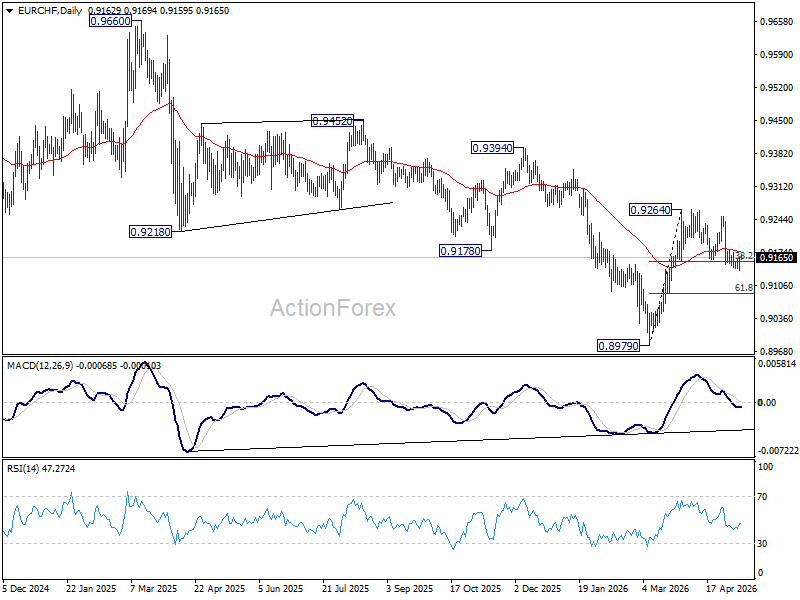
In the bigger picture, considering bullish convergence condition in W MACD, a medium term bottom should be in place at 0.8979. Sustained trading above 55 W EMA (now at 0.9241) will add more credence to this case. Further break of 0.9394 resistance will pave the way to 0.9660 resistance next. However rejection by the 55 W EMA will set up another fall through 0.8979 low at a later stage.
Valuation Vertigo
Major US and European indices resisted well yesterday despite a sharp rise in oil prices after US/Iran peace hopes fell off a cliff. Regardless, the S&P500 and Nasdaq100 printed fresh record highs, while even the industrial-heavy Dow Jones eked out a small gain. Most gains came from tech names, however, with VanEck’s Semiconductor ETF surging another 1.72% to — of course — another record high, while European indices were less enthusiastic, as rising yields in reaction to higher oil prices somehow tamed enthusiasm.
This morning, US crude is consolidating within the $98–100pb range, and futures are in the red.
Now, I’ve trained myself to look at the market through different — and rosier — lenses. Because let’s admit it: stock prices have risen through financial crises, pandemics, wars, energy crises and more. Measures like liquidity injections, QE, lower rates and fiscal spending help, while new tools and technologies increase productivity, new businesses emerge, and the world moves on. But what we see today is that downside corrections are disappearing, leaving no room for the market to readjust. Today, markets rally on good news, and on bad news — on hopes that things will get better tomorrow. And that’s leading to a parabolic rise in some sectors. As much as I love technology and the stocks involved, a chart like the Kospi raises a few questions.
In fact, I collected a few charts and opinions regarding what’s causing the market rally to extend despite the deluge of unfavourable geopolitical headlines and rising energy prices — considering that energy is the building block of every sector out there, from food to tech.
The main explanation being pointed to is strong earnings. According to FactSet, among the 89% of S&P 500 companies that have reported results so far, 84% posted a positive EPS surprise and 80% reported a positive revenue surprise. And earnings expectations were not soft heading into the earnings season. On the contrary, the S&P500 earnings growth was expected to come in around 13.1%–13.2% YoY. Now that we’re entering the final stretch of the season, the verdict is that S&P 500 earnings growth is tracking near 27.7%. If 27.7% is confirmed as the final growth rate for the quarter, it would mark the S&P500’s strongest earnings growth since Q4 2021, when earnings rose 32.0%, according to FactSet. In other words, S&P 500 earnings growth came in at roughly twice the level analysts had expected.
How come? Stronger-than-expected AI-driven growth, resilient demand and surging energy profits led companies to massively outperform expectations. Fine. That also explains why the equity rally has narrowed to a handful of tech and energy stocks. In fact, if you strip tech out of the equation, the implied earnings growth for the rest of the S&P500 was likely in the mid-single digits, roughly around 5–7%.
Tech optimism also pushed chip-heavy Asian indices higher, with the Taiex and Kospi standing out.
But if we broaden the scope beyond the US and tech, and despite rising oil prices and a strong US dollar, EM stocks also extended gains to record highs.
Why? Investors rotated away from expensive US equities into cheaper international and EM valuations, and despite the strong US dollar, global liquidity remained abundant because AI-driven capex and commodity revenues likely continued recycling into financial markets. Copper — a barometer for global economic health — has risen 24% since the end of March!
But something doesn’t add up. First, higher energy prices and a stronger dollar are fundamentally harmful for EM markets, and those that are not tech-heavy will at some point face the reality of energy scarcity.
And it’s not only EM. If the Middle East war doesn’t end quickly, the world — including the G7 economies that have relied on their ample oil reserves — will start facing scarcity. If there’s no resolution to the Middle East conflict and the Strait of Hormuz remains closed, global oil inventories could reach operational stress levels by June. If there’s still no resolution by September, inventories could fall toward operational floor levels — the minimum required to keep pipelines functioning and refineries operating. That risk appears underpriced — if not mostly ignored — overshadowed by the strength of earnings.
But even there, in an X post, Mike Zaccardi highlighted that this year’s global equity rally is almost entirely driven by higher EPS estimates. And that is especially striking for MSCI EM stocks.
And last but not least, Michael Burry — arguably the most famous bear of modern times, whose hedge fund has recently been washed away by the strength of the bullish tide — insists that today’s tech rally resembles the peak of the dot-com bubble. He highlighted that the Nasdaq 100 is trading at around 43 times earnings, above its implied level of 30, because he argues that “Wall Street may be overstating by more than 50% the earnings at our fastest-growing, most highly valued companies”, he said. The same companies that largely helped the S&P500 print that 27.7% earnings growth, versus the 5–7% growth seen outside tech.
But you know what they say “the market can remain irrational longer than you can remain solvent.”
Anyway, today, the US inflation report will be in focus, with inflation expected to have risen due to the Iran-led jump in energy prices. A higher-than-expected reading could revive hawkish Federal Reserve (Fed) expectations, push yields higher and weigh on equity valuations, while a softer-than-expected print would offer relief that energy-led inflation is being contained. In all cases, the US is trying to put several measures together to ease price pressures — including a proposed gas tax holiday and a suspension of tariff-rate quotas on beef imports. But rising energy prices could easily offset those efforts, alongside mounting pressure from Chinese goods prices, which had so far helped keep Western inflation in check. Today, even that pillar may be starting to crack.
US April CPI Set to Test Iran-Related Inflation Worries
In focus today
- In the US, the most important data release of the week will be the April CPI this afternoon. We forecast headline inflation at 0.6% m/m SA (3.7% y/y) and core inflation at 0.3% m/m SA (2.6% y/y), with the latter below consensus. Markets are naturally looking for signs of underlying inflation accelerating due to the war in Iran.
- In the euro area, the German ZEW index is due today, providing financial analysts' view of the current economic situation and expectations for May.
Economic and market news
What happened overnight
In the Middle East conflict, President Trump warned the ceasefire with Iran is "on life support" after Tehran's counterproposal. Brent crude is trading around USD105/bbl this morning, extending gains from yesterday's session. Trump is reportedly meeting his national security team to consider next steps, including a possible resumption of military action and a renewed naval mission in the Strait of Hormuz. The conflict is also likely to be on the agenda when he meets President Xi Jinping this week.
In Japan, the Bank of Japan's April summary showed a clear hawkish tilt, with some policymakers arguing for raising rates soon and one flagging a possible move at the 15-16 June meeting. Three of nine members backed a hike in April, and the Iran-related oil shock, upgraded inflation outlook and second-round effects were central to the debate, pushing 10-year Japanese government bond yields to a 29-year high this morning. We continue to expect a June rate hike, although developments in the Middle East will be important.
Japan and the US reaffirmed close coordination on exchange rates and FX intervention, Finance Minister Katayama said on Tuesday after a meeting in Tokyo with US counterpart Scott Bessent. Katayama said Japan is acting in line with last September's joint statement allowing FX intervention against excessive volatility, reinforcing expectations that recent large yen-buying operations have tacit US backing.
What happened yesterday
In Norway, core inflation rose to 3.2% y/y in April, as expected and in line with Norges Bank's March MPR. Headline inflation eased to 3.4% y/y (prior: 3.6%). The details show a stronger-than-expected rebound in food prices, while lower service inflation excluding rent surprised to the downside, driven mainly by transport services and hotels/restaurants. There are still no signs of second-round effects from higher energy prices, and higher imported inflation is entirely driven by food, while inflation on other imported goods edged lower.
In Denmark, headline inflation increased as expected to 1.4% y/y in April from 1.2% y/y in March. Electricity prices hit a 25-year low, offsetting higher fuel prices. Food prices rose 0.8% m/m after several months of decline, and signals on the food price outlook remain mixed. A key uncertainty is whether a new government will implement the proposed fee cuts on chocolate and coffee, which could lower food prices by 2%. Core inflation edged down to 1.6%, and seasonally adjusted m/m momentum remains weak.
Equities: Global equities ended 0.2% higher following a solid rally during the US hours. S&P500 rose 0.2% with Nasdaq up 0.1% and Russell2000 0.3% higher. The performance was centred around specific names and sectors, with only 43% of the names in the S&P500 ending higher. Energy was the top performer driven by higher oil prices, amid hostile Trump comments, yet it was the tech and specifically the semi-conductor names that secured the overall performance of the index. US futures are modestly lower and Asian equities are mixed.
FI and FX: Yields rose across tenors and regions during yesterday's session as negotiations between Iran and US took a setback. President Trump warned the ceasefire with Iran is "on life support" after Tehran's counterproposal. Brent crude is trading around USD105/bbl this morning, extending gains from yesterday's session. EUR/USD continues to trade just below 1.18 despite the renewed uptick in oil prices. The rebound in oil prices coupled with softer details in the Norwegian inflation print caused the NOK to perform among G10 peers. Today's US April CPI release is a key data point, and we forecast headline inflation close to consensus at 3.7% y/y but expect to see core inflation below consensus at 2.6% y/y, which could lift EUR/USD above 1.18 even amid the geopolitical concerns. If the print undershoots expectations it could act as a trigger for intervention in the USD/JPY cross which has gradually drifted above 157.5 and in such a scenario we expect the cross to drop to 156.0.