Sample Category Title
ECB Muller: We should be able to end PEPP in March
ECB Governing Council member Madis Muller said, "given the recovery that we're seeing in the economy, also the outlook for inflation and most importantly the extremely favorable financing conditions that we continue to have in the euro area, we should be able to end PEPP in March as it has been communicated and as it has been the original plan." He added, "if you ask what is the most likely outcome then to me personally, this is the base case."
Muller also argued that inflation could start stronger than ECB's forecasts. "Looking at possible factors that could be pushing prices higher and those that could be pulling it lower, the factors pushing prices higher seem to be stronger at the moment," he said. "It's more likely that we will have inflation, for example, in 2023 higher than 1.5% rather than lower. The same probably applies for the 1.7% inflation forecast for 2022."
However, "it would be a problem if there is a very sharp cliff effect at the end of the pandemic emergency purchase program," he noted. ""part of the discussion we will have on how to phase out PEPP and what it would mean for asset purchases going forward." A potential increase in the APP program was being discussed. But, "of course the decision will depend on market conditions next spring and the economic outlook at that point."
All Eyes On The Fed
All lights are expected to be on the release of the Fed’s interest rate decision and the bank is widely expected to remain on hold at 0.0-0.25%. It should be noted that recent financial releases allowed for expectations that the Fed may taper its QE program rather sooner than later, to be maintained, yet August’s soft employment data tended to suggest caution. The FOMC’s interest rate decision is expected to shed more light on the matter, and attention turns to any clues which are to show when the bank may actually start tapering its massive quantitative easing program. Exactly whether the bank’s policymakers are in the mood for any possible earlier rate hikes will be revealed in the bank’s new dot plot, so we expect that document to be also closely scrutinized. Please note that the balance of power in the Fed, regarding the timing of rate hikes remains thin. We would also like to see whether the bank will alter its economic projections in regards of the US economic recovery, and we’ll get a chance to have a glimpse at the expectations for 2024. Last but not least, we highlight Fed Chairman Powell’s press conference which is to follow shortly after the release.
EUR/USD stabilised somewhat yesterday just above the 1.1695 (S1) support line. We tend to maintain a bias for a sideways movement currently, yet the Fed’s interest rate decision could increase volatility and alter the pair’s direction. On the other hand, it should be noted that the RSI indicator below our 4-hour chart is between the readings of 50 and 30, providing an advantage for the bears to take over. Should the bears actually take over, we may see the pair breaking the 1.1695 (S1) support line and aim for the 1.1615 (S2) level. Should the bulls be in charge of the pairs’ direction we may see the EUR/USD breaking the 1.1785 (R1) resistance line and aim for the 1.1885 (R2) resistance level.
Evergrande worries ease yet remain present
US stockmarkets try to recover after their wide drop on Monday, as the worries for the ripple effects of a possible default of Evergrande, one of China’s largest developers seem to ease, yet are still present. It should be noted that a number of analysts and investors seem to expect the crisis to be manageable, yet the uncertainty is still wide and present for the markets putting a lid on any clear upward price action. Should there be further signs that the crisis is manageable, we may see US stockmarkets recovering some ground. On the other hand, gold’s price seems to feed from the uncertainty as it was in the greens since the issue started on Monday. Should the uncertainty persist, the precious metal may continue to enjoy safe haven inflows, yet for now all of the market’s attention turns to the Fed’s interest rate decision later today.
Dow Jones dropped a bit more yesterday yet seems about to recover somewhat for now in the premarket hours. For the time being we expect the stabilisation to solidify maybe even see the index gaining some ground yet the situation is still quite fluid. Should a selling interest be displayed once again, we may see the index breaking the 33740 (S1) support line and aim for the 33340 (S2) support level. Should the buyers be in charge of the index’s direction, we may see Dow Jones breaking the 34060 (R1) resistance line and aim for the 34400 (R2) resistance level.
Other economic highlights today and the following Asian session:
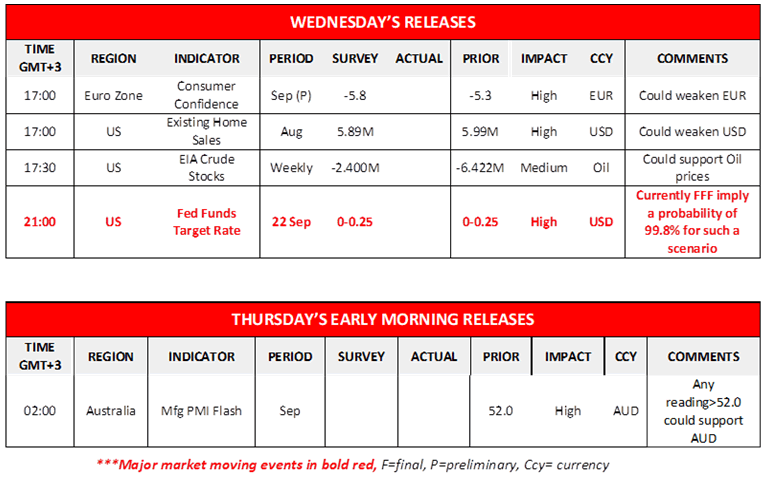
During today’s American session, we get Eurozone’s preliminary consumer confidence for September and the US existing home sales for August. Oil traders on the other hand may be more interested in the release of the EIA crude oil inventories figure, while later on we get the Fed’s interest rate decision, which could create considerable volatility for the markets. During tomorrows’ Asian session, we get from Australia the preliminary PMI readings for September.
EUR/USD H4 Chart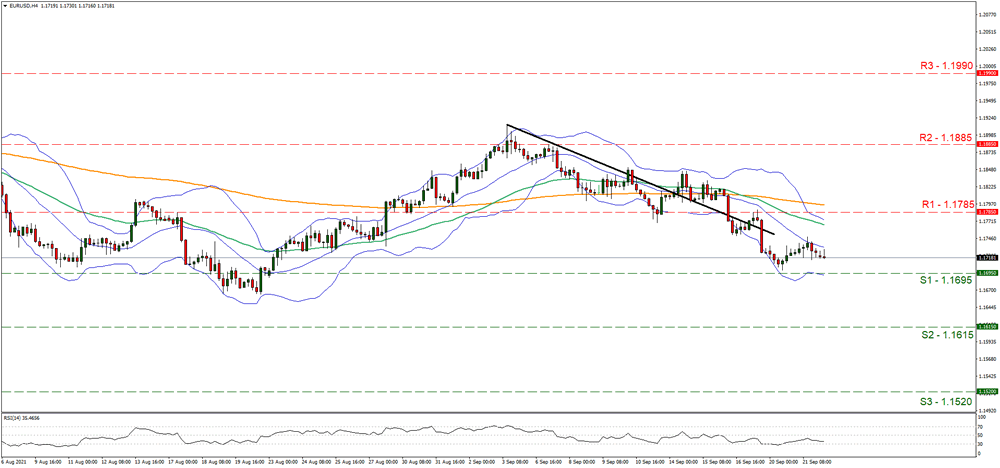
Support:1.1695 (S1), 1.1615 (S2), 1.1520 (S3)
Resistance: 1.1785 (R1), 1.1885 (R2), 1.1990 (R3)
US 30 Cash H4 Chart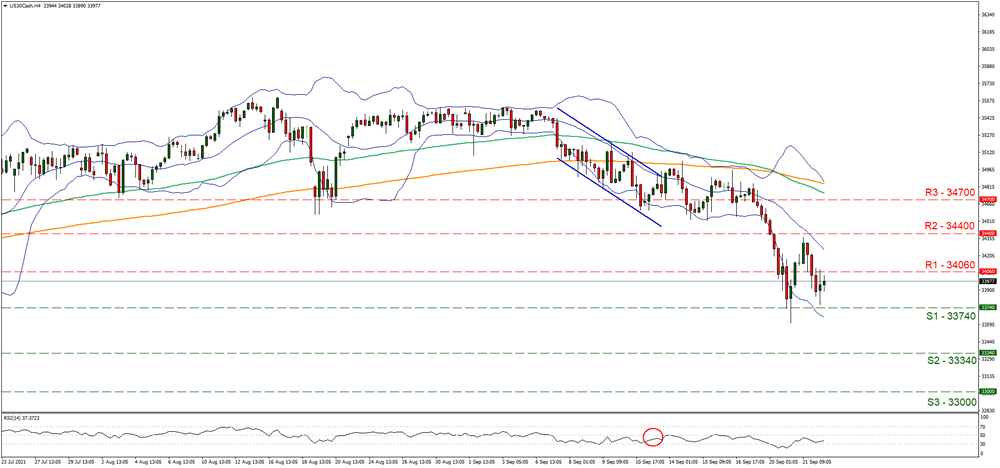
Support: 33740 (S1), 33340 (S2), 33000 (S3)
Resistance: 34060 (R1), 34400 (R2), 34700 (R3)
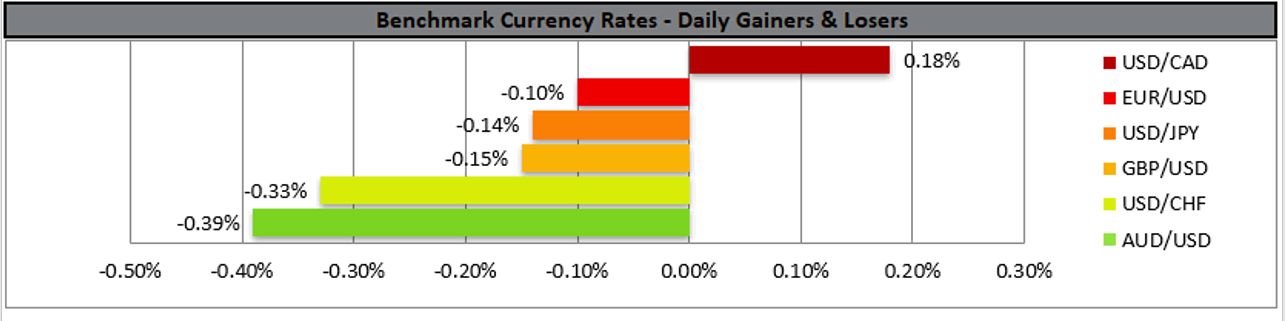
Global GDP Has Surpassed Pre-Pandemic Levels, But Production And Employment Remain Lower In Many Countries
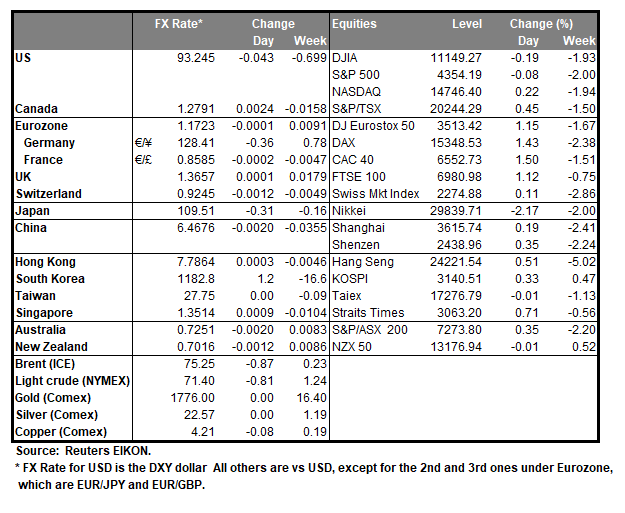
The US stock market ended Tuesday's trading without a single trend. At the close of the stock exchange, the Dow Jones Industrial Average decreased by 0.15%, the S&P 500 decreased by 0.08%, while the Nasdaq added 0.22%. The US Federal Reserve is expected to meet today. Amid the sell-off in global stock markets on Friday and Monday, the dollar index and Japanese yen have become safe haven assets for investors. Economists believe that Jerome Powell will give a hint about the QE program cuts today, with an official announcement to be made in November. But many analysts believe the Fed will have a problem convincing investors that the plans to cut asset purchases are not an obstacle to raising interest rates.
President Biden plans to announce the purchase of 500 million doses of the Pfizer-BioNTech vaccine. The FDA is expected to announce its decision on the Pfizer booster today.
Western European stock indexes rebounded on Tuesday after the strongest fall the day before. The British FTSE 100 increased by 1.1%, German DAX increased by 1.4%, French CAC 40 jumped by 1.5%, Spanish IBEX 35 and Italian FTSE MIB added 1.2% each. Germany's house price index fell slightly in August despite the ECB flooding the economy with cheap money. But the situation is likely to start to change soon. The ECB will also start to reduce its asset purchase program to prevent the acceleration of inflation, which promises to be even higher amid Europe's energy problems. The unemployment rate in Sweden increased to 8.5% (previously 8.0%).
The United Arab Emirates oil minister said that OPEC+ would not need to change its current production agreement. The group of 23 countries has agreed to increase production by 400,000 barrels a day each month following the global economic recovery. Also, OPEC+ is not concerned about a surplus in the second quarter of 2022.
Aluminum prices jumped to a 13-year high amid China's production cuts.
The People's Bank of China left the key loan prime rate unchanged. It also became known that the People's Bank of China had injected 120 billion yuan ($18.6 billion) into the banking system through repurchase agreements, which would result in a net impact of 90 billion yuan. Evergrande will pay interest on the bonds on Thursday. Amid this news, China's CSI 300 blue-chip index cut its initial losses slightly. Analysts at Bank of America cut China's GDP growth forecast for the next 3 years.
The Bank of Japan kept its negative interest rates and asset purchase targets unchanged amid pressure on the economy related to Covid and the upcoming prime minister elections. The central bank has also released more details about its green lending program and will begin issuing loans in December. On the back of this news, Japan's Nikkei 225 Index has decreased by 0.5% since the trading day’s opening.
Main market quotes:
- S&P 500 (F) 4,354.19 −3.54 (−0.081%)
- Dow Jones 33,919.84 −50.63 (−0.15%)
- DAX 15,348.53 +216.47 (+1.43%)
- FTSE 100 6,980.98 +77.07 (+1.12%)
- USD Index 93.22 −0.05 (−0.06%)
Important events for today:
- China Loan Prime Rate at 04:30 (GMT+3);
- BOJ Monetary Policy Statement at 05:00 (GMT+3);
- BOJ Press Conference at 06:00 (GMT+3);
- BoJ Interest Rate Decision at 06:04 (GMT+3);
- US Existing Homes Sales (m/m) at 17:00 (GMT+3);
- US Crude Oil Inventories (w/w) at 17:30 (GMT+3);
- US FOMC Economic Projections at 21:00 (GMT+3);
- US FOMC Meeting Minutes at 21:00 (GMT+3);
- US Fed Interest Rate Decision at 21:00 (GMT+3);
- US FOMC Press Conference at 21:30 (GMT+3).
USDJPY Indecisive Between Key Boundaries
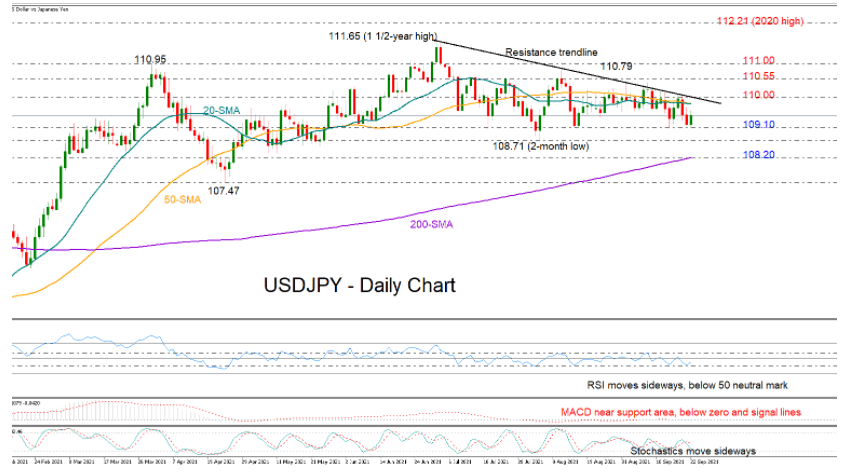
USDJPY used the support around 109.10 once again to stand on its feet on Wednesday after two days of declines.
The tough resistance trendline drawn from the top of 111.65 remains the main target at 110.00, and the pair’s resilience above 109.00 increases the odds for an upside breakout. But the momentum indicators are not fully in line with this narrative. The RSI is below its 50 neutral mark and continues to swing in a range. The Stochastics are also following a horizontal trajectory, while the MACD is hovering around a former support area below its zero and signal lines, flagging a neutral-to-bearish short-term bias.
If the trendline gives way, the bulls will push for a close above the 110.55 barrier, which has been caping upside movements since the start of July. A successful violation at this point could set a test around the 111.00 number before all eyes shift to the 111.65 peak.
Alternatively, failure to hold above 109.10 could initially see some consolidation around the two-month low of 108.71. A clear step below this floor would open the door for the 200-day simple moving average currently around 108.20, while deeper, an extension past April’s low of 107.47 would send stronger bearish signals about the neutral medium-term outlook.
In brief, USDJPY is still indecisive between the 109.10 and 110.00 boundaries. Any break above these thresholds could switch the bias accordingly.
NZDUSD Remains Below Descending Trend Line
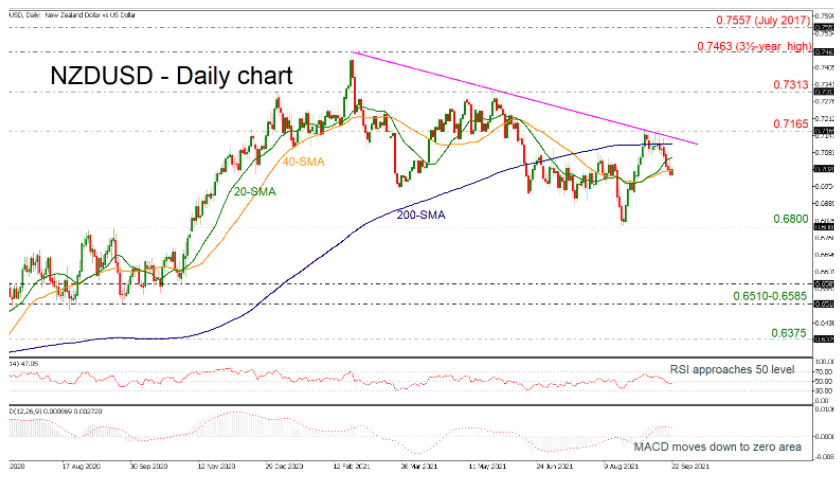
NZDUSD is rising somewhat after it found strong resistance at the long-term descending trend line around the 0.7465 resistance. According to the SMAs, they are mainly promoting a neutral price development.
The technical indicators appear to be flat and are signaling weak and mixed indications in directional momentum. Positively, the RSI is attempting to improve in the bullish zone. The MACD oscillator is falling below its trigger line and near the zero level.
Sellers may find it difficult to close below the 40-day simple moving average (SMA) at 0.7016; however, if this happens, a zone of support might come from the 0.6800 handle. Steeper decreases may open the way for lower lows, taking the market until the 0.6510-0.6585 region.
On the other hand, the 200-day SMA at 0.7120 may act as a preliminarily upward-blocking obstacle before the resistance of 0.7165 comes into place. Breaking the falling trend line to the upside may shift the broader outlook to neutral, hitting 0.7313 and the 0.7463 crucial level.
It may be concluded that because NZDUSD is trapped between the 20- and 40-day SMAs, directional forces are weakening. However, a break above the 0.7165 resistance or below 0.6800 might lead to a new trading direction.
BoJ Kuroda: Consumption to strengthen, external demand remains solid
In the post meeting press conference, BoJ Governor Haruhiko Kuroda said the recent slump in consumption was "in a way unexpected". But he's still optimistic on consumption outlook. He added that the decline was not because households lacked income, but more due to the pandemic keeping them from boosting spending. He added, "as the pandemic subsided, consumption is expected to strengthen."
Kuroda also said he expected "external demand to remain solid" and there is no need to project a "clear slowdown" in US and China growth. He added that actual economic indicators, consumption and output were growing very steadily in the US. The woes of Evergrande is see as "purely" and individual company's issue, and that of the real estate sector.
Markets Wait For Fed Decision, Ready For New Big Trends
Markets are quiet in anticipation of the Fed's comments later today. The most popular currencies and equity indices have stabilised near important levels near the limits of their trading ranges, from where they are equally likely to step back into established trends or break them.
The S&P500, the benchmark stock index, has found some support from buyers after it fell 5% from the early September peaks, but so far, it has not found enough support from buyers to develop growth ahead of the Fed statement and press conference. A renewal of the week's lows would pave the way for a deeper, 10% correction near 4100 on the S&P500, near which the major 200-day moving average also runs. Soft comments from the Fed could bring back active buying in shares and push indices to new all-time highs as early as next month.
EURUSD, the FX flagship pair, has settled near 1.1700, a support area from last July. It has traded lower for only a few days and was quick to find buyers. With hawkish FOMC comments, a dip below this level would occur, highlighting the contrast in policy between the Fed and the ECB. In that case, the EURUSD may correct towards 1.1200 before the end of the year. The Fed's dovishness may push the pair towards the upper end of the range above 1.21 by the end of 2021.
The precious metals have been resisting the general consolidation trend in recent days. After last week's tumultuous dip, cautious buying remains in place. Gold is again near $1780, staying away from significant technical levels to highlight and reinforce the bullish sentiment. Silver is hitting the downside to the former lower band trading channel of the last year, and it cannot move back above $23 just yet. Fed softer comments will spur demand for metals, as overall demand risk.
By the Fed's soft stance, we mean the desire to get more data before announcing a reduction in the asset purchase programme on the balance sheet. This is the most likely scenario due to Chinese uncertainty (has Evergrande triggered a domino effect?) and the latest weak labour market report.
However, if the Fed emphasises that the current stimulus has outlived its usefulness and is introducing adverse secondary effects, a deeper correction and reassessment of risks could begin in the markets.
S&P 500 Attempts Rebound
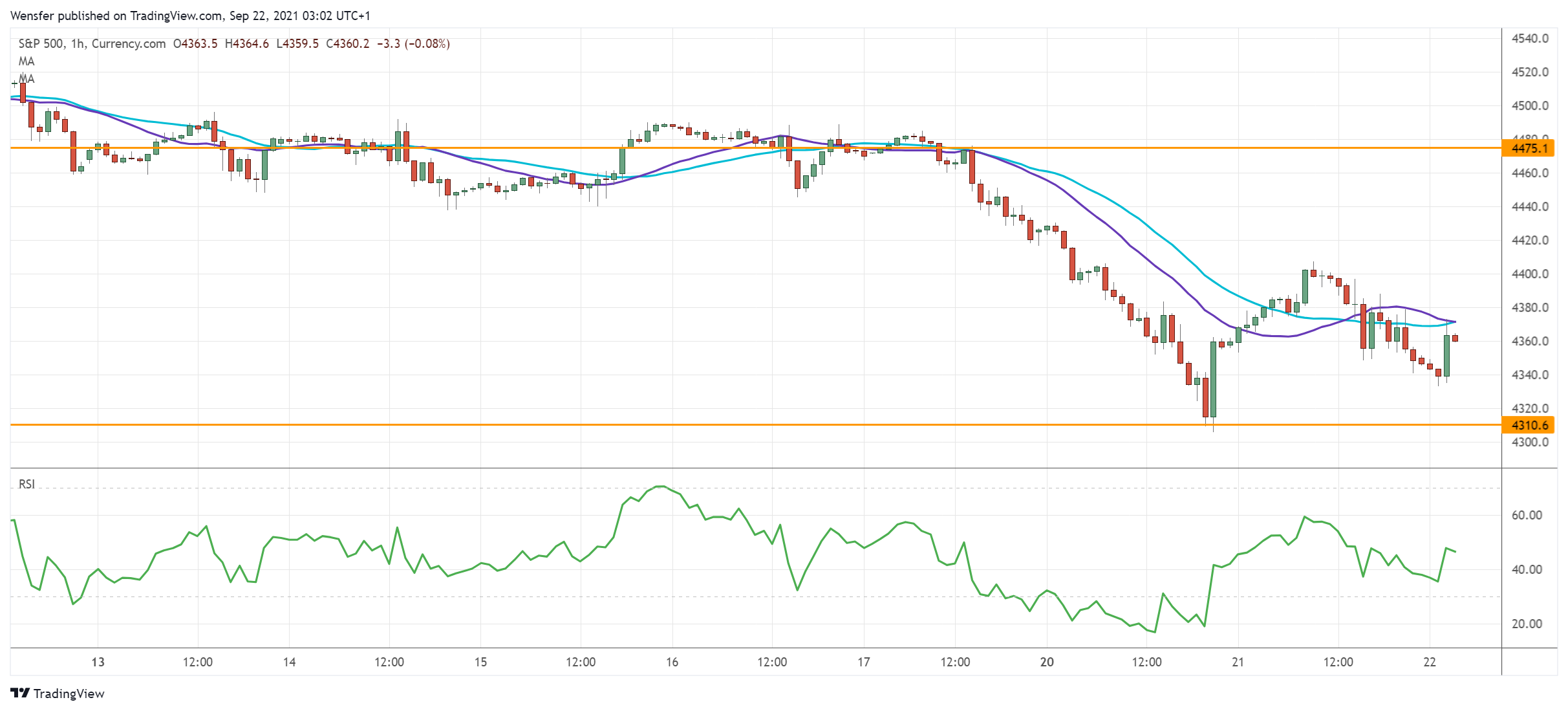
The S&P 500 surges back as investors bet on the Fed’s patience for tapering.
The index has found support above the psychological level of 4300. The close above the immediate resistance at 4405 may prompt sellers to cover, though the plunge below the daily support at 4360 has dented the bullish sentiment.
As a deeply oversold RSI makes its way back up, patient buyers may wait for price action to stabilize first before staking in. 4310 is fresh support. On the upside, selling interests may gather around 4475.
GER 40 Rebounds From Daily Support
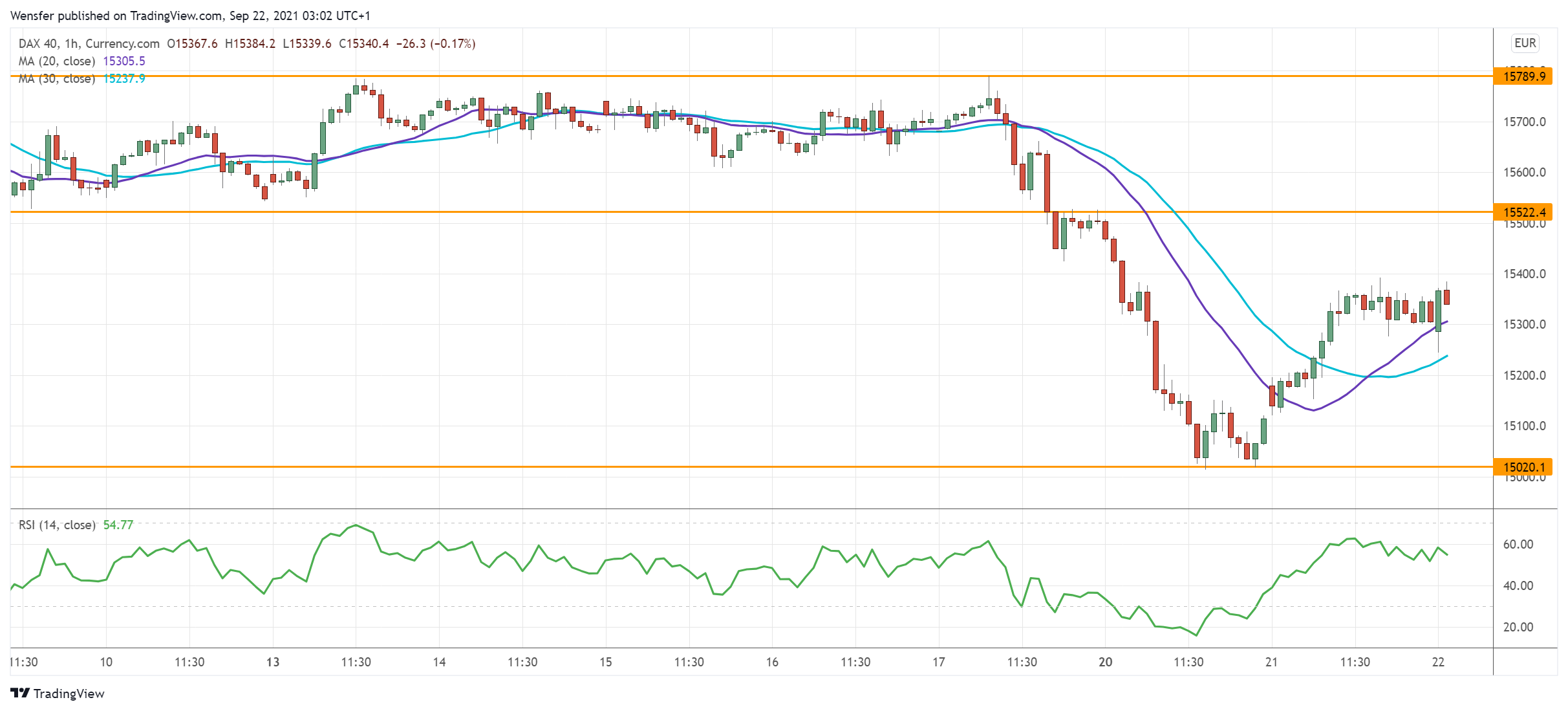
The Dax 40 whipsaws due to the risk of contagion from Chinese real estate developer Evergrande defaulting.
The tentative break of the daily support at 15050 has put leveraged buyers under stress. A combination of short-term profit-taking and buying-the-dips mentality has triggered a sharp rebound.
15520 is the first resistance ahead, then the bulls will need to lift 15800 to make a turnaround. In the meantime, an overbought RSI may limit the V-shaped rally. 15020 is fresh support in case of a relapse.
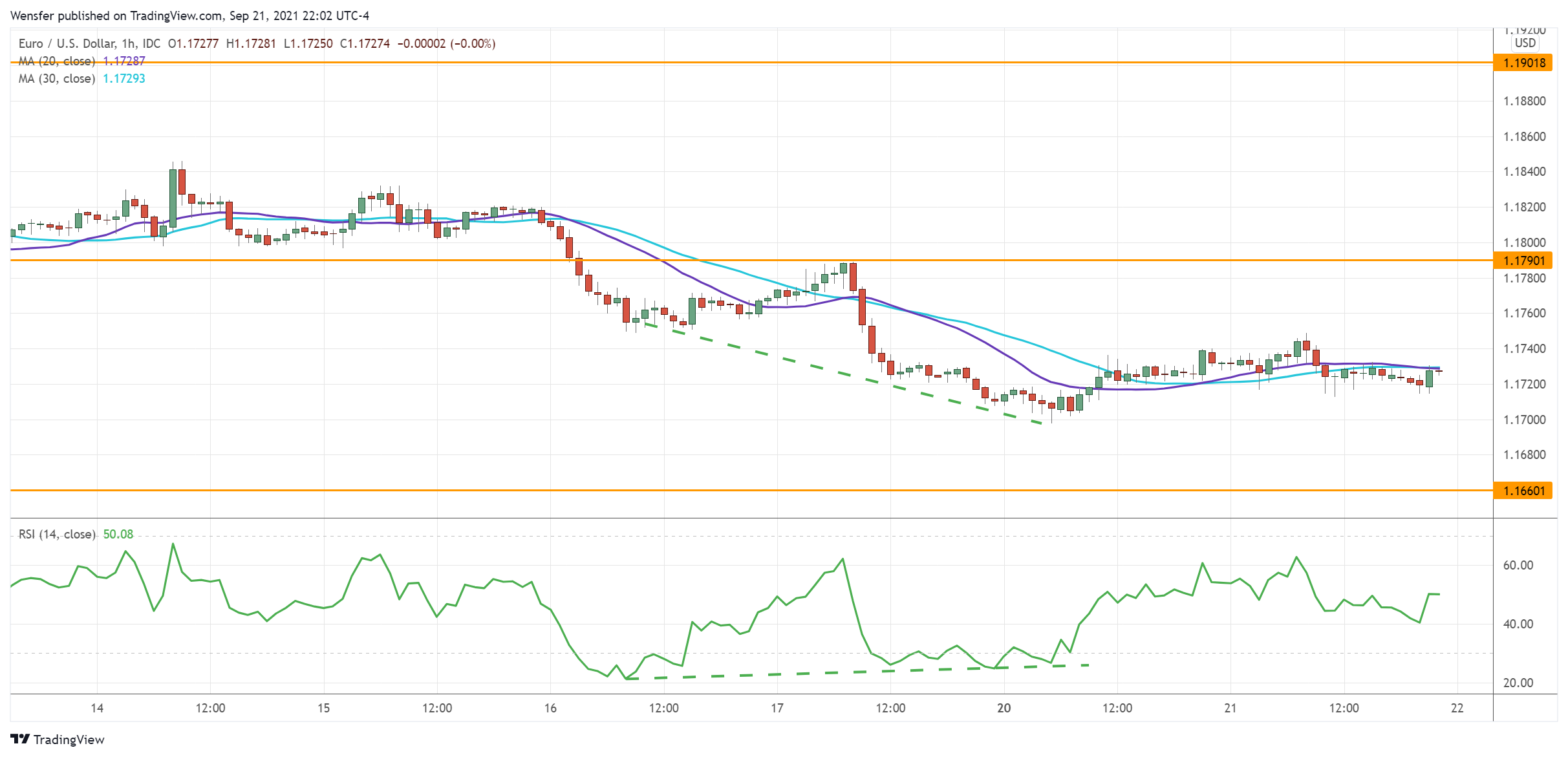
EUR/USD Tests Demand Area
The US dollar treads water ahead of the Fed meeting. After a limited rebound, the euro’s fall below 1.1750 has put the bulls on the defensive.
The pair is testing the demand zone around 1.1700 with the lower boundary being the critical daily support at 1.1660. A bullish RSI divergence suggests that the sell-off might be losing steam.
We can expect buying interest in this congestion area as the indicator climbs back into the neutrality area. 1.1790 is a key hurdle to clear before a meaningful bounce would happen.