

Sample Category Title
Market Morning Briefing: Pound Seems To Be Holding Above 1.36
STOCKS
Dow trades higher after the FOMC and looks bullish for the near term. A rise above 35000 is needed to prevent further fall towards 33000. Dax is also bullish and needs to sustain above 15500 to move up further. Nikkei looks bearish while below 30000. Shanghai has risen well from support and looks bullish. Nifty and Sensex can see a steady rise in the near term.
Dow (34258.32, +338.48, +1%) has risen back above 34000 and while it holds strong, we may expect a rise back towards 34500-34750. However, in the medium term it needs to rise above 35000 and sustain higher to prevent any vulnerability to fall back towards 33000.
DAX (15506.74, +158.21, +1.03%) has risen well too but needs to rise and sustain above 15500 to indicate bullishness towards 15700/800 in the medium term.
Nikkei (29639.40, -200.31, -0.67%) continues to fall over the last few sessions and the view is bearish while below 30000 to see a dip towards 29250-29000 followed by a rise towards 30500-3700 eventually in the longer run. Japan markets are closed today.
Shanghai (3648.57, +20.08, +0.55%) rose sharply from support near 3560 and while that holds, view is bullish on the shanghai.
Nifty (17546.65, -15.35, -0.087%) went up to test the level of 17623 and has come down from there yesterday. The view is bullish while above 17200-17400 to see a rise towards 17700-1800 levels eventually.
Sensex (58927.33, -77.94, -0.13%) has come down too. Sensex has support at the level of 58500 which can hold and we can see a bounce from here towards the level of 59500-60000 eventually.
COMMODITIES
Commodities have risen well. Crude prices have risen and are heading towards resistances. Brent needs to hold below 77-78 while WTI can test 73-74 before coming off from there. Any break above the mentioned resistances can take them higher towards 80 and 75 respectively which are crucial in the medium term. Gold has dipped and needs to sustain above 1740 to move up again soon. Else a fall to 1725/00 cannot be negated in the longer run. Silver can fall towards 22-21.50 but before that it can attempt to rise towards 23.50. Copper tested 4 and has bounced back well from there. It can now rise back towards 4.30/40.
Brent (76.44) has risen well breaking above 75 and could now head towards interim resistance at 77-78 above which there is crucial resistance at 80. The broad 77-80 zone is likely to be tested before a sharp fall towards 70 is seen in the medium term.
WTI (72.41) has risen well as expected and could test 73-74 in the near term.
Gold (1763.90) has fallen as expected from resistance zone of 1780/90 and while that holds, a dip to 1740 cannot be negated. We would have to watch price action near 1740 to see if the price bounces from there or falls further down in the medium term. While correlation with Euro remains strong, a possible bounce in Euro from 1.1665 can help Gold bounce back too.
Silver (22.55) has risen a bit and has scope to rise towards 23.50 before falling off from there. Any break below 22 if seen in the near term would prove contrary to our view and lead to a sharp fall towards 22-21.50. .
Copper (4.1960) fell to almost test 4.00 before rising sharply from there. While above 4.00/10, the price can rise back towards 4.30/40 in the near term.
FOREX
FED announced that it would start tapering by end of this year and stop purchases by mid-2022. It also signaled 3-rate hikes in 2023. Dollar Index rose sharply but needs to sustain above 93.40 to trade higher else a decline towards 93 is possible soon. Euro has broken below 1.17 and may test 1.1665 support which needs to hold to prevent further dip to 1.16. Aussie and Pound have bounce well from immediate supports. USDCNY is holding below resistance zone of 6.47/48. USDINR can test 74 on the upside but has 50% chance that it would come off from there back to 73.80/60. Watch price action near 74.00
Dollar Index (93.44) rose sharply to 93.4150 yesterday as FED announced starting of tapering by end of this year and signaled 3-rate hikes in 2023. Although the index has come off a bit it needs to break below 93.40 and sustain lower to avoid any further rise towards 93.60-93.80 in the near term. Watch price action near 93.40.
Euro (1.1697) fell to test 1.1684 yesterday before rising slightly from there. Note support near 1.1665 which needs to hold in order to keep some room on the upside intact. Else a fall towards 1.16 cannot be neagted.
EURJPY (128.50) has bounced well from support near 128 and while it holds, there is scope for a rise to 129 in the near term.
Dollar-Yen (109.88) rose sharply along with the rise in Dollar Index. But note that the pair still trades within 109-110.40 range which could hold for some more time.
Aussie (0.7226) has paused its fall near 0.7220-0.7200 and a bounce looks possible from current levels towards 0.7250-0.73 eventually.
Pound (1.3625) seems to be holding above 1.36 and while that holds, a bounce back to 1.3650-1.37 cannot be negated in the near term. Only a break below 1.36 if seen will force to look for lower levels.
USDCNY (6.4677) moved up but the resistance zone of 6.47/48 seems to be holding as of now. While below the mentioned resistance zone, the pair can come down towards 6.46/45 again in the near term.
USDINR (73.8750) needs to sustain the rise above 73.80 seen yesterday to test resistance at 74 on the upside. Else a fall from current levels is likely towards 73.80/60. We have 50% chance of resistance at 74 holding.
INTEREST RATES
The US Federal Reserve left the rates unchanged at 0%-0.25%. It had said that the stimulus taper will begin soon. The PCE and Core PCE inflation projections have been revised higher to 4.2% and 3.7% respectively from its earlier projection of 3.4% and 3% respectively. The US Treasury yields have risen at the near-end (2Yr and 5Yr) while the far-end (10Yr and 30Yr) yields have seen a dip. A break below the immediate supports can drag the far-end yields further lower from here. The German yields remain stable and are likely see a fresh fall from here and resume the broader downtrend. The 5Yr and 10Yr GoI have risen-back yesterday. However, they have key resistances ahead that can cap the upside and keep it pressured for a further fall going forward.
The US 2Yr (0.24%) and 5Yr (0.85%) Treasury yieldshave risen while the 10Yr (1.30%) and the 30Yr (1.81%) have dipped after the Fed meeting outcome. A fall below 1.28% on the 10Yr and 1.8% on the 30Yr can drag the yields to 1.2%-1.18% (10Yr) and 1.7% (30Yr) in the coming days. It will also negate the chances of seeing 1.4%-1.45% (10Yr) and 2% (30Yr) on the upside. We will have to wait and watch the follow-up movement in the coming sessions.
The German 2Yr (-0.72), 5Yr (-0.64%), 10Yr (-0.33%) and 30Yr (0.16%)yields continue to remain stable below their key resistances. Our view remains the same. We expect the yields to resume the broader downtrend and see a fresh fall from here. The 10Yr can fall to -0.5% while below -0.25% and the 30Yr can test 0% while it sustains below 0.2%.
The Indian 10Yr GoI (6.1390%) and 5Yr GoI (5.5938%) bounced-back yesterday. However, resistances are at 6.16% and 6.2% for the 10Yr and 5.6% and 5.64% on the 5Yr which can cap the upside from here. While these resistances hold, our broader bearish view of seeing 6.1%-6% (10Yr) and 5.55%-5.5% (5Yr) on the downside remains intact.
Eco Data 9/23/21
[php_everywhere instance="1"]
US Crude Oil Inventory Fell More than Expected, while Gasoline Stockpile Gained
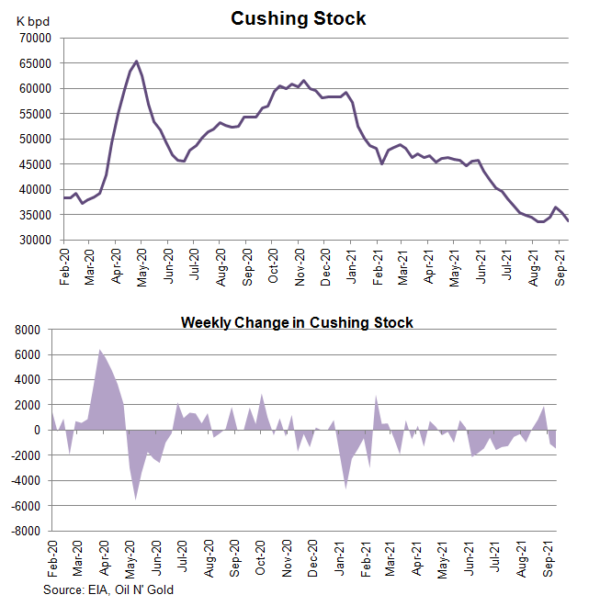
The report from the US Energy Information Administration (EIA) shows that total crude oil and petroleum products (ex. SPR) stocks fell -8.78 mmb to 1234.64 mmb in the week ended September 170. Crude oil inventory fell -3.48 mmb (consensus: -2.44 mmb) to 413.96 mmb. Stockpile fell in 4 out of 5 PADDs. PADD2 (Midwest) alone saw -2.73 mmb decline during the week. Cushing stock slipped -1.48 mmb to 33.84. Utilization rate soared +5.4 percentage points to 87.5% while crude production gained +0.5 mmb to 10.6M bpd for the week. Crude oil imports increased +0.7M bpd to 6.47M bpd in the week.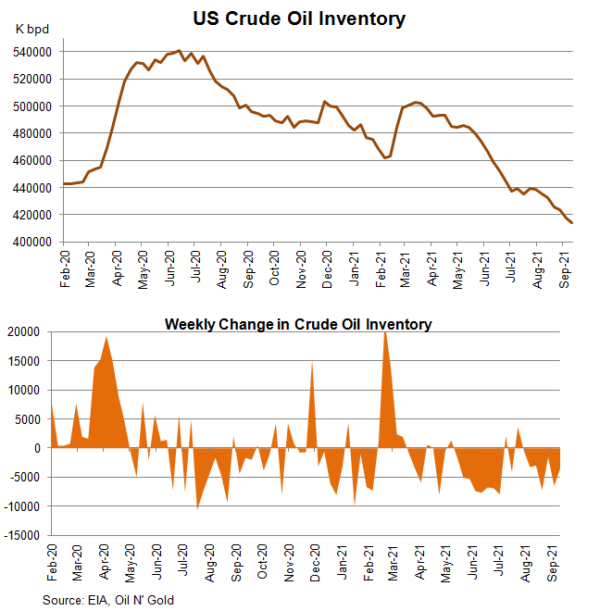
 Concerning refined oil product inventories, gasoline inventory rose +3.47 mmb to 221.62 mmb while demand added +0.04% to 8.9M bpd. The market had anticipated a -1.07 mmb fall in stockpile. Production gained +4.01% to 9.64M bpd while imports soared +69.59% to 1.08M bpd during the week. Distillate stockpile declined -2.55 mmb to 129.34 mmb. The market had anticipated a -1.19 mmb decrease. Demand soared +16.57% to 4.42M bpd. Imports rose +12.2% to 0.18 mmb while production gained +7.17% to 4.45M bpd during the week.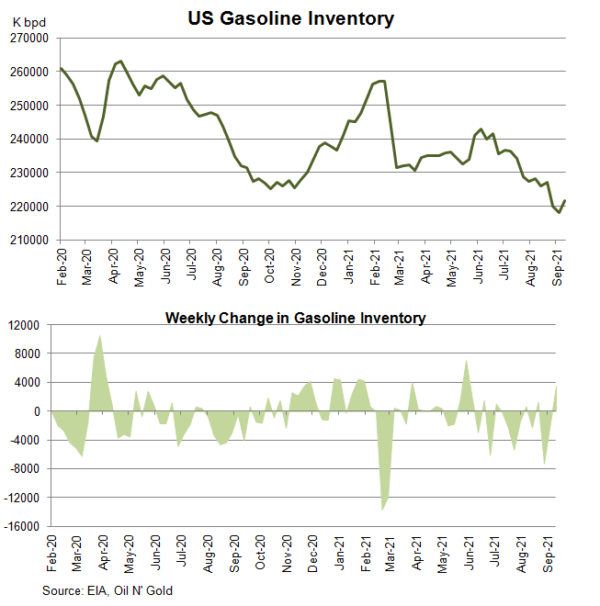

A day earlier, the industry-sponsored API estimated that crude oil inventory sank -6.11 mmb. Gasoline stockpile dropped -0.43 mmb, while that for distillate was down -2.72 mmb.
FOMC Review: Tapering will Start “Soon” while First Rate Hike may Come in as Soon as 2022
The Fed turned more hawkish in September, with the first rate hike pushed forward to 2022. Fed Chair Jerome Powell indicated that QE tapering will come “soon”. The staff downgraded the GDP growth forecast for this year, but revised higher that for 2022 and 2023. Inflation projections were revised higher all the way through to 2023, although its strength was still described as transitory. All monetary policy measures stayed unchanged. The Fed funds rate was left at 0-0.25% and the QE program at 120B.
In the policy statement, the Fed acknowledged improvement of economic activities as driven by vaccination and policy support. It also noted improvement of sectors that have been “most adversely affected by the pandemic|. Yet, it warned that the recovery has been slowed by “rise in COVID-19 cases”. It also reiterated that view that the path of the economy is dependent on the developments of pandemic.
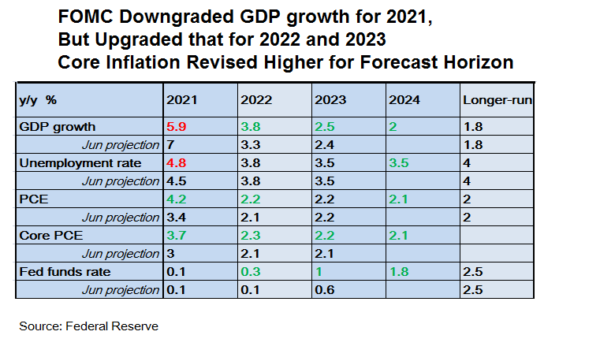
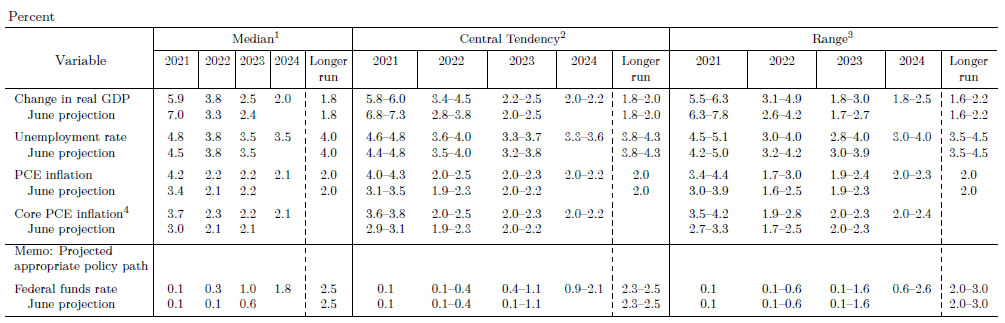
The Fed staff downgraded the near-term economic outlook and revised higher inflation forecasts. The median projection for real GDP growth was downgraded to +5.9% y/y in 2021 and upgraded to +3.8% in 2022. The forecast for 2023 was revised higher to +2.5%. The median unemployment rate forecast was raised to 4.8% 2021, but maintained unchanged at 3.8% and 3.5% for 2022 and 2023 respectively. On inflation, the median estimate for core PCE was revised higher to +3.7% y/y in 2021 +2.3% in 2022 and +2.2% in 2023. The staff also introduced projection for 2024 which is expected to reach +2.1%.
On the monetary policy outlook, policymakers noted that the economy has made progress toward the central bank’s goals. They suggested that “a moderation in the pace of asset purchases may soon be warranted”, if the “progress continues broadly as expected”. This sounds more hawkish than the July’s reference which affirmed that the members would continue to assess the progress in coming meetings. Together with the forward guidance made at the Jackson Hole symposium that a tapering could happen by “year-end”, it is highly likely that a formal announcement should some at the next meeting (November) with implementation starting in December. We expect the Fed will lower purchases of Treasury and MBS by 10B and 5B, respectively, each month, until the program ends in about July 2022.
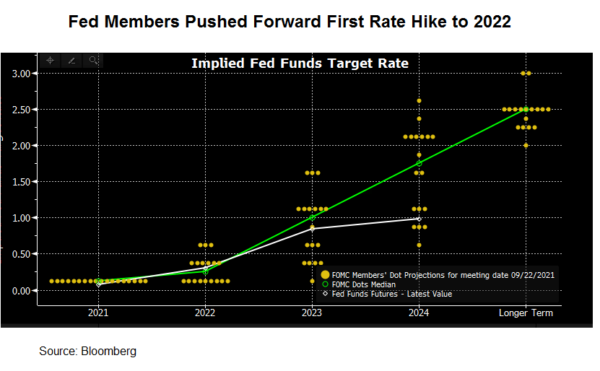
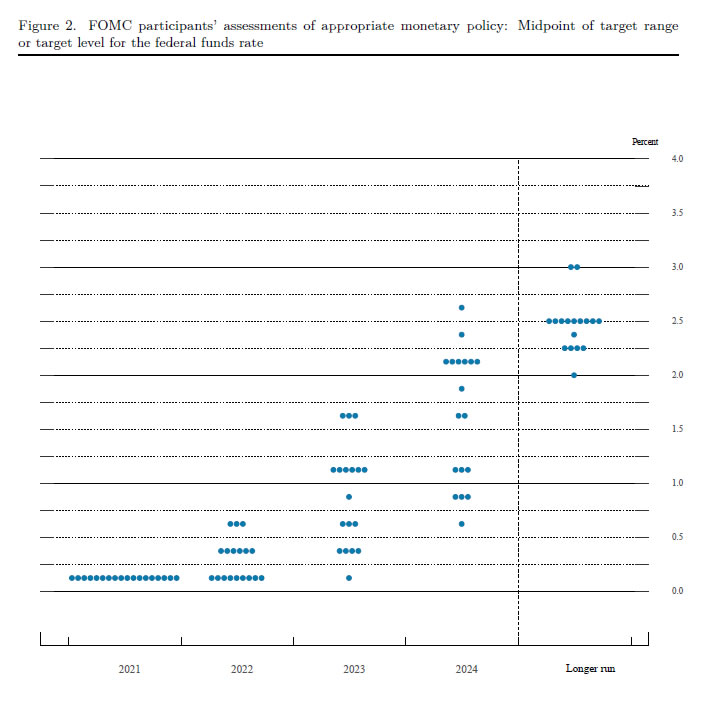
Members have also pushed forward the timing of the first rate hike. The median dot plots showed that 9 out of 18 members projected it to happen in 2022. Indeed, the staff projection also showed that the policy rate would increase to 0.3% next year, up from the current 0.1%. This would be followed by further increase to 1% in 2023 and 1.8% in 2024. The longer-term policy rate will stay at 2.5%. If the QE tapering process completes as we have expected, the first rate hike could come in September 2022.
Fed chair Jerome Powell press conference live stream
https://www.youtube.com/watch?v=n-azWgGI9iU
Fed dot plot shows more members favor rate hike in 2022
In Fed's new median economic projections, comparing to June's projection, the outlook in 2021 looks weaker with lower GDP growth projection, and higher unemployment rate and core PCE inflation. But a stronger bounce back is projected in 2022.
Meanwhile, the median projection now shows 1 rate hike in 2022. In the dot plot, 9 members penciled in one hike or more in 2022, versus 8 members expecting no change.
GDP growth:
- 2021 downgraded from 7.0% to 5.9%
- 2022 upgraded from 3.3% to 3.8%
- 2023 upgraded from 2.4% to 2.5%
- 2024 at 2.0% (new)
Unemployment rate:
- 2021 raised from 4.5% to 4.8%
- 2022 unchanged at 3.8%
- 2023 unchanged at 3.5%
- 2024 at 3.5% (new).
Core PCE inflation:
- 2021 upgraded from 3.0% to 3.7%
- 2022 raised from 2.1% to 2.3%
- 2023 rased from 2.1% to 2.2%
- 2024 at 2.1% (new)
Federal funds rate:
- 2021 unchanged at 0.1%
- 2022 raised form 0.1% to 0.3%
- 2023 raised from 0.6% to 1.0%
Fed stands pat, tapering may soon be warranted
Fed kept monetary policy unchanged as expected. Federal funds rate is held at 0-0.25%. The target range will be maintained "until labor market conditions have reached levels consistent with the Committee's assessments of maximum employment and inflation has risen to 2 percent and is on track to moderately exceed 2 percent for some time."
The asset purchase pace is also held at at least USD 80B on treasury securities and USD 40B on MBS per month. Though, it added that "if progress continues broadly as expected, the Committee judges that a moderation in the pace of asset purchases may soon be warranted."
(FED) Federal Reserve Issues FOMC Statement
The Federal Reserve is committed to using its full range of tools to support the U.S. economy in this challenging time, thereby promoting its maximum employment and price stability goals.
With progress on vaccinations and strong policy support, indicators of economic activity and employment have continued to strengthen. The sectors most adversely affected by the pandemic have improved in recent months, but the rise in COVID-19 cases has slowed their recovery. Inflation is elevated, largely reflecting transitory factors. Overall financial conditions remain accommodative, in part reflecting policy measures to support the economy and the flow of credit to U.S. households and businesses.
The path of the economy continues to depend on the course of the virus. Progress on vaccinations will likely continue to reduce the effects of the public health crisis on the economy, but risks to the economic outlook remain.
The Committee seeks to achieve maximum employment and inflation at the rate of 2 percent over the longer run. With inflation having run persistently below this longer-run goal, the Committee will aim to achieve inflation moderately above 2 percent for some time so that inflation averages 2 percent over time and longer‑term inflation expectations remain well anchored at 2 percent. The Committee expects to maintain an accommodative stance of monetary policy until these outcomes are achieved. The Committee decided to keep the target range for the federal funds rate at 0 to 1/4 percent and expects it will be appropriate to maintain this target range until labor market conditions have reached levels consistent with the Committee's assessments of maximum employment and inflation has risen to 2 percent and is on track to moderately exceed 2 percent for some time. Last December, the Committee indicated that it would continue to increase its holdings of Treasury securities by at least $80 billion per month and of agency mortgage‑backed securities by at least $40 billion per month until substantial further progress has been made toward its maximum employment and price stability goals. Since then, the economy has made progress toward these goals. If progress continues broadly as expected, the Committee judges that a moderation in the pace of asset purchases may soon be warranted. These asset purchases help foster smooth market functioning and accommodative financial conditions, thereby supporting the flow of credit to households and businesses.
In assessing the appropriate stance of monetary policy, the Committee will continue to monitor the implications of incoming information for the economic outlook. The Committee would be prepared to adjust the stance of monetary policy as appropriate if risks emerge that could impede the attainment of the Committee's goals. The Committee's assessments will take into account a wide range of information, including readings on public health, labor market conditions, inflation pressures and inflation expectations, and financial and international developments.
Voting for the monetary policy action were Jerome H. Powell, Chair; John C. Williams, Vice Chair; Thomas I. Barkin; Raphael W. Bostic; Michelle W. Bowman; Lael Brainard; Richard H. Clarida; Mary C. Daly; Charles L. Evans; Randal K. Quarles; and Christopher J. Waller.
Stocks Rally ahead of the Fed
Stock markets are looking surprisingly bullish ahead of the Federal Reserve decision later today, with Europe posting gains above 1% and the US not far behind.
It seems all of the unease around Evergrande in recent days is abating, with the company's onshore unit announcing an agreement had been reached on an interest payment due tomorrow. The problem has by no means gone away but one hurdle has been overcome that buys the company a little more time.
What's more, the PBOC injected 120 billion yuan into the financial system overnight in a bid to calm the markets; a move that's seemingly done just that. There's still a long way to go in this saga but the company surged more than 40% in Frankfurt following the events overnight.
The Evergrande story has been a big distraction from what was meant to be the headline act this week, the Fed. The central bank has been front and centre of investors minds for weeks as markets prepared for its taper announcement, something that's left investors rather anxious at times as the data has deteriorated and risks to the outlook have grown.
The day has finally arrived and seemingly those nerves have disappeared. Given the growing list of downside risks in the coming months, investors are expecting the Fed to continue to target a taper this year - probably in November - but wrap it in dovish caveats that give it plenty of outs should those risks become reality.
There is clearly an appetite within the Fed to pare back asset purchases in anticipation of a rate hike in 2023 but it must keep investors on board while doing so or risk a dreaded taper tantrum in the markets.
Ultimately, it may not be the taper itself that determines how investors respond but the dot plot. While the Fed removed the link between tapering and rate hikes, the latter will not be far behind and the dot plot should give us a better idea of when that will be. There may well be more backing for a rate hike next year given the current path of inflation, something that could make investors worried.
Oil bounces back but China remains a risk
The improvement we've seen in risk appetite has helped lift oil prices after they slipped back this week. Chinese growth concerns are naturally a big downside risk for crude prices, with it being the world's largest importer. With sentiment much improved following the PBOC's cash injection and Evergrande reaching an agreement on an interest payment in yuan-denominated bonds, oil has taken a turn for the better.
The rebound was also aided by a 6.1million inventory draw, reported by API on Tuesday. Although part of this has already been given back after EIA reported only a 3.5 million decline, in line with previous expectations.
Still, oil prices look healthy once more with WTI seeing strong support around $70 over the last couple of days. That said, it will remain sensitive to headlines coming from China in the coming days and I'm sure there will be plenty, including an update on the coupon due on its dollar-denominated bond, also due Thursday.
Gold rallies ahead of the Fed
The dollar has softened a little over the last couple of days which has provided some reprieve for gold, which has rebounded off its lows earlier in the week. I'm not sure how much better it will get for the yellow metal though unless the Fed has a dovish surprise in store for the markets, which would weigh heavily on the dollar and push yields lower.
Gold is seeing resistance currently around $1,780, where it saw strong support lat-August and early September, before smashing through a little under a week ago. A rotation off this level would be a very bearish signal for the yellow metal and could see focus switch back towards $1,740 and maybe even $1,700.
Bitcoin fighting back
Bitcoin is enjoying a bit of a rebound today but the near-term outlook isn't looking great. The cryptocurrency broke below $44,000 on Tuesday, where it had seen strong support in recent weeks. The move triggered a rapid drop back towards $40,000 before it clawed some of those losses back.
Now we're seeing a test of $44,000 from below, a failure of which could be another bearish signal and pile pressure back on yesterday's low. A move below $40,000 could see attention shift back towards $36,000 and perhaps even $30,000.
Pound Edges Lower ahead of FOMC, BoE
The British pound has resumed its downswing on Wednesday, after taking a pause on Tuesday. GBP/USD is currently trading at 1.3645, down 0.11% on the day.
Will BoE hint at an interest hike?
The markets will have plenty to digest this week from central bankers, with the Federal Reserve holding a policy meeting on Wednesday, followed by the Bank of England on Thursday. With the UK economy recovering well from the Covid-19 downturn and inflation well above the BoE’s 2% target, there have been calls for the Bank to tighten policy earlier rather than later, perhaps in early 2022. The BoE had signalled its plan for ‘modest tightening’ in the next few years, but policy makers haven’t indicated a timeline regarding a rate hike.
The Bank tightened policy in May, when it tapered its bond purchases from GPP 4.4 billion a week to GBP 3.4 billion a week. Granted, this was a minor move, but it was nonetheless an important signal to the markets that the BoE was giving a vote of confidence to the UK recovery. The markets are expecting a rate hike in 2022, but I wouldn’t be surprised if at the Thursday meeting policymakers steer away from a timeline on a rate hike and focuses on economic conditions.
The markets are eagerly awaiting the Federal Reserve policy meeting later today. There are expectations that the Fed may signal that it will make an announcement at the November meeting as to whether it will begin tapering. The Fed may take a hawkish turn by bringing forward projections of a rate hike in the dot plot. The previous dot plot pointed to rate hike in 2023, but there is a good chance that this will be brought up to 2022. If this occurs, the US dollar and Treasury yields could respond with gains in the North American session.
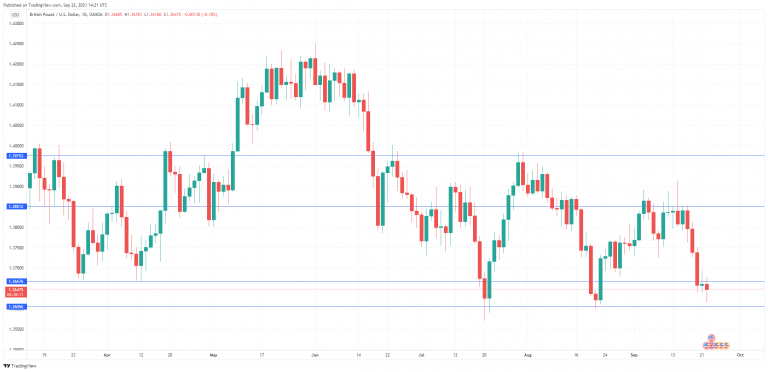
GBP/USD Technical Analysis
- There are resistance lines at 1.3851 and 1.3975
- The pair is testing support at 1.3666. Below, there is support at 1.3605