

Sample Category Title
USD/CHF Daily Outlook
Daily Pivots: (S1) 0.9229; (P) 0.9251; (R1) 0.9286; More....
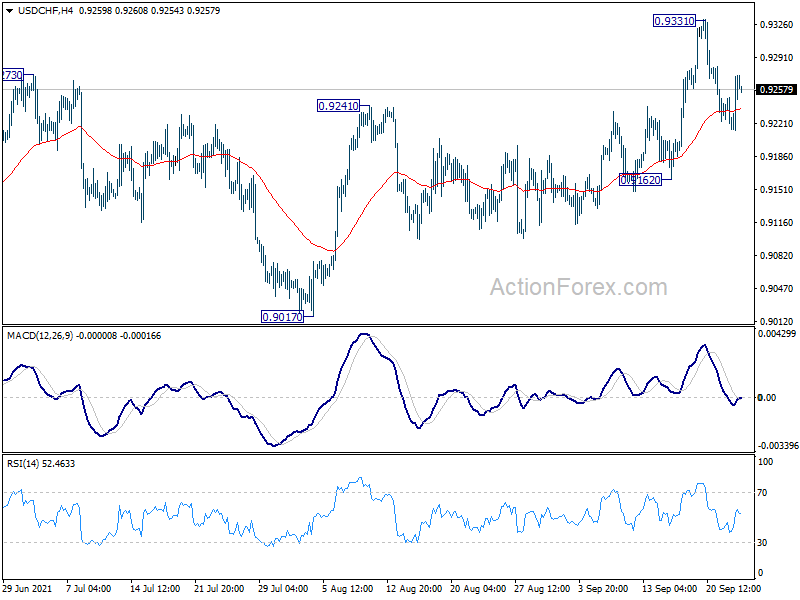
Intraday bias in USD/CHF remains neutral at this point, as consolidation from 0.9331 might extend further. Rises from 0.9017 and 0.8925 are in favor to continue as long as 0.9162 support holds. On the upside, break of 0.9331 resistance will target 0.9471 key resistance. Sustained break there will carry larger bullish implications. However, break of 0.9162 will turn bias back to the downside for 0.9017 support instead.
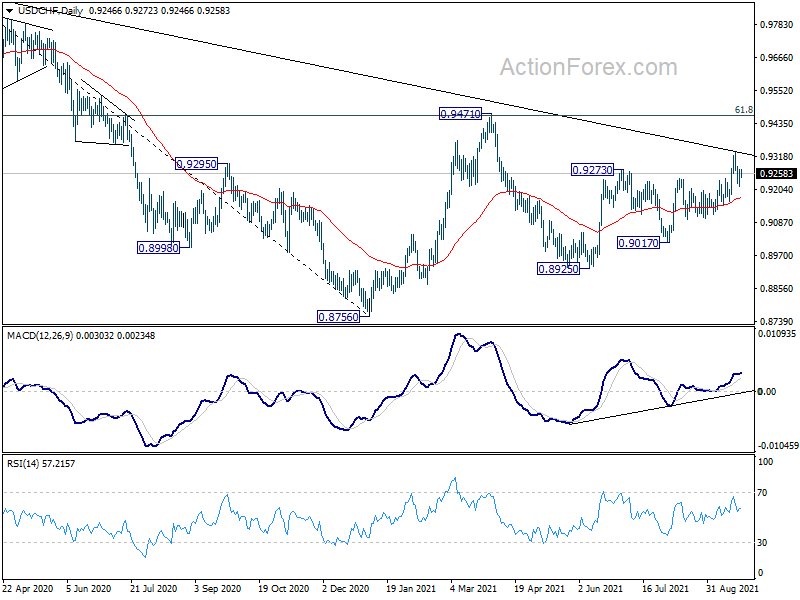
In the bigger picture, the strong rally above 55 week EMA (now at 0.9182) now tilts favor to the case of bullish trend reversal. That is, decline from 1.3042 (2016 high) is probably completed at 0.8756 already. Sustained break of 0.9471 resistance should confirm this case and pave the way to retest 1.0342 ahead. However, rejection by 0.9471 will mix up the outlook again and retain some medium term bearishness.
GBP/USD Daily Outlook
Daily Pivots: (S1) 1.3588; (P) 1.3639; (R1) 1.3668; More...
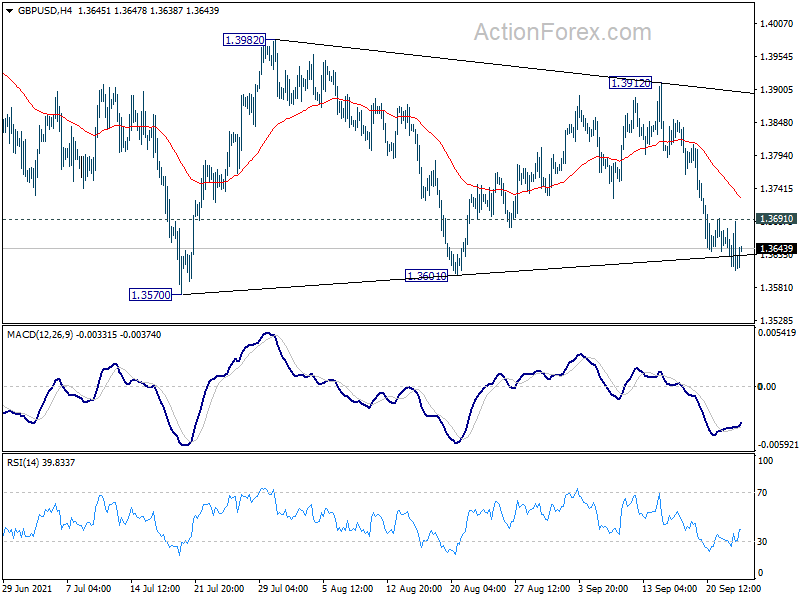
GBP/USD continues to lose downside momentum as seen in 4 hour MACD. But with 1.3691 minor resistance intact, further decline is still expected. Larger fall from 1.4248 is likely resuming and break of 1.3570 will target 1.3482 key support level. Sustained break there will carry larger bearish implication and target 1.3163 fibonacci level. On the upside, above 1.3691 minor resistance will turn intraday bias back to the upside for 1.3912 resistance instead.
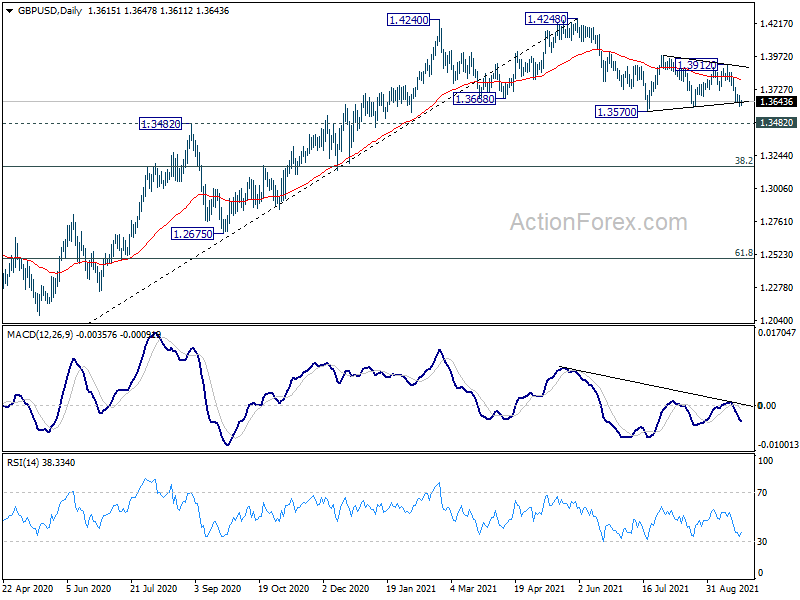
In the bigger picture, as long as 1.3482 resistance turned support holds, we'd still treat price actions from 1.4248 as a corrective move. That is, up trend from 1.1409 (2020 low) is in favor to resume. Decisive break of 1.4376 key resistance (2018 high) would indeed carry long term bullish implications. However, sustained break of 1.3482 will at least bring deeper fall to 38.2% retracement of 1.1409 to 1.4248 at 1.3164, or even further to 61.8% retracement at 1.2493.
EUR/USD Daily Outlook
Daily Pivots: (S1) 1.1665; (P) 1.1710; (R1) 1.1735; More...
EUR/USD's fall from 1.1908 is still in progress and intraday bias remains on the downside for 1.1663 low. Decisive break there will resume the fall from 1.2265, and the pattern from 1.2348, to 1.1602 key support next. On the upside, above 1.1788 minor resistance will turn bias back to the upside for 1.1908 again.
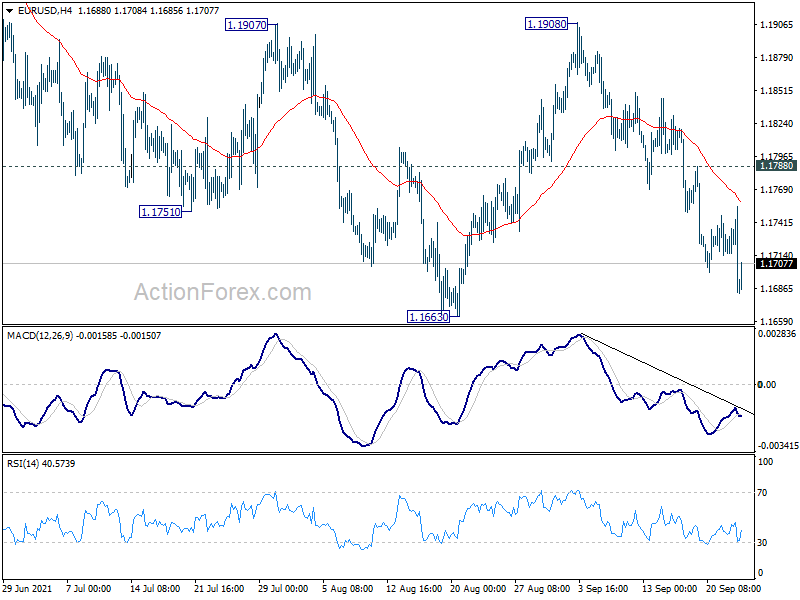
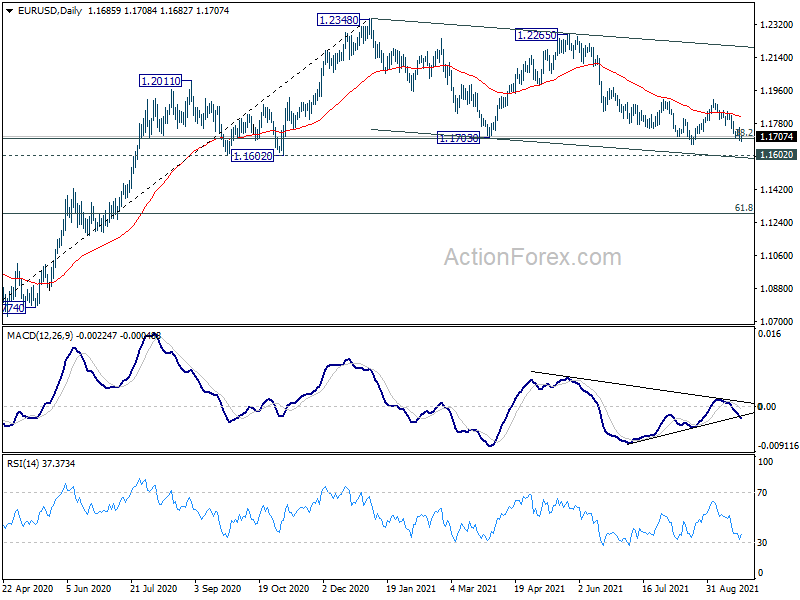
In the bigger picture, rise from 1.0635 is seen as the third leg of the pattern from 1.0339 (2017 low). Further rally remains in favors long as 1.1602 support holds, to cluster resistance at 1.2555 next, (38.2% retracement of 1.6039 to 1.0339 at 1.2516). However sustained break of 1.1602 will argue that the rise from 1.0635 is over, and turn medium term outlook bearish again. Deeper fall would be seen to 61.8% retracement of 1.0635 to 1.2348 at 1.1289 and below.
Markets Responded Positively to FOMC, Sterling Stays Soft ahead of BoE
Dollar initially dipped after FOMC overnight, but quickly found its footing. Overall market reaction was positive, but insufficient to alter the near term outlook. Sterling remains the worst performing one for the week while Swiss Franc is the strongest. Both will look into BoE and SNB policy decision today. Commodity currencies are on the softer side for now, while Yen is the firmer one.
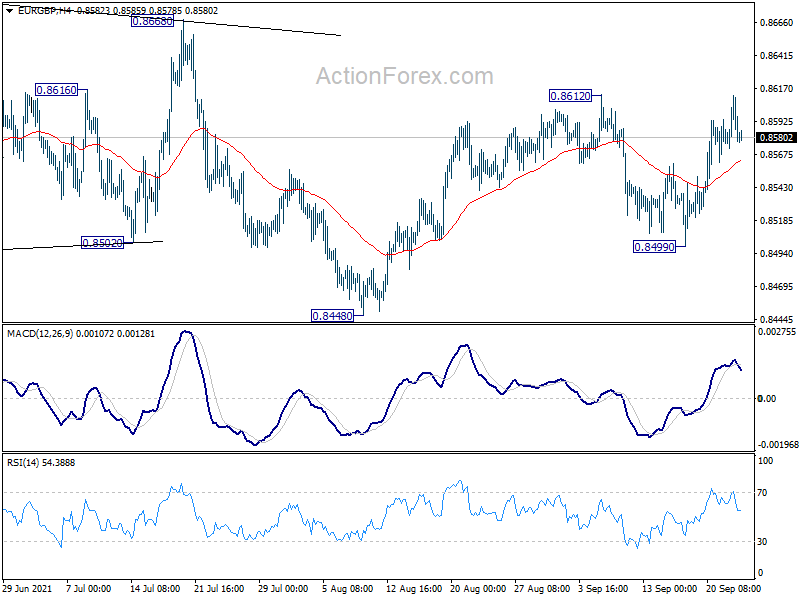
Technically, we'll keep a close eye on Sterling pairs for today. In particular, EUR/GBP failed to break through 0.8612 resistance on the first attempt. GBP/JPY also stabilized after hitting 149.03 key support level. Meanwhile, GBP/USD lost some downside momentum after breaching 1.3601 support. We'd see if Pound sellers would come back after BoE, or the currency would rebound from current levels.
In Asia, at the time of writing, Hong Kong HSI is up 0.69%. China Shanghai SSE is up 0.58%. Singapore Strait Times is up 0.86%. Japan is on holiday. Overnight, DOW rose 1.00%. S&P 500 rose 0.95%. NASDAQ rose 1.02%. 10-year yield rose 0.012 to 1.336.
S&P 500 closed up after FOMC, but risk stays on downside
Overall response to Fed's announcement overnight was positive, with major stock indexes closed higher. In short, Fed indicated that tapering will come "soon". Members have also pushed forward the timing of the first rate hike. The median dot plots showed that 9 out of 18 members projected it to happen in 2022.
Suggested readings on Fed:
- FOMC Review: Tapering will Start "Soon" while First Rate Hike may Come in as Soon as 2022
- FOMC Members Pull Forward Expectations for the Start of Rate Hikes Again!
- For the FOMC, Taper Requirements are "All But Met"
- FOMC Meeting Recap: Powell Projects A November Taper Announcement
- VOLATILITY ALERT! The Taper Is Coming
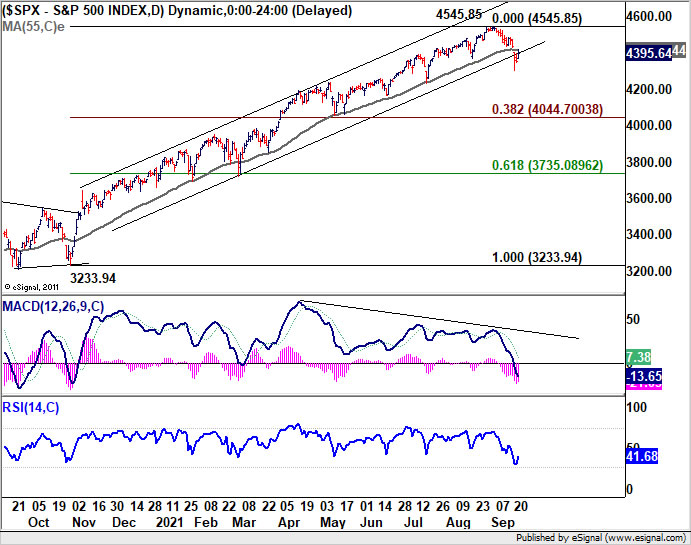
S&P 500 gained 0.95% to close at 4395.64. But it struggled to break through 55 day EMA (now at 4412.38). Near term risk will remain on the downside unless SPX could sustain above the EMA in the next few days. Indeed, a break of this week's low at 4305.91 will further affirm that it's already in correction to whole up trend from 3233.94. Deeper fall would be seen to 38.2% retracement at 4044.70 before SPX finds a bottom.
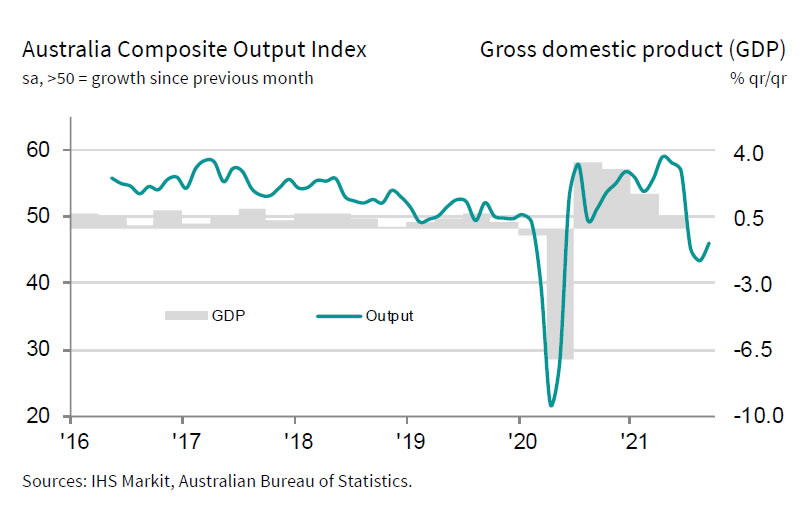
Australia PMI composite rose to 46.0, early signs of a turning point
Australia PMI Manufacturing rose from 52.0 to 57.3 in September, hitting a 3-month high. PMI Services also rose from 42.9 to 44.9, staying in contraction but hit a 3-month high. PMI Composite rose from 43.3 to 46.0.
Jingyi Pan, Economics Associate Director at IHS Markit, said: "The extension of COVID-19 restrictions into September continued to dampen business conditions in the Australian private sector, although the slight easing of restrictions was picked up in the latest IHS Markit Flash Australia Composite PMI, seeing the overall Composite Output Index contracting at a slower rate in September. This may also be suggesting that we are looking at early signs of a turning point.
"The employment index meanwhile pointed to higher workforce levels, which was a positive sign following the decline recorded in August, driven by the severe COVID-19 disruptions. That said, price pressures intensified once again for Australian private sector firms while evidence of worsening supply constraints gathered, all of which remains a focal point for the Australian economy."
Looking ahead
BoE and SNB policy decisions are the major focuses in European session. BoE is is expected to keep Bank rate unchanged at 0.1% by unanimous vote. Asset purchase target will also be held at GBP 875 with 8-1 vote. The focus will indeed be on how two new MPC member would shift the hawk/dove balance. SNB is widely expected to make no change to policy, and reiterate the necessity of negative rate and readiness for currency intervention.
Suggested readings:
- BOE Preview – How will New Members Shift the Views of Rate Hike Conditions?
- BoE Preview: Too Soon For A Hawkish Bias Despite Soaring Inflation
- Bank Of England Policy Meeting: A Hawkish Tilt With Some Caution
On the data front, Eurozone PMIs, UK PMIs, US PMIs and jobless claims, and Canada retail sales will be featured.
EUR/USD Daily Outlook
Daily Pivots: (S1) 1.1665; (P) 1.1710; (R1) 1.1735; More...
EUR/USD's fall from 1.1908 is still in progress and intraday bias remains on the downside for 1.1663 low. Decisive break there will resume the fall from 1.2265, and the pattern from 1.2348, to 1.1602 key support next. On the upside, above 1.1788 minor resistance will turn bias back to the upside for 1.1908 again.
In the bigger picture, rise from 1.0635 is seen as the third leg of the pattern from 1.0339 (2017 low). Further rally remains in favors long as 1.1602 support holds, to cluster resistance at 1.2555 next, (38.2% retracement of 1.6039 to 1.0339 at 1.2516). However sustained break of 1.1602 will argue that the rise from 1.0635 is over, and turn medium term outlook bearish again. Deeper fall would be seen to 61.8% retracement of 1.0635 to 1.2348 at 1.1289 and below.
Economic Indicators Update
| GMT | Ccy | Events | Actual | Forecast | Previous | Revised |
|---|---|---|---|---|---|---|
| 23:00 | AUD | Manufacturing PMI Sep P | 57.3 | 52 | ||
| 23:00 | AUD | Services PMI Sep P | 44.3 | 42.9 | ||
| 7:15 | EUR | France Manufacturing PMI Sep P | 57.3 | 57.5 | ||
| 7:15 | EUR | France Services PMI Sep P | 56.1 | 56.3 | ||
| 7:30 | CHF | SNB Interest Rate Decision | -0.75% | |||
| 7:30 | EUR | Germany Manufacturing PMI Sep P | 61.3 | 62.6 | ||
| 7:30 | EUR | Germany Services PMI Sep P | 60.3 | 60.8 | ||
| 8:00 | EUR | Eurozone Manufacturing PMI Sep P | 60.4 | 61.4 | ||
| 8:00 | EUR | Eurozone Services PMI Sep P | 58.4 | 59 | ||
| 8:00 | EUR | ECB Economic Bulletin | ||||
| 8:30 | GBP | Manufacturing PMI Sep P | 59 | 60.3 | ||
| 8:30 | GBP | Services PMI Sep P | 55 | 55 | ||
| 11:00 | GBP | BoE Interest Rate Decision | 0.10% | 0.10% | ||
| 11:00 | GBP | BoE Asset Purchase Facility | 875B | 875B | ||
| 11:00 | GBP | MPC Official Bank Rate Votes | 0--0--9 | 0--0--8 | ||
| 11:00 | GBP | MPC Asset Purchase Facility Votes | 0--1--8 | 0--1--7 | ||
| 12:30 | CAD | Retail Sales M/M Jul | 2.50% | 4.20% | ||
| 12:30 | CAD | Retail Sales ex Autos M/M Jul | 2.70% | 4.70% | ||
| 12:30 | USD | Initial Jobless Claims (Sep 17) | 317K | 332K | ||
| 13:45 | USD | Manufacturing PMI Sep P | 61.1 | 61.1 | ||
| 13:45 | USD | Services PMI Sep P | 55.1 | 55.1 | ||
| 14:30 | USD | Natural Gas Storage | 83B |
Australia PMI composite rose to 46.0, early signs of a turning point
Australia PMI Manufacturing rose from 52.0 to 57.3 in September, hitting a 3-month high. PMI Services also rose from 42.9 to 44.9, staying in contraction but hit a 3-month high. PMI Composite rose from 43.3 to 46.0.
Jingyi Pan, Economics Associate Director at IHS Markit, said: "The extension of COVID-19 restrictions into September continued to dampen business conditions in the Australian private sector, although the slight easing of restrictions was picked up in the latest IHS Markit Flash Australia Composite PMI, seeing the overall Composite Output Index contracting at a slower rate in September. This may also be suggesting that we are looking at early signs of a turning point.
"The employment index meanwhile pointed to higher workforce levels, which was a positive sign following the decline recorded in August, driven by the severe COVID-19 disruptions. That said, price pressures intensified once again for Australian private sector firms while evidence of worsening supply constraints gathered, all of which remains a focal point for the Australian economy."
S&P 500 closed up after FOMC, but risk stays on downside
Overall response to Fed's announcement overnight was positive, with major stock indexes closed higher. In short, Fed indicated that tapering will come "soon". Members have also pushed forward the timing of the first rate hike. The median dot plots showed that 9 out of 18 members projected it to happen in 2022.
Suggested readings on Fed:
- FOMC Review: Tapering will Start "Soon" while First Rate Hike may Come in as Soon as 2022
- FOMC Members Pull Forward Expectations for the Start of Rate Hikes Again!
- For the FOMC, Taper Requirements are "All But Met"
- FOMC Meeting Recap: Powell Projects A November Taper Announcement
- VOLATILITY ALERT! The Taper Is Coming
S&P 500 gained 0.95% to close at 4395.64. But it struggled to break through 55 day EMA (now at 4412.38). Near term risk will remain on the downside unless SPX could sustain above the EMA in the next few days. Indeed, a break of this week's low at 4305.91 will further affirm that it's already in correction to whole up trend from 3233.94. Deeper fall would be seen to 38.2% retracement at 4044.70 before SPX finds a bottom.
FOMC Members Pull Forward Expectations for the Start of Rate Hikes Again!
The Federal Reserve Open Market Committee (FOMC) maintained the current stance of monetary policy, which includes keeping the federal funds rate at the current 0% to 0.25% range. The statement also maintained the commitment to purchase at least $80 billion in Treasuries and $40 billion in agency mortgage-back securities per month.
The Fed's statement on economic conditions noted that "with progress on vaccinations and strong policy support, indicators of economic activity and employment have continued to strengthen. The sectors most adversely affected by the pandemic have improved in recent months, but the rise in COVID-19 cases has slowed their recovery."
The statement altered its language on future asset purchases, moving well past the "talking about talking" stage by saying, "the Committee judges that a moderation in the pace of asset purchases may soon be warranted"
The accompanying Summary of Economic Projections downgraded the near-term economic outlook and raised expectations for inflation:
- The median projection for real GDP growth was downgraded to 5.9% (from 7%) in 2021 and upgraded to 3.8% (from 3.3%) in 2022. The forecast for 2023 ticked up to 2.5% from 2.4%, while the expectation for growth over the longer run was unchanged at 1.8%.
- The median unemployment rate forecast was raised to 4.8% (from 4.5%) in 2021, unchanged at 3.8% in 2022, and unchanged at 3.5% in 2023. The median longer-run estimate for the unemployment rate remained at 4.0%.
- On inflation, the median estimate for core PCE rose to 3.7% in 2021 (from 3.0%) , 2.3% in 2022 (from 2.1%), 2.2% in 2023 (from 2.1%), and 2.1% in 2024.
- The median projection for the fed funds rate at the end of each calendar year was raised to 0.3% in 2022 (from 0.1%), to 1.0% in 2023 (from 0.6%). A rate of 1.8% is now expected for 2024 (new forecast). The long-run neutral rate was unchanged at 2.5%.
All of the members of the FOMC voted in favor of the decision.
Key Implications
Heading into today's meeting, expectations were for the Fed to give further guidance on when it will taper its Quantitative Easing (QE) purchases. It hinted at it, but gave no firm direction, opting to say that a taper "may soon be warranted." Look for lots of questions being hurled at Chair Powell during the post-meeting presser. During the Jackson Hole Symposium in August, Chair Powell gave forward guidance that a tapering could happen by "year-end". Though a more precise announcement today was on the table, November is now most likely.
In addition to a decision on QE, Fed watchers were also looking to see if FOMC officials changed their outlook in light of recent Delta-driven economic weakness. Based on today's release, Fed officials are clearly looking past recent weakness. They have simply moved more of it into next year and have GDP growth continuing to run at an above trend clip through 2024. They see the unemployment rate dropping below the long-run level in 2022 and have inflation staying above 2% for the next three years.
Markets were little changed on today's announcement. The US10Y yield is down slightly and is still hovering around 1.3%. The U.S. dollar index is flat at 93 and equity markets have held on to earlier gains. Though markets have maintained calm today, the fundamental drivers for high yields remain in place. There exists a severe underpricing of the Fed's future policy path and the compensation investors are receiving for inflation risk is insufficient. A rebound in economic data once we are past this Delta hurdle may be the impetus that markets need to deliver a repricing. Please see our updated forecast here.
For the FOMC, Taper Requirements are “All But Met”
A decision by year end and six (or so) month taper is the FOMC’s expectation, in line with Westpac’s view.
The FOMC’s September meeting communications met our expectations, with a near-term taper signalled without a formal decision being made.
While the Committee’s views on the immediate outlook have deteriorated between June and September because of the current delta wave, the 2021 GDP forecast revised down from 7.0% to 5.9% and the end-2021 unemployment rate projection up from 4.5% to 4.8%, the Committee’s confidence in the outlook from 2022 remains strong.
Indeed: growth in 2022 has been revised up from 3.3% to 3.8% and is seen above trend through 2023 and 2024 (2.5% and 2.0%); as a result, the unemployment rate is forecast to be back at its ‘full-employment’ level in 2022/23 (respectively 3.8% and 3.5%). This is why the Committee believe that if “progress continues broadly as expected… a moderation in the pace of asset purchases may soon be warranted”.
The questions that need answering are what is meant by “soon” and at what pace the taper will proceed. From Chair Powell’s press conference and the fed funds rate dot plot, December 2021, if not November, will see a formal decision on this policy, with Chair Powell clearly articulating in the press conference that the taper test for inflation has been surpassed and that for the labour market “all but met”. The decision between November and December will be determined by the strength of the September and October jobs reports. Regarding the pace of the taper process, he repeatedly looked to the middle of 2022 as a likely end point, giving a 6-8 month timeline (in line with our January to June 2022 expectation).
The updated fed funds rate dot plot confirms this is the view not only of Chair Powell but the Committee, with the fed funds rate now seen at 0.3% at end-2022 (essentially a split vote on a first hike) rather than the lower bound. This forecast change was not necessary, particularly as data has disappointed of late and given risks related to the delta wave. As per the economic forecasts above, it speaks to strong confidence in the recovery and an ability to begin normalising monetary policy without undue risk to the economy.
Looking at the long view for the fed funds rate, after a potential first hike in late-2022, the Committee sees a further three hikes in 2023 to 1.0% and another three in 2024 to 1.8%. This profile is in keeping with our established expectation of a fed funds rate of 0.375%; 0.875%; and 1.625% at year-end 2022-2024 respectively.
On this path to policy normalisation, two facts need to be recognised: (1) the FOMC do not expect to act pre-emptively or aggressively; and (2) at the end of 2024, the stance of monetary policy is still best characterised as accommodative.
Highlighting these points, while their immediate expectation for PCE inflation has been revised up from 3.4% to 4.2%, in 2022-2024 and the longer-run inflation is seen at target, with both the headline and core measures rounding to 2%yr. On the stance of policy, note that the FOMC expects the nominal fed funds rate to remain below their ‘longer-run’ neutral rate throughout and, in real terms, to be negative, with the fed funds rate below the rate of inflation to end-2024.
There are two implications of the above: (1) at or above-trend growth should be sustained into the long-run; and (2) risks of higher inflation and a consequent need to maintain a rate-hike bias beyond the current forecast period should remain in frame.
While we hold 1.625% as the most-likely peak for the fed funds rate for this cycle, we recognise the risk of further tightening proving necessary by maintaining a positive spread between the 10-year yield and the fed funds rate.
A final word on the US dollar. Currently the US dollar is pricing in a near-term adjustment of US monetary policy without fully recognising that other central banks will be acting at the same time, some in a more aggressive fashion than the FOMC. Most notable is the Bank of England/ ECB who respectively will end/ abruptly-reduce purchases in December and March. Arguably, global delta risks and current uncertainties in China’s property sector are leading the market to look through these near-term policy changes to the rate-hike cycle beyond which the US will almost certainly lead and Europe most definitely lag. The projections provided by the FOMC overnight are supportive of this status quo.
Elliott Wave View: EURUSD Looking For Further Downside
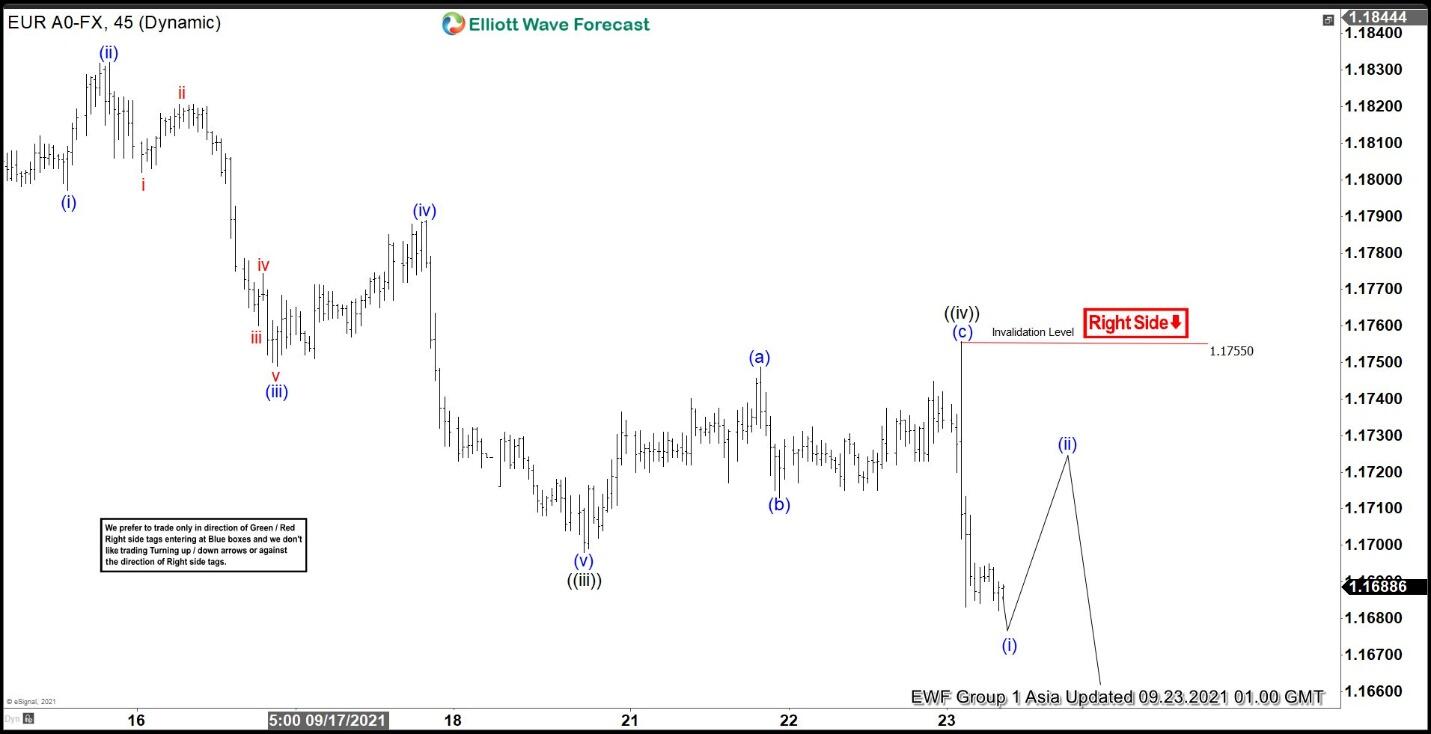
Short Term view in EURUSD suggests the decline from September 6, 2021 peak is unfolding as a 5 waves impulse Elliott Wave structure. Down from September 6, wave ((i)) ended at 1.1768 and rally in wave ((ii)) ended at 1.1846. Pair resumes lower in wave ((iii)) towards 1.17 with internal subdivision as 5 waves impulse in lesser degree. Down from wave ((ii)), wave (i) ended at 1.1797, and rally in wave (ii) ended at 1.1832. Pair resumes lower in wave (iii) towards 1.1749, rally in wave (iv) ended at 1.17889, and final leg lower wave (v) of ((iii)) ended at 1.1698.
Rally in wave ((iv)) ended at 1.1755 with internal subdivision as a zigzag structure. Wave (a) ended at 1.1748, pullback in wave (b) ended at 1.1713, and wave (c) of ((iv)) ended at 1.1755. Pair has turned lower in wave ((v)) with internal as a 5 waves in lesser degree. Down from wave ((iv)), wave (i) ended at 1.1682. While wave (ii) rally fails below 1.1755, expect pair to extend a few more lows. Potential target lower is 100% – 123.6% Fibonacci extension from January 2021 peak towards 1.146 – 1.161.
EURUSD 45 Minutes Elliott Wave Chart
Gold Price Is Facing Crucial Hurdle Near $1,800
Key Highlights
- Gold price started an upside correction from the $1,740 region.
- A major bearish trend line is forming with resistance near $1,786 on the 4-hours chart.
- EUR/USD declined below 1.1700, and GBP/USD is trading well below 1.3700.
- The US Manufacturing PMI could increase from 61.1 to 62.5 in Sep 2021 (Preliminary).
Gold Price Technical Analysis
This past week, gold saw a bearish reaction below the $1,800 support against the US Dollar. The price broke the $1,780 support to move into a negative zone.
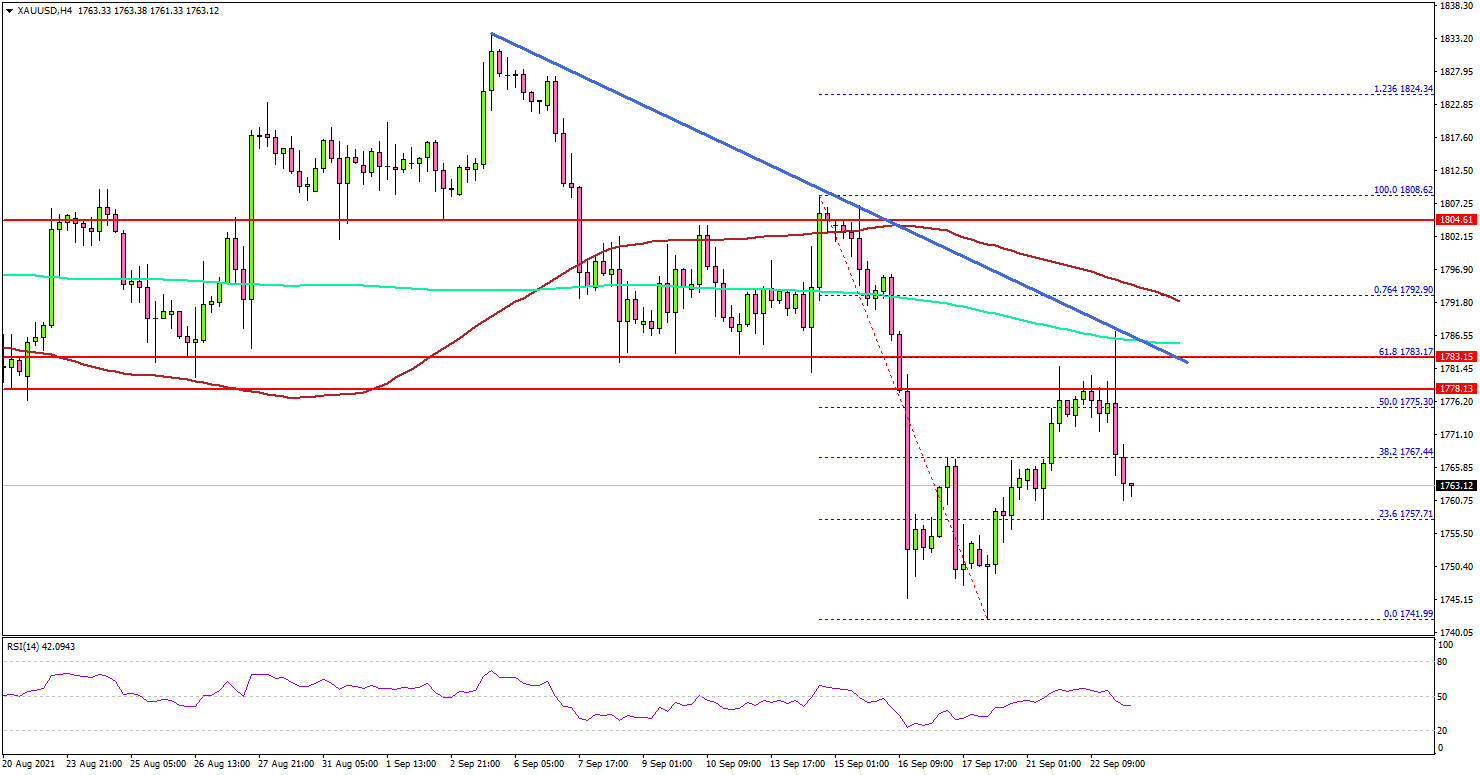
The 4-hours chart of XAU/USD indicates that the price even broke the $1,760 and $1,750 support levels. There was a daily close below $1,800, the 100 simple moving average (red, 4-hours), and the 200 simple moving average (green, 4-hours).
The price traded as low $1,741 and recently started an upside correction. The price corrected above the $1,765 and $1,770 levels.
There was a break above the 50% Fib retracement level of the key decline from the $1,808 swing high to $1,741 low. However, the price is facing an uphill task near the $1,785 and $1,790 levels.
There is also a major bearish trend line forming with resistance near $1,786 on the same chart. The next major resistance is near the $1,792 level and the 100 simple moving average (red, 4-hours). It is close to the 76.4% Fib retracement level of the key decline from the $1,808 swing high to $1,741 low.
The main hurdle sits at $1,800, above which the price could rise towards $1,825. Any more gains could lead the price towards the $1,850 level.
Looking at EUR/USD, the pair could start a decent recovery if there is a break above 1.1750. Conversely, GBP/USD is struggling to recover above 1.3700.
Economic Releases to Watch Today
- Germany's Manufacturing PMI for Sep 2021 (Preliminary) - Forecast 65.0, versus 62.5 previous.
- Germany's Services PMI for Sep 2021 (Preliminary) - Forecast 61.4, versus 60.8 previous.
- Euro Zone Manufacturing PMI for Sep 2021 (Preliminary) – Forecast 62.0, versus 61.4 previous.
- Euro Zone Services PMI for Sep 2021 (Preliminary) – Forecast 59.8, versus 59.0 previous.
- UK Manufacturing PMI for Sep 2021 (Preliminary) – Forecast 61.4, versus 60.3 previous.
- UK Services PMI for Sep 2021 (Preliminary) – Forecast 56.5, versus 55.0 previous.
- US Manufacturing PMI for Sep 2021 (Preliminary) – Forecast 62.5, versus 61.1 previous.
- US Services PMI for Sep 2021 (Preliminary) – Forecast 59.5, versus 55.1 previous.