Sample Category Title
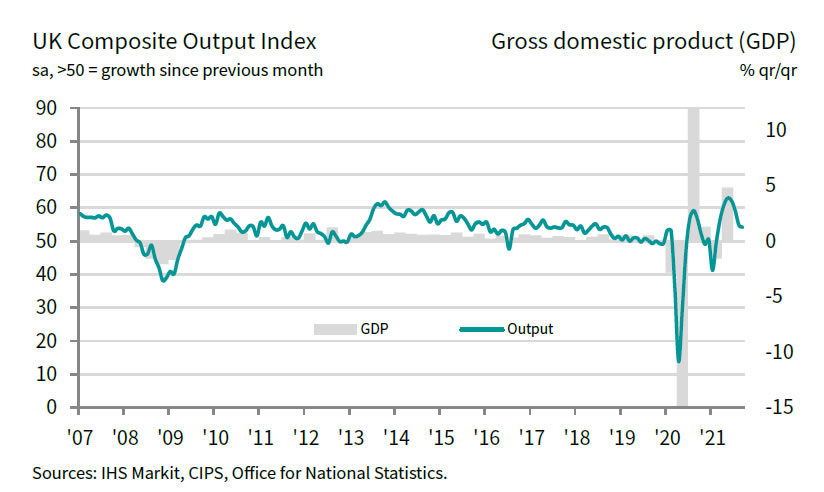
UK PMI composite dropped to 54.1, heading towards a bout of stagflation
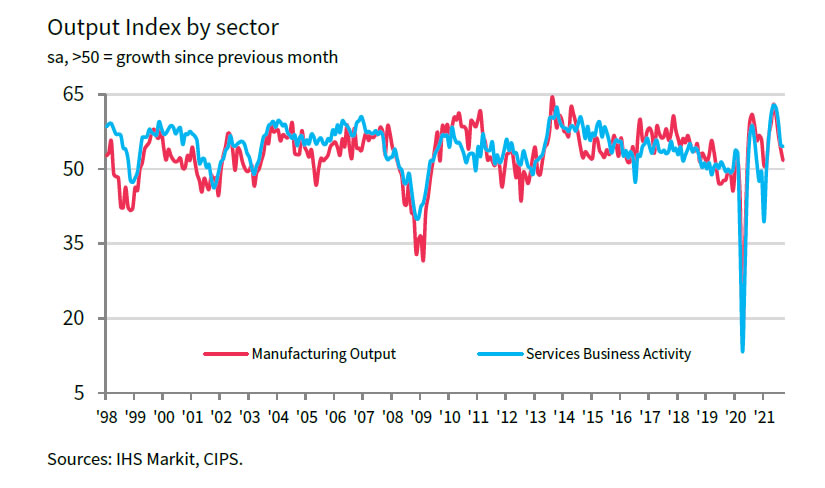
UK PMI Manufacturing dropped from 60.3 to 56.3 in September, below expectation of 59.0, a 7-month low. PMI Services dropped from 55.0 to 54.6, below expectation of 55.0, a 7-month low. PMI Composite dropped from 54.8 to 54.1, also a 7-month low.
Chris Williamson, Chief Business Economist at IHS Markit, said:
"The September PMI data will add to worries that the UK economy is heading towards a bout of 'stagflation', with growth continuing to trend lower while prices surge ever higher.
"While there are clear signs that demand is cooling since peaking in the second quarter, the survey also points to business activity being increasingly constrained by shortages of materials and labour, most notably in the manufacturing sector but also in some services firms. ...
"Shortages are meanwhile driving up prices at unprecedented rates as firms pass on higher supplier charges and increases in staff pay...
"Business expectations for the year ahead are meanwhile down to their lowest since January, with concerns over both supply and demand amid the ongoing pandemic casting a shadow over prospects for the economy as we move into the autumn."
US Federal Reserve Prepares To Cut Quantitative Easing Program
At yesterday’s Fed meeting, Jerome Powell said that the US central bank planned to start cutting the QE program shortly, but nothing was said about specific dates. However, the Rate Settlement Committee revised the statement after the meeting and indicated that the Fed might start cutting its monthly asset purchases by $120 billion as early as its next meeting on November 2-3. An interest rate hike is likely to happen in the second half of 2022. A good jobs report would support the start of the cuts in November.
The US stock market ended Wednesday’s trading higher amid the strength of the oil and gas, financial, and technology sectors. The Dow Jones Index increased by 1.00%, the S&P 500 added 0.95%, and the NASDAQ Composite jumped by 1.02%. The Dow Jones recovered by more than 300 points after a four-day decline.
European stocks followed the American ones on Wednesday due to the growth of quotes of banks and energy companies. The European market was also supported by positive news from China, where the government is trying to cut Evergrande’s debt. The British FTSE 100 added 1.5% yesterday, German DAX added 1%, French CAC 40 increased by 1.3%, Spanish IBEX 35 increased by 0.6%, and Italian FTSE MIB jumped by 1.4%.
During the Fed meeting, US 10-year bond yields initially decreased to 1.306% as the Fed was not yet ready to cut stimulus. But after Mr. In Powell’s speech, the yields increased to 1.333%, sending gold and silver prices down. Gold and silver have an inverse correlation to the dollar index and government bond yields.
Oil rose in price after a report on US crude oil inventories showed another significant decline. Crude oil inventories were -3.48 million barrels compared to the -3.02 million expected. Analysts at Goldman Sachs said a cold winter could suppress the oil market’s ability to make up for supply shortfalls, leading to a price spike with consequences for the economy. The bank said nearly 2 million barrels of oil a day could be needed for power generation and industrial purposes.
Asian currencies are falling as the Fed’s reduction plan is boosting the dollar index. But Asian stock indices take advantage of the fact that the People’s Bank of China has added liquidity to the banking system to suppress concerns about the debt problems of major real estate developer Evergrande. Hong Kong’s Hang Seng and China’s CSI 300 increased by 0.7%, while Australia’s ASX 200 added 1%. South Korea’s Kospi decreased by 0.6% after a 3-day bank holiday. Japanese stock markets are closed because of the holiday. Singapore’s consumer price index increased by 2.4% in August compared with a year earlier, contributing to a significant increase in food, housing, transport, and utility spendings.
Main market quotes:
- S&P 500 (F) 4,395.64 +41.45 (+0.95%)
- Dow Jones 34,258.32 +338.48 (+1.00%)
- DAX 15,506.74 +158.21 (+1.03%)
- FTSE 100 7,083.37 +102.39 (+1.47%)
- USD Index 93.44 +0.24 (+0.26%)
Important events for today:
- Singapore Consumer Price Index (y/y) at 08:30 (GMT+3);
- Switzerland SNB Interest Rate Decision (q/q) at 10:30 (GMT+3);
- Switzerland SNB Monetary Policy Assessment at 10:30 (GMT+3);
- German Manufacturing PMI (m/m) at 10:30 (GMT+3);
- German Service PMI (m/m) at 10:30 (GMT+3);
- Eurozone Manufacturing PMI (m/m) at 11:00 (GMT+3);
- Eurozone Service PMI (m/m) at 11:00 (GMT+3);
- UK Manufacturing PMI (m/m) at 11:30 (GMT+3);
- UK Service PMI (m/m) at 11:30 (GMT+3);
- UK BoE Interest Rate Decision at 14:00 (GMT+3);
- UK BoE Monetary Policy Statement at 14:00 (GMT+3);
- US Initial Jobless Claims (w/w) at 15:30 (GMT+3);
- Canada Retail Sales (m/m) at 15:30 (GMT+3);
- US Manufacturing PMI (m/m) at 16:45 (GMT+3);
- US Service PMI (m/m) at 16:45 (GMT+3);
- Natural Gas Storage (w/w) at 17:30 (GMT+3).
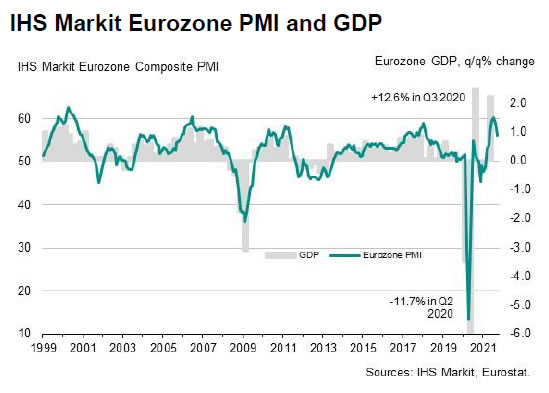
Eurozone PMI composite dropped to 56.1, unwelcome combination of sharply slower economic growth and steeply rising prices
Eurozone PMI Manufacturing dropped from 61.5 to 58.7 in September, below expectation of 60.4, a 7-month low. PMI Services dropped from 59.0 to 56.3, below expectation of 58.4, a 4-month low. PMI Composite dropped from 59.0 to 56.1, a 5-month low.
Chris Williamson, Chief Business Economist at IHS Markit said:
"September's flash PMI highlights an unwelcome combination of sharply slower economic growth and steeply rising prices.
"On one hand, some cooling of growth from the two-decade highs seen earlier in the summer was to be expected. On the other hand, firms have become increasingly frustrated by supply delays, shortages and ever-higher prices for inputs. Businesses, most notably in manufacturing but also now in the service sector, are being constrained as a result, often losing sales and customers.
"Concerns over high prices, stressed supply chains and the resilience of demand in the ongoing pandemic environment has consequently eroded business confidence, with expectations for the year ahead now down to the lowest since January.
"For now, the overall rate of expansion remains solid, despite slowing, but growth looks likely to weaken further in coming months if the price and supply headwinds show no signs of abating, especially if accompanied by any rise in virus cases as we head into the autumn."
AUDUSD Resilient Above 0.7230, But Still Under Bearish Risk
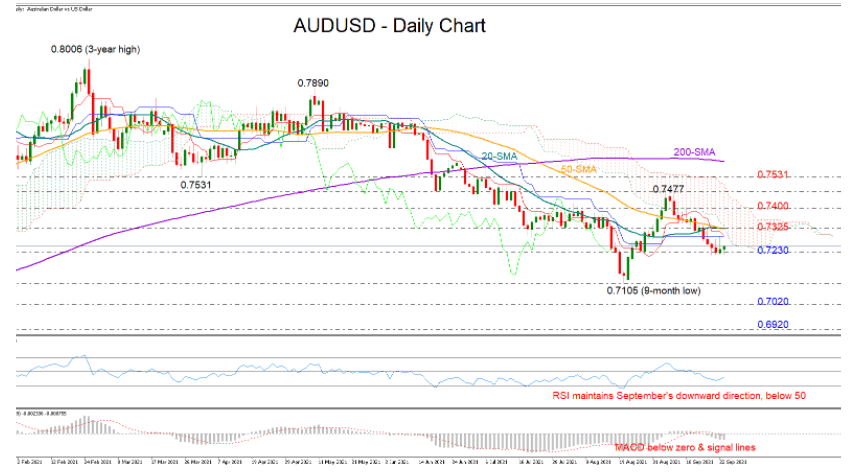
AUDUSD was unsuccessful in piercing the 0.7300 level late on Wednesday but resilient enough to hold above the familiar base of 0.7230, where the bulls found some footing in the last week of August and market actions paused in the second half of 2020.
The RSI and the MACD have yet to show any convincing improvement, with the former maintaining its downward pattern from the start of September comfortably below its 50 neutral mark despite its latest upturn, and the latter extending its negative momentum below its zero and signal lines. Hence, there is not sufficient evidence yet that the sell-off has found a bottom.
Nevertheless, if the price manages to bounce off 0.7230, the former support region of 0.7325 could play a resistance role with the help of the 20- and 50-day simple moving averages (SMAs), which are hovering around the same location. Beyond that, the bulls will need a green pass around the 0.7400 barrier in order to gear up to September’s ceiling of 0.7477.
Otherwise, another negative extension to the three-week decline could last until the 9-month low of 0.7105. Cracking that floor would further amplify losses, likely bringing the Autumn 2020 support of 0.7021 next into view, while deeper, the spotlight may turn to the 0.6920 restrictive territory.
In summary, AUDUSD still appears to be under bearish control despite the recent consolidation in the price, with confirmation awaited below 0.7230
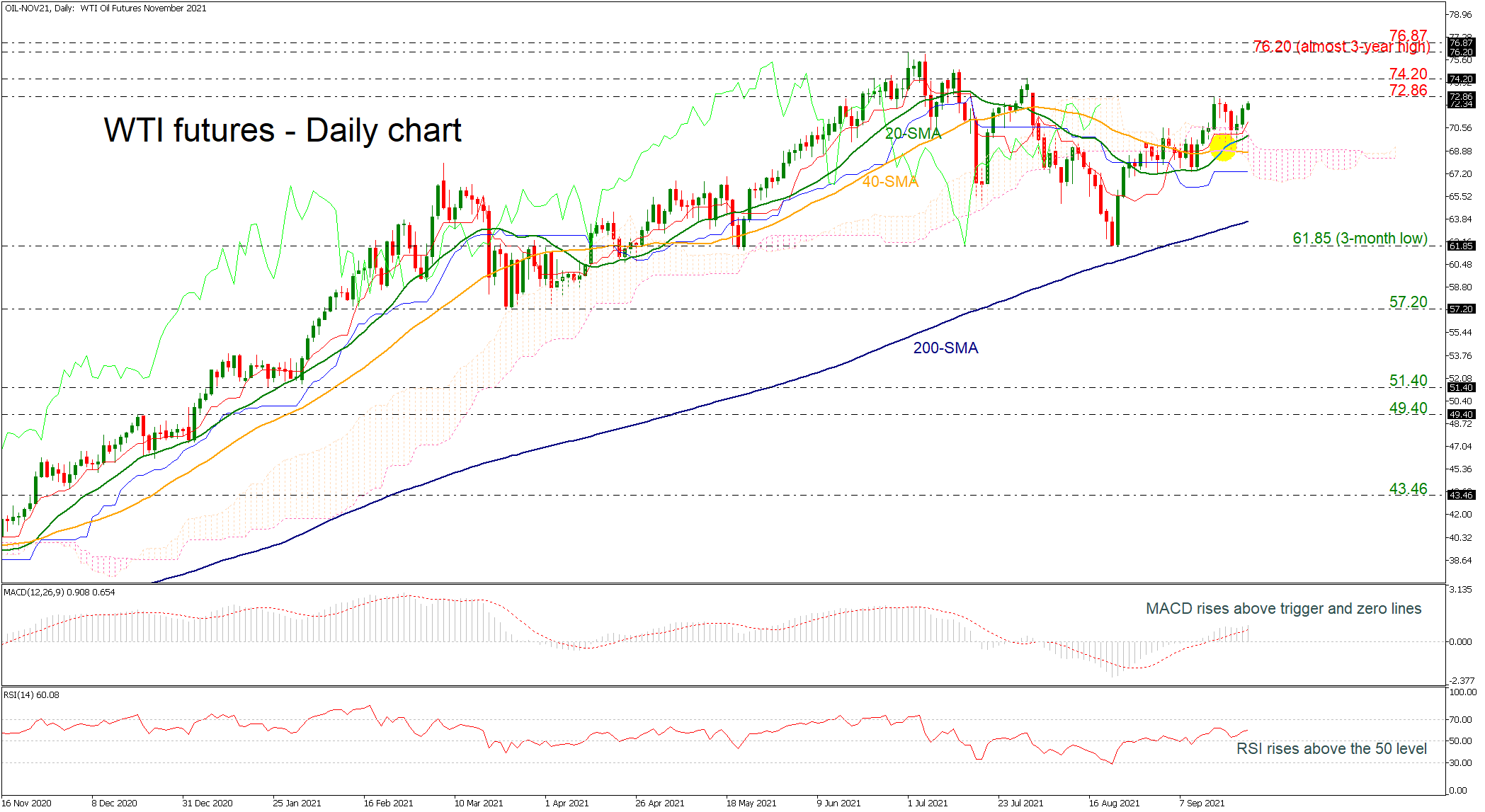
WTI Futures Holds A Bullish Bias But Strong Resistance Awaits Near 73.00
WTI futures are climbing above the Ichimoku cloud and the bullish crossover within the 20- and 40-day simple moving averages (SMAs), challenging again the previous days’ high of 72.86.
According to the technical indicators, the MACD is overcoming its trigger line and is gaining momentum in the positive region, while the RSI indicator is ticking higher above the neutral threshold of 50. Both are confirming the recent bullish bias in the near term. Also, the market is trading above the Ichimoku cloud and the red Tenkan-sen line is following the price action, holding above the blue Kijun-sen, which is a positive sign for the outlook.
In case the price jumps beyond the 72.86 resistance, it could rest near the 74.20 barrier ahead of the almost three-year high of 76.20, registered on July 1. Slightly higher, the 76.87 hurdle could attract traders’ attention as the commodity reached that level back in September 2018.
In the negative scenario, a successful drop below the short-term SMAs and the Ichimoku cloud could open the way for the 200-day SMA at 63.68. Penetrating this level, a marginal negative correction may be on cards, hitting the three-month low of 61.85 before meeting the 57.20 support.
Summarizing, oil prices are moving higher after the rebound off 61.85, and only a decisive close below the 200-day SMA and 61.85 may shift the bias to negative.
Germany PMI composite dropped to 55.3, activity is beginning to level off
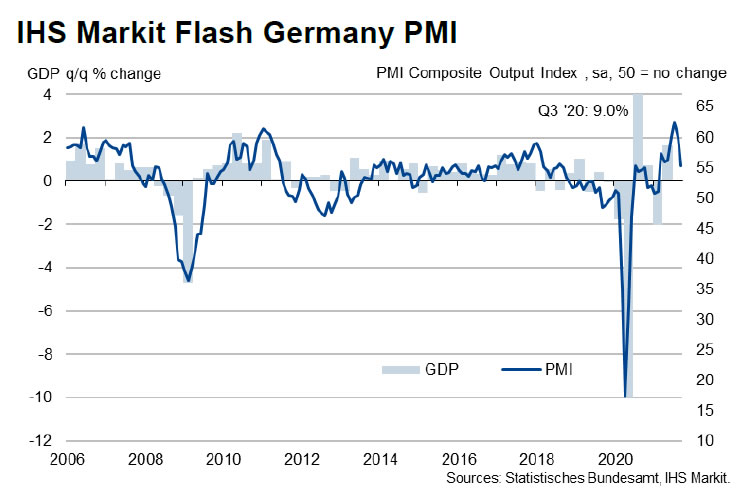
Germany PMI Manufacturing dropped from 62.6 to 58.5 in September, below expectation of 61.3, an 8-month low. PMI Services dropped from 60.8 to 56.0, below expectation of 60.3, a 4-month low. PMI Composite dropped from 60.0 to 55.3, a 7-month low.
Phil Smith, Associate Director at IHS Markit said:
- "September's flash PMI survey showed a notable slowdown in the rate of growth of the German economy, in a sign that activity is beginning to level off after rebounding sharply over the summer.
- "However, despite the slowdown in September, the pace of economic growth in the third quarter still looks to have surpassed the 1.6% expansion seen in the three months to June.
- "The survey pointed to a continued drag on growth from the manufacturing sector, which is bearing the brunt of supply shortages and rising costs. Coupled with this, services activity showed its smallest rise since May, as the post-lockdown surge in demand waned further.
- "While business sentiment towards future activity remains positive, reflecting continued hopes of an end to the pandemic, growth expectations are being held back by supply-chain concerns and the risks posed to demand from rising prices."
The Fed Is In No Hurry Yet But Prepares To Raise Rates Faster
The US central bank kept its monetary policy unchanged at the end of the two-day meeting. This was in line with market expectations and therefore did not cause much excitement. Nevertheless, the outcome of the discussion was neither dull nor "passé".
In an official commentary, the Fed made it clear that it is ready to proceed with a soft rollback of monetary stimulus before the end of the year. Markets were pricing in a slim chance that tapering would be announced in September. However, the publication of these comments triggered some relief rally for equities, with leading US indices closing up around 1% on Wednesday.
The Fed's pronounced stance puts risky asset purchases back in the focus of investors and allows for equity indices to return to their recent all-time highs in the next few weeks.
However, on the currency and debt market, the chances of further strengthening the US dollar increase. More than half of the FOMC members predict a rate hike by the end of 2022, just a few months after the end of QE. Remarkably, after the GFC, there was one year between the end of the QE and a rate hike date.
The debt and currency markets will no longer build on this and will likely be more actively pricing in an accelerated normalisation of US policy. Considering past practice in terms of the events themselves rather than their duration, it is worth setting ourselves up for a stronger dollar over the next two to three quarters with the potential for DXY gains of 7.5-12% from current levels. This would return the US currency to the highs of recent years.
The outlook for dollar growth outside of this horizon is highly uncertain. Other central banks are likely to catch up with the Fed very quickly and could even act more aggressively in tightening monetary policy, as EM countries are already doing.
US Oil To Test Major Resistance
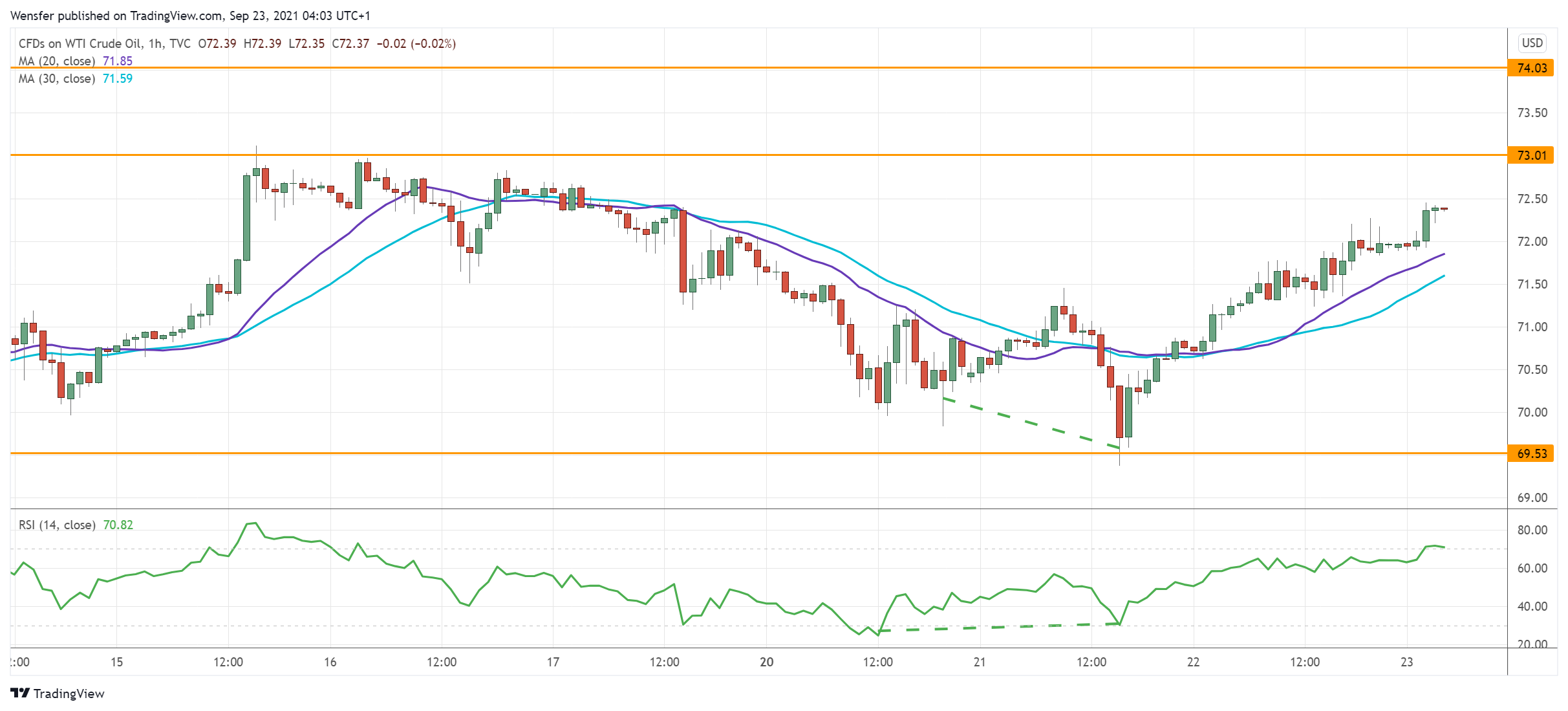
WTI crude holds onto its gains after a larger-than-expected decrease in US inventories. The price had met stiff selling pressure at 73.00 where the August sell- off started.
A bullish RSI divergence in the demand zone of 69.50 indicates a loss of momentum in the retracement. A rebound above 71.30 is a confirmation that buyers are still in the game and a bullish MA cross may suggest an acceleration in the rally.
A break above 73.00 would lead to the next daily resistance at 74.00. 70.60 is the first support in case of a pullback.
France PMI composite dropped to 55.1 in Sep, clear evidence of cooling
France PMI Manufacturing dropped from 57.5 to 55.2 in September, below expectation of 57.3, lowest in 8 months. PMI Services dropped slightly from 56.3 to 56.0, below expectation of 56.0, lowest in 5 months. PMI Composite dropped from 56.9 to 55.1, lowest in 5 months.
Joe Hayes, Senior Economist at IHS Markit said:
- "Flash PMI data for September provides clear evidence that economic growth in France is cooling...
- "The most striking finding from the September survey was the strong drop-off in manufacturing production growth, which panel members linked to the well-documented supply-side issues that are ongoing at present...
- "These issues aren't just confined to the manufacturing sector either, with service providers also affected.
- "An accelerated deterioration in supplier delivery times has again pushed up inflation, after August data provided tentative hopes that some of these pressures were coming off the boil.
- "Overall, slowing demand growth, rising prices and considerable supply-side issues are – to say the least – far from the ideal conditions as we head into what seems to be another challenging winter period."
XAU/USD Meets Tough Resistance
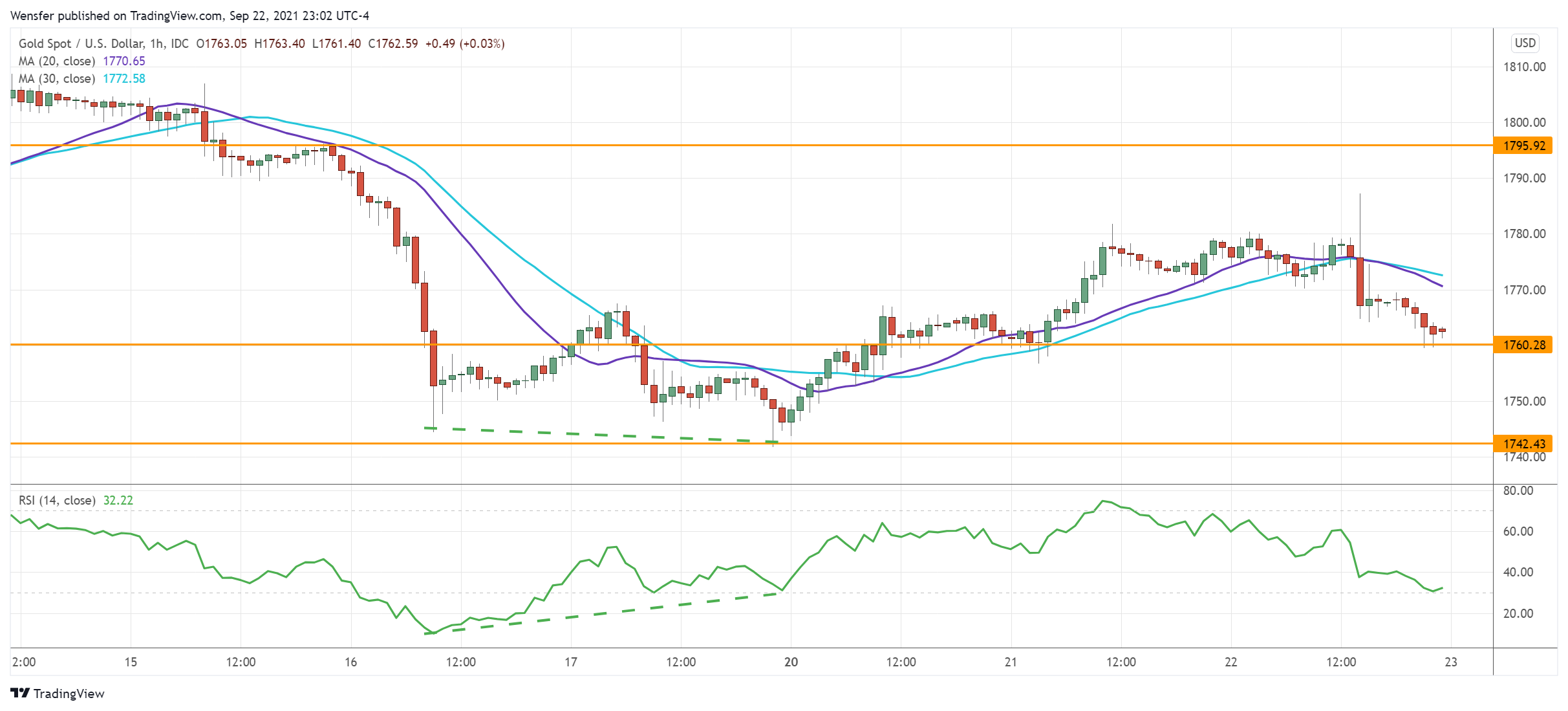
Gold tumbles as the US dollar’s rally gains traction. The precious metal has met solid bids in the demand zone around 1742.
A bullish RSI divergence has indicated that selling pressure may have waned. A close above the immediate resistance at 1767 has attracted some buying interests, though an overbought RSI has checked the upward impetus.
1796 from the previous consolidation remains a key hurdle. Its breach would open the door to the daily resistance at 1830. On the downside 1760 is fresh support.