

Sample Category Title
European Monetary Policy and FX Roundup
Summary
It has been a particularly busy week across Europe, with several of the G10 central banks making monetary policy announcements and contributing to varying degrees of market excitement. In this report we briefly recap these announcements and assess their FX implications.
Norway's central bank became the first G10 central bank to raise rates with a 25 bps rate hike as the economy returns to a more normal growth path. While the central bank's projections signaled further rate hikes, the increases penciled in for 2022 still look a touch light to us. We see upside risk to our current forecast of Norwegian krone appreciation.
The Bank of England held monetary policy steady and, despite cross-currents affecting the U.K. economy, said the case for modest tightening has potentially strengthened. With the announcement we have brought forward our expected timing for rate increases, and we now expect the Bank of England to initiate a rate hike cycle with an increase in May 2022, followed by November 2022. While the pound may be subject to some near-term uncertainties, we expect the U.K. currency to strengthen against the U.S dollar and the euro over the medium-term.
Sweden's central bank and Switzerland's central bank both held monetary policy steady, with no indication either central bank will move to a less accommodative monetary policy stance for the foreseeable future. Given the strength of Sweden's economic rebound we still anticipate modest Swedish krona strength versus the euro. For Switzerland, moderate Swiss growth and inflation, combination with some improvement in global economic and market sentiment over time, should see the franc soften versus the euro.
Norway's Central Bank Kicks Off G10 Rate Hike Cycle
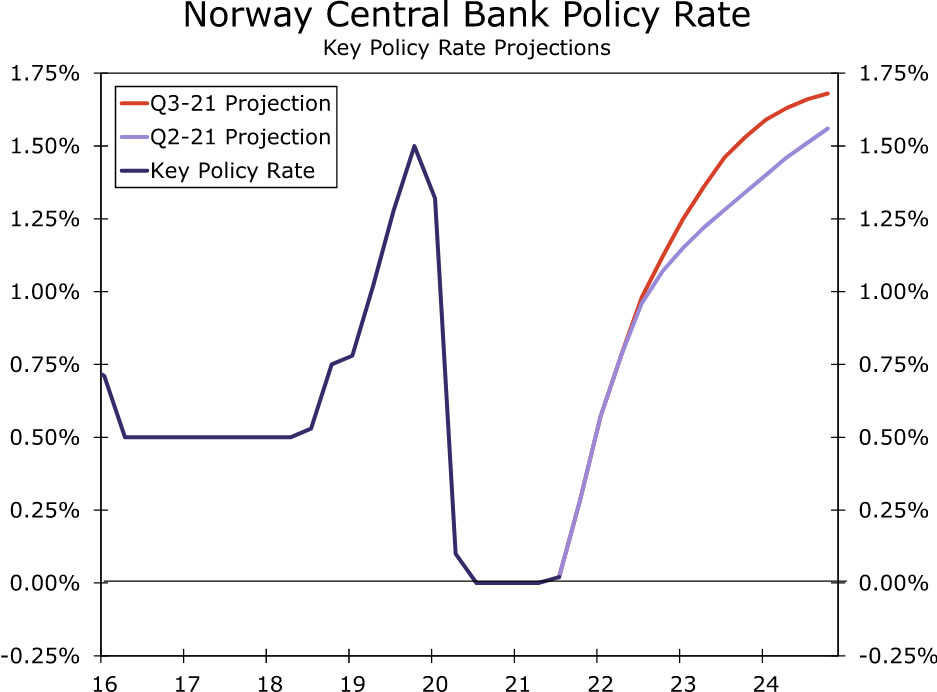
The Norges Bank, Norway's central bank, became the first developed economy central bank to raise interest rates during the current cycle, lifting its Deposit rate by 25 bps to 0.25%. The move was widely expected by market participants, and was justified by the central bank on the back of firming growth rather than inflation concerns per se. The Norges Bank said a "normalising economy now suggests that it is appropriate to begin a gradual normalisation of the policy rate", and added that while underlying inflation is low increased activity and rising wages should push it towards 2%.
The Norges Bank's updated projections anticipate further normalization of the economy, with the mainland GDP growth forecast at 3.9% for 2021 (versus 3.8% previously) and 4.5% for 2022 (4.1% previously). The interest rate path contained within those projections is also slightly higher than previously. In its announcement, the Norges Bank explicitly stated the policy rate would most likely be raised further in December, while the revised rate path sees the policy rate rising to 1.12% by Q4-2022. We are in agreement on a December 2021 rate increase. However, given we also expect a solid ongoing economic rebound, the rate path for next year still appears to be a touch light. We expect at least a further 75 bps of rate increase, and perhaps as much as 100 bps of rate increase, in 2022. Against this growth and monetary policy backdrop we believe the risks around our Norwegian krone forecast are tilted towards a faster pace of appreciation relative to our base case, which anticipated a EUR/NOK exchange rate of NOK9.95 by the end of next year.
Bank of England Still Moving Towards 2022 Tightening
The Bank of England (BoE) held monetary steady at its September meeting, although the announcement was arguably marginally hawkish in tone. Policymakers voted unanimously to hold its policy rate steady at 0.10%, while there was a 7-2 vote to continue with the government bond purchase programme, with the two dissenters voting for an early end to asset purchases. That was a slight change from previous meetings which has seen just one dissent in favor of an early end to bond purchases.
The Bank of England's statement highlighted cross currents affecting the U.K. economy contributing to softer growth (for now) and higher inflation. The central bank said the forecast for the level of real GDP in Q3-2021 has been revised down around 1% since its August projections, noting some supply disruptions. Moreover, while the BoE noted softness in reported retail sales it said other indicators of spending have remained stronger. On inflation, the central bank cited increased natural gas prices as an upside risk and said cost pressures are still elevated, even if they are likely to be transitory.
Importantly, with respect to overall monetary policy the Bank of England said:
"At its previous meeting, the Committee judged that, should the economy evolve broadly in line with the central projections in the August Monetary Policy Report, some modest tightening of monetary policy over the forecast period was likely to be necessary to be consistent with meeting the inflation target sustainably in the medium term. Some developments during the intervening period appear to have strengthened that case, although considerable uncertainties remain."
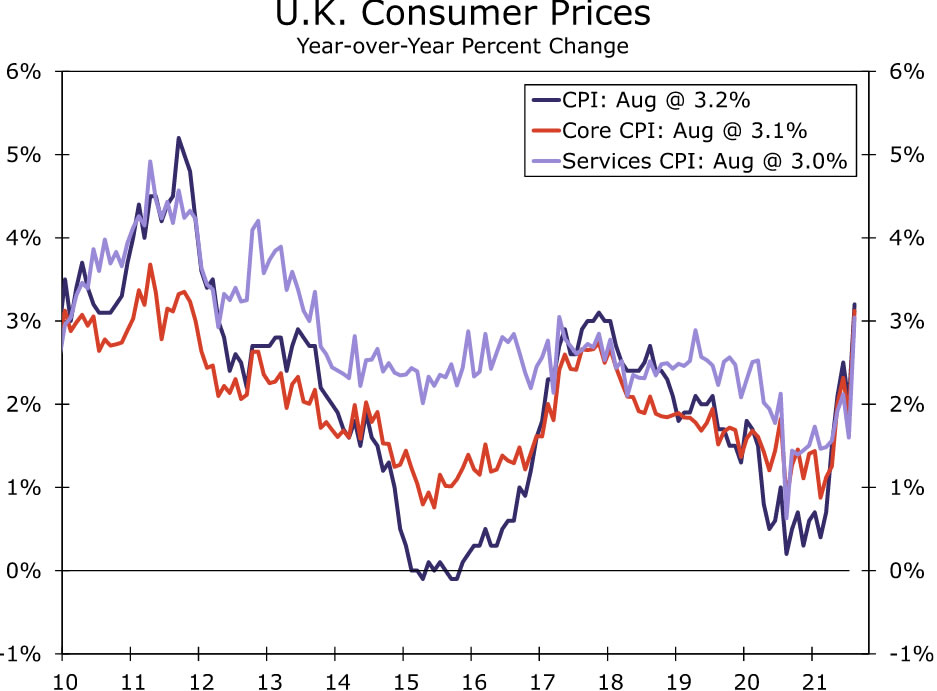
From our perspective, while the uptick of inflation will very likely be transitory, it is somewhat challenging to discern how much of the current spike in inflation is temporary and how much is more persistent. In August for example, we note the headline, core and services CPI all showed an increase of 3.0% year-over-year or greater. By 2022 we expect the U.K. economy will have returned to a steadier growth path and CPI will still be above target (even if it is slowing). As a result, we still expect the Bank of England to begin raising rates around the middle of next year. In fact, with today's announcement we have brought forward our expected timing of Bank of England rate hikes by a quarter, and now anticipate a 15 bps policy rate hike in May 2022 (to 0.25%) and a 25 bps rate hike in November (to 0.50%). While the pound could be subject to some near-term uncertainty, we still expect the U.K. currency to strengthen against both the U.S. dollar and the euro over the medium term. Our current year-end 2022 targets are $1.4300 for the GBP/USD exchange rate a EUR/GBP exchange rate of 0.8325.
Riksbank Unmoved By Sweden's Economic Upswing
The monetary policy announcement from the RIksbank, Sweden's central bank, was perhaps notable for a lack central bank action or intent. The Riksbank appears largely unmoved by Sweden's firming economic recovery. Not only did the Riksbank keep its repo rate at 0.00%, it projected the policy rate would remain at that level over the entire forecast horizon out until Q3-2024. Moreover, the Riksbank held out some possibility that further monetary easing could still be forthcoming if inflation prospects weaken, whether that is through repo rate cuts or some other form.
Developments regarding the Riksbank's quantitative easing program are more cut-and-dried. The central bank said it would complete its bond purchases by the end of 2021, and keep bond holdings steady through 2022, in line with its previous announcements. Finally, in the one concrete measure the Riksbank took, it closed the emergency lending facilities that were set up at the outset of the COVID crisis.
The benign announcement from Sweden's central bank comes even as it raised its 2021 GDP growth forecast to 4.7% (from 4.2% previously), while its GDP forecasts of 3.6% for 2022 and 2.0% for 2023 are little changed from its prior outlook. For CPIF inflation, the Riksbank forecast 2.3% inflation in 2021, easing back to 2.1% in 2022 and 1.8% in 2023. The central bank said its expects a near-term, electricity-related increase in inflation, but does not expect a lasting firming of inflation just yet.
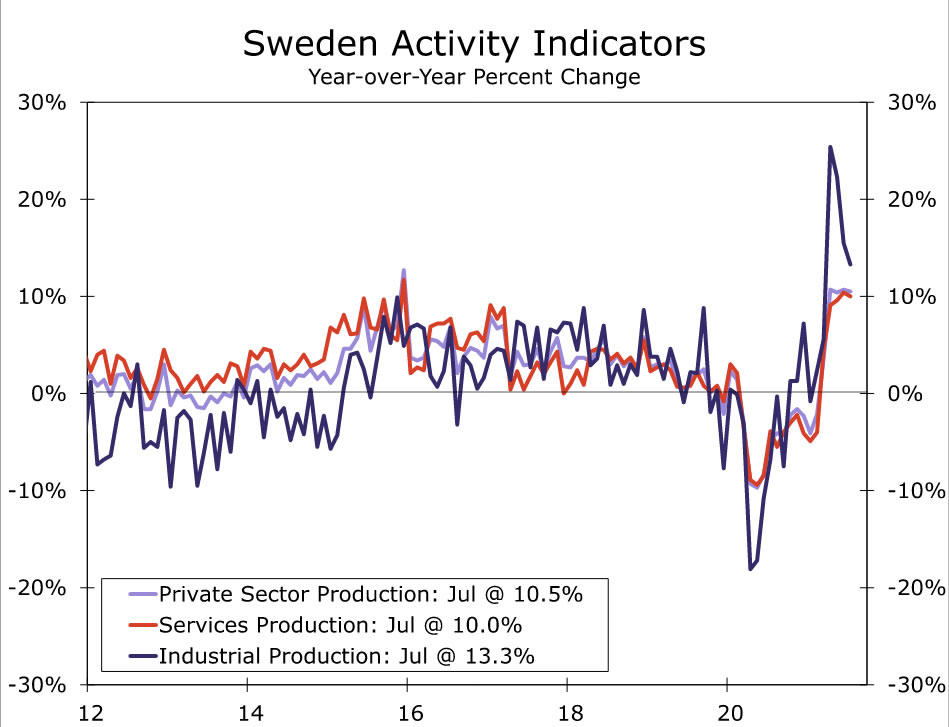
Sweden's economic upswing has certainly been impressive so far in 2021. Not only did Q2 GDP growth reach 9.7% year-over-over, elevated PMI indices and confidence surveys suggest some of that momentum has carried into the second half of this year. The rebound also appears to be broad-based—for example, July private sector production rose 10.5% year-over-year as services production rose 10.0% and industry production rose 13.3%. The strength of Sweden's recovery means we still expect very modest gains in the krona versus the euro over time, especially with the European Central bank, if anything, shifting even more gradually from its accommodative monetary policy stance. For year-end 2022, we target the EUR/SEK exchange rate at SEK10.05.
Swiss Inflation Low, Swiss Rates Even Lower
Switzerland's monetary policy announcement had a very familiar feel to it as the Swiss National Bank (SNB) maintained its accommodative monetary policy stance and gave no hint of any change in policy for the foreseeable future. The SNB held its policy rate at -0.75%, and said the Swiss franc remains highly valued. The central bank said it "remains willing to intervene in the foreign exchange market as necessary, in order to counter upward pressure on the Swiss franc."
Regarding its economic projections, the SNB expects GDP growth 3% for 2021, a bit less than in June. On the price front, inflation is expected to be slightly higher in the near-term on elevated oil prices and supply disruptions, but virtually unchanged of the medium-term, such that CPI inflation is still below 1% by the end of its forecast horizon in 2024.
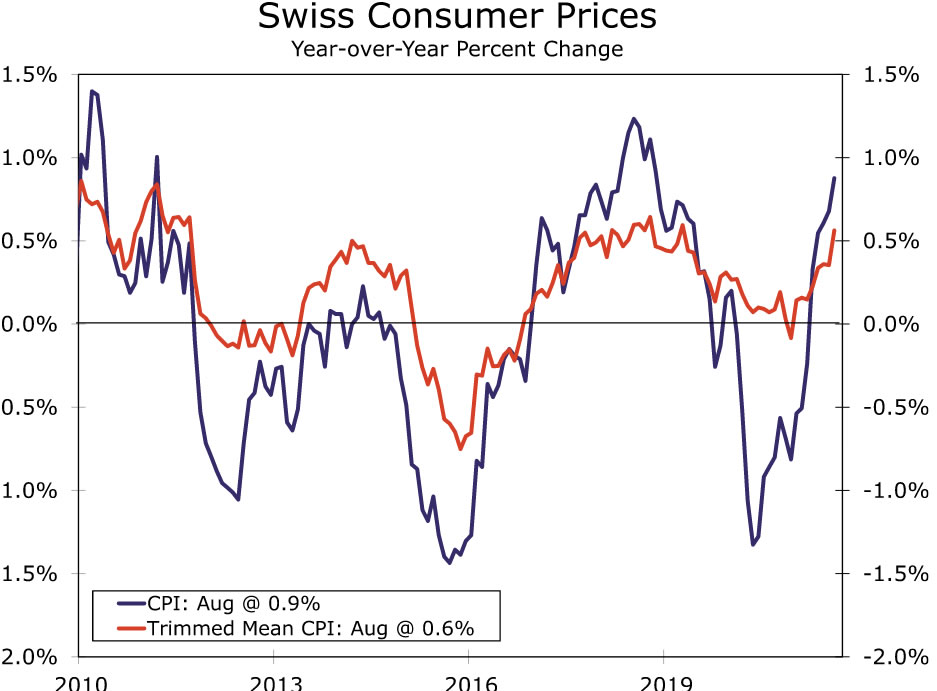
To be sure, both Swiss growth and inflation have shown firmer trends in 2021, with both headline and core inflation rising at their fastest pace in more than two years. However, as this week's announcement makes clear, the uptick in inflation in particular is still modest. Along with the Bank of Japan, the Swiss National Bank appears to be the other central bank that is most likely to maintain expansionary monetary policy for an indefinite period. With many other G10 central banks moving towards less accommodative policy (at varying speeds), an outlook for rising global yields, and should COVID concerns recede as 2022 progress, that should translate to an underwhelming performance from the Swiss currency. We expect the franc to soften versus the euro over time, and we target a EUR/CHF exchange rate of CHF1.0950 by the end of 2022.
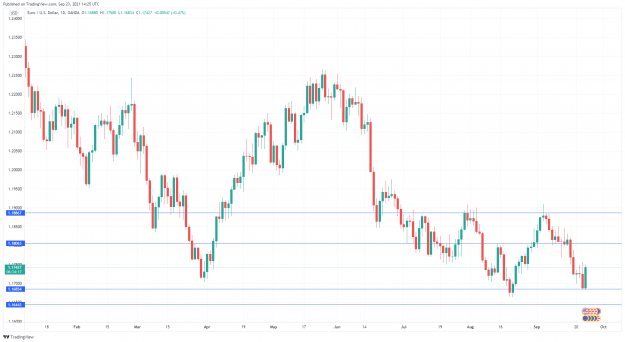
Euro Back above 1.17 after Post-FOMC Lift
The euro has reversed directions in the Thursday session and posted considerable gains. Currently, EUR/USD is trading at 1.1735, up 0.41%.
German, eurozone PMIs dip
The euro shrugged off soft PMI reports for September out of Germany and the eurozone. German Manufacturing PMI slowed to 58.5, down from 62.6 beforehand. Although the PMI continues to point to expansion in manufacturing, the index slipped to its lowest level in eight months. The Services PMI fell to 56.0, down from 60.8 and a 4-month low. The PMI also pointed to a slight drop in business confidence towards future activity – although positive, it fell to its lowest level since December 2020. Manufacturers are reporting significant supply shortages and rising prices, while the post-lockdown demand for services has eased. It has been a similar story for eurozone PMIs, which are pointing to a slowdown in manufacturing and services.
Although the PMIs continue to show expansion in the manufacturing and services sectors, the de-acceleration in growth and loss of confidence could weigh on the euro. The currency is in positive territory as the US dollar has retreated against the majors on Thursday, with the exception of the Japanese yen. Still, as the PMIs indicate, this is a result of US dollar weakness rather than euro strength.
The highly-anticipated FOMC meeting signaled that a taper is on its way, provided the US economy continues to perform well. The markets had anxiously been looking for the Fed to provide some clarity on tapering, and there was even hope that policymakers might provide a timeline for scaling back bond purchases. However, there were no commitments from the Fed to press the taper trigger. At a follow-up press conference, Fed Chair Jerome Powell said that the Fed could taper in November if he was satisfied with the economy’s performance. As well, the dot plot showed that two more members projected a rate hike in 2022.
The markets’ reaction is that the Fed is in no hurry to raise interest rates, as they still believe that inflation will be transitory in 2022. The Fed may be committed to tapering in the next few months, but a rate hike is further down the road. With a rate hike on the low burner, the US dollar is under pressure.
EUR/USD Technical
- On the upside, EUR/USD faces resistance at 1.1806 and 1.1886
- There is weak support at 1.1685, followed by support at 1.1544
Canadian: Retail Sales Take a Step Back in July
Retail sales fell by 0.6% (month-on-month) in July, giving back some of June's hefty gain. This left sales 4% below the March level, but 7.3% above its pre-pandemic (February 2020) level.
July's decline was much smaller than Statistics Canada's preliminary estimate of a 1.7% drop. Looking ahead, the agency's flash estimate calls for nice bounce back in August, with sales projected to increase by 2.1%.
Regionally, sales were down in eight of 10 Provinces in July, with only Ontario (+0.9%) and New Brunswick (+0.2%) posting modest gains. Other provinces saw sizeable declines, ranging from -3.3% in Nova Scotia to -1.1% in Quebec.
Sales of motor vehicle & parts edged up only slightly (+0.4%) as semiconductor shortages continued to weigh on vehicle availability. Higher prices and improving mobility trends drove sales of gasoline higher in both nominal (+1.4%) and volume terms (+0.3%).
Core sales, which exclude the two above-mentioned categories, declined more than the headline (-1.3%).
- With activity in the housing market cooling off, consumers have redirected their spending away from home improvements. Sales of building materials & garden improvements declined for the fourth month in a row (-7.3%). Sales were also slightly lower at the electronic and appliance stores (-0.3%).
- Ditto for sales at food & beverage stores, which took another step back (-3.4%). Sales at the food & beverage stores declined in five of the last six months, and are now down 3.5% relative to a year ago.
- On the other hand, activity continued to recover in some of the categories most impacted by earlier restrictions. Sales were higher at clothing (+7.6%) and furniture (+2.6%) stores. Notably, sales of clothing and accessories now have recovered to the their pre-pandemic level.
As consumer continued to return to the brick-and-mortar locations, e-commerce sales fell by a whopping 19.5% (seasonally adjusted), marking the largest of the four consecutive monthly declines. This left online sales down 2.9% relative to the year ago but still up significantly compared to pre-pandemic times.
Key Implications
Retail activity gave up some of its strength in July following a brisk increase upon reopening in June. A lot of weakness in July came from lower sales at food and beverage stores, which account for a sizeable 20% of retail sales. In addition, other categories, which saw strong gains earlier in the pandemic, such as online sales, have been easing as well.
Consumers are shifting their spending patterns away from goods and toward services such as dining out, recreation, and travel. Indeed, sales in food services and drinking places rose 11% in July.
Spending on services still has a long way to full recovery, but this process is likely to be slowed by the fourth wave. Most provinces have paused reopening their economies, and many have instituted vaccine passports to help avoid painful business closures. Alberta and Saskatchewan are likely to face the biggest tests in the months ahead due to lower vaccination rates and the steepest rise in cases and hospitalizations. That said, colder fall and winter months might bring renewed health worries for consumers and headwinds for businesses from coast-to-coast.
Sunset Market Commentary
Markets
There was not a lot of room for overthinking yesterday’s Fed policy decision today. A slew of other central bank meetings (Turkey, Norway, Switzerland, and Bank of England) and the European PMI indicators were scheduled for today. Some of the former are discussed in headlines below and latter here. Regarding the PMI’s, it became clear that economic momentum is slowing in Europe as it is headed for the final quarter of this year. The September headline index fell from 59 to 56.3 for services and from 61.4 to 58.7 in manufacturing. Both services and manufacturing output growth slowed substantially amid raw material shortages, supply constraints and/or poor freight availability. This also affects demand (growth) in general, as do still sharply increasing prices that make some projects economically no longer viable. Markit described it as an “unwelcome combination of sharply slower economic growth and steeply rising prices”. That said, given the still very high levels of the indicators there is no need for worry right now. Markets agreed. European yields pared some of the opening gains in the wake of the report but reversed course later in the session. The German curve steepens with the belly of the curve (3.9-4.6 bps in 5y-10y) underperforming the wings (+1.7 bps 2y, +3.3 bps 30y). US yields show a more textbook-like trading pattern today. The curve bear steepens with yields higher 1 bp (2y) to 6.3 bps (10y) with the 10y yield nearing key resistance at 1.37%. This neatly fits yesterday’s Fed announcement that it will soon start tapering (affecting the long end) and in any case well in advance of any rate hike (dot plot suggest one in 2022 at the earliest). It also makes sense that it’s real yields doing most of the job, also in Europe. Yields rise on both sides of the Atlantic but for EUR/USD it’s the equity sentiment doing the trick. Stocks again inch a little less than 1% higher in a constructive setting and that’s supporting EUR/USD back towards 1.173 after testing the 1.1694 zone post-Fed. USD/JPY is a balance of weakness that for now is tilting in favour of the dollar (>110). DXY fell from the 93.43 resistance to 93.15 currently.
Also in the UK, PMIs dropped further and more than expected from 55 to 54.6 (services) and 60.3 to 56.3 (manufacturing). Sterling couldn’t care less, eying a more hawkish Bank of England. In its meeting today, the BoE chose not to put too much emphasis on slowing growth but instead focus on rising inflation. With the recent developments in the energy market, the BoE sees its case for some tightening strengthened. Markets brought forward their rate hike expectations with now one hike (more than) fully priced for May 2022. Together with the bright sentiment, EUR/GBP slipped from 0.8585 to 0.855 currently. Cable jumps back above 1.37.
News Headlines
The Norges Bank took a first step on the path of policy normalisation, raising its policy rate from 0% to 0.25%. A normalising economy doesn’t require the current degree of accommodation. Countering the build-up of financial imbalances also suggests higher interest rates, the NB says. Activity in Norway returned above its pre-corona level, the unemployment rate has fallen further and capacity utilization is close to normal. Underlying inflation is low but increased activity and rising wage growth will help push inflation up towards the 2% target. The NB pencils in a next rate hike in December. The bank sees the policy rate at 1.7% in 2024, with the rate path slightly higher than in June. The Norwegian krone gained modestly to trade near EUR/NOK 10.08.
The Central Bank of Turkey (CBRT) went in the opposite direction and cut its policy rate from 19.0% to 18.0%. The move was a surprise even as CBRT governor Kavcioglu recently struck a more dovish tone, referring the lower core inflation (16.76% in August) as a reference for policy rather than the headline figure (19.25%). The CBTR assesses current high inflation temporary. At the same time, monetary tightening is said to have a decelerating impact on domestic demand. This negative impact of high yields on growth already for long causes president Erdogan to push the CBTR to cut interest rates. The CBTR moving away from its previous commitment to keep a positive real policy rate hammered the lira. EUR/TRY rises more than 1.5% to the 10.30 area.
GBP/JPY Mid-Day Outlook
Daily Pivots: (S1) 149.05; (P) 149.50; (R1) 149.99; More...
GBP/JPY's break of 150.80 minor resistance suggests that fall from 152.82 has completed, after defending 149.03 key support again. Intraday bias is back on the upside for 152.82 resistance first. Sustained break there will argue that whole consolidative pattern from 156.05 has completed and bring retest of this high. On the downside, again, decisive break of 148.43/149.16 key support zone will resume whole fall from 156.05 to 143.78 fibonacci level.
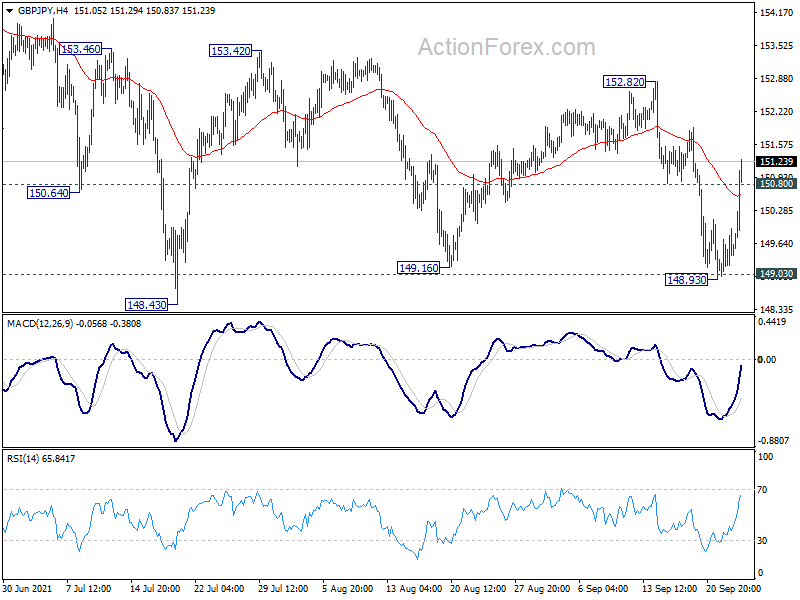
In the bigger picture, rise from 123.94 is seen as the third leg of the pattern from 122.75 (2016 low). As long as 149.03 support holds, such rise would still resume at a later stage. However, sustained break of 149.03 support will indicate rejection by 156.59. Fall from 156.05 would be at least correcting the whole rise from 123.94. Deeper fall would be seen back 38.2% retracement of 123.94 to 156.05 at 143.78 first.
USD/JPY Mid-Day Outlook
Daily Pivots: (S1) 109.32; (P) 109.61; (R1) 110.10; More...
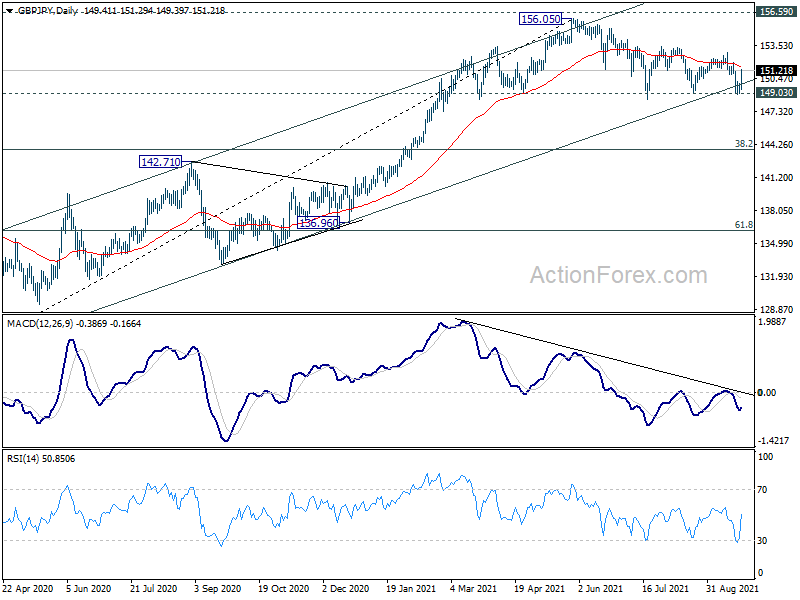
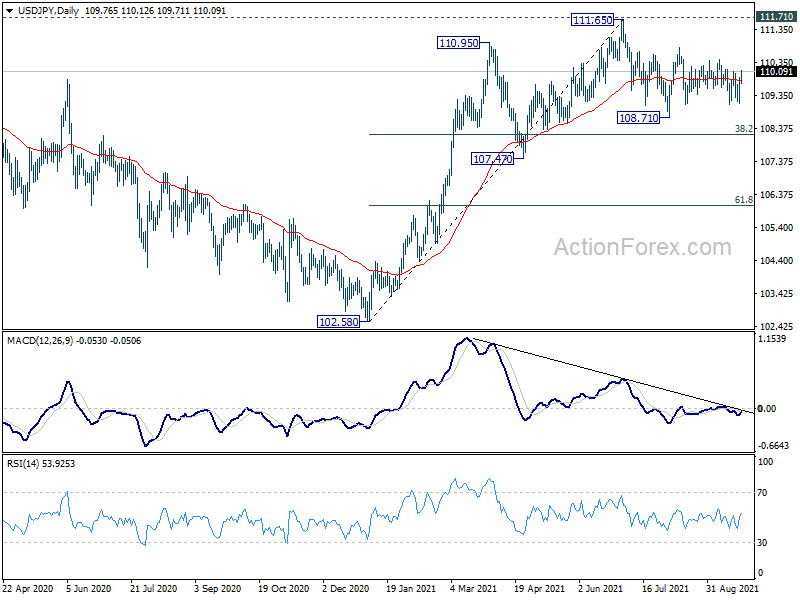
Intraday bias in USD/JPY remains neutral as range trading continues. On the upside, above 110.44 will turn bias back to the upside for 110.79, and then 111.65 high. On the downside, break of 109.10 will argue that larger fall from 111.65 is resuming. Deeper decline should then be seen to 108.71 support first, and then 38.2% retracement of 102.58 to 111.65 at 108.18 next.
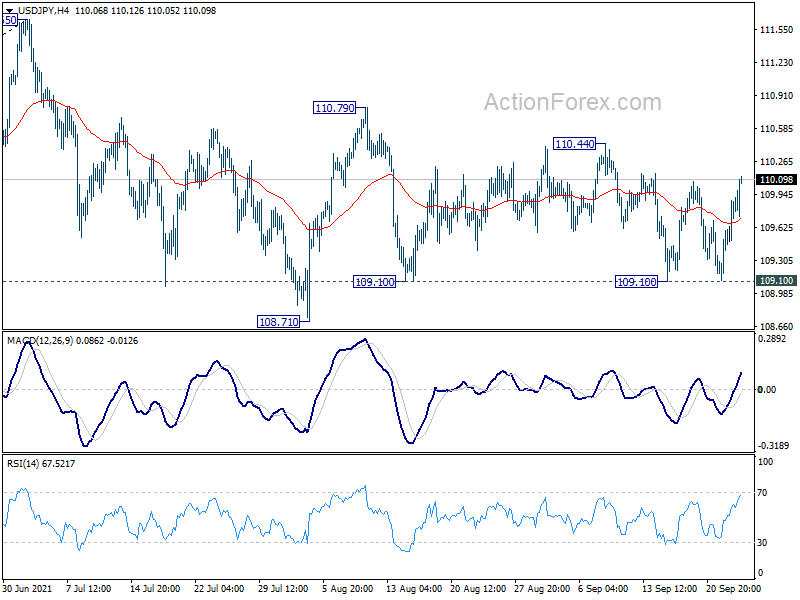
In the bigger picture, medium term outlook is staying neutral with 111.71 resistance intact. The pattern from 101.18 could still extend with another falling leg. Sustained trading below 55 day EMA will bring deeper fall to 107.47 support and below. Nevertheless, strong break of 111.71 resistance will confirm completion of the corrective decline from 118.65 (2016 high). Further rise should then be seen to 114.54 and then 118.65 resistance.
USD/CHF Mid-Day Outlook
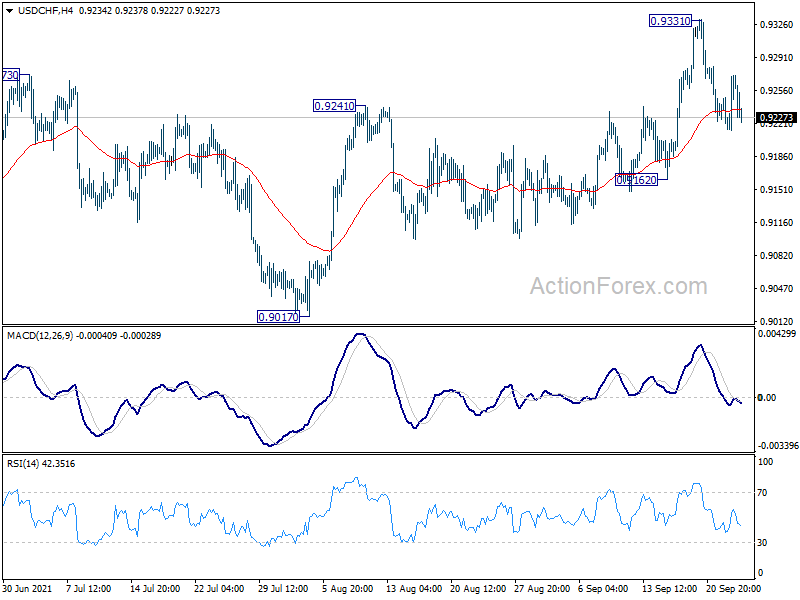
Daily Pivots: (S1) 0.9229; (P) 0.9251; (R1) 0.9286; More....
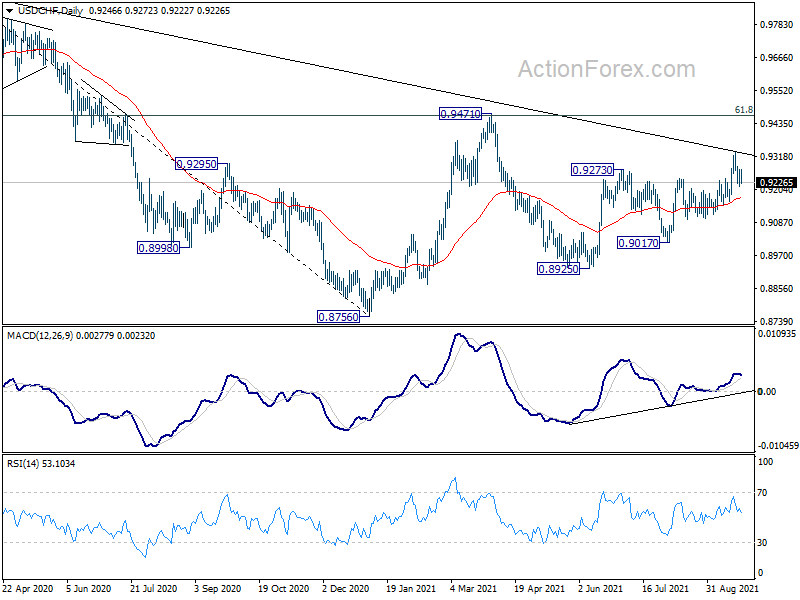
Consolidations continues in USD/CHF below 0.9331 and intraday bias remains neutral first. Rises from 0.9017 and 0.8925 are in favor to continue as long as 0.9162 support holds. On the upside, break of 0.9331 resistance will target 0.9471 key resistance. Sustained break there will carry larger bullish implications. However, break of 0.9162 will turn bias back to the downside for 0.9017 support instead.
In the bigger picture, the strong rally above 55 week EMA (now at 0.9182) now tilts favor to the case of bullish trend reversal. That is, decline from 1.3042 (2016 high) is probably completed at 0.8756 already. Sustained break of 0.9471 resistance should confirm this case and pave the way to retest 1.0342 ahead. However, rejection by 0.9471 will mix up the outlook again and retain some medium term bearishness.
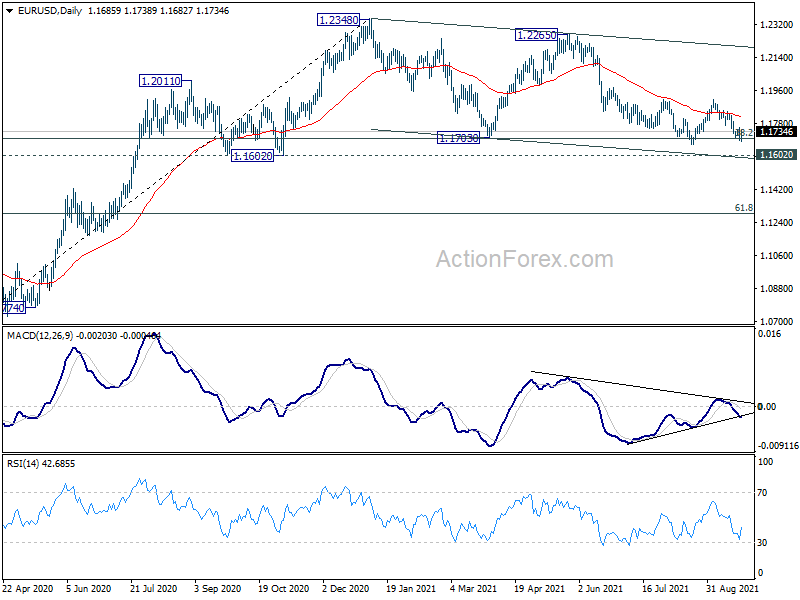
EUR/USD Mid-Day Outlook
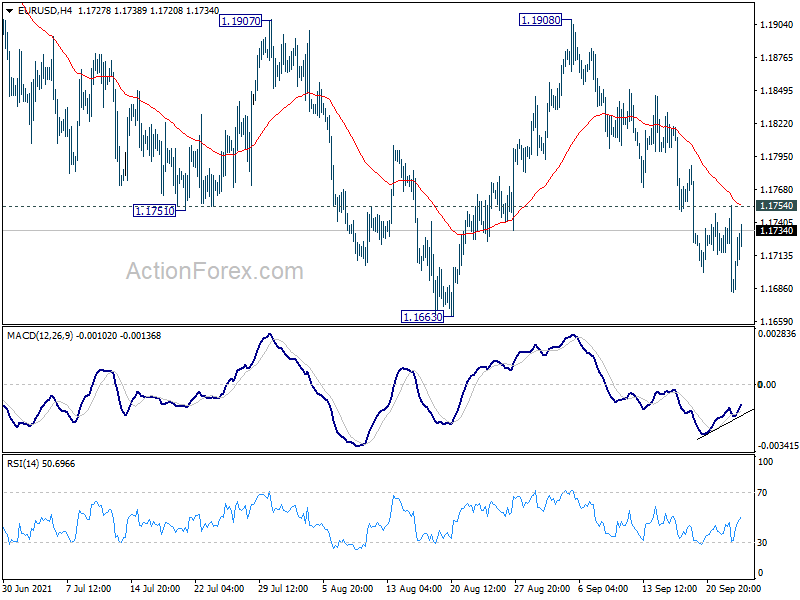
Daily Pivots: (S1) 1.1665; (P) 1.1710; (R1) 1.1735; More...
Intraday bias in EUR/USD is turned neutral with today's recovery. On the downside, sustained break of 1.1663 support will resume the fall from 1.2265, and the pattern from 1.2348, to 1.1602 key support next. On the upside, however, above 1.1754 minor resistance will turn bias back to the upside for 1.1908 again.
In the bigger picture, rise from 1.0635 is seen as the third leg of the pattern from 1.0339 (2017 low). Further rally remains in favors long as 1.1602 support holds, to cluster resistance at 1.2555 next, (38.2% retracement of 1.6039 to 1.0339 at 1.2516). However sustained break of 1.1602 will argue that the rise from 1.0635 is over, and turn medium term outlook bearish again. Deeper fall would be seen to 61.8% retracement of 1.0635 to 1.2348 at 1.1289 and below.
FOMC, Manufacturing PMI lifts Aussie
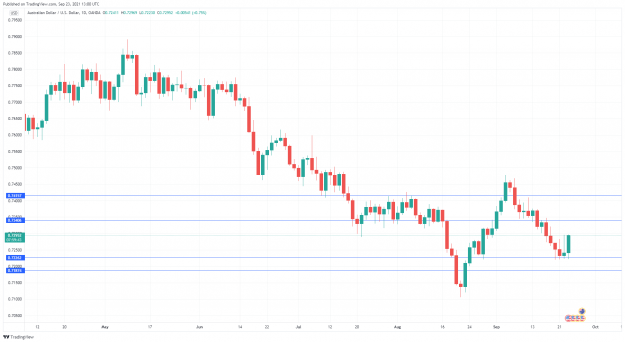
The Australian dollar has extended its gains in the Thursday session. Currently, AUD/USD is trading at 0.7293, up 0.71% on the day.
Risk appetite rises on Evergrande, FOMC
The Australian dollar is closely linked to risk, sentiment, and this connection sent the Aussie downwards earlier in the week but has since rebounded. The China Evergrande crisis sent shivers in the financial markets and weighed on the currency. However, investors’ nerves have been soothed somewhat as Evergrande said on Wednesday that it had reached an agreement to settle interest payments on a domestic bond, sending company shares sharply higher.
As well, risk appetite has risen after the FOMC meeting on Wednesday. Fed members signalled their readiness to taper before the end of the year, but this is contingent on the performance of the economy. In other words, the Fed is leaning towards a taper of its bond purchases but has not made any commitments in that regard. The Fed has also stressed repeatedly that there is no link between tapering and a hike in interest rates. This means that although a taper appears imminent, any rise in rates is further down the road. The dot plot shows that FOMC members are evenly split on whether the Fed will hike rates in 2022 or 2023, which indicates that the Bank is no rush to raise rates. This has lifted risk sentiment and sent the Australian dollar sharply higher on Thursday.
On the economic front, Australia PMIs for September pointed to a mixed picture. The Manufacturing PMI accelerated to 57.3, up from 52.0 beforehand. However, business activity declined for a third straight month, as the Services PMI came in at 44.9, up slightly from 42.9. The easing of Covid restrictions allowed resulted in both PMIs showing improvement in September.
AUD/USD Technical
- There is resistance at 0.7340, followed by 0.75415
- On the downside, 0.7226 is a weak support line. Below, there is support at 0.7187
BOE Downgraded Short-Term Growth, but Turned Slightly More Hawkish about Tightening
The BOE voted 9-0 to leave the Bank rate at 0.1% at the September meeting. The members voted 7-2 to keep the QE program at 895B pound. Deputy governor Dave Ramsden and external member Michael Saunders favored lowering the amount of asset purchase to 840B pound. Policymakers warned that inflation could rise above +4% by year-end, thanks to the spike in energy prices.
On economic developments, the central bank upgraded the assessment on inflation outlook but revised growth forecast for this year. As the rise of inflation proves more persistent than previously expected, the central bank warned that it could exceed +4% y/y by year-end, mainly driven by the energy price shock. As noted in the minutes, the material rise in spot and forward wholesale gas prices since the August Report represented “an upside risk to the MPC’s inflation projection from April 2022, and meant that CPI inflation could remain above 4% into 2Q22, all else equal”.
UK’s economy has shown signs of moderation since the last meeting. The BOE revised lower its GDP growth forecasts at the meeting, warning that supply chain problems are disrupting growth. GDP growth is projected to reach +2.1% in 3Q21, down from previous estimate of +2.9% and around +2.5% lower than the pandemic level.
While leaving all monetary policy tools unchanged, the central bank did deliver a slightly more hawkish message. First, two, instead of one, member voted to reduce the size of asset purchases. Second, policymakers acknowledged that “some developments during the intervening period appear to have strengthened that case [of tightening], although considerable uncertainties remain”. The market apparently takes is as a hawkish signal with GBPUSD rebounding to a 3-day high of 1.3711 after the announcement.