Sample Category Title
USD/JPY Daily Outlook
Daily Pivots: (S1) 109.94; (P) 110.14; (R1) 110.54; More...
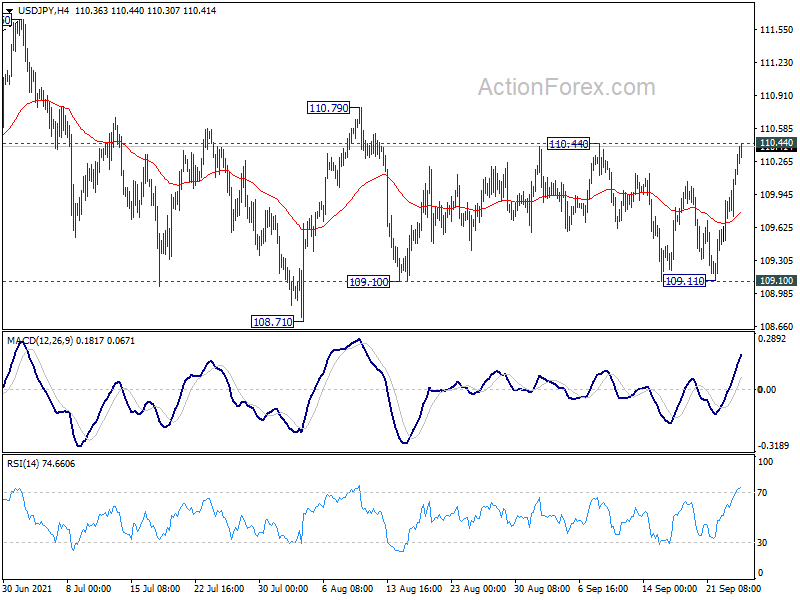
USD/JPY's rebound from 109.11 extends higher today and focus is now immediately on 110.44 resistance. Firm break there will argue that consolidation pattern from 111.65 might have finally completed. Stronger rise would be seen through 110.79 to retest 111.65 high. On the downside, though, break of 109.10 will argue that larger fall from 111.65 is resuming. Deeper decline should then be seen to 108.71 support first, and then 38.2% retracement of 102.58 to 111.65 at 108.18 next.
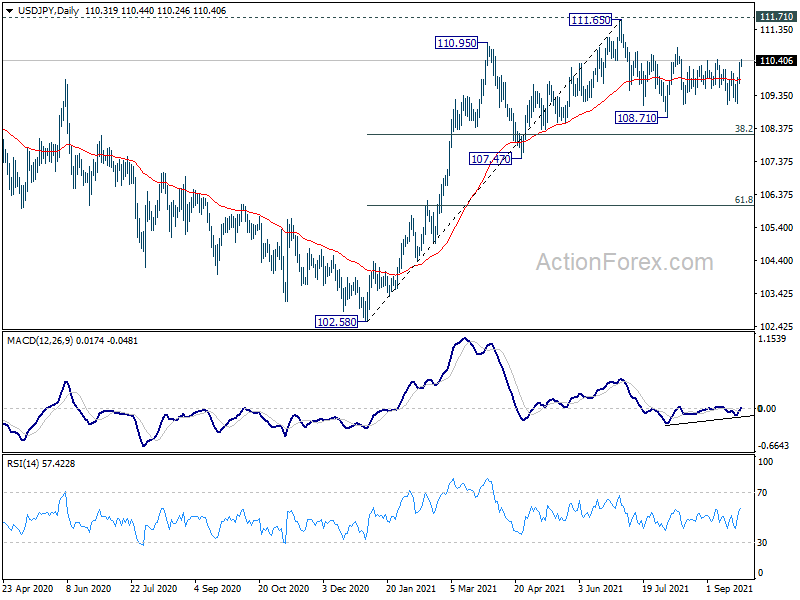
In the bigger picture, medium term outlook is staying neutral with 111.71 resistance intact. The pattern from 101.18 could still extend with another falling leg. Sustained trading below 55 day EMA will bring deeper fall to 107.47 support and below. Nevertheless, strong break of 111.71 resistance will confirm completion of the corrective decline from 118.65 (2016 high). Further rise should then be seen to 114.54 and then 118.65 resistance.
Yen Dives as Market Sentiment Turned Bullish, USD/JPY Pressing 110.44 Resistance
Market sentiment took a big turn overnight with strong rally in US indexes. Nikkei follows in Asia and reclaimed 30k handle, but other Asian markets are soft. Yen dropped notably following return of risk appetite while Dollar also weakened. On the other hand, commodity currencies rebounded notably. Yen is now the worst performing one for the week, followed by Sterling. Swiss Franc is the strongest followed by Canadian. But the picture could change before weekly close.
Technically, a focus is now on whether Yen's selloff would extend further immediately. In particular, break of 110.44 resistance in USD/JPY will be a strong sign of bullish range breakout. Further break of 110.79 resistance would pave the way to retest 111.65 high. Such development, if happens, could be accompanied by break of 130.73 resistance in EUR/JPY, and 152.85 resistance in GBP/JPY.
In Asia, at the time of writing, Nikkei is up 2.01%. Hong Kong HSI is down -0.03%. China Shanghai SSE is down -0.07%. Singapore Strait Times is down -0.12%. Japan 10-year JGB yield is up 0.0142 at 0.050. Overnight, DOW rose 1.48%. S&P 500 rose 1.21%. NASDAQ rose 1.04%. 10-year yield rose 0.074 to 1.410.
Japan PMI manufacturing dropped to 51.2 in Sep, services rose to 47.4
Japan's PMI Manufacturing dropped from 52.7 to 51.2 in September, below expectation of 52.5. PMI Services rose from 42.9 to 47.4. PMI Composite also rose from 45.5 to 47.7.
Usamah Bhatti, economist at IHS Markit said: "The pace of decline was softer than that seen in August, as the larger services sector saw a considerable easing in the rate of contraction... Input prices across the private sector rose at the fastest pace for 13 years, with businesses attributing the rise to higher raw material, freight and staff costs amid supply shortages."
Also from Japan, CPI core (all items ex fresh food) rose from -0.2% to 0.0% yoy in August, matched expectations. Headline CPI (all items) dropped from -0.3% yoy to -0.4% yoy. CPI core-core (all items ex fresh food and energy) improved from -0.6% yoy to -0.5% yoy.
New Zealand: Record monthly trade deficit as imports surged
New Zealand goods exports dropped -0.9% yoy to NZD 4.4B in August. Goods imports rose 38.0% yoy to NZD 6.5B. Trade deficit came in at record NZD -2.1B, versus expectation of NZD 110m surplus.
Exports to top trading partners were mixed, up 12% to China and 5.9% to Japan, but down -9.1% to Australia, -11% to US and -12% to EU. Imports from all top trading partners were up, from China up 40%, from EU up 42%. from Australia up 19%, from USA up 15%, and from Japan up 83%.
"This is a larger deficit than normal because of higher values for imports, particularly vehicles, continuing the trend observed over the last few months. August is also the month when we typically see lower values for dairy exports," international trade manager Alasdair Allen said.
UK Gfk consumer confidence dropped to -13 in Sep, consumers slamming on the brakes
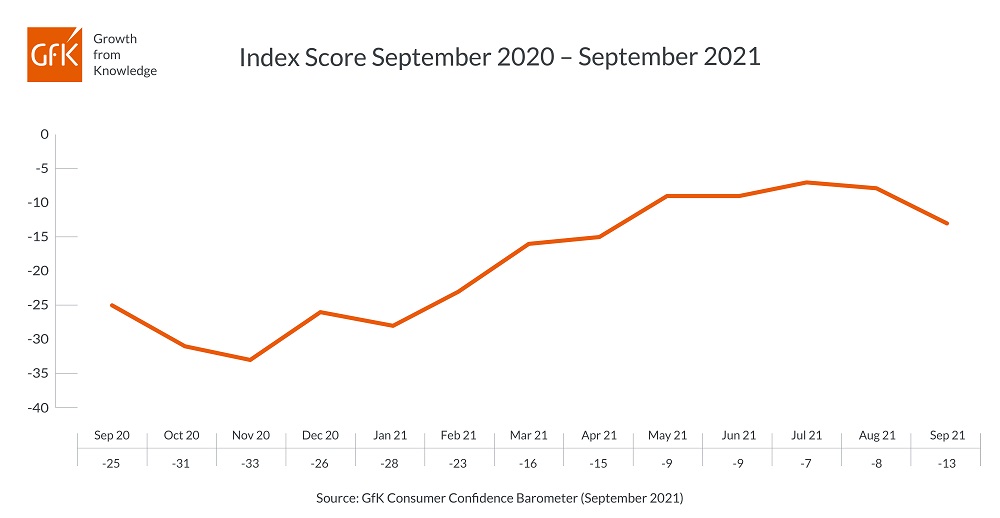
UK Gfk consumer confidence dropped form -8 to -13 in September, with all measures down. In particular, general economic situation over the next 12 months dropped sharply from -6 to -16.
Joe Staton, Client Strategy Director GfK, comments: "On the back of concerns about rising prices for fuel and food, the growth in headline inflation, tax hikes, empty shelves and the end of the furlough scheme, September sees consumers slamming on the brakes as those already in economic hardship anticipate a potential cost of living crisis.
Looking ahead
Germany Ifo business climate is the main feature today while US will release new home sales. Attention will also be on Fed Chair Jerome Powell's comment but he's unlikely to deviate from what he said at the post FOMC press conference just two days ago.
USD/JPY Daily Outlook
Daily Pivots: (S1) 109.94; (P) 110.14; (R1) 110.54; More...
USD/JPY's rebound from 109.11 extends higher today and focus is now immediately on 110.44 resistance. Firm break there will argue that consolidation pattern from 111.65 might have finally completed. Stronger rise would be seen through 110.79 to retest 111.65 high. On the downside, though, break of 109.10 will argue that larger fall from 111.65 is resuming. Deeper decline should then be seen to 108.71 support first, and then 38.2% retracement of 102.58 to 111.65 at 108.18 next.
In the bigger picture, medium term outlook is staying neutral with 111.71 resistance intact. The pattern from 101.18 could still extend with another falling leg. Sustained trading below 55 day EMA will bring deeper fall to 107.47 support and below. Nevertheless, strong break of 111.71 resistance will confirm completion of the corrective decline from 118.65 (2016 high). Further rise should then be seen to 114.54 and then 118.65 resistance.
Economic Indicators Update
| GMT | Ccy | Events | Actual | Forecast | Previous | Revised |
|---|---|---|---|---|---|---|
| 22:45 | NZD | Trade Balance (NZD) Aug | -2144M | 110M | -402M | -397M |
| 23:01 | GBP | GfK Consumer Confidence Sep | -13 | -7 | -8 | |
| 23:30 | JPY | National CPI Core Y/Y Aug | 0.00% | 0.00% | -0.20% | |
| 00:30 | JPY | Manufacturing PMI Sep P | 51.2 | 52.5 | 52.7 | |
| 08:00 | EUR | Germany IFO Business Climate Sep | 100.4 | 99.4 | ||
| 08:00 | EUR | Germany IFO Current Assessment Sep | 100.8 | 101.4 | ||
| 08:00 | EUR | Germany IFO Expectations Sep | 100 | 97.5 | ||
| 14:00 | USD | New Home Sales Aug | 708K | 708K |
Market Morning Briefing: Dollar Index Fell Sharply Yesterday From 93.52 To 92.98
STOCKS
Dow and Dax have sharply risen and while Dow looks bullish in the near term, Dax has to break above immediate resistance at 15700 to head higher. Nikkei, Shanghai, Nifty and Sensex all look bullish for the near term and have scope for some more rise before any indication of reversal is seen.
Dow (34764.82, +506.50, +1.48%) rose strongly overnight. While the rise continues, we cannot negate a test of 35250-35500 soon.
DAX (15643.97, +137.23, +0.88%) has risen well but has immediate resistance at 15700 which if holds can produce a fall towards 15500-15400 again in the near term. On the flipside, the index needs to break above 15700 to head higher towards 16000 eventually. For now, watch price action near 15700.
Nikkei (30200.89, +561.49, +1.89%) has risen above 30000 as expected. As the index rises a re-test of 30500-30750 looks possible on the upside.
Shanghai (3639.96, -2.26, -0.062%) has dipped slightly today but while above 3600, view is bullish towards 3700-3750 eventually.
Nifty (17822.95, +276.30, +1.57%) rose strongly yesterday in line with our expectation of the target but contrary to expectation of a slow rise. It could pause for breath near 17850-75 today. But we cannot negate some more upside towards 18000 over the next 2-3 weeks before indicating a reversal from there.
Sensex (59885.36, +958.03, +1.63%) has also risen sharply. A pause near 60000 can be seen followed by a fall towards 58500-58000.
COMMODITIES
Brent and WTI have risen and have further room to rise towards $77/80 and $74/75 respectively now before coming down from there. Gold can test 1780 again if it holds above 1740/50 else a fall to 1700 cannot be negated. Silver is heading towards 23-23.5 as expected and copper is stuck near 4.20 but can slowly rise towards 4.40/50 level.
Brent (77.15) has risen as expected coming into the 77-78 resistance region which is likely to hold and produce a fall. Any break above 78 would take Brent to higher resistance at 80 from where the expected fall would then be seen. Overall upside is limited for the near term as we expect a sharp correction on the cards soon.
WTI (73.12) has risen above 73 and could test 74 or even 75 before falling off from there in the near term.
Gold (1750.20) fell to 1743 as expected but has bounced back from there. Support at 1740 seems to be holding well for now and while that holds, price can rise back to 1780/90. Failure to hold above 1740 can drag the price towards 1700 slowly, the next crucial support below 1740.
Silver (22.65) continues to rise and is headed towards 23-23.50 on the upside. Immediate view is bullish.
Copper (4.2110) has risen a bit and could be eventually headed towards 4.30/40 while the upmove continues.
FOREX
Ranged movement in Dollar Index but has scope to fall towards 92.75. Euro has held below 1.1750 and remains above support near 1.1665. A range of 1.1665-1.1750 is possible. A break above crucial resistance at 1.1800/10 is needed for any bullish signal. EURJPY is rising towards 130.50. Aussie and Pound have risen and look bullish. USDCNY and USDINR could be ranged within 6.44-6.47 and 73.60-73.90 respectively.
Dollar Index (93.44) fell sharply yesterday from 93.52 to 92.98. The index has again risen from yesterday’s lows and could head towards 93.20/40 again in the next few sessions with a possible fall to 92.75 on the downside. View is unclear just now on further direction.
Euro (1.1739) fell to almost test 1.1680 over the last 2-sessions before rising to 1.1750/60 on the upside which seems to be holding well as a decent immediate resistance just now. Above 1.1750/60, there is crucial resistance near 1.1800/10 which if breaks would be an initial confirmation of a fresh upmove. Failure to break above 1.1800/10 would keep the exchange ranged below 1.18.
EURJPY (129.60) has been rising sharply and is headed towards 130-130.50 soon. Immediate view is bullish within the 128-130.50 range.
Dollar-Yen (110.40) has risen strongly to test the upper end of our mentioned range of 109-110.40. Above 110.40, it needs to further rise above 110.75/80 to move up further towards 111.50/60 in the medium term, else we may expect a decline from 110.75/80 back towards 110 or lower. Watch price action closely in the near term.
Aussie (0.7296) has bounced well and could be headed towards 0.7350 soon from where a decline looks possible in the medium term.
Pound (1.3721) tested 1.3750 before coming off slightly from there. A break above 1.3750 is needed for Pound to rise further towards 1.39 else we may expect a fall from current levels itself towards 1.3650-1.36 eventually.
USDCNY (6.4612) is stuck within a broad sideways range of 6.47-6.45/44 and could hold that for a few more sessions.
USDINR (73.6475) traded well within 73.60-73.80 as expected. We may consider a range of 73.60-73.90 over today and Monday before breaking on either side by end of next week.
INTEREST RATES
The US Treasury yields have risen sharply across tenors yesterday. Though there is room to rise further from here, strong resistances are coming up that can cap the upside. We expect these resistances to hold and the yields to reverse lower again. The price action in the coming days will need a close watch. The German yields have risen back again and can move up further if this bounce sustains. If so our view of seeing a fresh fall will get delayed. The 10Yr and 5Yr GoI may consolidate in the near-term before seeing a fresh fall from here.
The US 2Yr (0.26%), 5Yr (0.94%), 10Yr (1.42%) and the 30Yr (1.94%) have risen sharply yesterday. The 10Yr can test 1.45%-1.5%. The 30Yr has risen above 1.9% and can now test 2% from where it can turn down. The level of 1.5% on the 10Yr and 2% on the 30Yr are crucial resistances which we expect to hold and trigger a reversal. The price action at these levels will need a close watch in the coming days.
The German 2Yr (-0.70), 5Yr (-0.59%), 10Yr (-0.26%) and 30Yr (0.22%) yields have risen back sharply. The 30Yr has broken above the crucial level of 0.20%. If this sustains a further rise to 0.30%-0.35% can be seen. The 10Yr on the other hand has resistance in the -0.25%/-0.20% zone which will have to be broken for it to move up further. Overall, the fresh fall that we had expected to begin seems not to be happening immediately. We will have to wait and watch.
The Indian 10Yr GoI (6.1397%) had bounced from the day’s low of 6.1218% yesterday, Our view remains the same. 6.16% and 6.2% are strong resistances that can cap the upside and keep the broader bearish view intact of testing 6.1% and 6% on the downside.
The 5Yr GoI (5.5787%) on the other hand has closed lower yesterday. It can trade in the range of 5.56%-5.64% in the near-term with a bearish bias to break the range on the downside and fall to 5.5% eventually.
Japan PMI manufacturing dropped to 51.2 in Sep, services rose to 47.4
Japan's PMI Manufacturing dropped from 52.7 to 51.2 in September, below expectation of 52.5. PMI Services rose from 42.9 to 47.4. PMI Composite also rose from 45.5 to 47.7.
Usamah Bhatti, economist at IHS Markit said: "The pace of decline was softer than that seen in August, as the larger services sector saw a considerable easing in the rate of contraction... Input prices across the private sector rose at the fastest pace for 13 years, with businesses attributing the rise to higher raw material, freight and staff costs amid supply shortages."
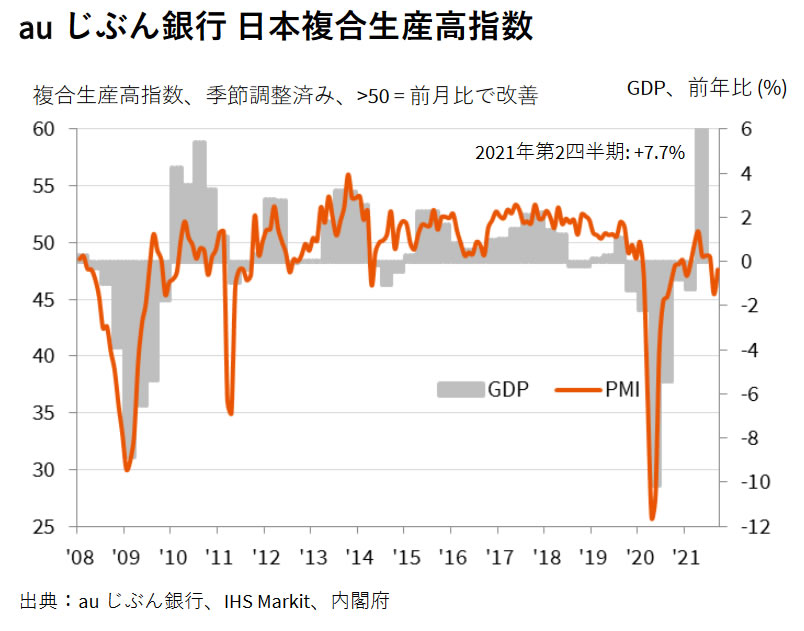
Also from Japan, CPI core (all items ex fresh food) rose from -0.2% to 0.0% yoy in August, matched expectations. Headline CPI (all items) dropped from -0.3% yoy to -0.4% yoy. CPI core-core (all items ex fresh food and energy) improved from -0.6% yoy to -0.5% yoy.
USD/JPY Breaks Key Hurdle, 110.40 Presents Resistance
Key Highlights
- USD/JPY cleared a major hurdle near the 109.80 level.
- It broke a crucial bearish trend line with resistance near 109.85 on the 4-hours chart.
- EUR/USD corrected higher above 1.1700 and 1.1740.
- GBP/USD climbed higher sharply above the 1.3720 resistance.
USD/JPY Technical Analysis
The US Dollar started a fresh increase from the 109.12 support zone against the Japanese Yen. USD/JPY cleared a couple of important hurdles near 109.50 and 109.80.
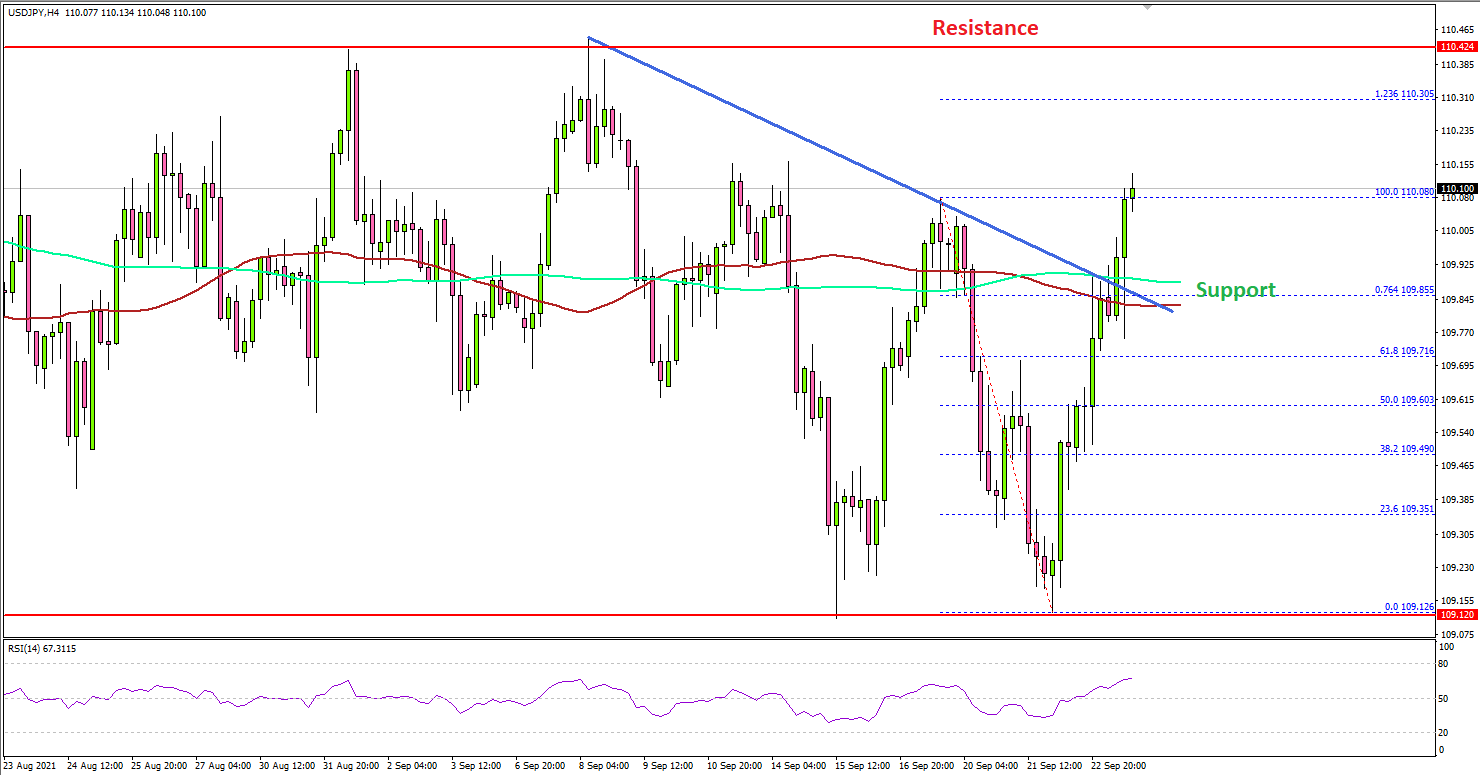
Looking at the 4-hours chart, the pair gained pace above the 109.80 resistance. There was a break above a crucial bearish trend line with resistance near 109.85.
The pair surpassed the 110.00 level, the 100 simple moving average (red, 4-hours), and the 200 simple moving average (green, 4-hours). Finally, it spiked above the last swing high at 110.08.
If the pair continues to rise, it could test the 110.30 resistance. It is near the 1.236 Fib extension level of the last decline from the 110.08 swing high to 109.12 low. The main resistance is near the 110.40 level, above which USD/JPY could accelerate higher.
An immediate support is near the 109.80 level and the 100 simple moving average (red, 4-hours). A close below the 109.80 support could put a lot of pressure on the bulls. The main support sits near the 109.12 level.
Looking at EUR/USD, the pair spiked below the 1.1700 level before it recovered above 1.1740. Similarly, GBP/USD jumped above the 1.3700 and 1.3720 resistance levels.
Economic Releases
- German IFO Business Climate Index for Sep 2021 – Forecast 100.4, versus 99.4 previous.
- German IFO Current Assessment Index for Sep 2021 - Forecast 100.8, versus 101.4 previous.
- German IFO Expectations Index for Sep 2021 – Forecast 100, versus 97.5 previous.
UK Gfk consumer confidence dropped to -13 in Sep, consumers slamming on the brakes
UK Gfk consumer confidence dropped from -8 to -13 in September, with all measures down. In particular, general economic situation over the next 12 months dropped sharply from -6 to -16.
Joe Staton, Client Strategy Director GfK, comments: "On the back of concerns about rising prices for fuel and food, the growth in headline inflation, tax hikes, empty shelves and the end of the furlough scheme, September sees consumers slamming on the brakes as those already in economic hardship anticipate a potential cost of living crisis.
New Zealand: Record monthly trade deficit as imports surged
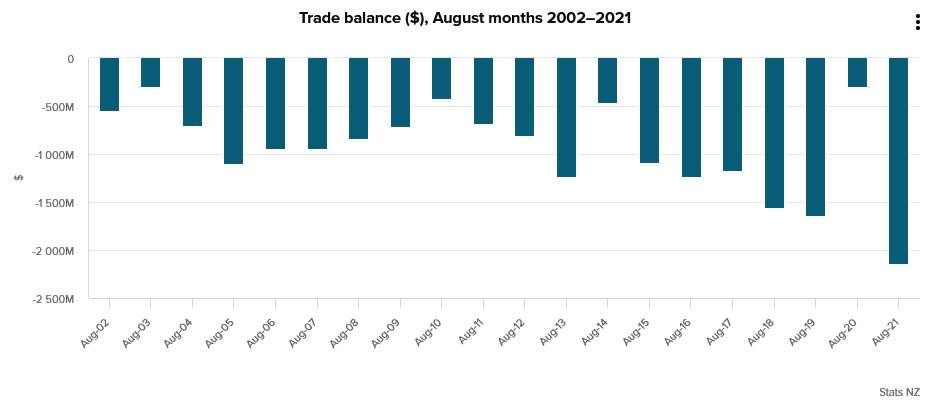
New Zealand goods exports dropped -0.9% yoy to NZD 4.4B in August. Goods imports rose 38.0% yoy to NZD 6.5B. Trade deficit came in at record NZD -2.1B, versus expectation of NZD 110m surplus.
Exports to top trading partners were mixed, up 12% to China and 5.9% to Japan, but down -9.1% to Australia, -11% to US and -12% to EU. Imports from all top trading partners were up, from China up 40%, from EU up 42%. from Australia up 19%, from USA up 15%, and from Japan up 83%.
"This is a larger deficit than normal because of higher values for imports, particularly vehicles, continuing the trend observed over the last few months. August is also the month when we typically see lower values for dairy exports," international trade manager Alasdair Allen said.
Cliff Notes: FOMC and BoE Hold Their Course as Evergrande Threatens Outlook
Key insights from the week that was.
This week had a near sole focus on economic policy, here and abroad.
For the RBA, the minutes of their September meeting highlighted the reasoning behind their decision to take the first step in tapering asset purchases this month, but to then delay the next until 2022. Keeping asset purchases at $5bn per week until “at least November 2021” was also considered, but the decision to taper this month was eventually made given the economy is seen returning “to its pre-Delta path by mid-2022” and as “a number of other central banks are tapering”.
The decision to reduce asset purchases based on expectations of our economy over the year ahead and policy abroad contrasts with the RBA’s clear intention with regards to subsequent rate hikes to make each decision on actual data instead of forecasts, and to not let the timing of other central banks impact. Arguably, this is because QE is seen as an extraordinary measure for times of heightened risk and uncertainty, and as reducing the pace of asset purchases is not regarded as policy tightening, but rather easing at a lesser rate.
We take from the September minutes and other recent RBA communications that the RBA believe the outlook is likely to be strong enough to see a further reduction in asset purchases from February, and an end to the program in May/August. Thereafter, the decision to increase interest rates will be made on progress in the economy, particularly the pursuit of full employment and robust wage gains which are seen as necessary to hold inflation in the RBA’s 2-3%yr target range.
The first steps towards policy normalisation were also front of mind in the US this week as the FOMC held their September meeting. As we anticipated, there was no formal taper announcement. But Chair Powell and the Committee guided that the conditions for this decision were “all but met”. Depending on the strength of the September and October employment reports, their decision to taper could come at either the November or December meeting. At present, risks related to the US’ delta wave of COVID-19 and developments in China seem to be having little bearing on US monetary policy (more on China below).
Highlighting the belief that Chair Powell and the Committee have in the US economy, not only do they expect to taper asset purchases fully by mid-2022, but a first rate hike by end-2022 is now seen as an even bet, with a moderate rate hike cycle to follow, taking the fed funds rate to 1.8% by end-2024.
Over this period, full employment and growth above trend are expected to be sustained. This highlights that at no time over the forecast period is policy expected to be restrictive. Indeed, if the 1.8% for the fed funds rate at end-2024 is achieved, the real fed funds rate would still be negative. These revised FOMC forecasts are broadly in line with Westpac’s existing views, both with respect to the timing and scale of policy changes. Our terminal fed funds rate is a little lower though at 1.625%.
While the US dollar gained on the September FOMC meeting communications, it more than reversed the move in 24 hours. Principally this looks to have come about because of the Bank of England’s September meeting which saw a greater focus on supply constraints, wage pressures and hence the persistence of inflation in 2022. Inbuilt in our currency forecasts is a view that the FOMC will be slower to act on tapering (the BoE/ECB respectively stopping/materially reducing purchases at December 2021/ March 2022) and potentially could raise rates after some other major central banks, most notably the Bank of England and Canada.
To March 2022, we therefore continue to expect the US dollar to weaken at the margin before recovering back to near current levels by end-2023. While the US may take time in beginning both stages of normalisation, they are likely to increase interest rates further to end-2024. Note the ECB is unlikely to increase rates over this entire period, leaving the Euro most susceptible to weaker outcomes in late-2022 and 2023.
China has also remained in the headlines this week, not because of monetary policy, but instead because of the plight of Evergrande and the impact of broader reforms to the residential construction sector which, together, have materially reduced momentum.
The Evergrande situation is immensely complex and so will take time to work through. But there is a way forward, at least for the construction projects being undertaken by the firm. These projects are diversified by region and, even with the Evergrande holding company in a precarious financial position, still in demand.
To protect both the purchasers of these apartments and the workers, they could be sold or handed over to other developers for completion. Notably, Evergrande’s spread across tier 2 and 3 locations is important to authorities as it fits with their intention to make wealth and quality of life more equitable across the population. This means the projects should also be valuable to other developers.
While such a course would allow existing projects to be completed and prices to stabilise, thereby resetting the sector for another period of growth, it would do little to alleviate the parent company’s financial issues, at least in the near term. We expect these would be worked through slowly to not hit confidence or take unnecessary risks, at least for domestic investors. These parties will receive the proceeds that flow from the construction subsidiaries and the other assets of Evergrande, likely in order of sophistication – least to most. Preferencing retail investors and domestic bond holders over the local banks also makes sense given the banks can be helped by liquidity provision as necessary.
Our take home for China’s outlook from the current circumstances is that, while risks will remain near term, like most regulatory change China undertakes, authorities actions here will make the economy and financial sector stronger for the long-term.
Eco Data 9/24/21
[php_everywhere instance="1"]
European Monetary Policy and FX Roundup
Summary
It has been a particularly busy week across Europe, with several of the G10 central banks making monetary policy announcements and contributing to varying degrees of market excitement. In this report we briefly recap these announcements and assess their FX implications.
Norway's central bank became the first G10 central bank to raise rates with a 25 bps rate hike as the economy returns to a more normal growth path. While the central bank's projections signaled further rate hikes, the increases penciled in for 2022 still look a touch light to us. We see upside risk to our current forecast of Norwegian krone appreciation.
The Bank of England held monetary policy steady and, despite cross-currents affecting the U.K. economy, said the case for modest tightening has potentially strengthened. With the announcement we have brought forward our expected timing for rate increases, and we now expect the Bank of England to initiate a rate hike cycle with an increase in May 2022, followed by November 2022. While the pound may be subject to some near-term uncertainties, we expect the U.K. currency to strengthen against the U.S dollar and the euro over the medium-term.
Sweden's central bank and Switzerland's central bank both held monetary policy steady, with no indication either central bank will move to a less accommodative monetary policy stance for the foreseeable future. Given the strength of Sweden's economic rebound we still anticipate modest Swedish krona strength versus the euro. For Switzerland, moderate Swiss growth and inflation, combination with some improvement in global economic and market sentiment over time, should see the franc soften versus the euro.
Norway's Central Bank Kicks Off G10 Rate Hike Cycle
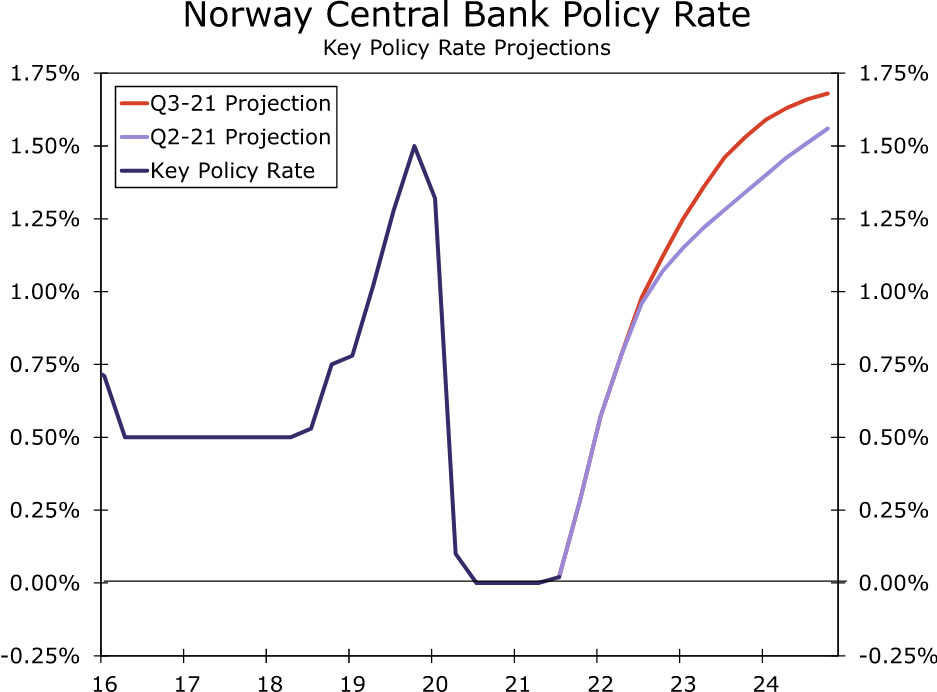
The Norges Bank, Norway's central bank, became the first developed economy central bank to raise interest rates during the current cycle, lifting its Deposit rate by 25 bps to 0.25%. The move was widely expected by market participants, and was justified by the central bank on the back of firming growth rather than inflation concerns per se. The Norges Bank said a "normalising economy now suggests that it is appropriate to begin a gradual normalisation of the policy rate", and added that while underlying inflation is low increased activity and rising wages should push it towards 2%.
The Norges Bank's updated projections anticipate further normalization of the economy, with the mainland GDP growth forecast at 3.9% for 2021 (versus 3.8% previously) and 4.5% for 2022 (4.1% previously). The interest rate path contained within those projections is also slightly higher than previously. In its announcement, the Norges Bank explicitly stated the policy rate would most likely be raised further in December, while the revised rate path sees the policy rate rising to 1.12% by Q4-2022. We are in agreement on a December 2021 rate increase. However, given we also expect a solid ongoing economic rebound, the rate path for next year still appears to be a touch light. We expect at least a further 75 bps of rate increase, and perhaps as much as 100 bps of rate increase, in 2022. Against this growth and monetary policy backdrop we believe the risks around our Norwegian krone forecast are tilted towards a faster pace of appreciation relative to our base case, which anticipated a EUR/NOK exchange rate of NOK9.95 by the end of next year.
Bank of England Still Moving Towards 2022 Tightening
The Bank of England (BoE) held monetary steady at its September meeting, although the announcement was arguably marginally hawkish in tone. Policymakers voted unanimously to hold its policy rate steady at 0.10%, while there was a 7-2 vote to continue with the government bond purchase programme, with the two dissenters voting for an early end to asset purchases. That was a slight change from previous meetings which has seen just one dissent in favor of an early end to bond purchases.
The Bank of England's statement highlighted cross currents affecting the U.K. economy contributing to softer growth (for now) and higher inflation. The central bank said the forecast for the level of real GDP in Q3-2021 has been revised down around 1% since its August projections, noting some supply disruptions. Moreover, while the BoE noted softness in reported retail sales it said other indicators of spending have remained stronger. On inflation, the central bank cited increased natural gas prices as an upside risk and said cost pressures are still elevated, even if they are likely to be transitory.
Importantly, with respect to overall monetary policy the Bank of England said:
"At its previous meeting, the Committee judged that, should the economy evolve broadly in line with the central projections in the August Monetary Policy Report, some modest tightening of monetary policy over the forecast period was likely to be necessary to be consistent with meeting the inflation target sustainably in the medium term. Some developments during the intervening period appear to have strengthened that case, although considerable uncertainties remain."
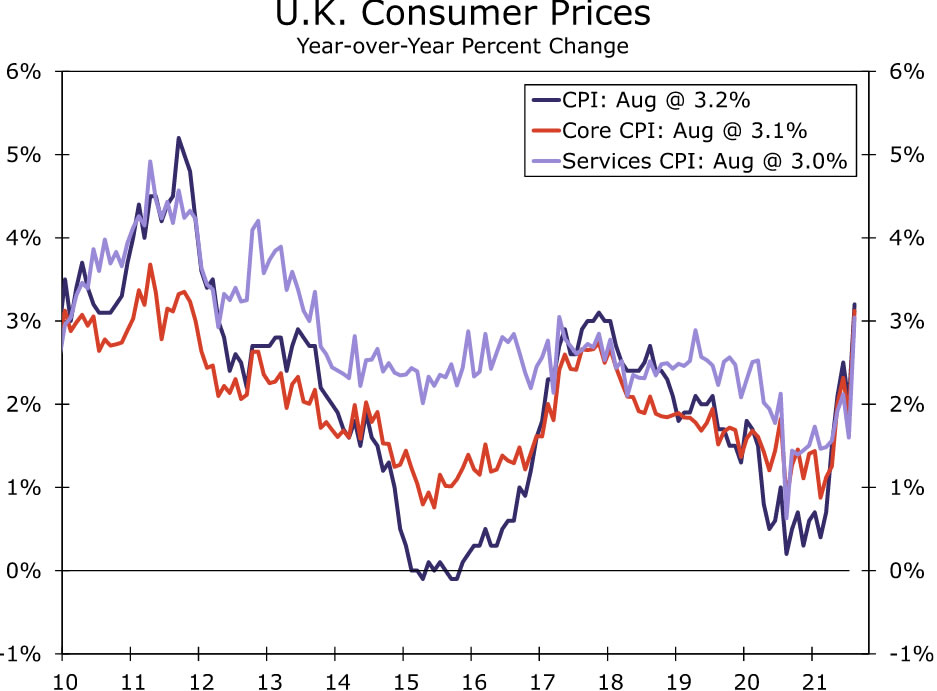
From our perspective, while the uptick of inflation will very likely be transitory, it is somewhat challenging to discern how much of the current spike in inflation is temporary and how much is more persistent. In August for example, we note the headline, core and services CPI all showed an increase of 3.0% year-over-year or greater. By 2022 we expect the U.K. economy will have returned to a steadier growth path and CPI will still be above target (even if it is slowing). As a result, we still expect the Bank of England to begin raising rates around the middle of next year. In fact, with today's announcement we have brought forward our expected timing of Bank of England rate hikes by a quarter, and now anticipate a 15 bps policy rate hike in May 2022 (to 0.25%) and a 25 bps rate hike in November (to 0.50%). While the pound could be subject to some near-term uncertainty, we still expect the U.K. currency to strengthen against both the U.S. dollar and the euro over the medium term. Our current year-end 2022 targets are $1.4300 for the GBP/USD exchange rate a EUR/GBP exchange rate of 0.8325.
Riksbank Unmoved By Sweden's Economic Upswing
The monetary policy announcement from the RIksbank, Sweden's central bank, was perhaps notable for a lack central bank action or intent. The Riksbank appears largely unmoved by Sweden's firming economic recovery. Not only did the Riksbank keep its repo rate at 0.00%, it projected the policy rate would remain at that level over the entire forecast horizon out until Q3-2024. Moreover, the Riksbank held out some possibility that further monetary easing could still be forthcoming if inflation prospects weaken, whether that is through repo rate cuts or some other form.
Developments regarding the Riksbank's quantitative easing program are more cut-and-dried. The central bank said it would complete its bond purchases by the end of 2021, and keep bond holdings steady through 2022, in line with its previous announcements. Finally, in the one concrete measure the Riksbank took, it closed the emergency lending facilities that were set up at the outset of the COVID crisis.
The benign announcement from Sweden's central bank comes even as it raised its 2021 GDP growth forecast to 4.7% (from 4.2% previously), while its GDP forecasts of 3.6% for 2022 and 2.0% for 2023 are little changed from its prior outlook. For CPIF inflation, the Riksbank forecast 2.3% inflation in 2021, easing back to 2.1% in 2022 and 1.8% in 2023. The central bank said its expects a near-term, electricity-related increase in inflation, but does not expect a lasting firming of inflation just yet.
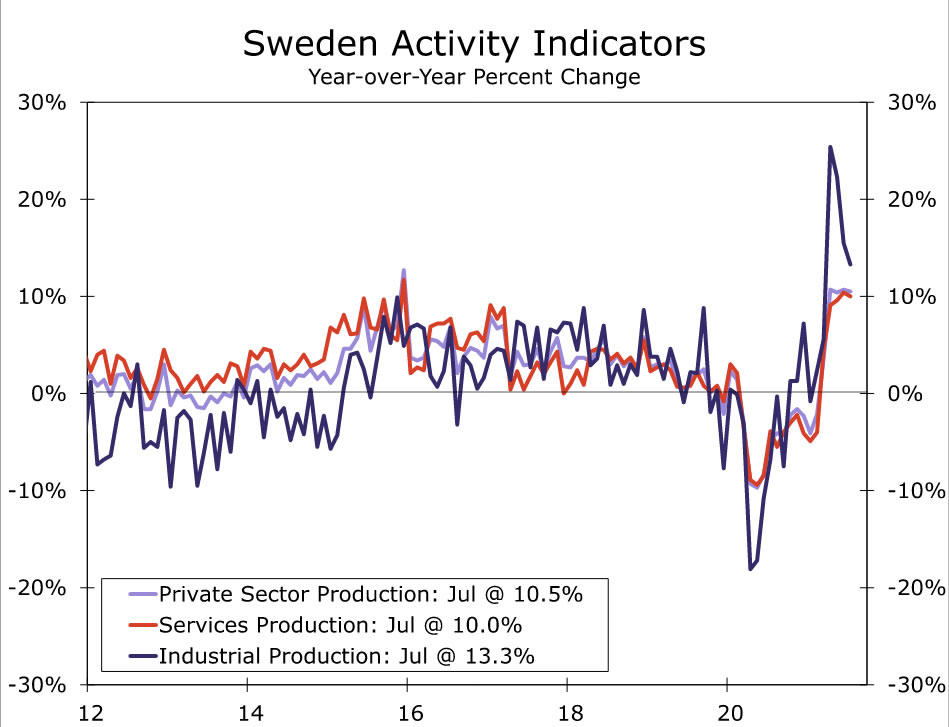
Sweden's economic upswing has certainly been impressive so far in 2021. Not only did Q2 GDP growth reach 9.7% year-over-over, elevated PMI indices and confidence surveys suggest some of that momentum has carried into the second half of this year. The rebound also appears to be broad-based—for example, July private sector production rose 10.5% year-over-year as services production rose 10.0% and industry production rose 13.3%. The strength of Sweden's recovery means we still expect very modest gains in the krona versus the euro over time, especially with the European Central bank, if anything, shifting even more gradually from its accommodative monetary policy stance. For year-end 2022, we target the EUR/SEK exchange rate at SEK10.05.
Swiss Inflation Low, Swiss Rates Even Lower
Switzerland's monetary policy announcement had a very familiar feel to it as the Swiss National Bank (SNB) maintained its accommodative monetary policy stance and gave no hint of any change in policy for the foreseeable future. The SNB held its policy rate at -0.75%, and said the Swiss franc remains highly valued. The central bank said it "remains willing to intervene in the foreign exchange market as necessary, in order to counter upward pressure on the Swiss franc."
Regarding its economic projections, the SNB expects GDP growth 3% for 2021, a bit less than in June. On the price front, inflation is expected to be slightly higher in the near-term on elevated oil prices and supply disruptions, but virtually unchanged of the medium-term, such that CPI inflation is still below 1% by the end of its forecast horizon in 2024.
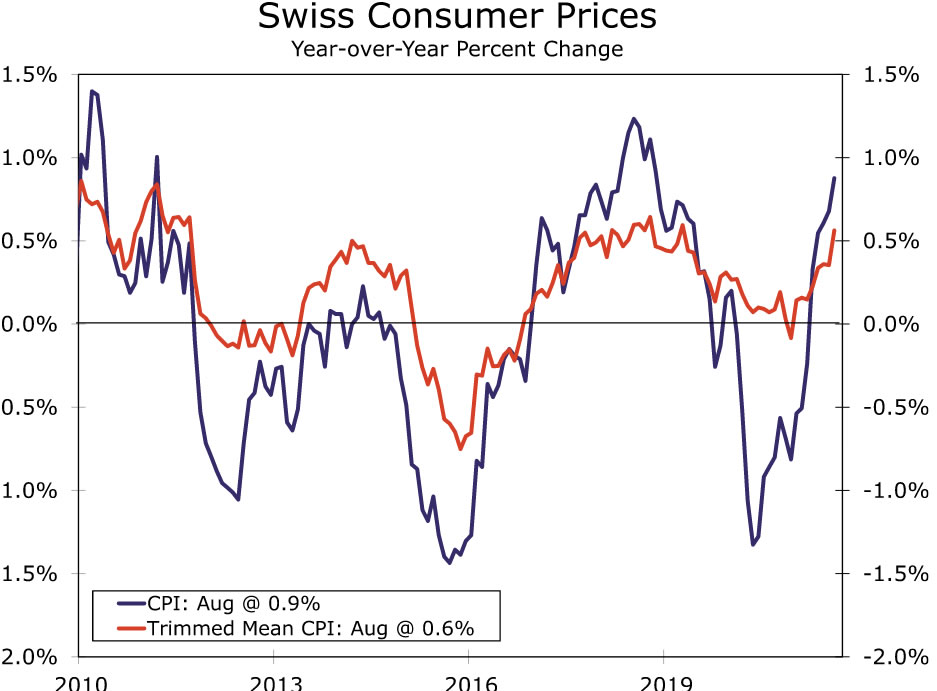
To be sure, both Swiss growth and inflation have shown firmer trends in 2021, with both headline and core inflation rising at their fastest pace in more than two years. However, as this week's announcement makes clear, the uptick in inflation in particular is still modest. Along with the Bank of Japan, the Swiss National Bank appears to be the other central bank that is most likely to maintain expansionary monetary policy for an indefinite period. With many other G10 central banks moving towards less accommodative policy (at varying speeds), an outlook for rising global yields, and should COVID concerns recede as 2022 progress, that should translate to an underwhelming performance from the Swiss currency. We expect the franc to soften versus the euro over time, and we target a EUR/CHF exchange rate of CHF1.0950 by the end of 2022.