

Sample Category Title
GBPJPY Surpasses 200-Day SMA In Descending Channel
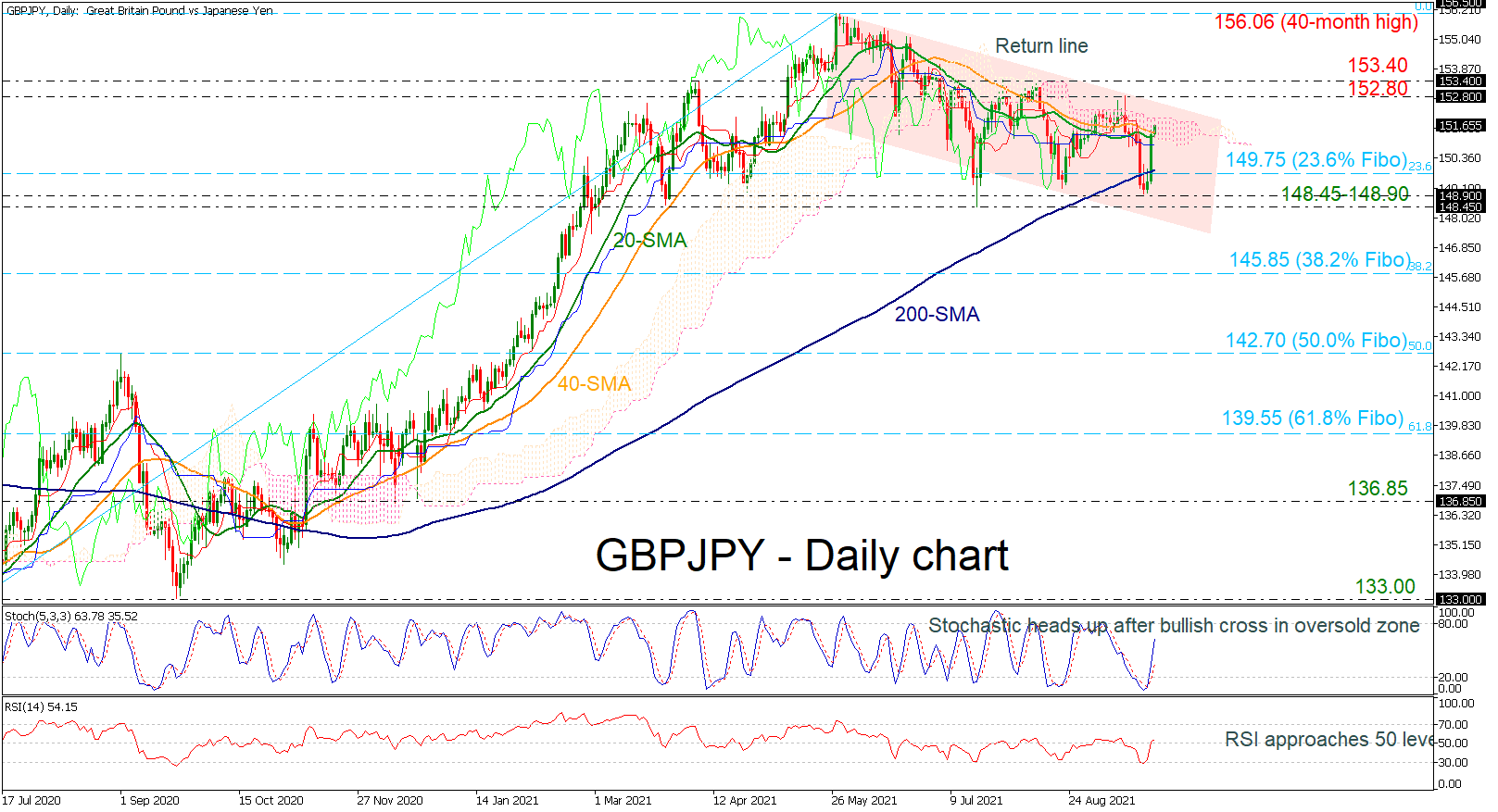
GBPJPY is advancing above the 200-day simple moving averages (SMAs) and the 23.6% Fibonacci retracement level of the up leg from 129.30 to 156.06 t 149.75, remaining in a medium-term downward sloping channel.
Regarding the technical indicators, the stochastic oscillator is turning upwards after the bullish crossover within the %K and %D lines in the oversold territory, suggesting a positive bias. Moreover, the RSI is rising in the positive region, following the rebound off the 30 level.
A break above the Ichimoku cloud and the return line of the channel would ease the downside pressure, while a climb above the 152.80-153.40 could help turn the medium-term bias to a bullish one.
If the bears take the upper hand again and the price drifts below the 23.6% Fibonacci, that could bring into play the 148.45-148.90 zone and the 38.2% Fibonacci of 148.85. More declines could take the market until the 50.0% Fibonacci of 142.70.
Overall, GBPJPY has been in a descending channel since May 27; however, a rise above the 40-month high of 156.06 could switch the outlook to positive.
Smart Money Performance Creates Doubts In The Stock Rally
US markets closed a second consecutive day with an impressive gain of more than 1%. The price of a barrel of Brent on Thursday returned to an area of yearly highs near $77. However, investors and traders should be aware that some shifts are already taking place in the markets, which will affect a broader range of assets sooner rather than later.
We should note the daily jump in 10-year US treasury yields from 1.3% to 1.44%, the sharpest one-day increase since February. It confirms that for the "smart money", often called US debt markets, the latest Fed comments was more hawkish than they had expected. At the start of the year, the rise in bond yields triggered revaluation in equity markets, supporting value stocks against growth stocks and making financing more expensive.
The weakness in the precious metals market is also worrisome. Towards the end of the US session, the price of gold dipped to a six-week low of $1737 as rising bond yields around the world made investing in the yellow metal less attractive. With the start of trading in Asia, gold returned to above $1750. Closing the week below that level promises to be a bearish signal. Apart from the Fed, quite a few countries are moving towards policy tightening.
In addition, the problems of Chinese property developer Evergrande are by no means solved. The People's Bank of China is intervening heavily in the money market. However, this only temporarily gives more money than solves the giant company's impending default, influencing yields far beyond the sector or the PRC.
On the currency market, we have not yet seen a significant strengthening of demand for the dollar. Moreover, it has given up somewhat against commodity currencies in recent days. However, it needs to remember that a sustained rise in yields at some point translates into USD growth. In February, the pressure on equities intensified at yields above 1.2%, and the demand for the dollar against major competitors showed up at levels above 1.3%. The market has already passed both these points.
The S&P500 is trading at its 50-day moving average. Closing the week above this level will signal the bulls to push the market back to the highs. A decline from these levels would indicate a depletion of the rebound and a further reduction in demand for risky assets. For the Dollar Index, a consolidation above 93.50, the top end of the trading range since last November, would be significant. For the gold bulls, it is crucial to maintain the price above $1750 at the end of the week.
USD/CAD Breached Channel
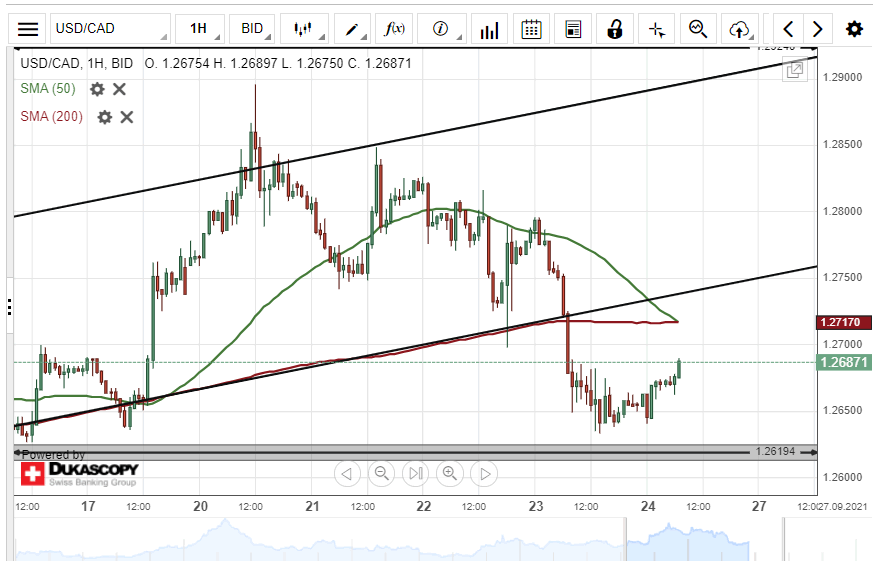
On Thursday, the US Dollar fell by 156 pips or 1.22% against the Canadian Dollar. A Breakout occurred through the lower boundary of an ascending channel pattern during Thursday's trading session.
Given that a breakout has occurred, the USD/CAD currency pair could continue to edge lower within this session. The potential target for sellers would be near the 1.2550 level.
However, bearish traders may encounter support at 1.2619 during Friday's trading session
GBP/JPY Breakout Occurs
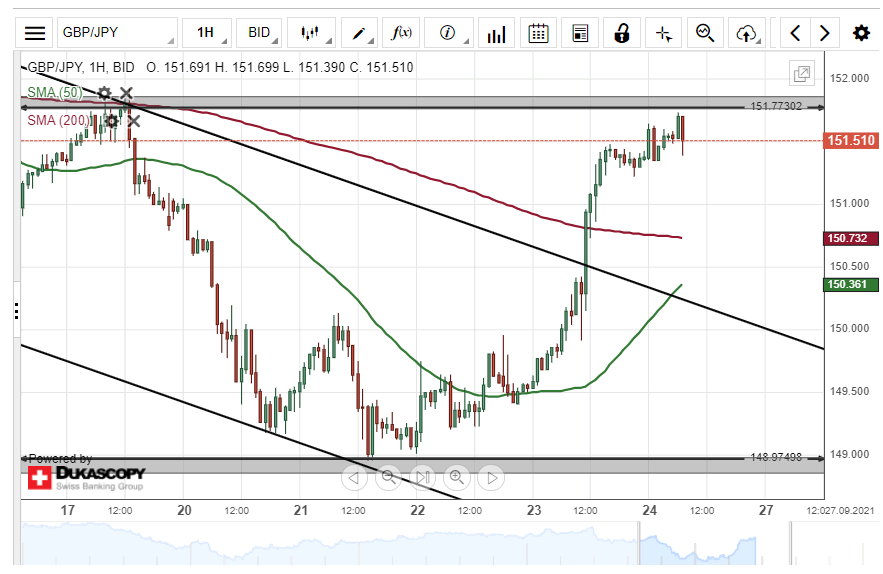
On Thursday, the British Pound edged higher by 201 pips or 1.34% against the Japanese Yen. A breakout occurred through the upper boundary of a descending channel pattern during Thursday's trading session.
Given that a breakout has occurred, buyers could continue to drive the price higher within the following trading session. The potential target for the currency pair would be near the 152.60 area.
However, the GBP/JPY currency exchange rate could encounter resistance at 151.77 in the shorter term.
AUD/USD Breaks Channel Pattern
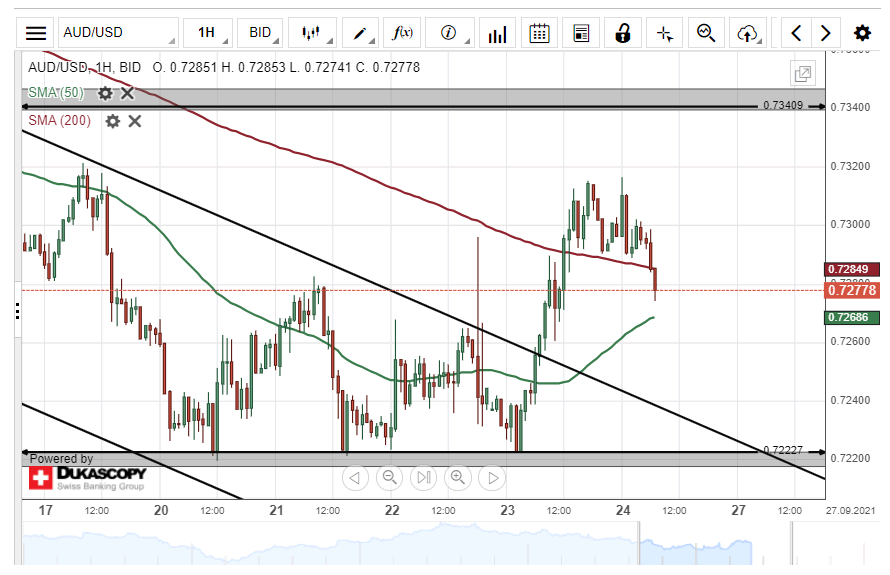
The AUD/USD currency pair bounced off a support level at 0.7222 on Thursday. As a result, the Australian Dollar edged higher by 91 pips or 1.26% against the US Dollar during Thursday's trading session.
Everything being equal, the exchange rate could continue to trend higher within the following trading session. The potential target for buyers would be near the 0.7340 level.
On the other hand, the currency exchange rate could reverse from the current price level at 0.7299 and target the 50– hour SMA at 0.7266 within this session.
EUR/JPY Bullish Momentum Likely To Continue
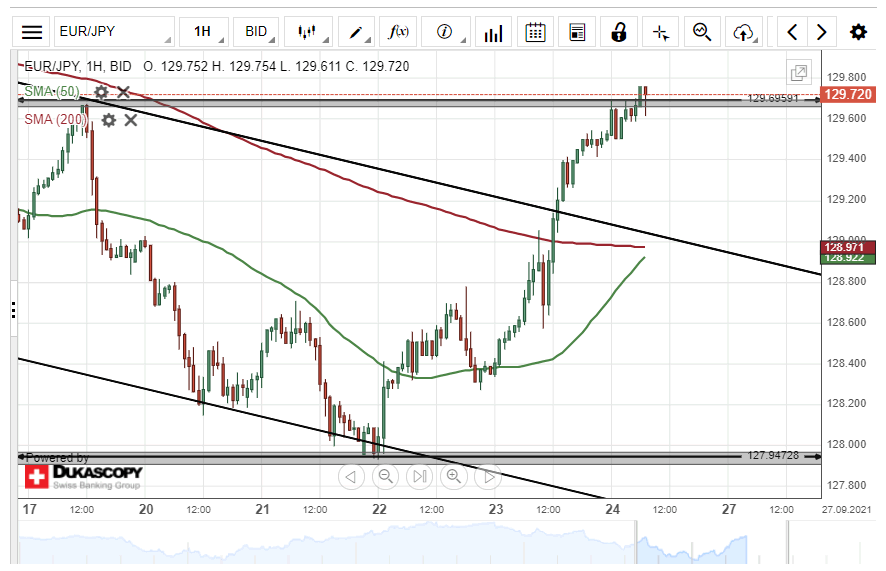
Upside risks pressured the EUR/JPY currency pair higher on Thursday. As a result, the common European currency surged by 121 pips or 0.94% against the Japanese Yen during Thursday's trading session.
All things being equal, the bullish momentum is likely to continue within this session. The potential target for the exchange rate would be near the 130.22 level.
However, a resistance level at 129.69 could provide resistance for the currency exchange rate during the following trading session.
USD/CAD Tests Key Support
The Canadian dollar halts its advance as July’s retail sales unexpectedly show a contraction.
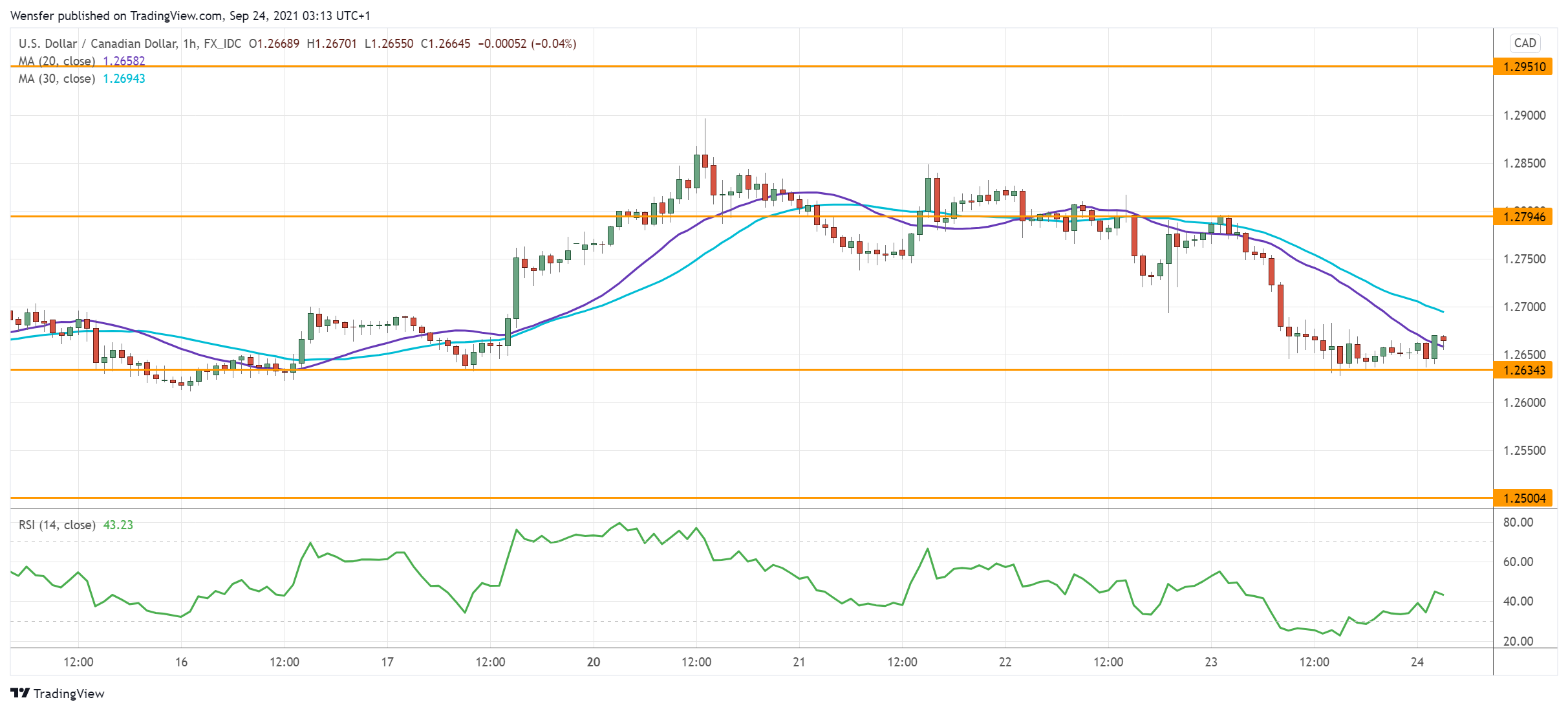
The pair has met stiff selling pressure near the August high (1.2950). The pullback is testing the key support at 1.2635. An oversold RSI may attract some bids. Then the bulls need to lift 1.2795 for continuation.
Failing that, a bearish breakout would dent the optimism and those who previously bought in this demand area would have to get out. Then 1.2500, a is major support on the daily chart, would be the second line of defense.
USD/CHF Tests Fibonacci Level
The Swiss franc softened after the Swiss National Bank pledged to keep its policy loose.
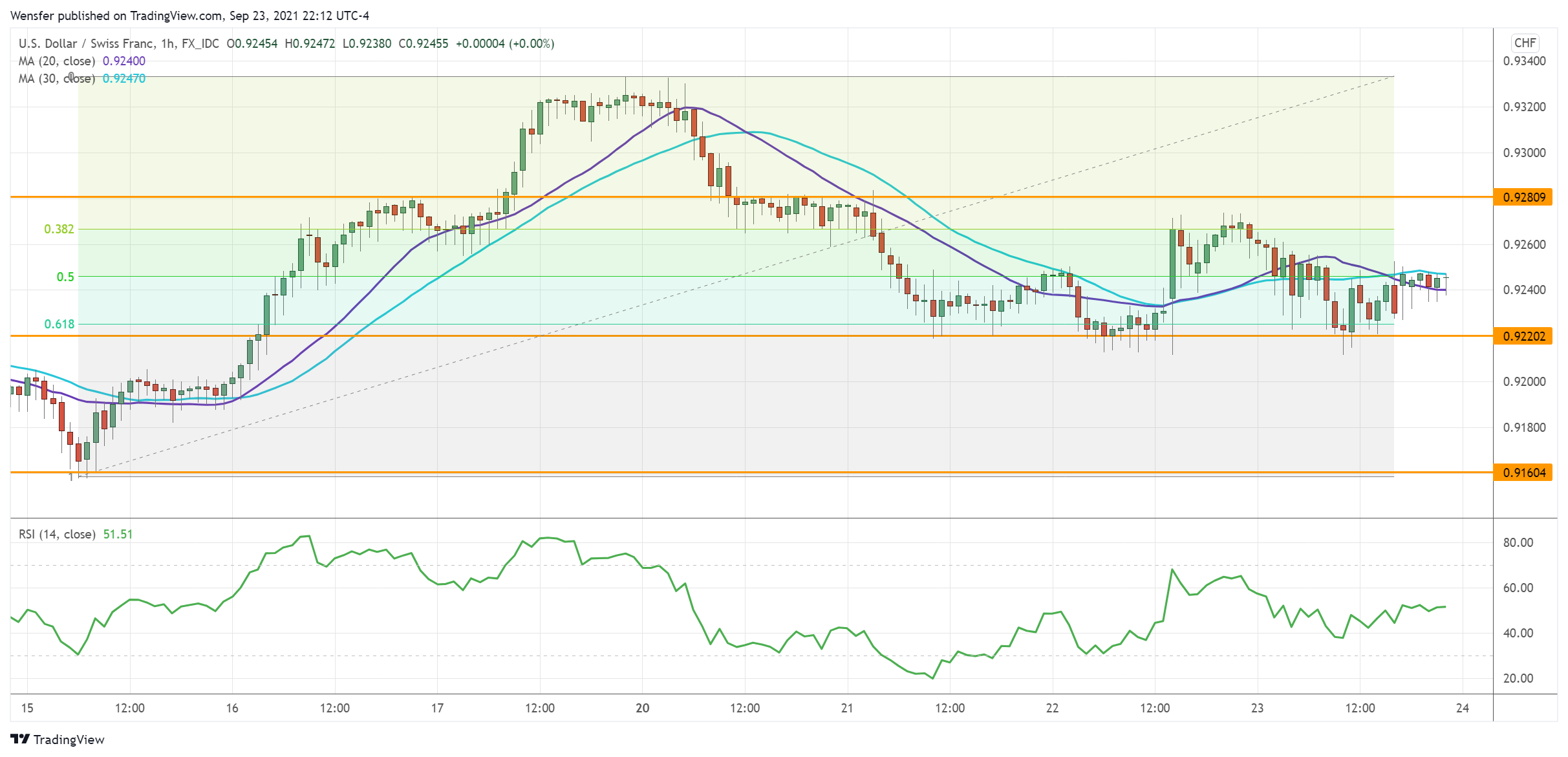
The US dollar saw an acceleration in its momentum after it cleared the daily resistance at 0.9260. The RSI’s double top has triggered a pullback to let the bulls catch their breath.
The pair has found bids at the 61.8% (0.9220) Fibonacci retracement level. A break above 0.9280 would resume the rally towards April’s peak at 0.9460.
A bearish breakout could send the greenback to 0.9160, a key floor to keep the uptrend afloat.
GBP/USD Bounces Off Triple Bottom
The pound surged after the Bank of England raised its inflation forecast.
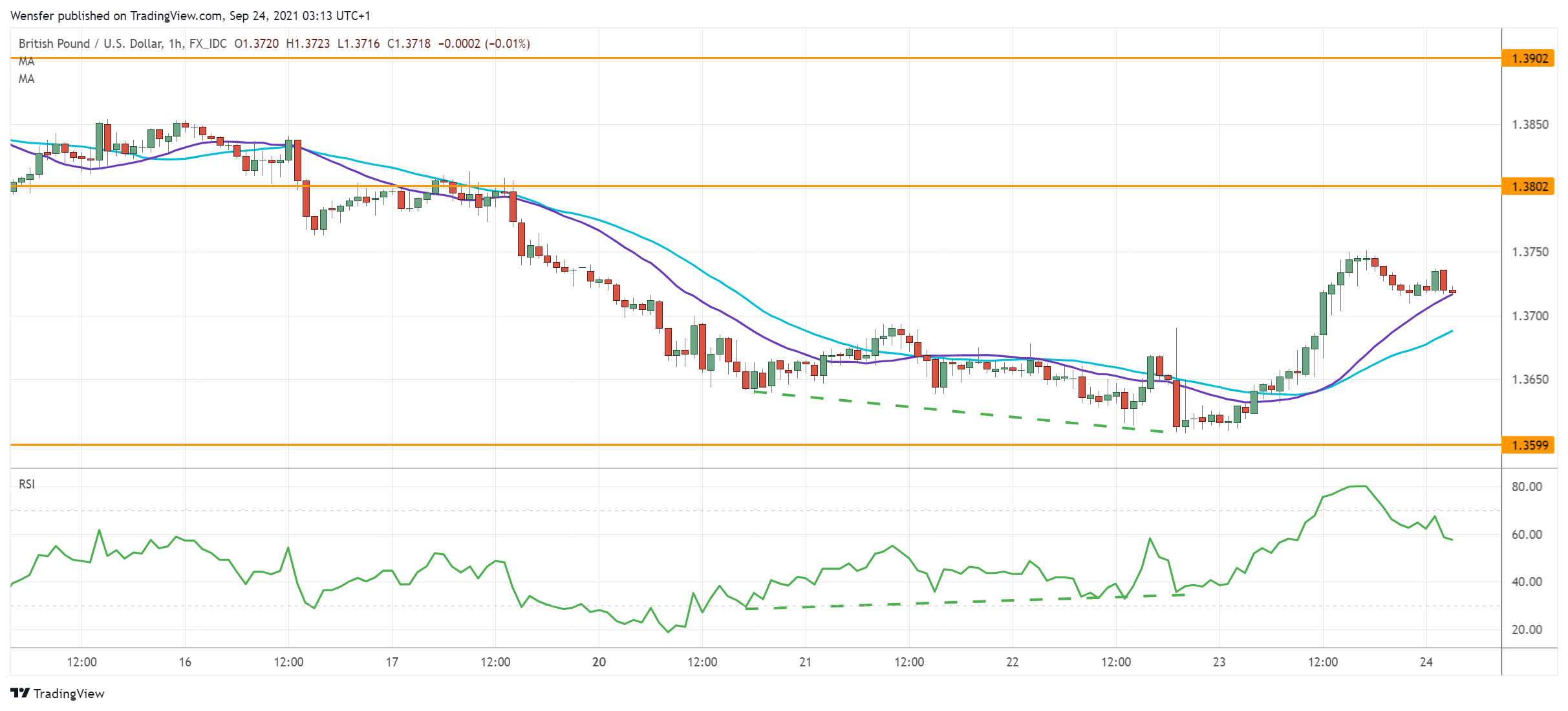
The pair has met strong buying interest at the triple bottom (1.3600) on the daily chart. A bullish RSI divergence was an indication that the sellers have taken their feet off the pedal.
A subsequent rally above 1.3690 would prompt more bears to cover. An overbought RSI may temporarily limit the initial impulse.
Patient buyers would be waiting for a pullback before jumping in. A rebound above 1.3800 would challenge the September high at 1.3900.
US Yields Are Still Marginally Higher And So Is The Dollar
Markets
It took markets an overnight sleep to realize that the Fed on Wednesday set out the framework for a new era in monetary policy. European yield markets showed some hesitation as EMU PMI’s printed softer than expected. Growth activity is over its peak momentum (composite index eased from 59.0 to 56.1). Supply bottlenecks are further complicating the post-corona rebound, but this also applies to sharp price rises. Bond market bears took control as US traders joined the fray. The Bank of England policy statement only reinforced the idea that policy normalization might come sooner rather than later. UK economic growth recently lost some momentum and the labour market remains a source of uncertainty. Still, accelerating prices made Bailey an Co conclude that some developments since the August meeting strengthened the case for some modest tightening over the policy horizon. Combined with a further risk rebound on global equity markets, this provided the trigger for an impressive broad based bear steepening move. US yields jumped between 2.5 bps (2-y) and 13 bps (10 and 30 y) mainly driven by a rise in real yields. The 1.37% resistance for the 10-y yield, which looked far out of reach post-Fed, was simply blown away (currently 1.44%).The German curve showed a similar, albeit more modest steepening trend with yields rising between 2 bps (2-y) and 6.6 bps (10-y). For now, intra-EMU government yields were little affected. US equities still closed with solid gains (about 1.0%/1.5%), but the rally lost momentum as the bond sell-off accelerated. The dollar throughout the session lost its post-Fed gain (DXY close 93.08). EUR/USD rebounded even as interest rate differentials widened in favour of the dollar (EUR/USD close 1.1739). The yen was the main victim on higher real yields and a global risk-on. USD/JPY extended its rebound north of 110 (110.33 close ). EUR/JPY jumped sharply after recent tests of the 128 support area (close 129.5). Sterling outperformed as markets see an ever growing chance of a BoE rate hike in Q1 next year. After a test of the 0.8610/15 resistance, EUR/GBP returned back in the established 0.8450/0.8615 range (close 0.8556).
Asian equities showed a mixed picture this morning as next steps in the Evergrande saga remain uncertain. Japanese equities outperform (weaker yen). Japanese August inflation data (0.0% Y/Y core ex-fresh food) were close to expectations. US yields are still marginally higher and so is the dollar. The eco calendar is thin today. German IFO business climate remains interesting but will probably confirm the trends visible in the PMI’s. Key question is whether the repositioning in the bond markets continues. We think it can. Next technical reference in the US 10-y yield near 1.45%1.47% (50% retr/previous lows) is already within reach. For the German 10-y yield -0.15% is a next reference. European bond and FX markets for sure will keep a close eye on the German elections. An outcome that would open the door for more fiscal support might propel European yields and the euro. EUR/USD at least took some further distance from the 1.1664 support area.
News headlines
House Speaker Nancy Pelosi said that Democrats are ready to pass a stopgap spending bill without a debt ceiling increase to avert a government shutdown at the start of next month. The current proposal which passed Democraticled House on Tuesday includes suspending the debt limit until December 16 2022. Republicans vowed to block it in the split Senate though where 60 out of 100 votes are needed. By passing a so-called continuing resolution, they allow time to find a deal on the debt limit which is expected to be hit by the end of October. The US risks default without agreement.
The IMF said in its concluding statement of the 2021 Article IV discussions that Australia should employ macroprudential measures to address incipient risks stemming from surging house prices which raise concerns about affordability and financial stability. Potential action includes increasing interest serviceability buffers and instituting portfolio restrictions on debt-to-income and loan-to-value ratios.