Sample Category Title
Forward Guidance: Spending on Services to Support Growth Despite Supply Chain Challenges
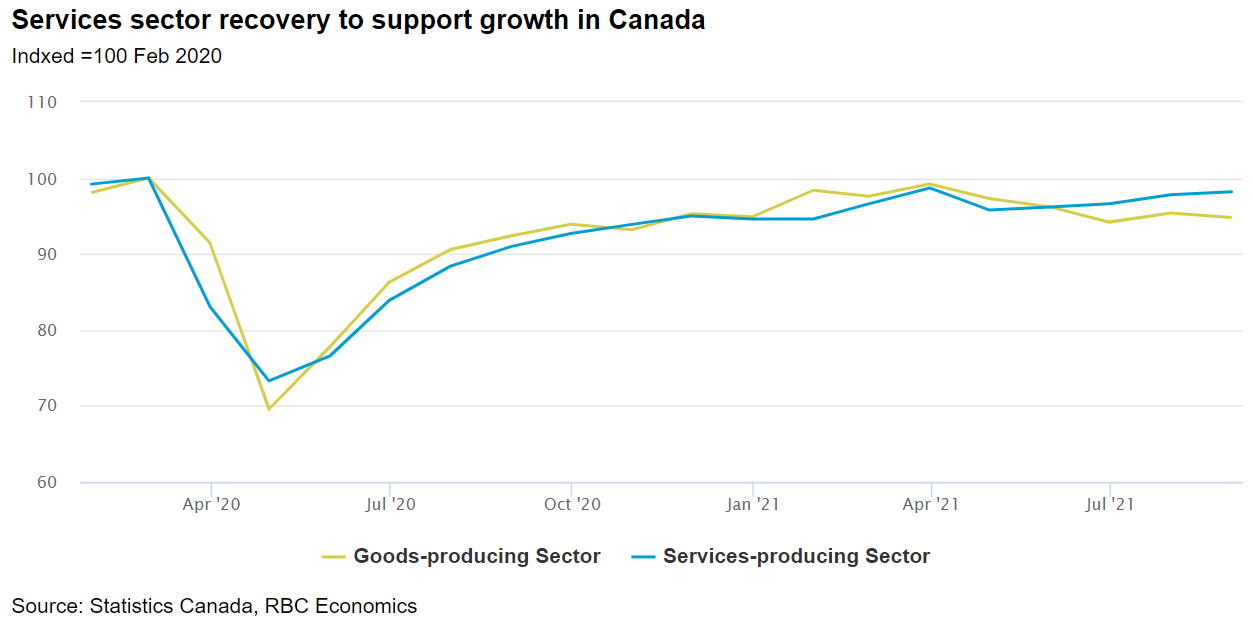
All eyes will be on Canada’s GDP report next week—and more specifically, its ‘official’ July estimate. A preliminary report in August called for a surprising 0.4% decline in GDP in July, despite an easing of COVID restrictions in provincial economies. We expect an upward revision of the July figure, with output holding steady at June’s level. Indeed, we saw a solid 1.3% rise in hours worked and indications of sharply higher spending on services over the summer—though these were offset by supply chain disruptions that weighed on manufacturing sales and construction activity.
The early estimate of August GDP should look better. While supply chain disruptions won’t go away any time soon, household spending likely continued to rise. The preliminary estimate of August retail sales was up 2.1% from July, and our own tracking of card transactions is pointing to a further recovery in spending on high-contact services like restaurants and hotels. The more pressing question is how much of that strength in services can be maintained during the fourth wave of virus infections. Broad lockdowns still look less likely given a high share of the population is vaccinated—and infection rates have shown some tentative signs of plateauing in parts of Canada. Fear of public spaces could still keep households closer to home, even as vaccine passport systems kick in, but the economic impact of the latest COVID wave is expected to be less severe.
Week ahead data watch:
- Next week’s Canadian SEPH employment data for July will likely show yet another strong gain as hard hit sectors reopened over the summer.
- US personal spending likely rose in August. Retail sales increased 0.7% from July and spending on services likely continued to improve.
Week Ahead – German Elections, China Woes, and Tons of Data
An action-packed week lies ahead. Elections in Germany will be crucial for Eurozone’s spending agenda, while Japan’s ruling party will also select its new leader. Meanwhile in China, the Evergrande fallout is unlikely to spiral out of control, but the upcoming PMIs will tell us whether it has already started to infect economic growth. There’s also a heavy dose of data releases from the major economies and a rare meeting of the G4 central bank governors.
Fed says ‘all systems go’
The Fed meeting this week did not disappoint. Chairman Powell essentially signaled that the tapering process will begin in November absent a catastrophe, while the new interest rate projections showed the FOMC is now split evenly on whether interest rates will be raised next year. He also downplayed the impact of Evergrande and spillover risks to America.
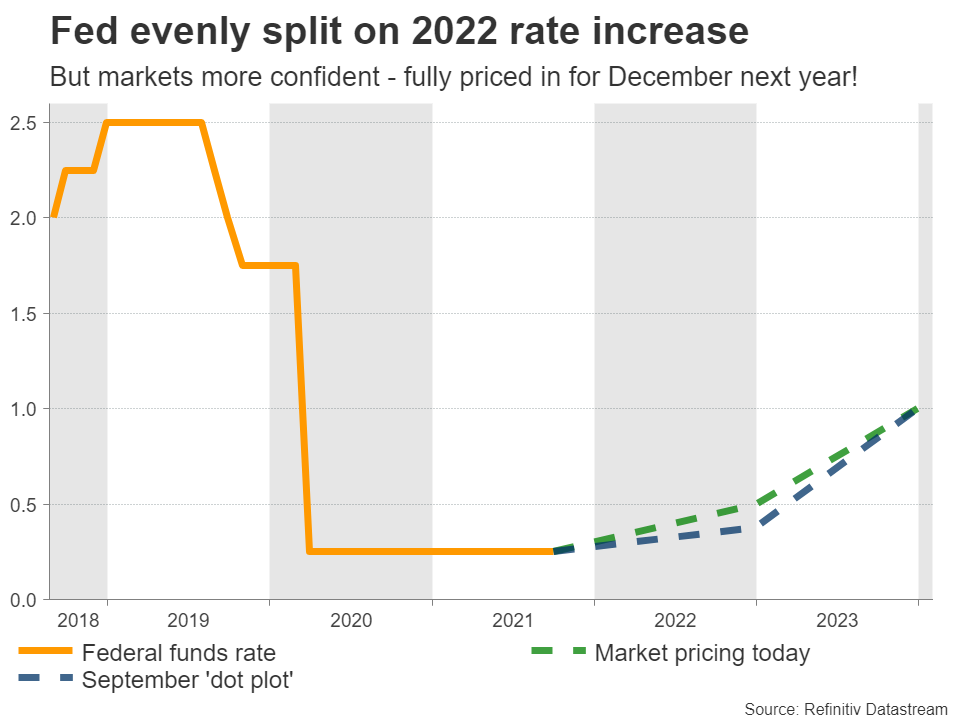
Despite this hawkish message, the dollar has struggled to maintain its gains. That probably comes down to some market relief that Evergrande won’t collapse in a disorderly fashion, which has taken the shine off the reserve currency for now. Someone is listening to the Fed though, as futures markets have fully priced in the first rate increase for December 2022, pushing Treasury yields higher.
The main question now is how quickly the tapering process will be completed and whether an even earlier rate hike - say September 2022 - is possible. Indeed, it might be. Inflation could remain elevated for a while as supply disruptions aren’t getting better, consumption is far higher than pre-crisis levels, the labor market will likely return to full employment next year, and Congress might put a floor under growth by approving a massive spending bill.
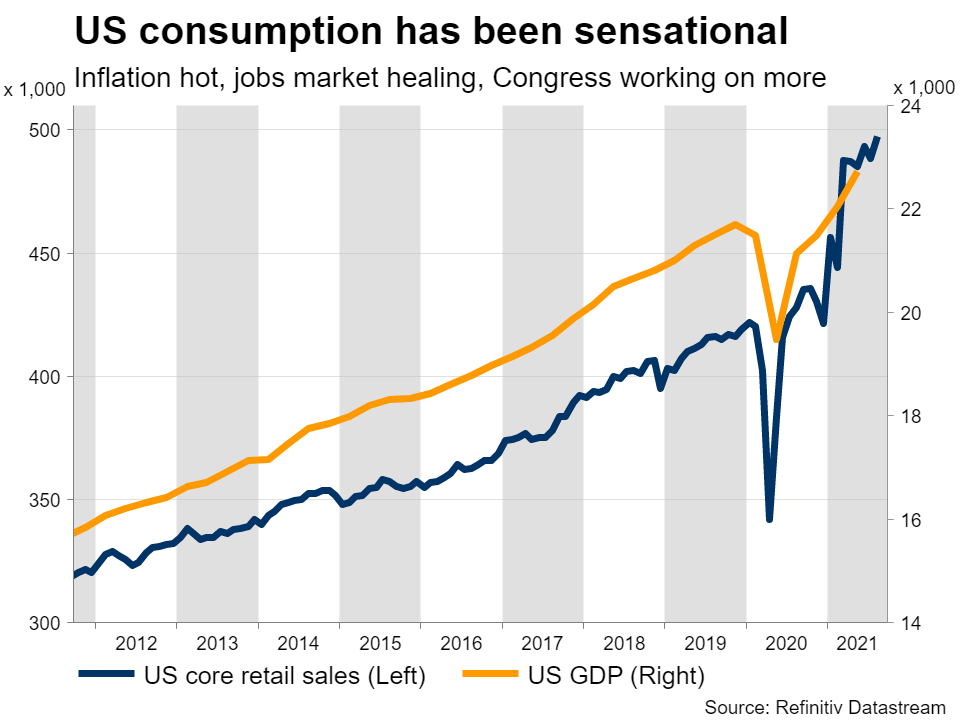
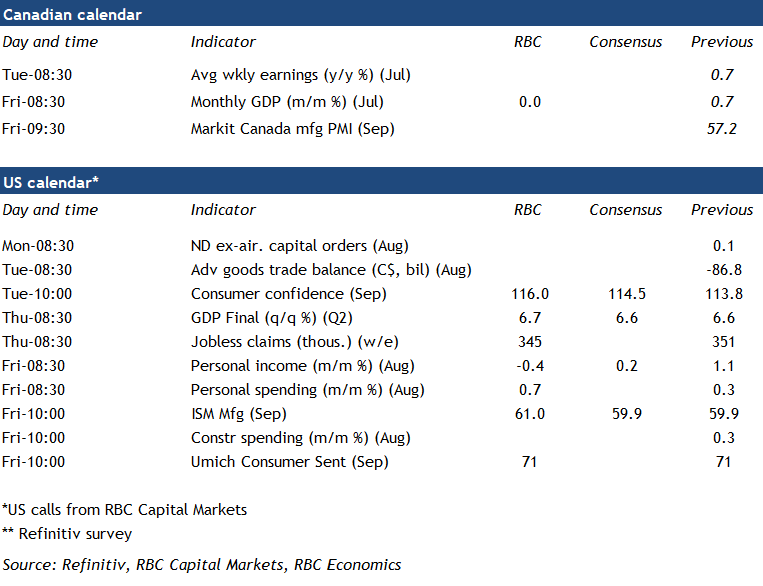
In short, the overall picture for the dollar remains quite encouraging as the Fed out-normalizes the ECB and BoJ. As for next week, there’s a barrage of US data, starting with durable goods orders on Monday. Then on Friday, personal income and consumption numbers, along with the Fed’s favorite inflation metric are due out. But the most important release will be the ISM manufacturing PMI for September, which will give us a taste of what to expect from the next jobs report.
Germany votes
The wind of political change is blowing in Germany. Voters will go to the ballots on Sunday, in an election that could bring an end to decades of strict budget rules. No single party is likely to achieve a majority, therefore strategic alliances will need to be forged.
Opinion polls currently favor the Social Democrats, led by finance minister Olaf Scholz. He oversaw the economic battle against the pandemic, so he’s considered an experienced crisis manager. In second place is Merkel’s conservative CDU party, whose new leader - Armin Laschet - hasn’t really resonated with the public. The Greens are in third place and will likely be the kingmakers of this election.
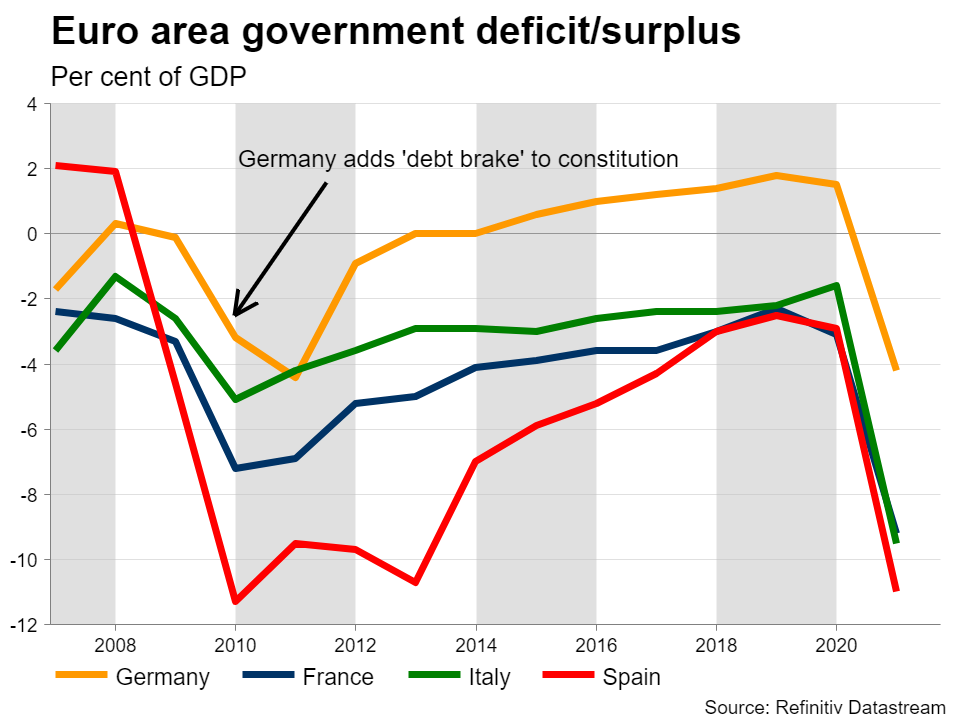
The most likely outcomes are either a center-left coalition spearheaded by the Social Democrats or a center-right coalition led by the CDU. The left alliance is the highest probability scenario according to polls and betting odds. That would allow for greater investment both domestically and on a European level, so the euro could storm higher as investors recalibrate their expectations for economic growth.
On the flip side, a CDU-led coalition would signal a continuation of conservative policies, with less spending and an eventual return to balanced budgets. There would also be pressure on other EU countries to follow suit, slowing the recovery. That’s a euro-negative cocktail.
The catch is that the winning coalition probably won’t be known for several days or even weeks while the parties negotiate. Therefore, if the outcome is close and the ultimate winner isn’t clear, the euro’s initial reaction might be a gap lower on Monday amid the uncertainty.
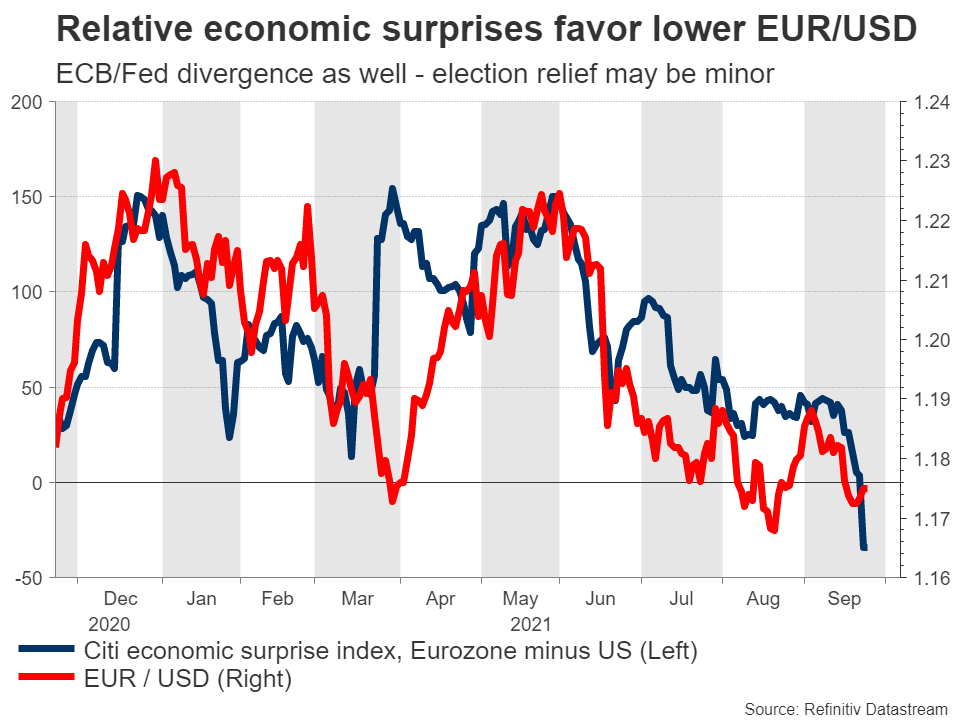
Beyond the election, there is an ECB forum on central banking on Wednesday. We will hear from the chiefs of the ECB, BoJ, Fed, and BoE, so it should be quite interesting for FX markets. The latest inflation data from the Eurozone will also be released Friday and might reflect the soaring energy prices across the continent.
Japan gets a new leader too
In the land of the rising sun, the ruling LDP party will host its leadership election on Wednesday. The winner is almost guaranteed to become the next prime minister because of the party’s majority in parliament but may not keep that position for long as there will also be a national election in the next two months.
The three frontrunners in the LDP election are Taro Kono, Fumio Kishida, and Sanae Takaichi. Kono is leading the race and supports a spending package that focuses on boosting wages and growth. He has also urged the Bank of Japan in the past to outline an exit strategy from cheap money, so he might replace Governor Kuroda with someone less ‘aggressive’ when his term expires in 2023.
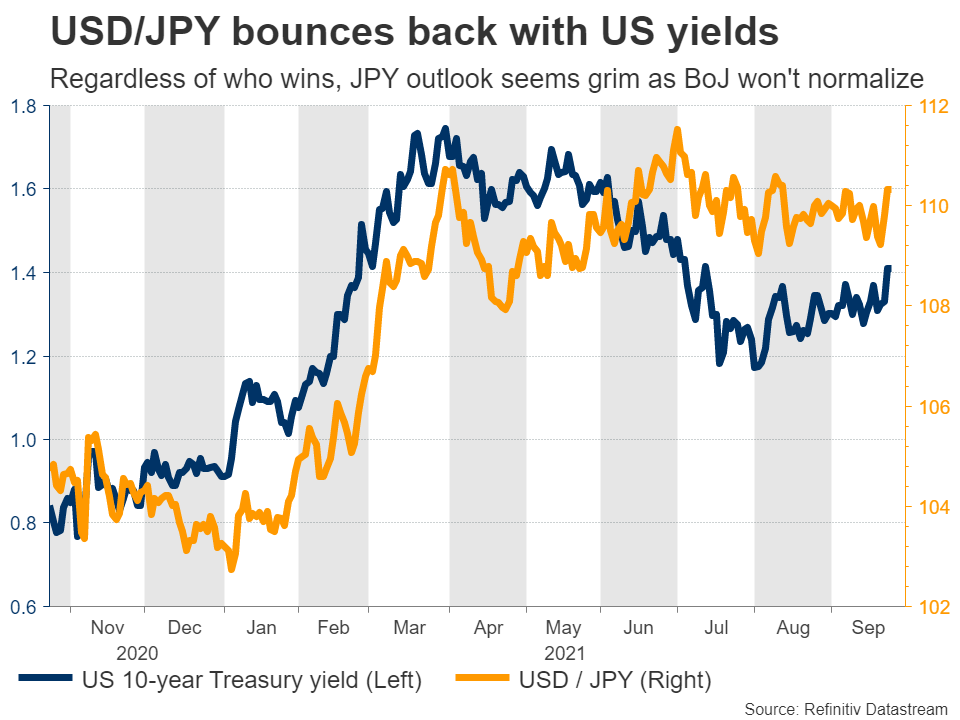
Kishida is more conservative. He favors higher spending but has advocated for balancing the books in the past and has warned that BoJ stimulus cannot last forever. Finally, Takaichi is the exact opposite. She favors massive government spending and ultra-loose monetary policy.
For the yen, the best-case scenario might be Kono, given his incentives for businesses to raise wages and the prospect of a more conservative BoJ Governor. On the flipside, Takaichi would imply a continuation of ‘Abenomics’, which is bad news for the currency. Politics aside, the BoJ will also release its quarterly Tankan business survey on Friday.
China’s controlled demolition
Of course, how the Evergrande situation evolves could be infinitely more important for market sentiment. At this stage, it looks like any contagion effects will be mostly contained to the local property sector and not spill over into the financial system. There are reports that the Chinese government is working on a restructuring deal that would effectively prevent contagion and protect domestic investors.
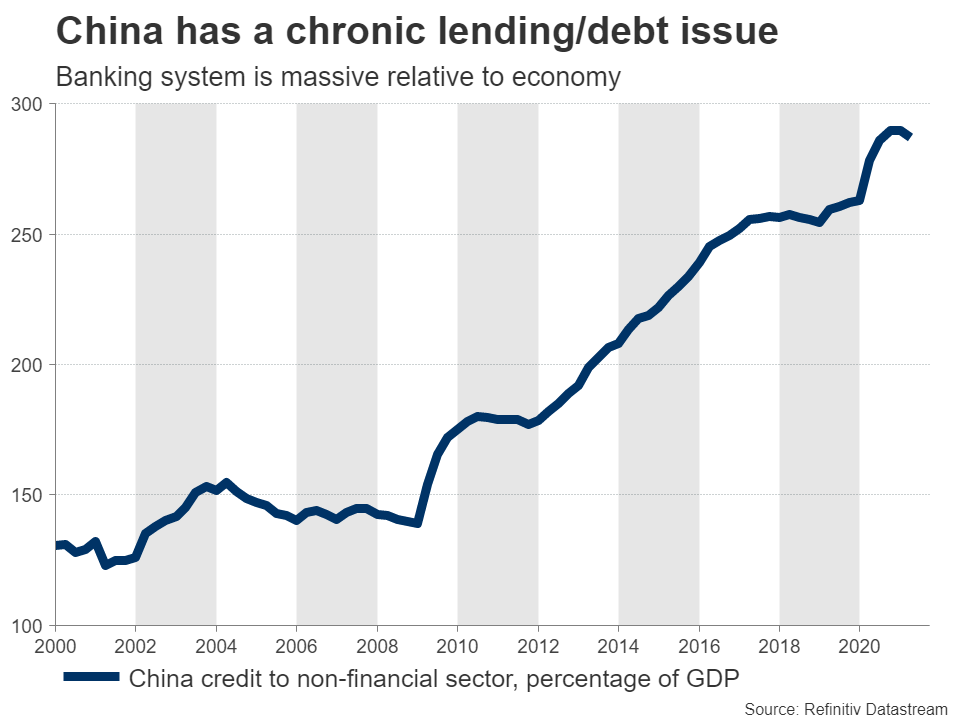
The real issue is whether this will lead to a massive hangover in the real estate sector, which accounts for nearly 30% of GDP. China’s economic data pulse was already slowing down, so this calamity could suppress growth further. And the authorities can’t simply ‘juice up’ the economy with a flood of cheap money like in the past, as the banking sector is quite over-levered.
That’s why the nation’s PMI business surveys for September will be closely watched on Thursday. If the economy continued to lose momentum even before the Evergrande debacle, that could inflict some damage on China-sensitive currencies like the Australian dollar.
NZDUSD Positive Impetus Fades as 100-MA Deters Gains
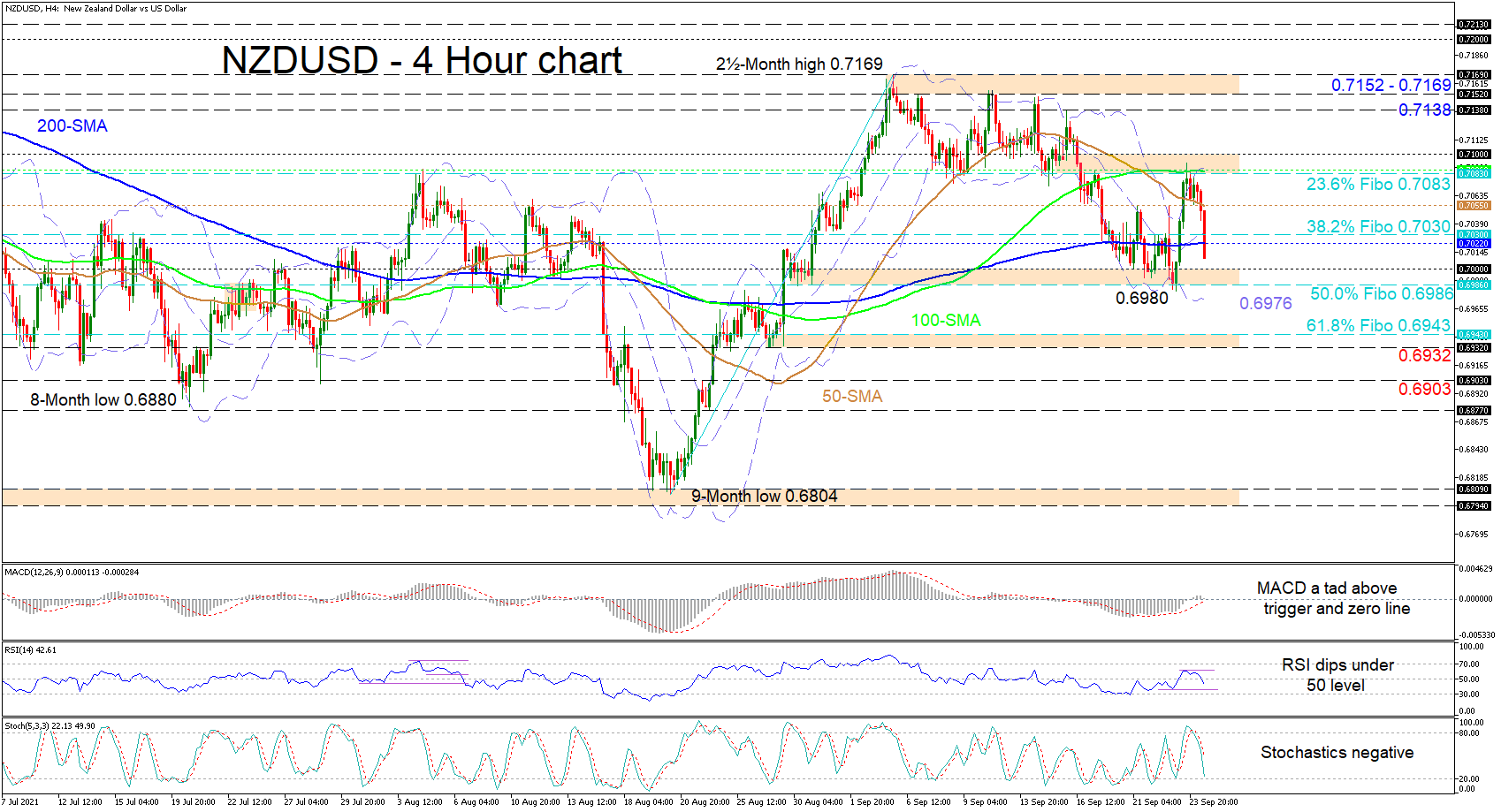
NZDUSD has dipped back down to the 200-period simple moving average (SMA) after the pair’s recent bounce around the 0.6986 level was capped by the 100-period SMA. The horizontal 100- and 200-period SMAs are promoting an overall trendless bias, while the diving 50-period SMA, is suggesting a downward tendency in the pair.
At the moment the short-term oscillators are skewed more to the downside and are reflecting the pickup in bearish momentum. The MACD is holding marginally above its red trigger and zero lines, while the RSI is falling in negative territory. Furthermore, endorsing additional downward forces is the negative charge in the stochastic oscillator.
If the price manages to close below the support zone between the 0.7030 level, that being the 38.2% Fibonacci retracement of the up leg from 0.6804 until 0.7169, and the 200-period SMA at 0.7022, the bears may extend the drop to test the support section from the 0.7000 hurdle until the 50.0% Fibo of 0.6986. Additional deterioration in the pair beneath this defence, and simultaneously past the 0.6980 trough and lower Bollinger band could reinforce the decline to challenge the 0.6932-0.6943 obstacle. Should selling interest overpower, the bears may then target the 0.6903 barrier.
Alternatively, if buyers re-emerge and drive the price back above the 200-period SMA and the mid-Bollinger band around 0.7030, successive upside restraints could emanate from the 50-period SMA at 0.7055. From here buyers would need to muster the power to pilot the price over the tough resistance section from the 23.6% Fibo of 0.7083 until the 0.7100 mark. Successfully reviving upside momentum, the pair may then float the price towards the 0.7138 high before challenging the resistance boundary of 0.7152-0.7169, the latter being a two-and-a-half-month peak.
In conclusion, negative forces have yet to fully negate the soundness of the short-term positive structure. That said, to cement the bearish outlook in NZDUSD, the price would need to close below the 200-period SMA and the 0.6980 trough.
German Election Next after Eventful Eeek
This week promised to be lively and it didn’t disappoint but the final day is looking much more peaceful, with stocks slightly paring gains of recent days.
The week has been littered with central bank meetings and there has been so much to take away from them. The Fed is determined to taper this year despite rising risks and slowing growth, while the BoE is expected to raise rates sooner and twice next year as it prepares for higher inflation. Both view inflation as transitory, still, but not everyone is as confident as they were.
The CBRT is only committed to keeping interest rates above inflation as long as inflation remains below the repo rate. If they’re going to break a promise, they’ll do it properly and cut rates and cross their fingers. President Erdogan will be happy, Governor Kavcıoğlu will keep his job and the central bank will hope inflation does prove transitory and fall as anticipated. The lira is less forgiving and Kavcıoğlu’s credibility is shattered. This doesn’t have a tendency to end well and new lows in the currency may just be the start.
Evergrande caused quite the stir at the start of the week as it was days from missing coupon payments on yuan and dollar-denominated bonds. A deal was reached on the first while the second has passed without even a comment from the company. But seemingly that’s fine as long as the PBOC continues with its massive liquidity injections.
Buy the dip is alive and well it seems because the end result is that Evergrande remains at risk, central banks will soon be tightening and are increasingly concerned that inflation may not be quite as transitory as previously thought. Which begs the question, what exactly was the undesirable outcome for investors this week? It certainly makes the next few weeks interesting.
Next up is the German election this weekend which will mark the end of an era. Angela Merkel has been an ever-present through the various crises of the last 13 years and at the centre of many all-nighters during the darkest days of the debt crisis. And it seems that not only is Germany preparing to bid farewell to “Mutti”; the CDU may also be facing defeat for the first time in 16 years, with the SPD holding a narrow lead in the polls.
While the SPD look on course to win the election, negotiations to form the next government will be far from straightforward and may take months to conclude. So this weekend will be watched with interest but the market reaction may be minimal. Oil prices are a little lower on Friday following a couple of days of impressive gains. Evergrande remains a risk for China despite market concerns having seemingly abated considerably in recent days. Oil prices have been among the beneficiaries of that, not to mention production in the Gulf coming back online and sky-high gas prices.
PBOC takes another swing at cryptocurrencies
Cryptocurrencies were dealt a heavy blow on Friday as the PBOC announced that all transactions are illegal. Bitcoin was already pulling back after hitting USD 45,000 but the drop was accelerated after the announcement taking losses for the day to around 7%.
China’s opposition to cryptocurrencies is nothing new but the latest clarification would suggest those involved are at risk of prosecution. China’s actions haven’t held back cryptos’ rise too much in the past so I wouldn’t be surprised to see it bounce back once more. Where’s every crypto enthusiast’s friend, Elon Musk, when they need him?
Of course, this time it’s happening as bitcoin appears to have entered into a correction phase which may have contributed to its declines. A move below USD 40,000 could see it come under further pressure after such a long period of consolidation above here.
The fundamentals continue to look positive for crude prices; the developments in China being the primary downside risk in the coming weeks. Brent crude now has its sights set on USD 80, where it could once again see some resistance, with the next test for WTI being USD 75.The Fed delivered a hammer blow to gold’s hopes of recapturing USD 1,800 this week and the yellow metal now has its sights set lower, with USD 1,740 providing some support for now. A break of this could see gold eyeing up the August lows, with support perhaps coming first around USD 1,720 and USD 1,700.
With the Fed and others laying the groundwork for a new tightening cycle next year, gold faces a tough task making much ground to the upside from here. That said, there are numerous downside risks to their respective outlooks so I don’t expect the yellow metal to spiral lower. The road ahead is filled with potholes that could see gold shine once more.
Weekly Focus – Evergrande Situation Remains Unclear
The past week did not provide much clarity around the situation of Evergrande. While market sentiment rebounded strongly, the fate of China's second-largest property developer remains unclear. The Chinese central government could let Evergrande fall, but we think it will likely attempt to ring fence the effects on the country's financial sector to avoid a broader crisis. Furthermore, only USD19bn of Evergrande total debt of USD300bn is denominated in USD, so the direct effect on the rest of the world from the possible bankruptcy should remain limited. Read more in Research China - The Evergrande situation and what we expect, 21 September. Next week, more debt payments are due on Wednesday, and markets will also focus on PMIs on Thursday for gauging developments in the broader economy, we expect to see further decline.
Fed took a relatively hawkish stance in its September meeting. While no exact decision was made, Powell gave strong verbal indication that Fed will most likely begin tapering in November, and conclude the process by mid-2022. Fed's median estimate saw core inflation running above 2% through the forecast horizon stretching until 2024, but Powell argued that the current inflationary pressures still mostly reflected transitory factors. Read more in Fed Research - Review: Fed is about to start a tightening cycle, 22 September.
Among other central banks, Norges bank delivered the long-awaited first hike and a hawkish shift to the rate path, while Riksbank maintained its rate path flat, read more in the Scandi section below. Market interpreted Bank of England's September interim meeting hawkishly, as 2 members voted for lower asset purchases. Market is now pricing in the first 15bp hike already for March 2022.
Next week, markets will closely follow a series of Fed speeches throughout the week, as Powell noted that there was broad-based support for the current tapering plans. On the US data front, private consumption data released on Friday will signal whether US goods consumption has remained elevated. Consensus expects a slight drop in the September ISM Manufacturing index released on Friday after Markit's counterparts declined modestly this week. Finally, Fed's preferred measure of inflation, the PCE, will also be released on Friday.
In Europe, ECB's annual forum will take place on Tuesday and Wednesday, and the focus will be on the strategy review published last July (for a recap, see Flash: ECB Research - Strategic Review: Striving for symmetry, 8 July). While near term monetary policy outlook is not on the agenda, we may receive a number of sources stories and official interviews at the same time. We will also get the
September flash HICP on Friday where we likely are going to see a further rise in inflation on the back of rising energy and core inflation, not least with the natural gas and electricity price surge. We look for 3.3% for headline and 1.8% for core. We recently revised our Euro Area inflation outlook higher, take a closer look at Research Euro Area - Rising pipeline pressures for euro inflation, 17 September.
In Japan, the ruling liberal democratic party will elect a new party president on Wednesday, who will also become the new Prime Minister. For markets, this will primarily be important for the prospects for the green transition.
Sunset Market Commentary
Markets:
European bonds opened with additional losses in a catch-up move with US Treasuries’ continuing decline on Thursday evening. Throughout the day, both German Bunds and US Treasuries treaded water near sell-off lows. Rewind to this week’s earlier events: the Fed on Wednesday evening paved the way for a slightly more aggressive policy normalization campaign than anticipated. It took bond investors a night’s sleep before the message hit. But when it hit, it hit hard. From a technical point of view, the US 10-yr yield pierced 1.37% resistance which is 38% retracement of the April/July decline and was tested already 4 times before. The US 10-yr yield today tried to take out 50% retracement on that same move at 1.45% but so far without success. Daily US yield changes currently vary between -1.3 bps (5-yr) and +0.1 bp (2-yr). The German 10-yr yield today trades north of 62% retracement of the May/August slide (-0.24%). A sustained break higher would be highly relevant and suggests a medium term return to the YTD high at -0.07%. German yields add up to 2.3 bps (30-yr) in a daily perspective. We connect the Bund repositioning to last week’s FT rumours on ECB policy. They suggested a 1.8% inflation forecast for 2024 in internal documents, implying that the ECB will follow other big central banks faster than many thought. Next week’s ECB forum on Central Bank, ordinarily held in Sintra (ring a bell?!) with topic “Beyond the pandemic: the future of monetary policy” serves as a potential platform to soft sound how 2022 ECB policy could look like. Winding down asset purchases is obviously the first step, but it’s worth noting that the Euribor 3-month strip curve bear steepened since the Fed meeting with contracts from 2024 trading some 10 bps higher already. The zero flip point now is September 2025 from March 2026.
European stock markets lose up to 1% today. Yesterday’s real rate shocker bites. The real rate dynamic in combination with a tougher risk climate supports the dollar. EUR/USD returns to the low 1.17-area. We remain cautious in joining the USD-momentum ahead of German elections. A SPD victory and possibility to ditch CDU/CSU in the next government, could pave the way for some German reflation vibes as it opens the door for some more fiscal spending. Other European nations tend to copy/paste the German playbook. Sterling today returns some of the post-BoE gains in the risk-off market setting. EUR/GBP changes hands at 0.8560.
News Headlines:
The composite economic sentiment indicator as published by the Czech statistical office (CSO) declined for the third consecutive month from 98.6 to 96.2. Sentiment eased both among business and consumers. On the decline in business sentiment (95.3 from 97.1), the CSO mentioned that activity is negatively affected by a lack of key components in industry (92.7 from 97.1) and construction (111.6 from 116.4) and fast-growing prices of building materials. Especially, the situation in the car industry is said to be extremely severe as companies have to restrict or even suspend production. On the other hand, sentiment in trade (103.6 from 102.4) and services (95.3 from 94.2) improved. Consumer confidence declined from 106.0 to 100.7, as citizens are worried that rising prices might negatively affect their future financial situation. The Czech krona today declines slightly (EUR/CZK 25.41), but resists the rise in core yields rather well. The CNB decides on policy rates on Thursday next week.
In a regular report on financial Stability, the South Korean central bank warned on the risk of an ever growing household debt. In the second quarter, the debt-to disposable income ratio for South Korean households rose 10.1 ppt from a year earlier to 172.4%. Vulnerable households could face substantial debt repayment burden as interest rates start to rise. The report also said "Funds concentrated into the asset market, as well as rapid home price increases, could bode ill for financial stability when market sentiment of economic entities rapidly change due to internal or external shocks"
Canadian Dollar Lower as USD Recovers
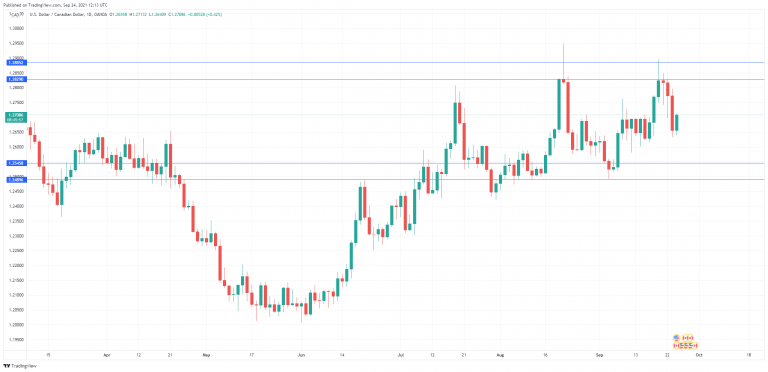
The Canadian dollar has reversed directions and lost ground in the Friday session. Currently, USD/CAD is trading at 1.2710, up 0.43% on the day.
After beating a hasty retreat against the major currencies on Thursday, the US dollar has managed to claw back some of these losses on Friday. The Canadian dollar has also followed this trend and jumped almost one percent on Thursday. The currency was lifted as risk sentiment climbed following the FOMC policy meeting. The Fed signalled that it was readying to taper its bond purchase program, but this was contingent on the performance of the economy. Fed Chair Powell referred to two key areas that the Fed is monitoring ahead of a taper – inflation is running well above the Fed target of 2%, while unemployment, which has dropped to 5.2%, still has some ways to go before reaching the Fed goal.
The market take of the FOMC meeting was that a rate hike remains on a low burner, with Fed members split on whether to hike in 2022 or 2023. This fuelled a strong rally of the majors at the expense of the US dollar, as risk appetite improved. The Canadian dollar, which is sensitive to risk sentiment, climbed sharply. Investors were willing to ignore soft Canadian retail sales data for July, as the headline reading came in at -0.6%, compared to a sizzling 4.2% gain a month earlier.
The Canadian dollar faces a major test next week, with the release of GDP for July. The June reading showed a modest gain of 0.7%, and another gain could give the Canadian currency a boost.
USD/CAD Technical
- USD/CAD has broken above resistance above 1.2659. This is followed by resistance at 1.2829
- There is support at 1.2545. Close by, we find support at 1.2489
Pound Dips After Mini-Rally
The British pound is in negative territory in the Friday session. GBP/USD is currently trading at 1.3682, down 0.27% on the day.
BoE stays pat, but pound jumps
The BoE held the course on monetary policy, leaving its key interest rate at 0.10% and its asset purchase target at GBP 875 billion. At the same time, two MPC members voted for an early end to the Bank’s bond purchases, up from one member at the previous meeting, as the case for tightening has gathered a bit more momentum. The Bank downgraded growth forecasts while warning that inflation would rise above the 4% level by the end of the year, double the Bank’s inflation target.
The BoE’s stance can be summed up as a “wait and see mode”, as policymakers try and make sense out of an economic picture that shows growth slowing and inflation heading higher. However, many investors are convinced that the central bank may hike rates as early as February of 2022 if inflation does not ease. This sentiment buoyed the British pound on Thursday, with gains of 0.76%.
For its part, the Bank continues to insist that inflation is transient, but this view is becoming a hard sell as inflation continues to head higher – CPI jumped 3.2% in August (YoY), up sharply from 2.0% in August. The September CPI reading will be closely watched, as the BoE will be under further pressure to tighten policy if inflation shows no signs of cooling off.
With Fed Chair Jerome Powell strongly hinting that the Fed is preparing to press the taper trigger by the end of the year, the markets will look ahead to the timing of a rate hike. The Fed has stressed that there is no link between tapering and a rate hike, but with the Fed finally acknowledging that it will tighten policy, discussions about the timing of a rate hike are sure to intensify. FOMC members are split on whether a rate hike will take place in 2022 or 2023, and the economy’s performance will be a key factor as the timing of a rate increase.
GBP/USD Technical Analysis
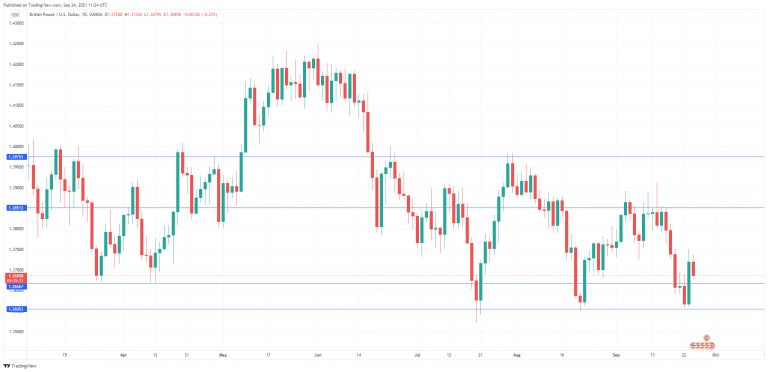
- There are resistance lines at 1.3851 and 1.3975
- 1.3666 is a weak support line. Below, there is support at 1.3605
Oil Price Outlook: A Major Bullish Trend Line Forming with Support Mear $72.50
Crude oil price started a fresh increase above the $70.00 resistance against the US Dollar. The price remained well bid and it even surpassed the $71.50 level.
There was a close above the $73.00 level and the 50 hourly simple moving average. A high is formed near $73.51 and the price is now slowly moving lower. On the downside, there is a major bullish trend line forming with support near $72.50 level on the hourly chart.
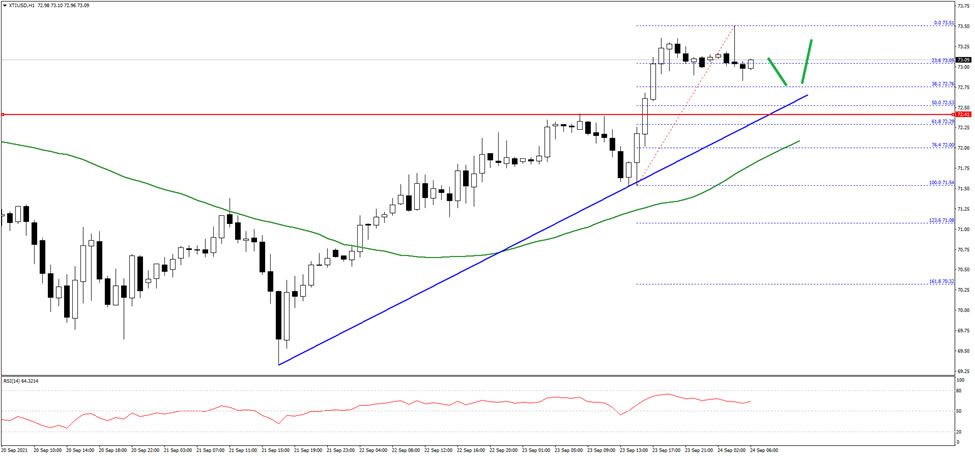
A break and close below the trend line support could lead the price towards the $72.00 support level. Any more losses might call for a test of $70.00 on FXOpen.
Conversely, there could be more upsides above the $73.50 level. The first key resistance is near the $74.00 level, above which the price might rise steadily towards the main $75.00 resistance level.
EURUSD Is Possibly Bearish
Technical analysis
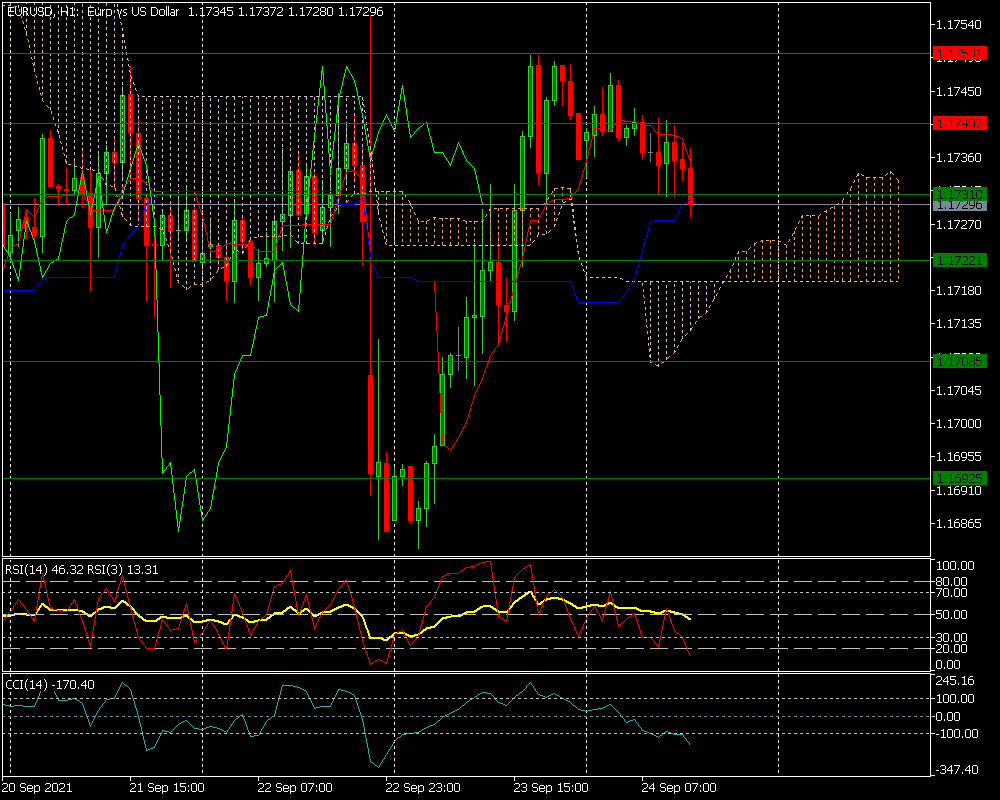
The RSI(14) and the RSI(3) point to a possible downwards correction
The Ichimoku indicator displays a prevailing flat
The CCI suggests a possible upwards movement.
Most likely scenario - SELL
Target prices: 1.17221 1.17085
Alternative scenario - BUY
Target prices: 1.17407 1.17501
Key levels
Support 1.17221 1.17085
Resistance 1.17407 1.17501