

Sample Category Title
USD/CAD Weekly Outlook
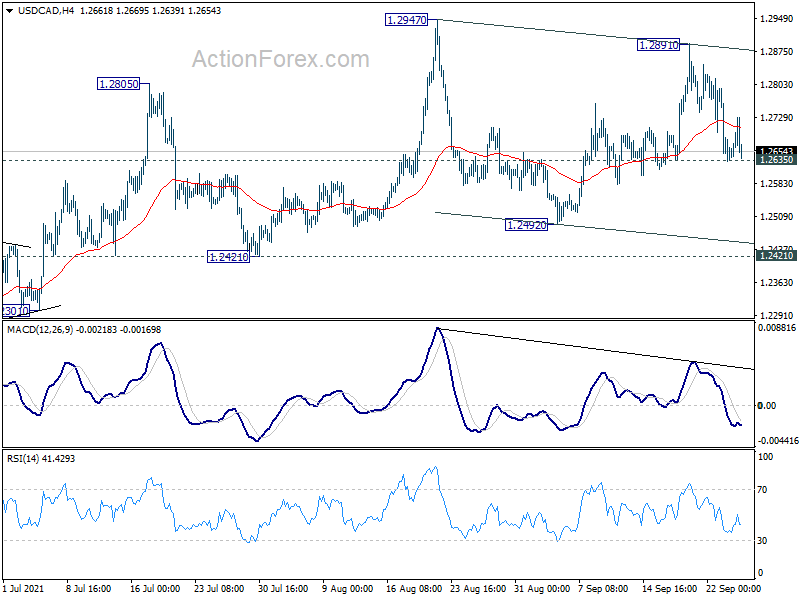
USD/CAD reversed after rising to 1.2891 last week, but downside is contained by 1.2635 minor support so far. Initial bias is neutral this week first. On the downside, break of 1.2635 will target 1.2492 support and possibly below, to extend the pattern from 1.2947. On the upside, above 1.2891 will target a test on 1.2947 high. Overall, with 1.2421 support intact, rise from 1.2005 should still be in progress for another rise through 1.2947 at a later stage.
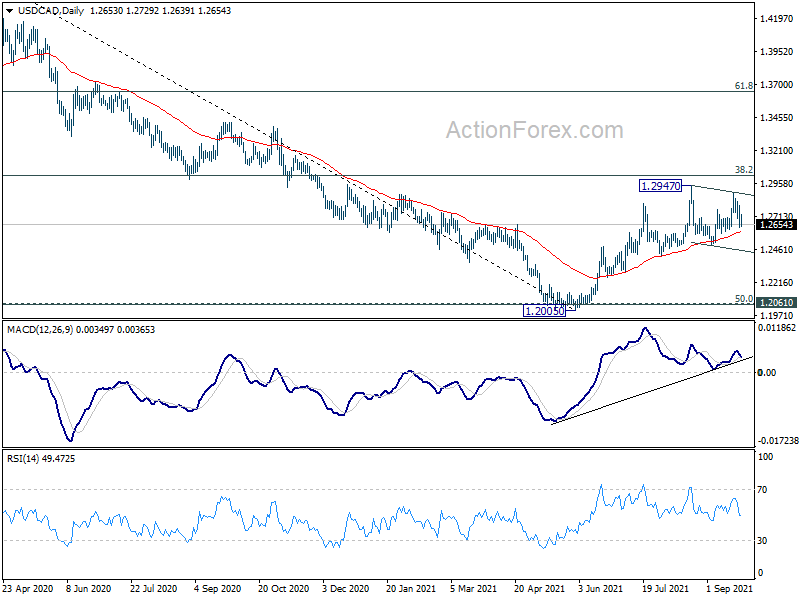
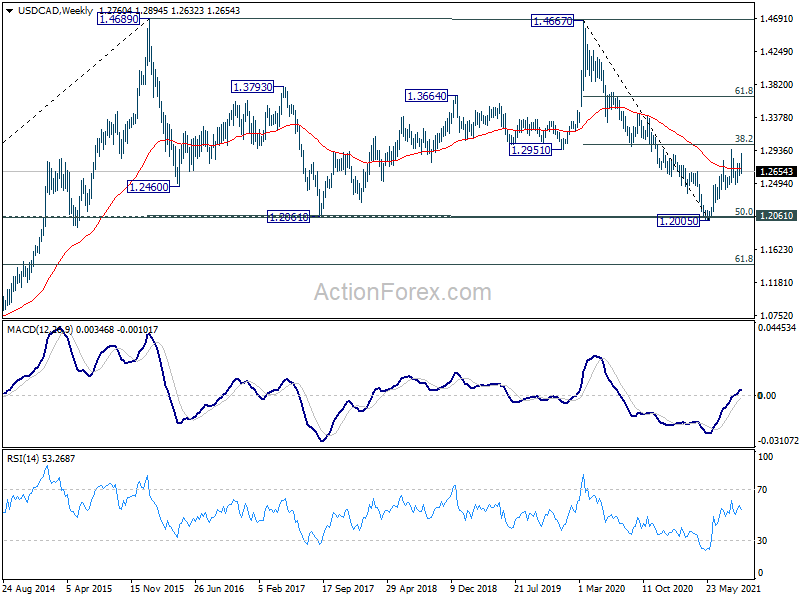
In the bigger picture, fall from 1.4667 is seen as the third leg of the corrective pattern from 1.4689 (2016 high). It should have completed after hitting 1.2061 (2017 low) and 50% retracement of 0.9406 to 1.4689 at 1.2048. Sustained break of 38.2% retracement of 1.4667 to 1.2005 at 1.3022 will pave the way to 61.8% retracement at 1.3650 and above. Overall, medium term outlook remains neutral at worst with 1.2048/61 support zone intact.
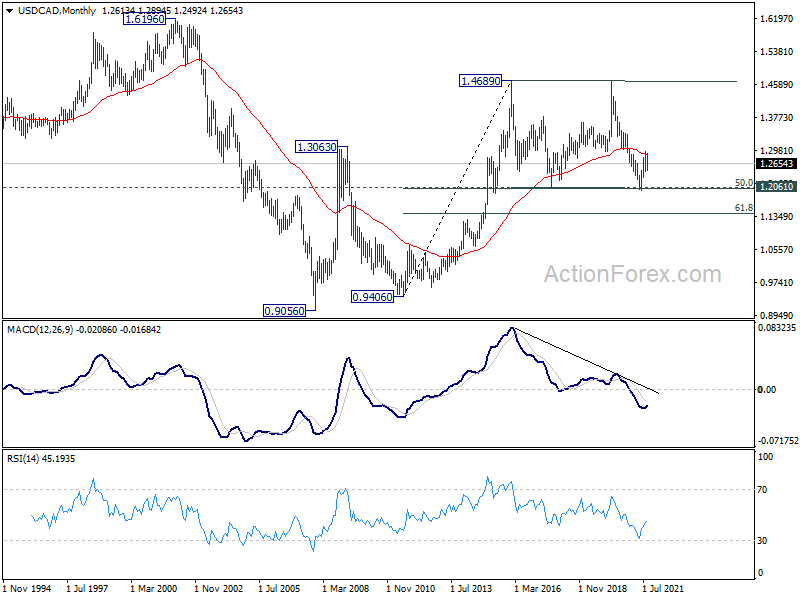
In the longer term picture, we're viewing price actions from 1.4689 as a consolidation pattern. Thus, up trend from 0.9506 (2007 low) is still expected to resume at a later stage. This will remain the favored case as long as 1.2061 support holds, which is close to 50% retracement of 0.9406 to 1.4689 at 1.2048. However, rejection by 55 month EMA, follow by firm break of 1.2061 support, will argue that USD/CAD has already started a long term down trend.
GBP/JPY Weekly Outlook
GBP/JPY defended 149.03 key support and rebounded strongly last week. The development suggests that fall from 152.28 has completed. Initial bias stays mildly on the upside for 152.82 resistance first. Sustained break there will suggest that correction from 156.05 has completed, and turn near term outlook bullish for retesting this high. On the downside, break of 150.70 minor support will turn bias back to the downside for 149.03 key support instead.
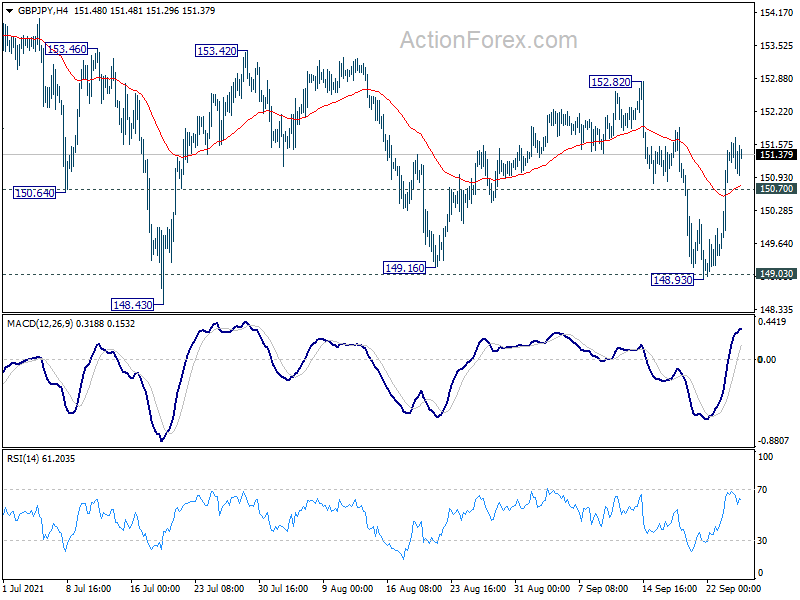
In the bigger picture, rise from 123.94 is seen as the third leg of the pattern from 122.75 (2016 low). As long as 149.03 support holds, such rise would still resume at a later stage. However, sustained break of 149.03 support will indicate rejection by 156.59. Fall from 156.05 would be at least correcting the whole rise from 123.94. Deeper fall would be seen back 38.2% retracement of 123.94 to 156.05 at 143.78 first.
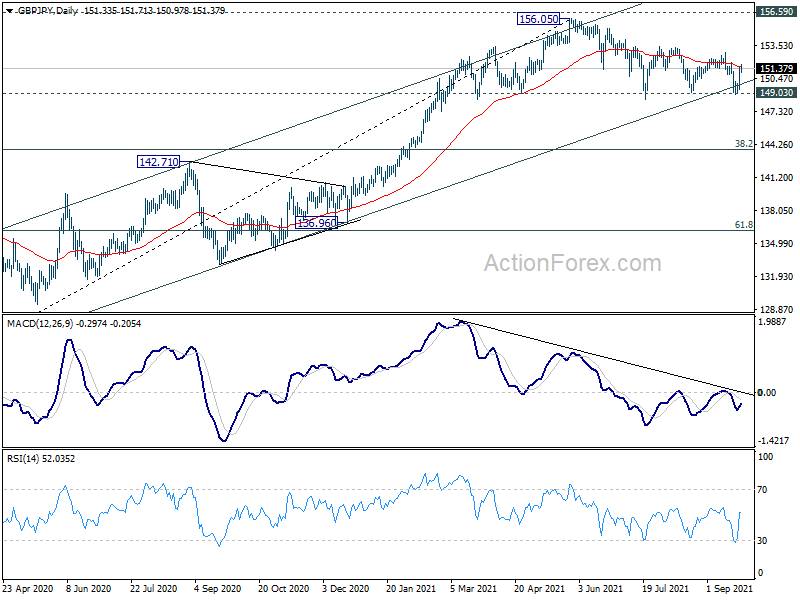
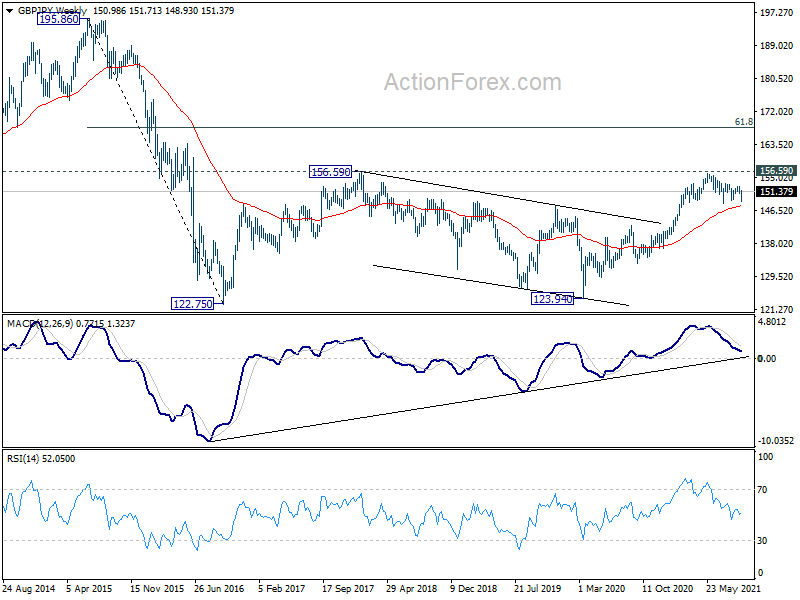
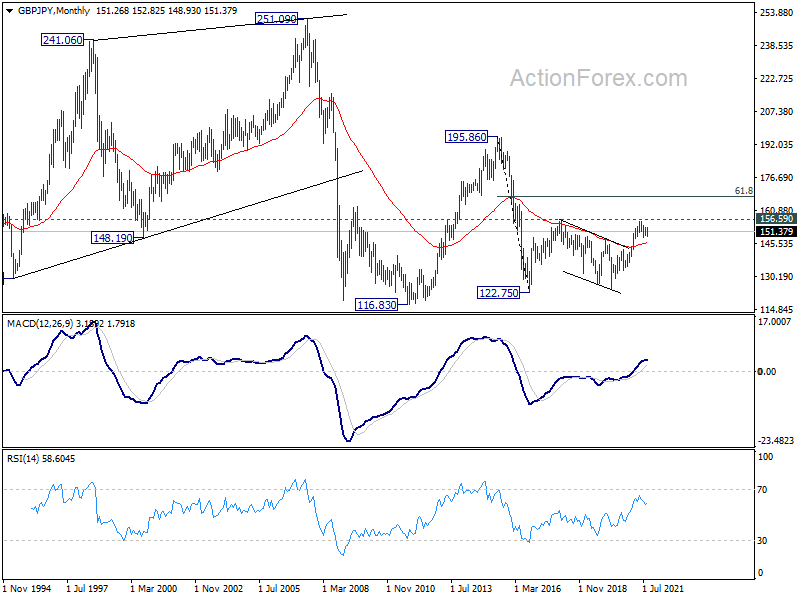
In the longer term picture, the strong break of 55 months EMA was an early sign of long term bullish reversal. Firm break of 156.69 resistance should now confirm the start of an up trend for 195.86 (2015 high). However, rejection by 156.69 will invalidate the bullish signal and keep long term outlook neutral first.
EUR/JPY Weekly Outlook
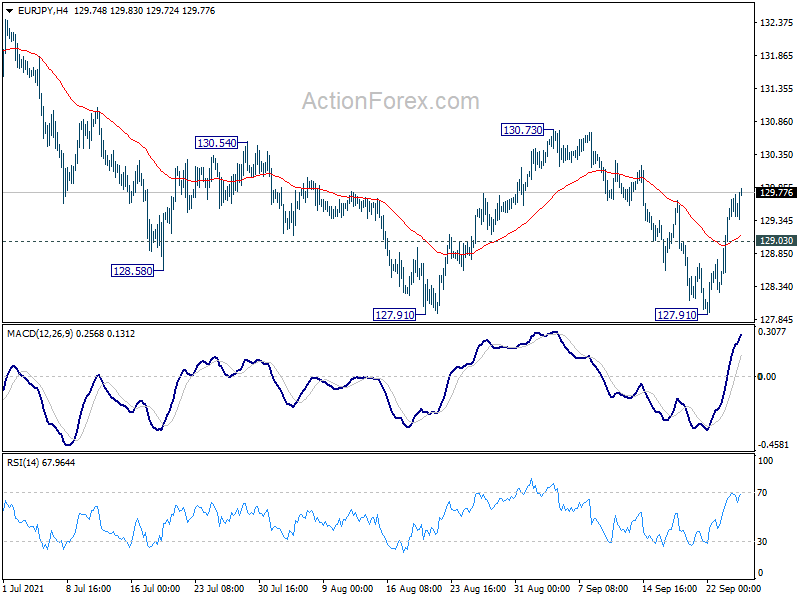
EUR/JPY defended 127.91 support and then rebounded last week. The development suggests that fall from 130.73 has completed. Initial bias stays on the upside this week for 130.73 resistance first. Firm break there will argue that correction from 134.11 has completed and turn near term outlook bullish for retesting this high. On the downside, break of 129.03 minor support will turn bias back to the downside for retesting 127.91 instead.
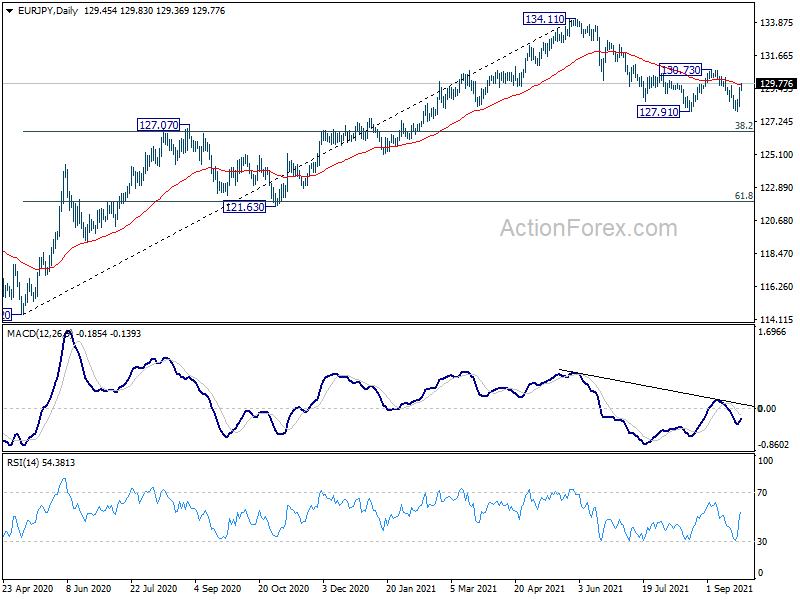
In the bigger picture, rise from 114.42 is seen as a medium term rising leg inside a long term sideway pattern. As long as 127.07 resistance turned support holds, further rise is still expected to retest 137.49 (2018 high). However, firm break of 127.07 will argue that the medium term trend has reversed, deeper fall would be seen to 61.8% retracement of 114.42 to 134.11 at 121.94.
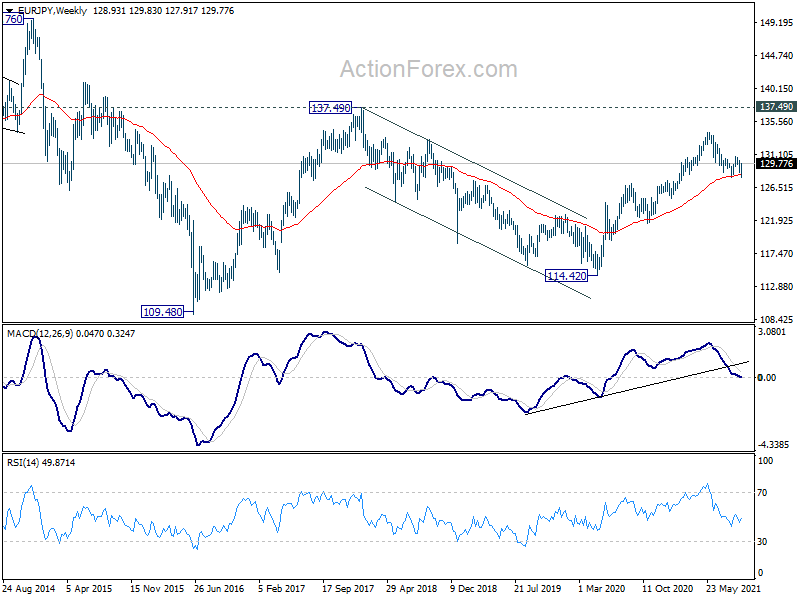
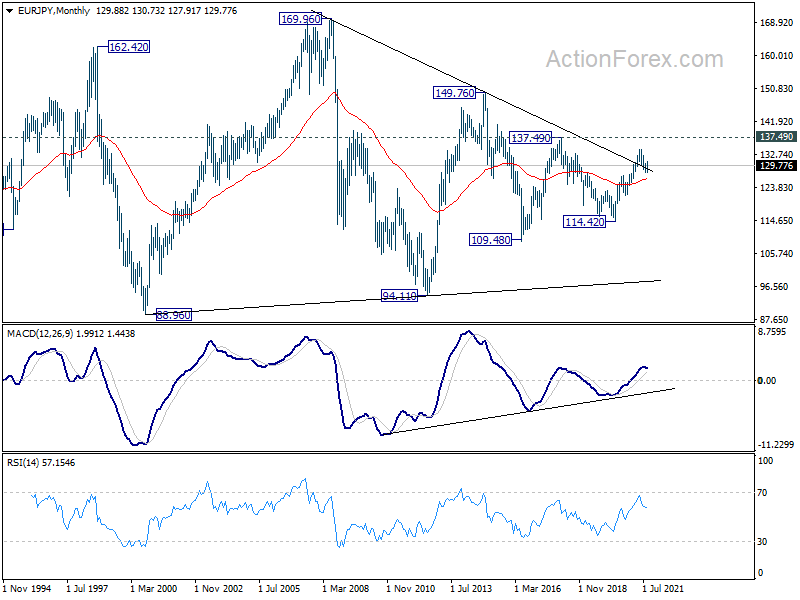
In the long term picture, EUR/JPY is staying in long term sideway pattern, established since 2000. Another rising leg in progress for 137.49 resistance and above.
EUR/GBP Weekly Outlook
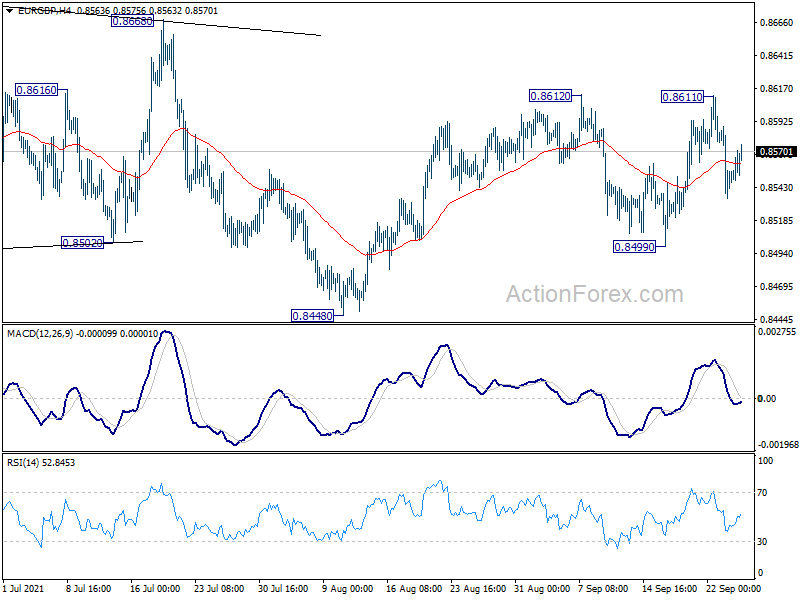
EUR/GBP failed to break through 0.8612 resistance last week and stayed in sideway trading. Initial bias remains neutral this week first. On the upside, break of 0.8612 will resume the whole rise from 0.8448 for 0.8668 key structural resistance. Sustained break there will be a strong sign of larger bullish reversal. On the downside, however, break of 0.8499 support will bring another fall towards 0.8448 low instead.
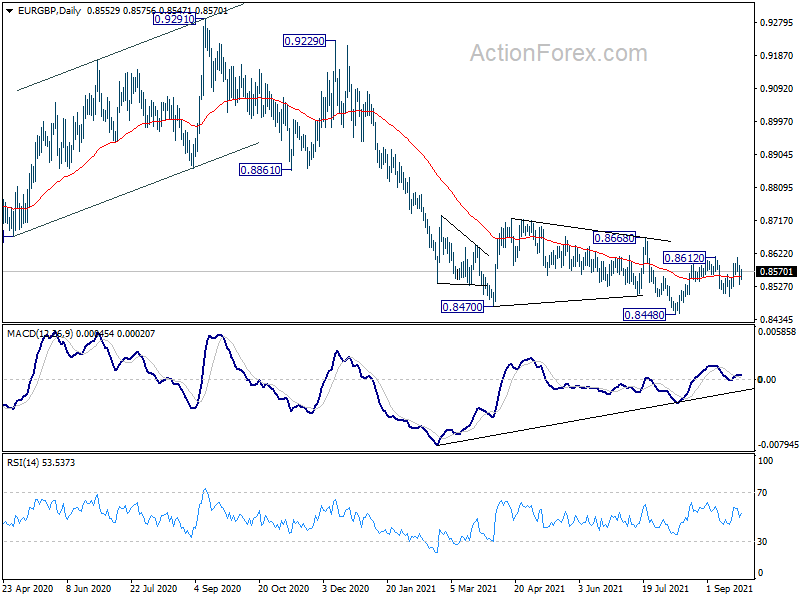
In the bigger picture, price actions from 0.9499 (2020 high) are still seen as developing into a corrective pattern. Deeper fall could be seen as long as 0.8668 resistance holds, towards long term support at 0.8276. However, firm break of 0.8668 resistance would argue that a medium term bottom was already formed. Stronger rise would be seen to 0.8861 support turned resistance to confirm completion of the corrective pattern.
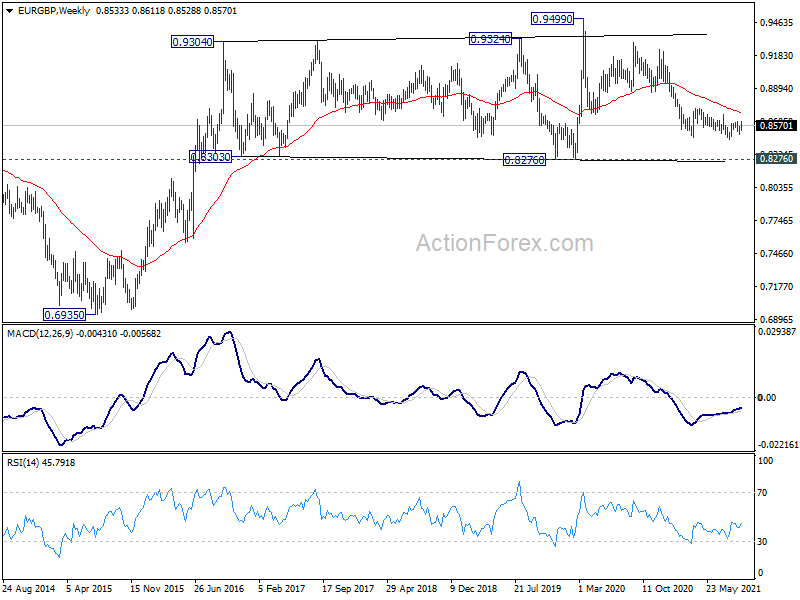
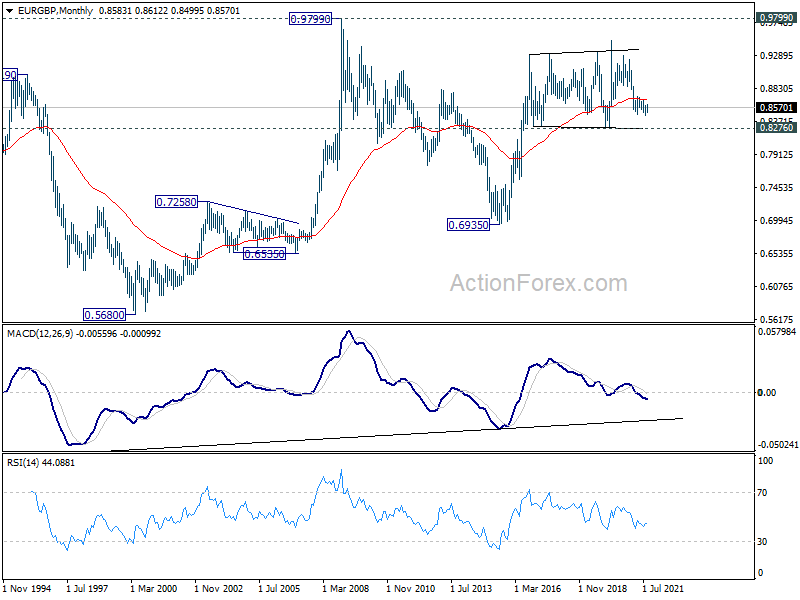
In the long term picture, outlook will stay bullish as long as 0.8276 support holds. Break of 0.9499 is in favor at a later stage, to resume the up trend from 0.6935 (2015 low).
EUR/AUD Weekly Outlook
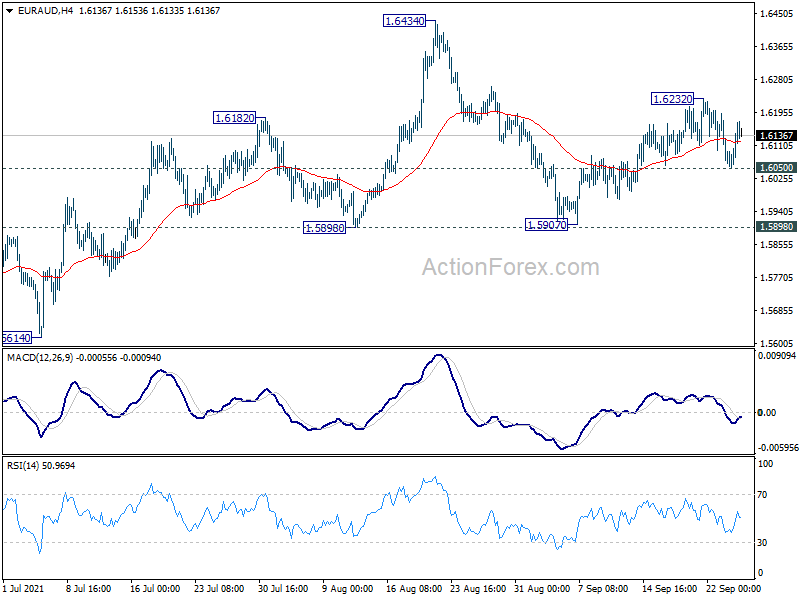
EUR/AUD dipped to 1.6050 last week but quickly recovered. Initial bias is neutral this week first. On the upside, break of 1.6232 will resume the rebound from 1.5907 to retest 1.6434 high. On the downside, below 1.6050 support will suggest that rebound from 1.5907 has completed. Intraday bias will be turned back to the downside for 1.5907. Overall, with 1.5898 support intact, larger rise from 1.5250 is still in progress, and break of 1.6434 will confirm resumption.
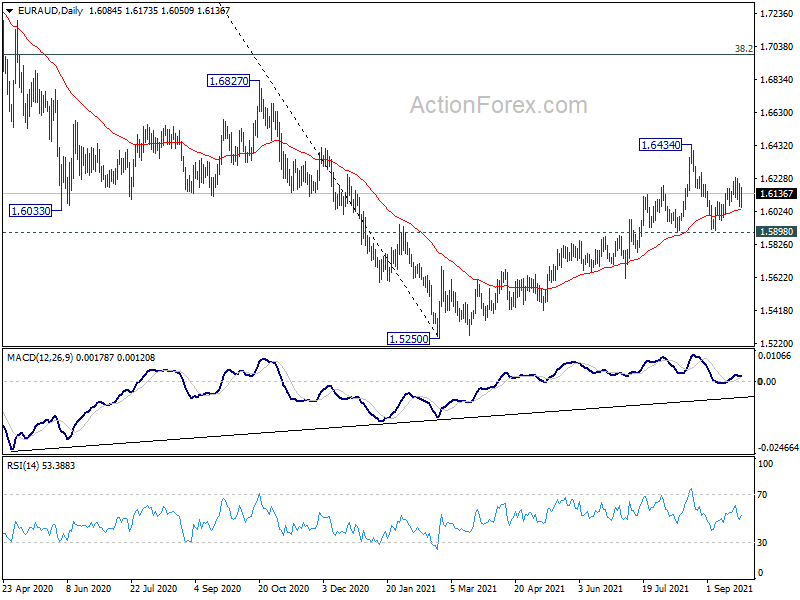
In the bigger picture, rise from 1.5250 medium term bottom is currently seen as a correction to the down trend from 1.9799 first. Stronger rise could be seen to 38.2% retracement of 1.9799 to 1.5250 at 1.6988 next. We'd tentatively expect strong resistance from there to limit upside, at least on first attempt. Meanwhile, break of 1.5898 support will indicate that the rebound has completed. Larger down trend from 1.9799 might be ready to resume through 1.5250 low.
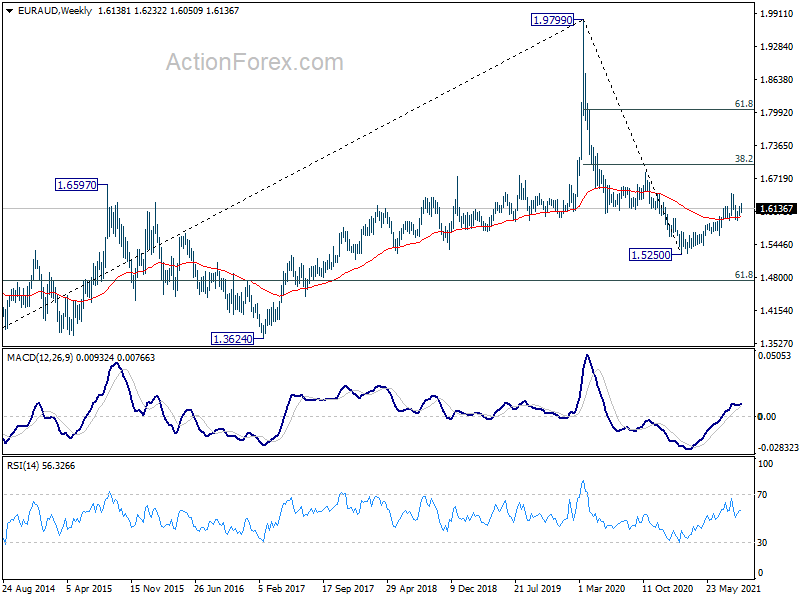
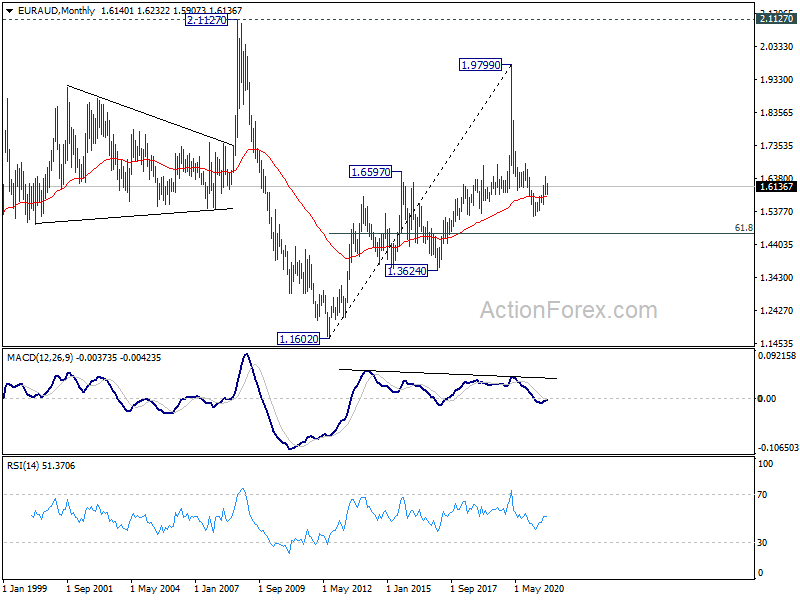
In the longer term picture, rise from 1.1602 (2012 low) should have already completed with three waves up to 1.9799 (2020 high). Fall from there is seen as a medium term to long term down leg as a long term down trend, or a sideway pattern. We'll assess the odds again at a later stage.
EUR/CHF Weekly Outlook
EUR/CHF's fall last week argues that rebound from 1.0694 might have completed at 1.0936 already. But as a temporary low as formed at 1.0811, initial bias remains neutral this week first. On the downside, below 1.0811 will resume the fall from 1.0936 to retest 1.0694 low. On the upside, above 1.0884 minor resistance will turn bias back to the upside for 1.0936 resistance again.
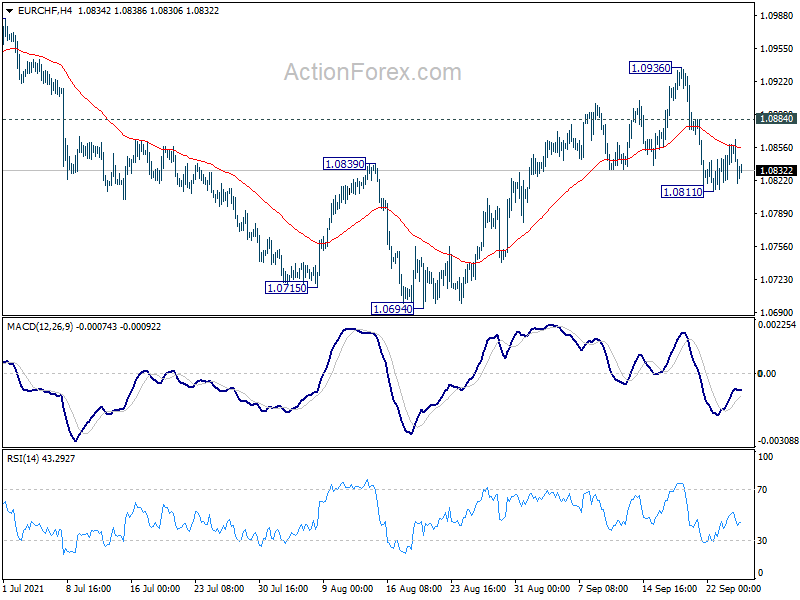
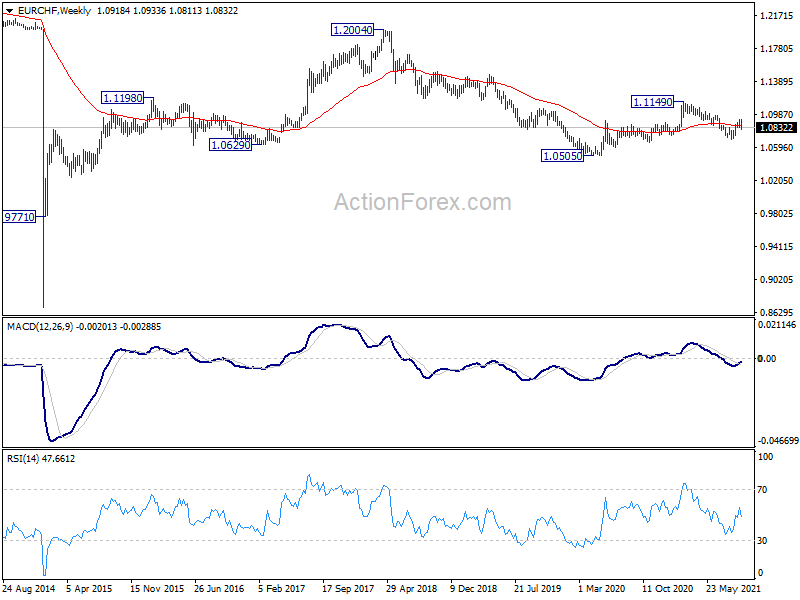
In the bigger picture, the stronger than expected rebound from 1.0694 and break of 55 week EMA (now at 1.0861) mixes up the medium term outlook. On the upside, break of 1.1149 will resume the whole rise from 1.0505 (2020 low). On the downside, break of 1.0694 will revive some medium term bearishness for 1.0505 and below.
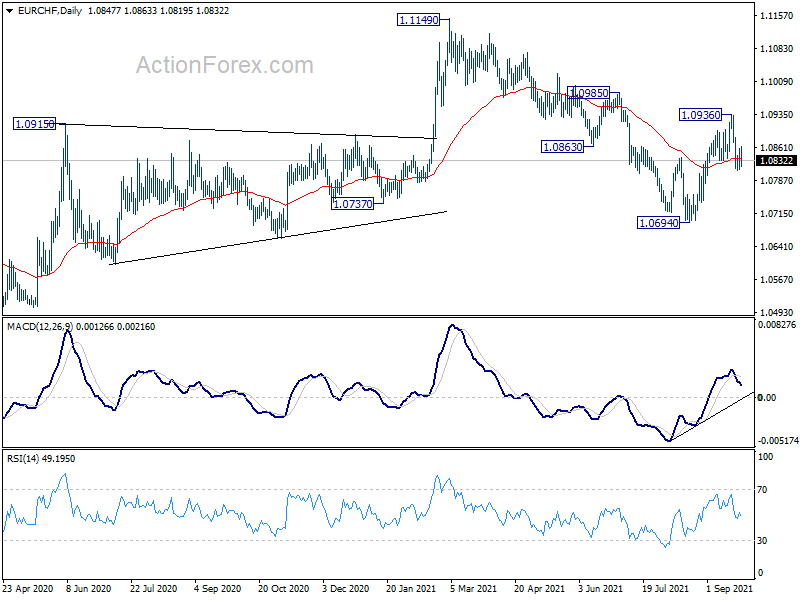
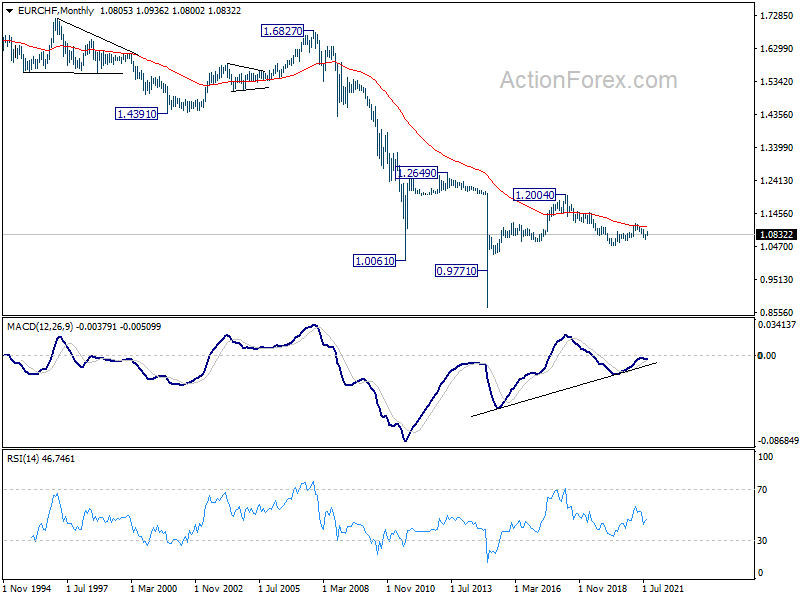
In the long term picture, rejection by 55 month EMA (now at 1.1056) retains long term bearishness. Break of 1.0505 low will resume down trend to 61.8% projection of 1.2004 to 1.0505 to 1.1149 at 1.0223.
Weekly Economic & Financial Commentary: Tapering “May Soon Be Warranted”
Summary
United States: Housing Data and FOMC Outcome Show Economic Recovery Still Intact
- The FOMC left monetary policy essentially untouched, but hinted at a forthcoming taper of bond purchases. Housing data for the month of August came in mixed, but generally showed still-strong activity. Existing home sales fell during the month, as rapid home price appreciation continues to take some air out of buyer demand, while new home sales rose modestly. Meanwhile, housing starts strengthened, although all the gain was in multifamily construction. The Leading Economic Index (LEI) advanced in August, which shows the economic recovery is still very much intact despite the Delta variant wave and pervasive supply side constraints.
- Next week: Durable Goods Orders (Mon), Personal Income & Spending (Fri), ISM Manufacturing (Fri)
International: European Monetary Policy Roundup
- Several G10 central banks made monetary policy announcements this week. Norway's central bank became the first G10 central bank to raise interest rates, with a policy rate increase of 25 bps and signals of more to come. The Bank of England (BoE) held policy steady, but repeated that a modest tightening in policy would still likely be needed at some point. We expect the BoE to begin its tightening cycle with hikes in May and November 2022. The Swedish and Swiss central banks also held policy steady, with no change likely from either in the foreseeable future.
- Next week: China PMIs (Thu), Japan Tankan survey (Fri), Eurozone CPI (Fri)
Interest Rate Watch: Tapering "May Soon Be Warranted"
- The Federal Open Market Committee (FOMC) voted unanimously to keep the target range for the fed funds rate unchanged at 0.00% to 0.25%. The Committee also decided to keep its monthly pace of asset purchases unchanged at $80 billion of Treasury securities and $40 billion of mortgage-backed securities, but said that tapering "may soon be warranted."
Topic of the Week: What Is All the Fuss About Evergrande?
- Evergrande, one of China’s largest real estate developers, injected volatility in global financial markets this week due to concerns that the company could default on its debts. Given its sheer size and the importance of the real estate sector to China's economy, an Evergrande default could weigh on China's economy and possibly spill over into the prospects for the global economy.
The Weekly Bottom Line: More Fiscal Stimulus On The Way
U.S. Highlights
- Housing starts surprised to the upside in August (rising 3.9%), powered by gains in the multifamily segment.
- Solid data out of the housing sector and reassuring words from the FOMC confirm that the economic recovery is well under way. However, notable risks remain, primarily the ongoing standoff over the debt ceiling.
Canadian Highlights
- This week was all about the Federal election. The Liberals maintained their minority government status, winning 159 seats (projected), an increase of two from the 2019 election.
- The Liberal campaign platform promised net new spending of around $80 billion over the next five years. Shared commitments with other major parties suggest the minority government will find support to enact much of its agenda.
Financial
- The stand-off in Washington continues, with two issues becoming evermore pressing. The government’s spending power needs to be renewed and the debt ceiling needs to be raised to avoid a default on U.S. Treasury debt.
- The deadlines are approaching quickly. Though a deal should get done, the closer we get to the dropdead date, the greater the risk that this gridlock turns into financial market stress.
U.S. - Recovery Continues, But Debt Ceiling Looms
The week kicked off with market jitters over the prospects of contagion from the ongoing deleveraging in the Chinese property sector. Yet, positive data from the U.S. housing market and a reassuring message from the FOMC reinforced the notion that, with each passing week, the American economy is leaving the pandemic recession in the rearview mirror. As of the time of writing the S&P 500 is back up 2.1% over last Monday’s close.
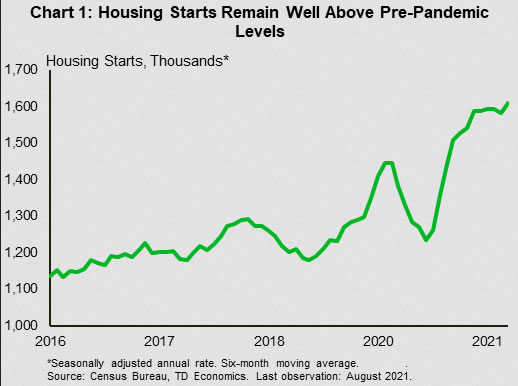
After declining in July, housing starts recovered on the month – rising 3.9% and outstripping the 1.9% gain the analyst consensus was expecting. Smoothing out some of the near-term volatility, the six-month moving average of housing starts now stands at 1.61 million units (annualized), well above the pre-pandemic high of 1.45 million units (Chart 1). The strong reading was entirely supported by strength in the multifamily segment, which was up over 20% month-on-month. Single family starts pulled back modestly on the month, though remain at a very healthy level of 1.08 million – slightly above their pre-pandemic level of 1.06 million units. With permitting also up in August, it appears that residential construction will continue to be a net positive for economic growth over the coming months.
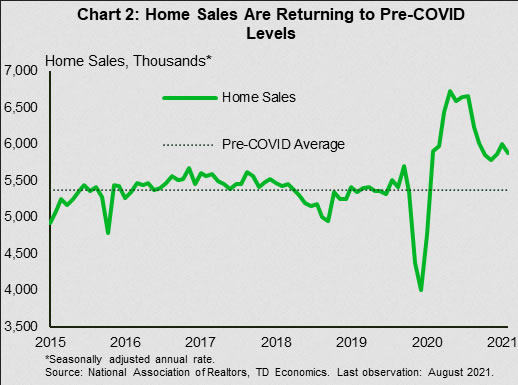
On the demand side of the equation, a small contraction in existing home sales (-2.0%) fell right in line with consensus expectations. After the frenzy in the market between the summer of 2020 and early 2021 some give-back in sales was expected. The ongoing reversion to pre-pandemic trends reflects a return to a more sustainable pace of activity (Chart 2). In fact, the 5.88 million (annualized) sales in August were still 8.5% higher than in the same month in 2019. Over two years that amounts to an average growth rate of roughly 4.2%, still well above trend.
Further evidence that the economic recovery remains on track came from the Fed on Wednesday. In its statement, FOMC members strengthened the language around the economic recovery and hinted that some “moderation” in its asset purchase program “may soon be warranted”.
In the accompanying projections, FOMC members shaved their growth forecast for 2021 (now expecting 5.9% for the year, from 7.0% in June), but lifted it for 2022 and 2023. Risks to the inflation forecast continue to be described as “transitory” with PCE inflation expected to moderate from 4.2% this year to 2.2% in 2022. A more stable inflation path and the steady return to full employment have officials now projecting rate hikes to commence in 2022, with three more coming in 2023.
Altogether, we’ve received a reassuring message of an economy on the mend. There are certainly risks to the outlook – the standoff over the debt ceiling (discussed in the financial section below) being top of mind – but the broader picture is one of healthy domestic demand and gradually receding supply side stresses. The pandemic isn’t over yet, but the light at the end of the tunnel is getting brighter.
Canada - More Fiscal Stimulus On The Way
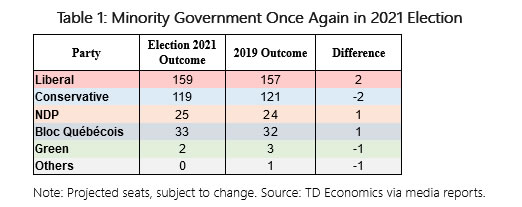
This week was all about the Federal election. On Monday, Canadians took to the polls to elect the 44th Parliament. The Liberal party once again came out on top, winning 159 seats (projected), an increase of two since the 2019 election (Table 1). This once again secured the party a minority government. As for the others, the Conservatives won 119 seats, two fewer than the 2019 result, the NDP went up one to 25 seats, and the Bloc Quebecois won 34 seats, a loss of two from two years ago. So, on the whole, the pandemic election didn’t bring a massive shift in Canada's political landscape.
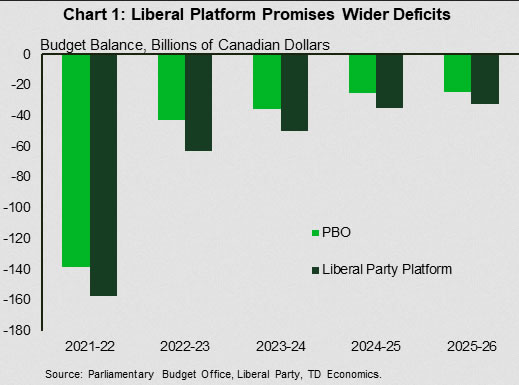
That said, the election did offer a chance for parties to lay out their fiscal plans for Canada. The Liberal platform envisioned around $80 billion in net new spending over the next five years with special focus on improving housing affordability, extending COVID-19 supports, and boosting funding for health care. The platform also proposed introducing new taxes that would increase revenues by $25.5 billion over the same time frame. If enacted exactly as planned, new fiscal outlays could increase GDP growth by 0.2 to 0.5 percentage points (ppts) in 2022, and by 0.1 to 0.2 ppts in 2023, while presenting a small drag in 2024 as spending weakens.
The additional expenditure would also lead to wider national deficits compared to the Parliamentary Budget Office's baseline forecast (Chart 1). As a result, the debt burden, measured using the debt-to-GDP ratio, would also be higher, and the discrepancy would grow every year. By 2025-26, the Liberal platform’s debt-to-GDP ratio is 2.3 percentage points (ppts) higher than the PBO estimate.
Notably, other major parties had drawn up fiscal plans that would also lead to larger deficits over the next several years. Like the Liberals, the NDP and Conservatives proposed significant spending measures on housing, health care, and pandemic supports. It may not be all that difficult for the minority government to secure support to push through legislation on these issues in the near future.
Extending COVID-19 programs is likely to be the most pressing matter for the new federal government. Cases have risen across the country and some provinces (Alberta, Saskatchewan) are in the midst of a brutal fourth wave. The Liberal government had prioritized prolonging the Canada Recovery Hiring Program, which subsidizes staffing costs for businesses. But they may also need to consider renewing income support programs, like the Canada Recovery Benefit, which is expiring at the end of October, especially if the pandemic resurges as we enter a cooler fall season.
The Bank of Canada will be watching pandemic and fiscal developments closely. As in our updated Quarterly Economic Forecast, the Bank does not expect the fourth wave to derail the economic recovery. High vaccination take-up and other mitigating efforts, like vaccine passports, should be enough to lessen the impact of the Delta variant and avoid strict lockdown measures. Moreover, to the extent that growth slows this year, it should be made up with stronger growth next year. Given additional fiscal stimulus, this should keep the economy well on track to absorb excess slack by the second half of 2022.
Financial – Another Debt Ceiling Debacle
President Biden continues to push his legislative agenda, which centers around two major proposals: a plan to spend $3.5 trillion on education, health, childcare, and to combat climate change and $1 trillion on the nation's aging infrastructure. Given the current state of bipartisan politics, getting agreement on these plans is no easy task and is sparking a lot of debate. In the meantime, the White House faces a pressing September 30th deadline to renew the government's spending power. If Congress does not act, the government will be forced to shut down.
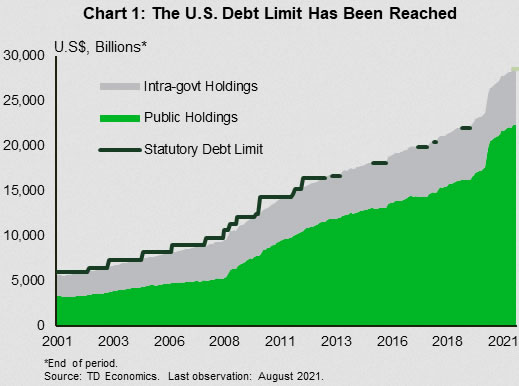
At the same time, Congress must lift the ever-precarious debt ceiling. Recall that the debt ceiling was reinstated on August 1st after a COVID-induced pause. The limit imposed by legislation means that the U.S. Treasury is not currently permitted to issue debt to pay its bills and has been running down its cash assets to make ends meet (Chart 1). It's estimated that around mid-to late-October, it will run out of cash for all needed payments. Last week, Treasury Secretary, Janet Yellen, warned that if swift resolution didn't occur, this impasse could turn into a financial market stress.
But You Already Promised!
The U.S. government has committed to spending a lot of money over fiscal 2022. But, for the government to continue its deficit spending, Congress needs to renew its spending authority. Logically we expect the government to pay its bills, but this isn't the first time it's dangled against the precipice.
The most recent incident happened in late-2018/early-2019 during the Trump presidency. The historic 35-day shutdown over the funding of the U.S.-Mexico border wall resulted in about $11 billion in lost output, with a disproportionate impact on government workers. Though it was impactful on those who were furloughed (or ended up temporarily working for free during that time), the overall impact on the economy was small (0.1% on GDP). And that has also been the case in prior episodes. However, the tension in getting a deal done so the government can keep working can keep markets on edge, at a time when global events are already causing angst. Then there's the debt ceiling issue, that poses much more economic and financial risk.
As American as Baseball and Apple Pie
The debate over the debt ceiling is a unique American past-time. This cap on the amount of government debt was established during World War I so that the U.S. Treasury could issue bonds and bills without the approval of Congress (particularly important given large/uncertain wartime spending). Though the spirit of the law was to make debt issuance easier, the ceiling has evolved to act as a blunt tool for political fiscal restraint.
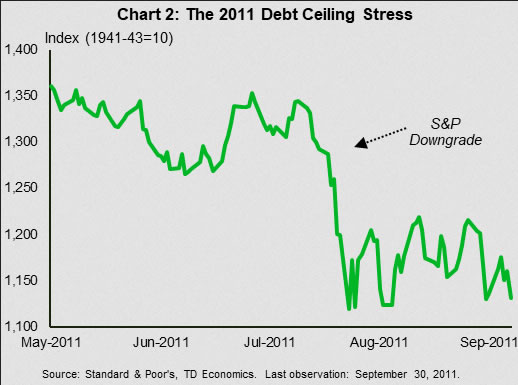
As the size of the American economy expands, the capacity for the government to take on new debt increases as well. This means that the debt ceiling needs to be raised at regular intervals. And indeed, it has – nearly 80 times since 1960. However, the debt ceiling debate has become more acrimonious and brinkmanship more common over the past several decades. Congress has, on several occasions waited until the very last minute to increase or suspend the limit. The most infamous incident occurred during the Obama presidency in 2011. While a deal was struck days before default would have occurred, the uncertainty caused by the quarrel spurred Standard & Poor's to downgrade the credit rating on U.S. sovereign debt. The stock market dropped around 12% in its wake (Chart 2).
Bottom Line
The news out of Washington will be closely watched over the coming days and weeks. Although financial markets have become more accustomed to legislative battles, the chance of this turning into a tail-risk rises by the day. From our perspective, the odds of a government shutdown will be high as the September 30th deadline approaches, though it should have a minimal impact on our economic outlook if history holds true.
On the other hand, if the debt ceiling battle extends and causes investors to get panicky about the government's ability to meet its debt payments, this would pose a bigger risk to markets. The worst-case scenario would be a missed Treasury payment, which would almost certainly result in a significant decline in equity prices, a large jump higher in yields, and a depreciation of the USD. Although the government would go to all lengths to avoid a missed Treasury payment, it only takes one misstep to set a new precedent. Our base assumption is that this unthinkable mistake will be avoided, but we will be intently watching negotiations as the clock ticks down.
Week Ahead – Risks Haven’t Gone Away
Are investors getting complacent?
The next few months are going to be extremely interesting in the markets, with central banks becoming less comfortable with the level of stimulus they’re providing, economic recoveries slowing and market risks mounting.
Evergrande has come to the forefront of investors minds in recent weeks. The threat of contagion is a concern that’s been discussed in depth the last week and one that’s unlikely to go away until more clarity is provided.
Country
US
Now that investors have come to expect a November taper by the Fed, the focus for the economy primarily resides on supply chain issues, labor shortages, and any additional pricing pressure catalysts. Much attention will fall on Capitol Hill over the debt ceiling and the grilling that Fed Chair Powell and Treasury Secretary Yellen will have to endure.
Monday is the tentative deadline for the House vote on the bipartisan infrastructure package. That could move if Republicans don’t make any concessions over the debt limit.
Thursday is the deadline for Congress to pass a stopgap funding bill that will avert a government shutdown. The debt ceiling standoff will likely go down to the wire, but expectations are still optimistic that Republicans won’t want to take the blame for sending the economy immediately into a recession and as that could trigger millions of jobs lost and wipe out $15 trillion in wealth.
Most of the economic data in the US will take a backseat to politics and corporate updates that might show further expectations that pricing pressures remain elevated and will be passed onto the US consumer. The most important economic reading will be the ISM manufacturing reading which could show a small deceleration in September. A steeper drop with the headline and higher prices paid could weigh on growth expectations for the rest of the year.
EU
German federal election takes place this weekend. The SPD holds a narrow lead in the polls going into the election but no party is even close to a majority meaning negotiations, potentially lasting months, lie ahead. The market impact should be limited.
The economic calendar next week primarily consists of survey data, with CPI the focus on Thursday, with inflation running at 3% currently.
UK
A number of BoE policymakers appear next week, including a couple of appearances from Governor Andrew Bailey on Tuesday and Wednesday. The MPC has turned more hawkish in recent meetings and the market is now pricing in two rate hikes next year, with the first (15 bps) in February and the second (25bps) in the summer. Given the number of downside risks to the outlook, this strikes me as hopeful.
A few data points of note next week including GDP on Thursday and the manufacturing PMI on Friday.
Emerging Markets
Russia
The United Russia party won more than two-thirds of the vote – giving them a supermajority – in last weekends election, the first to take place electronically. The result has been disputed by opposition supporters who declared the result was rigged. Challenges and potential unrest could follow.
South Africa
The SARB left rates unchanged last week at 3.5% as inflation rose slightly to 4.9%, just ahead of expectations. The calendar next week is light with only tier three data on the cards.
Turkey
The CBRT, led by Governor Şahap Kavcıoğlu, cut the repo rate by 1% to 18% this week, despite previously vowing to keep it above inflation, which currently stands at 19.25%. Rates are expected to be cut by at least another 100 basis points before the end of the year. The central bank expects inflation to fall in that time but its credibility is tarnished and the lira has slipped to record lows against the dollar as a result.
Kavcıoğlu is due to appear alongside finance minister, Lutfi Elvan, next week at an economy summit on Tuesday, when this topic will likely be discussed.
Asia Pacific
China
China spent most of the week on holiday leaving markets to tie themselves up in knots over whether Evergrande’s slow trainwreck posed a systematic risk or not. That will continue into next week with Asian markets, including China, acutely vulnerable to negative headlines emerging over Evergrande during the weekend. Evergrande is listed in Hong Kong and negative weekend headlines will see the Hang Seng slump.
The week ahead gives markets some distraction though with Industrial Profits on Monday, official Manufacturing and Non-Manufacturing PMIs and the Caixin Manufacturing PMI on Thursday. After a nightmare slump by the Non-Manufacturing PMI for last month, it will be most closely watched. A negative or positive surprise will be reflected in a similar reaction by China stock markets and Asia as a whole.
USD/CNY remains range-bound with no sign that the PBOC is looking to engineer a weaker currency to stimulate the economy, yet. The PBOC has been aggressively adding liquidity via the repos this past week, it has yet to translate to CNY weakness.
India
China is capturing the EM headlines at the moment and there has been little in the way of market-moving data from India. Q2 Current Account is released on Thursday but is now well and truly backwards-looking. Markit Manufacturing PMI is released on Friday but will create only short-term volatility. India, and EM, in general, will react more directly to sentiment surrounding the Fed taper and/or the impending US debt ceiling.
Australia & New Zealand
The Australian and New Zealand Dollars continue to bounce around on daily shifts in international risk sentiment, rather than domestic developments. Half of Australia and Auckland in New Zealand remain under virus lockdowns. That situation will continue in the week ahead with Evergrande contagion/collapse and US debt ceiling developments likely to drive the intraday direction. NZD remains vulnerable to the delta-variant jumping the Auckland boundaries which would see it move sharply lower.
Australian Retail Sales and NZ ANZ Business Confidence are the week’s data highlights. Readers should monitor developments in China next week for directional signals on Aust. and NZ markets.
Japan
Japan has a packed data week featuring the BOJ Minutes, Retail Sales, Industrial Production and the Tanken Surveys for Q3. However, Tanken aside, the data is all from August or July, making it somewhat irrelevant. Instead, all eyes will be on the ruling LDP who will choose a new Prime Minister on Thursday. Markets have priced in the certainty of more fiscal stimulus and the comments post-election will cause volatility in Japan equities.
USD/JPY remains a pure rate differential play between the US 10-year and Japan JGBs. The spike in US yields at the end of the present week has lifted USD/JPY to near the top of its near 4-month 109.00 to 110.50 trading range. Realistically, a close above 111.50 needs to occur to signal a medium-term directional move higher is occurring. Everything rests on whether US yields continue rising in the week ahead.
Key Economic Events
Saturday, Sept. 25
- New York Fed President Williams delivers a paper on international monetary policy coordination at a SNB research conference.
Sunday, Sept. 26
- German Federal Election Day
- United Nations 76th General Assembly resumes
Monday, Sept. 27
- Fed Governor Brainard and Chicago Fed President Evans speak at the National Association for Business Economics’s 63rd annual meeting.
- New York Fed President Williams talks about the economic outlook before the Economic Club of New York
Economic Data/Events
- US durable goods
- Mexico IGAE economic activity
Tuesday, Sept. 28
- Treasury Secretary Yellen, BOE policy maker Catherine Mann to speak at the NABE conference.
- BOE Governor Bailey speaks at the Society of Professional Economists dinner.
- Fed Chair Powell and Treasury Secretary Yellen testify at the Senate Banking Committee hearing on “CARES Act Oversight of the Treasury and Federal Reserve.”
- ECB President Lagarde to speak at the ECB Forum on Central Banking. Executive Board members Schnabel and Panetta, plus Vice President de Guindos, chair sessions.
- US Commerce Secretary Raimondo to speak at an Economic Club of D.C. event
Economic Data/Events
- US wholesale inventories, S&P CoreLogic Case-Shiller home prices, Sept Conf. Board consumer confidence: 114.6e v 113.8 prior
- Australia retail sales
- Mexico unemployment
- South Africa SARB Quarterly Bulletin
Wednesday, Sept. 29
- Japan’s Liberal Democratic Party elects a new leader
- Central Bank chiefs Bailey (BOE), Kuroda (BOJ), Lagarde (ECB) and Powell (Fed) speak on an ECB Forum panel. Riksbank’s Deputy Governor Breman will also attend.
- ECB’s Visco speaks at a Sustainable Policy Institute event.
Economic Data/Events
- US pending home sales
- Eurozone economic/consumer confidence
- Spain CPI
- Thailand rate decision: Expected to keep Benchmark interest rate unchanged at 0.50%
- EIA Crude Oil Inventory Report
Thursday, Sept. 30
- US Congress faces a deadline to approve a stopgap funding bill to avert a government shutdown on October 1st.
- Fed Chair Powell and Secretary Yellen testify to House Financial Services Committee
- New York Fed President Williams opens and closes a conference on the Fed’s pandemic response
- St. Louis Fed President Bullard speaks
- Chicago Fed President Evans speaks at an event hosted by the Bendheim Center for Finance
Economic Data/Events
- US GDP (third reading of Q2), initial jobless claims, MNI Chicago PMI
- Australia building approvals
- Unemployment: Brazil, Chile, Colombia, Eurozone, Germany, Italy, Israel
- China Caixin manufacturing PMI, non-manufacturing PMI
- Czech Republic GDP
- UK Final Q2 GDP
- Germany CPI
- France CPI
- Chile copper production
- Japan industrial production, retail sales
- Mexico rate decision: Expected to raise Overnight Rate by 25 basis points to 4.75%
- New Zealand building permits
- South Africa trade balance
- Thailand Trade
- Sweden Riksbank minutes
Friday, Oct. 1
- Philadelphia Fed President Harker talks about the economic outlook with the New Castle County Chamber of Commerce
- ECB’s Schnabel speaks at a Fed conference.
Economic Data/Events
- US Sept ISM manufacturing: 59.5e v 59.9 prior, University of Michigan sentiment,Manufacturing PMI, construction spending, spending/personal income
- Eurozone CPI
- Poland CPI
- Eurozone manufacturing PMIs: France, Eurozone, Germany
- India Manufacturing PMI
- Japan vehicle sales, unemployment, Tankan index, manufacturing PMI
- Macau casino revenue
- Russia unemployment, GDP
- Singapore home prices
Sovereign Rating Updates
- France (S&P)
- Poland (S&P)
GBP/USD – Long Term Consolidation?
Who will blink first?
The next few weeks will be interesting in GBPUSD with the pair seeing the currencies of two central banks intent on tightening going head to head.
This is perhaps why it has entered into broad consolidation with the pair once again failing to make a new low, despite breaking back below the 200/233-day SMA once more.
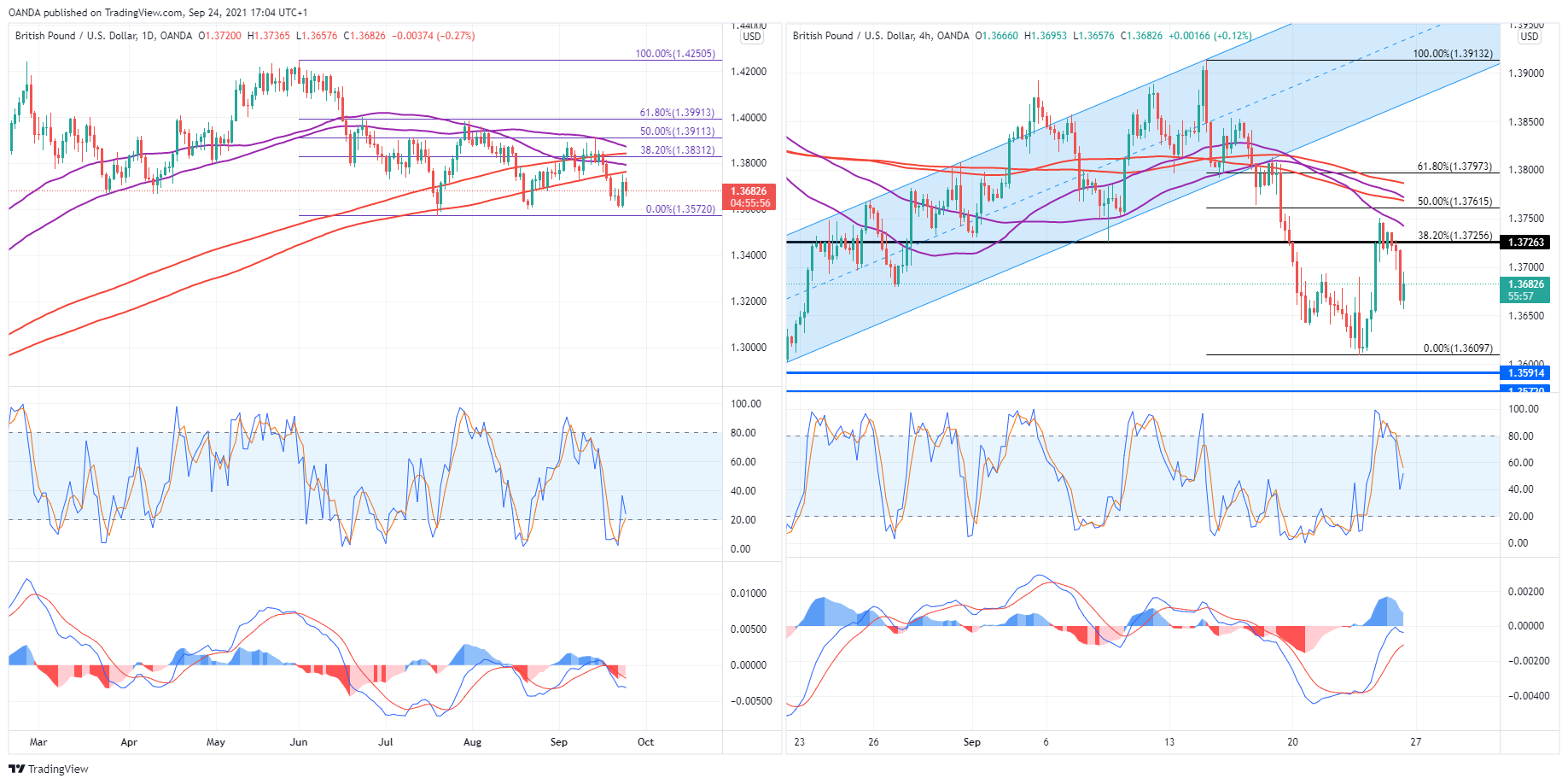
The pair rotated strongly off 1.3750 over the last 24 hours but it’s already seeing some support. While 1.3750 falls just short of the 50 fib on the 4-hour chart, another push higher would take it into really interesting territory, with the cluster of moving averages and 50/61.8 fib region being a massive test.
A move above here could see consolidation continue, with 1.39 being a big test above here and then 1. 40 . A move above here would see if break out of the consolidation phase and potentially make much larger gains.
Ultimately it may come down to which central bank is keener to tighten or, if the risks mount up, which will blink first. Until then, we may have to endure plenty more consolidation, at which point the moving averages on these longer time frames become less useful.